Mill Cities, Tobacco Fields and the Berkshire Hills
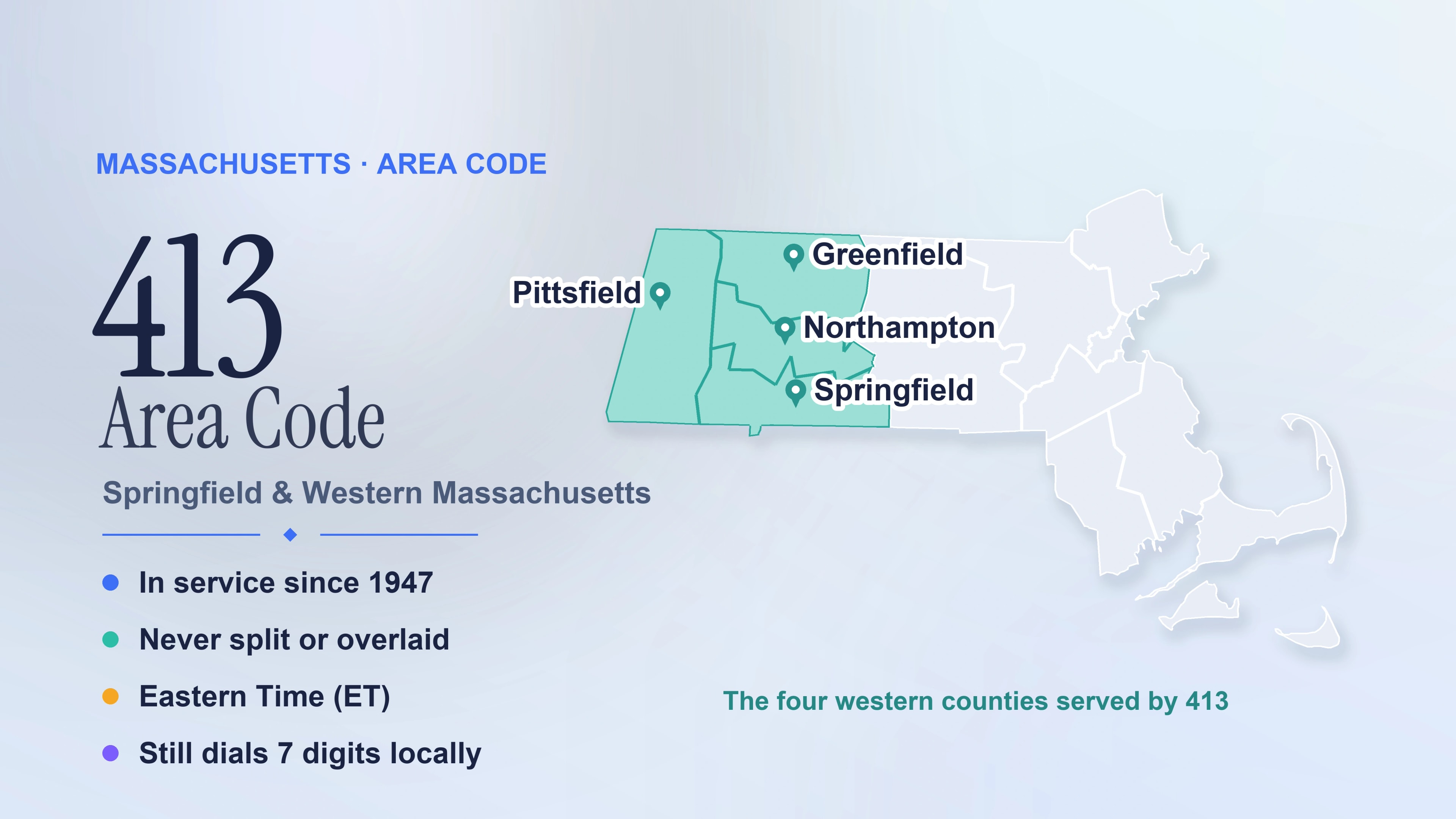
Say "413" anywhere in Massachusetts and locals picture a very different corner of the state from the crowded Boston coast: the mill cities and tobacco fields of the Pioneer Valley along the Connecticut River, the college towns of Northampton and Amherst, and the rolling Berkshire Hills rising toward the New York line, with Pittsfield and the arts towns of the far west beyond them. This single code covers the entire western third of the Commonwealth — a region of small cities, farm valleys and mountain towns that has always thought of itself as its own place, apart from Greater Boston.
It is one of the oldest area codes in the country, assigned in 1947 and unchanged ever since. This guide lays out exactly where 413 reaches, how it was born alongside 617 at the dawn of the numbering plan and never split, the Eastern time zone and its rare seven-digit dialing, and how any business can claim a genuine western-Massachusetts presence with a number of its own.
Key Takeaways
- The 413 area code covers the entire western third of Massachusetts, including Springfield, Chicopee, Holyoke and Westfield in the Pioneer Valley, plus Northampton, Amherst, Greenfield, Pittsfield, North Adams and Great Barrington in the hill country to the west.
- It is one of the two original Massachusetts area codes, in service since January 1, 1947, when the state was divided at the launch of the North American Numbering Plan — 413 for the west and 617 for the east.
- 413 is remarkably stable: nearly eighty years on it has never been split or overlaid, making it one of the few original 1947 codes that still covers its founding territory unchanged.
- Because no overlapping code has ever been added, 413 remains one of fewer than seventy-one U.S. area codes where a local call can still be placed with just seven digits.
- The whole region runs on Eastern Time — UTC-5 in winter (EST) and UTC-4 in summer (EDT) — the same clock as Boston and New York.
Where Does Western Massachusetts Begin on the Phone Map?
The 413 prefix is the telephone identity of western Massachusetts — a geographic code covering the whole of the state west of the Worcester County line, from the Vermont and New Hampshire borders in the north down to the Connecticut state line, and across to the New York border in the Berkshires. It is one of the very oldest codes in the nation, created in 1947 as part of the first nationwide numbering plan, and it has served the same broad territory ever since.
Where eastern Massachusetts built up into the dense, code-hungry Boston metro, the 413 side is a landscape of mid-sized cities, river valleys and hill towns. To the northeast, another part of the state built its own identity around the 978 area code, serving Lowell, Lawrence and the communities north of Boston — a reminder of how differently the eastern half of Massachusetts fragmented over the decades.
Because it blankets such a large, self-aware region, a 413 number reads as unmistakably local to anyone in Springfield, the Five College area or the Berkshires. To a customer in western Massachusetts it looks like a neighbor on the caller ID rather than a caller from Boston or out of state — a small but real credibility signal for any business working this market, and one reason 413 numbers stay in steady demand.
Hampden, Hampshire, Franklin and Berkshire Counties
The 413 code covers all four western Massachusetts counties — Hampden, Hampshire, Franklin and Berkshire — along with a couple of towns on the western edge of Worcester County. It runs from the Springfield metro up the Connecticut River valley and out across the Berkshire Hills, tying together a string of small cities and college and resort towns, including:
- Springfield (Hampden County) — the largest city in the region and the commercial anchor of the Pioneer Valley, at the crossroads of I-90 and I-91
- Chicopee, Holyoke, Westfield and Agawam (Hampden County) — the old mill and manufacturing cities clustered around Springfield
- Northampton and Amherst (Hampshire County) — the heart of the Five College area, home to Smith, Amherst, Hampshire, Mount Holyoke and UMass Amherst
- Greenfield (Franklin County) — the gateway to the rural northern valley and the Mohawk Trail
- Pittsfield (Berkshire County) — the largest city in the Berkshires, plus North Adams, Great Barrington, Lenox and Williamstown across the western hills
From the tobacco and dairy farms of the Connecticut valley to the ski slopes and summer theaters of the Berkshires, these communities are bound together by a single area code — a reminder of how much ground 413 quietly covers as the phone identity of an entire third of the state.
Eastern Time and a Rare Seven-Digit Local Call
The entire 413 region sits within Eastern Time — UTC-5 in winter (EST) and UTC-4 in summer (EDT) — the same clock as Boston, New York and the rest of the Northeast. Because there has never been an overlapping code to cause confusion, 413 is one of a shrinking group of area codes where callers can still reach a local number with just seven digits, though the full ten-digit form always works too.
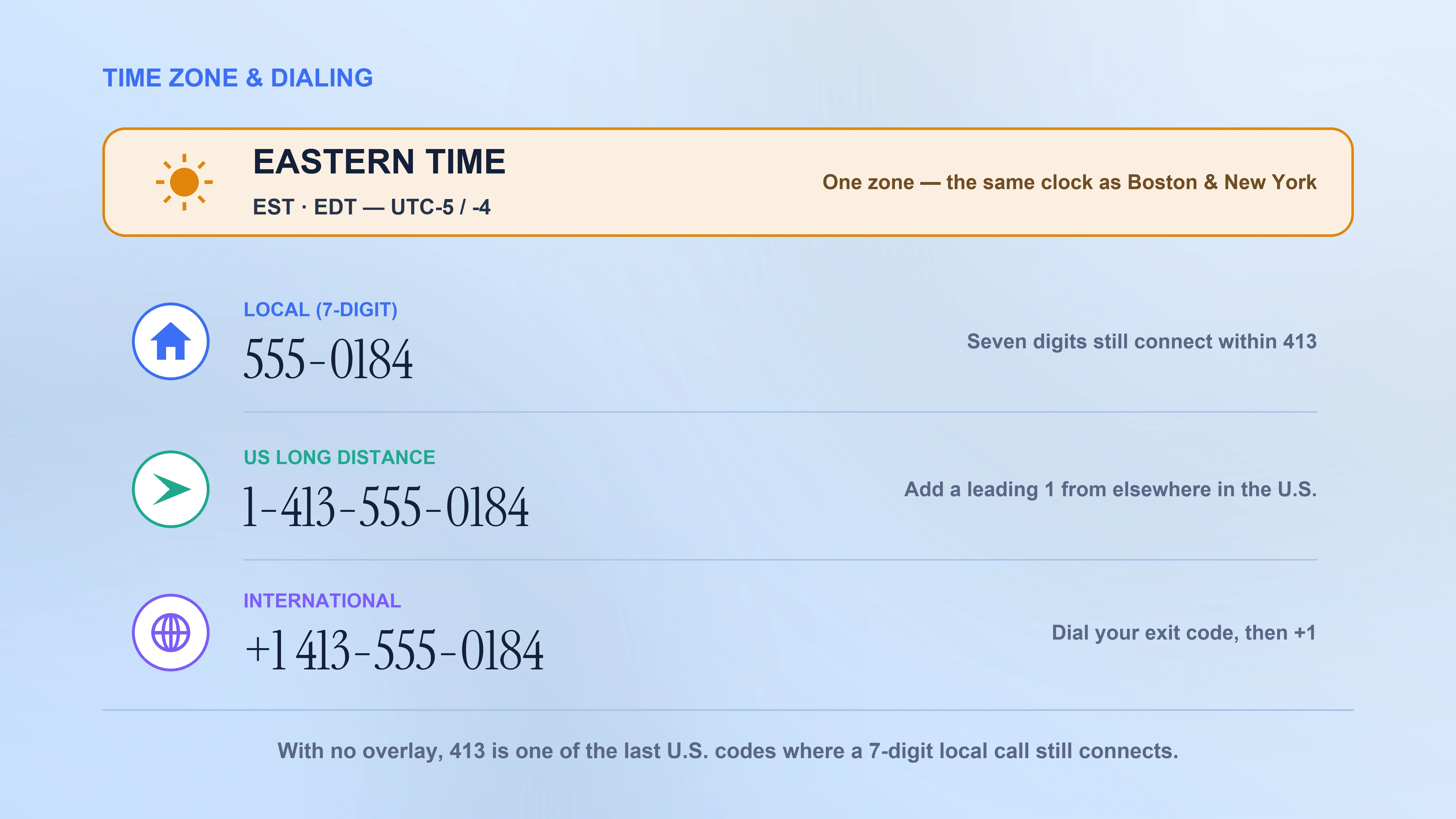
- Local calls within the region: seven digits still work — 555-0184 — because 413 has no overlay; the full 413-555-0184 is equally fine.
- Long-distance from elsewhere in the U.S.: add a leading 1 — 1-413-555-0184.
- International: dial the exit code, then +1, then the number — +1 (413) 555-0184.
- On mobile phones: cell numbers are stored and dialed with all ten digits anyway, so most people already reach 413 lines the same way from anywhere.
Two Original Codes — and Why 413 Never Split
When the North American Numbering Plan launched in 1947, Massachusetts was one of the first states divided into more than one area code. The eastern half around Boston was assigned 617, while everything west of it — the whole Connecticut River valley and the Berkshires — became 413. From that first day, western Massachusetts had a telephone identity of its own, and 413 has carried it ever since as one of the original codes printed on the very first NANP map.
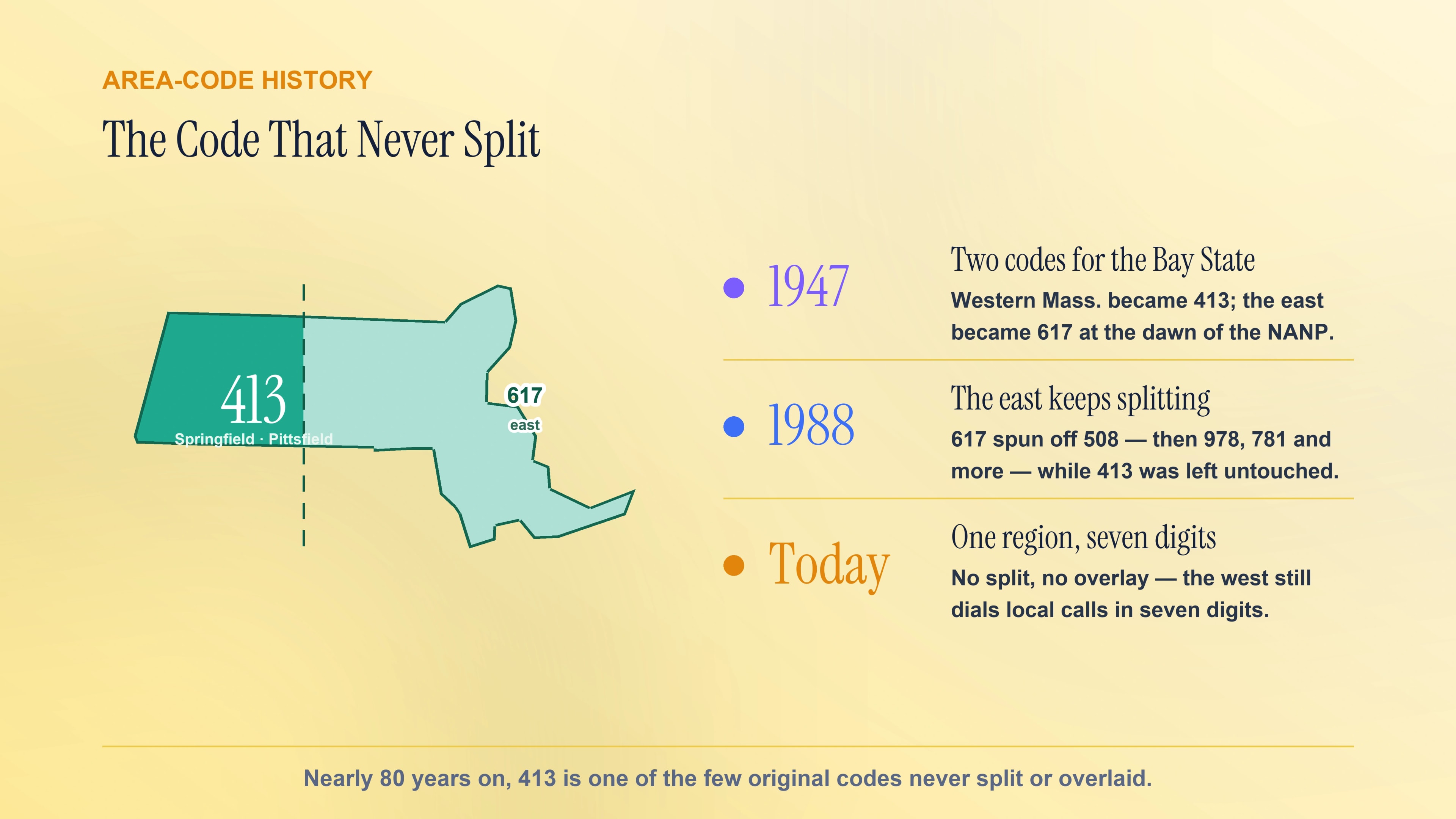
What makes 413 remarkable is what happened next: nothing. While the Boston side kept subdividing — 617 spun off 508 in 1988, and the east later added 978, 781, 351, 339 and more — the western code has never been split or overlaid in nearly eighty years. Its mix of mid-sized cities and rural county never burned through numbers fast enough to force a change. Elsewhere in the Northeast, growing regions often leaned on overlays instead of splits; New Jersey's 609 area code, for example, eventually gained a second overlapping code across the same territory. 413 has needed neither, which is exactly why it still allows seven-digit local dialing when most of the country has moved on to ten.
Benefits of a Local 413 Number for Business
A local number is one of the simplest trust signals a business can own, and across a region as distinct and self-aware as western Massachusetts, a 413 number carries real weight. The Pioneer Valley and the Berkshires know they are not Boston, and a 413 caller ID quietly says you understand that — that you are part of this side of the state, not a stranger cold-calling from somewhere else.
- Instant local credibility — a 413 caller ID signals that you belong to western Massachusetts, whether you are based in Springfield or serving the region from afar.
- Higher answer rates — in a region still dialing seven digits locally, a familiar 413 exchange gets picked up far more than an unknown or toll-free number.
- A single regional identity — one 413 number reads as local everywhere from Springfield to Northampton to the Berkshires, across the whole western third of the state.
- Flexibility without an office — cloud calling lets a business hold a 413 number from anywhere and still reach customers from Springfield to the Berkshires.
- Easy tracking and scaling — route calls separately for the Pioneer Valley and the Berkshires while keeping the single 413 number your customers already know.
Put a Local 413 Number to Work
Give your business an authentic western-Massachusetts presence with a 413 number that rings anywhere you do business.
How to Get a 413 Phone Number
For a 413 line, there is no need to wait on a technician or rent an office in the Pioneer Valley. The entire order runs through a cloud phone provider's website, and a number that looks local from Holyoke to Pittsfield can be working the same day. Four steps cover it:
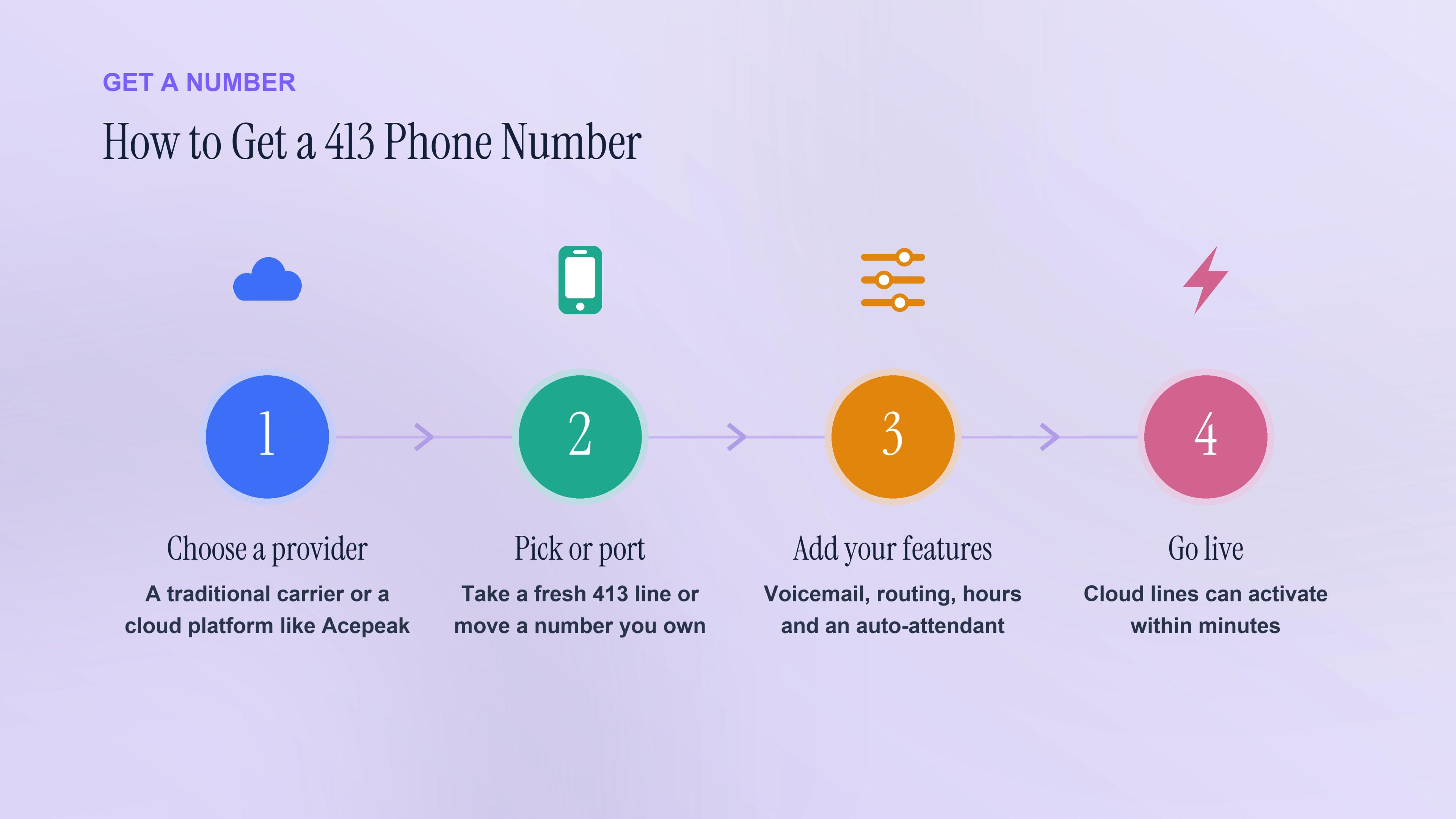
- Choose a cloud phone provider — confirm it draws from the same Hampden, Hampshire, Franklin and Berkshire county pool, since 413 has no overlay.
- Select your 413 number — search inventory across Springfield, Northampton or the Berkshires, or port a number you already use.
- Set up routing and features — add voicemail, an auto-attendant and business hours set to Eastern Time, the same clock as the rest of the Northeast.
- Start calling — make and receive calls from a laptop, desk phone or mobile app, and stay alert for spoofed 413 caller IDs.
Spotting and Avoiding 413 Scam Calls
Western Massachusetts callers see 413 and expect someone from Springfield, Amherst or the Berkshire hill towns, and scammers exploit exactly that. Caller ID spoofing makes a fraudulent call show up as a nearby 413 number, so the screen seems to display a neighbor. A few precautions protect you:
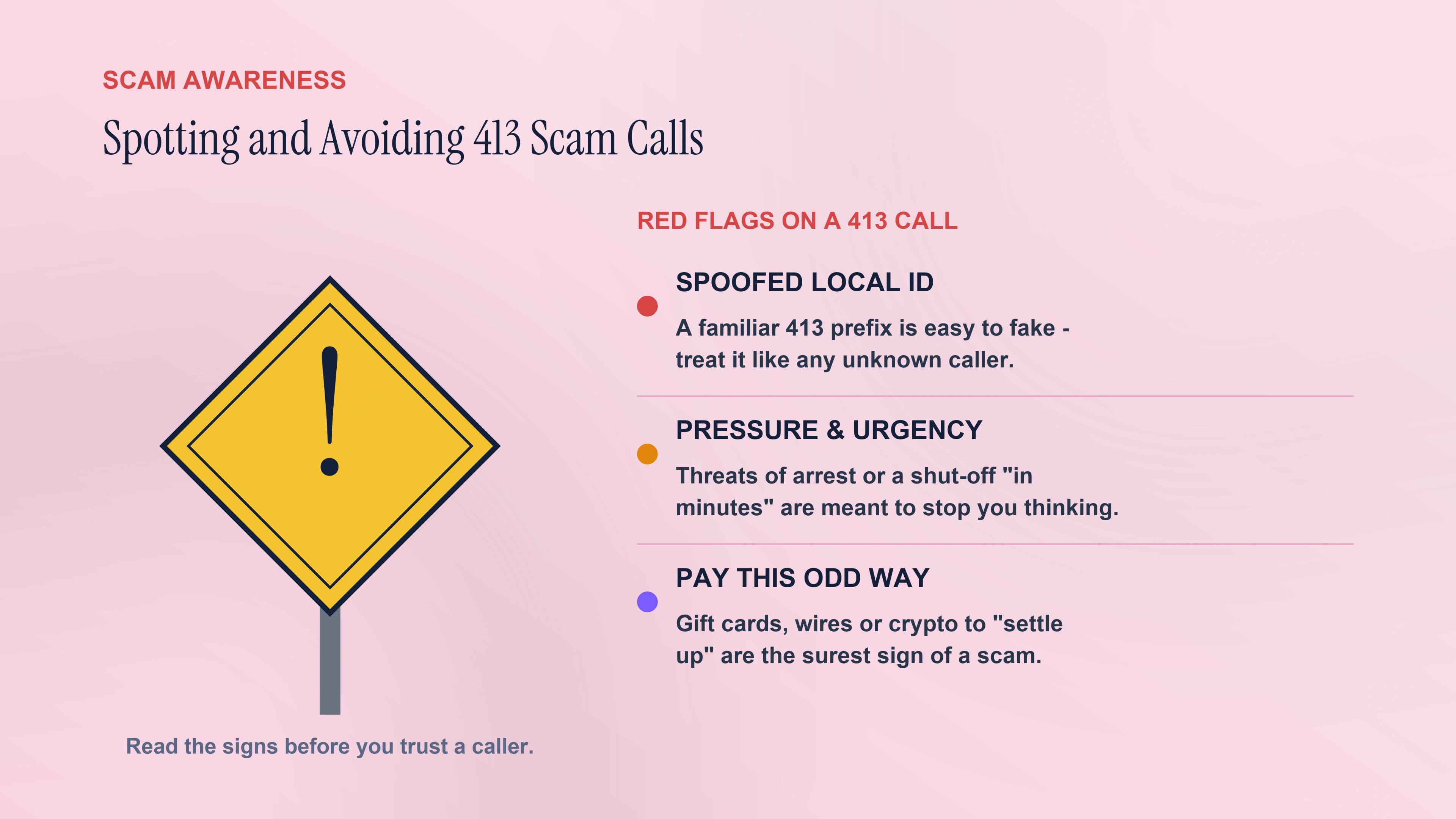
- Watch for pressure and urgency — real agencies and businesses do not demand that you act "right now" or the account will be closed.
- Be wary of odd payment demands — gift cards, wire transfers and cryptocurrency are the calling cards of a scam, never a legitimate bill.
- Do not trust caller ID alone — a 413 number on the screen can be faked; the local code is no guarantee the caller is who they claim.
- Hang up and call back on a number you trust — reach the bank, utility or agency directly using a number from a statement or official website.
- Report the call — logging unwanted calls with the authorities helps regulators track and shut down the operations behind them.
Room to Grow Without the Number Pressure Boston Faced
After nearly eight decades without a split or an overlay, 413 is in no hurry to change. Its territory still has room in its number pool, and the region's steady growth — real as it is around Springfield and the fast-reviving downtowns of the valley — is not on the scale that forces new codes onto dense urban metros. The City of Springfield, the region's largest municipality and economic anchor, continues to draw new investment to the Pioneer Valley without the number pressure that has repeatedly reshaped eastern Massachusetts.
For anyone doing business here, that stability is a quiet asset: a 413 number is one of the most recognizable and durable local identities in New England, and one you print today will still read as authentically western-Massachusetts for many years to come.
Belonging in the Pioneer Valley and the Berkshires
The 413 area code is far more than three digits — it is the shared phone identity of western Massachusetts, from the mill cities of the Pioneer Valley to the college towns of Northampton and Amherst and the mountains and arts colonies of the Berkshires. Born alongside 617 in 1947 and never divided since, it covers an entire third of the state on a single, stable prefix that still dials in seven digits. For any business hoping to connect with western Massachusetts, a local 413 number is one of the simplest and most authentic ways to belong.
Claim Your Western-Massachusetts Presence Today
Acepeak makes it easy to get a 413 number and start taking calls across the Pioneer Valley and the Berkshires.
Carriers and resellers sending traffic to 413 numbers can get termination, DIDs and SIP trunking from one wholesale VoIP provider, on Tier-1 direct routes with published per-route rates.
Questions, answered.
The 413 area code covers the entire western third of Massachusetts — Hampden, Hampshire, Franklin and Berkshire counties — including Springfield, Chicopee, Holyoke, Westfield, Northampton, Amherst, Greenfield, Pittsfield, North Adams and Great Barrington.
Area code 413 has been in service since January 1, 1947, when it was assigned as part of the original North American Numbering Plan. Massachusetts was divided at the start into two codes — 413 for the western part of the state and 617 for the Boston area in the east.
No. Unlike eastern Massachusetts, which has spun off many new codes since 508 arrived in 1988, 413 has never been split again or given an overlay in nearly eighty years. Its territory has never exhausted its supply of numbers, making it one of the few original 1947 codes still covering its founding region unchanged.
Yes. Because 413 has no overlay, it remains one of fewer than seventy-one U.S. area codes where a local call can still be placed with just seven digits. Dialing all ten digits (413 plus the number) always works too, and is required for long-distance calls.
The entire 413 region observes Eastern Time — UTC-5 in winter (EST) and UTC-4 in summer (EDT) — the same time zone as Boston, New York and the rest of the Northeast.
Absolutely. With a cloud phone provider you can choose a 413 number from anywhere and have it ring on your laptop, desk phone or mobile app. It gives your business an authentic western-Massachusetts presence without needing a physical office in the region.
Signing up for a 413 area code number takes minutes with a cloud phone provider — no local office in Springfield required. Pick the number, connect it to your existing phone or app, and calls route in immediately. This keeps the 413 area code presence you already have while adding the local credibility Massachusetts customers respond to.