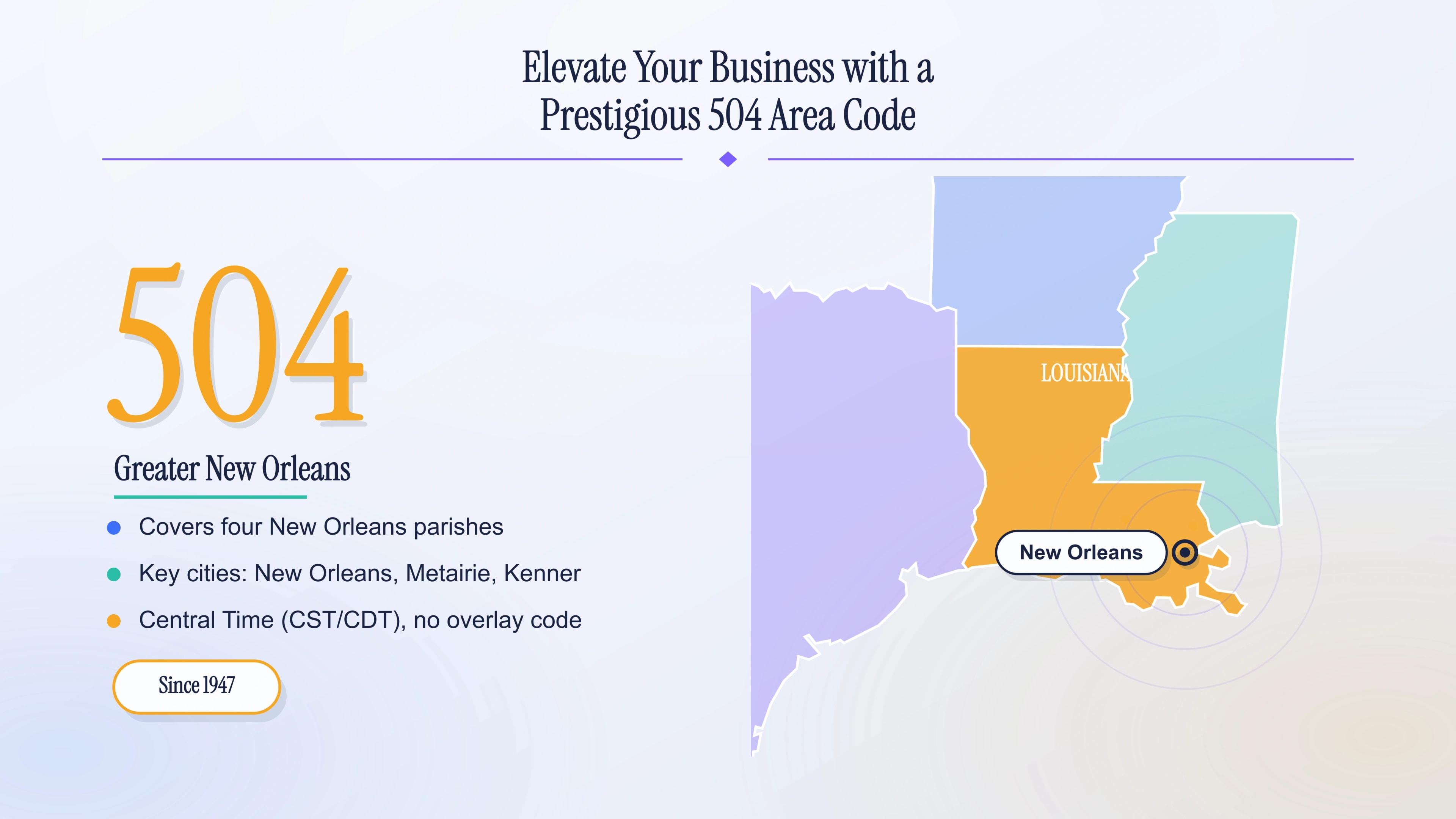
One of the Country's Most Recognizable Codes
Few area codes are as widely recognized across the country as 504, the prefix New Orleans has carried since 1947. It once covered all of Louisiana, now serves four parishes around the city, and still operates without an overlay. For a hotel, event vendor, or shipping company deciding whether its line should show New Orleans digits or a number from elsewhere, that choice colors a customer's view before the first ring is answered. This guide traces how the code shrank, which communities it reaches, what a line costs, and how to use one well.
Key Takeaways
- Origin — the 504 area code was one of the original 86 area codes created in 1947, and it originally served the entire state of Louisiana.
- Coverage — after three subsequent splits, the territory now centers on New Orleans, covering Orleans and St. Bernard parishes, all of Plaquemines Parish, and most of Jefferson Parish.
- No overlay — unlike many major metro codes, the territory still runs on a single prefix, with no companion overlay code in service.
- Time zone — Central Time (CST, UTC−6 / CDT, UTC−5).
- Typical cost — a standard local number runs from a few dollars a month with a cloud provider up to several hundred dollars, or more, for a premium vanity pattern.
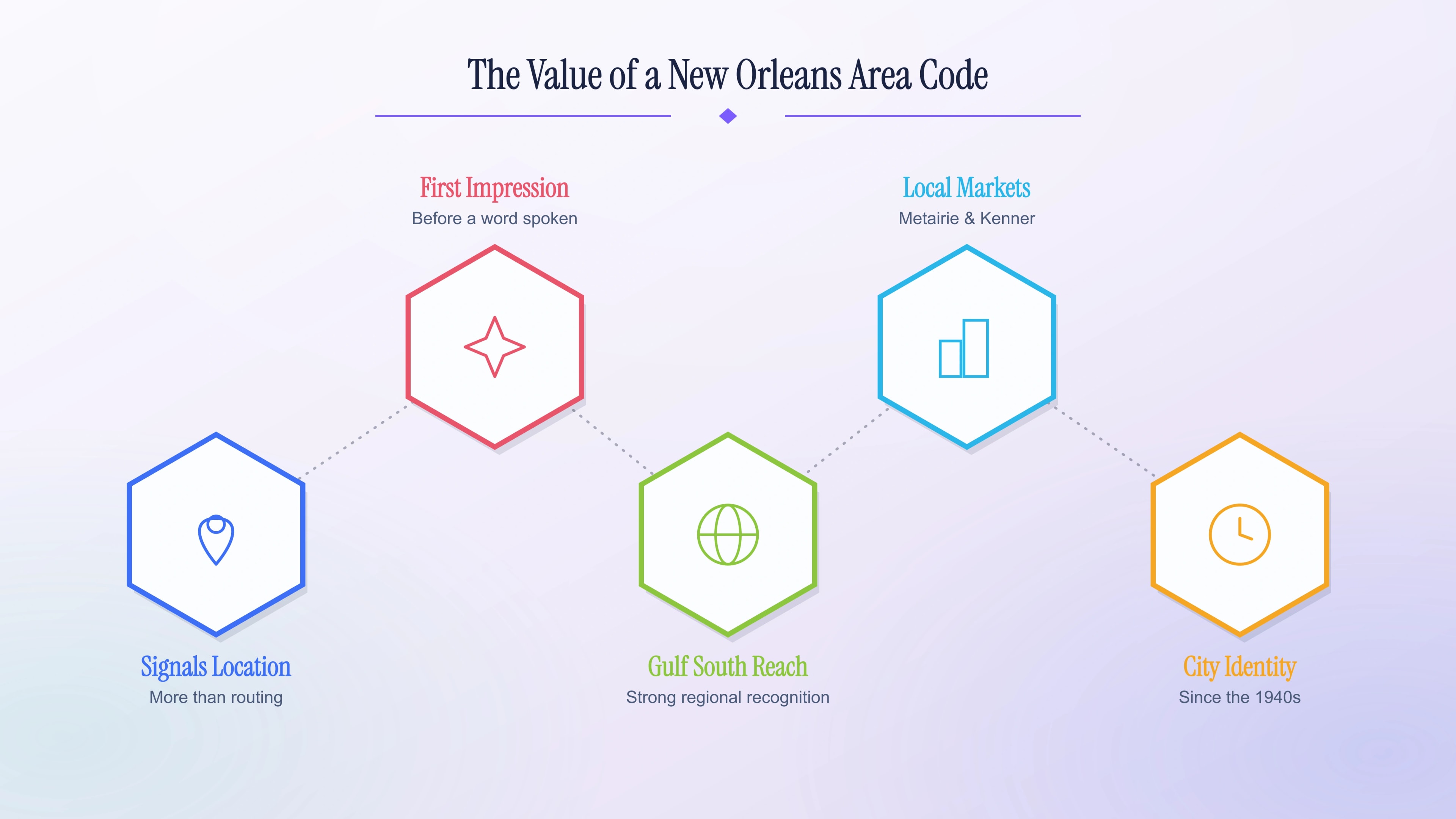
The Value of a New Orleans Area Code
Across the Gulf South, 504 on a caller ID points straight to New Orleans. A customer in Metairie, Kenner, or Chalmette who sees those digits is likely to assume the business works in the same parishes they do, and that assumption shapes how the call is received. Because the code has stood for the city since the mid-20th century, it gives a company a head start on trust that an out-of-state number usually lacks.
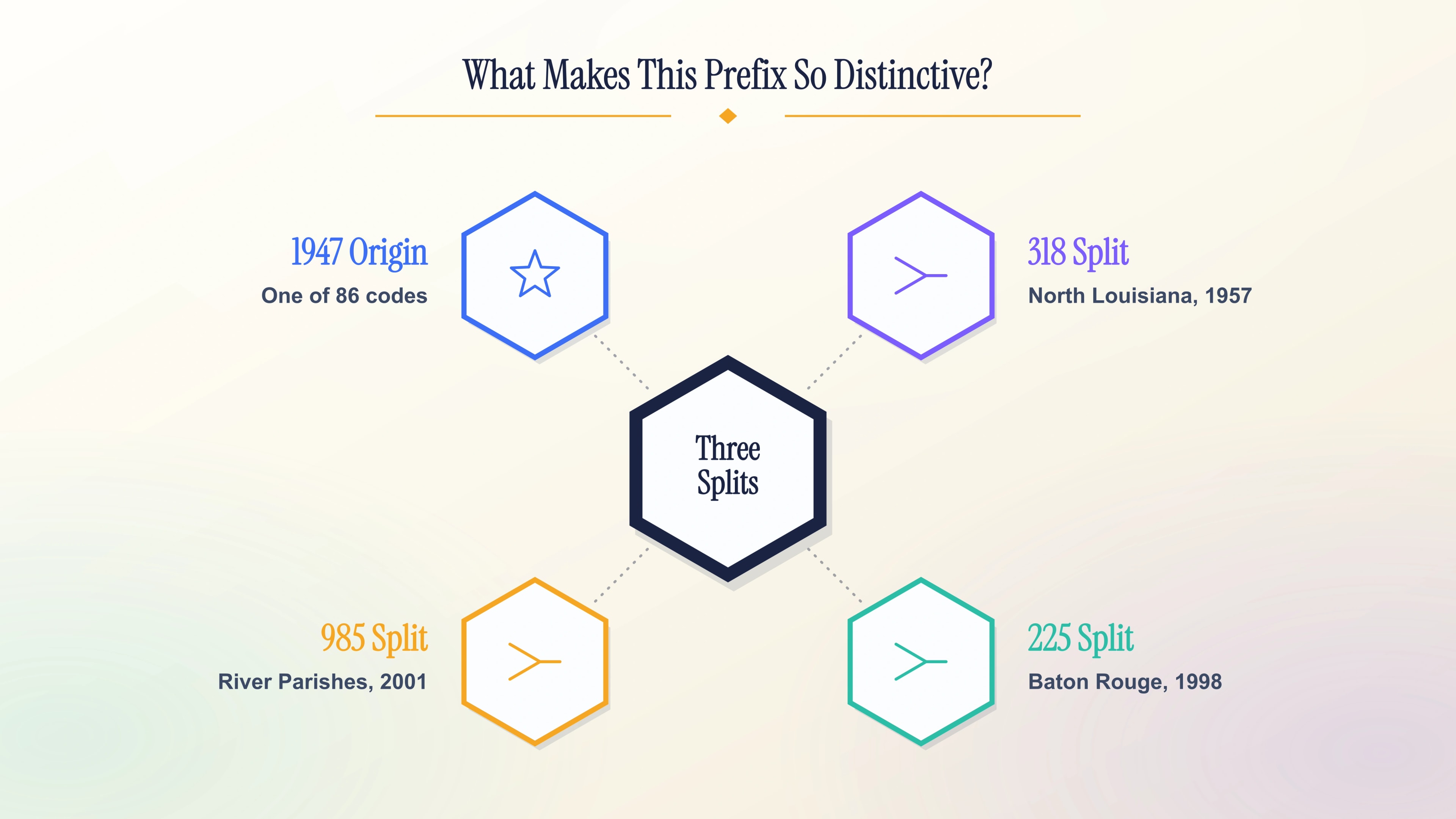
Three Splits That Shrank a Statewide Code
The code traces back to 1947, when it was assigned as one of the original area codes covering the whole of Louisiana. As the state's population grew, regulators carved out three separate numbering plan areas over the following decades: 318 took the northern and western reaches in 1957, 225 took the Baton Rouge corridor in 1998, and 985 took the River Parishes and North Shore in 2001. Each split narrowed the footprint until it settled on the metro area it serves today, a history that reinforces why the prefix still reads as a marker of an established, homegrown presence.
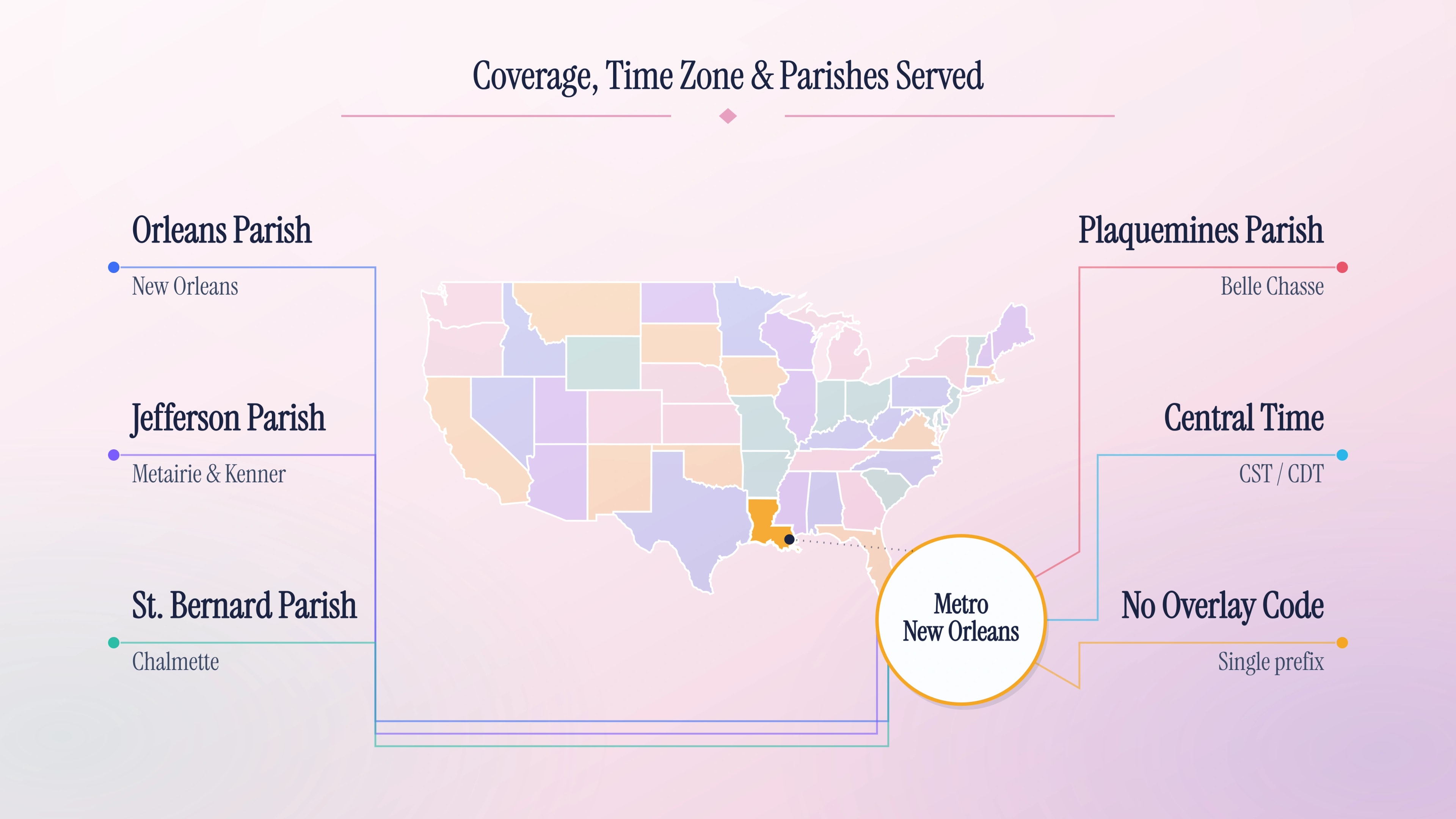
Coverage, Time Zone & Parishes Served
The service territory now centers on Orleans Parish and extends into most of Jefferson Parish along with all of St. Bernard and Plaquemines parishes. Major communities include New Orleans, Metairie, Kenner, Gretna, Marrero, Harvey, Westwego, Chalmette, and Belle Chasse. The entire footprint sits in the Central Time zone, observing CST in winter and CDT during daylight saving. With no overlay code sharing its territory, the region remains a rarer case among major metros: a single prefix covering the whole metro area.
Business Benefits of a Local New Orleans Number
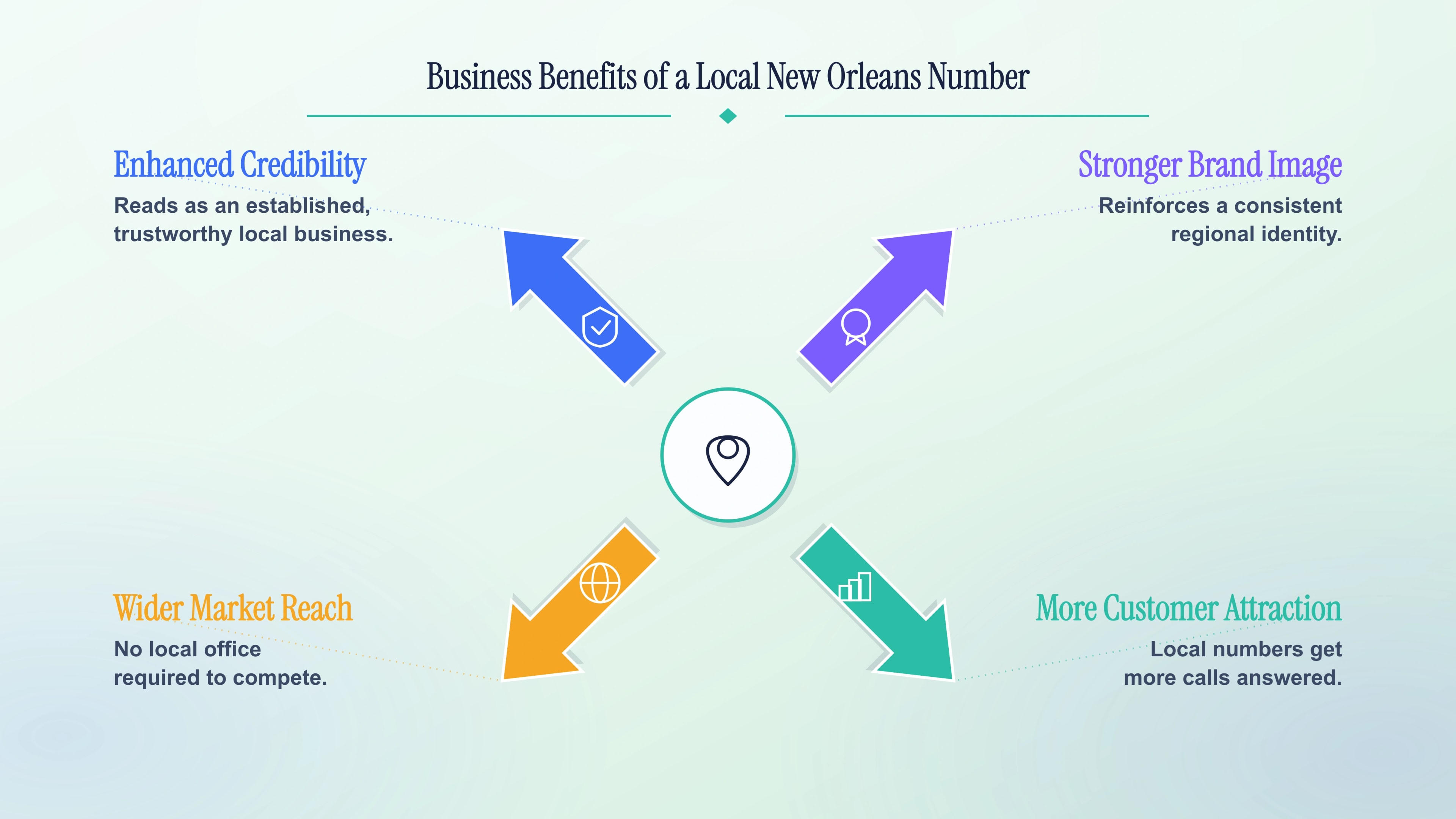
Businesses cite four consistent advantages to carrying a recognizable New Orleans number:
- Signals single-code permanence — a 504 number still reads as the original 1947 New Orleans prefix rather than a newer stand-in.
- Fits the parish-by-parish footprint — pairing it with an Orleans, Jefferson, or St. Bernard Parish listing shows exactly which part of the metro you serve.
- Wins over hospitality and tourism callers — a 504 caller ID gets answered more often by hotels and event vendors than an out-of-area number.
- Extends into the wider Gulf South — hold a New Orleans identity while still reaching neighboring markets like the 601 area code in Mississippi.
One Number Pool Shared by Four Parishes
A business in Gretna and one in Metairie are choosing from the same inventory, because one 504 supply serves the whole territory from Orleans Parish to Plaquemines. That supply keeps moving as lines come back into circulation, get ported, or are reassigned, which makes a flexible plan worth more than a hunt for one special sequence. Look first at what a provider has in stock right now, then weigh a straightforward sequential number against a vanity pattern, and make sure activation will not take long. Openness about the final digits usually gets a business connected sooner.
Listing the Number Parish by Parish
Hotels, event vendors, and every other New Orleans business get value from a 504 number only when customers notice it. It belongs on the Google Business Profile and in the website header, in email signatures, on vehicle wraps, and across print materials, ideally next to listings that name the parishes served, from Jefferson to St. Bernard. Treating the line as a hidden back-end setting wastes it. Using identical digits in every channel also keeps call-tracking results trustworthy for later review.
Tracking Calls from Hospitality and Tourism Contacts
A clear verdict on a 504 number usually rests on three measurements: the volume of incoming calls, the rate at which those calls become business, and how promptly hospitality and tourism contacts respond when the team reaches out. Stack a few months of those numbers against what the previous line produced to see plainly whether the change paid off. Call-tracking software can generally break out the new line's share without extra effort.
Ready for a local New Orleans number?
Acepeak activates 504-area numbers in minutes on a cloud platform — no Louisiana office required. Explore plans and route calls to any device.
A Few Dollars Monthly or a One-Time Broker Fee
For a business serving customers from Westwego to Belle Chasse, the most economical route to a local presence is a standard 504 line through a cloud communications platform, which typically runs a few dollars monthly on a business phone plan. Prices still vary by provider and by the kind of number. A standout vanity pattern is sold separately by brokers, and those one-time fees can land in the hundreds of dollars or climb into the low thousands. The standard monthly number supplies most of the local trust, so the premium route is rarely necessary.
Shipping and Energy Demand Keeps Blocks Moving
Demand for New Orleans numbers has stayed steady given the metro's role as a hub for shipping, tourism, and energy, and popular sequential blocks are often claimed quickly. Businesses that need a specific pattern should work with a provider that can flag inventory as it becomes available; those flexible on the exact digits will rarely wait long. Neighboring Louisiana markets, covered in Acepeak's 318 area code guide to the northern part of the state, follow a similar pattern.
A Phone Number Within the Whole Guest Experience
Hospitality and tourism businesses in New Orleans are judged on the whole experience, and the phone number is a small piece of it. Paired with a polished website and branding that matches across channels, a 504 number helps a company come across as dependable. It will not offset slow responses or poor service. The best returns show up when the number belongs to a brand that already feels coherent and carefully run, instead of standing in for everything else.
Reach Beyond Louisiana: The Global Angle
Where the staff sit makes no difference to a 504 line. The number rides on cloud telephony, so a team elsewhere in the country or abroad can answer it and New Orleans callers still see familiar digits. A tourism, energy, or shipping business looking at the Gulf South can start taking calls from Metairie and Gretna before it rents space in Orleans or Jefferson Parish.
Why Hotels and Vendors Pick Up Local Calls
Many people screen calls by the digits they recognize. Someone in Metairie or Harvey is much more apt to answer a call that begins with a familiar local code than one showing an out-of-region number or a toll-free prefix, because a local number looks like it has a real reason to call. That is part of why hotels and event vendors tend to answer a 504 caller ID more readily than an out-of-area number, and why outbound sales and outreach teams working the metro benefit across an entire calling list.
Health Sciences, the Port and a Closely Watched Pool
The metro area's economy continues to lean on the port, tourism, and a growing health-sciences sector, all of which draw new business formation into Orleans and Jefferson parishes — activity the City of New Orleans actively works to expand. As long as that activity continues, demand for a recognizable local number is likely to stay elevated, and the region's single-code status means the pool is watched closely as older numbers are released and reassigned.
A Code Worn as Local Pride
Long before the younger codes carved from its territory existed, 504 was already the number for New Orleans, and that head start gives it a familiarity they cannot match. Hospitality groups, logistics operators, and professional-services firms use the original prefix to show they are part of the city. It carries weight with customers who would sooner call a New Orleans number they recognize than take a chance on an unfamiliar one.
From First Search to a Working Line
From the first search to a working line, the path has four steps: find providers offering numbers in the 504 territory, run a live check for the pattern you want, compare the standard and vanity price points, and confirm the selection ahead of activation. A company transferring a number it already uses from another carrier should expect the port to need several business days.
Federal Porting Protections and Next Steps
Federal protections give a New Orleans business the right to keep its current number when it changes carriers, and providers may not delay a valid request without documented cause. When the business is ready, it can get a quote, browse the 504 numbers on offer, and have the new line running before the business week is out.
Local Credibility for a Small Recurring Price
Three rounds of splitting, with 318 in 1957, 225 in 1998, and 985 in 2001, reduced a code that once reached every corner of Louisiana to the metro parishes around New Orleans. The prefix came through all of it without gaining an overlay and remains the only code for Orleans, St. Bernard, Plaquemines, and most of Jefferson Parish. A standard 504 line is generally priced at a few dollars monthly on a cloud plan, a small outlay for a number that tells Gulf South customers a business is genuinely local.
Add a local New Orleans number to your business
Explore virtual number options through Acepeak and get a Gulf South line activated today.
Carriers and resellers sending traffic to 504 numbers can get termination, DIDs and SIP trunking from one wholesale VoIP provider, on Tier-1 direct routes with published per-route rates.
Questions, answered.
The territory covers Orleans and St. Bernard parishes in full, all of Plaquemines Parish, and most of Jefferson Parish, including New Orleans, Metairie, Kenner, Gretna, and Chalmette.
No. Unlike several major metro codes that share territory with a companion overlay, this prefix remains the sole code for its footprint, though providers still recommend dialing all ten digits for reliability.
Central Time — CST (UTC−6) in winter, shifting to CDT (UTC−5) during daylight saving, which runs from the second Sunday in March to the first Sunday in November.
Yes. Cloud communications providers issue virtual numbers in this territory to businesses located anywhere, and calls route through the standard telecom network while presenting a local New Orleans identity to callers.
A standard number typically costs a few dollars monthly through a business phone plan, while a distinctive vanity sequence sourced through a number broker can cost anywhere from roughly $150 to several thousand dollars as a one-time fee, depending on demand.
Consumers can report suspected scam or spoofed calls directly to the FCC and FTC, both of which track patterns of abuse tied to specific number ranges and can direct carriers to block confirmed offenders.
Signing up for a 504 area code number takes minutes with a cloud phone provider — no local office in New Orleans required. Pick the number, connect it to your existing phone or app, and calls route in immediately. This keeps the 504 area code presence you already have while adding the local credibility Louisiana customers respond to.