Farm Towns, College Towns and Common Misconceptions
Few Missouri prefixes cover as much ground as the one wrapped around the northern and western edges of the state. It reaches the railroad city of Sedalia, the university town of Kirksville, and a wide patchwork of county seats and farm communities that ring the Kansas City metro. Created in the late 1990s as the mobile era took hold, the prefix has quietly become part of the regional identity for a swath of Missouri that runs from the Iowa line to the Kansas border. This guide explains where it truly reaches, how it came to be, how to dial it, and why a local number still matters for business — while clearing up the surprising amount of misinformation that surrounds it.
Key Takeaways
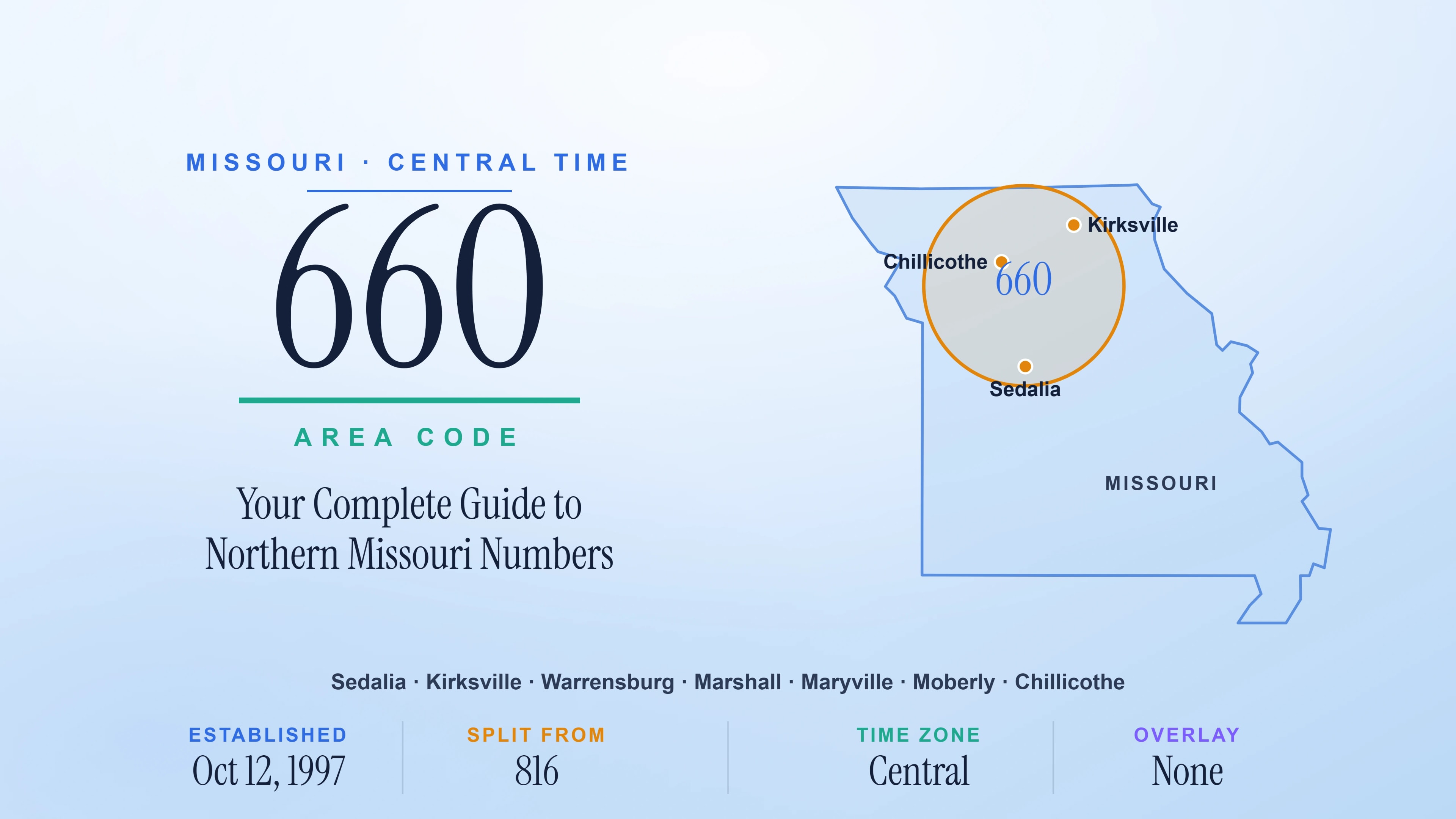
- The 660 prefix covers a broad band of northern and western Missouri — Sedalia, Kirksville, Warrensburg, Marshall, Maryville, Moberly, and Chillicothe — and was created on October 12, 1997 as a split from 816.
- Despite frequent misinformation online, Columbia and Jefferson City are not in this region (they use 573), and Kansas City kept 816 — so anyone choosing a number for a specific city should confirm the boundary first.
- The region surrounds the Kansas City metro on three sides, stretching from the Iowa border down toward the Kansas state line.
- The entire area observes Central Time (CST/CDT) and follows standard ten-digit-plus-1 dialing.
- A local Missouri number remains one of the simplest trust signals a business can own across the region's farm towns and college communities.
Understanding the 660 Area Code
The 660 area code is the telephone identity of northern and western Missouri. It was carved out on October 12, 1997, when it split from the Kansas City–anchored 816 region to relieve a numbering plan that the spread of cell phones and second lines had begun to exhaust. When the split took effect, the Kansas City metro and the St. Joseph area kept 816, while the rural and small-city remainder of the territory took the new prefix.
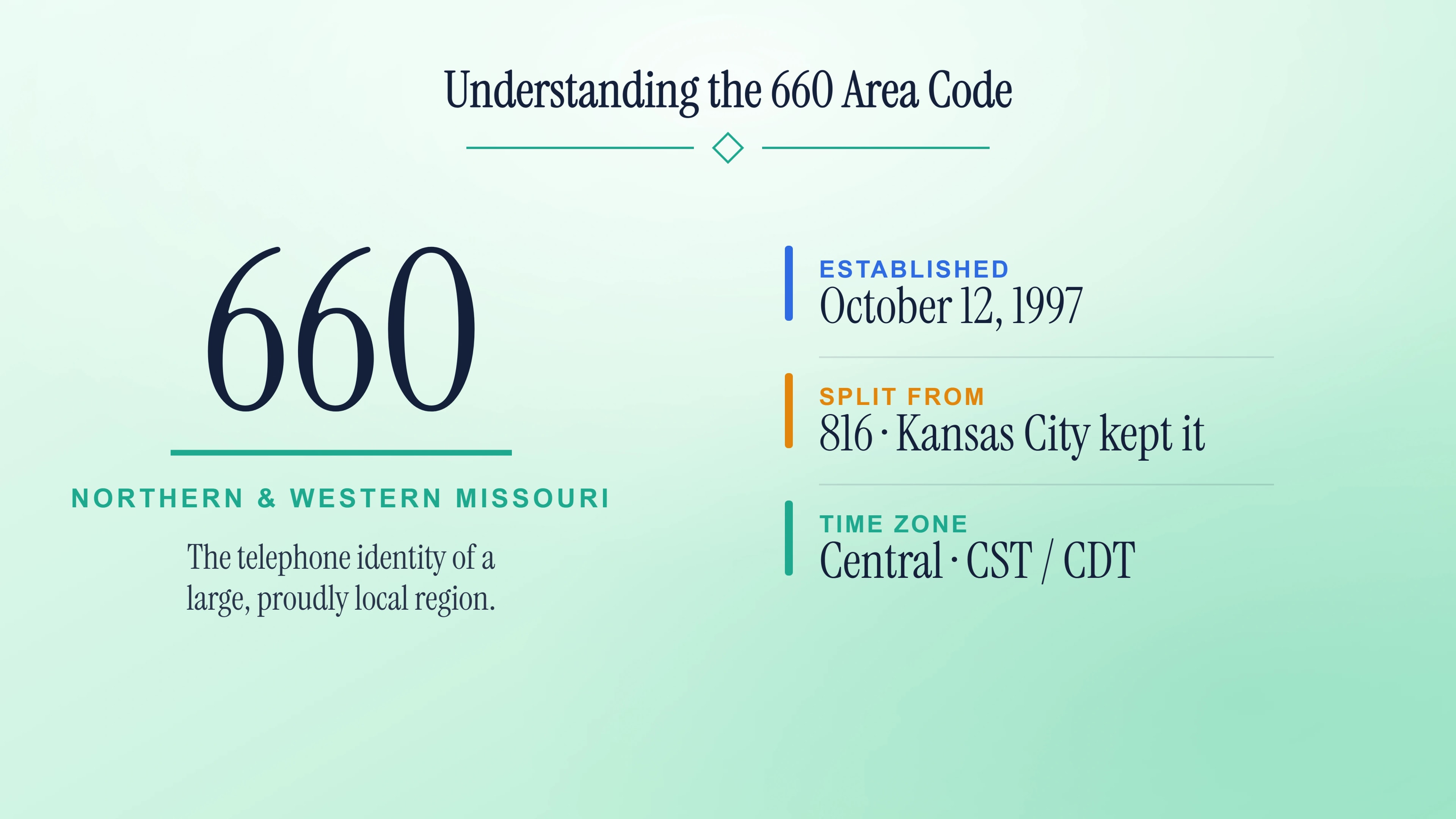
Much as the neighboring Kansas 785 code serves the rural counties just across the state line, this prefix knits together a large, mostly small-town region under a single recognizable identity. It signals a caller as part of greater rural Missouri — a quiet but real credibility marker in communities where local presence still counts.
Key Cities and Counties Covered
The prefix covers dozens of counties across northern and west-central Missouri. The principal cities include:
- Sedalia (Pettis County) and Warrensburg (Johnson County)
- Kirksville (Adair County) and Maryville (Nodaway County)
- Marshall (Saline County) and Moberly (Randolph County)
- Chillicothe (Livingston County), plus county seats across the northern tier
One correction is worth making plainly, because phone-lookup sites get it wrong constantly: several cities often listed with this prefix are not part of it. Columbia and Jefferson City belong to 573, Kansas City kept 816, and Hannibal, in the far northeast, also sits in 573. The region effectively wraps around the Kansas City metro rather than including it, so confirming the boundary before choosing a number for a named city avoids a common and costly mistake.
The Split from 816: How 660 Was Born
For decades a single area code covered most of western Missouri, from Kansas City out across the farm country. By 1996, deregulation under the Telecommunications Act and the rapid uptake of mobile phones were draining the available numbers. On July 28, 1997, the North American Numbering Plan Administrator announced a geographic split, and on October 12, 1997 the new prefix went live.
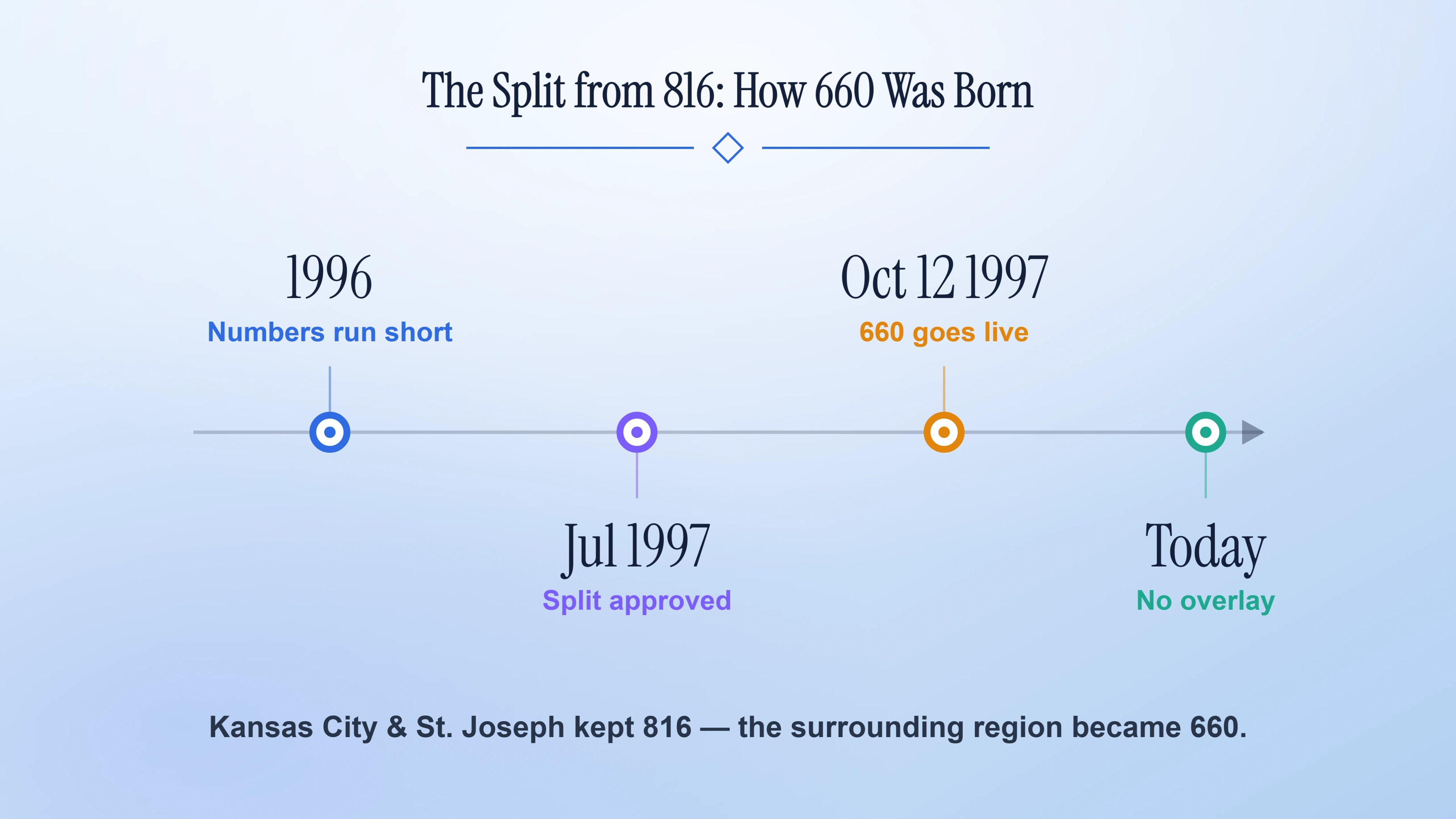
The boundary was drawn to keep the Kansas City and St. Joseph metros intact under 816 while the surrounding region took the new code. The territory has operated as a single geographic area code ever since, without an overlay — a calmer history than many urban regions, where rapid number exhaustion has forced repeated changes like the overlay added to Chicago's 872 area and other growing Midwest markets.
Dialing Format for the 660 Area Code
The entire region observes Central Time — UTC−6 in winter (CST) and UTC−5 during daylight saving (CDT), which runs from March to November. That places it one hour behind the East Coast, a useful detail when scheduling calls across the country.
- Local and regional calls: dial all ten digits — 660-555-1234.
- Long-distance from elsewhere in the U.S.: add a leading 1 — 1-660-555-1234.
- International: dial the exit code, then +1, then the number — +1 (660) 555-1234.
When in doubt, dialing all ten digits connects correctly in every scenario.
Benefits of a Local 660 Number for Business
Across northern Missouri's farm towns and college communities, people tend to answer calls they recognize. A 660 prefix tells a customer in Kirksville, Chillicothe or Sedalia that the business is part of the region, not a call center somewhere far away.
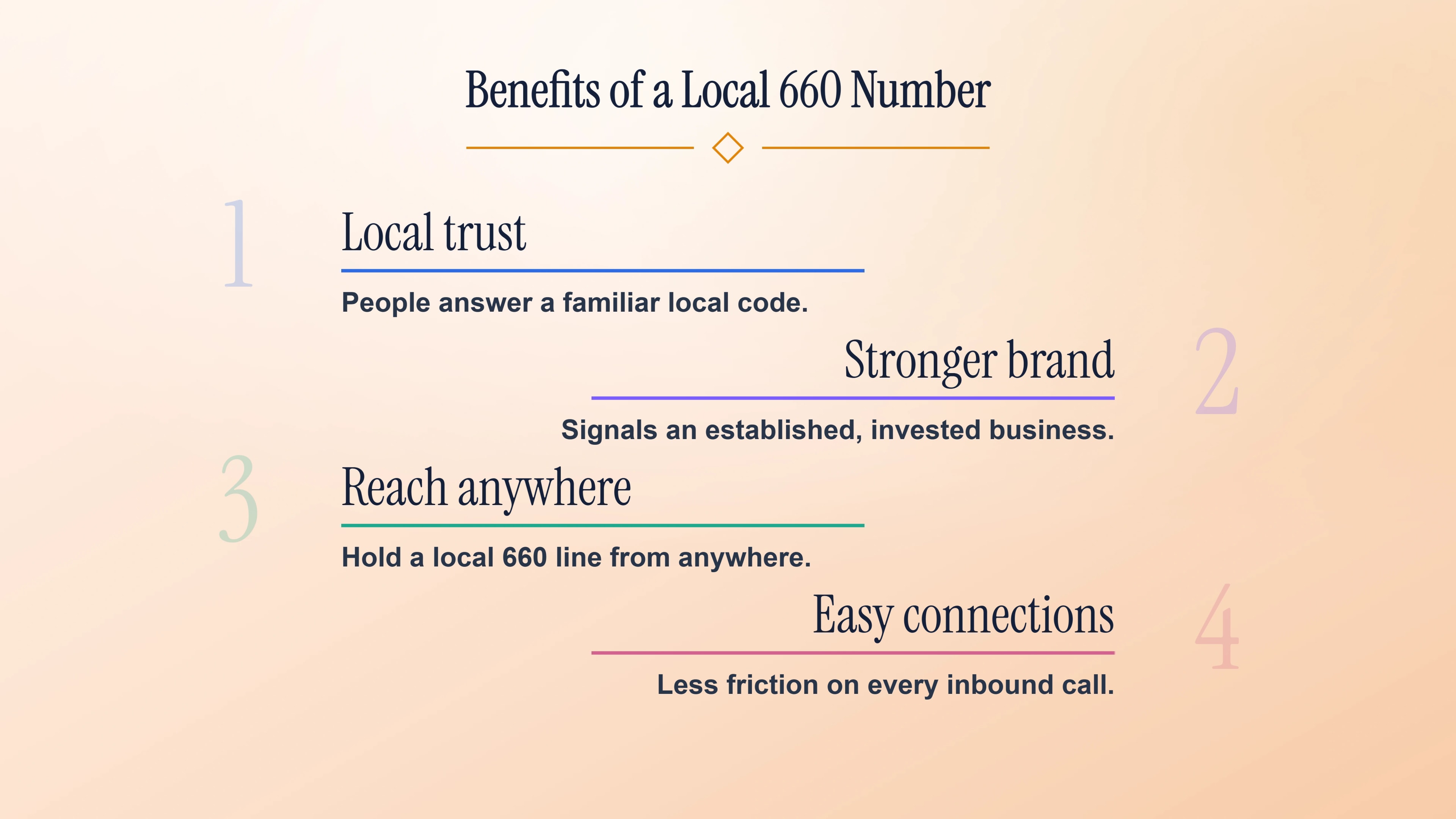
- Local trust and recognition: people are far more likely to answer a call from a familiar local code.
- Stronger brand image: a recognizable regional number signals an established, invested business.
- Reach anywhere: cloud calling lets a company hold a local presence here while operating from anywhere.
- Better customer connections: a local line lowers the friction of every inbound inquiry.
Ready to claim a northern-Missouri presence?
Acepeak provisions local numbers with carrier-grade routing and instant activation, so a business can sound local from day one.
How to Get a 660 Phone Number
Once the target city is confirmed as 660 territory rather than 573 or 816, setting up one line or a full team takes four steps.
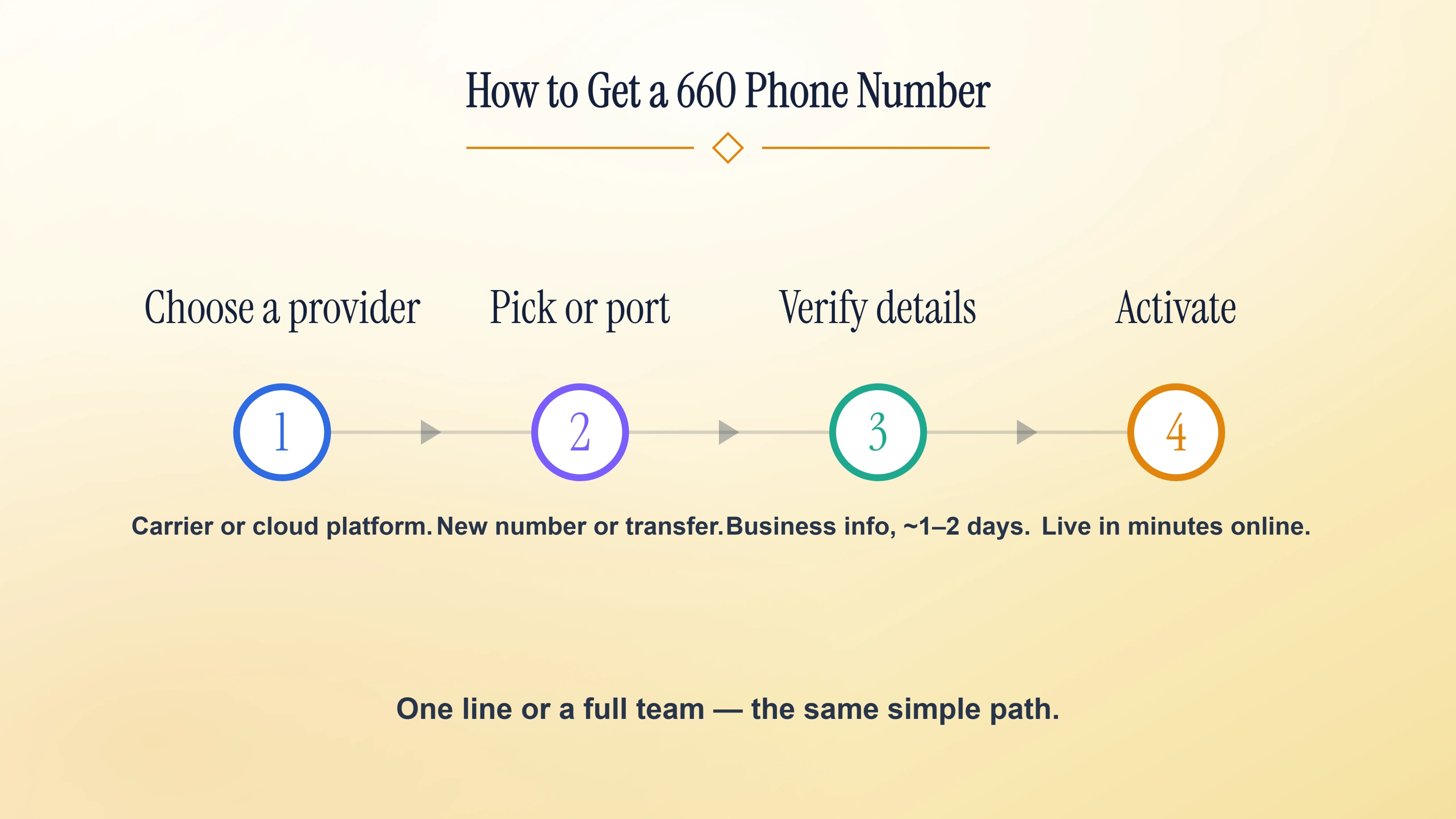
- Choose a provider: options range from traditional carriers to cloud platforms like Acepeak that assign numbers online.
- Pick or port a number: browse the available inventory, or transfer an existing local line.
- Verify details: provide basic business and billing information, typically approved within a day or two.
- Activate: cloud providers often go live in minutes rather than days.
Protecting Yourself from Scams
Because a local code looks trustworthy, scammers sometimes spoof it to appear nearby — often through robocalls claiming prizes or government action. A local-looking call still deserves scrutiny.
- Never share sensitive details — bank information or a Social Security number — with an unexpected caller.
- Verify urgent requests by hanging up and calling back on an official, published number.
- Use call-blocking and spam-filtering tools to screen unknown numbers.
- Report suspicious calls to your provider and the relevant authorities so others are protected.
The Future of the 660 Area Code
With no overlay and a largely rural footprint, the region has grown without the disruptive splits that crowded urban markets keep facing, and existing numbers stay exactly as they are. State regulators and federal numbering administrators monitor supply and decide if and when new numbers or an overlay are ever needed. For residents and businesses the takeaway is simple: the local identity is secure, and demand for a recognized Missouri number is only growing.
A Stable, Overlay-Free Identity Worth Claiming
Missouri's 660 prefix is more than a routing code; it is a marker of place across a large, proudly local stretch of the state. Born from a clean 1997 split and untouched by overlays since, it still ties together farm towns, county seats, and college communities under one identity. For a business, a local number remains one of the cheapest, most credible ways to signal local roots — and with cloud calling, that presence is available to anyone, anywhere.
Put a trusted northern-Missouri number to work today.
Acepeak delivers local lines with smart routing, voicemail and 24/7 support — everything a business needs to stay reachable.
Questions, answered.
It covers northern and western Missouri, including Sedalia, Kirksville, Warrensburg, Marshall, Maryville, Moberly, and Chillicothe. It wraps around the Kansas City metro without including it.
Missouri. The prefix serves the rural and small-city regions of the state's northern and western tiers.
No. Columbia and Jefferson City use 573, and Kansas City kept 816 after the 1997 split. This is one of the most common mistakes on phone-lookup sites.
It went live on October 12, 1997, as a geographic split from 816, prompted by the rise of mobile phones and second lines.
Yes. Cloud and hosted phone services let a business or individual hold a local Missouri number from anywhere while keeping a local identity.
Signing up for a 660 area code number takes minutes with a cloud phone provider — no local office in Missouri required. Pick the number, connect it to your existing phone or app, and calls route in immediately. This keeps the 660 area code presence you already have while adding the local credibility Missouri customers respond to.