Storefronts, Surfboards and More Than Thirty Cities
Few Southern California prefixes are as recognizable as the one stamped across Orange County storefronts, surfboards and business cards. It reaches Anaheim — the home of Disneyland — the county seat of Santa Ana, and the beaches of Huntington, across a dense region of more than thirty cities. Born in the early 1950s, the prefix has weathered three splits, a major overlay and the mobile era, and it remains one of the most sought-after local identities in the state. This guide explains where it truly reaches, how it has changed, why it still matters for business, and what is coming next.
Key Takeaways
- The 714 prefix serves northern and central Orange County, California — Anaheim, Santa Ana, Huntington Beach, Garden Grove, Fullerton and more — and was created in 1951 as a split from 213.
- Later splits created 619 (1982), 909 (1992) and 949 (1998); southern Orange County cities such as Irvine, Mission Viejo and Laguna Beach are actually 949, not this prefix.
- The 657 overlay went live on September 23, 2008, sharing the same geography and making ten-digit dialing mandatory.
- The region sits entirely in the Pacific Time Zone (PST/PDT) and observes daylight saving time.
- Regulators project the region's numbers will be exhausted by March 2027, with a new overlay in the works — but a local number still lifts answer rates and builds trust for Orange County businesses.
What Is the 714 Area Code?
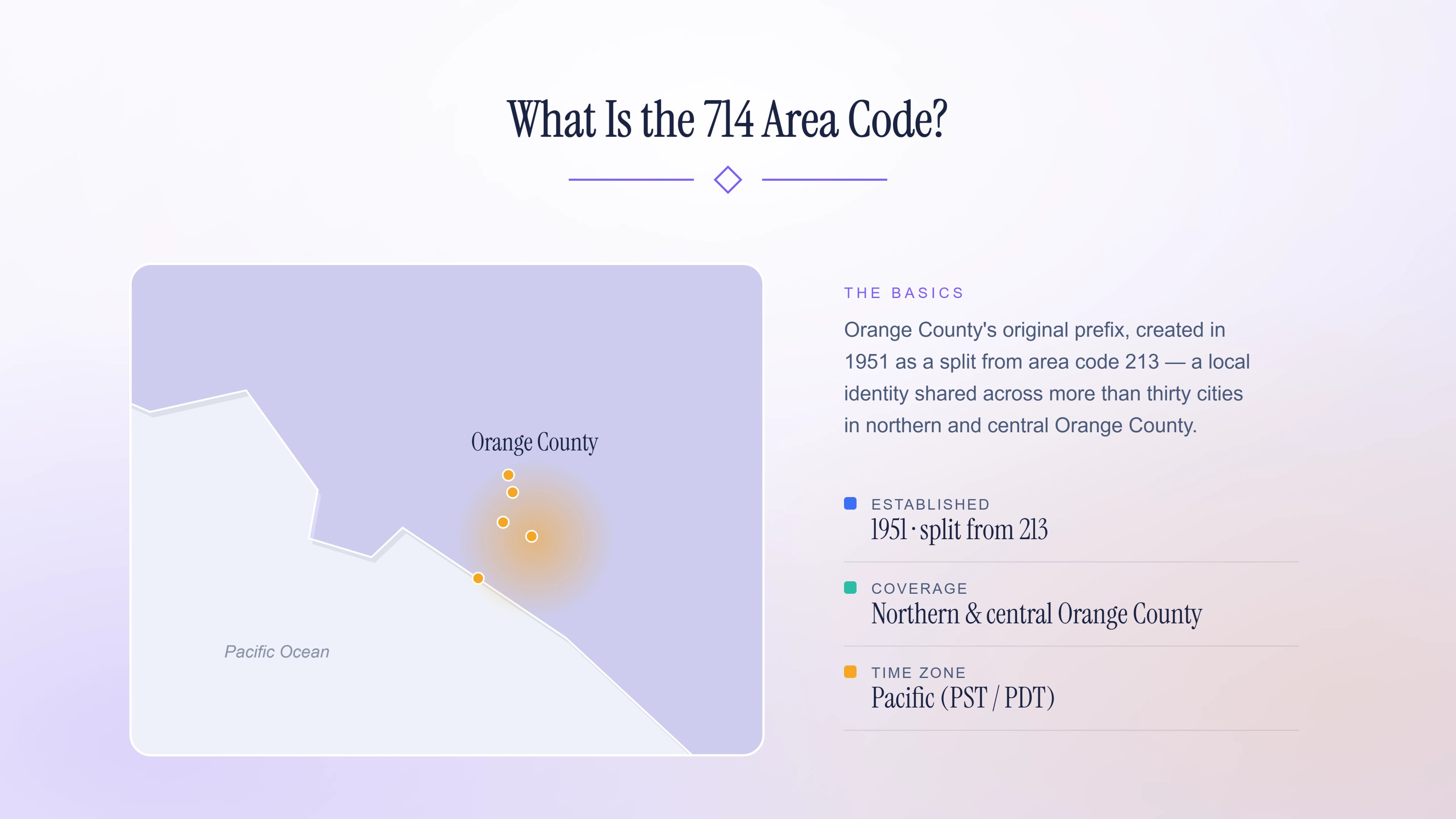
The prefix is one of California's earliest. It traces back to 1951, when it split from 213 — the original Southern California code that also later gave rise to Los Angeles's 323 area code. At first it blanketed a huge stretch of the southland, from the San Diego coast through the inland deserts, before decades of growth carved that territory down to its modern footprint in Orange County.
Today the code is firmly tied to one county. It identifies a caller as part of the Orange County community — a quiet but real credibility signal in a region where local presence carries weight with customers.
Northern and Central Cities and the Southern Boundary
The prefix covers northern and central Orange County, plus a small slice of the neighbouring 213 area code region in Los Angeles County and the Carbon Canyon area of Chino Hills in San Bernardino County. The major cities include:
- Anaheim, Santa Ana and Garden Grove
- Fullerton, Orange and Buena Park
- Huntington Beach, Westminster and Fountain Valley
- Cypress, Placentia, Yorba Linda, Brea, Tustin, Stanton and Villa Park
One common mix-up is worth clearing up: southern Orange County is not part of this prefix. Cities such as Irvine, Mission Viejo, Lake Forest, Aliso Viejo, Laguna Beach, Dana Point and San Juan Capistrano belong to the 949 region, which split away in 1998. Many phone-lookup sites still list those cities incorrectly, so anyone choosing a number for a specific city should confirm the boundary first.
The Splits and Overlay of 714
The original territory shrank in stages as Southern California's population exploded. Area code 619 split off in 1982 to serve San Diego and the desert; 909 followed in 1992 for the Inland Empire; and 949 separated in 1998 to take southern Orange County. Each split let the region keep issuing numbers without disruption.
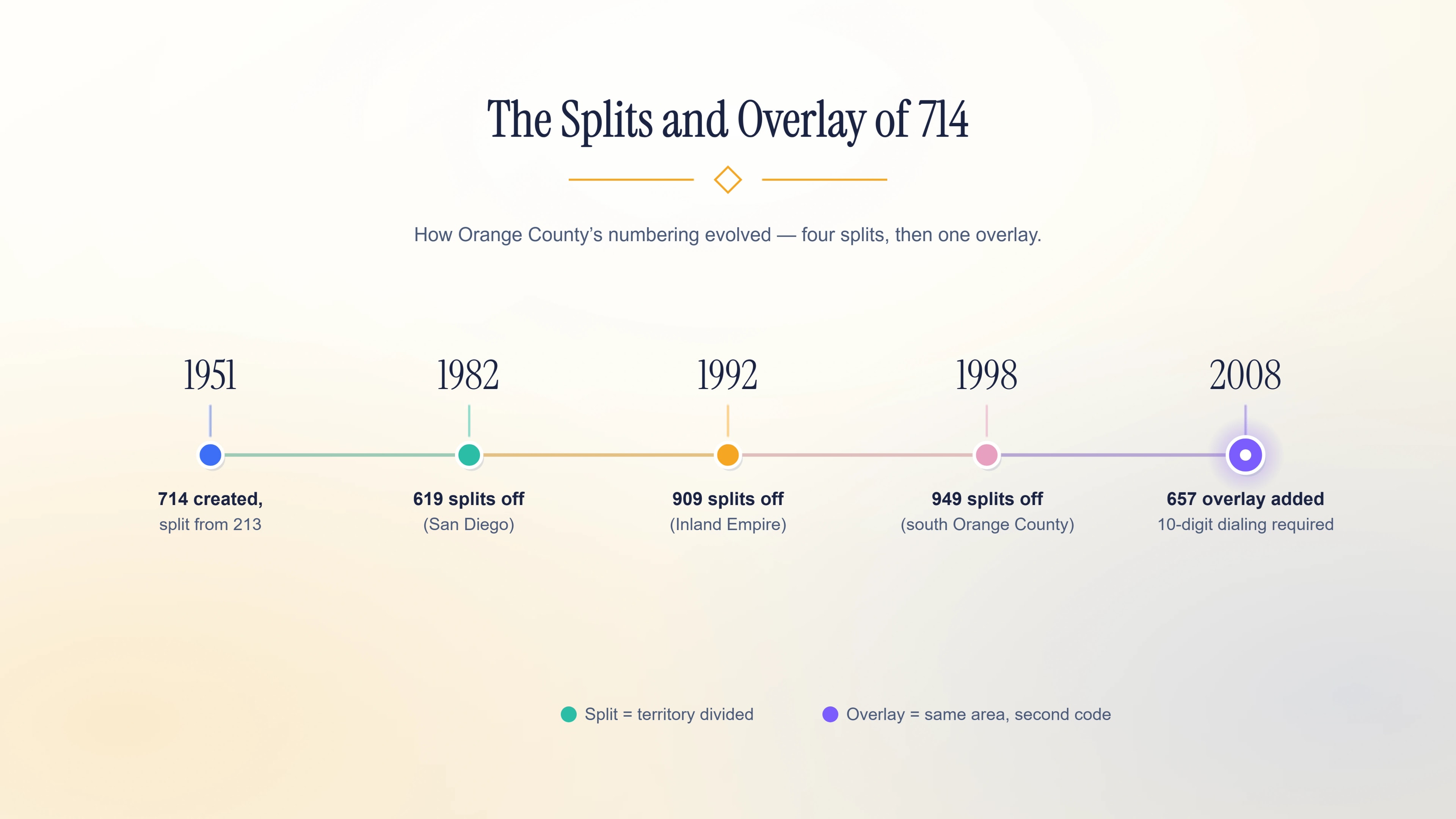
By the 2000s, splitting was no longer the preferred fix. Instead, the 657 area code was overlaid directly on top of the existing territory on September 23, 2008 — the same geography served by two codes at once. Because an overlay puts two prefixes in one region, ten-digit dialing became mandatory: every local call now requires the full code plus the seven-digit number, and no existing number had to change.
Pacific Hours and the Three Ways to Dial
Orange County runs on Pacific Time, moving from PST, which is UTC-8, to PDT, which is UTC-7, for daylight saving between March and November. With the East Coast three hours ahead, an early call from an eastern office can reach Anaheim or Santa Ana before most businesses there open. Because 657 shares the territory, local calls use all ten digits:
- Local and regional calls: dial all ten digits — 714-555-1234.
- Long-distance from elsewhere in the U.S.: add a leading 1 — 1-714-555-1234.
- International: dial the exit code, then +1, then the number — +1 (714) 555-1234.
Benefits of a 714 Number for Business
Few marketing moves take less effort than a matching area code. A shopper in Anaheim or Garden Grove who spots 714 on caller ID tends to assume the business is nearby rather than a distant call center.
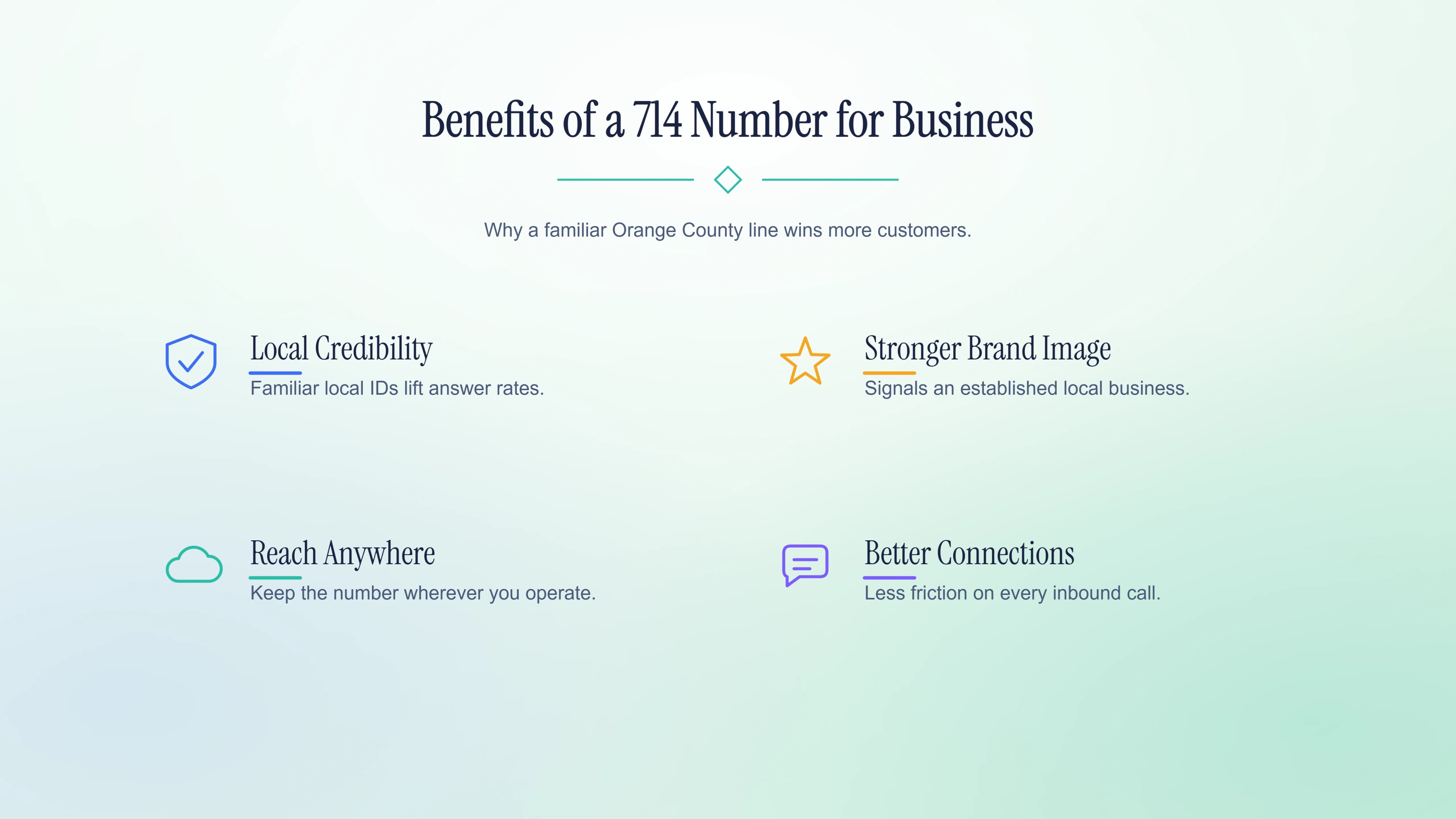
- Local credibility: an Anaheim or Santa Ana customer answers a 714 call as a neighbor's, not an unfamiliar out-of-county line.
- County-wide reach: a single 714 number ties a business to northern and central Orange County, from Fullerton to Huntington Beach, rather than the separate 949 territory to the south.
- Reach anywhere: cloud calling lets a company hold a local presence here while operating from anywhere.
- Original-code standing: 714 has anchored Orange County since 1951, giving it a longer local pedigree than the newer 657 overlay sharing its territory.
Ready to claim an Orange County presence?
Acepeak provisions local numbers with carrier-grade routing and instant activation, so a business can sound local from day one.
How to Get a 714 Phone Number
First confirm the cities you serve fall in northern or central Orange County, not 949 territory, then follow these steps:
- Choose a provider: pick a cloud platform like Acepeak or a traditional carrier that can provision a number across northern and central Orange County.
- Pick or port a number: browse the available inventory from Anaheim to Huntington Beach, or transfer an existing local line.
- Verify details: provide basic business and billing information.
- Activate: cloud providers often go live within minutes rather than the days a traditional carrier might need.
When a Familiar Prefix Hides a Spoofer
Because 714 and 657 both belong to the county, a spoofer can borrow either one and pass as a Fullerton or Garden Grove neighbor. Weigh what the caller asks for, not the prefix:
- Never share sensitive details — bank information or a Social Security number — with an unexpected caller.
- Verify urgent requests by hanging up and calling back on an official, published number.
- Use call-blocking and spam-filtering tools to screen unknown numbers.
- Report suspicious calls to the provider or the relevant authorities so others are protected.
The Future of the 714 Prefix
The region is running low on numbers. Regulators project that available prefixes across the 714 and 657 region will be exhausted by March 2027, and the California Public Utilities Commission has already begun the process of adding a new overlay to keep numbers available. For residents and businesses the takeaway is simple: existing numbers stay put, and demand for a recognized local identity is only growing.
Three Splits Later, a Local Line Still Earns Trust
Since splitting from 213 in 1951, the 714 code has given up San Diego, the Inland Empire, and southern Orange County, taken on the 657 overlay, and still kept its hold on Anaheim, Santa Ana, and Huntington Beach. With supply expected to run short by March 2027, those digits remain in demand. For a business, a local Orange County line is still an affordable, believable way to show roots in the county, and cloud calling lets a company claim one no matter where its staff sit.
Put a trusted Orange County number to work today.
Acepeak delivers local lines with smart routing, voicemail and 24/7 support — everything a business needs to stay reachable.
Questions, answered.
It covers northern and central Orange County, California — including Anaheim, Santa Ana and Huntington Beach — plus small portions of Los Angeles and San Bernardino counties.
Southern Orange County cities such as Irvine, Mission Viejo, Lake Forest and Laguna Beach use the 949 code, which split away in 1998 — not this prefix.
Yes. Since the 657 overlay went live in 2008, ten-digit dialing has been mandatory for every local call in the region.
Regulators expect the 714 and 657 supply to be exhausted by March 2027, which is why a new overlay is being planned. Existing numbers will not change.
Yes. Cloud and hosted phone services let a business or individual hold a local Orange County number from anywhere while keeping a local identity.
Signing up for a 714 area code number takes minutes with a cloud phone provider — no local office in Orange County required. Pick the number, connect it to your existing phone or app, and calls route in immediately. This keeps the 714 area code presence you already have while adding the local credibility California customers respond to.