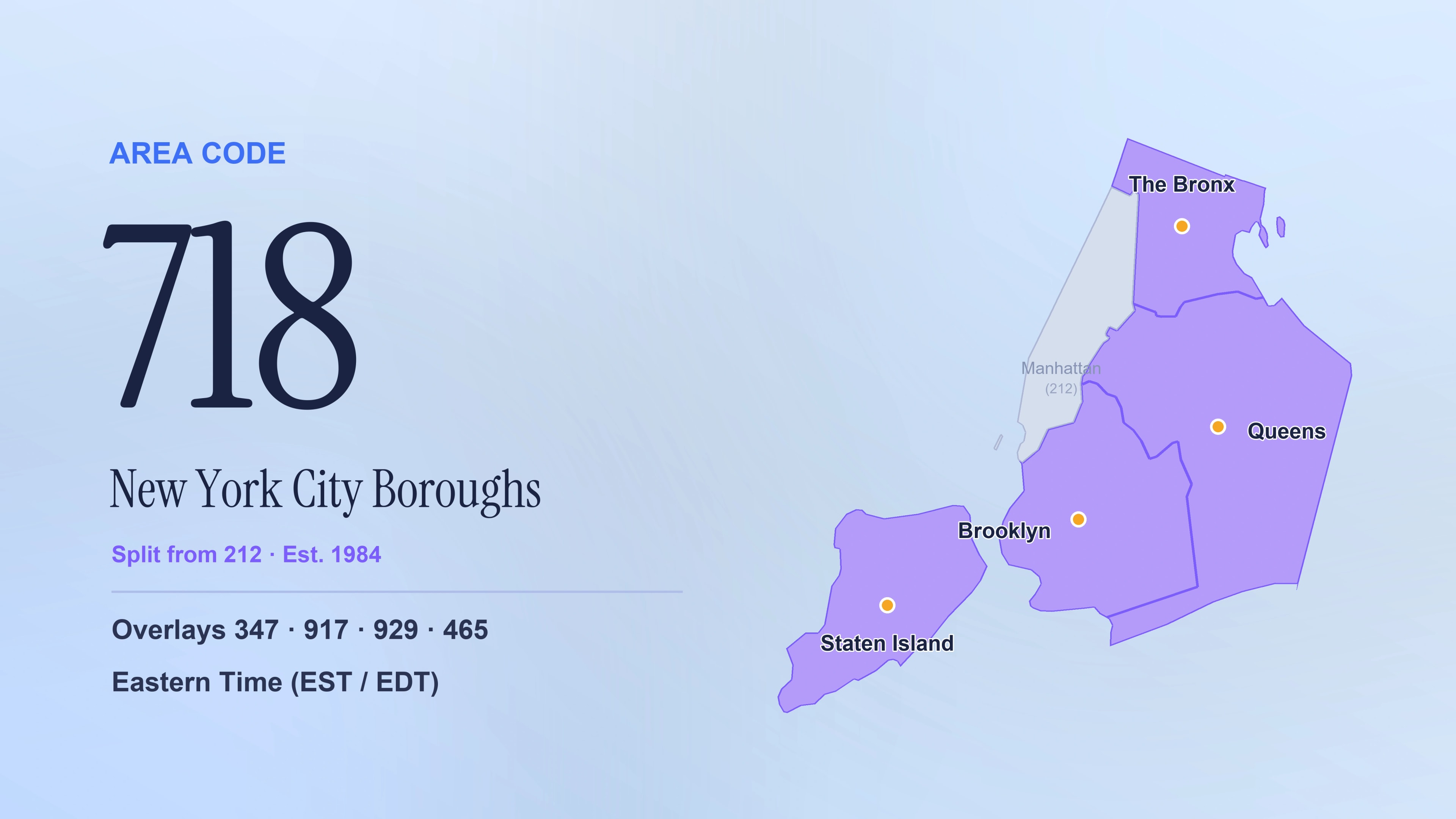
Brownstones, Diners, Ballparks and the Staten Island Ferry
Say "718" anywhere in New York and people picture the same place: the boroughs beyond Manhattan — Brooklyn brownstones, Queens diners, Bronx ballparks and the Staten Island Ferry. For four decades this code has been the dial-tone identity of the outer boroughs, born when Manhattan's crowded 212 code could no longer stretch across the whole city. This guide lays out exactly where 718 reaches today, how it was created and later layered with overlays, the brand-new 465 code arriving in 2026, and how any business can claim a local New York City presence with a number of its own.
Key Takeaways
- The 718 prefix covers New York City's four outer boroughs — Brooklyn (Kings County), Queens (Queens County), the Bronx (Bronx County) and Staten Island (Richmond County) — plus the small Marble Hill section of Manhattan.
- It was created on September 1, 1984, when it was split from Manhattan's original 212 code to relieve a numbering shortage; the Bronx was added to the 718 region on July 1, 1992.
- The territory is now shared by several overlays — 347 (1999) and 929 (2011), alongside the citywide 917 code — so every number in the outer boroughs is dialed with all ten digits.
- A new overlay, 465, begins service on June 18, 2026 — the first New York area code to start with a 4 — and no existing 718 number changes as a result.
- The region sits in the Eastern Time Zone, and a local 718 number remains an unmistakable outer-borough identity — a real advantage for any business courting the Brooklyn, Queens, Bronx and Staten Island market.
What Is the 718 Area Code?
The 718 prefix is the principal area code for the four outer boroughs of New York City — everything outside Manhattan. It is a geographic code with its own defined territory carved out in 1984, when the five-borough city outgrew a single area code. Like Los Angeles's 213 area code, it carries an unmistakable big-city identity: a number that instantly reads as home turf to the people who live there.
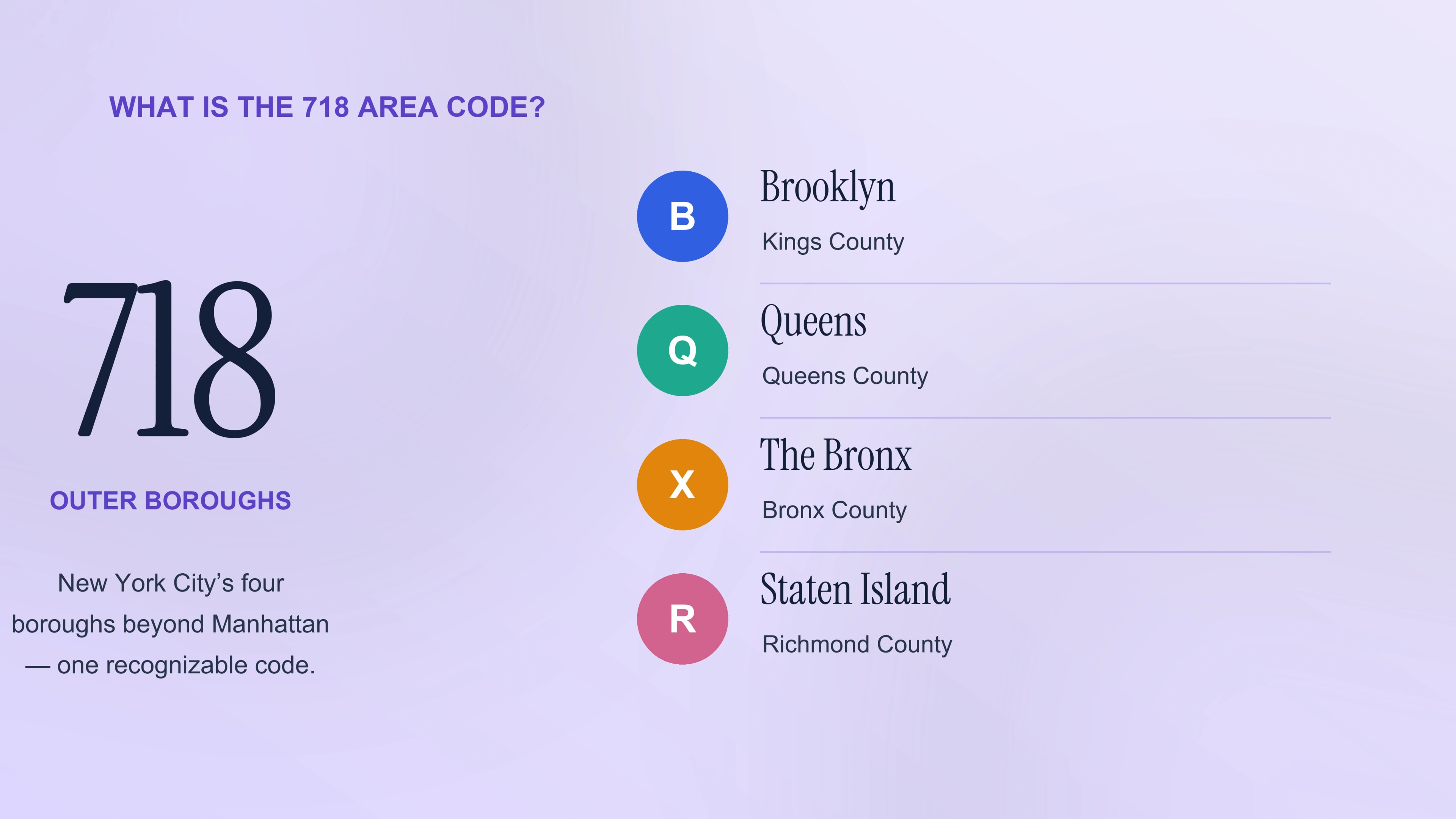
Because it covers Brooklyn, Queens, the Bronx and Staten Island, a 718 number reads as unmistakably local to millions of New Yorkers. To a customer in Astoria, Park Slope or Riverdale, it looks like a neighbor on the caller ID rather than a stranger from out of town — a small but real credibility signal for any business working the boroughs.
Geographic Coverage and the Boroughs It Serves
The 718 code blankets the four boroughs of New York City that lie outside Manhattan, spanning the western end of Long Island, Staten Island and the mainland Bronx. It also picks up Marble Hill, a small neighborhood that is legally part of Manhattan but physically attached to the Bronx. The major areas include:
- Brooklyn (Kings County) — the city's most populous borough, from Williamsburg and Park Slope to Bay Ridge, Flatbush and Coney Island
- Queens (Queens County) — the most diverse borough, covering Astoria, Long Island City, Flushing, Jamaica, Forest Hills and Far Rockaway
- The Bronx (Bronx County) — the only mainland borough, spanning Riverdale, Fordham, the South Bronx and Pelham Bay
- Staten Island (Richmond County) — the southernmost borough, from St. George near the ferry down to Tottenville
- Marble Hill — a small slice of Manhattan on the mainland side of the Harlem River that dials on the 718 region rather than 212
Together these boroughs hold well over six million people — more than most U.S. states — which is exactly why a single code could never keep up with demand for numbers, and why the region eventually gained a stack of overlays.
The Split from 212 and the Overlays That Followed
Until the 1980s, all five boroughs of New York City shared Manhattan's original 212 area code — one of the very first codes assigned in 1947. As demand for numbers soared, that single code ran short. On February 1, 1984 the New York Public Service Commission approved a split, and on September 1, 1984 the outer boroughs were moved to the new 718 code, leaving 212 to Manhattan and the Bronx. The Bronx was then shifted into the 718 region on July 1, 1992. Growth did not stop there: rather than split the boroughs again, regulators began layering additional codes on top of the same territory. The citywide 917 code arrived in 1992, the 347 overlay took effect on October 1, 1999, and 929 followed on April 16, 2011. The outer boroughs now share their geography with several overlapping codes rather than a single prefix.
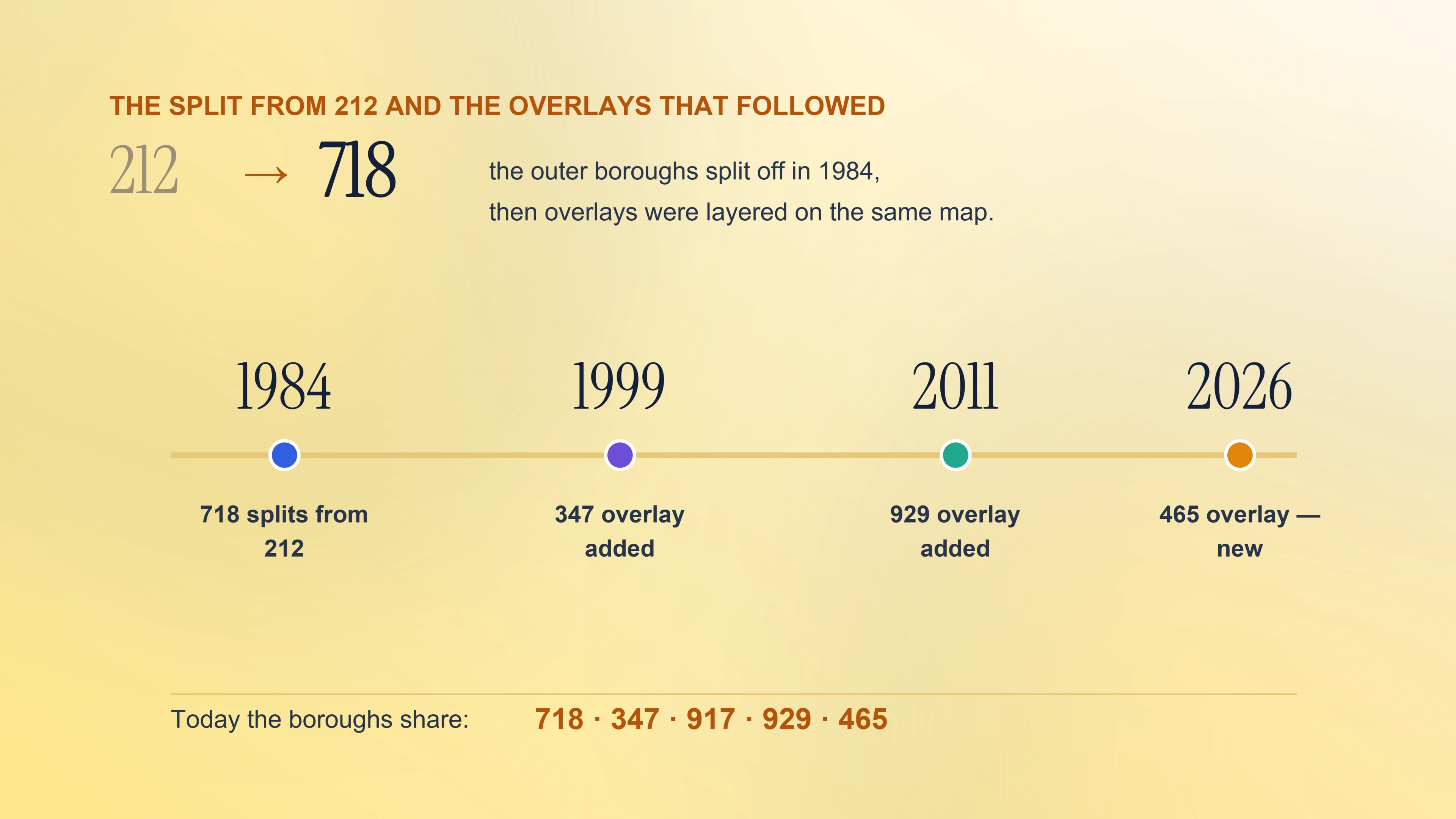
Because these later codes are overlays rather than splits, no existing 718 number ever had to change — the new codes simply supply fresh numbers within the same boroughs. The practical trade-off is ten-digit dialing: since the overlays arrived, every local call in the region must include the area code.
Ten Digits Mandatory Across the Boroughs Since 2000
The entire 718 region observes Eastern Time — UTC-5 in winter (EST) and UTC-4 during daylight saving (EDT), which runs from March to November. Because the boroughs are covered by overlay codes, mandatory ten-digit dialing has been in force since April 15, 2000, so every local call includes the area code:
- Local and regional calls: dial all ten digits — 718-555-1234.
- Long-distance from elsewhere in the U.S.: add a leading 1 — 1-718-555-1234.
- International: dial the exit code, then +1, then the number — +1 (718) 555-1234.
Benefits of a Local 718 Number for Business
A local number is one of the simplest trust signals a business can own. When a New Yorker in Brooklyn, Queens or the Bronx sees a familiar 718 number, the call reads as a neighbor rather than an out-of-town cold call.
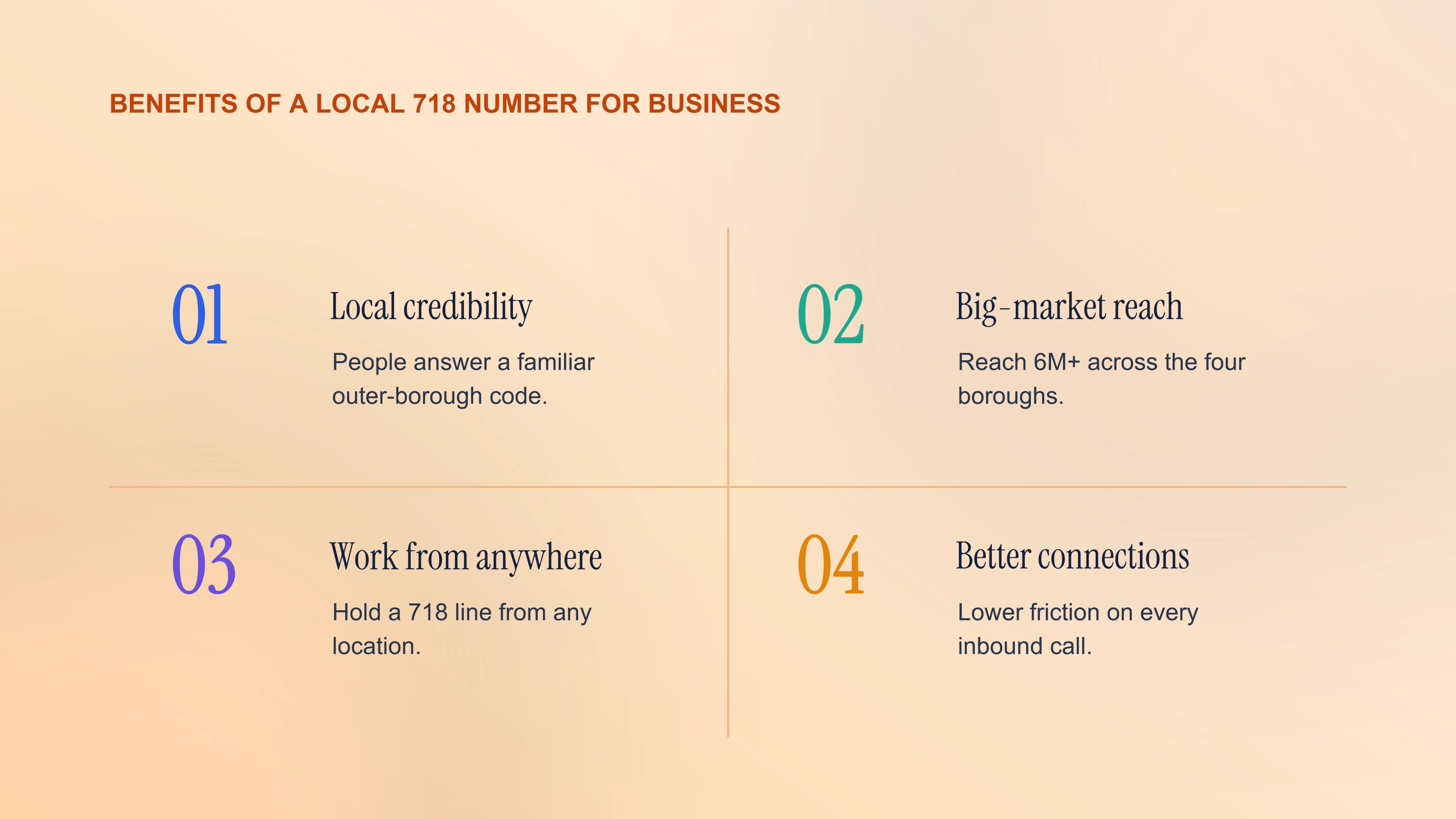
- Local credibility: a 718 number reads as a native outer-borough line rather than a Manhattan or out-of-town cold call to customers from Bay Ridge to Flushing.
- Four-borough reach: one 718 number can represent a business across Brooklyn, Queens, the Bronx and Staten Island — a combined market of more than six million people.
- Original-code seniority: 718 predates the 347, 917, 929 and incoming 465 overlays, so it still reads as the longest-standing outer-borough prefix.
- Work from anywhere: cloud calling lets a team based anywhere answer a 718 line as if they were sitting in Astoria or Riverdale.
Ready to claim a New York City presence?
Acepeak provisions local numbers with carrier-grade routing and instant activation, so a business can sound local from day one.
How to Get a 718 Phone Number
Whether it serves one Queens storefront or all four boroughs, a 718 line is set up in four steps.
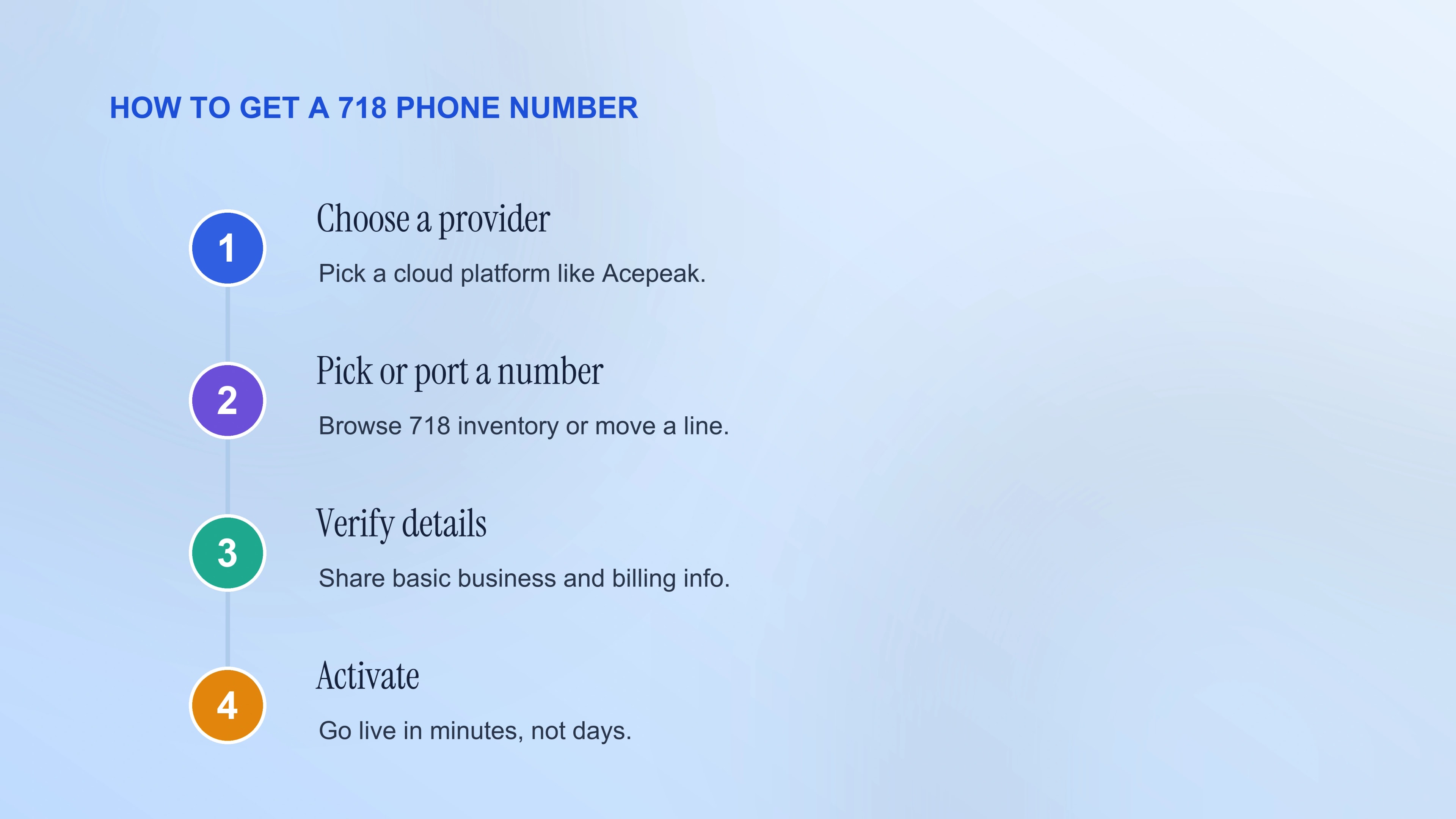
- Choose a provider: compare legacy New York carriers with cloud platforms like Acepeak that issue 718 numbers online.
- Pick or port a number: search 718 inventory across the four boroughs, or bring over an existing Brooklyn, Queens, Bronx or Staten Island line.
- Verify details: submit basic business and billing information for the account.
- Activate: cloud providers typically have outer-borough calls routing within minutes.
Reporting Spoofed Calls to the Consumer Frauds Bureau
Because a local code looks trustworthy, scammers sometimes spoof it to appear nearby. A 718 number on the caller ID still deserves the same scrutiny as any other. If a call feels suspicious, you can report it to the New York Attorney General's Consumer Frauds Bureau.
- Never share sensitive details — bank information or a Social Security number — with an unexpected caller.
- Verify urgent requests by hanging up and calling back on an official, published number.
- Use call-blocking and spam-filtering tools to screen unknown numbers.
- Report suspicious calls to your provider or the relevant authorities so others are protected.
The Future of the 718 Area Code
The outer boroughs keep generating demand for new numbers, and the answer is a fresh overlay rather than another split. Beginning June 18, 2026, a new 465 code enters service across the same Brooklyn, Queens, Bronx, Staten Island and Marble Hill territory — the first New York area code to begin with a 4. Existing customers keep their 718, 347, 917 and 929 numbers exactly as they are; 465 is simply assigned to new lines once the older codes are exhausted, and the familiar ten-digit dialing continues unchanged. The practical takeaway stays the same: a 718 number remains a recognizable, trusted local identity across all four outer boroughs.
Outer-Borough Roots, Claimable from Anywhere via the Cloud
New York City's 718 prefix is more than a routing code; it is the dial-tone identity of the outer boroughs. Born in 1984 from a split of Manhattan's original 212 territory, it has since been layered with overlays — 347, 917, 929 and soon 465 — without a single existing number ever changing. For a business, a 718 number remains one of the cheapest, most credible ways to signal New York roots — and with cloud calling, that outer-borough presence is available to anyone, anywhere.
Put a trusted New York City number to work today
Acepeak delivers local lines with smart routing, voicemail and 24/7 support — everything a business needs to stay reachable.
Questions, answered.
It serves the four outer boroughs of New York City — Brooklyn (Kings County), Queens (Queens County), the Bronx (Bronx County) and Staten Island (Richmond County) — plus the Marble Hill section of Manhattan.
It was created on September 1, 1984, when it was split from Manhattan's original 212 area code to relieve a numbering shortage. The Bronx was moved into the 718 region on July 1, 1992.
Yes. The outer boroughs originally shared Manhattan's 212 code. The New York Public Service Commission approved the split on February 1, 1984, and 718 went into service that September.
Yes — several. The 347 (1999) and 929 (2011) codes overlay the same territory, alongside the citywide 917 code, and a new 465 overlay begins service on June 18, 2026. Because of the overlays, all local calls use ten-digit dialing.
The New York City region observes Eastern Time — EST (UTC-5) in winter and EDT (UTC-4) during daylight saving time from March to November.
Yes. Cloud and hosted phone services let a business or individual hold a local 718 number from anywhere while keeping an authentic New York City identity.
Signing up for a 718 area code number takes minutes with a cloud phone provider — no local office in Brooklyn required. Pick the number, connect it to your existing phone or app, and calls route in immediately. This keeps the 718 area code presence you already have while adding the local credibility New York customers respond to.