Leafy Suburbs Just North of the New York City Line
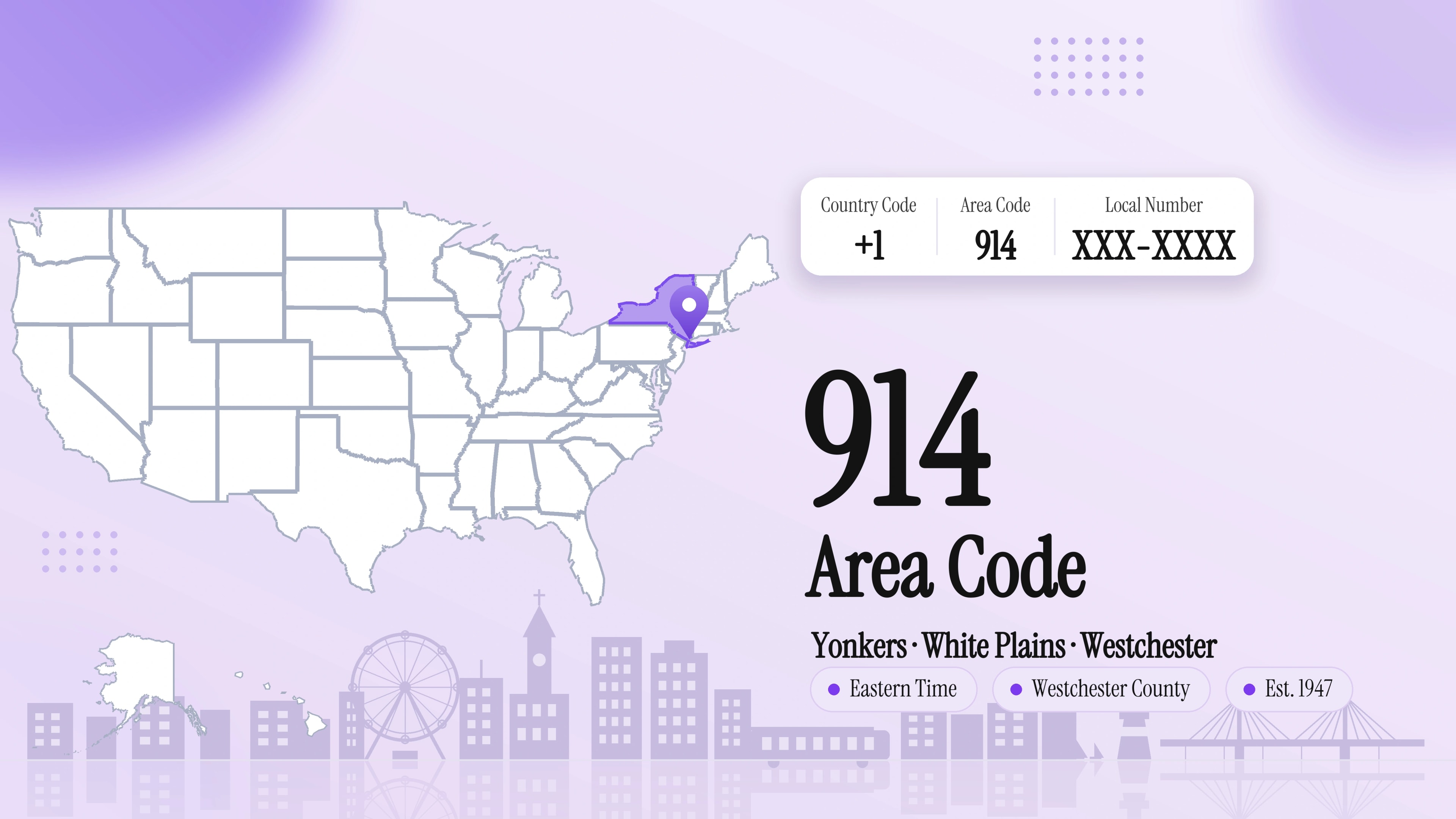
Say "914" anywhere in the New York area and people picture the same stretch of leafy suburbs just north of the city line: Yonkers rising above the Hudson, the county seat at White Plains, the Metro-North towns strung along the river from Tarrytown to Peekskill, and the Sound Shore communities of New Rochelle, Rye and Mamaroneck. This code has been Westchester's dial-tone identity for generations — one of the very first area codes in the country, and one that has slowly given up territory as the suburbs around New York filled in. This guide lays out exactly where 914 reaches today, how it was carved down from a much larger 1947 footprint, why it still has no overlay yet requires ten-digit dialing, the Eastern time zone, and how any business can claim a local Westchester presence with a number of its own.
Key Takeaways
- The 914 area code covers Westchester County, New York — the affluent suburban county just north of New York City — including Yonkers, White Plains, New Rochelle, Mount Vernon, Peekskill, Rye and Tarrytown.
- It is one of the original 86 area codes assigned in 1947, when a single 914 covered the whole ring of New York City suburbs outside the five boroughs.
- The code has shrunk twice: Long Island split off as area code 516 in 1951, and the Hudson Valley became the new 845 on June 5, 2000, leaving 914 to Westchester alone.
- There is no overlay — 914 remains a single code for the county — but ten-digit dialing has been required since October 24, 2021, when 988 was reserved as the national Suicide and Crisis Lifeline.
- A 914 number carries real New York-suburb prestige; because the code dates to 1947, an established 914 line reads as long-rooted and credible for any business serving Westchester.
What Is the 914 Area Code?
The 914 prefix is the telephone identity of Westchester County, the wealthy, densely settled suburban county immediately north of New York City. It is a geographic code with a defined territory — no longer the sprawling suburban ring it once was, but the single county that kept the original number when the rest split away. The same pattern shows up around other big cities: the fast-growing West Valley suburbs of Phoenix carry their own 623 area code, a single code standing in for a metro's suburban ring rather than its downtown core.
Because Westchester sits right on New York City's doorstep, a 914 number reads as unmistakably local-but-not-city — suburban, established and close to Manhattan without being of it. To a customer in Yonkers, White Plains or New Rochelle it looks like a genuine neighbor on the caller ID rather than an out-of-town cold call, a small but real credibility signal for any business working the county.
One County, Close to a Million People
The 914 code now maps to a single county — Westchester — but that county packs close to a million people into the towns, small cities and villages spread between the Hudson River and the Connecticut line. It is anchored by a handful of well-known communities rather than one dominant metro. The major places include:
- Yonkers (population around 210,000) — the largest city in Westchester and the third-largest in New York State, hugging the Hudson just above the Bronx
- White Plains — the county seat and its commercial and legal center, a compact downtown of offices and retail
- New Rochelle, Mount Vernon and Rye — the Sound Shore cities along Long Island Sound on the county's southeastern edge
- Peekskill and Ossining — the northern Hudson River communities, with Ossining home to the historic Sing Sing correctional facility
- Tarrytown and Sleepy Hollow — the storied river villages of Washington Irving country, gateways across the Mario M. Cuomo (Tappan Zee) Bridge
- Scarsdale, Chappaqua, Bronxville and Mamaroneck — the affluent commuter suburbs that give the 914 code much of its reputation
Together these communities make Westchester one of the most prosperous and heavily commuted counties in the country — enough demand, historically, that the original 914 had to shed territory more than once.
No Overlay, Yet Ten Digits Required Since October 2021
The whole 914 region runs on Eastern Time — UTC-5 in winter (EST) and UTC-4 in summer (EDT) — the same clock as New York City, Boston and the rest of the Northeast corridor. There is no time-zone split to worry about anywhere in Westchester. Dialing, however, changed a few years ago: even though 914 has no overlay, ten-digit dialing is now required, so every local call needs the area code:
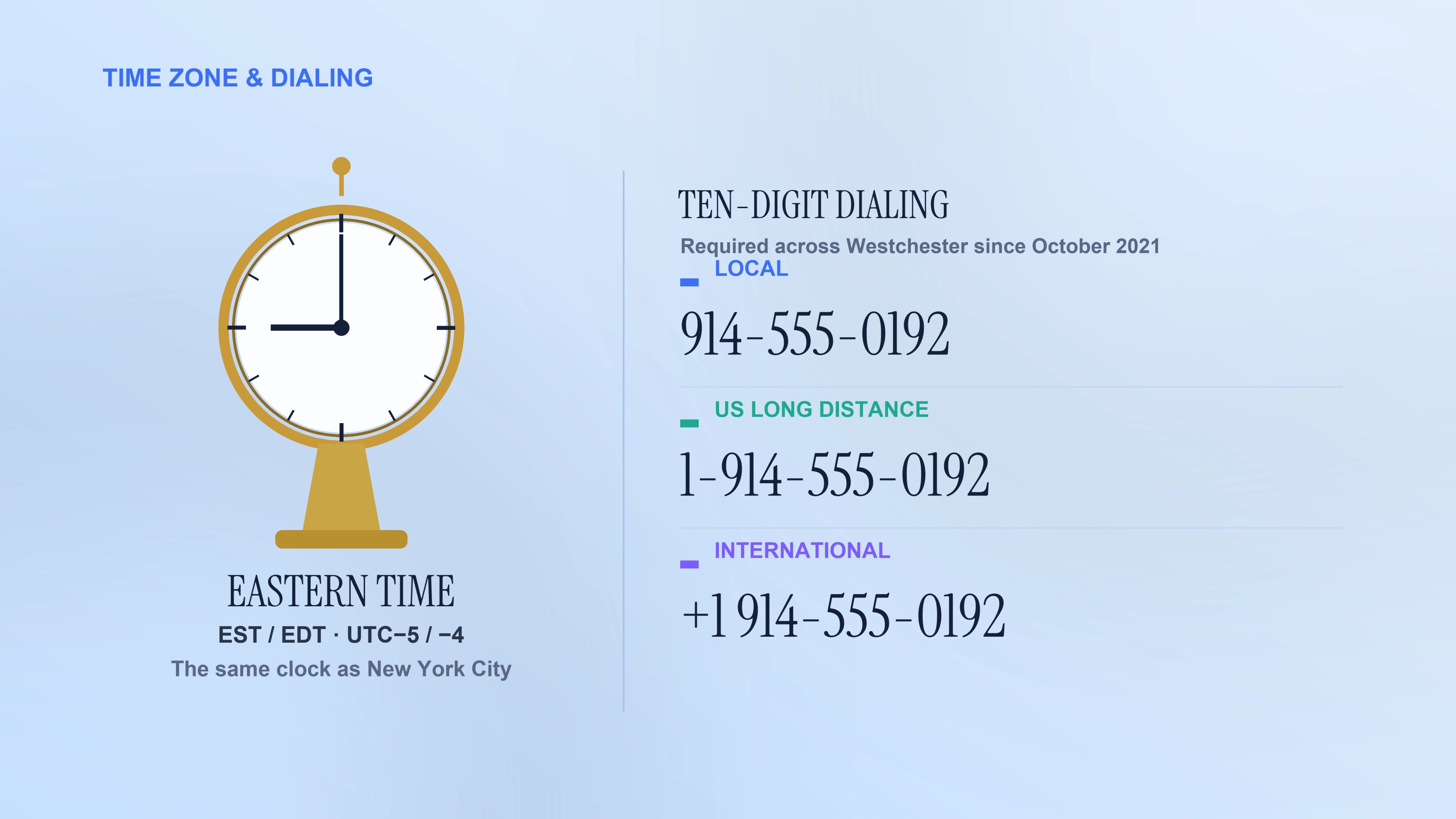
- Local calls within Westchester: dial all ten digits — 914-555-0192 — which has been required since October 2021.
- Long-distance from elsewhere in the U.S.: add a leading 1 — 1-914-555-0192.
- International: dial your country's exit code, then +1, then the number — +1 (914) 555-0192.
- Why ten digits without an overlay: when 988 was set aside as the national crisis line, area codes that still allowed seven-digit dialing — 914 among them — had to switch to ten digits so 988 could work everywhere.
How 914 Shrank to Westchester
When the North American numbering plan launched in 1947, 914 was one of the first 86 area codes, and it covered a huge arc of New York suburbs — everything around New York City except the five boroughs, which took 212. That footprint proved far too big for one code as the postwar suburbs boomed. In 1951, Long Island's Nassau and Suffolk counties broke away as area code 516. Then, on June 5, 2000, the entire Hudson Valley — Rockland, Orange, Putnam, Dutchess, Ulster, Sullivan and beyond — was split off as the new 845, leaving 914 with only Westchester. Splits reshaped many area codes the same way; West Texas's 432 area code was itself carved from a larger neighbor, splitting off from 915 in 2003.
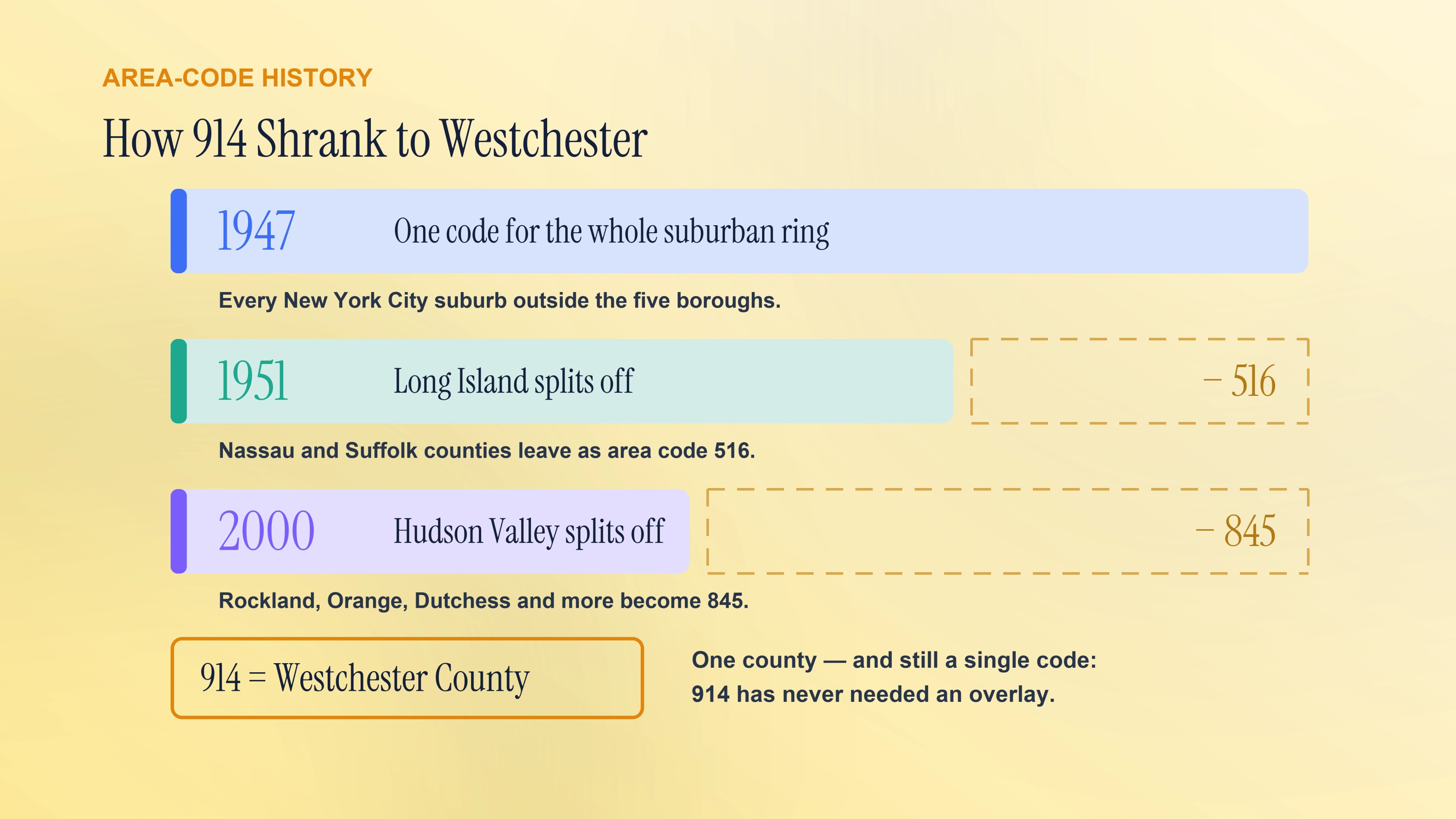
What is unusual is what did not happen next. Neighboring New York City codes filled up and took overlays — 917, 646, 332 — and the Hudson Valley's 845 later gained the 329 overlay. Westchester's 914, by contrast, has never been overlaid; it is still a single code serving a single county. That makes an original, un-overlaid 914 number an increasingly rare thing in the crowded New York market — even as the 988 rule brought the county in line with everyone else on ten-digit dialing.
Benefits of a Local 914 Number for Business
A local number is one of the simplest trust signals a business can own, and in a county as brand-conscious as Westchester, a 914 line carries real weight. When a customer in Yonkers, White Plains or Scarsdale sees a 914 number calling, it reads as an established neighbor rather than an out-of-state stranger.
- Local credibility: callers in Yonkers, White Plains, and the Sound Shore cities of New Rochelle and Rye see a familiar 914 code, not an out-of-county number.
- One of New York's rarest codes: because 914 has never been overlaid since the 845 split in 2000, a genuine 914 line still reads as scarce and long-established.
- Commuter-suburb reach: a single 914 number covers county seat White Plains and the affluent Scarsdale-Chappaqua-Bronxville corridor without separate local lines.
- Work from anywhere: cloud provisioning lets a business keep its Westchester identity while operating outside the county entirely.
Ready to claim a Westchester presence?
Acepeak provisions local numbers with carrier-grade routing and instant activation, so a business can sound local from day one.
How to Get a 914 Phone Number
Securing a 914 number is straightforward, whether a business is based in Westchester or simply wants a foothold in the New York suburbs.
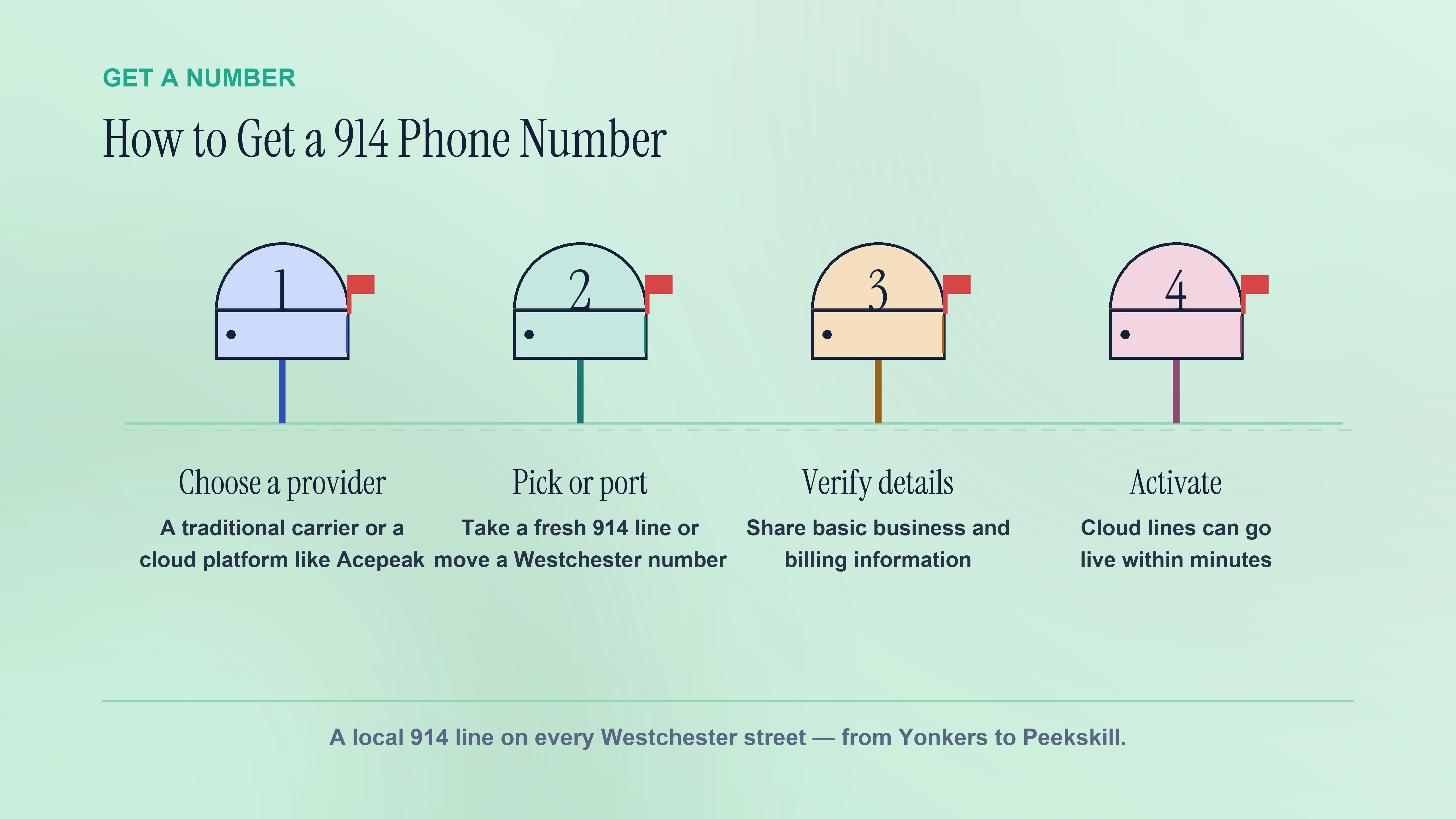
- Choose a provider: pick a carrier or cloud platform that lists Westchester-area 914 inventory rather than the neighboring 845 Hudson Valley code.
- Pick or port a number: browse open 914 numbers across the county's remaining supply, or transfer a Yonkers or White Plains line you already hold.
- Verify details: because 914 has never taken an overlay, providers confirm business and billing information before releasing a number from its single, finite pool.
- Activate: go live with ten-digit dialing already built in, the format required across Westchester since the 2021 988 rule change.
Spotting and Avoiding 914 Scam Calls
The reputation that makes a 914 line valuable also attracts impostors, who can put those digits on a caller ID for next to nothing. A call that seems to come from White Plains or Yonkers may start far from Westchester, so give it the skepticism you would give any unknown number, whether the caller claims a utility, a bank, or a New York state agency.
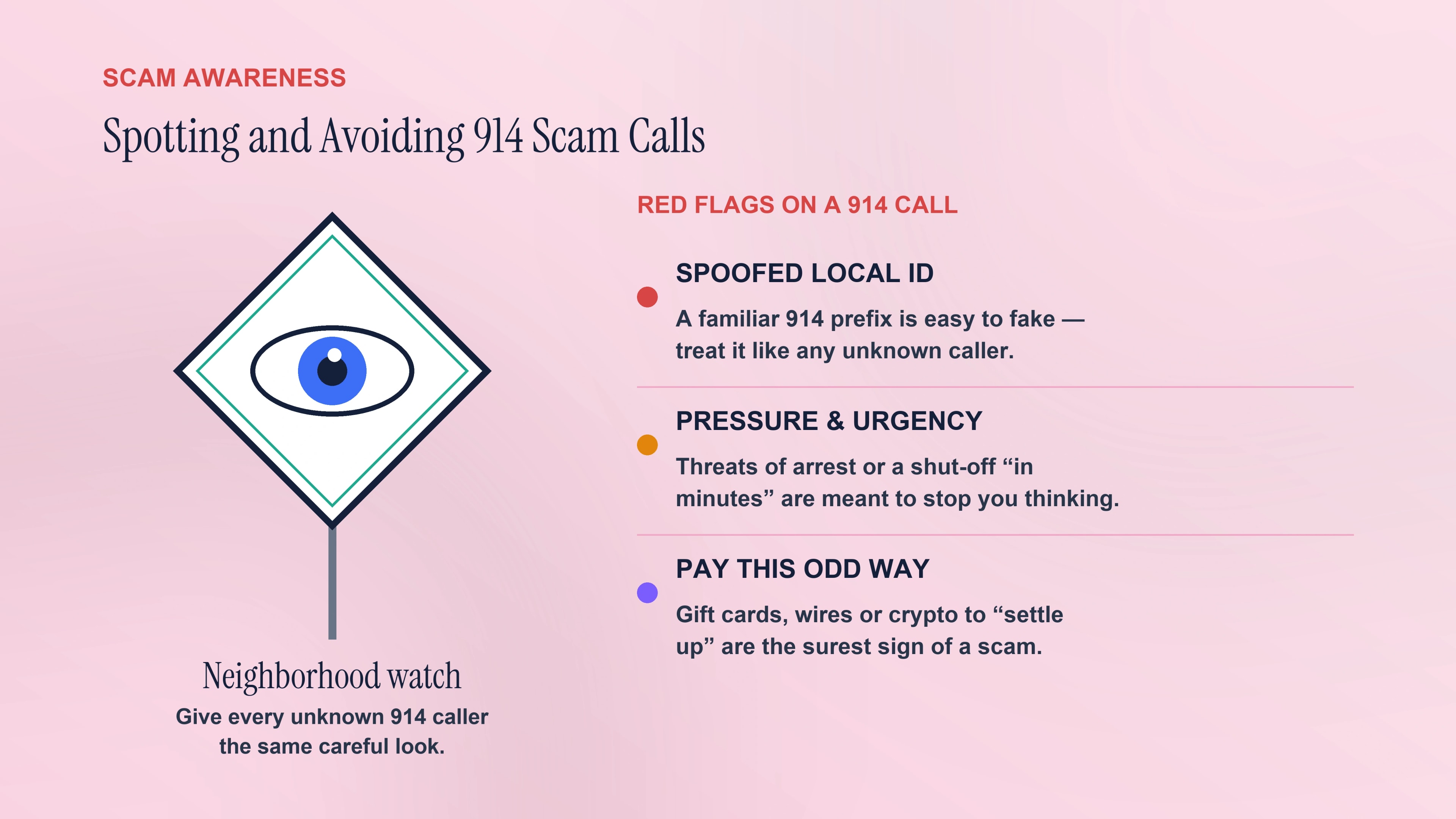
- Never share sensitive details — bank information or a Social Security number — with an unexpected caller.
- Verify urgent requests by hanging up and calling back on an official, published number.
- Use call-blocking and spam-filtering tools to screen unknown numbers.
- Report suspicious calls to your provider or the relevant authorities so others are protected.
The Future of the 914 Area Code
Westchester keeps growing and reinvesting, and its numbering plan has quietly kept pace without a single overlay. Yonkers, the county's largest city, keeps redeveloping its downtown and Hudson River waterfront, drawing new housing and business to the riverfront in recent years, while the City of White Plains anchors the county's office economy and the river towns draw steady demand. Because 914 never needed a second code, an original Westchester number remains both scarce and prized. The code will keep its cachet: across the New York suburbs, a 914 line quietly signals a business that has been rooted here for the long haul.
A Rare Un-Overlaid Number in a Crowded New York Market
New York's 914 prefix is more than a routing code; it is the shared dial-tone identity of Westchester County, from the Yonkers waterfront and the White Plains business district to the Sound Shore cities and the Hudson River villages of Sleepy Hollow country. One of the original codes of 1947, trimmed by the 516 split in 1951 and the 845 split in 2000, it has ended up meaning one specific, well-known thing: the affluent suburbs just north of New York City. For a business, a 914 number remains one of the cheapest, most credible ways to signal roots in Westchester — and with cloud calling, that presence is available to anyone, anywhere.
Put a trusted Westchester number to work today.
Acepeak delivers local lines with smart routing, voicemail and 24/7 support — everything a business needs to stay reachable.
Questions, answered.
It serves Westchester County, New York — the suburban county directly north of New York City — including Yonkers, White Plains, New Rochelle, Mount Vernon, Peekskill, Rye and Tarrytown.
It was one of the original 86 area codes assigned in 1947. At the time it covered the entire ring of New York City suburbs outside the five boroughs, a far larger area than it does today.
They were once the same code. On June 5, 2000, the Hudson Valley portion of the old 914 — Rockland, Orange, Putnam, Dutchess, Ulster, Sullivan and neighboring counties — split off as the new 845, leaving 914 to cover only Westchester County.
No. Unlike many New York codes, 914 has never been overlaid and remains a single area code for Westchester County. The 329 overlay applies to the neighboring 845 region, not to 914.
Yes. Even though 914 has no overlay, ten-digit dialing has been required for local calls since October 24, 2021, after 988 was reserved as the national Suicide and Crisis Lifeline.
Yes. Cloud and hosted phone services let a business or individual hold a local 914 number from anywhere while keeping an authentic Westchester, New York identity.
Signing up for a 914 area code number takes minutes with a cloud phone provider — no local office in Westchester County required. Pick the number, connect it to your existing phone or app, and calls route in immediately. This keeps the 914 area code presence you already have while adding the local credibility New York customers respond to.