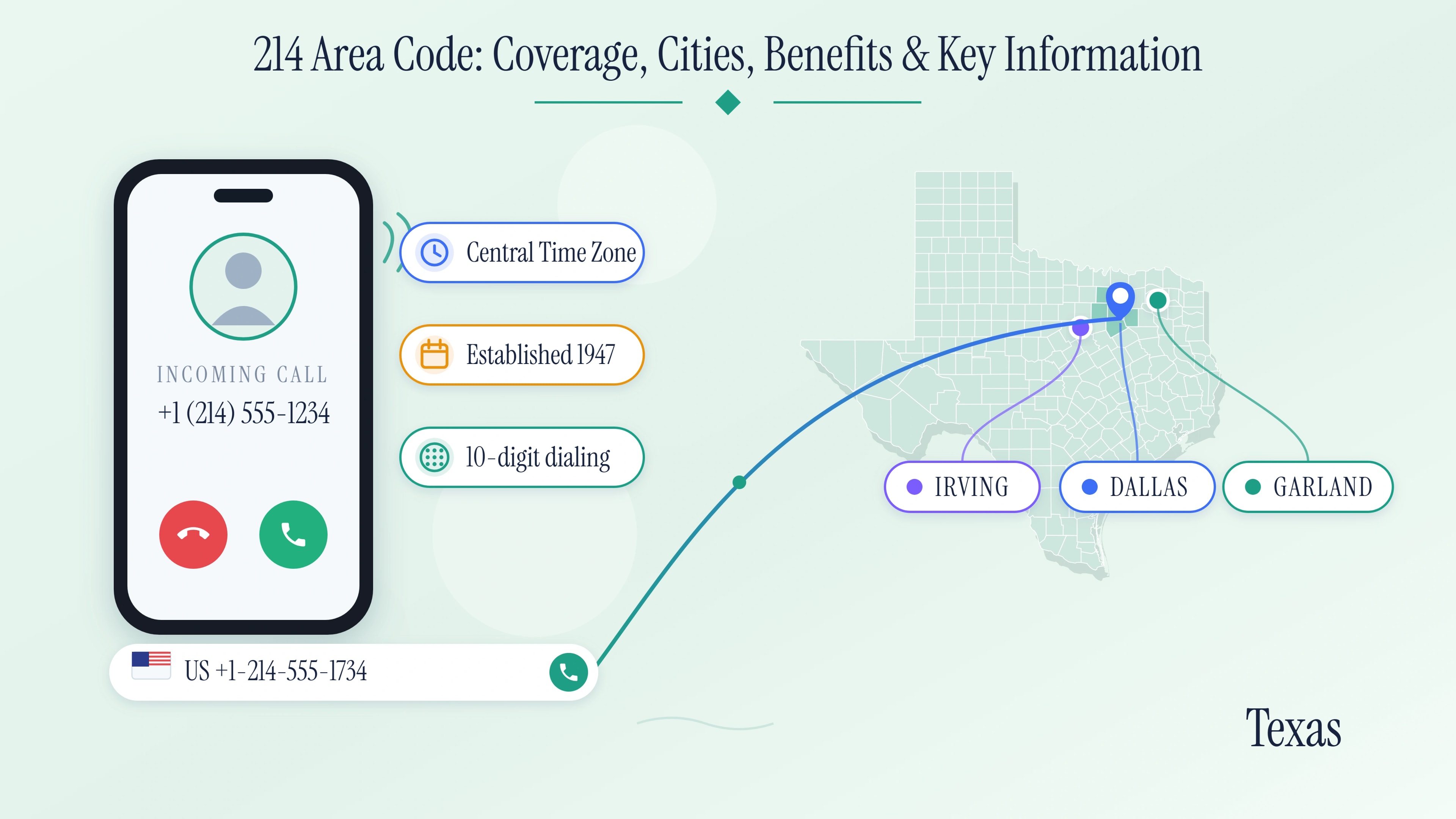
Deep Dallas Roots From the First Wave of Area Codes
Few three-digit codes carry as much local weight as 214. Say it anywhere in North Texas and people picture the same place: Dallas — the glass-tower skyline, the sprawling eastern half of the Dallas-Fort Worth Metroplex, and one of the fastest-growing economies in the country. For more than seventy-five years this code has been the dial-tone identity of the city, and because it dates to the very first wave of area codes, a 214 number still signals deep Dallas roots. This guide lays out exactly where 214 reaches today, why it is so prestigious, how the overlays reshaped the region, and how any business can claim a local Dallas presence with a number of its own.
Key Takeaways
- The 214 prefix is the original area code of Dallas and the eastern half of the Dallas-Fort Worth Metroplex, anchored by Dallas County and reaching into Collin, Denton, Rockwall, Kaufman and Ellis counties.
- It is one of the 1947 originals — among the very first batch of North American area codes AT&T assigned when direct long-distance dialing began — which gives a 214 number a rare, prestigious pedigree.
- As the metro boomed, three younger codes were layered onto the same territory: 972 arrived in 1996, 469 was overlaid in 1999, and 945 followed in 2021 — turning eastern DFW into a four-code overlay.
- Because several codes share one footprint, ten-digit dialing has been mandatory across the region since 1999 — every local call must include the area code.
- The area sits in the Central Time Zone, and a 214 number remains one of the most recognizable, sought-after local identities in Texas — a genuine advantage for any business courting the Dallas market.
What Is the 214 Area Code?
The 214 prefix is the principal area code for Dallas and the eastern portion of the Dallas-Fort Worth Metroplex. It is a geographic code with unmatched roots — it was assigned in 1947 as one of the original North American area codes, back when AT&T first divided the continent into numbering plan areas for direct long-distance dialing. On the western side of the same metroplex sits Fort Worth with its own 817 identity, while Dallas itself now shares its map with three overlay codes, the oldest of which is the 469 area code.
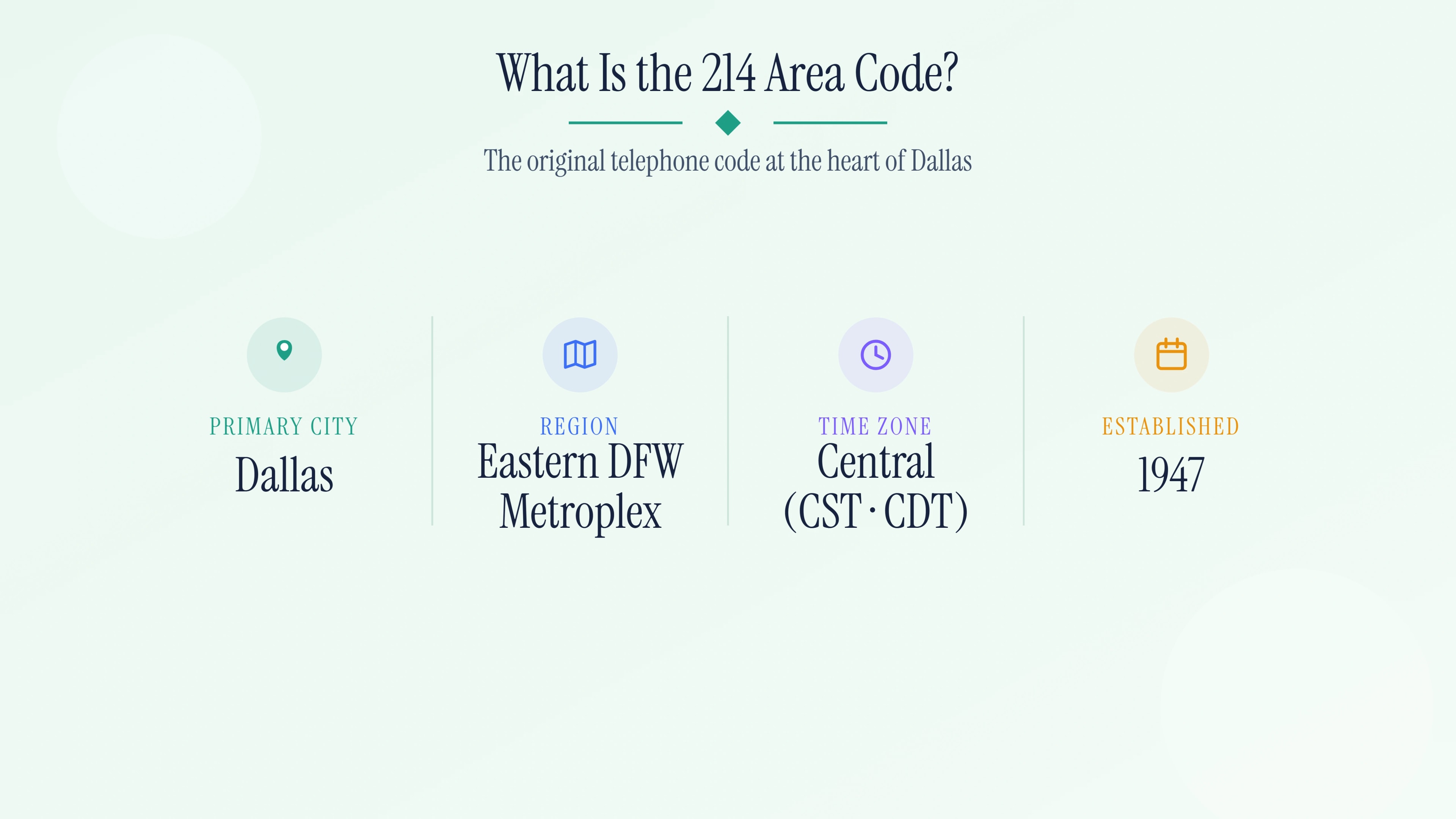
Because it covers Dallas proper plus the dense ring of suburbs across Dallas County, a 214 number reads as unmistakably local. To a customer in Plano, Richardson or Garland, it looks like a neighbor on the caller ID rather than a stranger from out of state — and because 214 is the oldest code in the region, it carries an extra note of established, been-here-forever credibility.
Dallas County and the Suburbs From Plano to Waxahachie
The 214 code is centered on Dallas County and spreads into the surrounding counties of Collin, Denton, Rockwall, Kaufman and Ellis, with a sliver reaching into eastern Tarrant County. It blankets the eastern side of the metroplex, where downtown Dallas gives way to a continuous run of fast-growing suburbs. The major communities include:
- Dallas — the heart of the code and the ninth-largest city in the United States, home to downtown, Deep Ellum and a booming corporate corridor
- Plano, Richardson, McKinney, Frisco and Allen — the affluent, tech-heavy northern suburbs of Collin and Denton counties
- Irving, Garland, Mesquite, Carrollton and Grand Prairie — the dense inner ring circling Dallas proper
- Rockwall, Rowlett, Waxahachie, Ennis and Cedar Hill — the outer towns spreading into Rockwall, Kaufman and Ellis counties
It is a large and still-expanding territory — a revitalized urban core, master-planned suburbs filling in to the north, and corporate campuses drawing new residents by the thousands every month. That relentless growth is exactly why a single area code could not hold the whole region forever.
The 972, 469 and 945 Overlays
For nearly fifty years, 214 covered the Dallas region on its own. But as the Metroplex exploded through the 1990s — and pagers, fax lines and the first wave of cellphones drained the number pool — relief became unavoidable. In 1996, regulators introduced 972, initially splitting it off to cover the suburban ring while Dallas kept 214, then quickly reconfiguring it as an overlay so both codes blanketed the same map. Three years later, on July 1, 1999, the 469 code was overlaid across the identical territory. Most recently, in January 2021, 945 was added as a fourth overlay. Together they turned eastern DFW into one of the most number-dense regions in Texas — a stark contrast to nearby single-code regions like Fort Worth's neighbor, the 817 area code, on the western side of the metroplex.
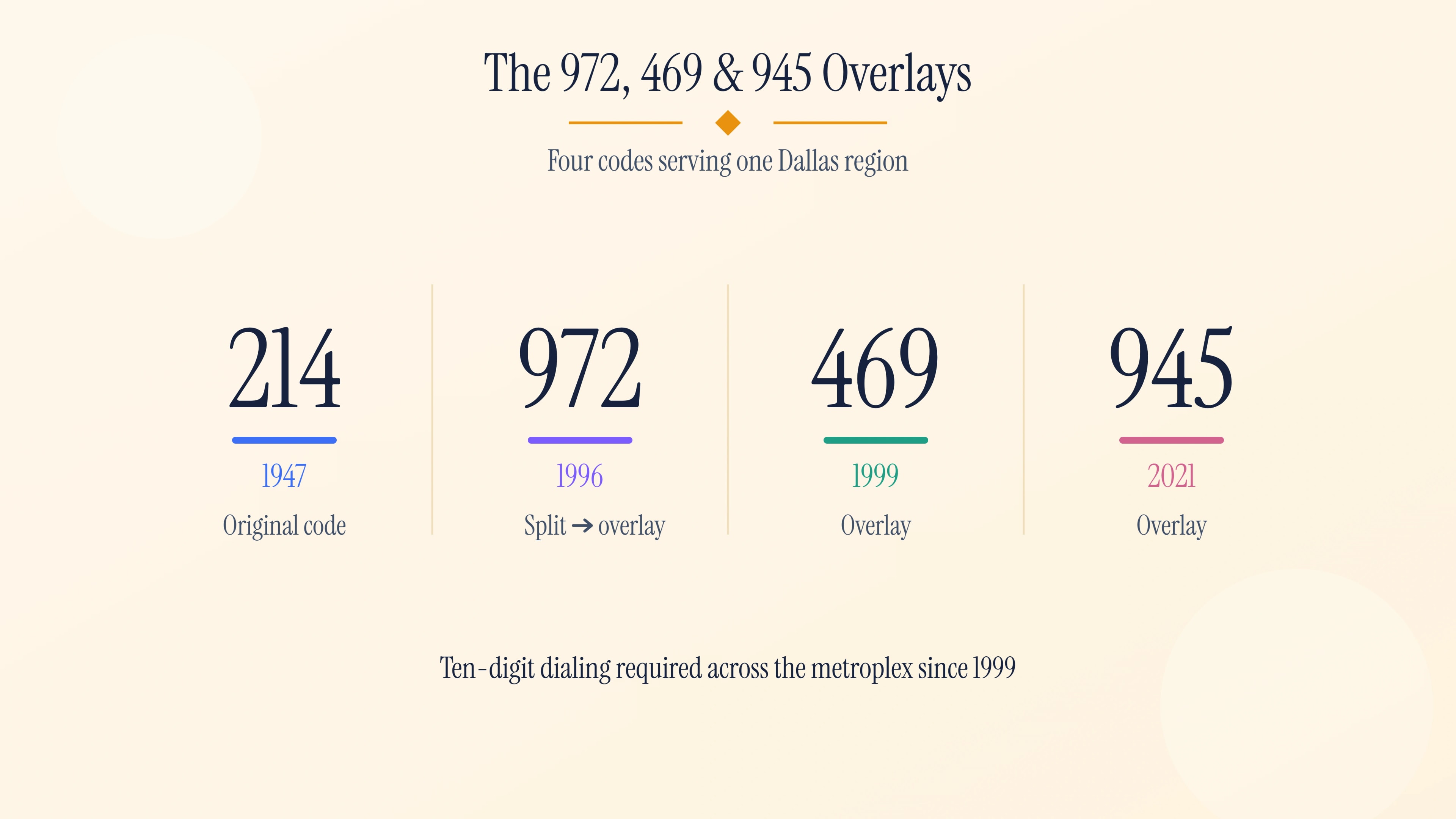
Because these codes share one footprint rather than dividing it, nobody in Dallas ever had to give up a 214 number — the overlays simply added new codes to the same region. The trade-off was ten-digit dialing: with multiple codes stacked on one map, every local call has had to include the area code since 1999.
Central Time and Mandatory Ten-Digit Dialing in Dallas
The entire 214 region observes Central Time — UTC-6 in winter (CST) and UTC-5 during daylight saving (CDT), which runs from March to November. Because Dallas has shared its territory with overlay codes since the 1990s, ten-digit dialing is mandatory for every local call:
- Local and regional calls: dial all ten digits — 214-555-1234.
- Long-distance from elsewhere in the U.S.: add a leading 1 — 1-214-555-1234.
- International: dial the exit code, then +1, then the number — +1 (214) 555-1234.
Benefits of a 214 Number for Business
A local number is one of the simplest trust signals a business can own. When a Dallas-area customer sees a familiar 214 number, the call reads as a neighbor rather than an out-of-state cold call — and the code's original-1947 pedigree only adds to the impression of an established, rooted business.
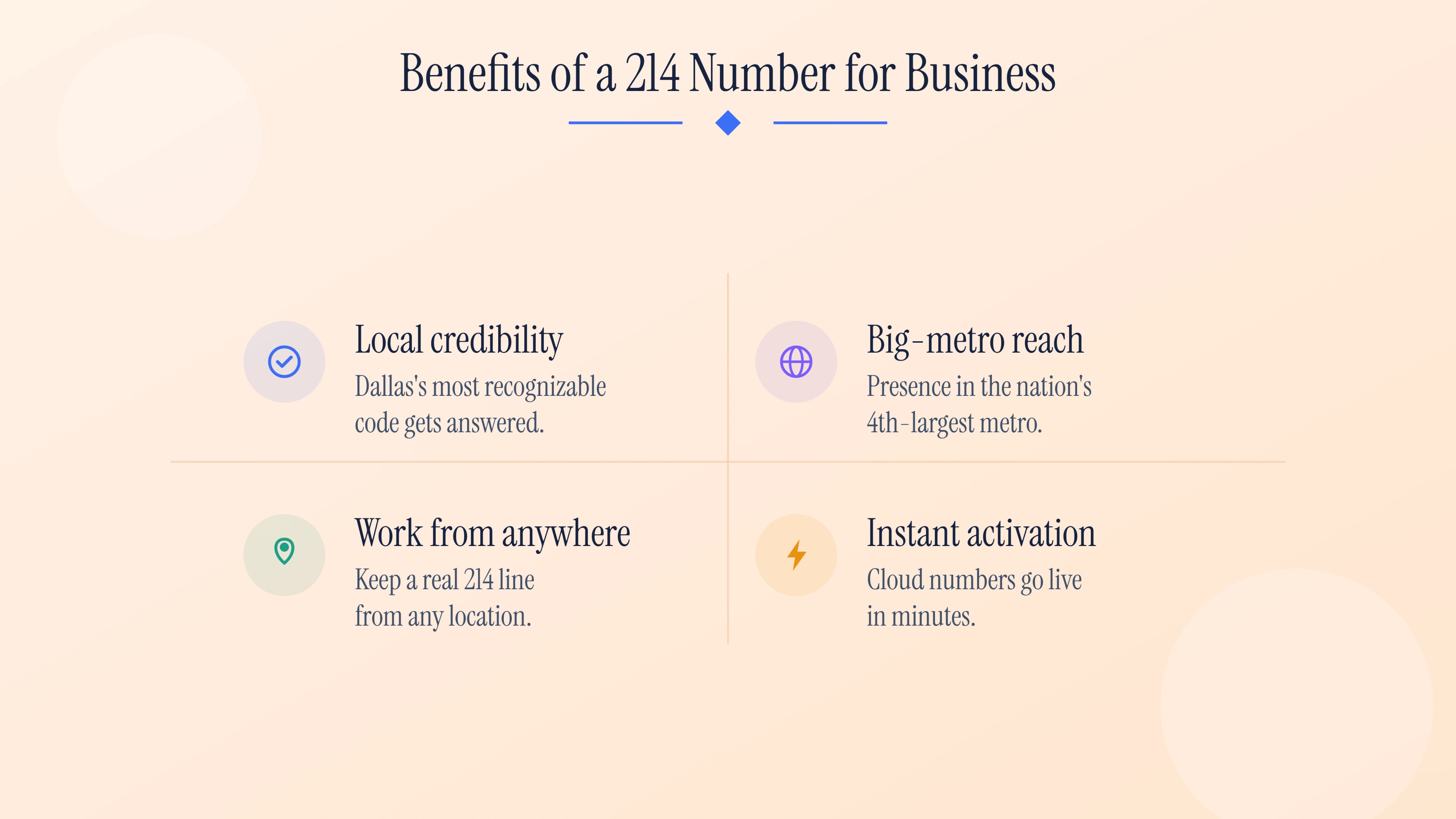
- Original-code prestige: a 214 number carries the same 1947 pedigree Dallas has traded on for generations, signaling an established business rather than a newly arrived one.
- Deep Ellum and downtown credibility: the code reads as native to Dallas's corporate corridor and revitalized urban core, not a suburb calling in from outside.
- Northern-suburb recognition: customers in Plano, Frisco and McKinney answer a 214 call the same way they would a neighbor's, even as most local suburbs now dial out on 972 or 469.
- A scarce number that still travels: cloud calling lets a company keep its original 214 line working from anywhere, carrying the prestige of the country's fourth-largest metro wherever the team sits.
Ready to claim a Dallas presence?
Acepeak provisions local numbers with carrier-grade routing and instant activation, so a business can sound local from day one.
How to Get a 214 Phone Number
Because 214 is the region's oldest and most in-demand code, fresh inventory is scarcer than for the newer overlays — but a local Dallas line is still straightforward to secure, whether for a single number or a full team.
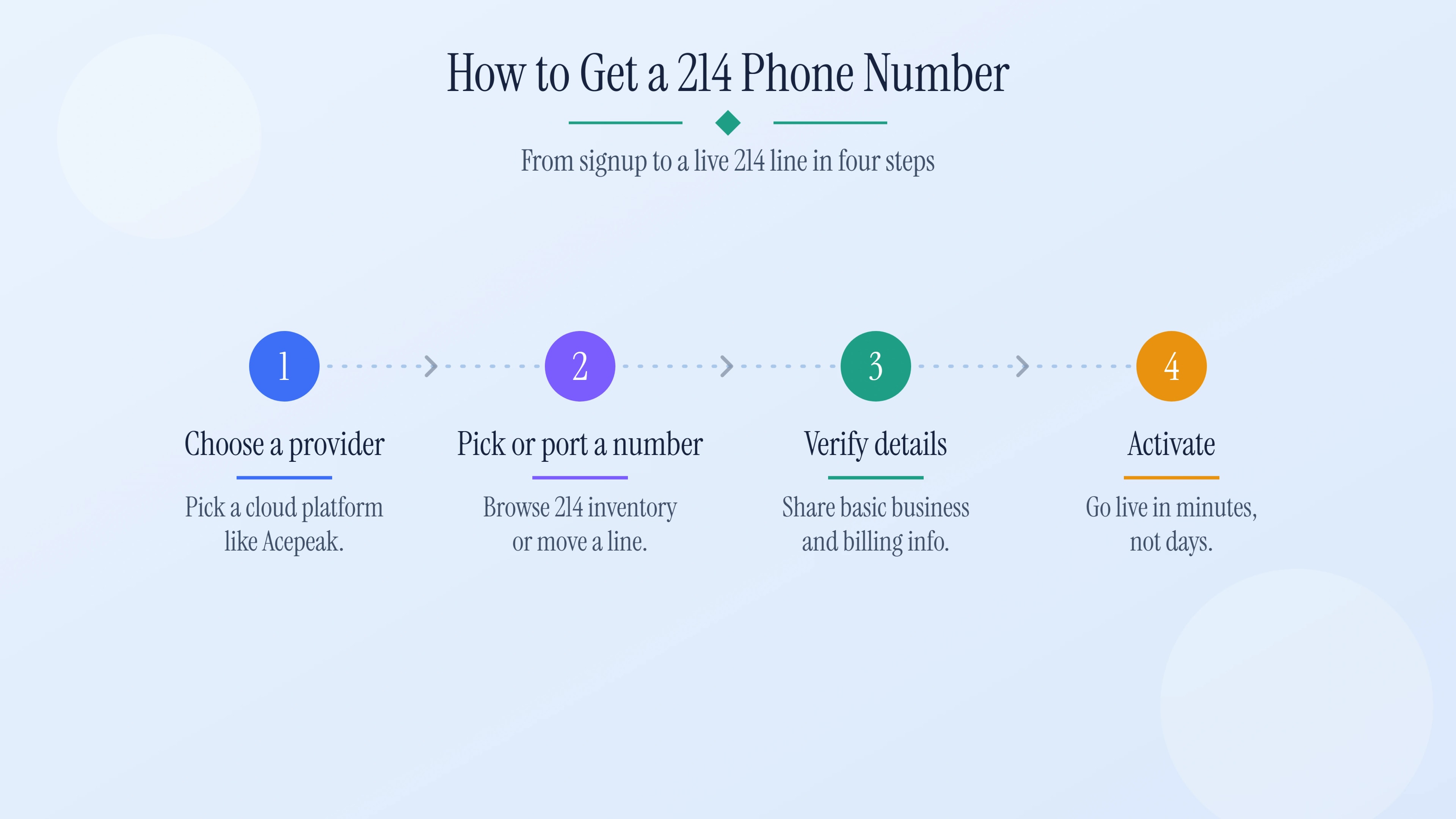
- Choose a provider: options range from traditional carriers to cloud platforms that track 214's limited remaining inventory alongside the newer 972, 469 and 945 overlays.
- Pick or port a number: browse whatever original 214 prefixes remain available, or transfer an existing Dallas line to keep the number you already have.
- Verify details: provide basic business and billing information tied to your Dallas service area.
- Activate: cloud providers often go live in minutes rather than days, even for a scarcer original-code number.
When a Familiar Dallas Caller ID Deserves a Second Look
The pedigree that makes a 214 caller ID feel safe is also why fraudsters fake it, dressing calls up as a Dallas neighbor in Plano or Garland. An unexpected 214 call earns the same caution as any unknown number.
- Never share sensitive details — bank information or a Social Security number — with an unexpected caller.
- Verify urgent requests by hanging up and calling back on an official, published number.
- Use call-blocking and spam-filtering tools to screen unknown numbers.
- Report suspicious calls to the provider or the relevant authorities so others are protected.
The Future of the 214 Prefix
Dallas is one of the fastest-growing large metros in the United States, so demand for numbers in the region will only keep rising. Future relief will almost certainly come through additional overlays rather than any split, which leaves every existing 214 number untouched — the code's scarcity is exactly what keeps it prestigious. Residents and businesses are already long accustomed to ten-digit dialing, so a new code would simply join the same pool. For anyone tired of unwanted calls in the meantime, the National Do Not Call Registry helps cut telemarketing to any 214 line. The practical takeaway is unchanged: a 214 number remains the most recognizable, trusted local identity in Dallas.
The Original Dallas Number Through Three Overlays
Dallas's 214 prefix is more than a routing code; it is a badge of the city's history. Assigned in 1947 among the first area codes ever created, it has been joined over the decades by the 972, 469 and 945 overlays, yet it has never lost its standing as the original — and most coveted — Dallas number. For a business, a 214 number remains one of the cheapest, most credible ways to signal local roots — and with cloud calling, that Dallas presence is available to anyone, anywhere.
Put a trusted Dallas number to work today
Acepeak delivers local lines with smart routing, voicemail and 24/7 support — everything a business needs to stay reachable.
Questions, answered.
It serves Dallas and the eastern half of the Dallas-Fort Worth Metroplex in north Texas — centered on Dallas County and reaching into Collin, Denton, Rockwall, Kaufman and Ellis counties, with a small portion of eastern Tarrant County.
It was established in 1947 as one of the original North American area codes — among the very first batch AT&T assigned when nationwide direct-dial long distance began, which makes it one of the oldest codes in Texas.
Three younger codes share the same territory: 972 (introduced in 1996), 469 (overlaid on July 1, 1999) and 945 (added in January 2021). Together with 214 they form a four-code overlay across eastern DFW.
Yes. Because multiple area codes share one geographic region, ten-digit dialing has been mandatory for every local call since 1999 — you must include the area code even for a call across the street.
The Dallas region observes Central Time — CST (UTC-6) in winter and CDT (UTC-5) during daylight saving time from March to November.
Yes. Cloud and hosted phone services let a business or individual hold a local 214 number from anywhere while keeping an authentic Dallas identity, though 214 inventory is scarcer than the newer 469 or 945 codes.
Signing up for a 214 area code number takes minutes with a cloud phone provider — no local office in Dallas required. Pick the number, connect it to your existing phone or app, and calls route in immediately. This keeps the 214 area code presence you already have while adding the local credibility Texas customers respond to.