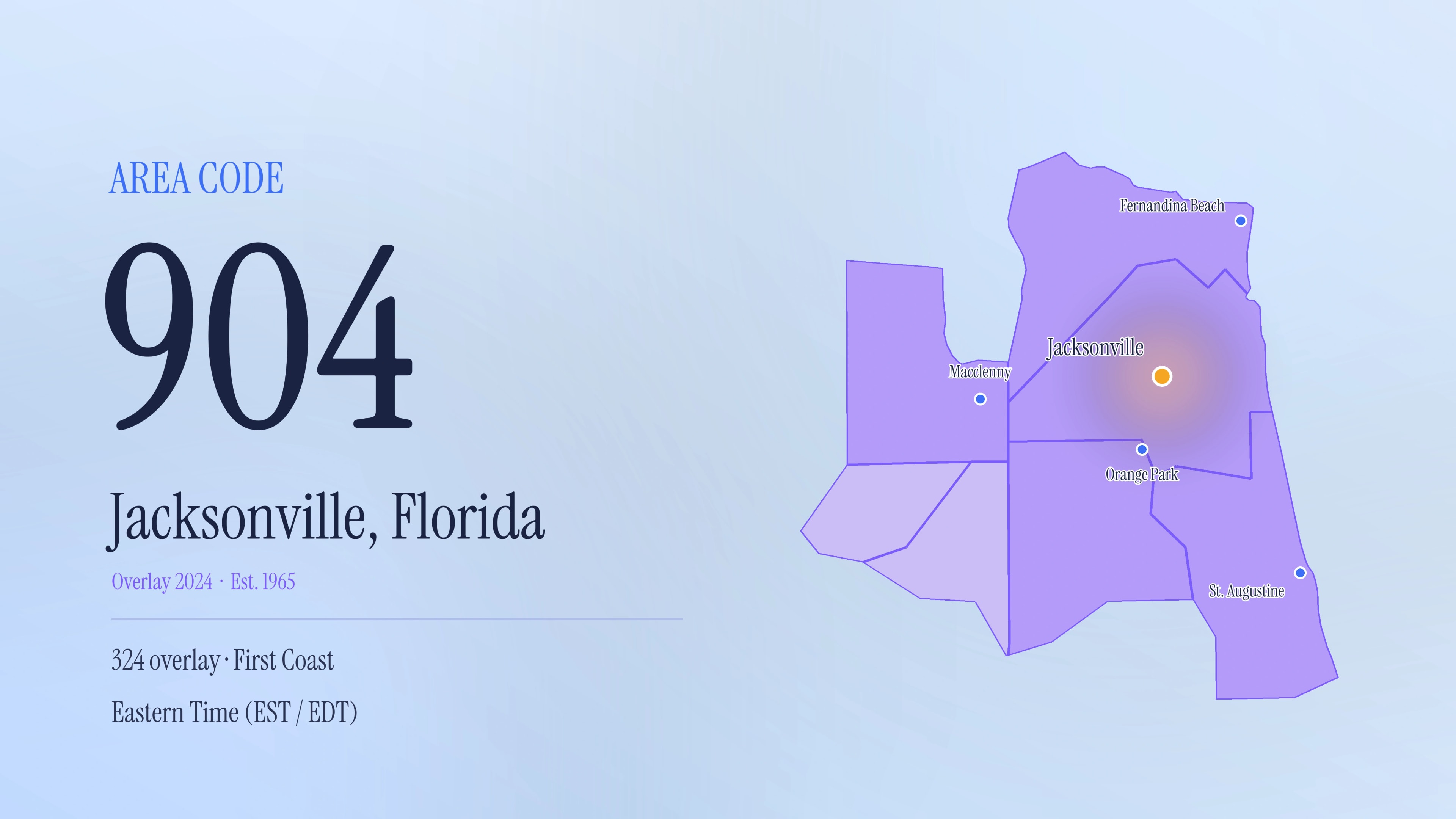
Jacksonville, the Beaches and Historic St. Augustine
Say "904" anywhere in northeast Florida and people picture the same stretch of coast: Jacksonville, the beaches, historic St. Augustine and the fast-growing suburbs of the First Coast. For sixty years this code has been the dial-tone identity of a region that grew from a river port into the most populous city in Florida by land area and one of the largest on the Atlantic seaboard. This guide lays out exactly where 904 reaches today, how it was created and later reshaped, the new overlay that brought ten-digit dialing, and how any business can claim a local Jacksonville presence with a number of its own.
Key Takeaways
- The 904 prefix is the signature area code of Jacksonville and Florida's First Coast, anchored by Duval County and reaching across Nassau, Baker, St. Johns and most of Clay county in the northeast corner of the state.
- It was created in 1965, when Florida's original 305 code was split and the northern half of the state — including Jacksonville — was assigned 904.
- Over the decades the territory was trimmed repeatedly, spinning off 352 in 1995, 850 in 1997 and 386 in 2001, until 904 settled onto the Jacksonville metro and the First Coast.
- A new code, 324, was overlaid across the same region: mandatory ten-digit dialing began on January 29, 2024, and 324 numbers entered service on February 26, 2024 — no existing 904 number changed.
- The area sits in the Eastern Time Zone, and a local 904 number still reads as authentically Jacksonville — a place so attached to the code that residents rally around the phrase "904ever."
What Is the 904 Area Code?
The 904 prefix is the principal area code for Jacksonville and the First Coast of northeast Florida. It is a geographic code with deep roots — unlike an overlay that simply layers onto an existing region, 904 has its own defined territory that it has held, in one form or another, since 1965. Like California's 661 area code, it is a geographic code with a single, well-defined home territory rather than an overlay scattered across another region's map.
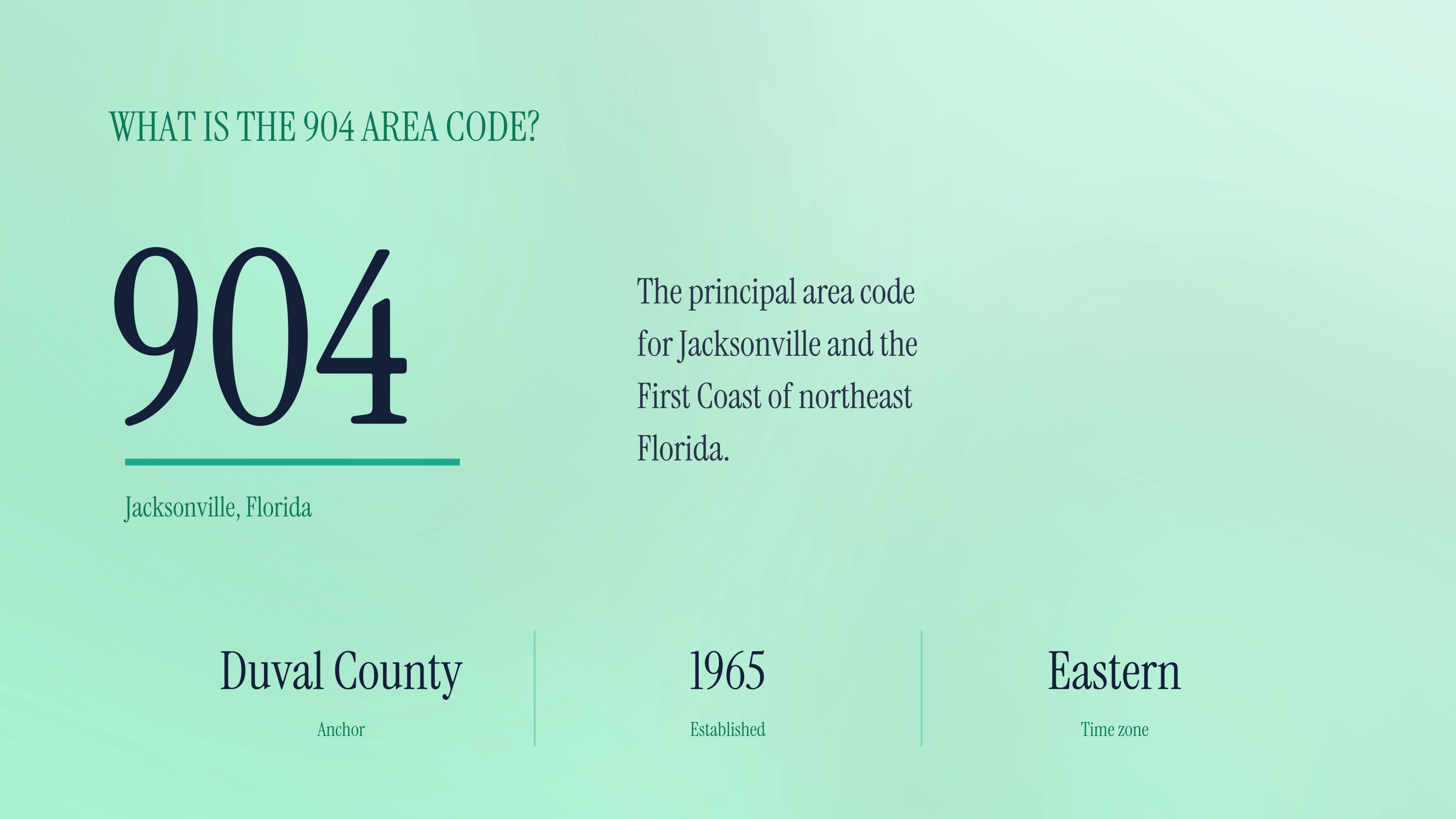
Because it covers Jacksonville proper plus the ring of beach towns and suburbs across Duval, St. Johns, Clay and Nassau counties, a 904 number reads as unmistakably local. To a customer in Orange Park, Fernandina Beach or Ponte Vedra, it looks like a neighbor on the caller ID rather than a stranger from out of state — a small but real credibility signal for any business working the region.
Duval County Outward to Amelia Island and Baker County
The 904 code is centered on Duval County and spreads across the surrounding First Coast counties of Nassau, Baker, Clay and St. Johns, with small reaches into Bradford and Union. It blankets the northeast corner of Florida, where downtown Jacksonville gives way to Atlantic beaches, historic towns and booming bedroom communities. The major communities include:
- Jacksonville — the heart of the code and the most populous city in Florida, straddling the St. Johns River in Duval County
- The Beaches — Jacksonville Beach, Atlantic Beach, Neptune Beach and Ponte Vedra Beach along the Atlantic shore
- St. Johns County — St. Augustine, the oldest continuously occupied European city in the U.S., plus fast-growing St. Johns and Nocatee
- Clay and Nassau counties — Orange Park, Fleming Island, Green Cove Springs, Middleburg, and Fernandina Beach and Yulee on Amelia Island
- The outer towns — Macclenny and Glen St. Mary in Baker County, and Starke, Lawtey and Callahan on the rural edges
It is a large and still-expanding territory — a revitalized urban core along the river, master-planned communities filling in St. Johns and Clay counties, and historic coastal towns drawing new residents every year. That steady growth is exactly why a single area code eventually ran short of numbers.
The Splits and the 324 Overlay
When 904 was created in 1965, it was carved from Florida's original 305 code and covered the entire northern half of the state. For decades that was plenty. But as Florida boomed, the code was trimmed again and again. In 1995 the Ocala and Gainesville area was assigned 352, in 1997 the Panhandle was split off as 850, and in July 2001 the Daytona Beach region and a second pocket became 386. Orlando's 407 area code, by contrast, came out of 305 in 1988. What remained was a tighter 904 focused squarely on Jacksonville and the First Coast.
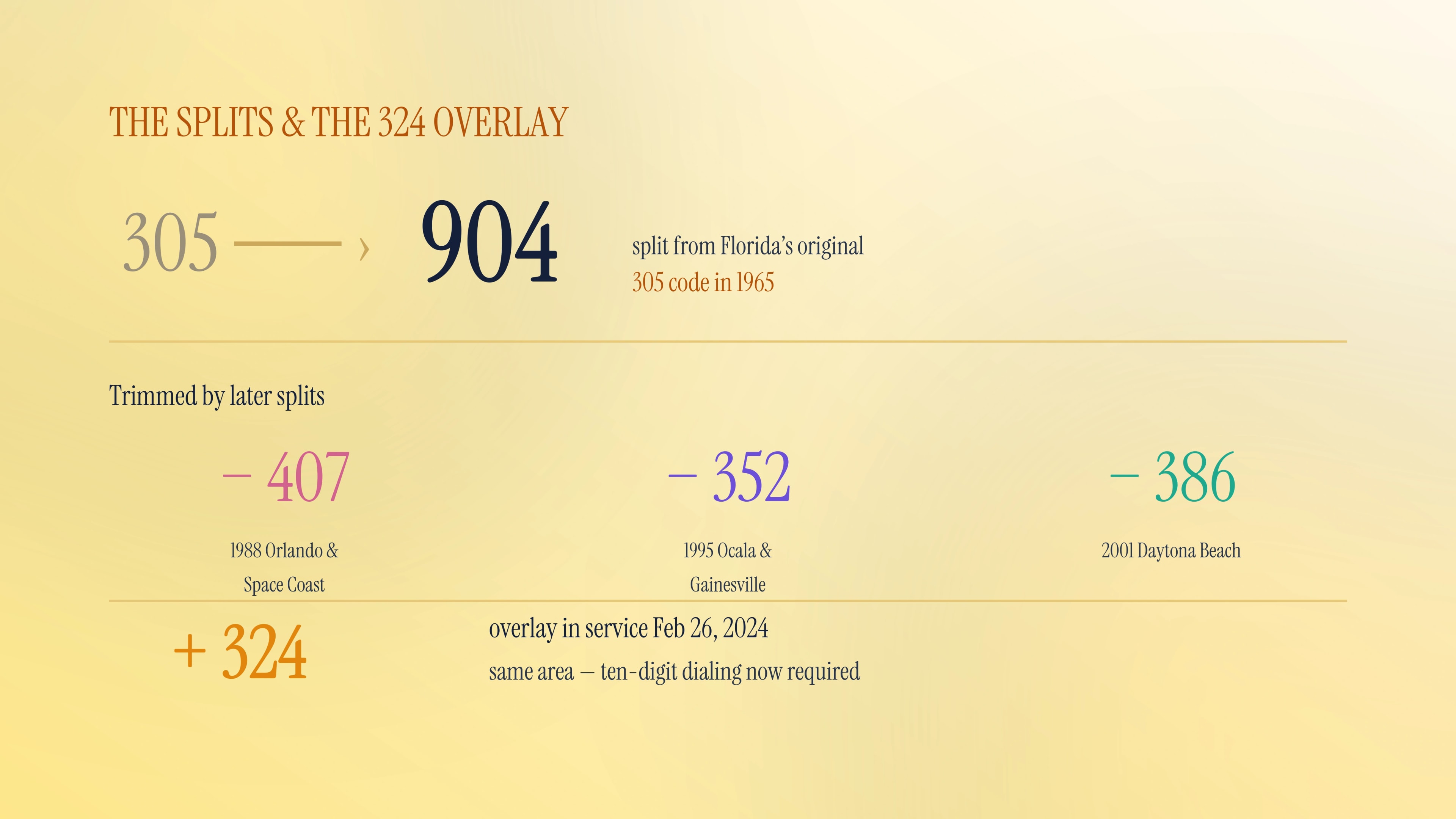
Even that tighter region eventually ran low on numbers. Rather than split the First Coast again and force anyone to change their number, the Florida Public Service Commission chose an overlay: a new code, 324, laid across the exact same territory. Mandatory ten-digit dialing began on January 29, 2024, and 324 numbers entered service on February 26, 2024. Every existing 904 number stayed the same — the only change was that every local call now has to include the area code.
Why Every First Coast Call Now Needs Ten Digits
The entire 904 region observes Eastern Time — UTC-5 in winter (EST) and UTC-4 during daylight saving (EDT), which runs from March to November. Because Jacksonville has shared its territory with the 324 overlay since 2024, ten-digit dialing is mandatory for every local call:
- Local and regional calls: dial all ten digits — 904-555-1234.
- Long-distance from elsewhere in the U.S.: add a leading 1 — 1-904-555-1234.
- International: dial the exit code, then +1, then the number — +1 (904) 555-1234.
Benefits of a 904 Number for Business
On the First Coast, a 904 caller ID has long signaled a business based in or around Jacksonville. Showing that prefix is a straightforward way to be taken for a neighbor in Duval or St. Johns County rather than an unfamiliar caller from out of state.
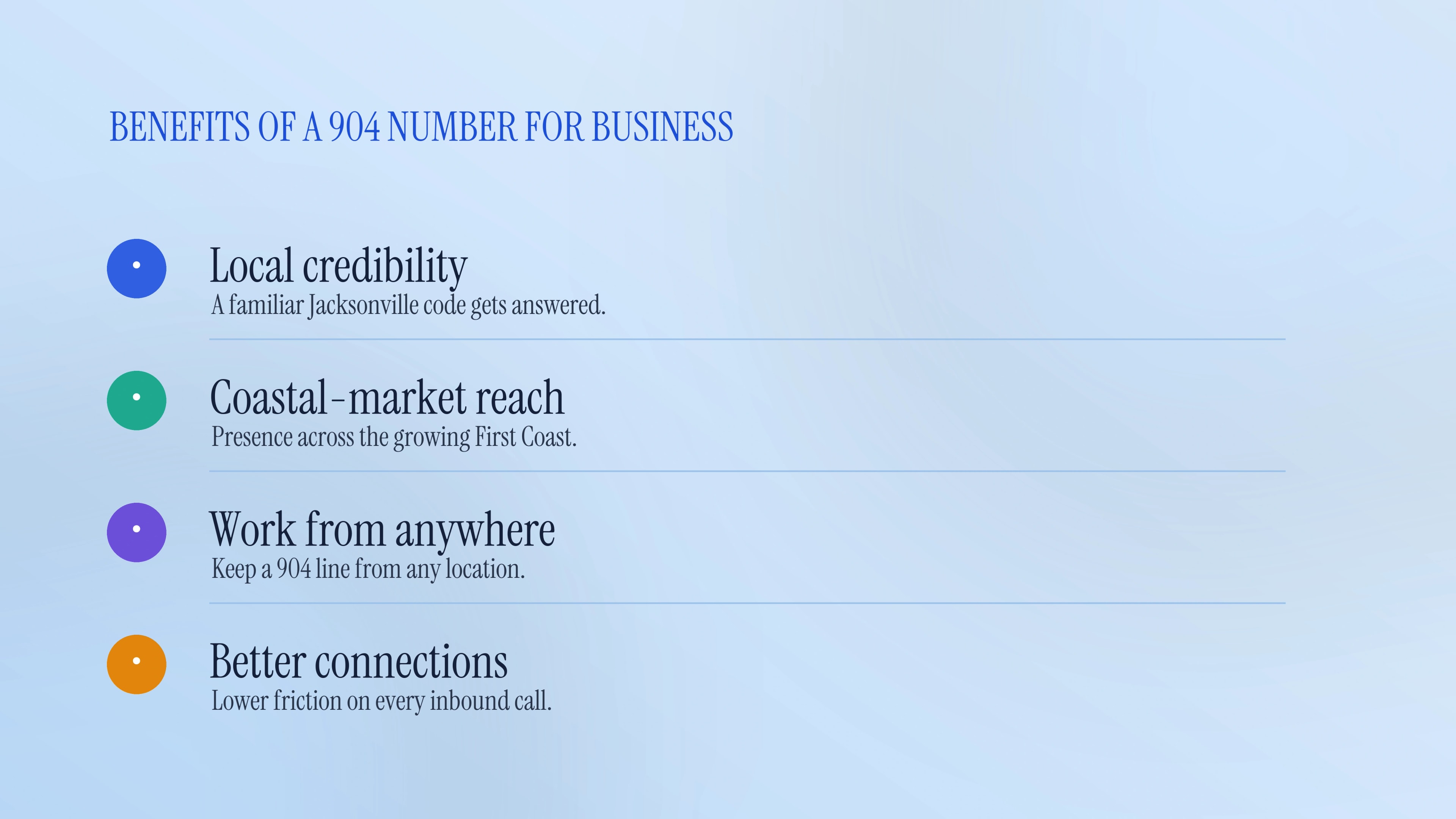
- St. Johns River credibility: a 904 number signals downtown Jacksonville and the river districts, the kind of local footing an out-of-state line can't fake.
- Beach-town and Amelia Island trust: Ponte Vedra, Fernandina Beach and Jacksonville Beach customers answer a 904 call the same way they'd answer a neighbor along the Atlantic shore.
- Historic First Coast reach: the tourism and hospitality trade built up around St. Augustine, the nation's oldest continuously occupied European city, already expects a 904 or 324 caller ID.
- Reach across four counties on one line: a distributed team can answer as First Coast local — Duval, St. Johns, Clay and Nassau — without opening an office in any of them.
Ready to claim a Jacksonville presence?
Acepeak provisions local numbers with carrier-grade routing and instant activation, so a business can sound local from day one.
How to Get a 904 Phone Number
For one person or a full First Coast staff, a 904 or 324 number is four steps away.
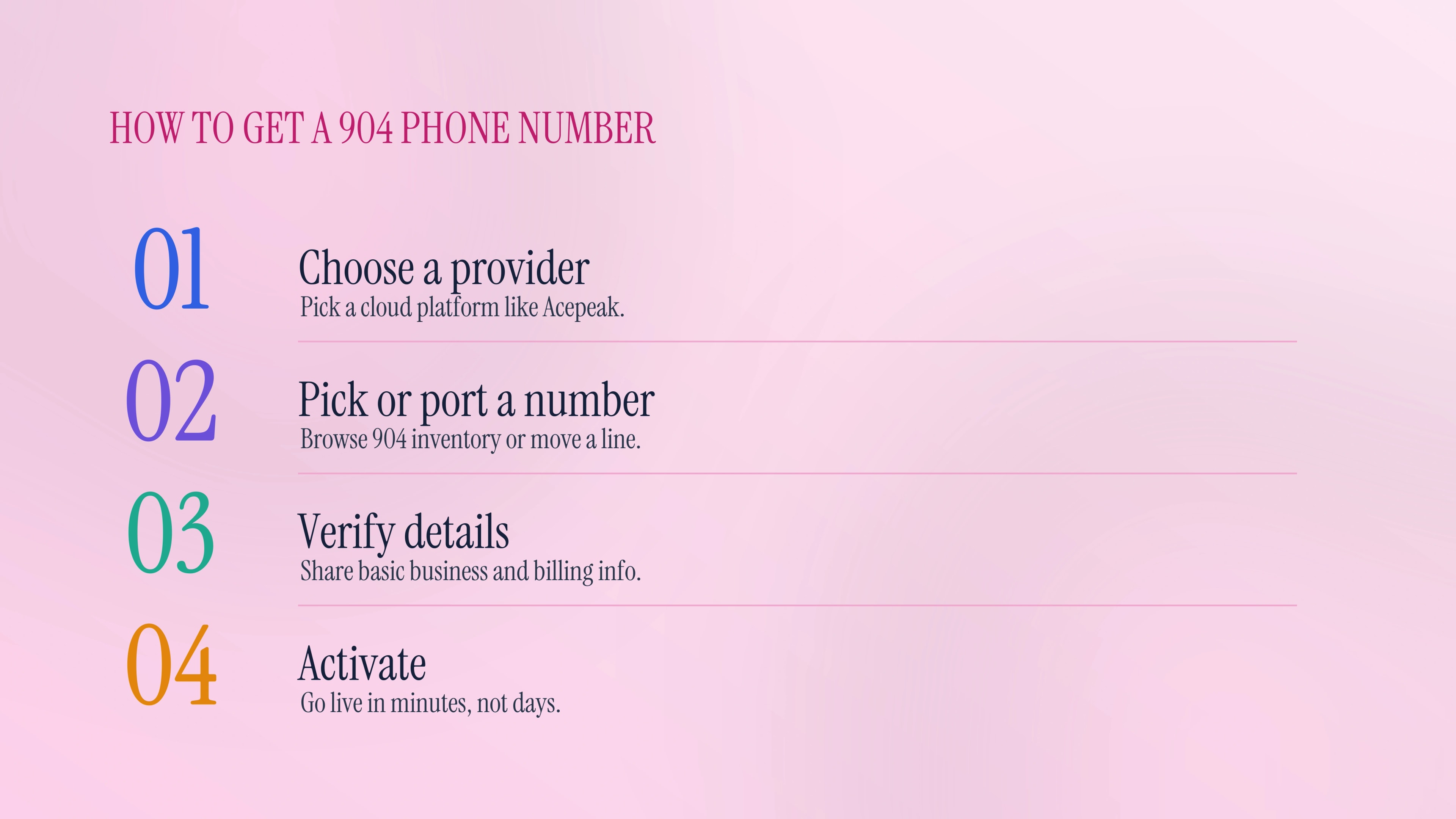
- Choose a provider: options range from traditional carriers to cloud platforms that assign both 904 and the newer 324 overlay numbers online.
- Pick or port a number: browse inventory tied to Jacksonville proper, the Beaches or St. Johns County, or transfer an existing First Coast line.
- Verify details: provide basic business and billing information tied to your First Coast service area.
- Activate: cloud providers often go live in minutes, with ten-digit dialing already configured since the 2024 overlay.
Local-Looking Scam Calls on the First Coast
Jacksonville's two local codes also give scammers two disguises. A spoofed 904 or 324 caller ID can pass as a call from the Beaches or St. Augustine, and since both codes belong to the First Coast, neither proves who is calling.
- Never share sensitive details — bank information or a Social Security number — with an unexpected caller.
- Verify urgent requests by hanging up and calling back on an official, published number.
- Use call-blocking and spam-filtering tools to screen unknown numbers.
- Report suspicious calls to the provider or the relevant authorities so others are protected.
The Future of the 904 Prefix
Jacksonville is one of the fastest-growing large cities in the Southeast, so demand for numbers across the First Coast is only rising. But future relief will now come through the 324 overlay rather than another split, which leaves every existing 904 number untouched. Residents and businesses are already adjusting to ten-digit dialing, so additional numbers simply join the same pool. Residents who want fewer unwanted calls on a 904 line can add their number to the state-run Florida Do Not Call registry. The practical takeaway is unchanged: a 904 number remains a recognizable, trusted local identity across Jacksonville and the First Coast.
Sixty Years of First Coast Roots, Now Open to Anyone
Jacksonville's 904 prefix is more than a routing code; it is a marker of northeast Florida's First Coast. Born in 1965 from the state's original 305, trimmed to its current shape across three later splits, and joined by the 324 overlay in 2024, it has evolved right alongside the region it serves. For a business, a 904 number remains one of the cheapest, most credible ways to signal local roots — and with cloud calling, that Jacksonville presence is available to anyone, anywhere.
Put a trusted Jacksonville number to work today
Acepeak delivers local lines with smart routing, voicemail and 24/7 support — everything a business needs to stay reachable.
Questions, answered.
It serves Jacksonville and the First Coast of northeast Florida — centered on Duval County and reaching across Nassau, Baker, St. Johns and most of Clay counties, with small portions of Bradford and Union.
It was established in 1965, when Florida's original 305 area code was split and the northern half of the state, including Jacksonville, was assigned area code 904.
Over the years 904 was trimmed three times: 352 was created in 1995 for the Ocala and Gainesville area, 850 in 1997 for the Panhandle, and 386 in July 2001 for the Daytona Beach region.
The 324 code is an overlay added on top of 904 across the same First Coast territory. Mandatory ten-digit dialing began on January 29, 2024, and 324 numbers entered service on February 26, 2024, so the two codes now share one geographic area.
The Jacksonville region observes Eastern Time — EST (UTC-5) in winter and EDT (UTC-4) during daylight saving time from March to November.
Yes. Cloud and hosted phone services let a business or individual hold a local 904 number from anywhere while keeping an authentic Jacksonville identity.
Signing up for a 904 area code number takes minutes with a cloud phone provider — no local office in Jacksonville required. Pick the number, connect it to your existing phone or app, and calls route in immediately. This keeps the 904 area code presence you already have while adding the local credibility Florida customers respond to.