Mill Towns and Lake Communities on an Original Code
From the salt flats of Syracuse to the shores of Lake Ontario and the Canadian border at Massena, one prefix has tied Central and Northern New York together for more than seventy-five years. It reaches the Erie Canal mill towns of Utica and Rome, the city of Watertown, and dozens of college and lake communities in between. Born in the very first numbering plan of 1947, the code has survived a split, an overlay and the mobile era while remaining the region's signature local identity. This guide covers where it truly reaches, how it has changed, why it still matters for business, and what comes next.
Key Takeaways
- The 315 prefix serves central and northern New York — Syracuse, Utica, Rome, Watertown and Oswego — and is one of the original 1947 area codes.
- In 1954 the southern portion (including Binghamton) split off as 607; Binghamton is not part of 315 today.
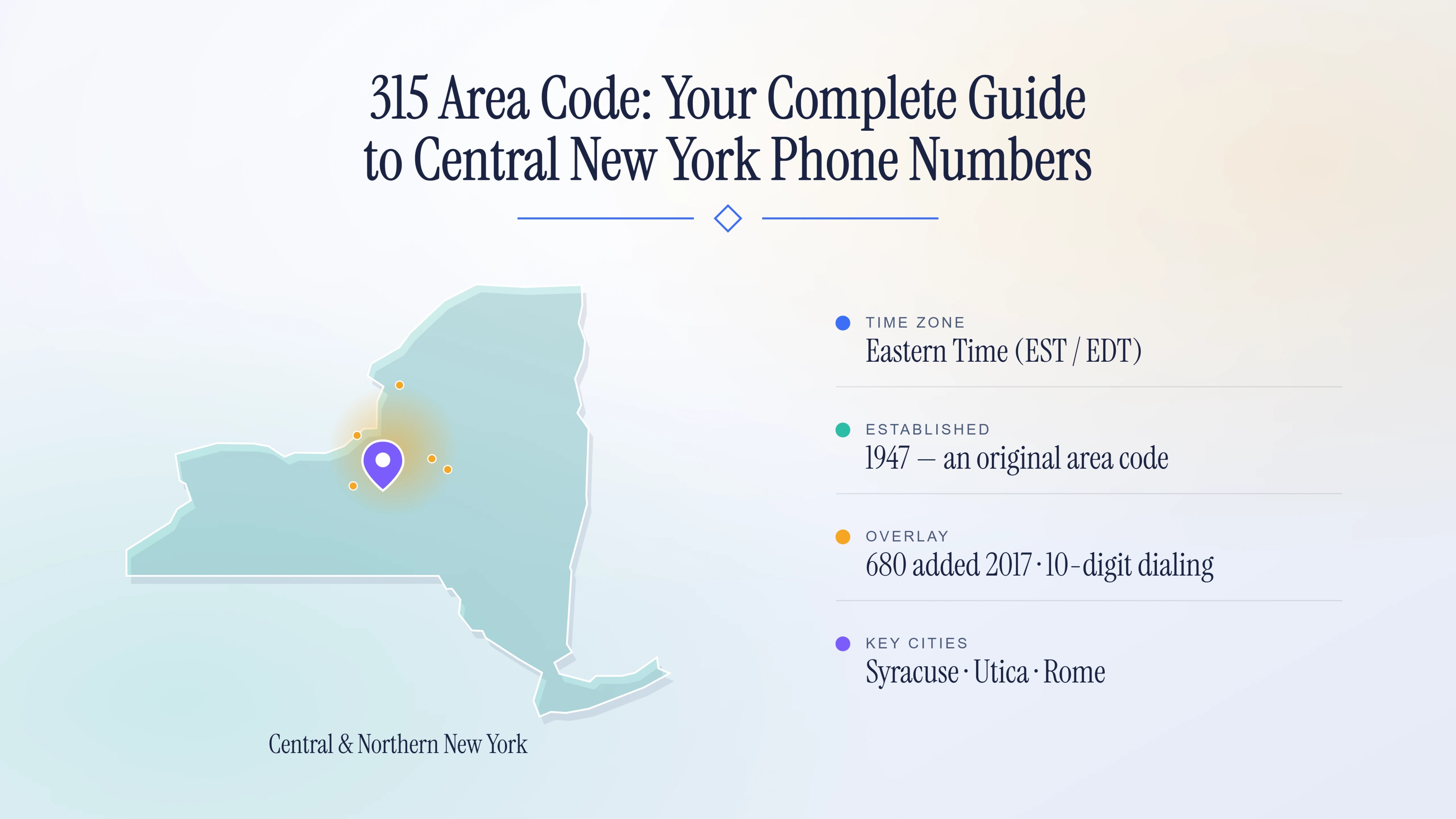
- The 680 overlay arrived in 2017, sharing the same geography; mandatory 10-digit dialing began February 11, 2017.
- The region sits in the Eastern Time Zone (ET) and observes daylight saving time, spanning 18 counties and roughly 1.66 million people (2020 Census).
- The 315/680 region is not near exhaustion — numbering is projected to last into the 2040s — yet a local number still lifts answer rates and builds trust for Central New York businesses.
What Is the 315 Area Code?
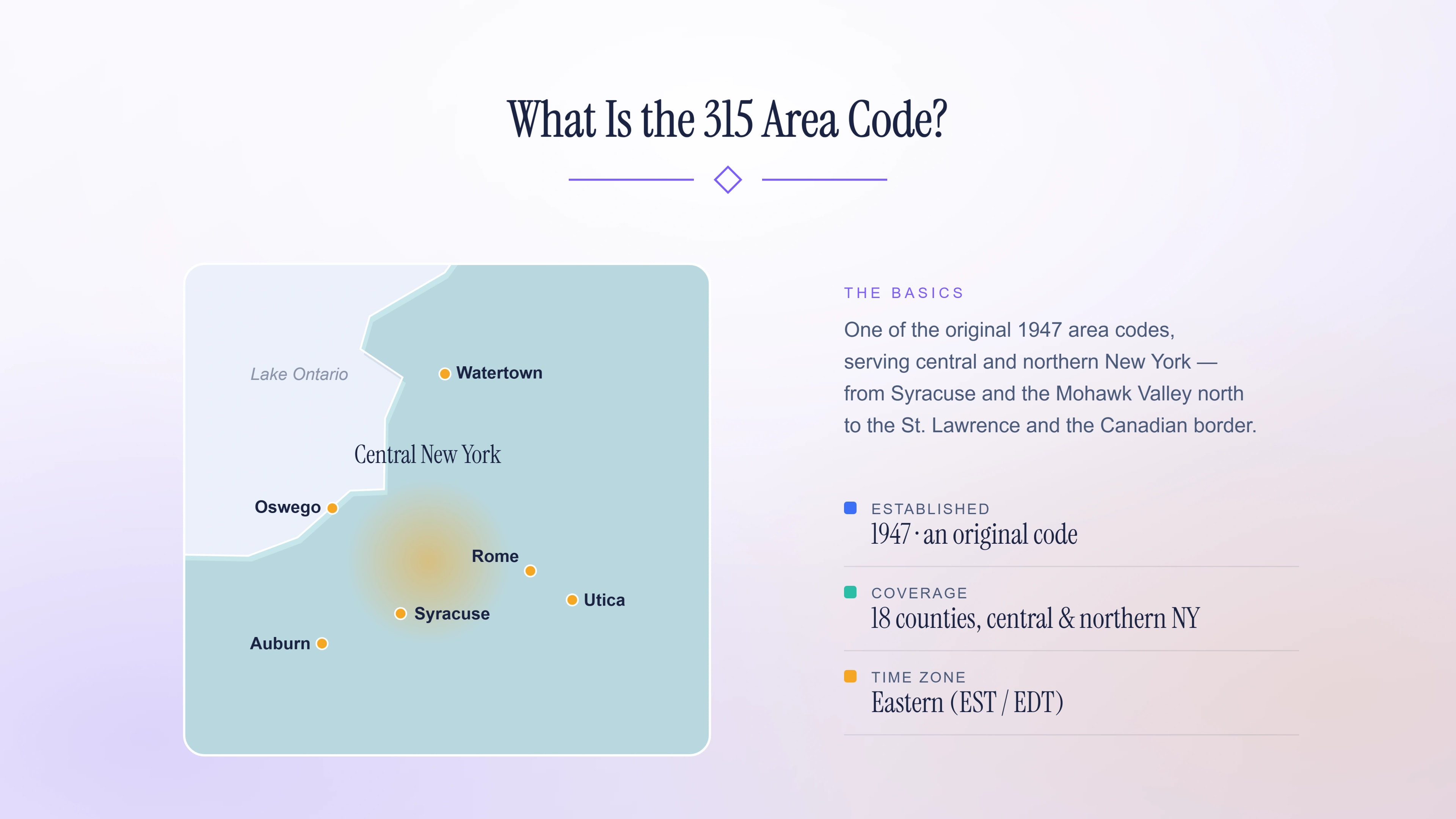
The prefix is one of the original North American codes, assigned in 1947 to serve a large swath of upstate New York. In its earliest form it stretched from the Pennsylvania line all the way to Canada — a world away from the downstate codes such as Long Island's 631 area code. Decades of growth steadily refined that footprint into the Central and Northern New York region it identifies today.
A 315 number marks a caller as part of the Central New York community — a quiet but real credibility signal in a region where local ties carry weight with customers.
Eighteen Counties and the Pre-Split Footprint Mix-Up
The prefix covers all or part of 18 counties across Central and Northern New York, anchored by Onondaga (Syracuse), Oneida (Utica and Rome), Jefferson (Watertown) and Oswego. Major communities include:
- Syracuse — the region's largest city
- Utica and Rome
- Watertown and Oswego
- Auburn, Fulton, Oneida, Geneva and Ilion
The territory runs from western Wayne County east to the Mohawk Valley, and north to the U.S.-Canada border at Massena. One clarification worth making: Binghamton is not in 315 — it moved to the 607 region in 1954, and some older descriptions still echo the pre-split footprint.
The Splits and Overlay of 315
The original 1947 territory was large, so it was trimmed once: in 1954 the southern section, including Binghamton, split off to form area code 607. After that, the footprint stayed stable for decades.
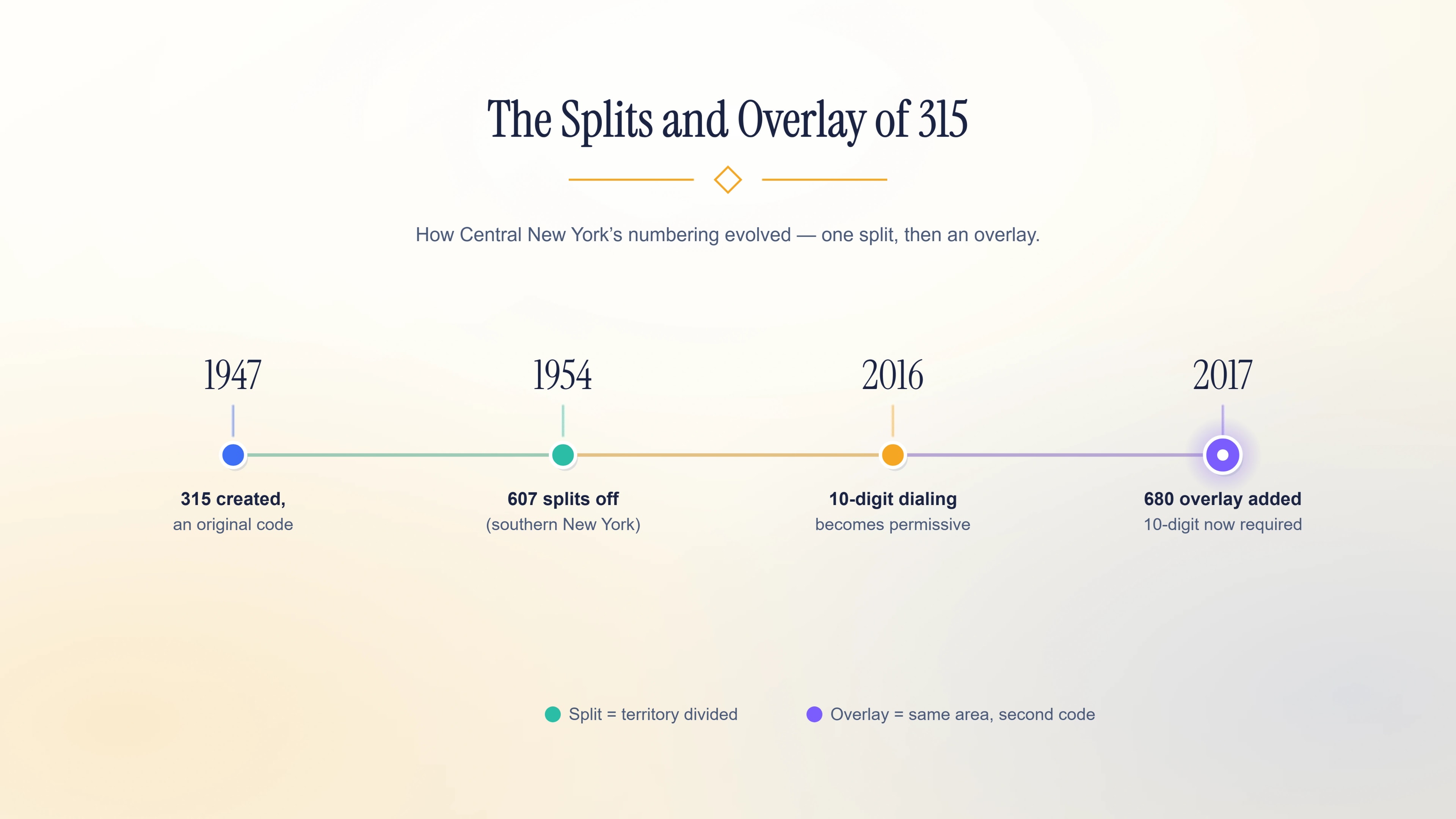
By the 2010s the answer to rising demand was an overlay rather than another split. Overlays are now the standard fix statewide — the same approach that added Manhattan's 332 area code. The 680 overlay was layered directly on top of the existing 315 territory, with new 680 numbers activating in March 2017. Because two codes now share one region, ten-digit dialing became mandatory on February 11, 2017 — every local call needs the area code plus the seven-digit number, and no existing number had to change.
Eastern Hours and the Overlay Dialing Rules
Clocks from Syracuse to the Canadian border at Massena run on Eastern Time: EST at UTC-5 through the winter, then EDT at UTC-4 for daylight saving from March to November. With 680 sharing the territory, calls are placed this way:
- Local and regional calls: dial all ten digits — 315-555-1234.
- Long-distance from elsewhere in the U.S.: add a leading 1 — 1-315-555-1234.
- International: dial the exit code, then +1, then the number — +1 (315) 555-1234.
Benefits of a 315 Number for Business
Since 1947, 315 has been the home prefix for Utica, Rome, Watertown and the rest of Central New York. A business that calls with it comes across as part of the region instead of a distant call center, one of the easiest kinds of credibility a company can claim.
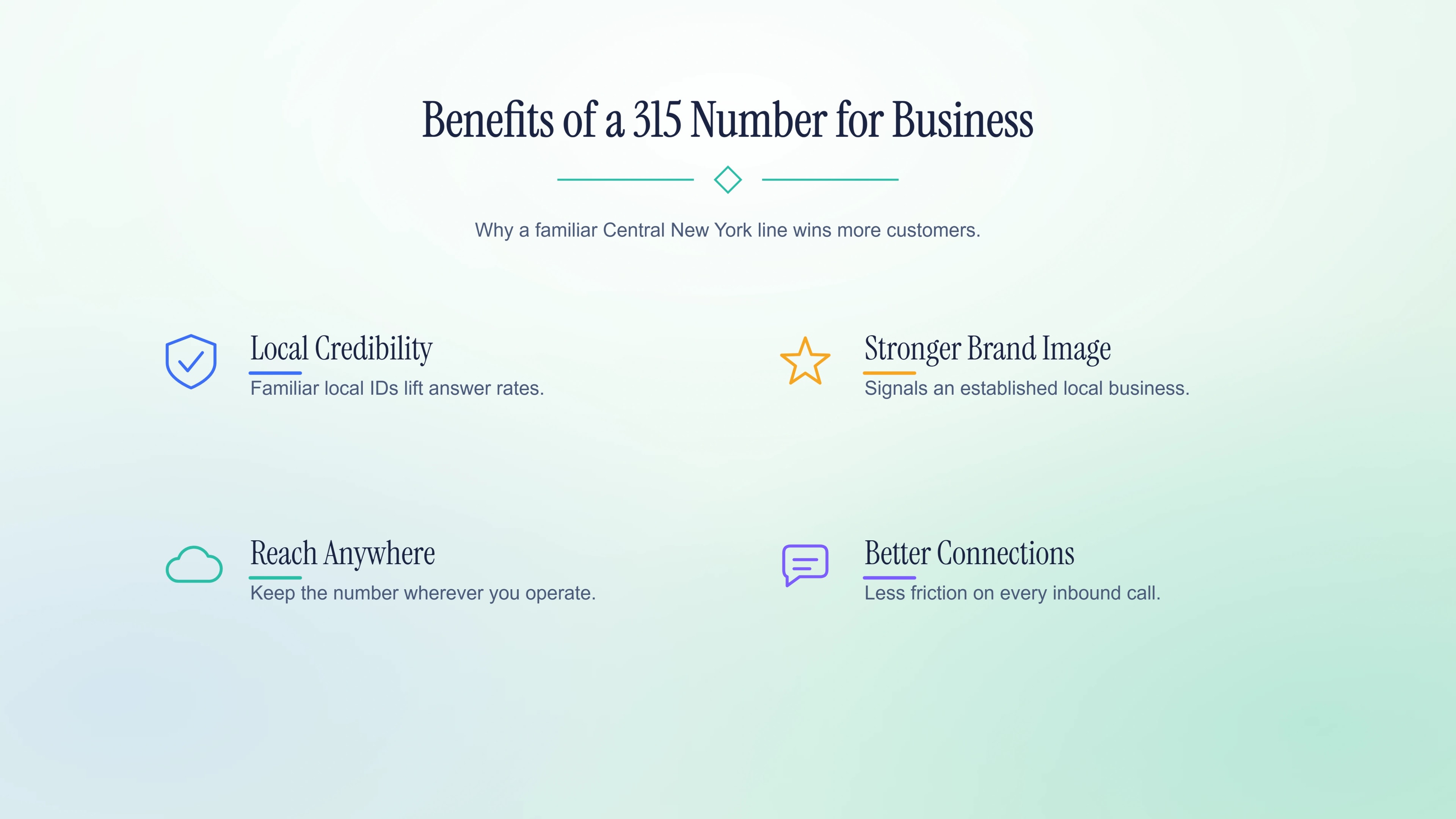
- Local credibility: a Syracuse or Utica customer answers a 315 call as a neighbor's, not an unfamiliar out-of-region number.
- Upstate-wide reach: a single 315 number covers the Mohawk Valley cities and the North Country up to the Canadian border at Massena.
- Reach anywhere: cloud calling lets a company hold a Central New York presence while operating from anywhere.
- Original-code standing: as one of the first 1947 area codes, 315 carries decades of continuous local identity that the newer 680 overlay shares but does not replace.
Ready to claim a Central New York presence?
Acepeak provisions local numbers with carrier-grade routing and instant activation, so a business can sound local from day one.
How to Get a 315 Phone Number
Numbers are available across all 18 counties under 315 or its 680 overlay, and one line or a whole team is set up the same way:
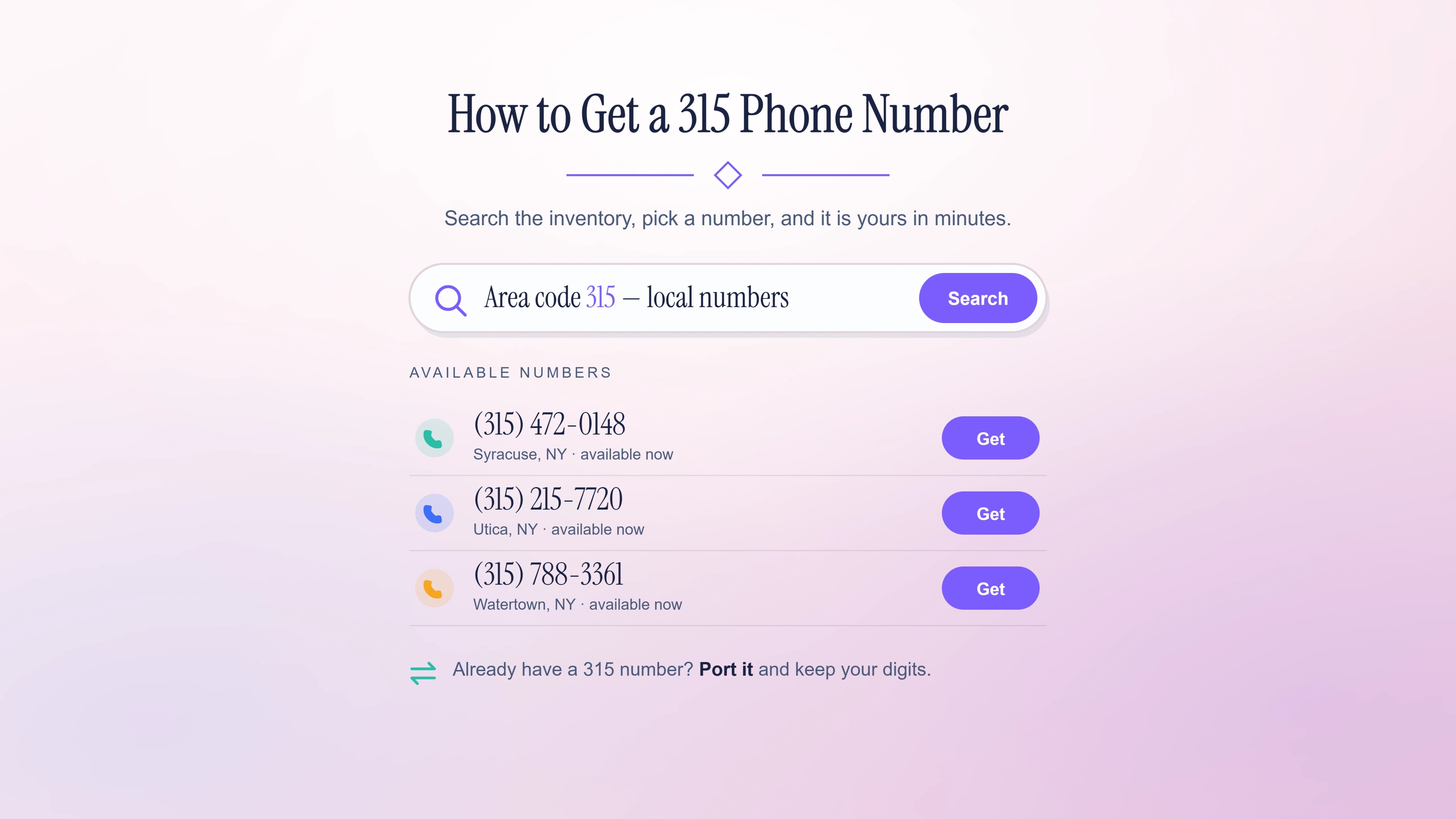
- Choose a provider: pick a cloud platform like Acepeak or a traditional carrier that can provision a number across the 18-county Central New York region.
- Pick or port a number: browse the available inventory from Syracuse to Watertown, or transfer an existing local line.
- Verify details: provide basic business and billing information.
- Activate: cloud providers often go live within minutes rather than the days a traditional carrier might need.
Why the Newer Overlay Code Can Be Spoofed Too
Since the 2017 overlay made 680 as familiar as 315 from Syracuse to Watertown, a spoofer can use either code to look local. Treat any unexpected request for money or personal details as suspect:
- Never share sensitive details — bank information or a Social Security number — with an unexpected caller.
- Verify urgent requests by hanging up and calling back on an official, published number.
- Use call-blocking and spam-filtering tools to screen unknown numbers.
- Report suspicious calls to the provider or the relevant authorities so others are protected.
The Future of the 315 Prefix
There is no number crunch on the horizon here. Thanks to the 2017 overlay, the 315/680 region has ample supply — numbering is projected to last well into the 2040s, far from exhaustion. New-York-specific numbering decisions are handled by the New York Public Service Commission, which oversaw the overlay and the move to ten-digit dialing. For residents and businesses the takeaway is simple: existing numbers stay put, and a recognizable local identity remains easy to obtain.
Split Once, Overlaid Once, and Still Worth Claiming
Syracuse, the Mohawk Valley and the North Country share more than a dialing prefix in 315; the code tells people where a caller is from. It gave up Binghamton to 607 in 1954, took on 680 as a partner overlay in 2017 and lived through the move to mobile phones, yet it still reads as Central New York's own. A 315 number remains an inexpensive, believable way for a business to show upstate roots, and cloud calling lets that line ring wherever the team happens to work.
Put a trusted Central New York number to work today.
Acepeak delivers local lines with smart routing, voicemail and 24/7 support — everything a business needs to stay reachable.
Questions, answered.
Central and northern New York — including Syracuse, Utica, Rome, Watertown and Oswego — across 18 counties anchored by Onondaga, Oneida and Jefferson.
No. Binghamton has been part of the 607 region since the 1954 split; it is not a 315 city.
Yes. Since the 680 overlay, ten-digit dialing has been mandatory (effective February 11, 2017) for every local call.
No. The 2017 overlay added ample supply, and numbering is projected to last into the 2040s.
Yes. Cloud and hosted phone services let a business or individual hold a local Central New York number from anywhere.
Signing up for a 315 area code number takes minutes with a cloud phone provider — no local office in Syracuse required. Pick the number, connect it to your existing phone or app, and calls route in immediately. This keeps the 315 area code presence you already have while adding the local credibility New York customers respond to.