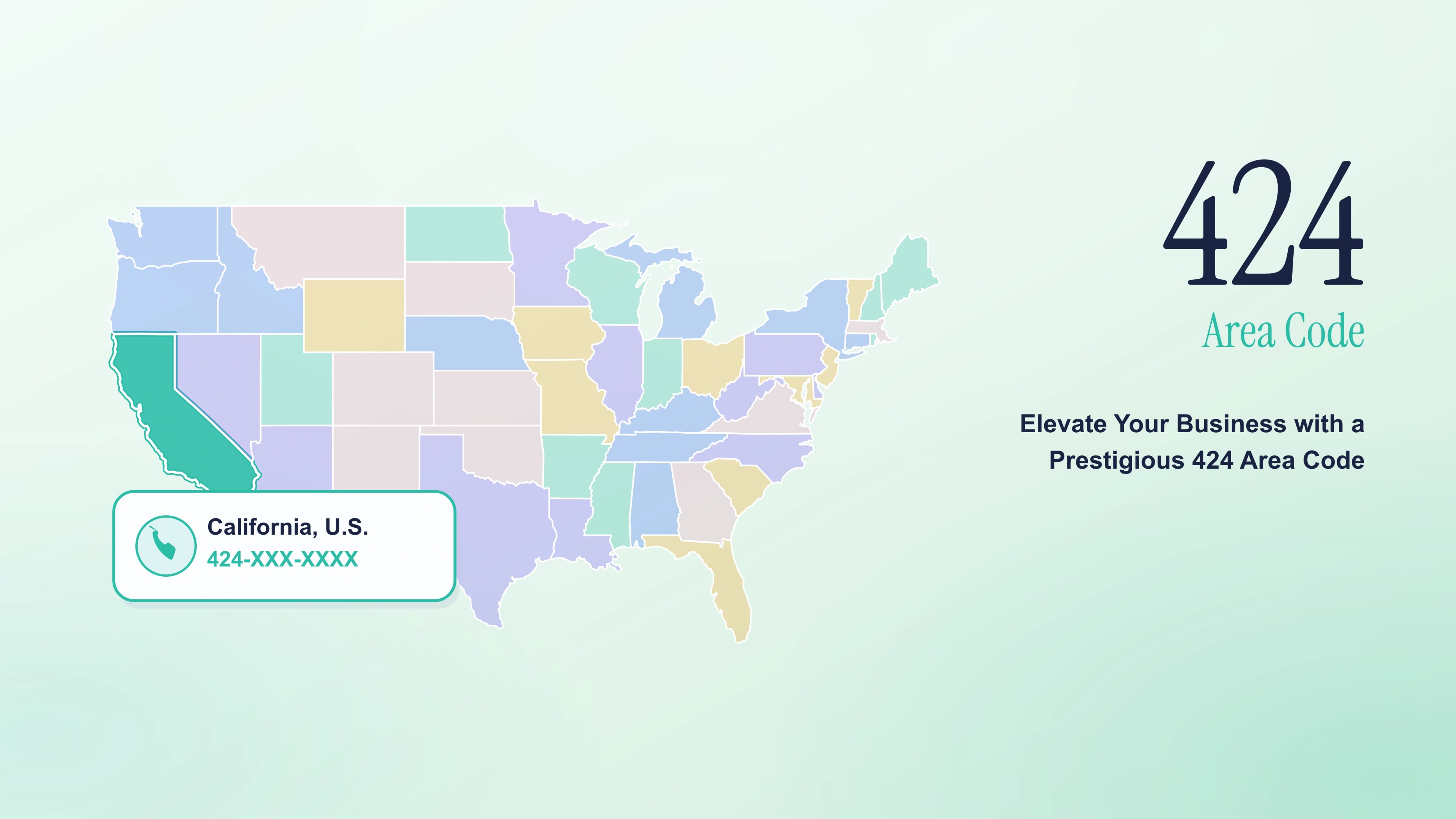
Palm-Lined Streets and a Coastline That Outgrew 310
Few places on earth are as instantly recognizable as the western edge of Los Angeles — the palm-lined streets of Beverly Hills, the pier at Santa Monica, the surf breaks of Malibu and the tight grid of beach towns strung along the South Bay. For decades this stretch of coast has answered the phone as 310, one of the most desirable area codes in the country. But numbers, like real estate here, eventually run short. When 310 began to run low, California reached for a brand-new kind of fix — an overlay — and the 424 area code was born. This guide explains exactly where 424 reaches, why it shares every street with 310, how it changed the way the whole region dials, and how any business can claim a local Los Angeles number of its own.
Key Takeaways
- The 424 area code is an overlay of 310, covering exactly the same territory — the Westside and South Bay of Los Angeles County, a small piece of Ventura County, and Santa Catalina Island.
- It took effect on July 26, 2006, as California's very first overlay — instead of splitting the region, regulators layered a second code on top of 310 so nobody had to change their existing number.
- Because two codes now share one area, ten-digit dialing is mandatory for every local call in the region — you dial all ten digits even to reach a neighbor.
- The footprint includes some of the most recognizable communities in America — Beverly Hills, Santa Monica, Malibu, Culver City and the beach cities of the South Bay from Manhattan Beach to Redondo Beach.
- The whole region runs on Pacific Time — UTC-8 in winter (PST) and UTC-7 in summer (PDT) — and a 424 number carries the same standing as a 310, an unmistakably Los Angeles line.
Can a Second Code Share Every Street with 310?
The 424 area code is the second telephone code for the Westside and South Bay of Los Angeles — the coastal and western communities that have long been served by the 310 area code. It is not a separate region with its own map; it is an overlay, meaning 424 numbers ring on the very same streets as 310 numbers. When it launched in 2006 it was the first overlay ever used in California, a model that has since spread to fast-growing metros across the state and the West. If you hold a 424 line, you are in exactly the same place as a 310 line — the two are interchangeable.
Since 424 rings on the same streets as 310, it inherits the Westside's reputation along with its territory. A resident of Santa Monica or Torrance sees a 424 call as coming from nearby, not from some unfamiliar place. Farther away, the code places a business inside the Los Angeles market, with its entertainment, aerospace and international trade, and that association lends a modest but useful measure of credibility to anyone making the call.
Malibu, the Aerospace Corridor and Catalina Island
The 424 code sits directly on top of 310, so it covers the Westside and South Bay of Los Angeles County together with a small piece of Ventura County and Santa Catalina Island offshore. It is a compact, coastal and famously affluent slice of the region — and every community inside it shares in the Los Angeles identity. The major communities include:
- Beverly Hills, Santa Monica, Malibu and Pacific Palisades — the celebrated Westside communities along and above the coast.
- Culver City, Marina del Rey, Venice and Playa del Rey — the creative and waterfront neighborhoods between the Westside and the airport.
- Inglewood, Hawthorne, El Segundo and Gardena — the communities around Los Angeles International Airport and the aerospace corridor.
- Manhattan Beach, Hermosa Beach, Redondo Beach and Torrance — the heart of the South Bay and its string of beach cities.
- The Palos Verdes Peninsula, San Pedro, Wilmington and Carson — the harbor communities and the hills above the Port of Los Angeles.
- Avalon and Santa Catalina Island — the resort town and island 26 miles off the coast that share the same codes.
Packed into that footprint are well over a million residents plus one of the densest concentrations of entertainment, aerospace, technology, tourism and international trade anywhere in the country — which is exactly why the region needed a second area code even after decades of using 310.
Pacific Hours and Ten Digits Even to a Next-Door Neighbor
The entire 424 region sits within Pacific Time — UTC-8 in winter (PST) and UTC-7 in summer (PDT) — the same clock as San Francisco, Seattle and the rest of the West Coast, three hours behind New York. Because 424 shares its territory with 310, one everyday habit is different here than in single-code regions: ten-digit dialing is mandatory for every call, even a call to your next-door neighbor.
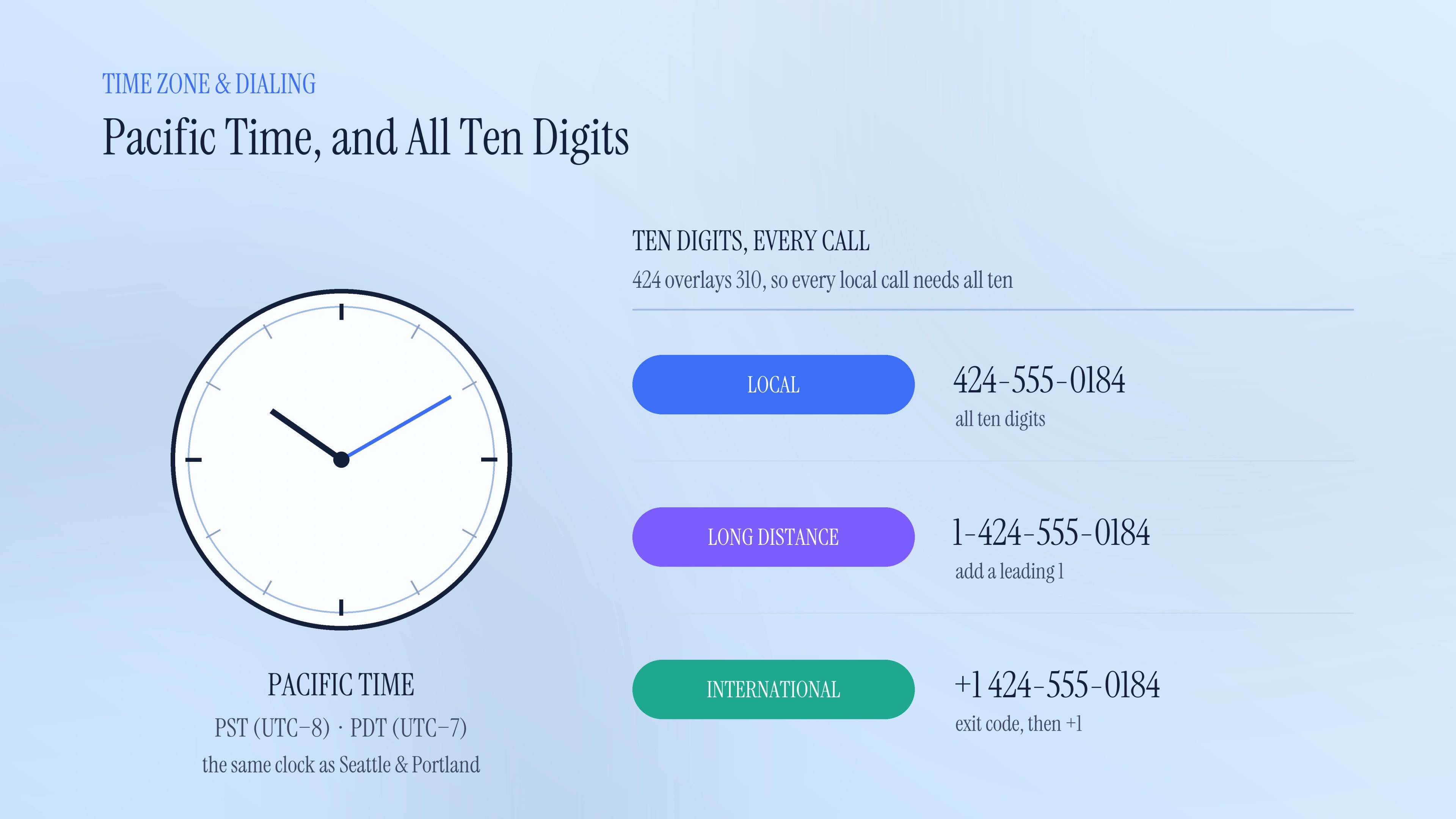
- Local calls within West LA and the South Bay: because 424 shares its area with 310, you must dial all ten digits — 424-555-0184 — for every local call.
- Long-distance from elsewhere in the U.S.: add a leading 1 — 1-424-555-0184.
- International: dial your country's exit code, then +1, then the number — +1 (424) 555-0184.
- On mobile phones: cell numbers are already stored and dialed with all ten digits, so most people reach 424 lines the same way from anywhere.
How 424 Was Created: The Overlay of 310
To understand 424 you first have to understand 310. When the North American numbering plan launched in 1947, all of Los Angeles answered as 213. As the metro exploded, that single code could not keep up, and on November 2, 1991, the Westside and South Bay split off into a brand-new area code, 310. For a while 310 had numbers to spare, but the same growth that filled 213 eventually filled 310 too — and this time regulators chose a different path.
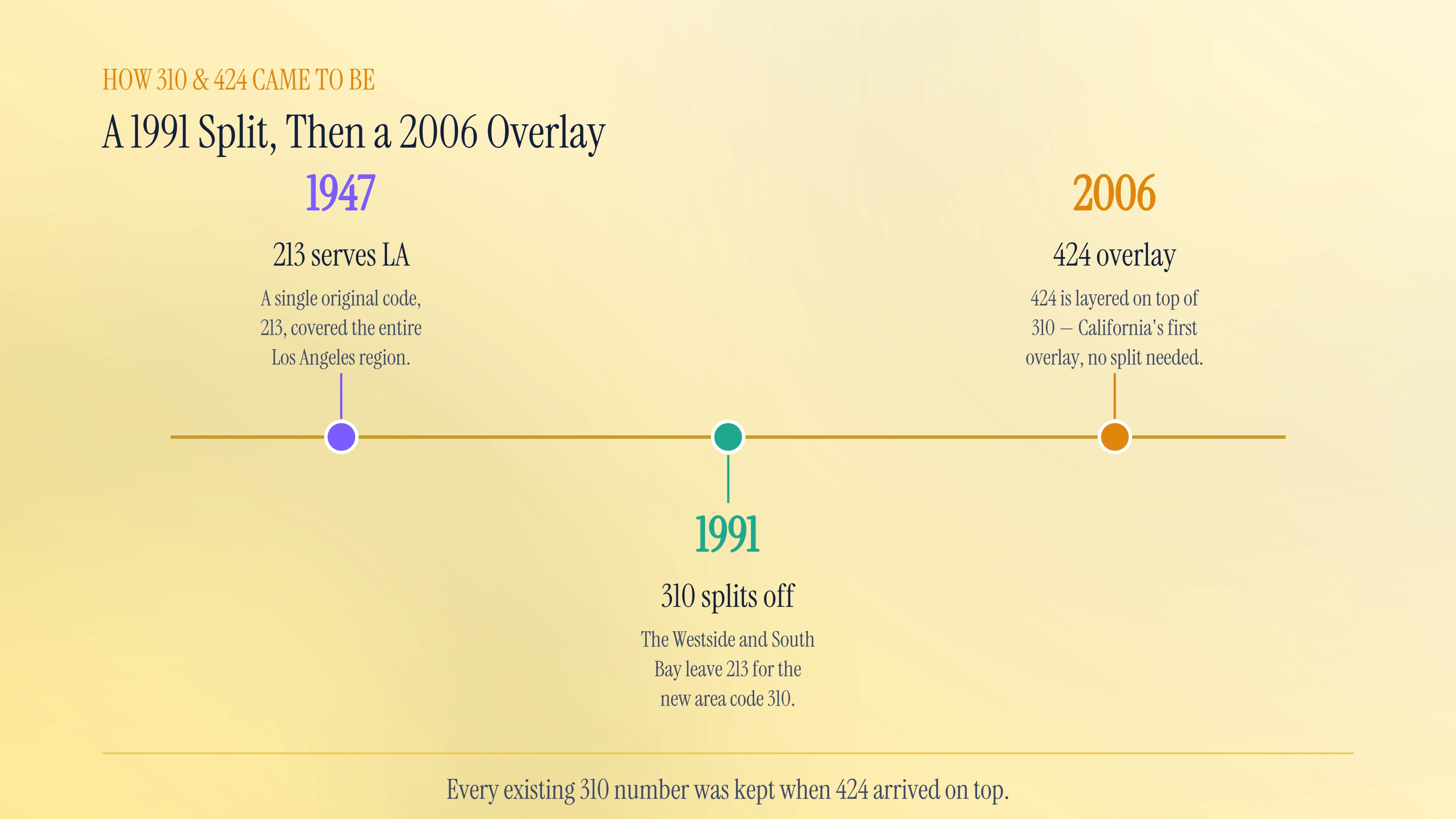
Rather than split the Westside and South Bay again — which would have forced half the region onto a new number — California introduced its first-ever overlay. On July 26, 2006, the 424 area code was layered directly over the same territory as 310, adding a fresh supply of numbers without changing a single existing line. It was the same solution later used across the country whenever a beloved code ran short, from Atlanta's 470 area code to countless other metros. The one trade-off is ten-digit dialing for everyone, but no one ever had to give up a 310 number — which is a big part of why the region still feels like a single, unbroken 310/424 community today.
Benefits of a Local 424 Number for Business
A local number is one of the simplest trust signals a business can own, and few carry the weight of a Los Angeles line. When someone sees a 424 or 310 number calling, it reads as an established Westside or South Bay presence — not an out-of-area cold caller. In one of the world's largest and most competitive markets, that instant recognition is worth a great deal.
- Carries the same weight as 310 — since 424 was California's first overlay, a 424 caller ID has read as authentically Westside for nearly two decades, not a knockoff of the original code.
- Recognized in the aerospace and airport corridor — logistics and aerospace firms around El Segundo, Hawthorne and LAX treat a 424 line the same as one dialed from inside their own office park.
- Speaks the South Bay's language — a 424 line reads as one more local number to the beach cities from Manhattan Beach to Redondo, the same way a 310 number always has.
- Extends to the harbor and the island — a business can answer for San Pedro, Wilmington and even Catalina's Avalon without staffing an office in any of them, just a routed 424 line.
- Sized for entertainment and trade cycles — scale lines up for a production's call sheet or a cargo season at the Port of Los Angeles, then scale back, all under one unchanged 424 number.
Put a local 424 number to work
Give your business an authentic Los Angeles presence with a 424 number that rings anywhere you do business.
How to Get a 424 Phone Number
You can own a 424 line without an installer or an office lease in Culver City or El Segundo. A cloud provider arranges everything over the internet, and a Westside or South Bay number can go live on the day you pick it. Demand along this stretch of coast is high, so waiting rarely helps, but setup takes only a few steps:
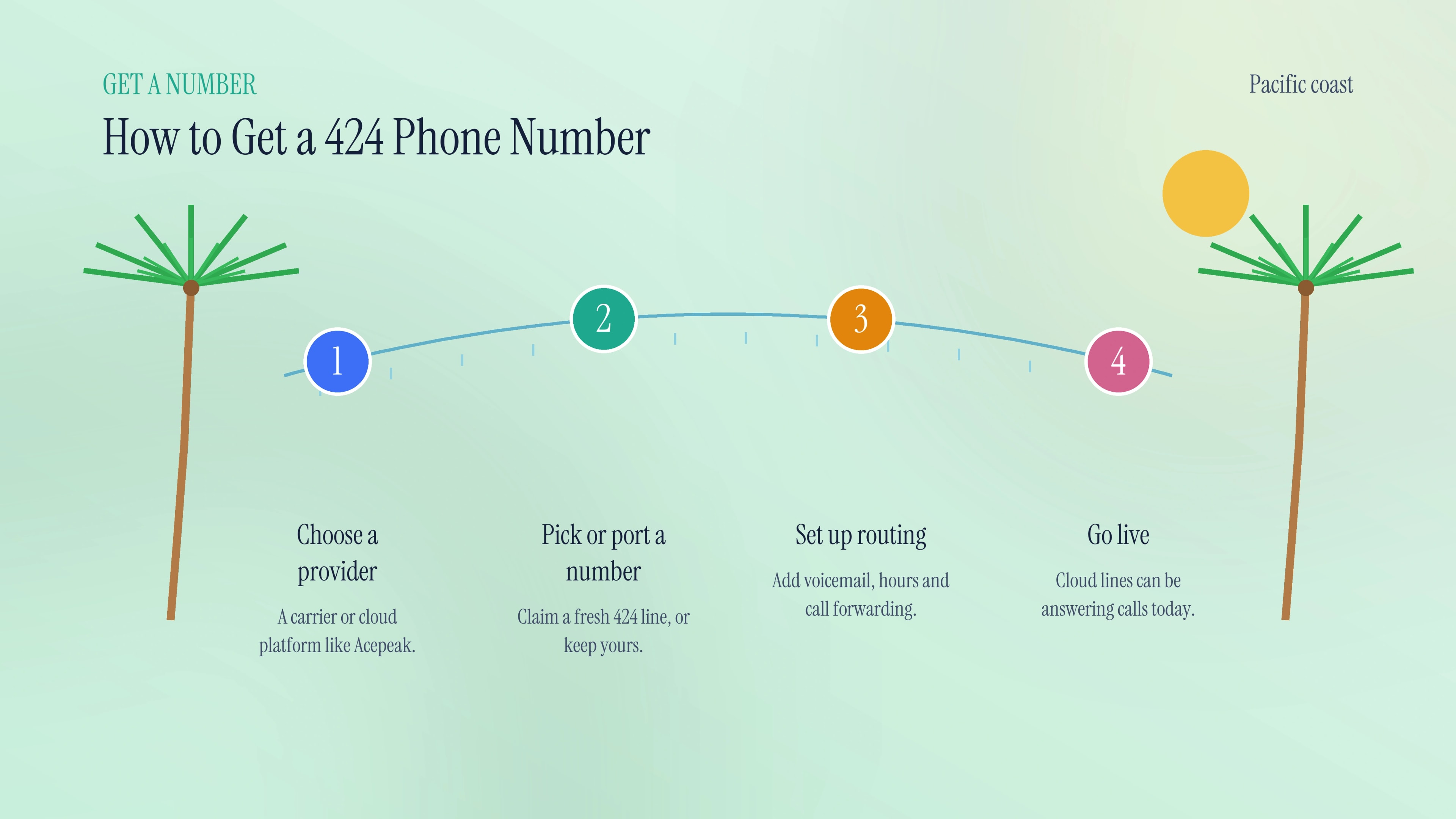
- Confirm your provider carries 424 numbers — since it was California's first overlay, inventory has had almost twenty years to fill in, so ask specifically about Westside and South Bay coverage.
- Choose a prefix by neighborhood — search for a number tied to the Westside, the airport corridor or a South Bay beach city, or port a line you already hold.
- Set ten-digit dialing as the default — because 424 and 310 share the same map, configure voicemail, an auto-attendant and forwarding to expect the full number on every call.
- Launch from any device — take calls on a laptop, desk phone or mobile app while presenting one Los Angeles identity from Beverly Hills to the Port district.
Spotting and Avoiding 424 Scam Calls
From Beverly Hills to the beach cities, people are more willing to answer when a familiar 424 or 310 prefix appears, and fraudsters use that instinct. A spoofed caller ID can make a scam look as though it originates from a Westside or South Bay line. Stay alert with these habits:
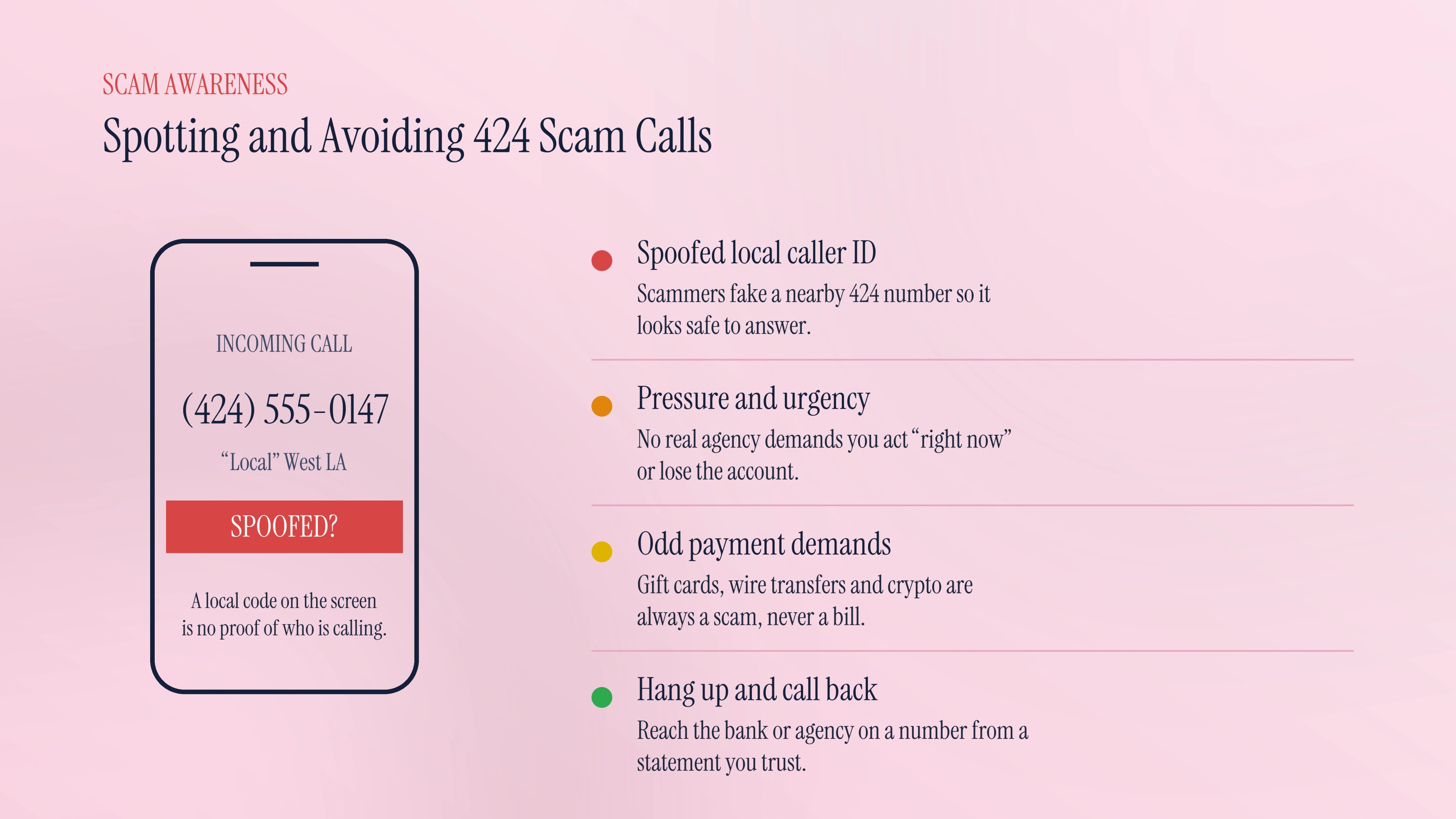
- Watch for pressure and urgency — real agencies and businesses do not demand that you act "right now" or the account will be closed.
- Be wary of odd payment demands — gift cards, wire transfers and cryptocurrency are the calling cards of a scam, never a legitimate bill.
- Do not trust caller ID alone — a 424 number on the screen can be faked; the local code is no guarantee the caller is who they claim.
- Hang up and call back on a number you trust — reach the bank, utility or agency directly using a number from a statement or official website.
- Report the call — logging unwanted calls with the authorities helps regulators track and shut down the operations behind them.
Scarce 310 Numbers and a Footprint That Won't Split Again
With 424 overlaying 310 since 2006, the Westside and South Bay now have a deep, shared pool of numbers to draw on, so another split is off the table — the region will keep its exact footprint indefinitely. The bigger story is demand: because 310 numbers are scarce and prized, most new lines are now issued as 424, and the two codes will keep working side by side. The City of Los Angeles remains one of the largest business, entertainment and trade hubs in the world, and its appetite for phone numbers keeps growing, which is exactly why the overlay was needed. For a business, the takeaway is simple: a local 424 number gives you an authentic Los Angeles presence today, and it will read as genuinely local for many years to come.
California's First Overlay and an Authentic LA Presence
The 424 area code is far more than three digits — it is the second phone identity of Los Angeles' Westside and South Bay, from the hills of Beverly Hills and the sand at Santa Monica to the beach cities of the South Bay and the harbor at San Pedro. Born in 2006 as California's first overlay, it shares every street with the storied 310 and secured the region's future without forcing anyone to change their number. For any business hoping to connect with the Los Angeles market, a local 424 number is one of the most recognizable and authentic ways to belong.
Claim your Los Angeles presence today
Acepeak makes it easy to get a 424 number and start taking calls across the Westside and South Bay.
Questions, answered.
The 424 area code covers the Westside and South Bay of Los Angeles County — including Beverly Hills, Santa Monica, Malibu, Culver City, Inglewood, El Segundo, Manhattan Beach, Redondo Beach, Torrance and San Pedro — along with a small piece of Ventura County and Santa Catalina Island. It runs on Pacific Time.
Yes. 424 is an overlay of 310, which means the two codes cover the exact same territory across West Los Angeles and the South Bay. A 424 number and a 310 number are interchangeable — neither is senior to the other, and both are local to the same streets.
The 424 area code took effect on July 26, 2006, as the first overlay ever used in California. It was layered on top of 310 because that code was running out of numbers, adding fresh capacity without forcing anyone to change their existing number.
The 424 region runs on Pacific Time — UTC-8 during standard time (PST) and UTC-7 during daylight saving time (PDT) — the same clock as San Francisco, Seattle and the rest of the West Coast, three hours behind New York.
Yes. Because 424 and 310 share the same territory, ten-digit dialing is mandatory for every call in the region, including local calls within West LA and the South Bay. Dialing just seven digits will not complete the call.
Absolutely. With a cloud phone provider you can choose an available 424 number from anywhere and have it ring on your laptop, desk phone or mobile app. It gives your business an authentic Los Angeles presence without needing a physical office on the Westside.
Signing up for a 424 area code number takes minutes with a cloud phone provider — no local office in LA Westside required. Pick the number, connect it to your existing phone or app, and calls route in immediately. This keeps the 424 area code presence you already have while adding the local credibility California customers respond to.