Which Side of the Delaware River a Call Comes From
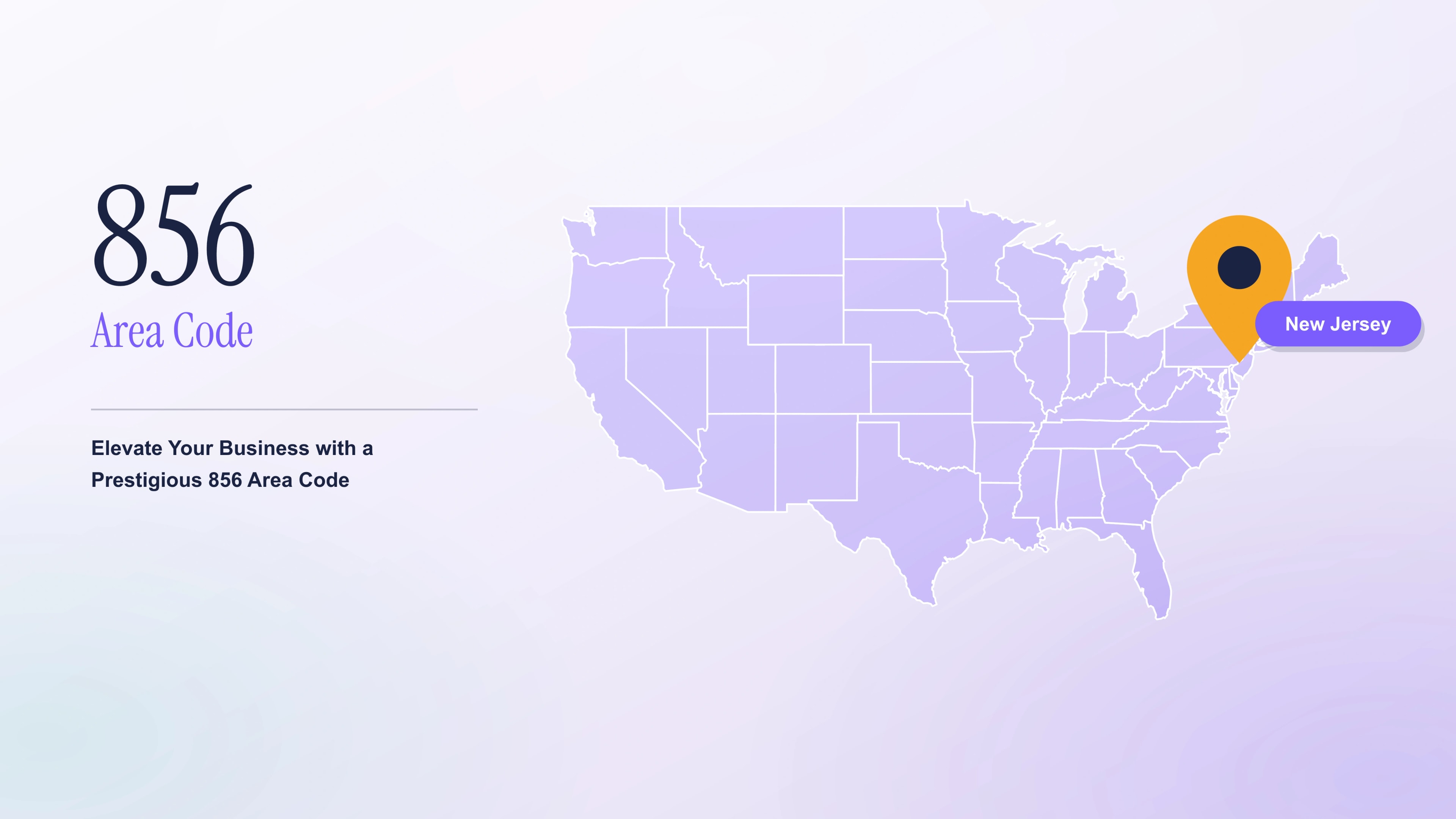
Stand on the Camden waterfront and Philadelphia is close enough to read the clock on City Hall — but the moment a call connects, the area code makes clear which side of the Delaware River you are on. For the densely populated suburbs of southwestern New Jersey, that code is 856. It rings phones from the rowhouse blocks of Camden and Collingswood to the shopping corridors of Cherry Hill and the farm-and-glass towns of Cumberland County.
Yet 856 is younger than many of the people who dial it. It was split from an older code barely a generation ago, as South Jersey's phone lines multiplied past what a single area code could hold. This guide explains where 856 came from, which counties and cities it reaches, how its Eastern-time dialing works, and the practical steps for a business to claim a local South Jersey number of its own.
Key Takeaways
- The 856 area code was created on June 12, 1999, as a split from area code 609 — the southwestern corner of southern New Jersey was carved out to form a brand-new code.
- It covers roughly 1.5 million people across Camden, Gloucester, Salem and Cumberland counties, including Camden, Cherry Hill, Vineland, and the New Jersey suburbs facing Philadelphia across the Delaware River.
- The region runs on Eastern Time (UTC-5), the same clock as New York and Philadelphia.
- Unlike its parent code, 856 has never received an overlay, so it still covers a single, exclusive slice of the map rather than sharing territory with a second code.
- A local 856 number gives South Jersey businesses instant regional credibility, and a cloud phone system makes one easy to get without a physical office.
What Is the 856 Area Code?
Area code 856 is the telephone area code for southwestern New Jersey — the band of the state that sits directly across the Delaware River from Philadelphia and stretches south toward the Delaware Bay. It serves the New Jersey side of the Philadelphia metropolitan area along with the rural and coastal-plain counties below it, a region of roughly 1.5 million residents woven into the same busy Northeast corridor as other demand-driven codes up and down the Mid-Atlantic.
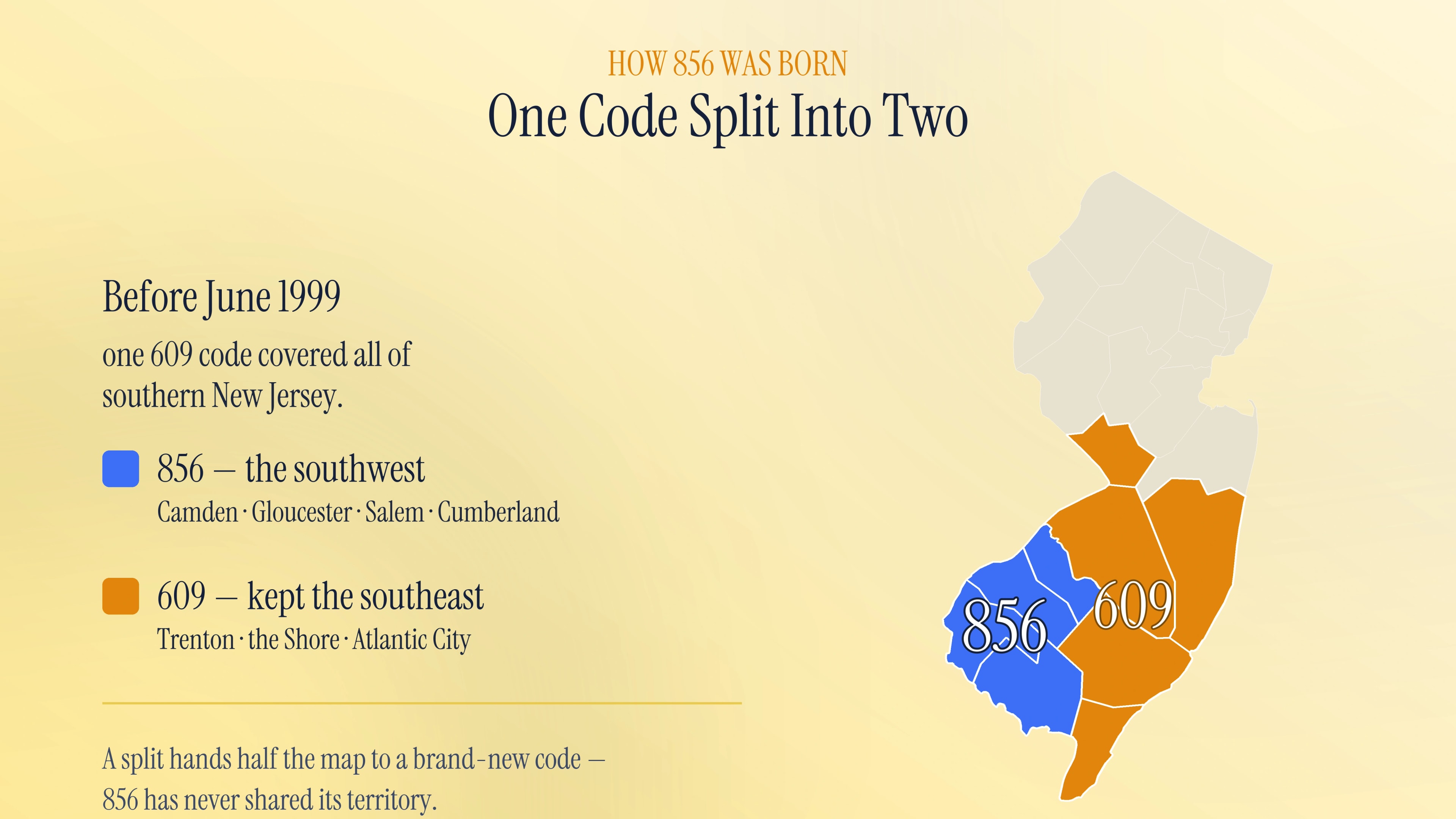
The code was born from growth. Through the 1990s, the single 609 code that once blanketed all of southern New Jersey ran short of available numbers, and regulators split it: the southwestern quarter became 856 in 1999, while 609 kept Trenton, the Jersey Shore, and Atlantic City. Because it was a split rather than an overlay, every affected phone line in the region physically changed its area code to 856.
Philadelphia's Jersey Suburbs Down to Cumberland County
The 856 area code covers all or part of six counties in the southwestern corner of New Jersey, concentrated in the populous suburbs east of Philadelphia and reaching down through the state's agricultural south. Coverage includes:
- Camden County core: Camden, Cherry Hill, Pennsauken, Collingswood, Gloucester City, and Voorhees
- Gloucester County: Deptford, Washington Township, Glassboro, and Woodbury
- Cumberland & Salem counties: Vineland, Millville, Bridgeton, and Salem
- Suburban Burlington edge: Moorestown, Maple Shade, and Marlton
In all, the code touches Camden, Gloucester, Salem and Cumberland counties along with slivers of Burlington and Atlantic. It is anchored by Camden — home to a rebuilt waterfront, Rutgers-Camden, and a cluster of hospitals and employers — and rounded out by the retail and residential suburbs that make South Jersey one of the busiest calling regions in the state.
Time Zone — Eastern Time
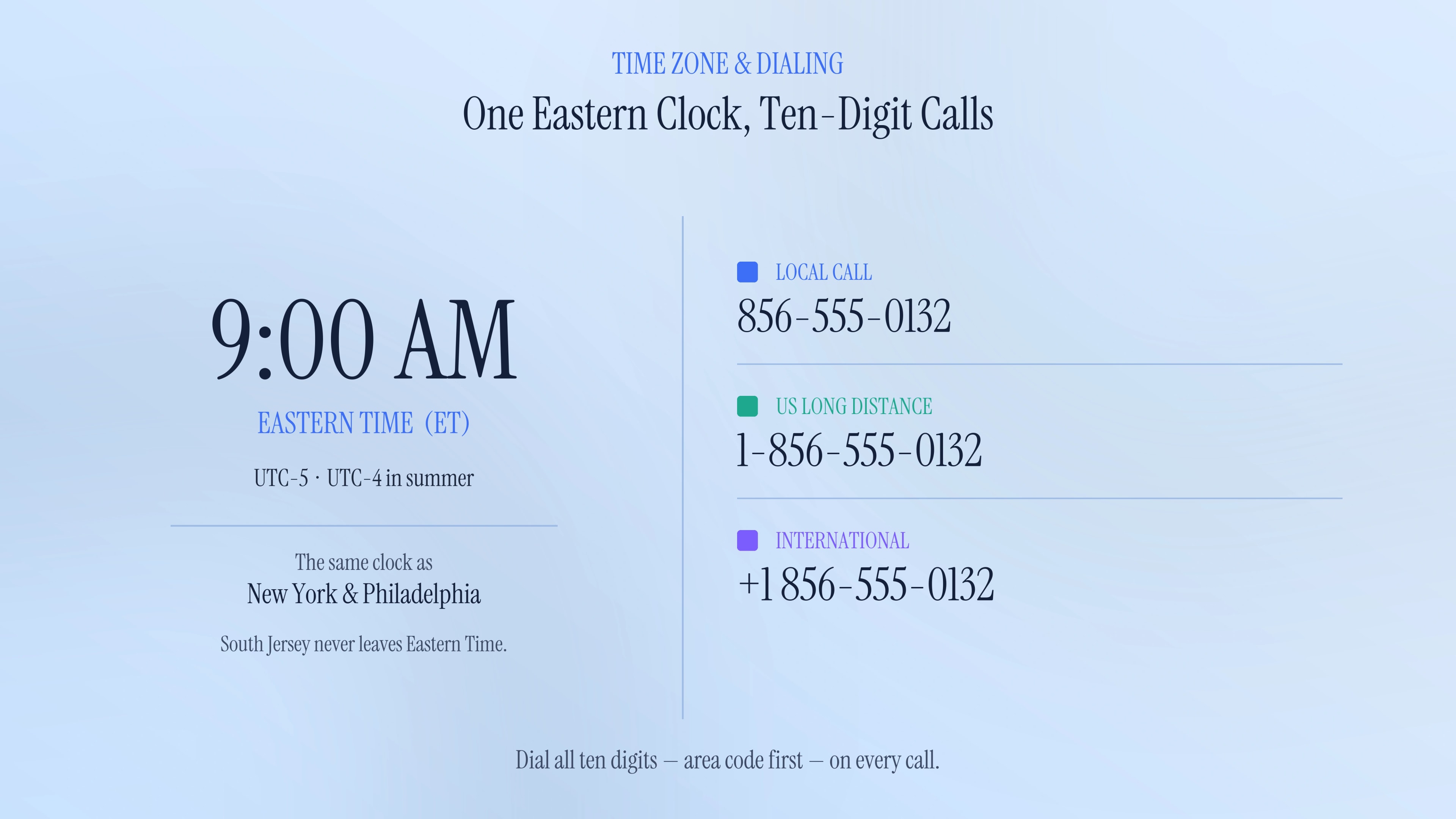
All of the 856 region observes Eastern Time (UTC-5), shifting to Eastern Daylight Time (UTC-4) from spring through fall — the same clock kept by New York, Philadelphia, and Washington, D.C. Any business staffing a support line or scheduling callbacks into South Jersey should plan around Eastern hours rather than the Central or Pacific schedules common at national call centers. Getting that right keeps an 856 line feeling genuinely local to the people on both ends of the call.
The Split from 609: How 856 Was Born
For most of the twentieth century, a single 609 code served all of southern New Jersey. As pagers, fax lines, second home lines, and the first wave of mobile phones ate through the supply of numbers in the 1990s, that one code could no longer keep up. On June 12, 1999, regulators split 609, and the fast-growing suburbs of the southwest became area code 856; new numbers entered service on June 14, with a permissive-dialing grace period that let people reach the region on either code until that November.
A split like this reassigns half of a region to a fresh code instead of layering a second code on top of the same streets — the same kind of split that carved the 978 area code out of Massachusetts's 508 code in 1997. Because 856 was drawn as an exclusive territory, it has never had to share its map, and every 856 number points unambiguously to southwestern New Jersey.
The practical upshot for callers is simple. Seven-digit dialing has traditionally worked for local calls inside 856, but because neighboring parts of South Jersey have moved toward ten-digit dialing as their numbering filled in, the reliable habit is to dial the full area code every time. For businesses, that means publishing every phone number in complete ten-digit form on websites, invoices, and signage so no customer ever misdials.
How an 856 Number Benefits Your Business
A South Jersey phone number does more than pin a business to a map; it shapes how a call is received before anyone picks up. Key advantages include:
- Recognized on both banks of the Delaware — an 856 caller ID tells Camden and Cherry Hill customers a business belongs to the New Jersey side of the Philadelphia metro.
- Fits the region's retail and healthcare hubs — from the shopping corridors of Cherry Hill to the hospitals anchoring Camden's rebuilt waterfront, a local prefix reads as established.
- A stable, unshared identity — because 856 has never been overlaid or split again, unlike its parent 609, the number a business claims today points unambiguously to South Jersey.
- Reaches from Vineland to Voorhees on one line — a cloud system lets a distributed team answer as local across Camden, Gloucester, Cumberland and Salem counties without local office space.
Put a local 856 number to work
Give your business an authentic South Jersey presence with an 856 number that rings anywhere you do business — no Camden office required.
How to Get an 856 Number
Securing a local South Jersey line is straightforward when the steps are taken in order. A clear process also improves the odds of landing a memorable, easy-to-share number:
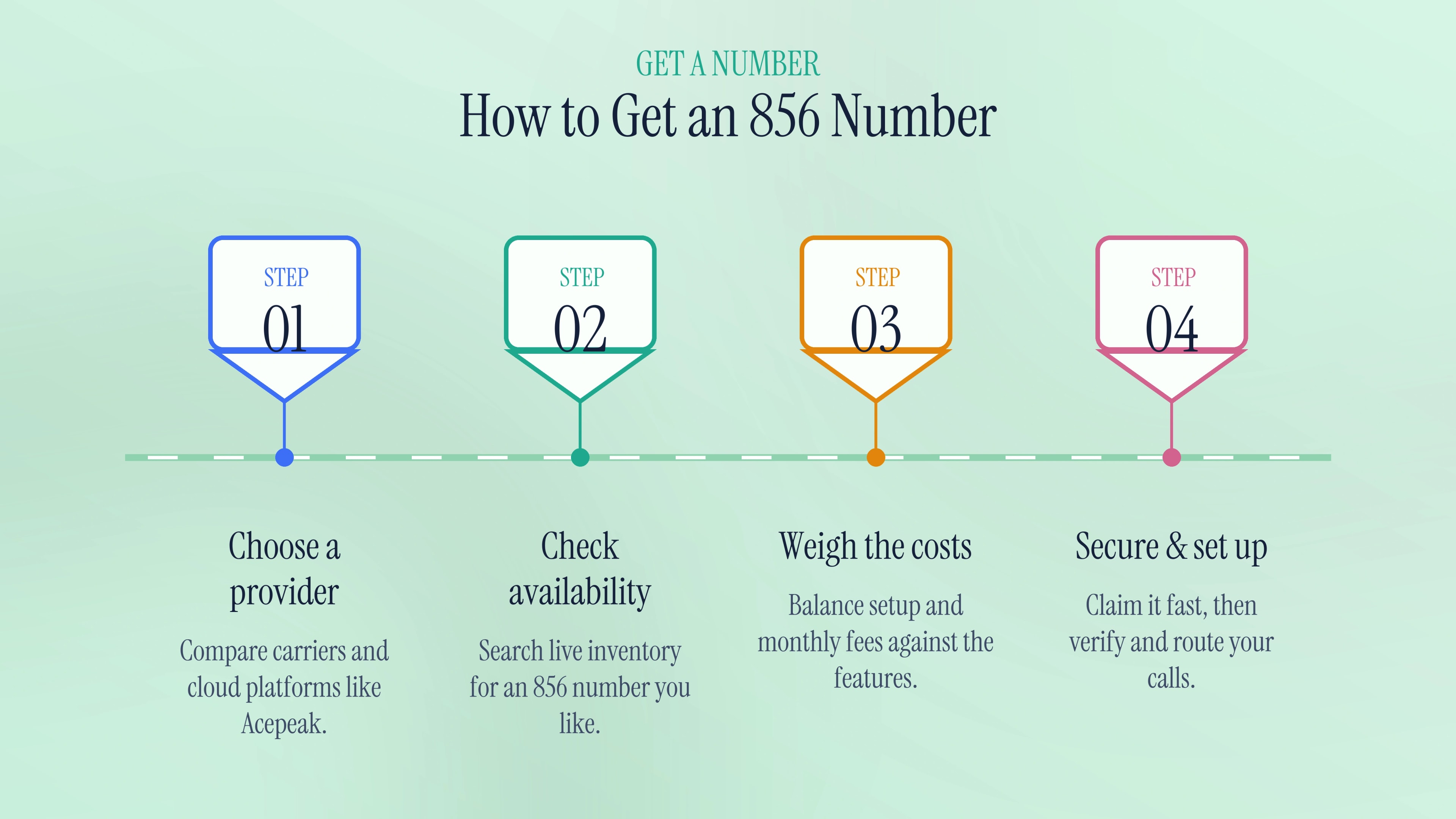
- Choose a provider stocking 856 numbers — compare cloud phone services carrying inventory across Camden, Gloucester and Cumberland counties, checking uptime and support quality.
- Check availability in your target town — search for prefixes tied to Cherry Hill, Vineland or the Camden waterfront specifically, and ask about alerts when new numbers open up.
- Weigh the costs against South Jersey needs — balance fees against features like call routing and voicemail-to-email that a distributed team calling into the region will actually use.
- Secure the number quickly — desirable 856 numbers in growing towns like Glassboro and Woodbury move fast, so lock one in and complete verification once you find it.
Staying Aware of Scam Calls
The same local familiarity that helps legitimate South Jersey businesses can be abused by bad actors who spoof an 856 number to look trustworthy on a neighbor's caller ID. A few habits keep customers and teams protected:
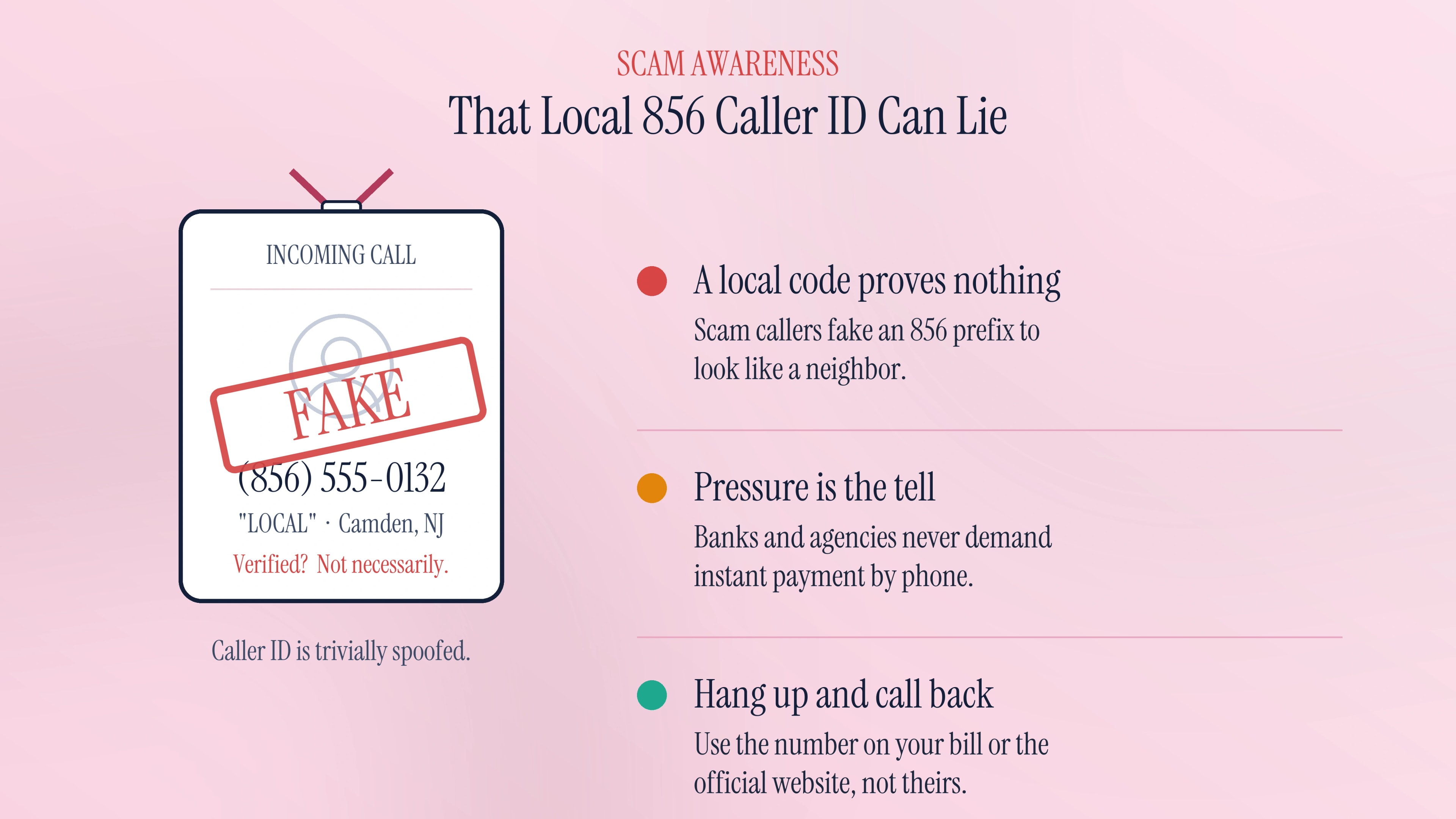
- A local code proves nothing — spoofing an 856 prefix is trivial, so a familiar area code is no guarantee the caller is who they claim.
- Be wary of urgency — threats, prizes, or "act now" pressure are classic warning signs, whatever the number on the screen.
- Never share sensitive data on inbound calls — verify the caller through an official number before giving any account or payment details.
- Hang up and call back — look up a company's published line and dial it yourself rather than trusting a number that called you.
The Future of the 856 Area Code
Because 856 was drawn as an exclusive code and has never been split again or overlaid, its supply of numbers has held up well even as South Jersey keeps growing. The suburbs of Camden County and the towns of Gloucester and Cumberland continue to add residents and businesses, and for now the region's numbering plan has the room to absorb that growth without another code change.
The practical benefit for South Jersey firms is predictability. An 856 number claimed now is unlikely to be pulled into a code change, and once it runs on a cloud platform it can ring in Voorhees, at a remote worker's desk, or in a new sales territory while callers still see a number from the New Jersey side of the Delaware River.
A Code Born of South Jersey's Growth, Built for Trust Today
More than a set of digits, 856 is a marker of how much southwestern New Jersey grew in the decades after a single code covered the whole south of the state. It gives businesses real local credibility and higher answer rates across Camden, Cherry Hill, Vineland, and the suburbs in between — all without the overhead of a physical storefront. With modern cloud calling, claiming and running a South Jersey line has never been simpler, and for any company serious about the market, a local number is a small step that pays off in trust.
Claim your South Jersey presence today
Acepeak makes it easy to get an 856 number and start taking calls across Camden, Cherry Hill, Vineland and the rest of southwestern New Jersey.
Questions, answered.
Area code 856 covers southwestern New Jersey — the suburbs across the Delaware River from Philadelphia and the counties below them, including Camden, Cherry Hill, Vineland, Millville, and Bridgeton.
It was created on June 12, 1999, as a split from area code 609, with new 856 numbers entering service that June and a permissive-dialing period running into November 1999.
856 was split from 609, which had previously served all of southern New Jersey. After the split, 609 kept the Trenton area, the Jersey Shore, and Atlantic City.
The entire region observes Eastern Time (UTC-5), moving to Eastern Daylight Time (UTC-4) during daylight saving months — the same clock as New York and Philadelphia.
No. Unlike its parent code 609, area code 856 has never received an overlay, so it still covers an exclusive territory rather than sharing the same map with a second code.
Yes. With a cloud phone system you can activate a local 856 number and route it to a team anywhere, so the number looks local to South Jersey callers while your staff works from any location.
Signing up for an 856 area code number takes minutes with a cloud phone provider — no local office in South Jersey required. Pick the number, connect it to your existing phone or app, and calls route in immediately. This keeps the 856 area code presence you already have while adding the local credibility New Jersey customers respond to.