Desert Basins, Sky Islands and a Fast-Growing Metro
Southeastern Arizona is a region of wide desert basins, mountain "sky islands," and a fast-growing metro anchored by Tucson — the state's second-largest city and home to the University of Arizona. From the copper towns of Cochise County to the border crossing at Nogales and the farmland of the Gila Valley, a single prefix ties this corner of the state together. Carved from the original statewide code in 1995, it later spun off a code of its own and now stands as the clear signature of southern Arizona. This guide explains where it reaches, how dialing works, and how any business can claim a local presence here.
Key Takeaways
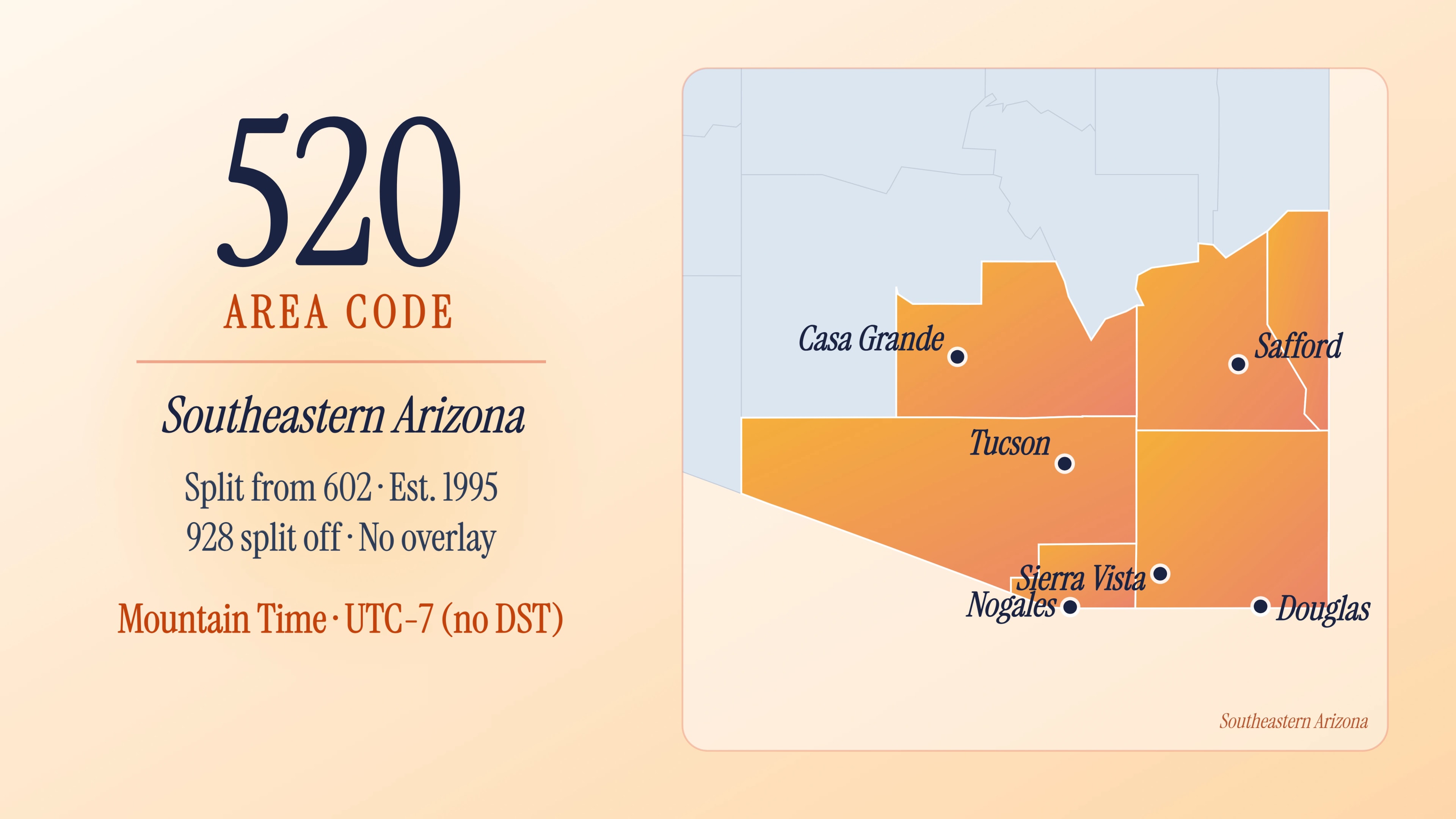
- The 520 prefix serves southeastern Arizona — Tucson and the communities of Pima, Pinal, Santa Cruz, Cochise, Graham, and Greenlee counties stretching to the Mexican border.
- It was created on March 19, 1995 as a split from area code 602, which had covered the entire state since 1947.
- In 2001 the 928 code split away to serve northern and western Arizona, leaving 520 with the southeast.
- The region observes Mountain Time and — like nearly all of Arizona — does not change clocks for daylight saving, so it stays on UTC-7 all year.
- A local southern-Arizona number lifts answer rates and builds trust, and a cloud provider can activate one in minutes.
What Is the 520 Area Code?
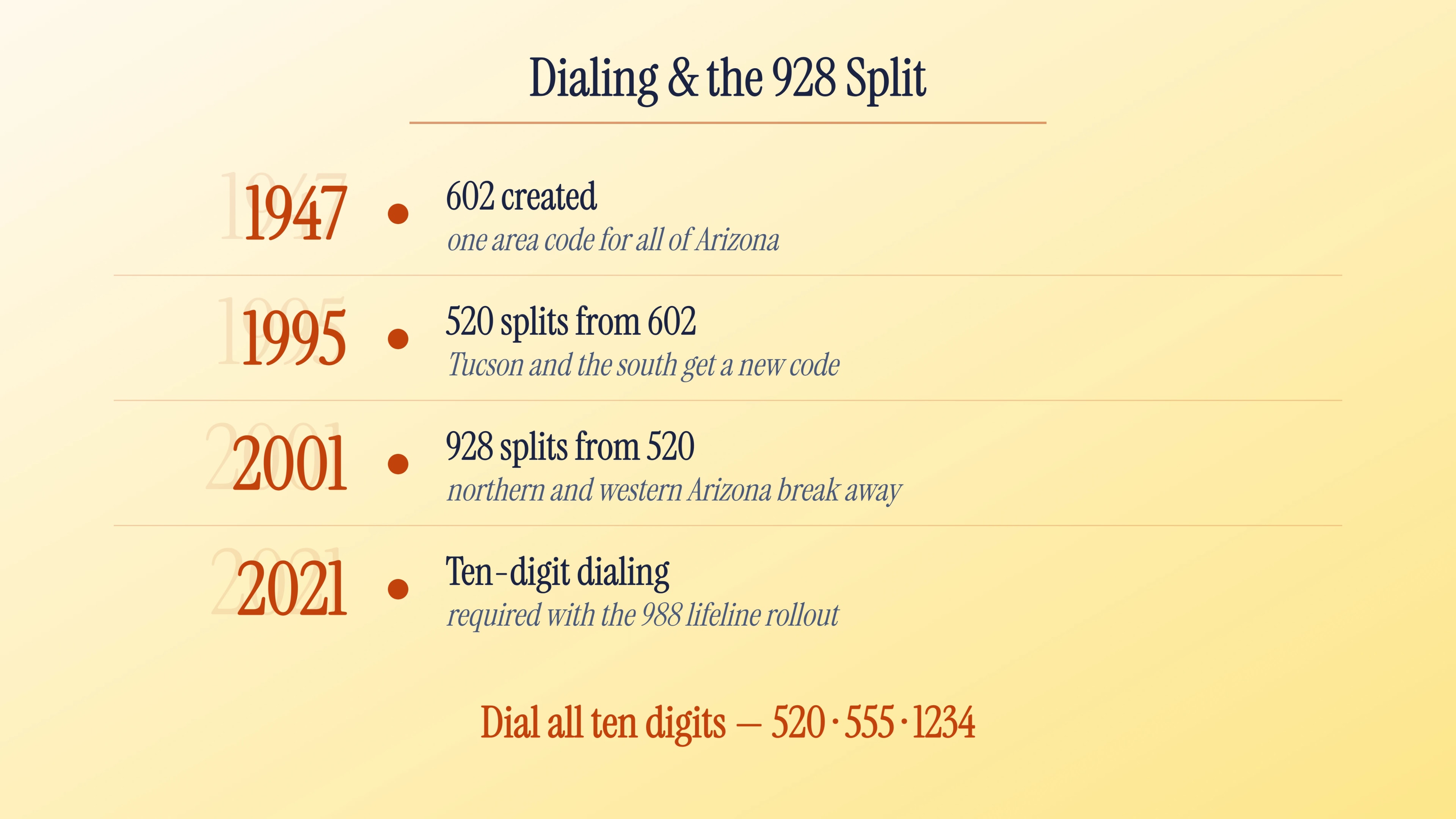
The prefix is a child of Arizona's original code. From 1947 until the mid-1990s, a single code — 602 — served the entire state. On March 19, 1995, rapid growth forced a split: metropolitan Phoenix kept 602, and everything else, including Tucson and the north, became 520. It was a vast territory, and the same growth that created it would soon divide it again. Sprawling metros across the Southwest faced the same pressure — Los Angeles split its core code to create the 323 area code in the same era.
Six Counties Stretching to Two Borders
Today the code covers southeastern Arizona — anchored by Pima County and Tucson, and reaching across Pinal, Santa Cruz, Cochise, Graham, and Greenlee counties to the New Mexico and Mexico borders. The major population centers include:
- Tucson — the region's largest city and home of the University of Arizona
- Casa Grande and the growing Pinal County corridor between Tucson and Phoenix
- Sierra Vista, Douglas, Bisbee and Benson across Cochise County
- Nogales and Rio Rico on the border, plus Safford and the Gila Valley to the east
Time Zone — Mountain, No Daylight Saving
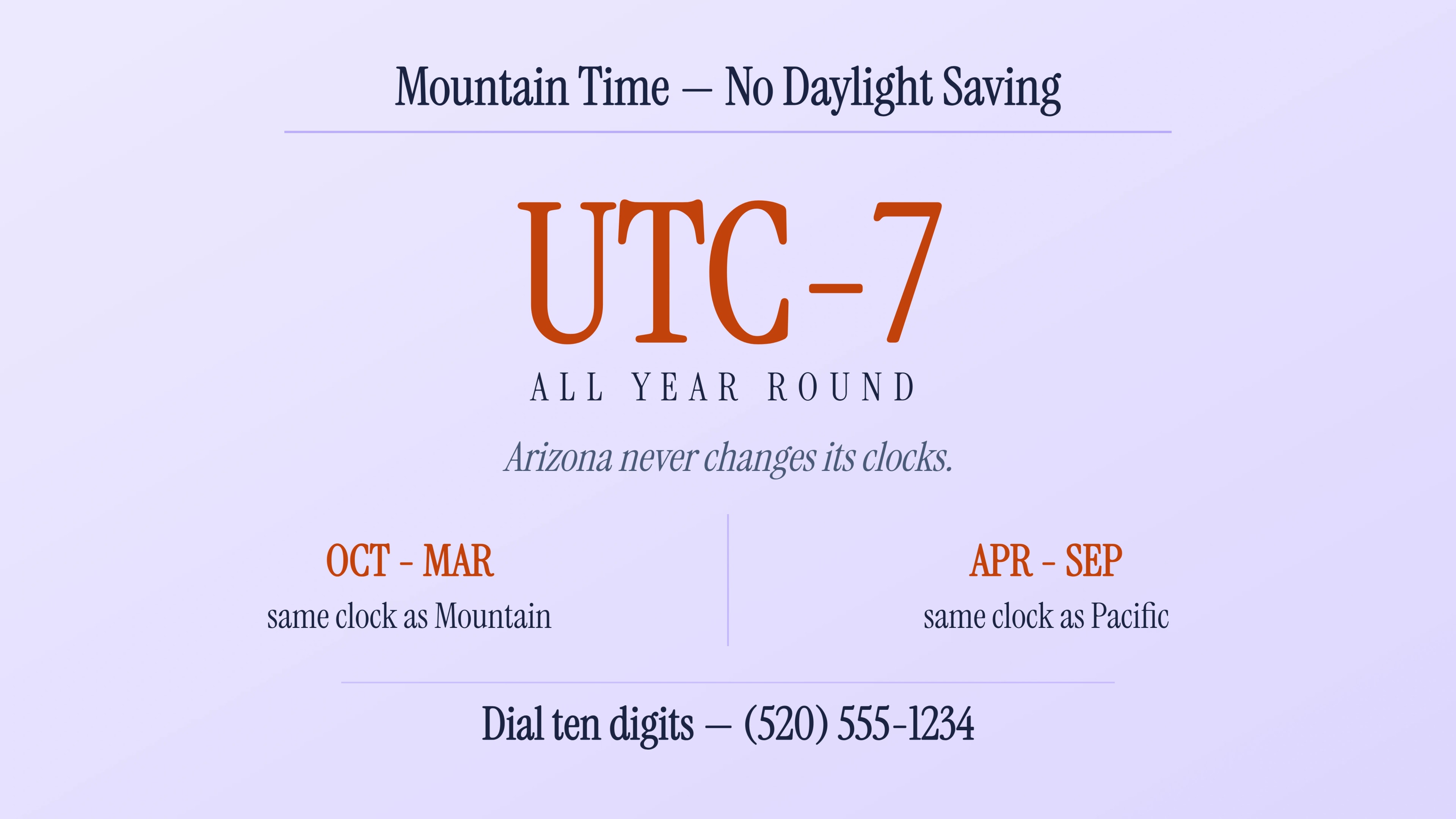
The 520 region observes Mountain Standard Time (UTC-7) — but with a twist that sets Arizona apart. The state does not observe daylight saving time, so clocks here never change. For roughly half the year that puts southern Arizona on the same clock as the Mountain zone, and for the summer half it matches Pacific Time on the West Coast. For businesses scheduling calls across state lines, it is worth remembering: Arizona stays put while most of the country springs forward and falls back.
Dialing and the 928 Split
For most of its life, the region dialed just seven digits. The 1995 territory proved too large to last: in 2001 the 928 code split away to serve northern and western Arizona — Flagstaff, Prescott, and Yuma — leaving 520 with the southeast. Ten-digit dialing later became mandatory in October 2021, when the nationwide rollout of the 988 Suicide and Crisis Lifeline ruled out seven-digit numbers beginning with 988. The split-and-renumber story is common in fast-growing regions — New York's Long Island carved out the 631 area code from its own crowded code the same way. Today every local 520 call uses the full ten digits.
Benefits of a 520 Number for Business
From Tucson to the Nogales border crossing, a 520 number tells callers that a business belongs to southern Arizona. That recognition does its work in the background on every call a company places or receives.
- Local credibility: a Tucson or Sierra Vista customer answers a 520 call as a neighbor's, not an unfamiliar out-of-state one.
- Border-to-basin reach: a single 520 number spans from the University of Arizona in Tucson to the border crossing at Nogales and the copper hills of Cochise County.
- Reach anywhere: cloud calling lets a company hold a local presence here while operating from anywhere.
- No-overlay clarity: since 520 has never needed a second code, a Tucson-area number carries the same unambiguous identity it has held since the 928 split in 2001.
Ready to claim a southern-Arizona presence?
Acepeak provisions local numbers with carrier-grade routing and instant activation, so a business can sound local from day one.
How to Get a 520 Number
One 520 line can serve customers from Casa Grande to Nogales, and getting it follows the same four steps for a single user or a team:
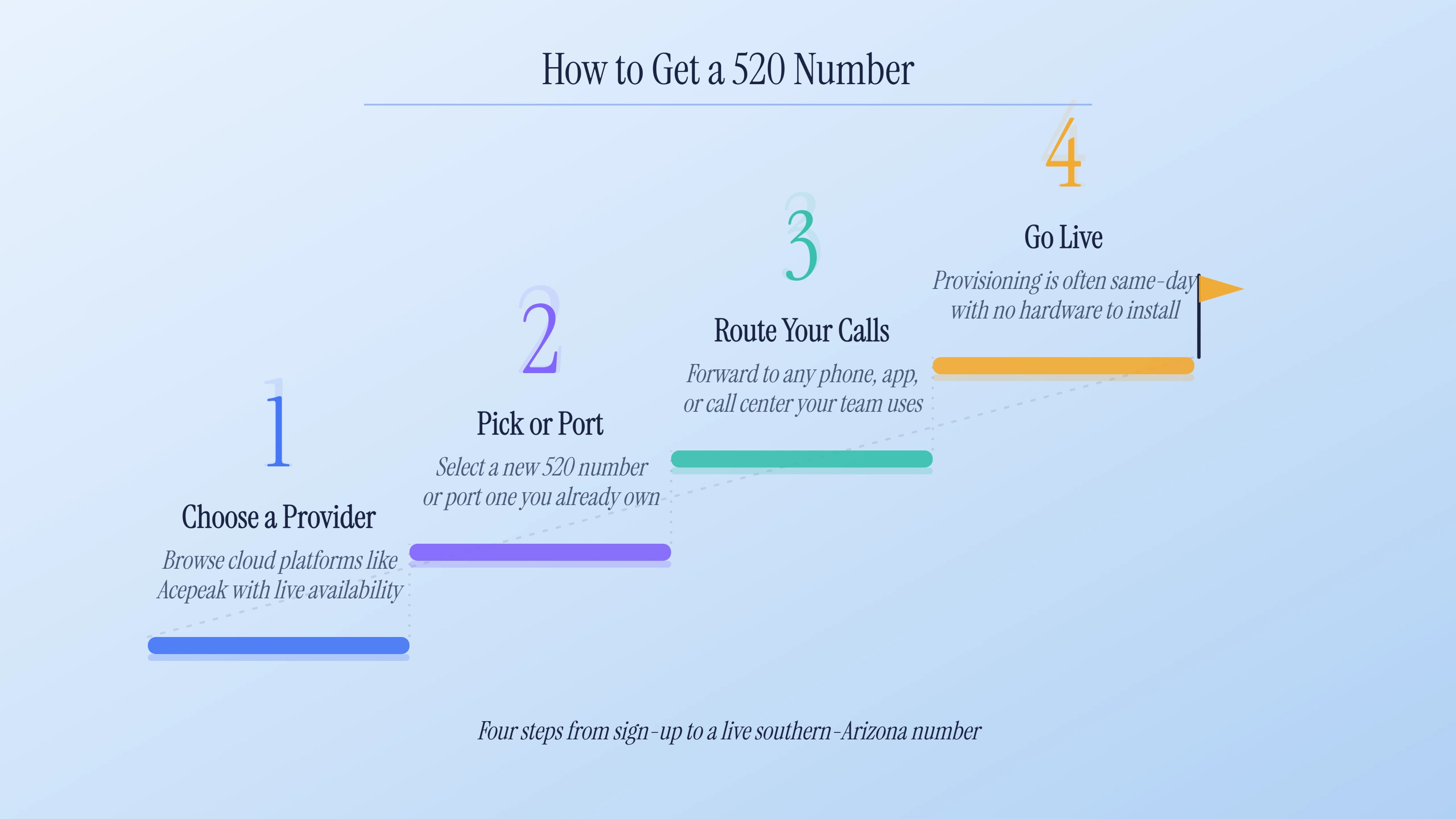
- Choose a provider: cloud platforms like Acepeak assign local numbers online with live availability.
- Pick or port a number: choose a new 520 number or transfer one you already own.
- Route your calls: send them to any phone, app, or call center your team uses.
- Go live: provisioning is often same-day, with no hardware to install.
Reporting Faked Local Numbers to State Authorities
Because a local code looks trustworthy, scammers sometimes spoof it to appear nearby. A local-looking call still deserves scrutiny — the Arizona Attorney General takes reports of robocalls and spoofed numbers and publishes guidance for residents.
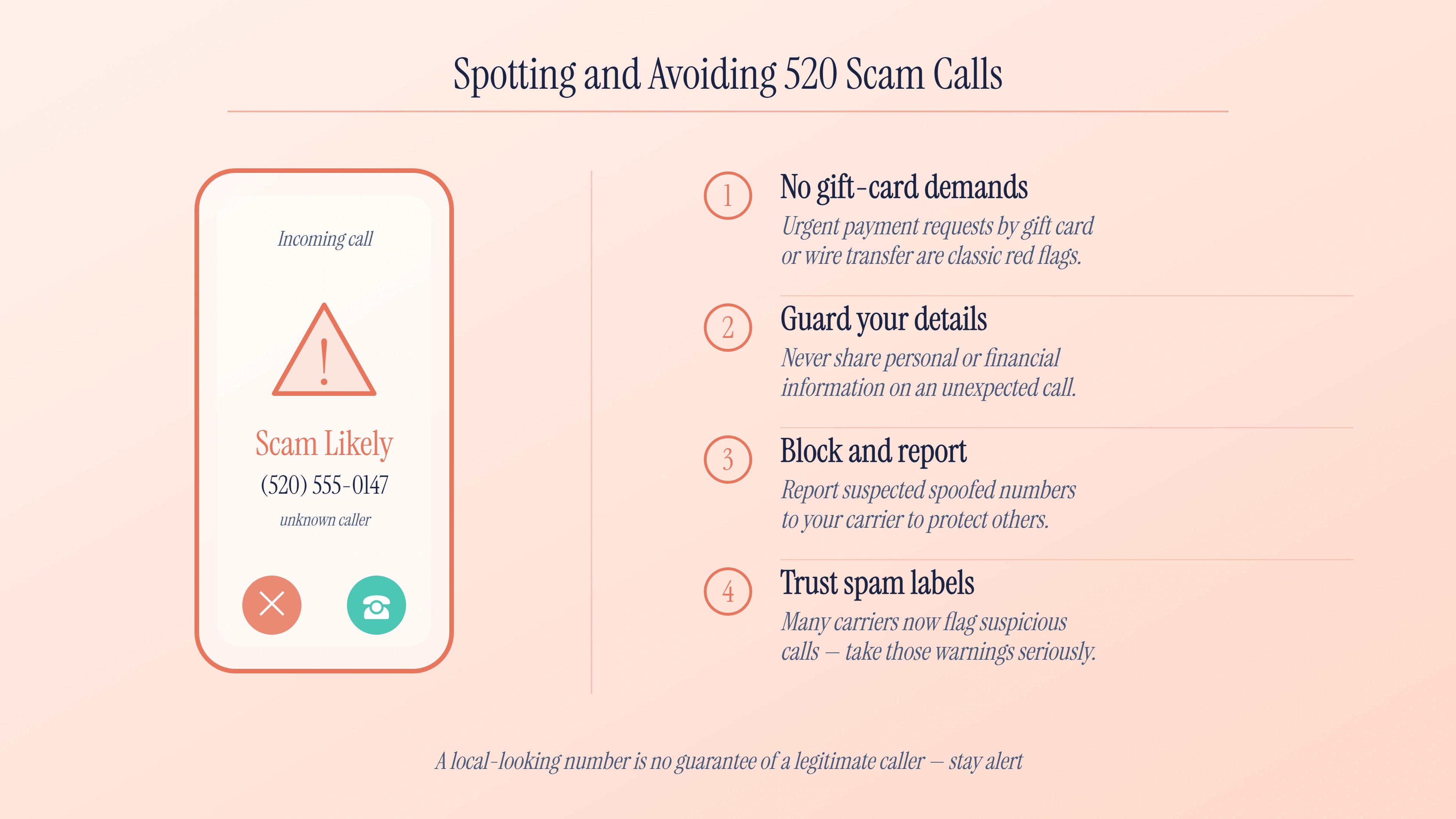
- Ignore urgent demands for payment by gift card or wire — they are classic red flags.
- Never share personal or financial details on a call you did not place.
- Block and report suspected spoofed numbers to your carrier.
- Heed the spam labels many carriers now add to suspicious calls.
The Future of the 520 Area Code
With no overlay and a single code now serving the southeast, 520 has a stable pool of numbers and no disruptive change on the horizon. The code is regulated as part of Arizona's telephone network, and demand stays healthy thanks to Tucson's steady growth and the spread of business across Pima and Pinal counties. For businesses and residents the outlook is steady: existing numbers stay in place, the code remains the unmistakable mark of southern Arizona, and a local identity is available through any cloud provider or carrier today.
Two Splits and a Dialing Change Did Not Dilute Its Identity
The 520 prefix is more than a routing code; it is shorthand for southern Arizona, from the streets of Tucson to the border at Nogales and the copper hills of Cochise County. It has weathered a 1995 split, the 2001 departure of 928, and the move to ten-digit dialing without losing its standing. For a business, a local number remains one of the cheapest, most credible ways to signal local roots — and with cloud calling, that presence is available to anyone, anywhere.
Put a trusted southern-Arizona number to work today.
Acepeak delivers local lines with smart routing, voicemail, and 24/7 support — everything a business needs to stay reachable.
Questions, answered.
It covers southeastern Arizona — including Tucson, Casa Grande, Sierra Vista, Nogales, Douglas and Safford — across Pima, Pinal, Santa Cruz, Cochise, Graham and Greenlee counties.
Mountain Standard Time (UTC-7). Arizona does not observe daylight saving, so the 520 region stays on the same clock all year while most of the country changes twice a year.
Yes. Ten-digit dialing became mandatory in October 2021 as part of the nationwide 988 rollout, so every local 520 call now uses the area code plus the seven-digit number.
They were once the same code. In 2001 the 928 code split away to serve northern and western Arizona (Flagstaff, Prescott, Yuma), while 520 kept the southeast around Tucson.
It was created on March 19, 1995 as a split from area code 602, which had served all of Arizona since 1947.
Yes. Cloud and hosted phone services let a business hold a local southern-Arizona number from anywhere while keeping a local presence.
Signing up for a 520 area code number takes minutes with a cloud phone provider — no local office in Tucson required. Pick the number, connect it to your existing phone or app, and calls route in immediately. This keeps the 520 area code presence you already have while adding the local credibility Arizona customers respond to.