Two Splits, One Overlay and Ten-Digit Dialing Since 2023
Arizona's original telephone prefix, 602, has anchored Phoenix communication since 1947. Decades of growth split the region twice — first into 520 in 1995, then into 480 and 623 in 1999 — yet 602 remains the number Phoenix businesses reach for first. Since September 2023, the Arizona Corporation Commission has run 602, 480, and 623 as a single overlay across the Valley, meaning all three now cover identical territory and every call requires ten-digit dialing. For a company weighing a local Phoenix presence, understanding what this prefix covers, what it costs, and how to activate one is the first step toward a credible regional footprint.
Key Takeaways
- 602 is Arizona's oldest active prefix, assigned in 1947 and still serving central Phoenix today.
- Since September 2023, 602, 480, and 623 operate as a single overlay with no geographic boundaries between them.
- Ten-digit dialing (area code + number) is mandatory for every call across the Phoenix metro.
- NANPA has projected 602 number exhaustion around 2026, making numbers increasingly scarce.
- A local Phoenix prefix improves call answer rates and reads as more credible than an out-of-state or toll-free number.
What Makes the 602 Area Code So Special?
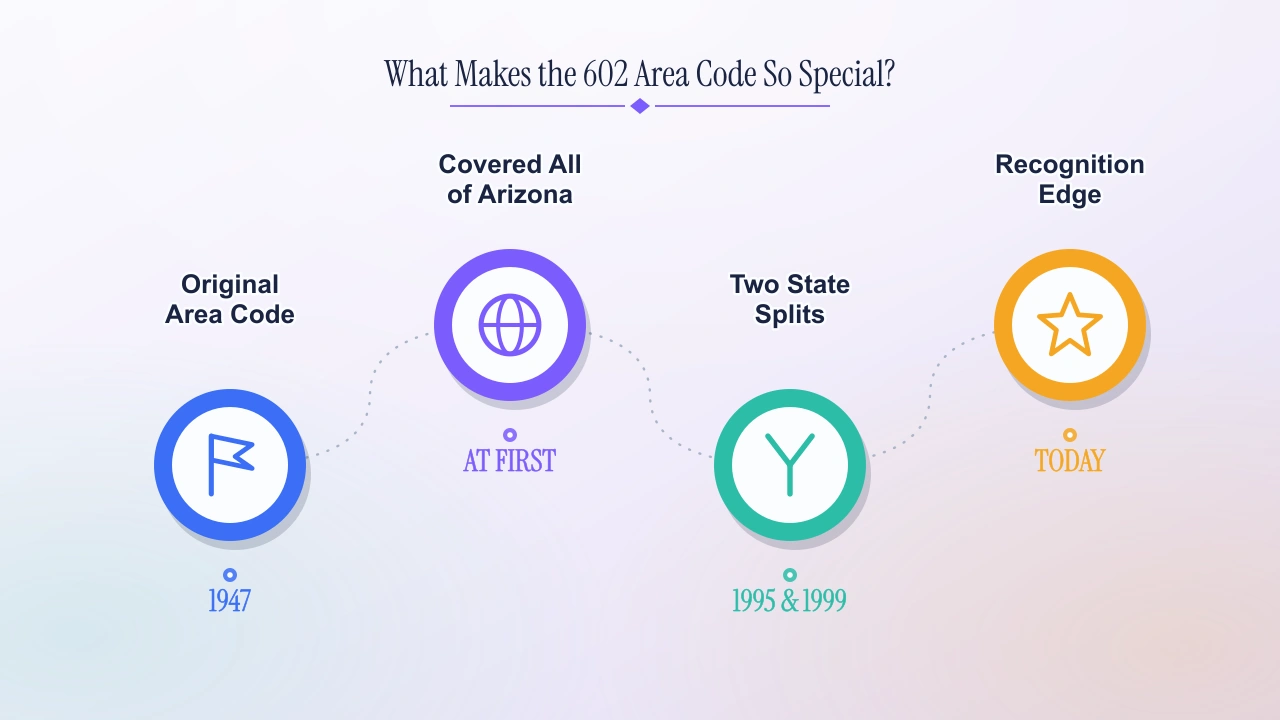
Assigned by AT&T in 1947 as one of the original 86 North American area codes, 602 once covered the entire state of Arizona. Two subsequent splits — carving out 520 in 1995 and both 480 and 623 in 1999 — narrowed its footprint to central Phoenix, but its age gives it a recognition edge: longtime residents and legacy businesses still associate 602 with the city's core rather than its newer suburbs.
Coverage, Time Zone, and Cities Served by the 602 Area Code
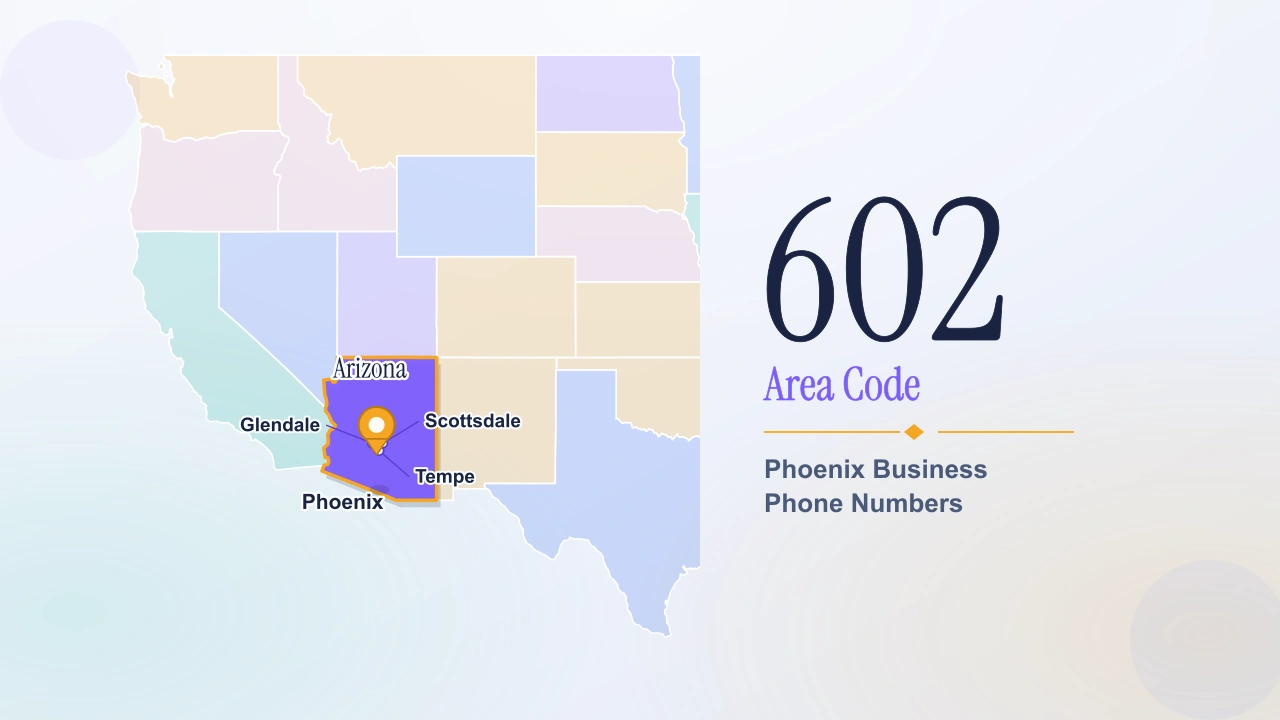
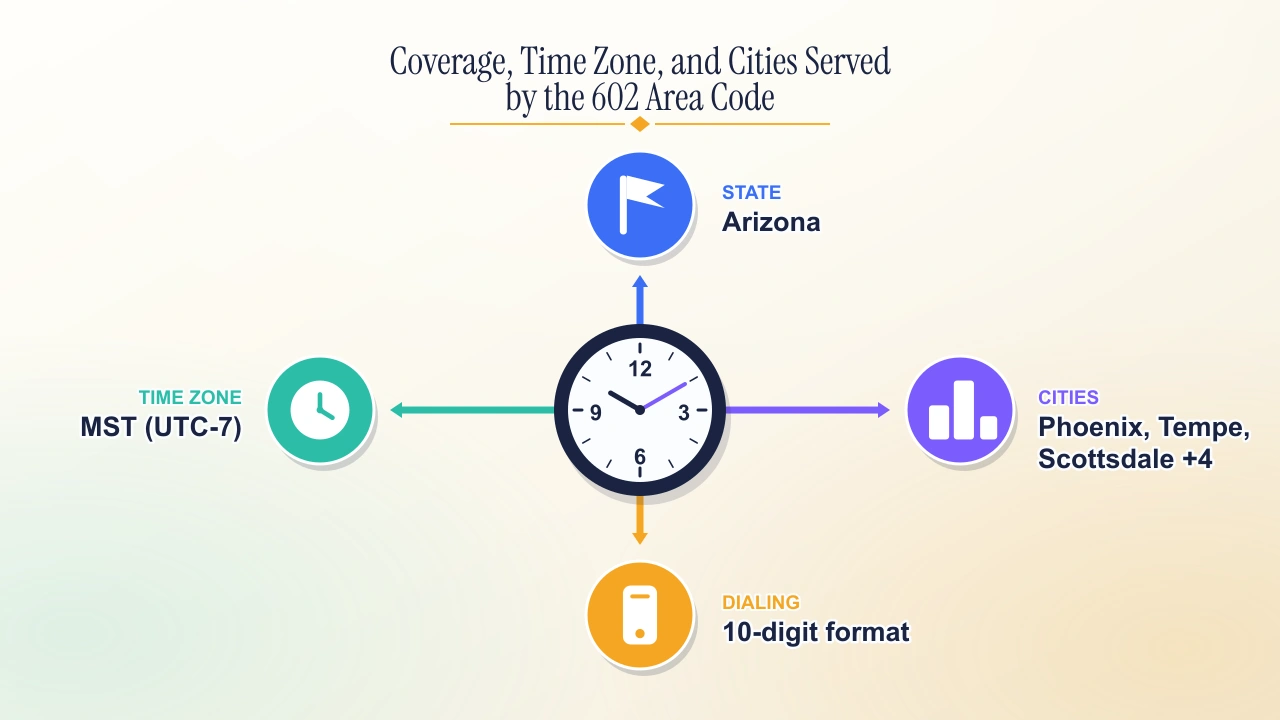
The prefix covers Phoenix, Tempe, Scottsdale, Glendale, Chandler, Cave Creek, and Maricopa — all within Maricopa County's urban core. The region observes Mountain Standard Time (MST, UTC−7) year-round; Arizona does not observe daylight saving. Since the 2023 overlay, every local call — even to a neighboring desk — requires all ten digits.
| Detail | Information |
|---|---|
| State | Arizona |
| Time zone | Mountain Standard Time (UTC−7), no daylight saving |
| Primary cities | Phoenix, Tempe, Scottsdale, Glendale, Chandler, Cave Creek, Maricopa |
| Dialing format | 10-digit (602-555-1234) required for all local calls |
Since the overlay took effect, 602 shares its territory with western Phoenix's 623 prefix, so a business number in either code reaches the identical metro footprint — the choice mostly comes down to which number is currently available.
How a 602 Number Can Benefit Your Business
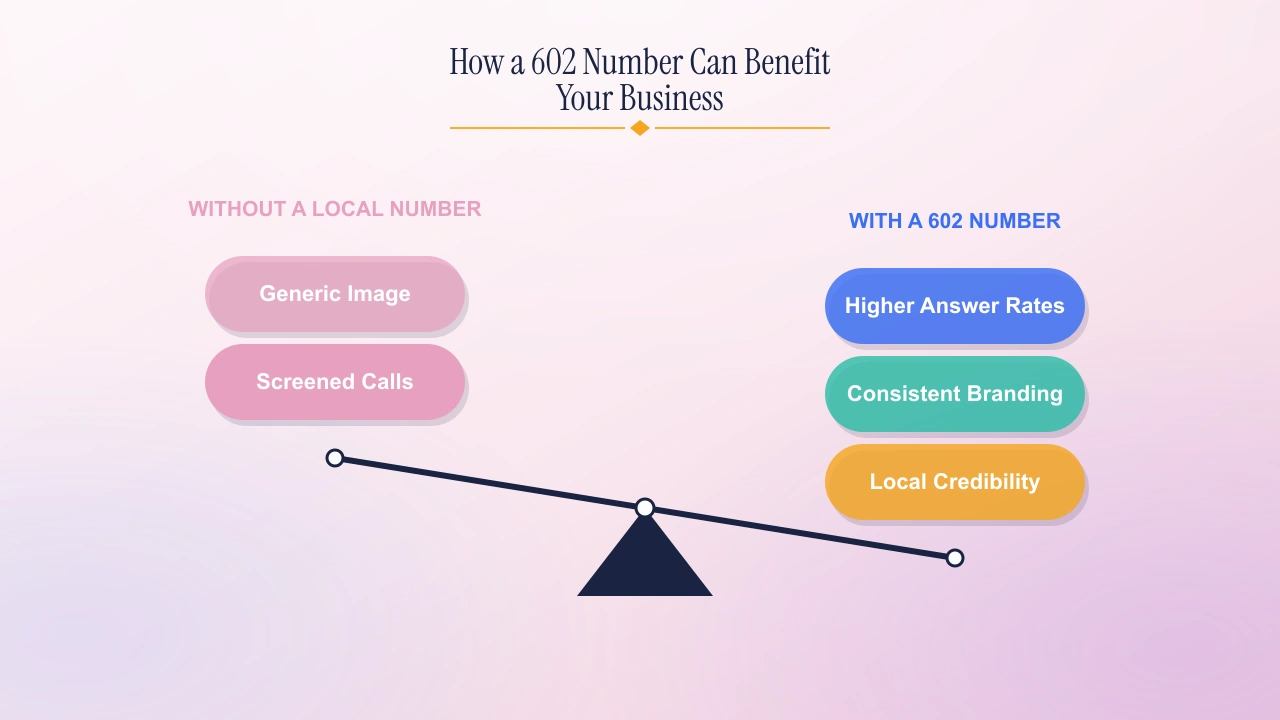
A Phoenix-based number reads as more established to local callers and improves answer rates, since customers screen unfamiliar codes far more often than recognizable local ones. Once secured, the number should appear consistently across a website footer, Google Business Profile, email signatures, and print materials — consistency matters more than placement, since a number formatted five different ways across five channels undermines the credibility it's meant to build.
Strategies and Costs for Acquiring a 602 Area Code
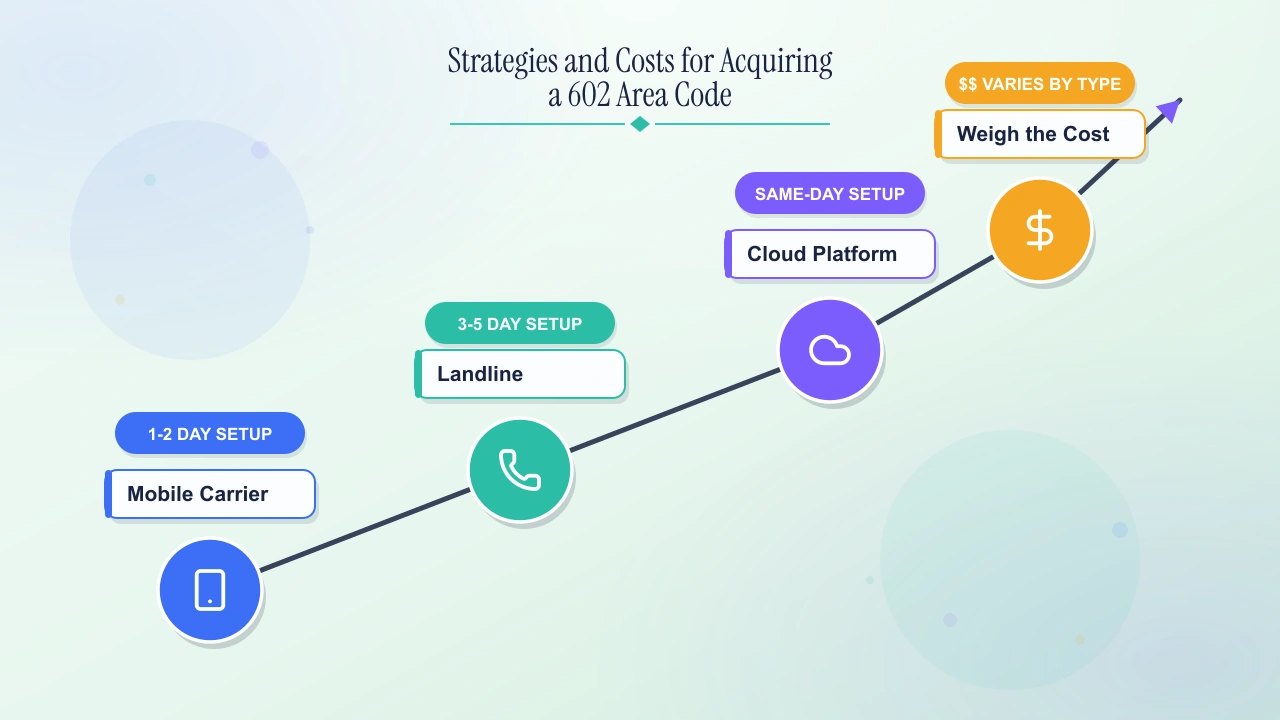
Businesses generally take one of two paths: porting an existing inactive 602 number from a previous holder, or requesting a fresh one directly through a cloud phone provider. It's worth checking availability across a few providers before committing, and staying flexible on the exact digits if a specific combination isn't open. Standard numbers typically run close to a provider's base monthly rate, while memorable or vanity combinations can climb into the hundreds of dollars as a one-time or premium recurring fee.
| Provider type | Best for | Typical setup time | Key features |
|---|---|---|---|
| Mobile carrier | Personal or small business | 1–2 days | Standard voice plan |
| Landline provider | Office use | 3–5 days | Fixed-line reliability |
| Cloud phone platform | Growing businesses | Same day | Call forwarding, analytics, porting |
Set up your Phoenix number today
Acepeak activates 602 numbers with call forwarding, voicemail transcription, and analytics built in — no hardware required.
The Availability and Future of 602 Numbers
Because 602 is Arizona's oldest and most number-dense prefix, inventory is tighter than in newer codes — a scarcity NANPA's own exhaustion forecast, projecting exhaustion around 2026, reflects directly. Businesses that can't find a suitable 602 number sometimes look at toll-free options instead, trading local familiarity for nationwide reach. Working with a provider that refreshes its inventory frequently improves the odds of landing a usable number either way.
Why a Local Number Still Matters
In a metro area with three overlapping area codes, the number a business displays is one of the few visible signals of where it's actually based — a Phoenix prefix on a business card or invoice reinforces that the company operates locally, not through a call center elsewhere. Caller behavior research consistently shows people are likelier to answer numbers that look local, so a 602 prefix reduces the odds a legitimate sales or support call gets screened as spam.
Getting Started: A Step-by-Step Guide
- Confirm what's actually open — since 602, 480, and 623 now cover identical Valley territory, check live inventory rather than assuming the original code is scarce.
- Move quickly on availability — NANPA's 2026 exhaustion forecast makes 602 the tightest of the three Phoenix codes, so set alerts and act fast.
- Compare providers on total cost — with mandatory ten-digit dialing across Phoenix, Tempe, Scottsdale, Glendale, Chandler, and Maricopa, weigh the plan itself, not which overlay code issues the digits.
- Secure and activate the line — once a workable 602 number appears, claim it promptly and configure forwarding and voicemail before publishing it anywhere.
Once a number is active, watch for callers spoofing it to run scams — report suspected phone scams if you or your customers ever receive one.
Ready to go local in Phoenix?
Acepeak makes it simple to claim a 602 number with same-day activation, call forwarding, and built-in analytics.
Why Phoenix Buyers Should Move Quickly on Open Numbers
The 602 area code has anchored Phoenix communication for nearly 80 years, and even after two boundary splits and a 2023 overlay that put it on equal footing with 480 and 623, it remains the prefix most closely tied to the city's core. For a business weighing a local Phoenix presence, the calculation is straightforward: check current availability, compare provider pricing, and move quickly once a workable number turns up, since NANPA's own exhaustion forecast suggests the window won't stay open indefinitely.
Questions, answered.
Phoenix, Tempe, Scottsdale, Glendale, Chandler, Cave Creek, and Maricopa, all within the Mountain Standard Time zone.
Geographically, no — since September 2023 all three operate as an overlay covering the same Phoenix metro territory, though they remain distinct number pools.
Yes. Ten-digit dialing has been mandatory across the 602, 480, and 623 overlay region since the boundary change.
Standard numbers are typically included in a provider's base monthly plan; premium or vanity combinations can cost significantly more, sometimes hundreds of dollars.
Yes, most cloud phone providers support porting an inactive or existing 602 number, subject to the current holder's release and standard verification.
Signing up for a 602 area code number takes minutes with a cloud phone provider — no local office in Arizona required. Pick the number, connect it to your existing phone or app, and calls route in immediately. This keeps the 602 area code presence you already have while adding the local credibility Arizona customers respond to.