Growth, Startups and the 2012 Arrival of a Second Code
Area code 669 plays an important role in California's phone system, particularly in the heart of Silicon Valley. It operates alongside the older 408 code and was introduced in 2012, after the region began running short of available phone numbers — a shortage driven by rapid population growth, a steady stream of new businesses, and the constant expansion of the technology industry.
Today, the 669 prefix helps support one of the world's leading technology centers, where millions of people live and work. For business owners, job seekers, and anyone staying in touch with friends and family, understanding how this code works can be genuinely useful. This guide explains where 669 numbers are used, how to dial them correctly, how to get one, and simple ways to stay protected from phone scams.
Key Takeaways
- The CPUC approved area code 669 as an overlay on the 408 region in October 2011; it went live on November 20, 2012.
- It serves Santa Clara County plus small parts of Alameda and northern Santa Cruz counties — the core of Silicon Valley.
- The region runs on Pacific Time: UTC-8 in winter, UTC-7 during Daylight Saving Time.
- Ten-digit dialing (1 + area code + seven-digit number) is required on every call, even local ones.
- Because scammers frequently spoof local numbers, unexpected calls from the prefix deserve caution.
The Bay Area's First Overlay, a Plan Delayed Since 1998
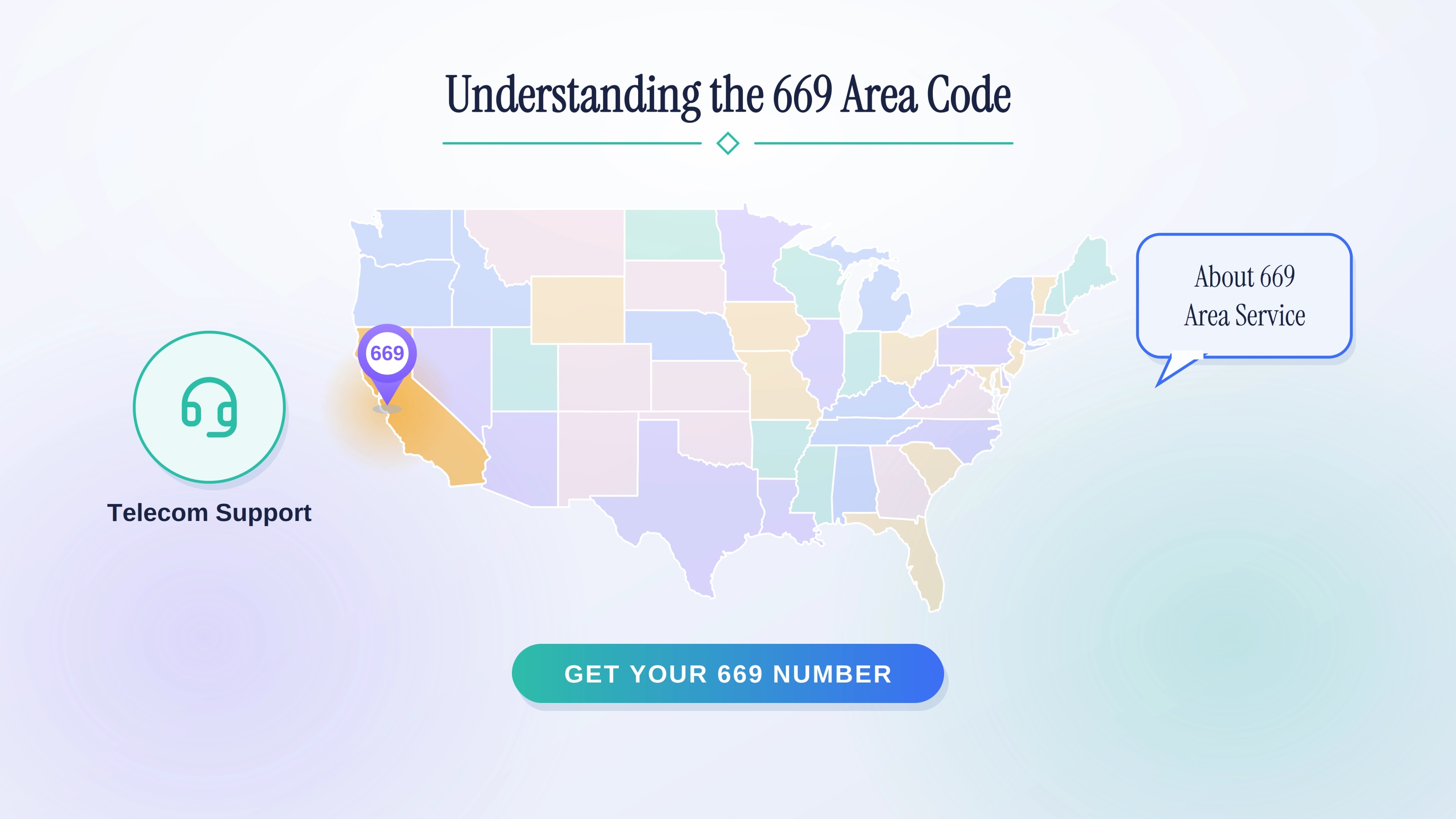
Area code 669 was created to relieve a critical shortage of available phone numbers in Silicon Valley. The original 408 code had become saturated as population and technology companies expanded. Rather than splitting the region geographically, the California Public Utilities Commission (CPUC) approved an overlay in Decision 11-10-031 on October 20, 2011 — the first overlay in the San Francisco Bay Area — and the new code became effective on November 20, 2012. The overlay let both codes serve the same territory without forcing anyone to change an existing number.
That decision supported continued growth while keeping service stable. The region had been scheduled for an overlay once before, in 1998, but the plan was suspended in 1999 after number pooling extended the supply; by 2011, forecasts showed 408 would exhaust the following year, making relief unavoidable. Today the prefix remains an important part of Silicon Valley's communication network, serving thousands of businesses, startups, and residents.
San Jose, Cupertino and 3.6 Million People on Two Codes
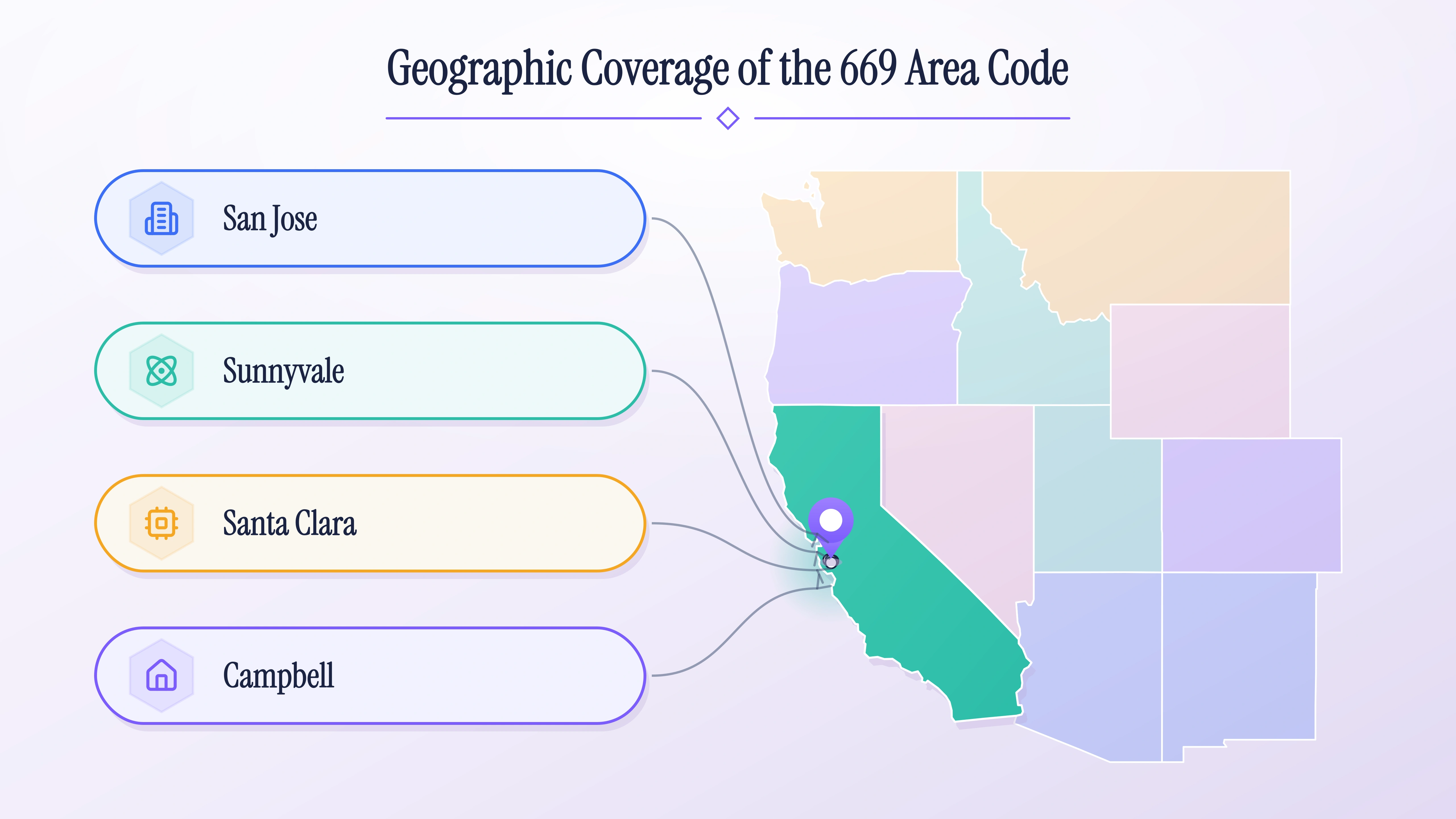
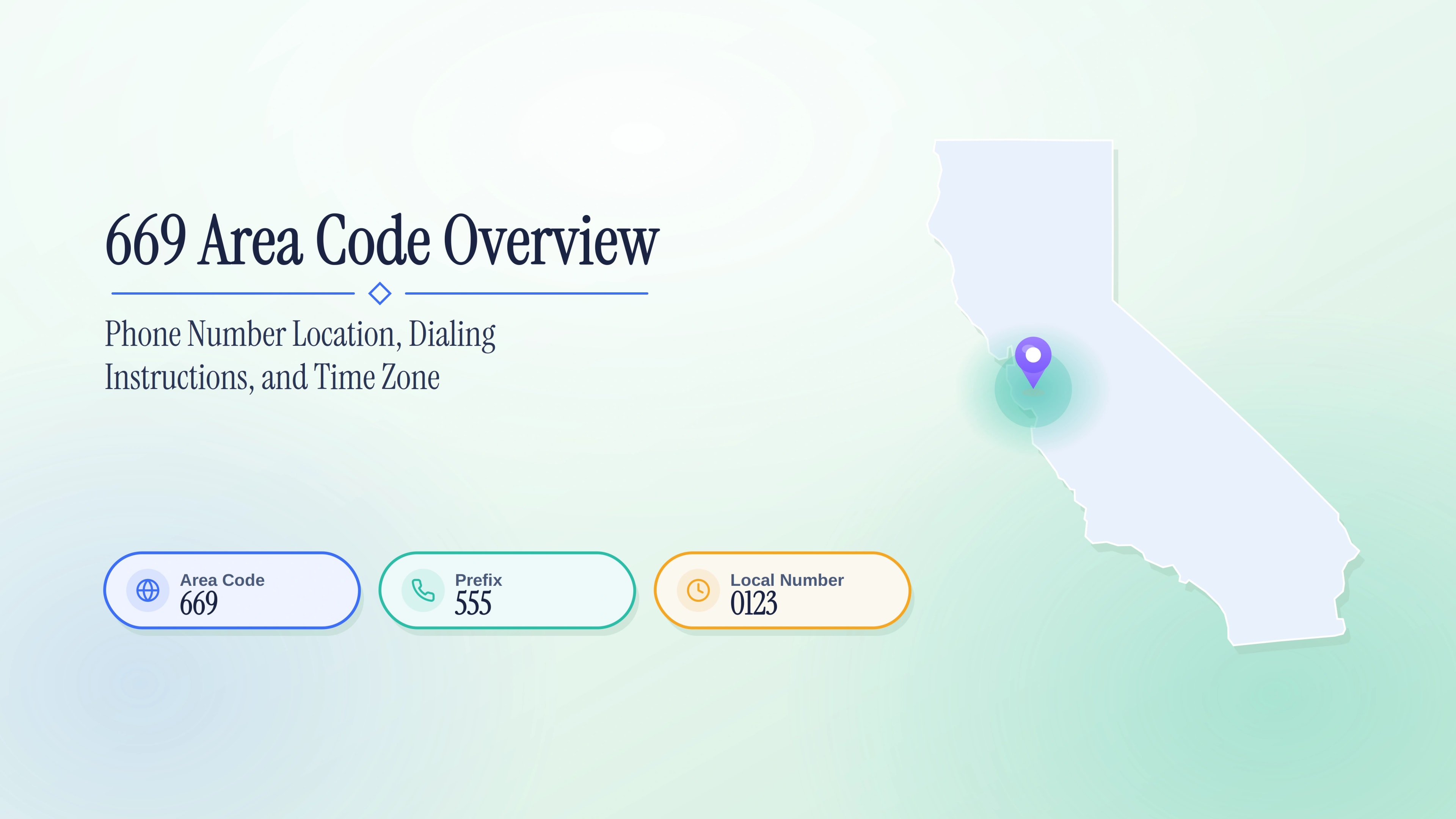
Area code 669 covers the heart of Silicon Valley. It primarily serves Santa Clara County, along with small unincorporated portions of Alameda County and northern Santa Cruz County in Northern California. The region is defined by its enormous tech footprint — home to some of the world's most recognizable technology companies and a constant flow of ambitious startups.
Major Cities Served
- San Jose — The largest city in the coverage area, with just under one million residents. San Jose is California's third-largest city and the self-styled "Capital of Silicon Valley," hosting major employers including Adobe, Cisco, eBay, PayPal, and Zoom.
- Sunnyvale — Home to roughly 155,000 people, this city hosts companies such as Intuitive Surgical and remains a busy technology center.
- Santa Clara — Known for semiconductors, Santa Clara is headquarters to Intel and Nvidia, with a population near 130,000, and is home to Levi's Stadium.
- Campbell — A smaller city that benefits from its proximity to major tech employers and serves as a residential hub for the region's workforce.
- Cupertino — Home to Apple's headquarters, this city is closely associated with innovation and product development.
Regional Demographics
Santa Clara County has a population of roughly 1.9 million, making it one of California's most densely populated counties. Counting both codes together, the 408/669 region serves about 3.6 million people. The area's economic weight extends well beyond its size, generating substantial revenue across technology, manufacturing, and services — and ranking among the highest-income regions in the United States. Businesses targeting both Silicon Valley and the LA metro often pair a 669 number with a 310 area code for statewide reach.
Dialing Procedures for This Prefix
Correct dialing is essential for smooth communication inside and outside the region. Knowing the right format prevents failed calls and keeps routing efficient.
Standard Phone Number Format
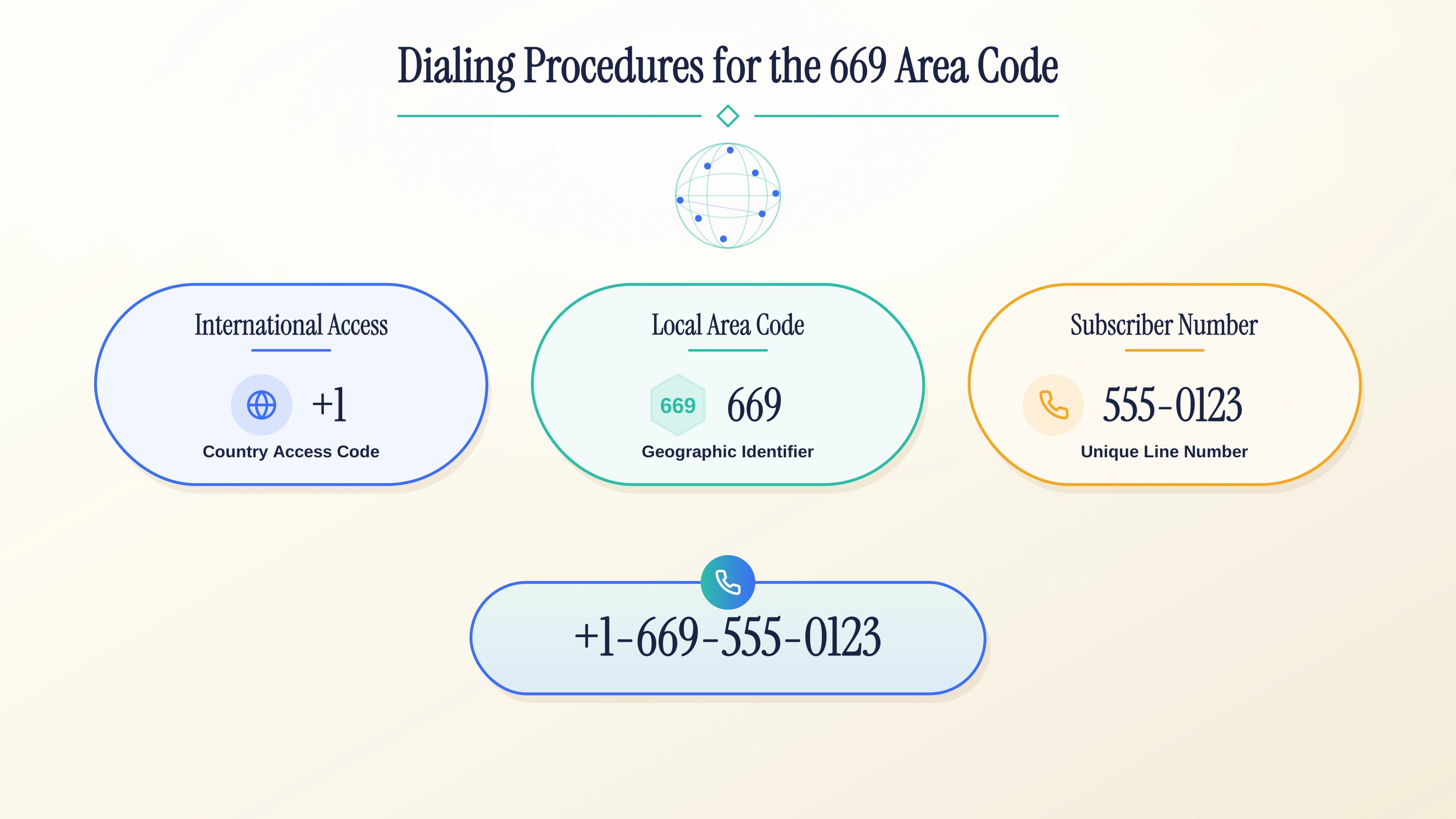
Every number follows the North American Numbering Plan (NANP) format: (669) XXX-XXXX. That structure combines the three-digit code with a seven-digit local number to form a complete 10-digit telephone number.
Local and Long-Distance Dialing
Since the overlay took effect, 10-digit dialing has been required for every call in the region. Callers must dial 1 + (669) XXX-XXXX or 1 + (408) XXX-XXXX, even when reaching a neighbor in the same city. Long-distance calls outside the 669 and 408 region follow the standard pattern: 1 + the destination area code + the seven-digit number.
| Dialing Scenario | Dialing Format | Example |
|---|---|---|
| Local call (669/408 area) | 1 + Area Code + XXX-XXXX | 1-669-555-0123 |
| Long-distance call | 1 + Area Code + XXX-XXXX | 1-212-555-0123 |
| International call | 011 + Country Code + Number | 011-44-20-XXXX-XXXX |
Time Zone Alignment
The region runs on Pacific Time. For most of the year that means eight hours behind Coordinated Universal Time (UTC-8), shifting to UTC-7 when clocks "spring forward" for Daylight Saving Time.
For anyone doing business here, that timing matters. Being on the West Coast puts Silicon Valley three hours behind New York and eight hours behind London. It creates interesting scheduling puzzles — especially when someone is trying to reach a remote team in Europe before the end of their workday, while the local morning is only just getting started.
Sound Local in Silicon Valley
Get a virtual 669 number from Acepeak and connect with South Bay customers from anywhere.
Why the 669 Area Code Matters for Silicon Valley
The overlay represents more than a telecom label. It reflects Silicon Valley's continued growth and the region's ability to adapt to shifting communication needs. As Acepeak and other providers serve the area, a local 669 presence remains valuable for connecting businesses with customers, employees, and partners around the world.
The prefix supports the region's most critical industries, including software development, semiconductor manufacturing, venture capital, and digital services. Companies that operate here gain local presence and credibility when they keep numbers tied to this region.
Getting a Local Phone Number
Finding a local number is straightforward these days, whether it's for a personal cell or a business line. Major carriers such as AT&T, Verizon, and T-Mobile offer them, but many people now choose specialized VoIP providers for added flexibility.
When comparing providers, price shouldn't be the only factor. The details that affect daily use matter more:
- Call Quality — Does it hold up during an important meeting?
- The "Extras" — Are features like call forwarding and auto-attendants included?
- Support — Is a real person available when something goes wrong?
Getting Set Up with a Virtual Number
For a business that wants a Silicon Valley presence without a physical San Jose office, virtual number providers such as Acepeak are a strong option, offering plans that scale as a company grows. The process is usually quick:
- Pick a Provider — Choose one that fits the budget and feature needs.
- Choose Your Plan — Decide how many lines and features are actually required.
- Sign Up — Complete a short registration, and the line is typically active within minutes.
Protecting Yourself from Phone Scams
A local number isn't only useful to Silicon Valley residents — it's also a favorite tool for scammers. The trick is simple: by displaying a familiar local code, fraudsters hope the recipient will lower their guard and answer. They count on that brief flash of recognition to build false trust before the conversation even begins.
This tactic has a name — "neighbor spoofing" — and it is widespread. A 2025 Nomorobo study found that roughly 74% of robocalls used fake local area codes, about a 50% jump from the previous year. The FTC's 2025 National Do Not Call Registry Data Book logged more than 2.6 million complaints, with robocalls making up the majority. The lesson is clear: a call that looks like it's coming from the neighborhood doesn't mean the person on the other end is local — or honest.
Common Scam Types
- Tech-support scams — Callers claim to represent major technology brands and offer to fix problems that don't exist.
- IRS impersonation scams — Fraudsters try to collect fake taxes or fines through threats of legal action.
- Spoofing scams — Caller ID is manipulated to appear as a trusted organization.
Protection Strategies
Never share personal or financial details with an unsolicited caller. Verify identity by hanging up and calling the organization back using a number from its official website. Be wary of any call that manufactures urgency or threatens legal consequences. Registering with the National Do Not Call Registry reduces unwanted calls, and caller ID apps can flag suspicious numbers before they're answered. Suspicious calls can be reported at ReportFraud.ftc.gov or to the FCC.
The Future of the 669 Area Code
As Silicon Valley's technology sector keeps expanding, the prefix is becoming a larger part of the region's backbone. It's no longer just a set of digits; it signals how quickly the area is growing. Some experts expect additional overlays across California over the next decade simply to keep pace with demand for new numbers.
That shift reflects a broader change in how people communicate. The move away from traditional landlines toward VoIP, mobile-first setups, and virtual offices continues to accelerate. Forward-thinking companies such as Acepeak are already ahead of the curve, offering cloud-based phone systems that bridge familiar local codes with the flexible, modern way people actually work.
From Scarcity Fix to Silicon Valley's Link with the World
Area code 669 is a fundamental part of Silicon Valley's communication ecosystem. Whether the goal is establishing a local business presence, staying connected to the tech industry, or simply understanding how phone numbers work in the region, knowing how this code functions is genuinely valuable.
From its origins as a fix for number scarcity to its current role supporting thousands of businesses, the overlay reflects the region's commitment to staying connected and innovative. By understanding dialing procedures, recognizing scams, and choosing a reliable provider, anyone can make the most of a local number here. As telecommunications keep evolving, this prefix will remain a key link between Silicon Valley and the rest of the world.
Get Your Local 669 Number Today
Establish an instant South Bay presence and manage calls from anywhere.
Questions, answered.
It serves cities across Silicon Valley — San Jose, Sunnyvale, Santa Clara, Campbell, Cupertino, Milpitas, Morgan Hill, and Los Gatos, along with Gilroy and Saratoga — plus nearby communities in Santa Clara County and small adjacent parts of Alameda and northern Santa Cruz counties.
It was created as an overlay to add more numbers as the 408 region neared exhaustion, driven by population growth, new businesses, and rising mobile and digital use. The CPUC approved it in 2011 and it took effect in November 2012, adding capacity without making anyone change existing numbers.
Ten-digit dialing is required. Dial 1 + the three-digit code + the seven-digit number, even for local calls within the 408/669 region.
Numbers are available through mobile carriers, VoIP providers, and virtual number services. Many providers let users pick a new number or port an existing one, subject to availability.
Avoid answering unknown numbers, never share personal or financial details unless certain of the caller, use call-blocking tools, and report suspicious calls to a provider or the FTC/FCC. Because spoofing makes calls look local, a familiar code alone isn't proof that a call is safe.
Signing up for a 669 area code number takes minutes with a cloud phone provider — no local office in Silicon Valley required. Pick the number, connect it to your existing phone or app, and calls route in immediately. This keeps the 669 area code presence you already have while adding the local credibility California customers respond to.