How Richmond Held On to Its Number When Norfolk Didn't
Ask anyone in Richmond what their phone number starts with and the answer has stayed the same for over fifty years: 804. The code has anchored Virginia's capital through two geographic splits, a wave of federal and state-government growth, and now a second area code layered over the same streets.
This guide walks through where 804 works today, the twist of history that let Richmond keep its number when Norfolk didn't, what the 686 overlay means for dialing, and the practical steps for putting an 804 number on your own business line.
Key Takeaways
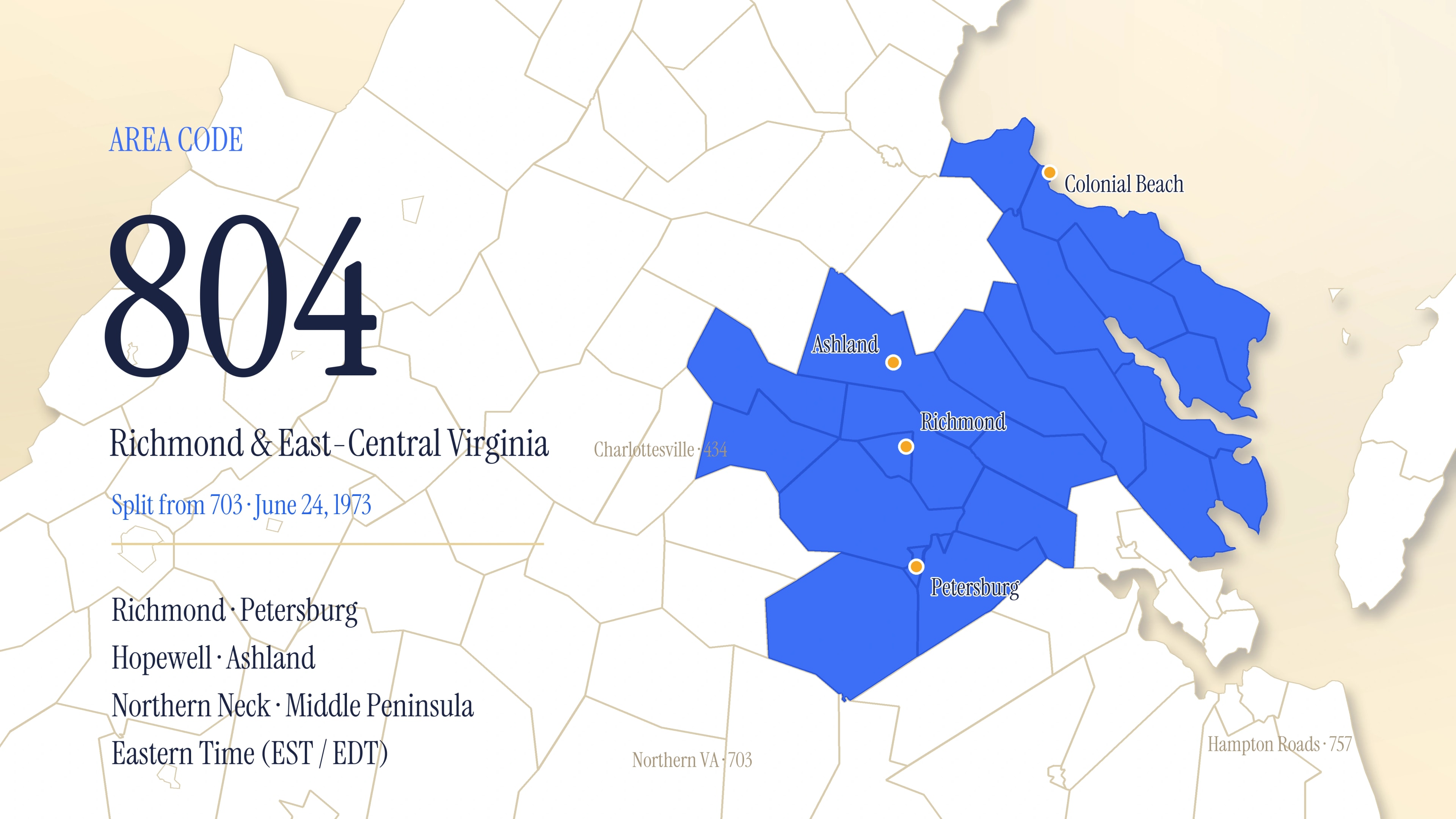
- The 804 area code covers east-central Virginia, anchored by Richmond and reaching Petersburg, Hopewell, the Northern Neck, and the Middle Peninsula.
- 804 was created in 1973 in a split from 703, and an old telephone-company decision let Richmond keep the new code while Northern Virginia's federal offices kept 703.
- Later splits carved off Hampton Roads (757, 1996) and the Danville-Lynchburg-Charlottesville corridor (434, 2001), shrinking 804 to its current footprint.
- Since February 1, 2024, the 686 overlay has shared the same territory, and every local call must be dialed with all ten digits.
- The whole region runs on Eastern Time, and a cloud phone provider can activate an 804 number for any business, anywhere.
What Is the 804 Area Code?
The 804 area code is the North American Numbering Plan code for Richmond and the surrounding communities of east-central Virginia. It was carved out of the state's original 703 area code on June 24, 1973, with a permissive dialing period that ended January 1, 1974. Normally, when a territory splits, the largest city keeps the old code and everyone else gets the new one — but Norfolk, then Virginia's biggest city, ended up with the new 804 number instead, because the phone company wanted to spare the federal agencies clustered in Northern Virginia the cost of renumbering out of 703.
That same instinct to protect government offices from renumbering is written into Virginia's own map — Northern Virginia's 703 area code kept the original designation precisely because of the federal agencies clustered around Washington, the very reason Richmond ended up on the new 804 in the first place.
Capital Suburbs, River Cities and the Chesapeake Peninsulas
Today the 804 footprint runs across east-central Virginia, anchored by Richmond and its metro counties, and reaching out to the rural peninsulas along the Chesapeake Bay. Communities using 804 numbers include:
- Richmond, Henrico County, and Chesterfield County — the core of the state capital's metro area
- Petersburg, Hopewell, and Colonial Heights — the historic river cities south of Richmond
- Ashland and Mechanicsville — Hanover County's fast-growing suburbs
- The Northern Neck — Westmoreland, Richmond, Lancaster, and Northumberland counties between the Potomac and Rappahannock rivers
- The Middle Peninsula — Essex, King and Queen, King William, Gloucester, Mathews, and Middlesex counties
A Petersburg, VA area code number specifically serves one of the region's oldest cities — a Civil War-era river port about 25 miles south of downtown Richmond, now home to a growing logistics and manufacturing base along the I-95 corridor. Because Petersburg sits inside the same 804/686 territory as Richmond, a business there uses the identical dialing rules and gets the same local recognition with Richmond-area customers as it would with its own city.
Eastern Time and the End of Seven-Digit Calls in 2021
Every community in the 804 region runs on Eastern Time — EST (UTC−5) in winter and EDT (UTC−4) during daylight saving. When it's noon in Richmond it's 11 a.m. in Chicago and 9 a.m. in Los Angeles, keeping 804 businesses aligned with the rest of the East Coast business day.
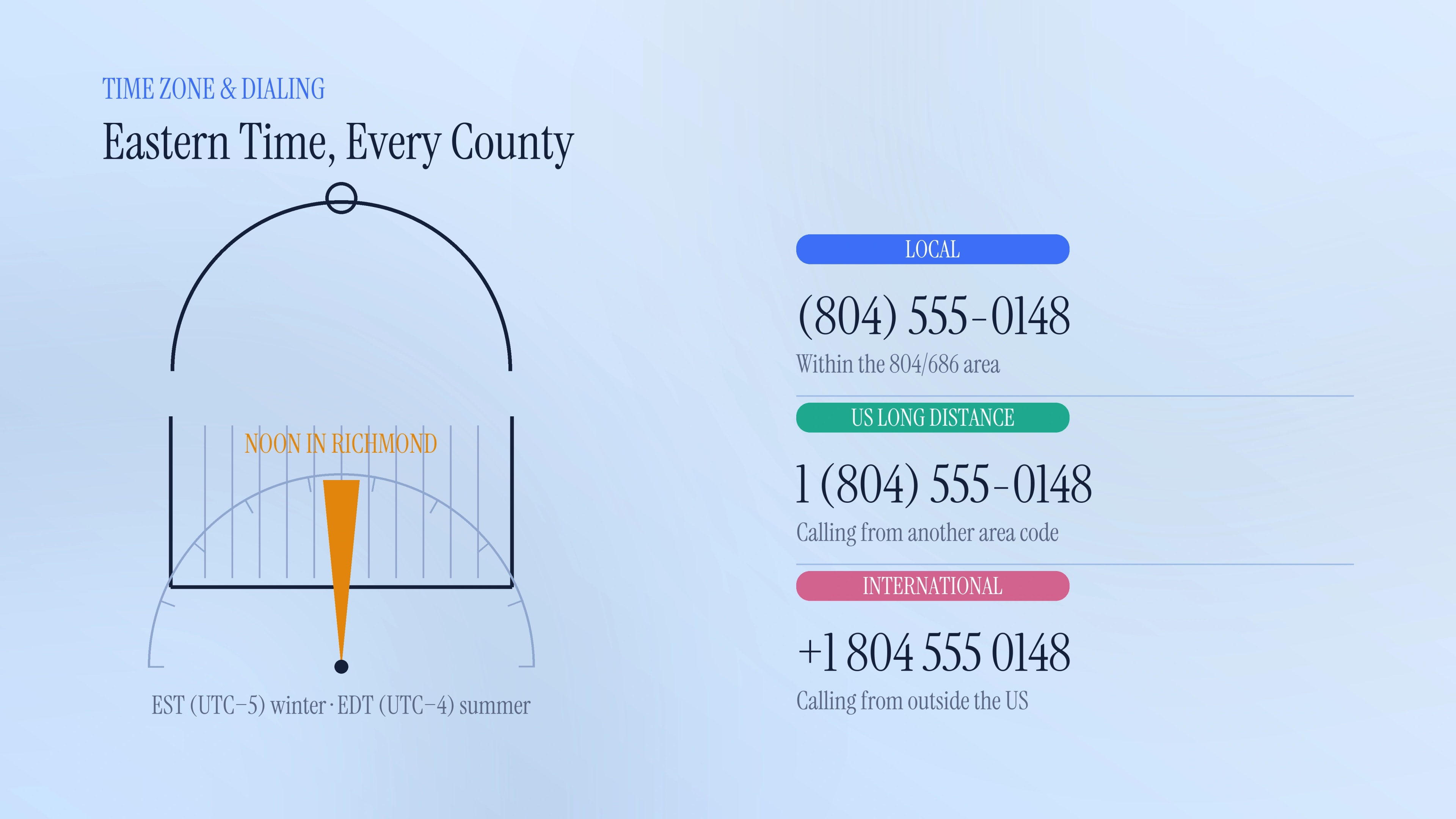
Dialing is simple but strict: every local call needs all ten digits — (804) 555-0123 — with a 1 in front for long distance, and +1 804 from abroad. Seven-digit dialing stopped working across the region back in 2021.
Splits and the 686 Overlay
The original 1973 territory stretched across the eastern two-thirds of Virginia, from Danville to the Eastern Shore. Growth trimmed that footprint twice. On July 1, 1996, the Eastern Shore and most of Hampton Roads became the 757 area code, while Richmond and Petersburg kept 804. On June 1, 2001, the western portion — Danville, Lynchburg, and Charlottesville — split off to become the 434 area code, leaving 804 with the Richmond–Petersburg core it still holds today.
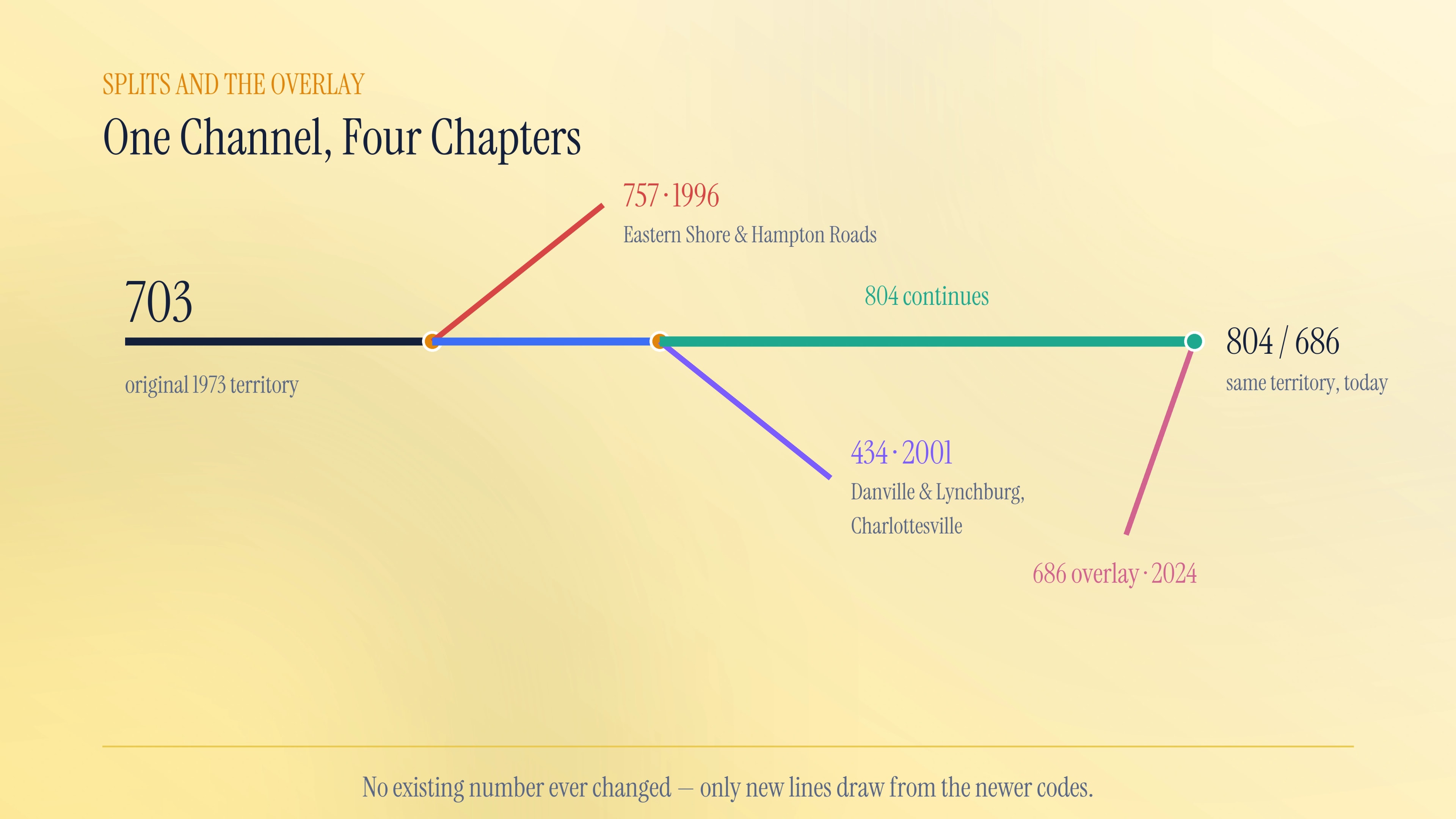
Mandatory ten-digit dialing arrived first, on October 24, 2021, after 988 was set aside nationwide as the Suicide & Crisis Lifeline and could no longer double as a local exchange prefix. The State Corporation Commission approved a full overlay soon after, on November 22, 2022, and area code 686 entered service across the entire 804 territory on February 1, 2024. No existing 804 number changed — new lines simply began drawing from the 686 pool.
Benefits of a Local 804 Number for Business
Richmond is a market where a local number still carries real weight. An 804 number gives a business:
- Half-century recognition — Richmond callers have trusted the 804 prefix since the 1973 split from 703, longer than either of the splits that followed it.
- Petersburg-to-Northern-Neck reach — a single 804 line covers the state capital, the I-95 logistics corridor through Petersburg and Hopewell, and the rural Northern Neck and Middle Peninsula alike.
- A foothold near state and federal government — Virginia's capital and its surrounding agencies keep call volume steady year-round.
- Location independence — because 686 is an overlay, not a split, an 804 line keeps working unchanged while cloud routing lets a team anywhere answer it as if they were on Monument Avenue.
Put a Richmond number on your business
Acepeak provisions local 804 numbers with instant activation, smart routing, and crystal-clear voice quality.
How to Get an 804 Phone Number
You don't need a Richmond office to hold an 804 number. A cloud telephony provider can activate one in minutes:
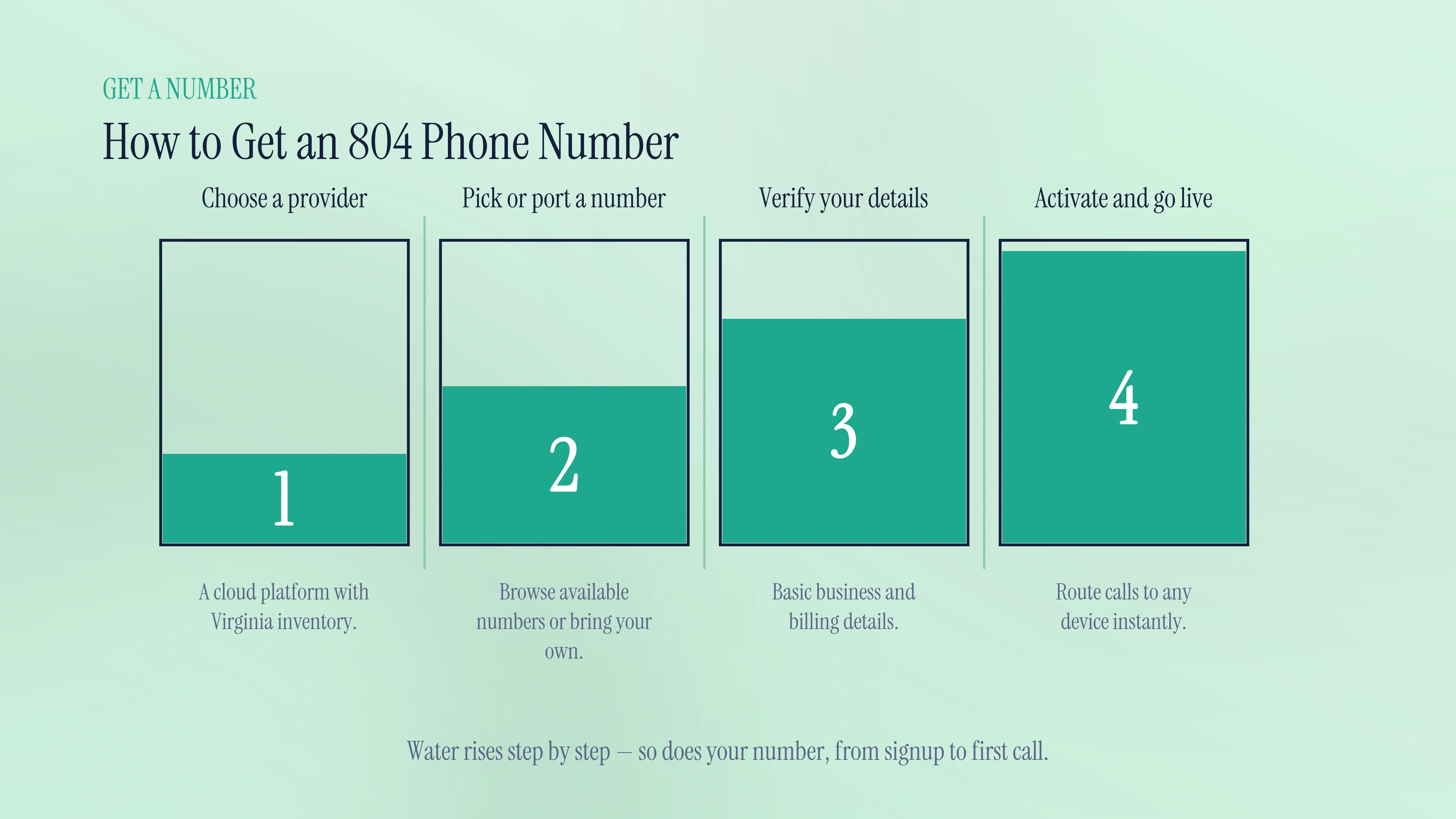
- Choose a provider — pick a cloud phone platform that carries Richmond-area inventory, like Acepeak.
- Pick or port a number — browse available 804 numbers across Richmond, Petersburg, and the Northern Neck, or bring an existing line with you.
- Verify your details — provide basic business and billing information for activation.
- Activate and go live — route calls to desk phones, mobiles, or softphone apps immediately, from Monument Avenue or anywhere else.
Spotting and Avoiding 804 Scam Calls
A trusted local code is also a favorite disguise for scammers, who spoof 804 caller IDs to look like a neighbor, a bank, or a state agency. A simple stop-check-go habit filters out almost all of it:
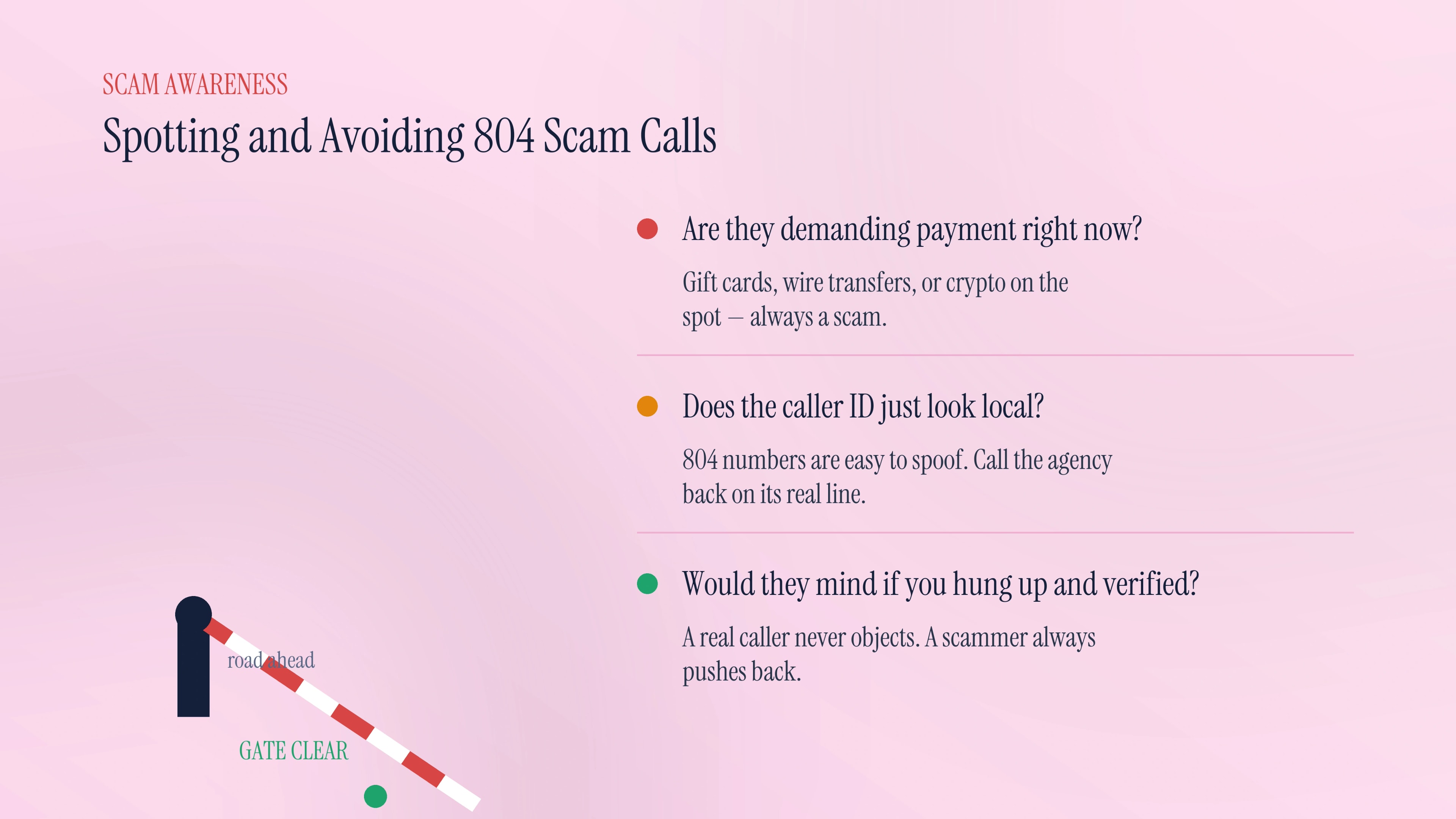
- Stop — hang up on any caller demanding gift cards, wire transfers, or immediate payment; no legitimate agency collects that way.
- Check — if caller ID claims a bank, the DMV, or law enforcement, call the organization back on its published number.
- Go — block confirmed scam numbers and report them to the FTC so carriers can act on the pattern.
- Never share one-time passcodes or account credentials with an inbound caller, no matter how local the number looks.
The Future of the 804 Area Code
The 686 overlay bought Richmond's numbering plan years of breathing room, and the region's growth shows why regulators moved when they did. The City of Richmond has added residents and businesses steadily as its downtown, riverfront, and logistics corridors continue to expand.
For businesses, the practical takeaway is simple. Existing 804 numbers keep working exactly as before, while 686 numbers cover the same ground for anyone activating a new line. Whichever prefix you land, a Richmond-area number keeps working unchanged for the foreseeable future.
Half a Century at the Capital's Side, Now With 686
Few area codes carry as much quiet history as 804. Born from a 1973 split that spared Northern Virginia's federal offices, trimmed by the 757 and 434 splits, and finally joined by the 686 overlay, it has tracked Richmond's growth for half a century without ever leaving the capital's side. For any business that wants Richmond-area customers to pick up the phone, an 804 — or its 686 twin — is still the strongest local signal you can send.
Ready for your 804 number?
Claim a Richmond-area local number with Acepeak and start connecting with Virginia's capital region today.
If you route calls into the 804 area code at carrier volume, Acepeak publishes its wholesale voice termination rates per destination, with free test credits and no contract.
Questions, answered.
The 804 area code covers east-central Virginia, including Richmond, Henrico County, Chesterfield County, Petersburg, Hopewell, Colonial Heights, Ashland, Mechanicsville, the Northern Neck, and the Middle Peninsula.
No. 804 is the area code for Richmond, Virginia and the surrounding east-central Virginia region. It has never been assigned to any California city — the confusion is easy to have, since some three-digit codes in that range do serve parts of California, but 804 specifically has served Virginia since 1973.
Area code 804 entered service on June 24, 1973, when it was split from Virginia's original 703 area code. It originally covered the eastern two-thirds of the state before later splits trimmed its territory.
Area code 686 is an all-services overlay of 804, in service since February 1, 2024. It covers exactly the same territory, so a 686 number is just as local to Richmond as an 804 number. The overlay was added because 804 was running out of available prefixes.
Yes. Since October 24, 2021, all local calls in the region must be dialed with the full ten digits — area code plus the seven-digit number. Calls dialed with only seven digits will not connect.
The entire 804 region observes Eastern Time — Eastern Standard Time (UTC−5) in winter and Eastern Daylight Time (UTC−4) during daylight saving — the same clock as New York and Washington, D.C.
Yes. Cloud telephony providers can assign an 804 (or 686) number to a business or individual located anywhere and route the calls to your existing phones or apps, giving you a local Richmond presence without a physical office there.
Signing up for an 804 area code number takes minutes with a cloud phone provider — no local office in Richmond required. Pick the number, connect it to your existing phone or app, and calls route in immediately. This keeps the 804 area code presence you already have while adding the local credibility Virginia customers respond to.