Inside the Beltway, on the Virginia Side of the Potomac
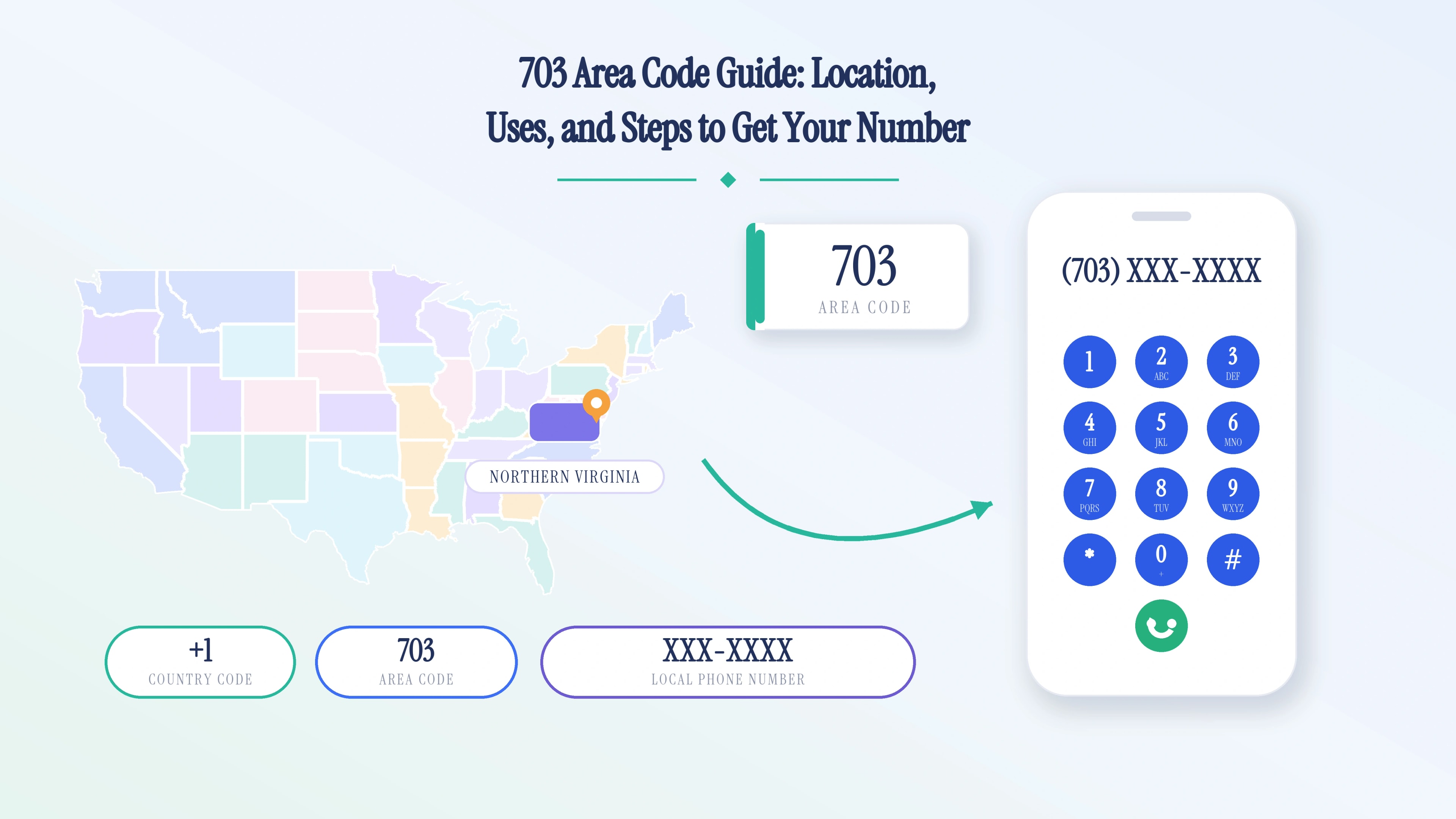
Few area codes carry as much quiet prestige as 703. It is the phone identity of Northern Virginia — the belt of suburbs, edge cities and technology corridors that fans out from the Virginia bank of the Potomac across from Washington, D.C. This is the land of Arlington's high-rises and the Pentagon, Old Town Alexandria's cobblestones, the glass towers of Tysons, the planned community of Reston, and the data-center and airport boom around Dulles in Loudoun County. A 703 number has signaled "inside the Beltway, on the Virginia side" for more than seventy-five years.
Yet the region it covers today is only a fraction of what it once did: 703 began life in 1947 covering the whole of Virginia, then gave up territory piece by piece as the state grew. This guide traces exactly where 703 reaches now, how it shrank from a statewide code to a Northern Virginia one, the 571 overlay and dialing rules, the Eastern time zone, and how any business can claim a local Northern Virginia presence with a number of its own.
Key Takeaways
- The 703 area code covers Northern Virginia — the Washington, D.C. suburbs on the Virginia side of the Potomac — including Arlington, Alexandria, Fairfax, Falls Church, McLean, Tysons, Vienna, Reston, Herndon, Annandale, Springfield, Chantilly, Centreville, and the fast-growing Loudoun and Prince William communities of Ashburn, Leesburg, Sterling, Manassas and Woodbridge.
- It is one of the original area codes from 1947 and once covered the entire Commonwealth of Virginia before decades of growth pared it back to just the state's northern tip.
- 703 shed territory twice: the 804 area code split off eastern and central Virginia in 1973, and the 540 area code took the Shenandoah Valley, Roanoke and the west in 1995, leaving 703 with only Northern Virginia.
- The 571 area code was overlaid across the same Northern Virginia footprint on March 1, 2000, which is why ten-digit dialing is mandatory for every local call in the region.
- The whole area runs on Eastern Time — UTC-5 in winter (EST) and UTC-4 in summer (EDT) — the same clock as Washington, D.C. and the East Coast.
What Is the 703 Area Code?
The 703 prefix is the telephone identity of Northern Virginia, the densely populated and affluent corner of the state that forms the Virginia half of the Washington, D.C. metropolitan area. It is one of the small handful of area codes that date back to the very first North American numbering plan in 1947, which gives it a pedigree few codes share. Over the decades it has been trimmed down to the region where the demand was always highest — the counties and independent cities packed against the nation's capital.
A 703 number reads as unmistakably Northern Virginia: professional, connected and close to the center of federal power. That reputation is part of why the numbers stay in demand. The same dynamic plays out elsewhere, where a code like the 786 area code became closely tied to the identity of Miami — a local prefix that signals a specific place and its status well beyond the phone number itself.
Because it hugs the capital, a 703 caller ID lands with weight across the whole D.C. region. To a customer in Arlington, Fairfax or Loudoun it looks like a genuine local — a neighbor working the same market — rather than an out-of-town or toll-free caller. For any business selling into one of the wealthiest, most connected metro areas in the country, that local signal is a small but real advantage.
Pentagon, Tysons and the Data Centers of Ashburn
The 703 code (together with its 571 overlay) covers Northern Virginia — the counties of Arlington, Fairfax, Loudoun and Prince William, plus the independent cities of Alexandria, Fairfax, Falls Church, Manassas and Manassas Park, and small slivers of Fauquier and Stafford. Packed into that compact but heavily populated footprint are some of the best-known suburbs in the Washington region, including:
- Arlington (Arlington County) — home to the Pentagon, Reagan National Airport and the high-rise corridors of Rosslyn, Ballston and Crystal City, directly across the Potomac from D.C.
- Alexandria — the historic port city of Old Town, with its waterfront, brick row houses and King Street shops
- Tysons, McLean, Vienna and Falls Church (Fairfax County) — the office towers and edge-city commerce of Tysons plus affluent inner suburbs
- Fairfax, Annandale, Springfield, Centreville and Chantilly (Fairfax County) — the broad residential and commercial heart of the region
- Reston and Herndon (Fairfax County) — the planned-community and tech-employer belt along the Dulles Toll Road
- Ashburn, Leesburg and Sterling (Loudoun County) — the data-center capital of the world and the fast-growing Dulles corridor, plus Manassas and Woodbridge in Prince William County
From the Pentagon and the airports to the data centers of Loudoun, this small territory is one of the densest concentrations of government, defense and technology employment in the United States — all reachable on a single, storied area code.
Eastern Time and the Ten-Digit Rule the 571 Overlay Set
All of Northern Virginia sits within Eastern Time — UTC-5 in winter (EST) and UTC-4 in summer (EDT) — the same clock as Washington, D.C., New York and the rest of the East Coast. Unlike more rural single-code regions, 703 has required ten-digit dialing for years, because it shares its territory with the overlaid 571 code. Every local call means dialing the full area code plus the seven-digit number.
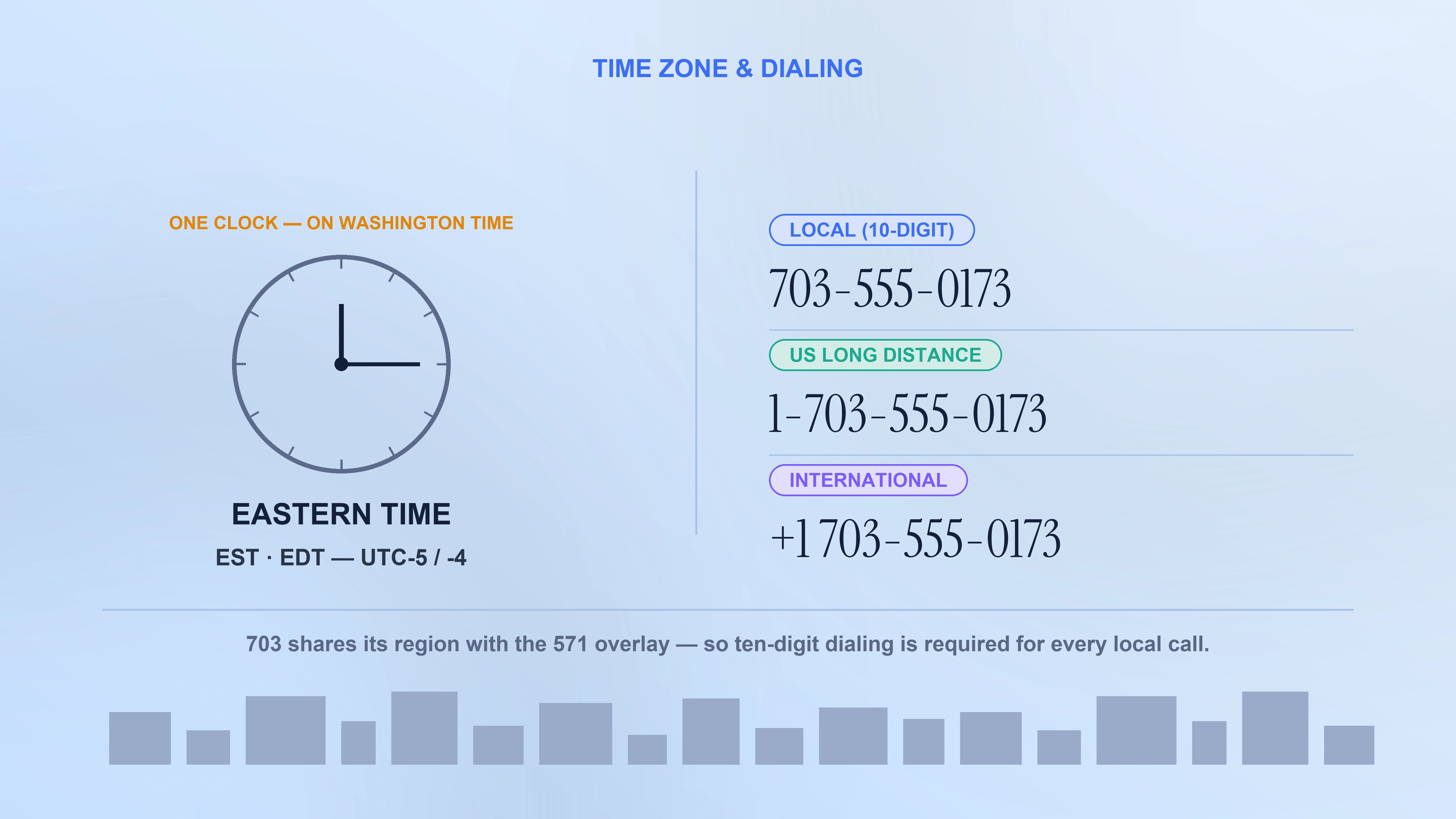
- Local calls within the region: dial all ten digits — 703-555-0173 — required across Northern Virginia because of the 571 overlay.
- Long-distance from elsewhere in the U.S.: add a leading 1 — 1-703-555-0173.
- International: dial the exit code, then +1, then the number — +1 (703) 555-0173.
- On mobile phones: cell numbers are stored and dialed with all ten digits anyway, so most people already reach 703 lines the same way from anywhere.
How 703 Shrank: From All of Virginia to the 571 Overlay
When the North American numbering plan launched in 1947, the entire Commonwealth of Virginia was assigned a single area code: 703. For a quarter-century, one code served the whole state, from the Atlantic shore to the Appalachian coalfields. Growth soon made that impossible. On June 24, 1973, eastern and central Virginia — Richmond, Norfolk and the Tidewater — were split off into the new 804 area code. Then, on July 15, 1995, a second split carved out the Shenandoah Valley, the Roanoke area and the state's western reaches as the 540 area code. What remained of the once-statewide 703 was just its northern tip: the D.C. suburbs.
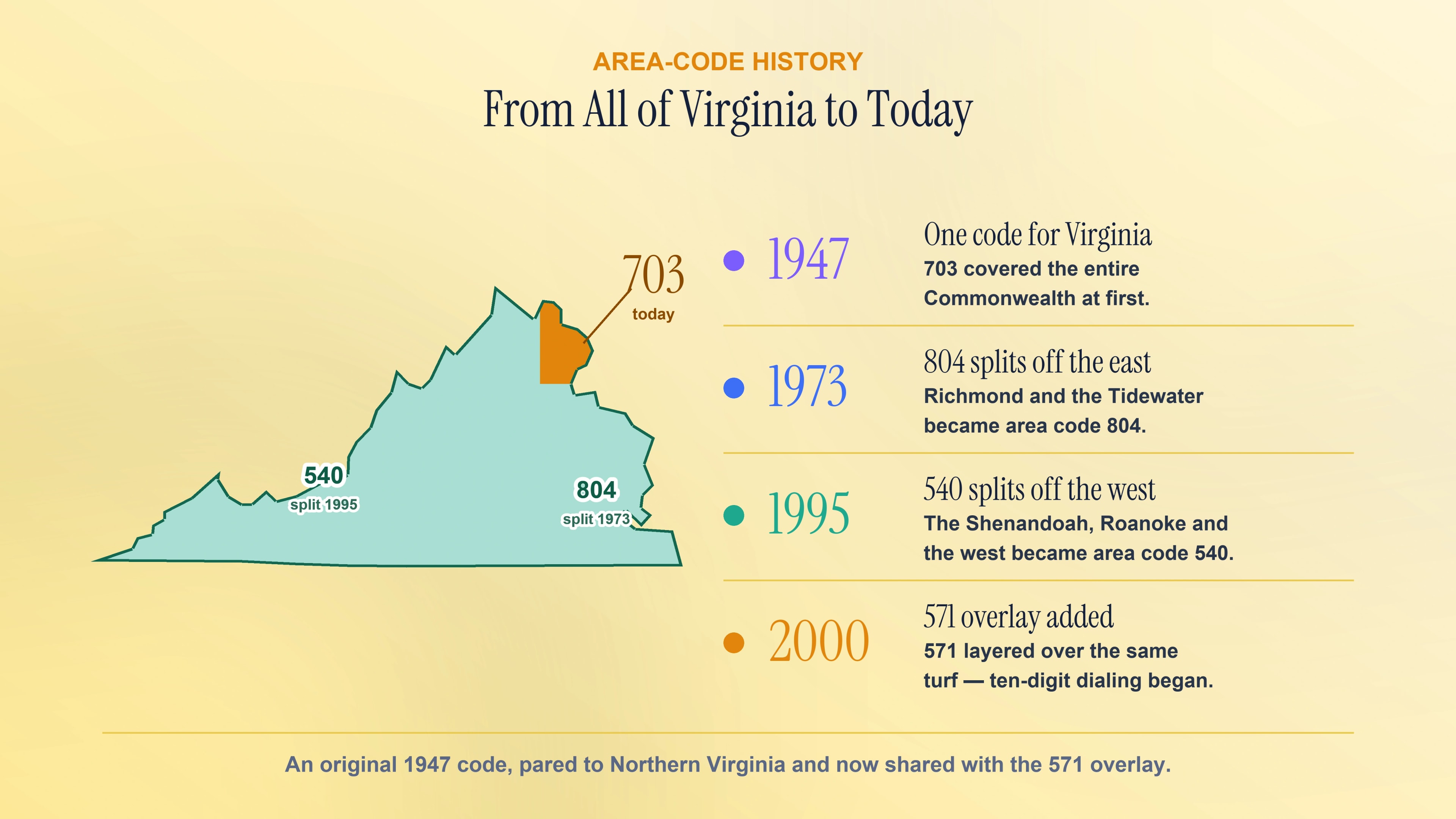
Even shrunk to Northern Virginia, the region's explosive growth — plus the flood of cell phones, pagers and fax lines in the late 1990s — burned through the remaining numbers fast. Rather than split the suburbs yet again, regulators chose an overlay: on March 1, 2000, the 571 area code was layered directly on top of the same Northern Virginia territory, so new lines could draw from a fresh pool of numbers while existing 703 lines kept theirs. That is why ten-digit dialing became mandatory here.
Benefits of a Local 703 Number for Business
A local number is one of the simplest trust signals a business can own, and in a market as competitive and status-aware as Northern Virginia, a 703 number carries real weight. It says you are established here — part of the Virginia side of the capital region, not a stranger cold-calling from out of state.
- Instant local credibility — a 703 caller ID signals that you belong to Northern Virginia and the D.C. metro, whether you are in Arlington or serving the region from afar.
- Higher answer rates — even with mandatory ten-digit dialing under the 571 overlay, a recognizable 703 exchange still outperforms an unfamiliar or toll-free number.
- A prestigious, recognizable identity — 703 is one of the oldest and most respected codes in the region, a subtle mark of being close to the capital.
- Flexibility without an office — cloud calling means you can hold a 703 number from anywhere and still reach clients from Arlington to the Dulles data-center corridor.
- Easy tracking and scaling — route calls separately for Tysons, Reston, or Loudoun clients while keeping the single legacy 703 number your customers already know.
Put a local 703 number to work
Give your business an authentic Northern Virginia presence with a 703 number that rings anywhere you do business.
How to Get a 703 Phone Number
In Northern Virginia, a 703 number no longer hinges on an installer's schedule or a lease in a Tysons office tower. Cloud phone providers take the request online, and a local line can be connected before the day is out. The main thing to watch is getting a true 703 instead of a default 571, so work through these steps:
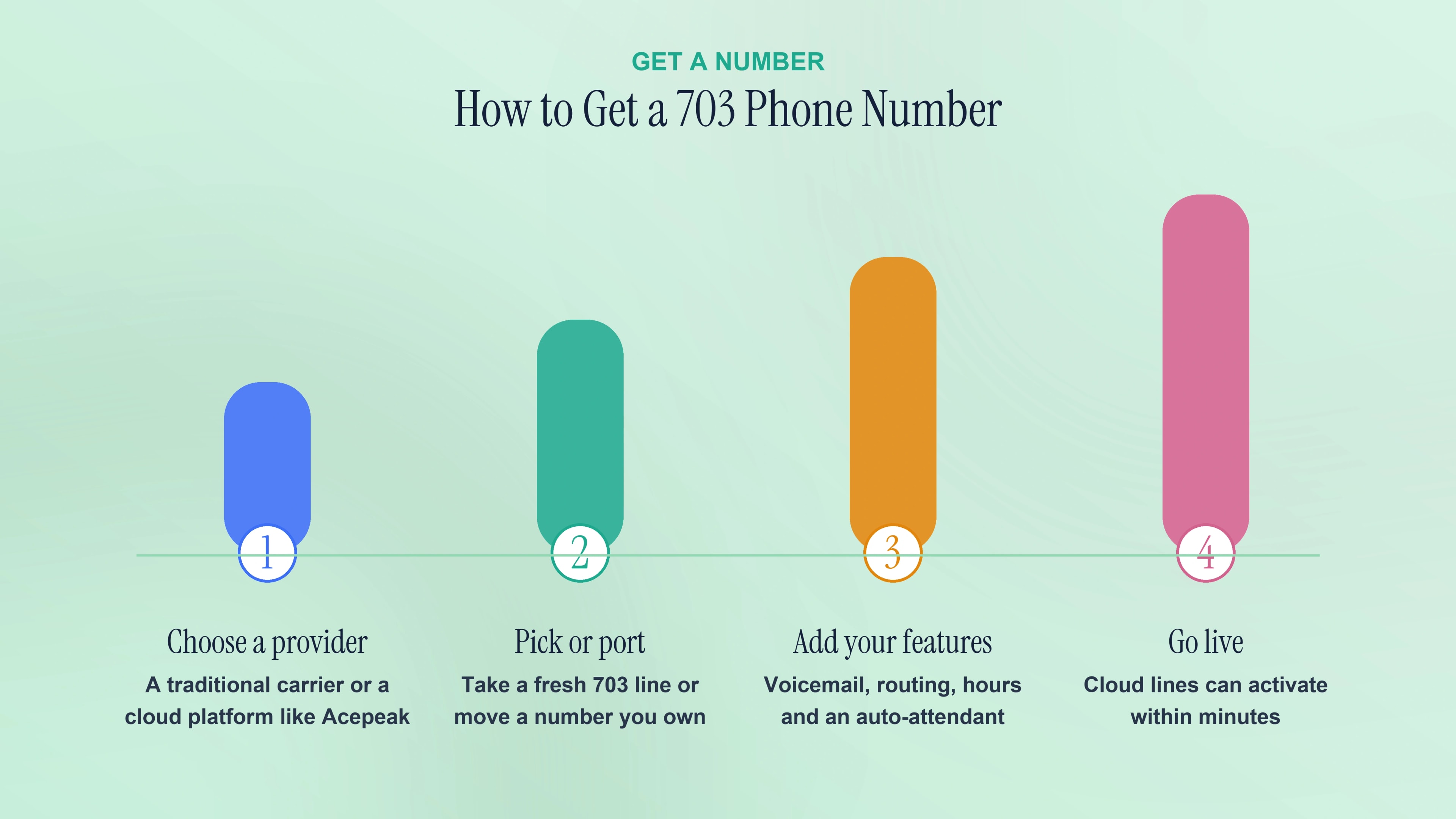
- Choose a cloud phone provider — confirm it can assign a legacy 703 number rather than defaulting new lines to the 571 overlay.
- Select your 703 number — search inventory across Arlington, Fairfax, or Loudoun, or port a number you already use into the same ten-digit exchange.
- Set up routing and features — add voicemail, an auto-attendant and business hours set to Eastern Time, the same clock as Washington, D.C.
- Start calling — make and receive calls from a laptop, desk phone or mobile app, and stay alert for spoofed 703 caller IDs.
Spotting and Avoiding 703 Scam Calls
In a region built around government and defense work, a 703 call that seems to come from a nearby office is easy to trust, and that is what scammers trade on. Neighbor spoofing places an Arlington or Fairfax number on the screen so a fraudulent call appears legitimate. Several habits make a difference:
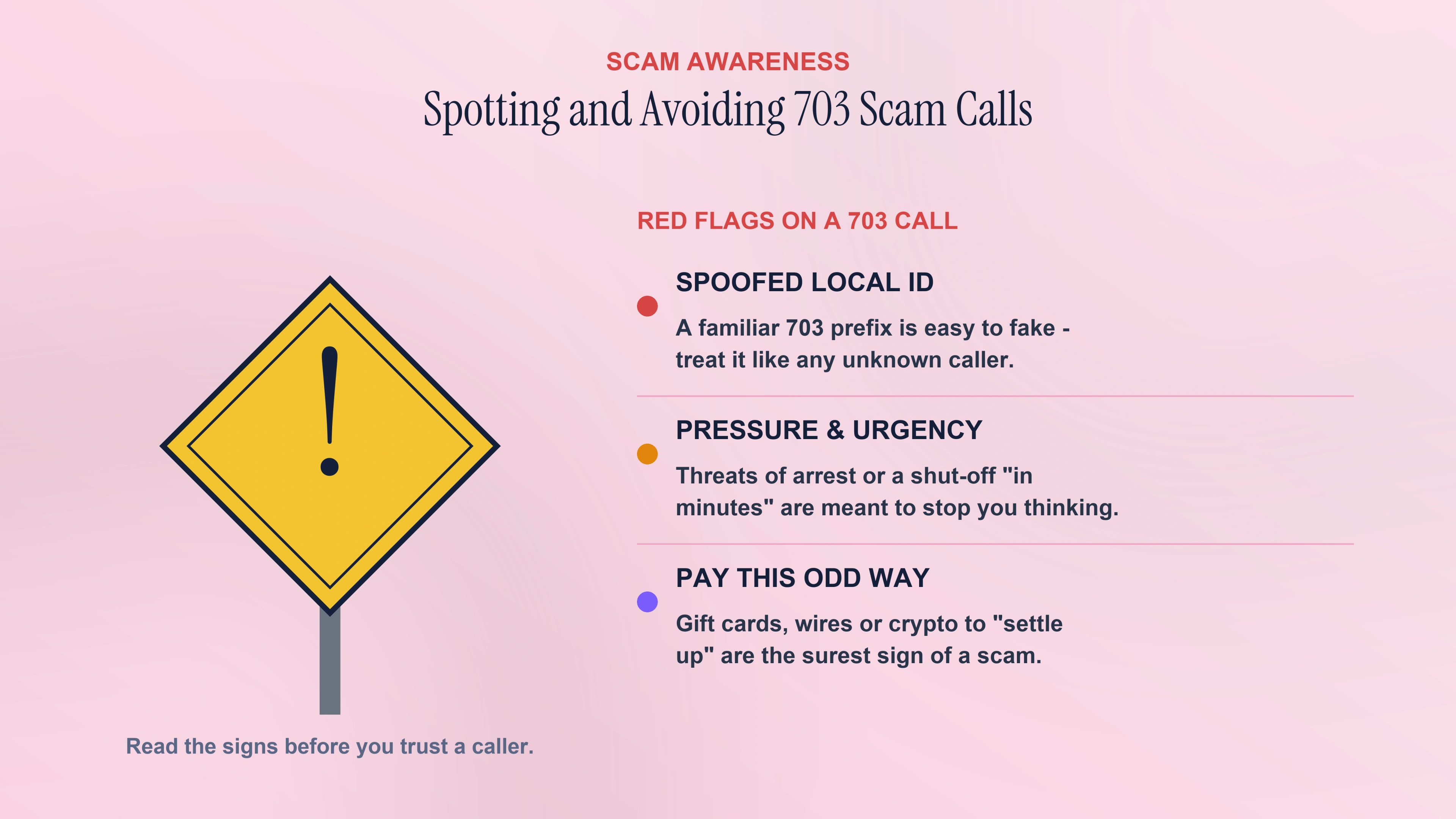
- Watch for pressure and urgency — real agencies and businesses do not demand that you act "right now" or the account will be closed.
- Be wary of odd payment demands — gift cards, wire transfers and cryptocurrency are the calling cards of a scam, never a legitimate bill.
- Do not trust caller ID alone — a 703 number on the screen can be faked; the local code is no guarantee the caller is who they claim.
- Hang up and call back on a number you trust — reach the bank, utility or agency directly using a number from a statement or official website.
- Report the call — logging unwanted calls with the authorities helps regulators track and shut down the operations behind them.
The Future of the 703 Area Code
With the 571 overlay carrying most of the demand for new numbers, the 703 code itself is in no danger of disappearing — it simply stays the prestige legacy prefix of Northern Virginia while fresh lines increasingly arrive on 571. The region keeps growing hard: Loudoun County remains one of the fastest-growing counties in the country, and its data-center corridor now carries a large share of the world's internet traffic. Local authorities such as the Fairfax County government plan for that expansion across housing, transportation and the Silver Line Metro out to Dulles.
As long as new numbers can be drawn from 571, regulators will not need to split or re-overlay the area again, which means a 703 number you print today will still read as authentically Northern Virginia for many years to come.
An Authentic Foothold in the Storied D.C. Suburbs
The 703 area code is far more than three digits — it is the shared phone identity of Northern Virginia, from the Pentagon and Old Town Alexandria to the towers of Tysons, the planned streets of Reston and the data centers of Ashburn. Once the single code for the whole Commonwealth, it was pared back through the 804 and 540 splits and then joined by the 571 overlay, leaving it as the storied prefix of the D.C. suburbs.
For any business hoping to connect with one of the nation's wealthiest and most connected markets, a local 703 number is one of the simplest and most authentic ways to belong.
Claim your Northern Virginia presence today
Acepeak makes it easy to get a 703 number and start taking calls across Arlington, Fairfax, Loudoun and the rest of the D.C. suburbs.
Questions, answered.
The 703 area code covers Northern Virginia — the Washington, D.C. suburbs on the Virginia side of the Potomac — including Arlington, Alexandria, Fairfax, Falls Church, McLean, Tysons, Vienna, Reston, Herndon, Annandale, Springfield, Chantilly, Centreville, and the Loudoun and Prince William communities of Ashburn, Leesburg, Sterling, Manassas and Woodbridge.
Area code 703 is one of the original area codes established in 1947 under the first North American Numbering Plan. It originally covered the entire Commonwealth of Virginia before later splits reduced it to just the northern part of the state.
Virginia's growth forced two splits. On June 24, 1973, eastern and central Virginia became the 804 area code, and on July 15, 1995, the Shenandoah Valley, Roanoke and the west became the 540 area code. Those splits left 703 covering only Northern Virginia.
The 571 area code is an overlay added on March 1, 2000, covering the exact same Northern Virginia territory as 703. Because two codes share one region, ten-digit dialing is mandatory — you must always dial the area code plus the seven-digit number, even for local calls.
The entire 703 region observes Eastern Time — UTC-5 in winter (EST) and UTC-4 in summer (EDT) — the same time zone as Washington, D.C., New York and the rest of the East Coast.
Absolutely. With a cloud phone provider you can choose a 703 number from anywhere and have it ring on your laptop, desk phone or mobile app. It gives your business an authentic Northern Virginia presence without needing a physical office in the region.
Signing up for a 703 area code number takes minutes with a cloud phone provider — no local office in Northern Virginia required. Pick the number, connect it to your existing phone or app, and calls route in immediately. This keeps the 703 area code presence you already have while adding the local credibility Virginia customers respond to.