Why Most New San Francisco Lines No Longer Start with 415
When people picture a San Francisco phone number they usually think of 415 — but for the last decade, most new lines in the city have actually been handed out under a different prefix: 628. It reaches exactly the same place, from the hills and the Financial District to the towns of Marin across the Golden Gate, yet it carries none of the "senior code" baggage. 628 is what telephone planners call an overlay: a second area code stacked on top of an existing one so a crowded region can keep issuing numbers without anyone having to give up the number they already have.
This guide explains precisely where 628 reaches, how and why it was added on top of 415 in 2015, the Pacific time zone and mandatory ten-digit dialing that come with it, and how any business can claim an authentic San Francisco presence with a local 628 line of its own.
Key Takeaways
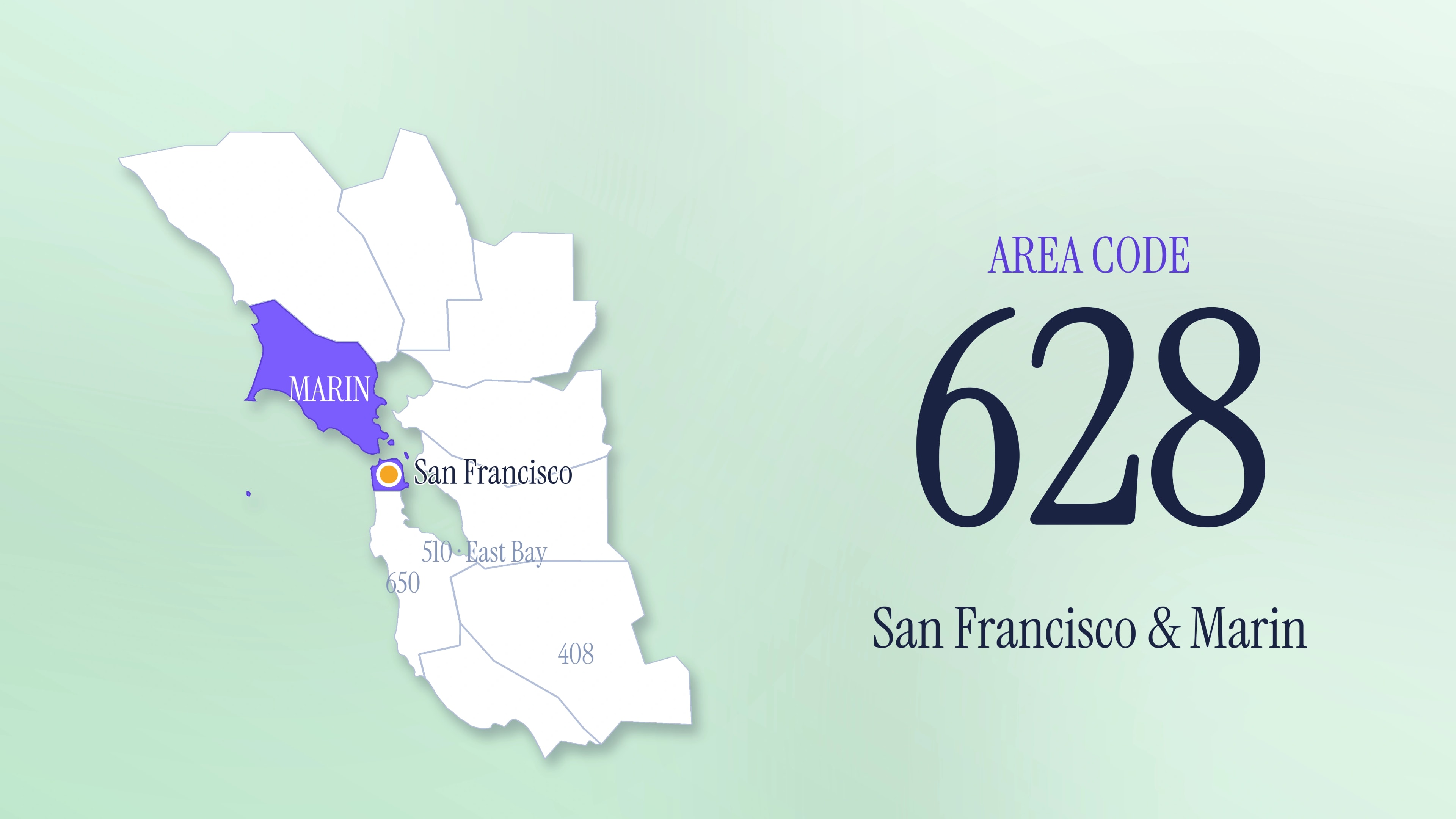
- The 628 area code is an overlay of 415, covering the exact same territory — the city of San Francisco, all of Marin County across the Golden Gate, and the northeast corner of San Mateo County.
- It went into service on March 21, 2015, laid on top of 415 rather than splitting off any land, so no existing number ever had to change.
- Because two codes now share one region, ten-digit dialing is mandatory for every call — this became the rule across the area on February 21, 2015, a month before the first 628 numbers were issued.
- 628 was created to solve number exhaustion: the San Francisco–Marin region was running out of available 415 prefixes, and the overlay added a deep new supply.
- A 628 number is a genuine San Francisco local line that carries the same weight as 415 — the entire region runs on Pacific Time (UTC-8 in winter, UTC-7 in summer).
What Does It Mean for Two Codes to Share One Place?
The 628 prefix is a telephone code for San Francisco and Marin County — the same city-on-the-peninsula and its northern neighbors across the bridge that 415 has always served. The difference is that 628 is not a standalone code with its own patch of ground; it is an overlay, sharing every street and every neighborhood with 415. When the region's supply of 415 numbers began to run low, regulators layered 628 over the identical territory so new lines could keep flowing. The result is two codes, one place, and a phone number that is every bit as local as its older sibling.
That shared footprint is the whole point. A 628 line rings and registers as a San Francisco number, because it literally belongs to San Francisco — the overlay simply doubled the pool of numbers available in the city and Marin. For a customer looking at their caller ID, a 628 call reads as a genuine local from the Bay Area, not an out-of-town stranger, which is exactly the credibility a business wants in one of the country's most competitive markets.
One Compact Footprint from Colma to West Marin
Because 628 overlays 415 exactly, it covers the same compact, high-value slice of the Bay Area: the entire city and county of San Francisco, all of Marin County to the north, and the small northeast corner of San Mateo County just below the city line. It is one of the most densely populated and sought-after footprints in the country. Much as Western Massachusetts's 413 area code anchors its own well-defined Pioneer Valley, this is a compact region with a strong identity of its own, packing an enormous amount of population and business into a small footprint. The major communities include:
- San Francisco — the whole city and county, from the Financial District, SoMa and the Mission to the Sunset, the Richmond and every neighborhood in between.
- San Rafael, Novato and San Anselmo (Marin County) — the larger inland towns of central and northern Marin, the county's civic and commercial hubs.
- Sausalito, Mill Valley, Tiburon, Belvedere and Corte Madera — the affluent bayside and hillside communities just across the Golden Gate.
- Larkspur, Greenbrae, Ross, Kentfield and Fairfax — the smaller residential towns of the Ross Valley and the Highway 101 corridor.
- Point Reyes Station, Inverness, Bolinas, Stinson Beach and Nicasio — the rural coastal and ranch communities of West Marin.
- Daly City, Brisbane and Colma — the slice of northern San Mateo County just south of the San Francisco line that shares the code.
Roughly 1.1 million residents live inside that footprint, alongside one of the densest concentrations of technology, finance and tourism anywhere in the world — which is precisely why even a famous code like 415 ran short of numbers and needed 628 to keep up.
Ten Digits Even to the House Next Door, on Pacific Time
San Francisco, Marin and the slice of northern San Mateo County all keep Pacific Time, which means PST (UTC-8) in winter and PDT (UTC-7) once daylight saving starts, leaving the whole footprint three hours behind New York. The rule people notice more is about dialing: since February 21, 2015, one month ahead of the 628 launch, every call has required all ten digits, even one to the apartment across the hall.
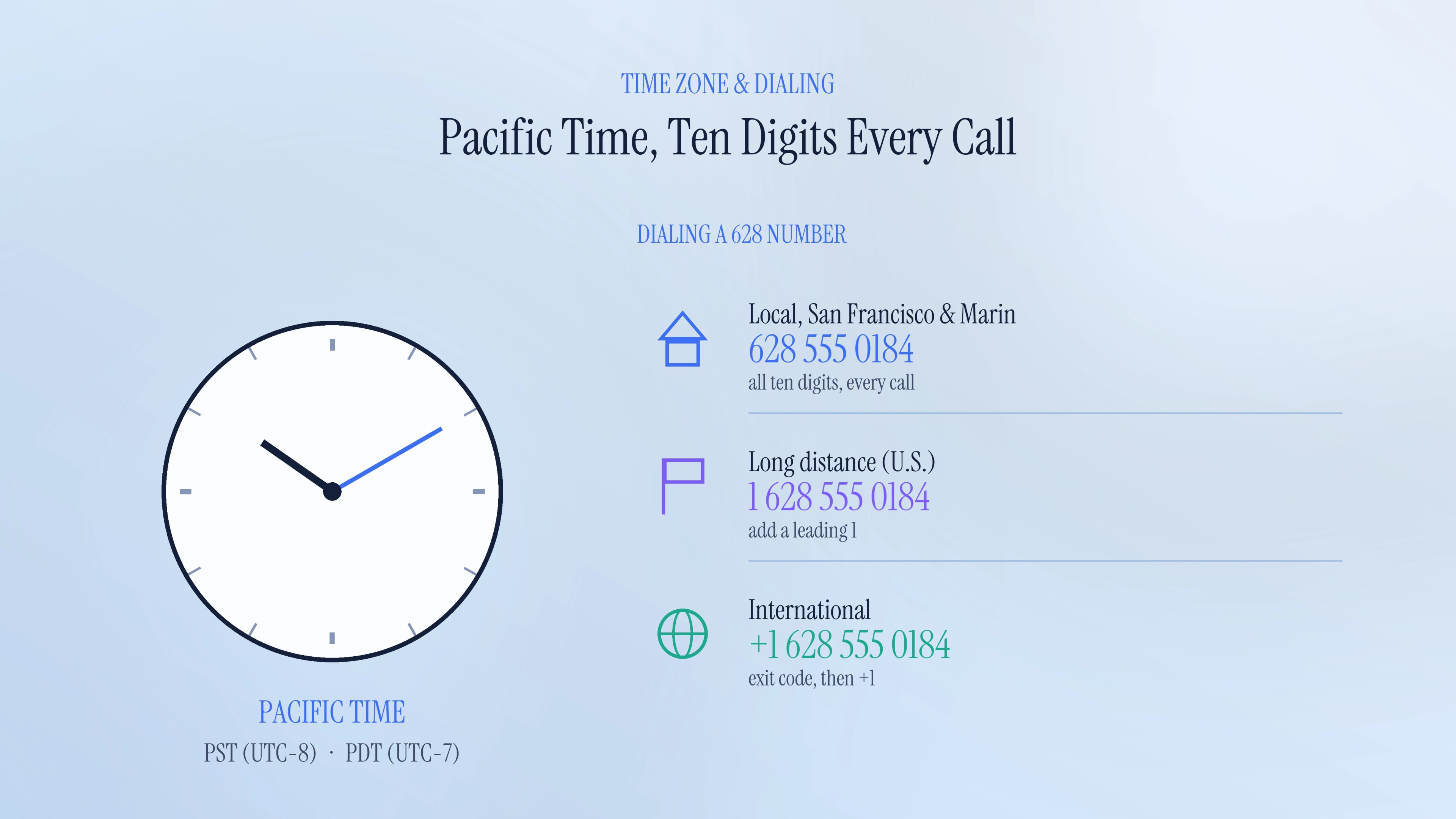
- Local calls within San Francisco and Marin: because 628 and 415 share the region, you must dial all ten digits — 628-555-0184 — for every local call.
- Long-distance from elsewhere in the U.S.: add a leading 1 — 1-628-555-0184.
- International: dial your country's exit code, then +1, then the number — +1 (628) 555-0184.
- On mobile phones: cell numbers are already stored and dialed with all ten digits, so most people reach 628 lines the same way from anywhere.
The 415 Overlay: How 628 Was Born
For most of its history San Francisco and Marin had a single telephone code: 415, one of the original prefixes assigned back in 1947. By the 2010s, though, the region was running out of central-office prefixes — the three-digit blocks that sit behind an area code — and a fresh source of numbers was needed. Regulators had two choices: split the region in two and force half of it onto a new code — the path taken in places like southeastern Texas, where the 936 area code broke off from 409 in 2000 — or overlay a second code across the whole territory so nobody had to change a thing. They chose the overlay.
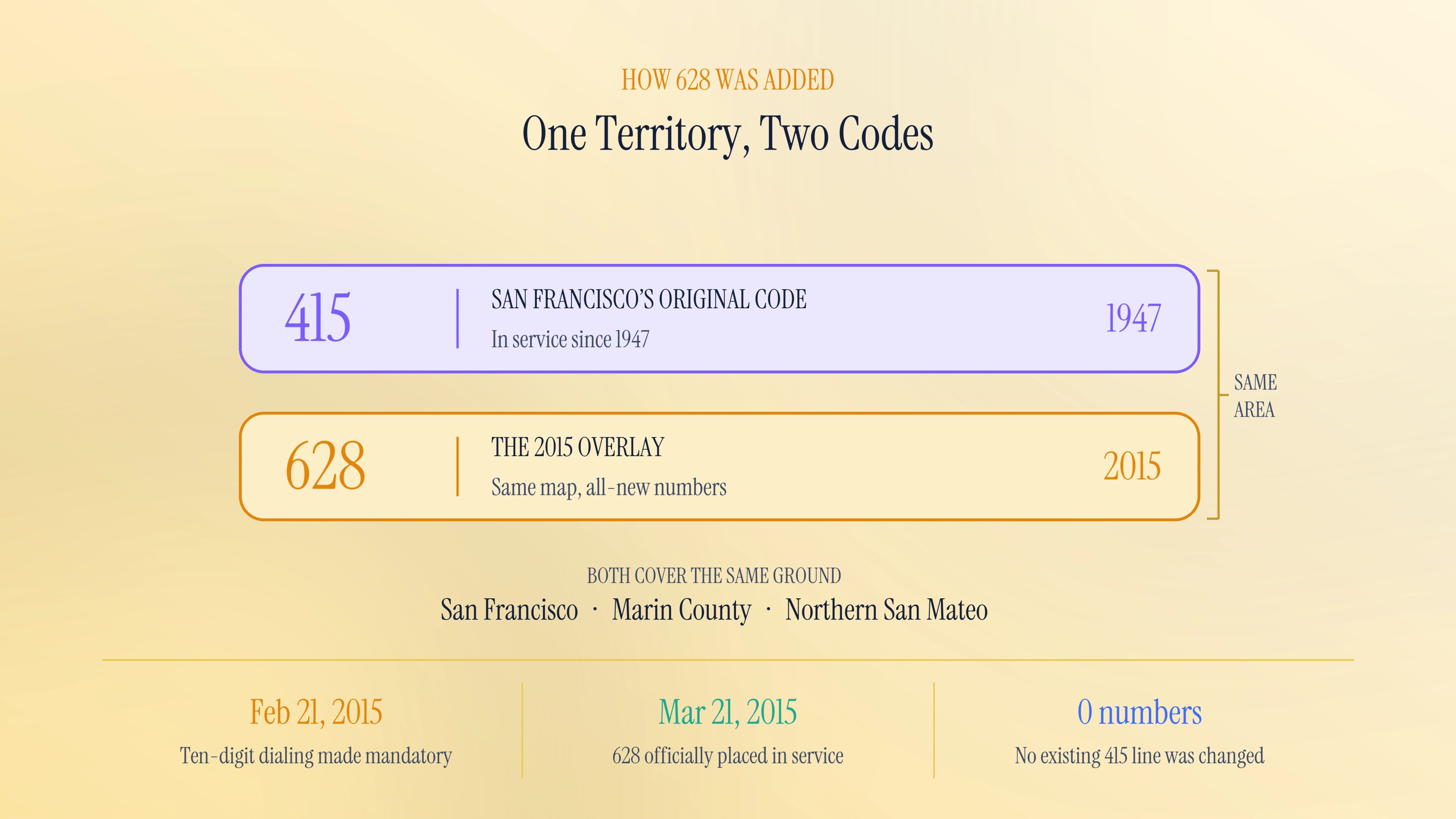
The timeline was straightforward. On February 21, 2015, ten-digit dialing became mandatory throughout the 415 region, preparing every phone in the city and Marin for a second code. One month later, on March 21, 2015, the 628 area code officially went into service, and new numbers began to be issued under it. Crucially, not a single existing 415 line was touched — an overlay adds numbers, it does not take them away. That is why 628 and 415 sit side by side today, two codes covering one identical map, with 628 quietly becoming the default prefix for most new San Francisco lines.
Benefits of a Local 628 Number for Business
A local number is one of the simplest trust signals a business can own, and a 628 line delivers the full weight of San Francisco. Because it shares the exact territory of 415, a 628 caller ID reads as an established Bay Area presence — not an out-of-area cold caller. In one of the world's most competitive markets, that instant recognition is worth a great deal, and there is no practical downside to being on the newer of the two codes.
- Financial District and SoMa credibility — a 628 caller ID reads as native to the banking, venture-capital and tech firms clustered in San Francisco's core business districts.
- Recognized across the overlay — Marin residents from Sausalito to San Rafael already dial ten digits daily, so a 628 call registers as just as local as a 415 one.
- Deep number inventory — 628 exists precisely because 415 ran out of prefixes, so a clean, memorable San Francisco number is still easy to claim today.
- Presence from the Mission to West Marin — cloud routing lets a team based anywhere answer as a local business across the full 628 footprint, coastal towns included.
- Built for tech, finance and tourism volume — add lines and route seasonal or campaign calls without ever changing the local number San Francisco customers already know.
Put a local 628 number to work
Give your business an authentic San Francisco presence with a 628 number that rings anywhere you do business.
How to Get a 628 Phone Number
You do not need a phone company truck or a physical office in San Francisco to own a 628 line. With a cloud phone provider the whole thing is handled online, and a new number can be live the same day. Because 628 is the region's active, well-stocked code, finding an available number is refreshingly easy — and the steps are straightforward:
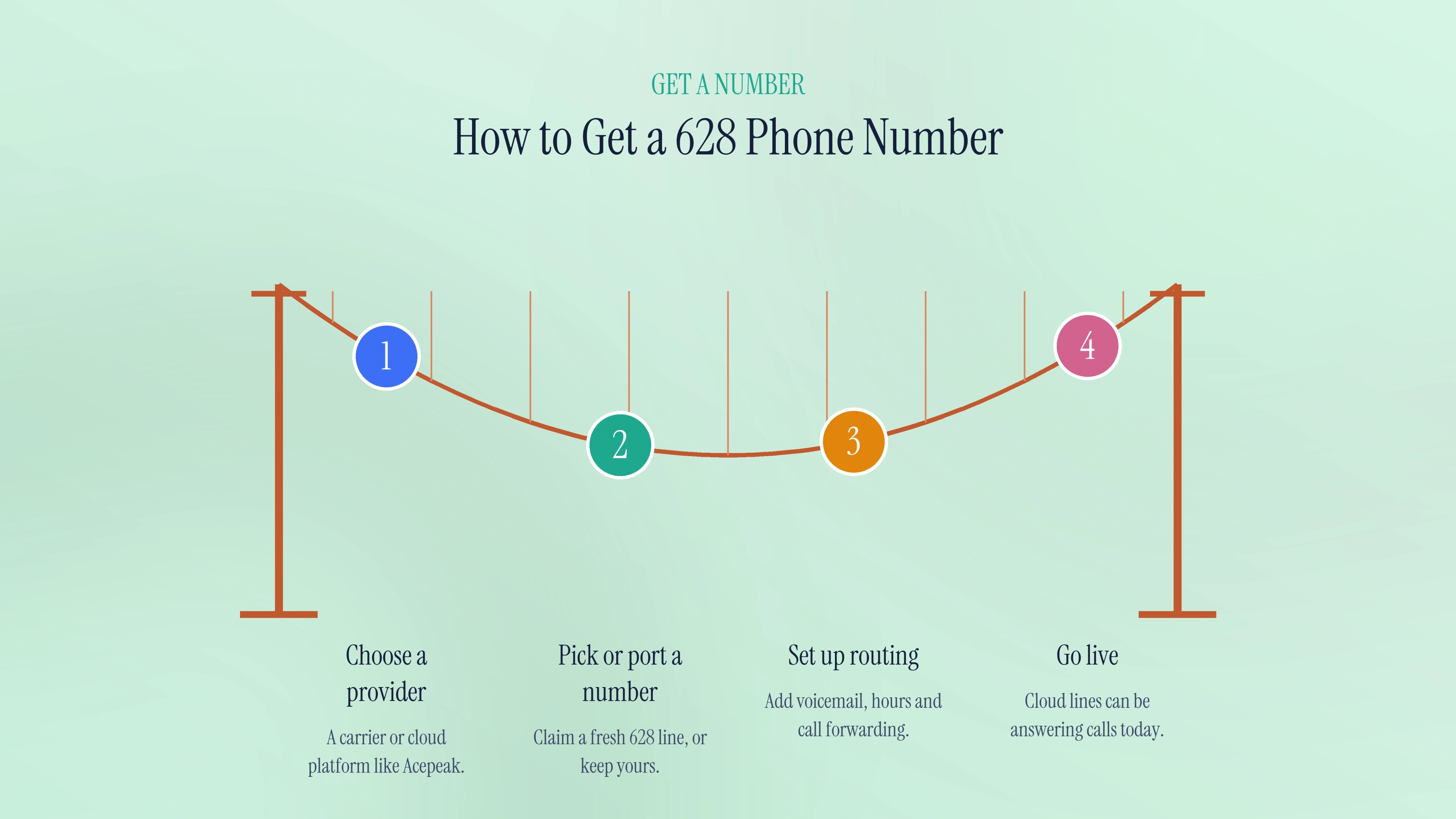
- Pick a cloud provider stocking 628 inventory — confirm they carry the overlay's deep supply of San Francisco numbers rather than only the scarcer original 415 block.
- Search and claim your number — browse available 628 prefixes tied to the neighborhood or Marin town you want to represent, or port an existing line into the overlay.
- Configure ten-digit routing and features — since every call in the region requires all ten digits, set up voicemail, an auto-attendant and forwarding so calls reach your team on schedule.
- Go live across the footprint — start taking calls from a laptop, desk phone or mobile app, presenting the same San Francisco identity from the Financial District to West Marin.
Spotting and Avoiding 628 Scam Calls
A spoofed 628 number works on people for the same reason a real one earns trust: from the Mission to Novato, the prefix is as local as 415. Scammers attach a nearby-looking 628 caller ID to fraudulent calls, betting that a familiar Bay Area code gets answered. These habits help you avoid them:
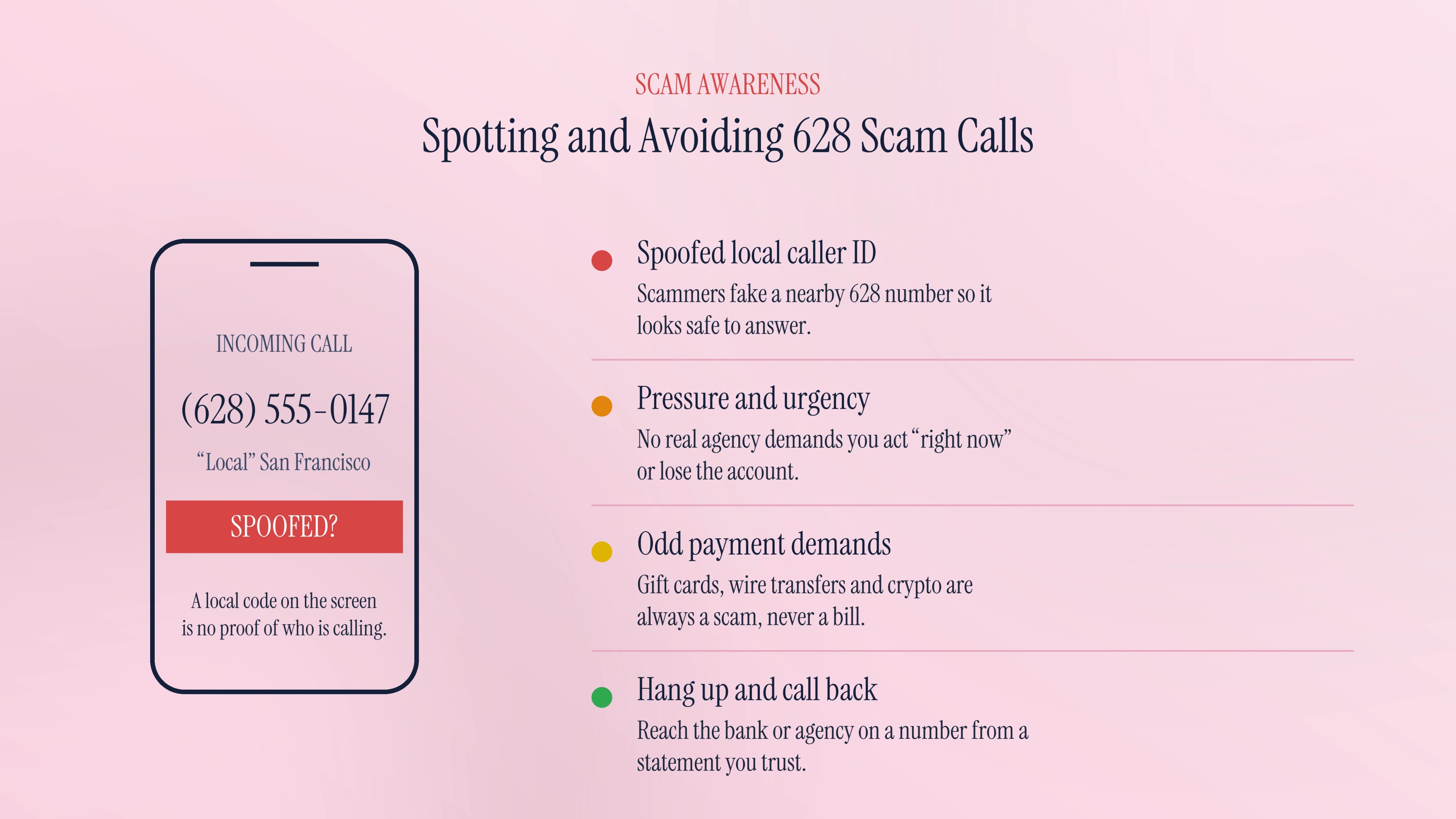
- Watch for pressure and urgency — real agencies and businesses do not demand that you act "right now" or the account will be closed.
- Be wary of odd payment demands — gift cards, wire transfers and cryptocurrency are the calling cards of a scam, never a legitimate bill.
- Do not trust caller ID alone — a 628 number on the screen can be faked; the local code is no guarantee the caller is who they claim.
- Hang up and call back on a number you trust — reach the bank, utility or agency directly using a number from a statement or official website.
- Report the call — logging unwanted calls with the authorities helps regulators track and shut down the operations behind them.
As 415 Stays Scarce, the Newer Code Becomes the Default
The overlay design means the San Francisco–Marin region is set for the long haul. With 415 and 628 sharing one deep pool of numbers, another disruptive split is off the table, and 628 will keep its exact footprint indefinitely. If anything, its role only grows: as the original 415 numbers stay scarce and prized, more and more new lines are issued under 628, making it the everyday face of San Francisco telephone numbers. The City of San Rafael and the rest of the Bay Area remain among the densest business and technology hubs on earth, and their appetite for phone numbers keeps rising — which is exactly what the overlay was built to feed.
For a business, the takeaway is simple: a 628 number is a genuine, readily available San Francisco line, and one you claim today will read as authentically local for many years to come.
A Memorable, Authentically Local Line That's Still Available
The 628 area code is more than a backup to 415 — it is the modern phone identity of San Francisco and Marin, covering the same map from the Financial District and the Mission to the houseboats of Sausalito, the redwoods of Mill Valley and the beaches of Point Reyes. Added as an overlay in 2015 to keep one of America's busiest regions supplied with numbers, it carries the same local standing as its famous older sibling, with the practical advantage that a memorable number is still easy to find. For any business hoping to connect with the San Francisco market, a local 628 number is one of the most authentic — and available — ways to belong.
Claim your San Francisco presence today
Acepeak makes it easy to get a 628 number and start taking calls across San Francisco and Marin.
Questions, answered.
The 628 area code covers the city and county of San Francisco, all of Marin County across the Golden Gate Bridge — including San Rafael, Novato, Sausalito, Mill Valley and Tiburon — and the northeast corner of San Mateo County around Daly City and Brisbane. It is an overlay of 415 and runs on Pacific Time.
Yes. 628 is an overlay of 415, which means the two codes share the exact same territory — San Francisco, Marin County and northern San Mateo County. A 628 number is just as local to San Francisco as a 415 number; the overlay was added in 2015 to supply more numbers to the same region.
Ten-digit dialing became mandatory across the 415 region on February 21, 2015, and the 628 area code officially went into service on March 21, 2015. It was added as an overlay to relieve number exhaustion, without changing anyone's existing 415 number.
The 628 region runs on Pacific Time — UTC-8 during standard time (PST) and UTC-7 during daylight saving time (PDT) — the same clock as Los Angeles, Seattle and the rest of the West Coast, three hours behind New York.
Yes. Because 628 and 415 overlay the same territory, ten-digit dialing is mandatory for every call in the region, including local calls within San Francisco and Marin. Dialing just seven digits will not complete the call.
Absolutely. With a cloud phone provider you can choose an available 628 number from anywhere and have it ring on your laptop, desk phone or mobile app. It gives your business an authentic San Francisco presence without needing a physical office in the city, and because 628 is the region's newer code, memorable numbers are easy to find.
Signing up for a 628 area code number takes minutes with a cloud phone provider — no local office in San Francisco required. Pick the number, connect it to your existing phone or app, and calls route in immediately. This keeps the 628 area code presence you already have while adding the local credibility California customers respond to.