A Coastal Badge Between Los Angeles and Big Sur
Say "the 805" to anyone who lives there and they picture the same thing: the long, sunlit stretch of California coast between Los Angeles and Big Sur. It is the wine country of the Santa Ynez Valley and Paso Robles, the red-tile roofs of Santa Barbara, the surf towns of Pismo Beach and Ventura, and the fast-growing suburbs of Thousand Oaks and Simi Valley at the southern end. Locals wear the code almost like a badge — a shorthand for the unhurried, upscale rhythm of the Central Coast. This guide lays out exactly where 805 reaches today, how it was cut from the original Los Angeles code in 1957 and later handed Bakersfield and the inland valleys to 661, the Pacific time zone and ten-digit dialing rules created by the 820 overlay, and how any business can claim a local 805 presence of its own.
Key Takeaways
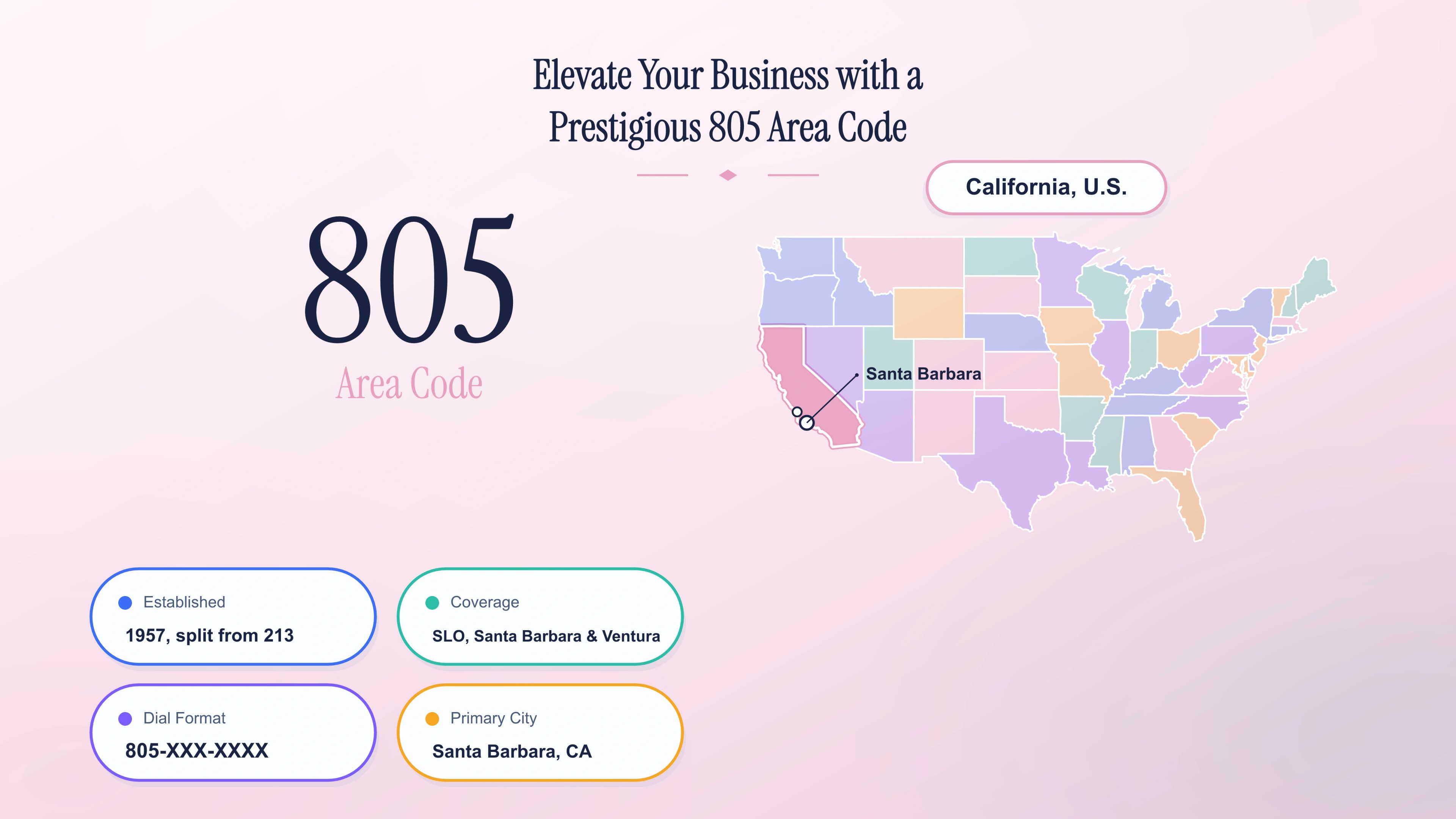
- The 805 area code covers California's Central Coast — the counties of San Luis Obispo, Santa Barbara and Ventura, plus the southernmost tip of Monterey County — including Santa Barbara, Ventura, Oxnard, Thousand Oaks, Simi Valley, San Luis Obispo, Paso Robles, Santa Maria and Lompoc.
- It is not an original 1947 code: 805 was created in 1957, when California's original 213 area code was reduced in size to free up more numbers around Los Angeles.
- In 1999 the inland east — Bakersfield and Kern County, the Santa Clarita Valley and the Antelope Valley — split off into the new 661 area code, leaving 805 with its current three-county coastal footprint.
- In 2018 the 820 area code was added as an overlay across the same territory, which means ten-digit dialing is now mandatory for every local call.
- The whole 805 region runs on Pacific Time — UTC-8 in winter (PST) and UTC-7 in summer (PDT) — and a local 805 number carries the relaxed, upscale identity of the California coast between Los Angeles and the Bay Area.
What Is the 805 Area Code?
The 805 prefix is the telephone identity of California's Central Coast — the roughly 200-mile ribbon of coastline and inland valleys that runs from the southern edge of the San Francisco Bay Area's orbit down to the northern county line of greater Los Angeles. It takes in three full counties — San Luis Obispo, Santa Barbara and Ventura — a region defined by beaches, universities, wine, agriculture and a string of mid-sized cities. Much like the 626 area code in the San Gabriel Valley, 805 is a Southern California code with a strong regional character all its own, distinct from the big-city prefixes on either side of it.
To a customer in the region, an 805 number reads as an unmistakable local — a business rooted on the Central Coast rather than an out-of-town caller. And because the code stretches across three counties and a mix of college towns, retirement communities, farm country and bedroom suburbs, it signals a genuine California-coast presence to customers well beyond the area's borders — a small but real credibility signal for any company.
Three Coastal Counties Along 200 Miles of Pacific
The 805 code spans three coastal counties and the southern tip of a fourth, covering a long, narrow band of California that hugs the Pacific for some 200 miles. Its communities range from historic Spanish-founded cities to university towns, agricultural hubs and commuter suburbs. The major communities include:
- Santa Barbara, Goleta, Carpinteria and Montecito (Santa Barbara County) — the county seat and its coastal neighbors, home to UC Santa Barbara and a world-famous tourism economy.
- Santa Maria, Lompoc, Guadalupe, Buellton and Solvang (northern Santa Barbara County) — the Santa Maria Valley and Santa Ynez wine country, plus the communities around Vandenberg Space Force Base.
- San Luis Obispo, Paso Robles, Atascadero and Arroyo Grande (San Luis Obispo County) — the SLO County hub, home to Cal Poly, framed by the Paso Robles wine region to the north.
- Pismo Beach, Grover Beach, Morro Bay, Nipomo and Cambria — the San Luis Obispo County beach and coastal towns strung along Highway 1.
- Oxnard, Ventura (officially San Buenaventura), Camarillo, Port Hueneme and Ojai (Ventura County) — the county's largest cities and its harbor and agricultural core.
- Thousand Oaks, Simi Valley, Moorpark, Santa Paula and Fillmore — the fast-growing eastern Ventura County suburbs along the Los Angeles county line.
Together those three counties hold roughly 1.5 million residents, spread across a mix of coastal cities, farm valleys and hillside suburbs — a large enough and fast-growing enough footprint that the region eventually needed the extra numbering capacity an overlay provides.
Pacific Clock, and a Dialing Habit the 820 Overlay Changed
The entire 805 region sits within Pacific Time — UTC-8 in winter (PST) and UTC-7 in summer (PDT) — the same clock as Los Angeles, San Francisco and the rest of the West Coast, three hours behind New York. Because 805 now shares its territory with the 820 overlay code, one everyday habit has changed: ten-digit dialing is mandatory for every call, even a call across the street.
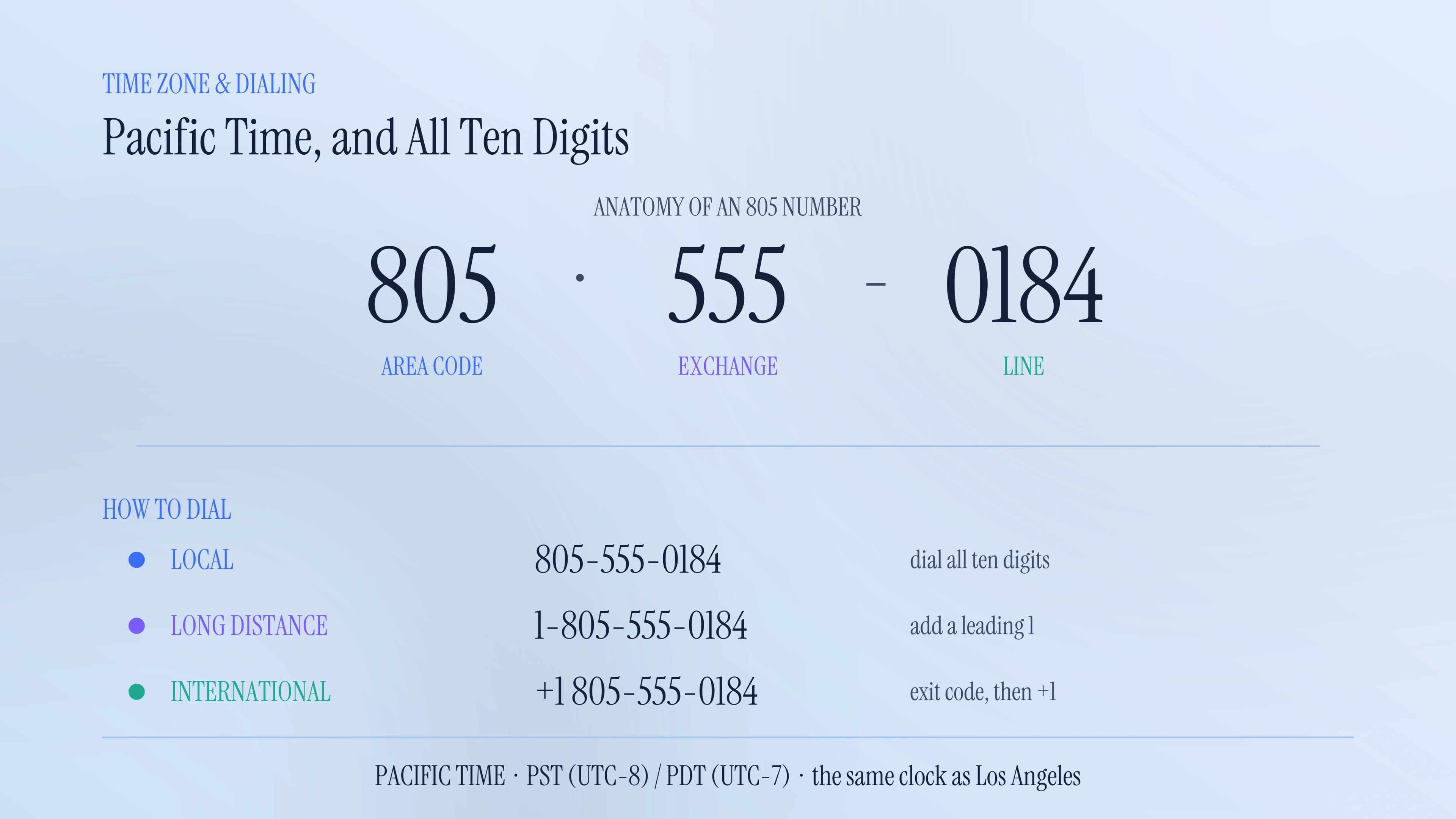
- Local calls within the Central Coast: because 805 shares its area with the 820 overlay, you must dial all ten digits — 805-555-0184 — for every local call.
- Long-distance from elsewhere in the U.S.: add a leading 1 — 1-805-555-0184.
- International: dial your country's exit code, then +1, then the number — +1 (805) 555-0184.
- On mobile phones: cell numbers are already stored and dialed with all ten digits, so most people reach 805 lines the same way from anywhere.
How 805 Took Shape: The 213 Origin, the 661 Split and the 820 Overlay
Contrary to a common assumption, 805 is not one of the original 1947 area codes. It was born in 1957, when California's very first code — 213, covering Los Angeles and a huge surrounding region — was reduced in size to free up more numbers for the booming L.A. area. The territory carved off became 805, a sprawling code that at first reached far inland across Kern County and the southern San Joaquin Valley as well as the coast. For decades that single prefix served everyone from Bakersfield's oil fields to the Santa Barbara waterfront.
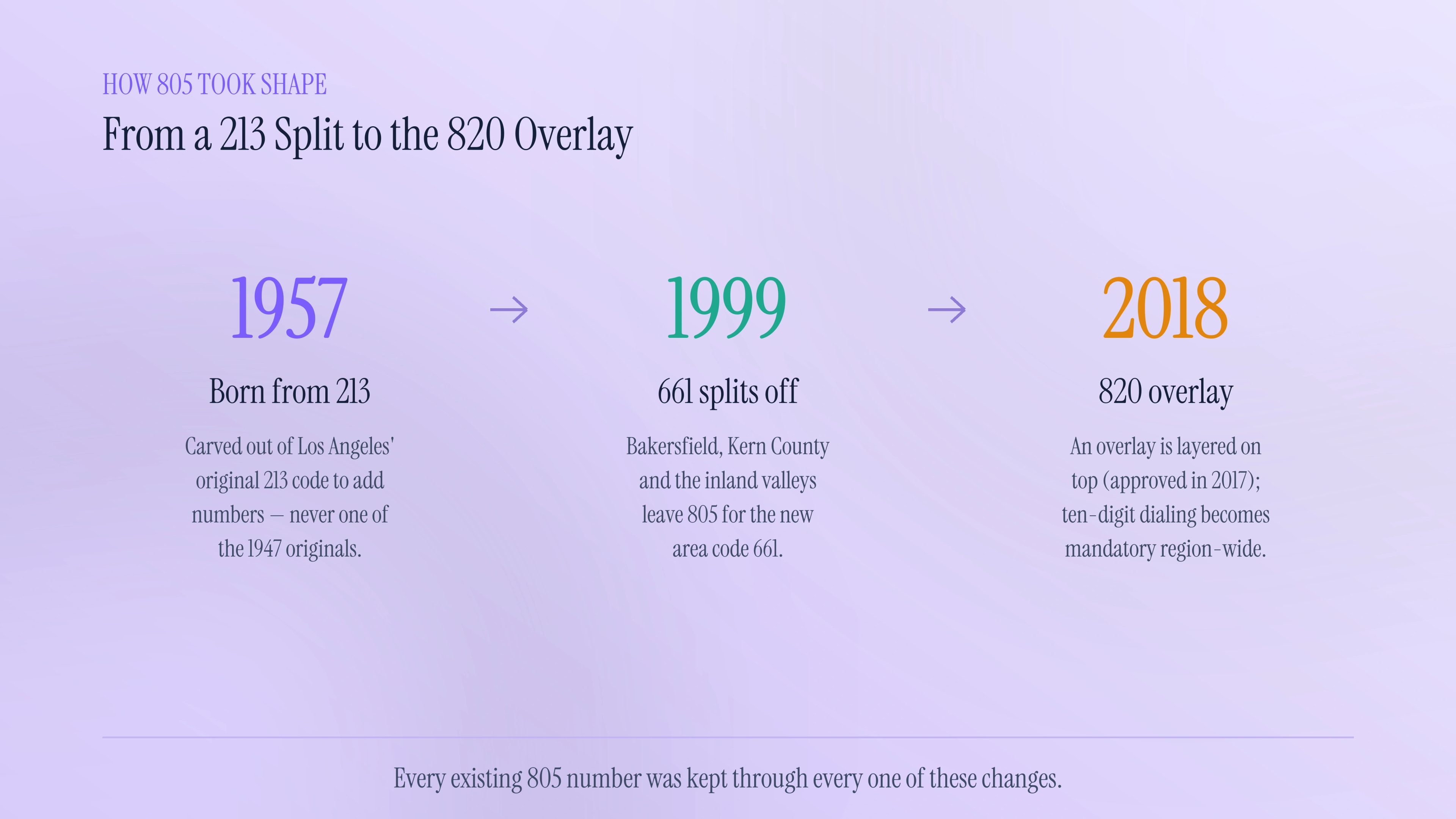
The defining change came on February 13, 1999, when the inland east split off into the new area code 661 — Bakersfield and Kern County, the Santa Clarita Valley and the Antelope Valley all left 805 at once. That split gave 805 the shape it holds today: the three coastal counties of San Luis Obispo, Santa Barbara and Ventura. By the 2010s even that footprint was running short of numbers, so rather than split the region again, regulators chose an overlay — the same approach California used for Los Angeles' 424 area code layered over 310. The California Public Utilities Commission approved 820 in 2017, and new 820 numbers went into service in June 2018 across the same Central Coast territory. No existing 805 number changed; the only trade-off is that every local call now takes all ten digits.
Benefits of a Local 805 Number for Business
A local number is one of the simplest trust signals a business can own. On the Central Coast, where communities are tight-knit and locally minded, an 805 line tells customers you are one of them — an established neighbor, not an out-of-area cold caller. That instant familiarity translates directly into calls answered and deals closed.
- Recognized from Goleta to Ojai — an 805 caller ID reads as Central Coast local whether customers are near UC Santa Barbara's campus or the harbor towns of Ventura County.
- Reflects the region's wine and agriculture economy — the code carries the same trusted identity used by tasting rooms in Santa Ynez and growers around Oxnard and Santa Maria.
- Numbers remain findable — since the 820 overlay added a second layer in 2018, a Central Coast business can still claim a memorable 805 line instead of settling for the newer code.
- Works without a beachfront office — cloud calling lets a company anywhere hold an 805 number and answer as a local presence from Paso Robles wine country to the Ventura suburbs.
- Scales with tourism season swings — add lines and route calls to match the visitor surges Santa Barbara and the Highway 1 coastal towns see each summer, without changing the number.
Put a local 805 number to work
Give your business an authentic California Central Coast presence with an 805 number that rings anywhere you do business.
How to Get an 805 Phone Number
Today an 805 number can be set up without booking a technician or finding office space in San Luis Obispo or Santa Barbara. The order goes through a cloud phone provider online, and a Central Coast line can be ready on the day you order it. With 820 now sharing the same three counties, it helps to follow these steps in order:
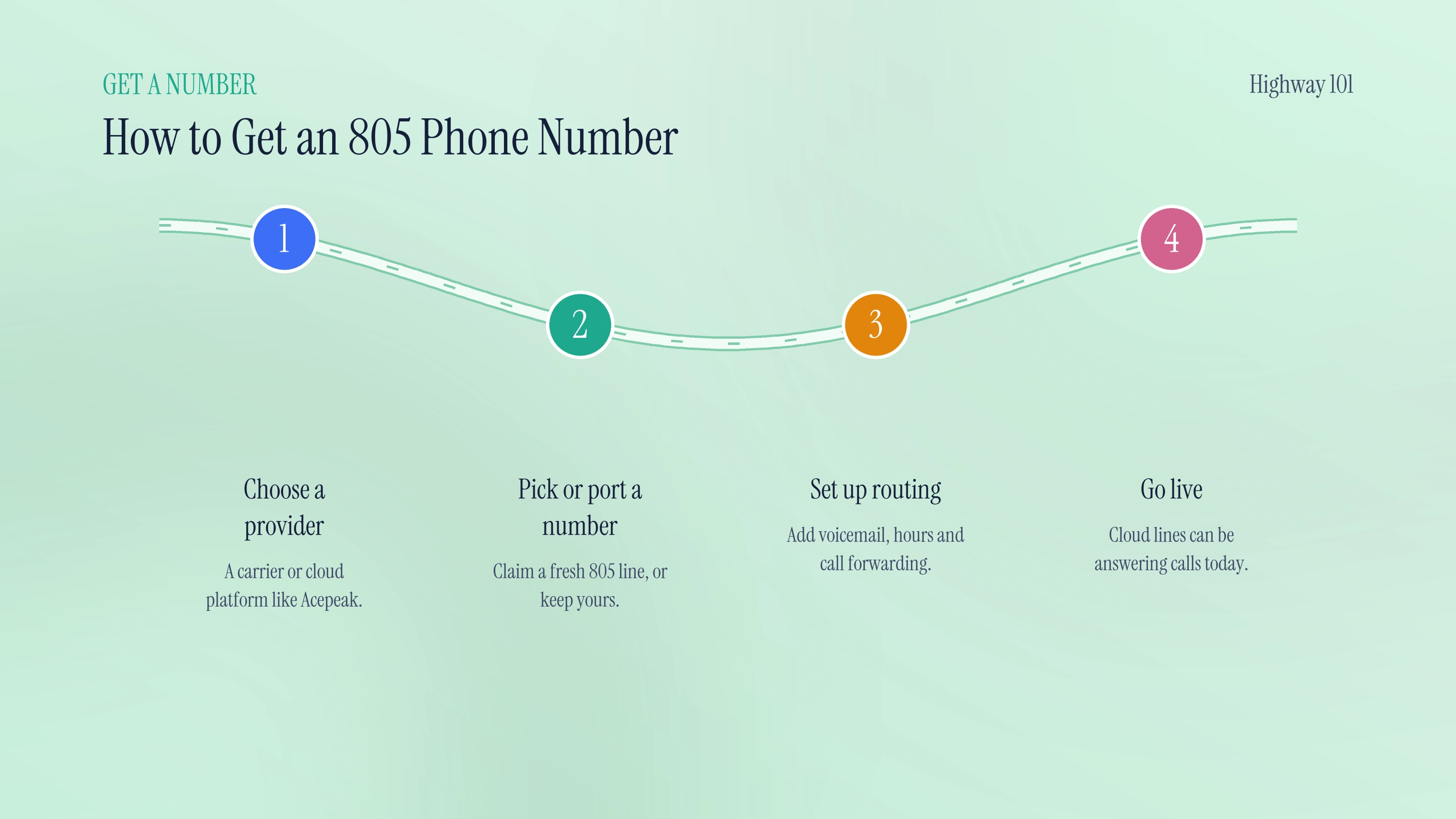
- Choose a cloud provider with 805 inventory — confirm they can issue Central Coast numbers even though the newer 820 overlay now shares the same three counties.
- Search and claim your number — pick a prefix tied to the county you serve, whether Santa Barbara's coastline or the farm towns around San Luis Obispo, or port an existing line.
- Configure ten-digit routing and features — since 805 and 820 share territory, set up voicemail, an auto-attendant and forwarding so every call reaches your team correctly.
- Go live across the coast — start taking calls from a laptop, desk phone or mobile app, presenting the same 805 identity from Thousand Oaks to Cambria.
Spotting and Avoiding 805 Scam Calls
Along the Central Coast, from Santa Ynez tasting rooms to the Ventura County suburbs, a call from 805 feels familiar, and fraudsters try to cash in. Neighbor spoofing puts a nearby 805 or 820 number on a fraudulent call so it looks safe to pick up. Protect yourself with these habits:
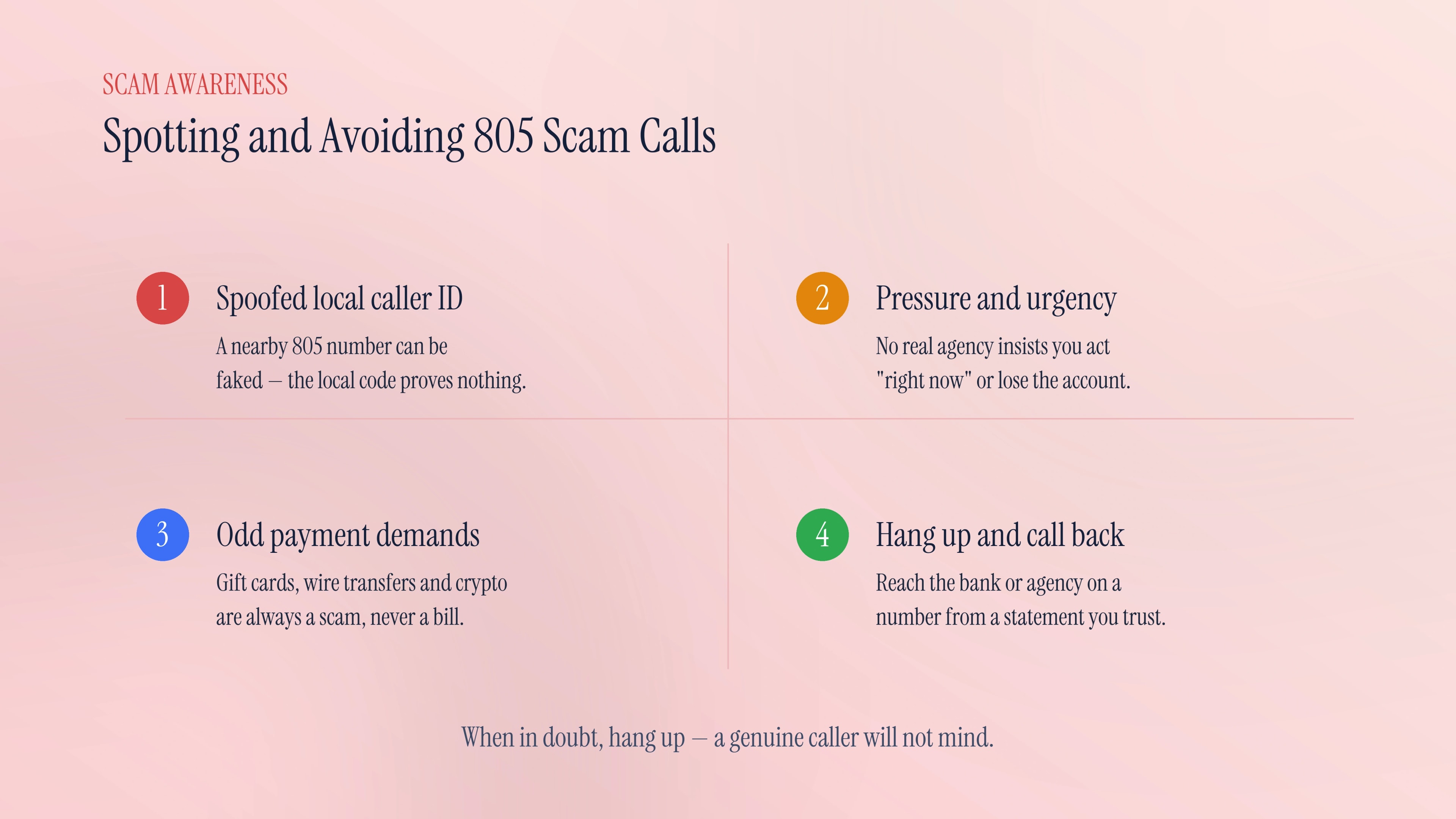
- Watch for pressure and urgency — real agencies and businesses do not demand that you act "right now" or the account will be closed.
- Be wary of odd payment demands — gift cards, wire transfers and cryptocurrency are the calling cards of a scam, never a legitimate bill.
- Do not trust caller ID alone — an 805 number on the screen can be faked; the local code is no guarantee the caller is who they claim.
- Hang up and call back on a number you trust — reach the bank, utility or agency directly using a number from a statement or official website.
- Report the call — logging unwanted calls with the authorities helps regulators track and shut down the operations behind them.
The Future of the 805 Area Code
With the 820 overlay in place since 2018, the Central Coast now has a deep, shared pool of numbers to draw on, so another split is off the table — 805 will keep its three-county footprint indefinitely. New lines are increasingly issued under 820, but the original 805 numbers remain in steady demand precisely because the code is so closely tied to the region's identity. The City of Santa Barbara and its neighbors up and down the coast continue to grow their tourism, technology and agricultural economies, and that steady expansion is exactly why the overlay was needed. For a business, the takeaway is simple: a genuine 805 number is a lasting local asset, and one you claim today will read as authentically Central Coast for many years to come.
Why Central Coast Customers Recognize a Local Line
The 805 area code is far more than three digits — it is the shared phone identity of California's Central Coast, from the wine country of Paso Robles and the Santa Ynez Valley to the Santa Barbara waterfront and the Ventura County suburbs. Cut from the original Los Angeles code in 1957, it handed Bakersfield and the inland east to 661 in 1999 before the 820 overlay secured its future, leaving it focused on the three coastal counties it has always defined. For any business hoping to connect with the Central Coast market, a local 805 number is one of the most recognizable and authentic ways to belong.
Claim your Central Coast presence today
Acepeak makes it easy to get an 805 number and start taking calls across Santa Barbara, San Luis Obispo and Ventura counties.
Questions, answered.
The 805 area code covers California's Central Coast — the counties of San Luis Obispo, Santa Barbara and Ventura, plus the southernmost tip of Monterey County. Major cities include Santa Barbara, Ventura, Oxnard, Thousand Oaks, Simi Valley, San Luis Obispo, Paso Robles, Santa Maria and Lompoc. The region runs on Pacific Time.
No. 805 was created in 1957, when California's original 213 area code was reduced in size to provide more numbers around Los Angeles. The territory that split off became 805, which at first stretched far inland before later splits pared it back to the Central Coast.
On February 13, 1999, the inland eastern portion of 805 split off into the new area code 661 — taking Bakersfield and Kern County, the Santa Clarita Valley and the Antelope Valley. That split left 805 with just the three coastal counties of San Luis Obispo, Santa Barbara and Ventura.
820 is an overlay area code added on top of the entire 805 region. The California Public Utilities Commission approved it in 2017, and new 820 numbers went into service in June 2018. It covers the same Central Coast territory as 805 rather than replacing it, so no existing 805 number had to change.
Yes. Because the 820 overlay shares the same territory as 805, ten-digit dialing is mandatory for every call in the region, including local calls within the Central Coast. Dialing just seven digits will not complete the call.
Absolutely. With a cloud phone provider you can choose an available 805 number from anywhere and have it ring on your laptop, desk phone or mobile app. It gives your business an authentic Central Coast presence without needing a physical office in Santa Barbara, San Luis Obispo or Ventura counties.
Signing up for an 805 area code number takes minutes with a cloud phone provider — no local office in California required. Pick the number, connect it to your existing phone or app, and calls route in immediately. This keeps the 805 area code presence you already have while adding the local credibility California customers respond to.