Not Quite City, Not Quite Country: The Hudson Valley Line
The Hudson Valley has always been a place apart — not quite the city, not quite the country, but something richer than either. The 845 prefix reflects that identity exactly. It spans a generous band of New York stretching from the wooded ridges of the Catskills down through dairy-farm valleys, college towns, and river cities to the commuter suburbs just north of the five boroughs. It is the phone identity of Poughkeepsie and Kingston, of Woodstock and New Paltz, of Newburgh's riverfront revival and Port Jervis's railroad heritage. This guide explains what the prefix covers, where it came from, how to dial it, and why a local Hudson Valley number still matters in 2026.
Key Takeaways
- The 845 prefix covers six counties in New York's Hudson Valley — Orange, Rockland, Sullivan, Ulster, Dutchess, and Putnam — and was split from the 914 area code on June 1, 2000.
- Westchester County kept the 914 code after the split, so cities like Yonkers and White Plains are outside the 845 region despite their geographic closeness.
- Major communities served include Poughkeepsie, Newburgh, Kingston, Middletown, Spring Valley, Port Jervis, Woodstock, New Paltz, and Beacon.
- The entire region operates in the Eastern Time Zone (EST/EDT) — the same zone as New York City.
- A local 845 number signals genuine Hudson Valley roots, a real advantage in a region where community trust drives word-of-mouth business.
What Is the 845 Area Code?
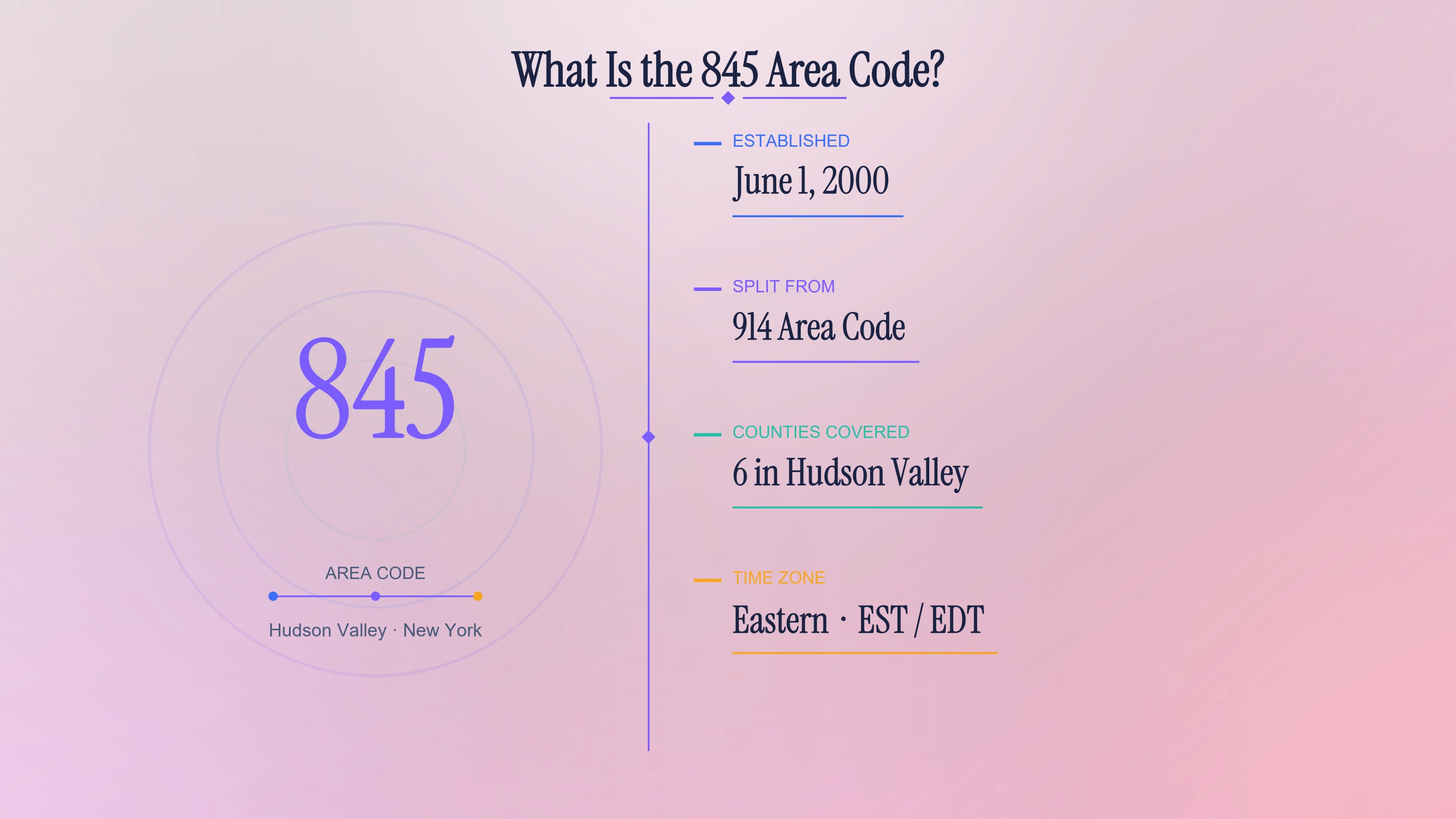
The 845 area code is New York's mid-Hudson region prefix. It was created on June 1, 2000, when it split from the 914 code that had covered the entire lower Hudson Valley since 1947. As the region grew and 914's number supply thinned, regulators separated the two territories: Westchester County — home to Yonkers, White Plains, and the immediate New York City suburbs — kept 914, while the six counties to the north and west took the new 845 designation.
The split gave the Hudson Valley its own distinct telephone identity for the first time. In the years since, the prefix has become synonymous with a corridor that blends rural character with genuine economic activity — agriculture, arts, technology campuses, and a steady stream of people drawn north from the city.
Geographic Coverage and Cities Served
The 845 region covers six full counties and a broad range of communities:
- Orange County: Newburgh, Middletown, Port Jervis, Goshen, Monroe, Warwick
- Rockland County: Spring Valley, New City, Nyack, Suffern, Monsey, Pearl River
- Sullivan County: Monticello, Liberty, Fallsburg, Livingston Manor
- Ulster County: Kingston, Woodstock, New Paltz, Saugerties, Ellenville, Highland
- Dutchess County: Poughkeepsie, Beacon, Wappingers Falls, Hyde Park, Rhinebeck
- Putnam County: Carmel, Brewster, Mahopac
One distinction matters: Westchester County is not part of the 845 region. Cities like Yonkers, White Plains, and Peekskill belong to the 914 code. Further south, New York City's 917 code covers a separate geography entirely. Callers and businesses should confirm which code applies before choosing a local number.
The Split from 914: How 845 Was Born
For more than fifty years, a single area code covered everything from Westchester to the Pennsylvania border. By the late 1990s, mobile phones, pagers, and fax lines were consuming numbers at a rate the original allocation could not sustain. The North American Numbering Plan Administrator approved a geographic split effective June 1, 2000.
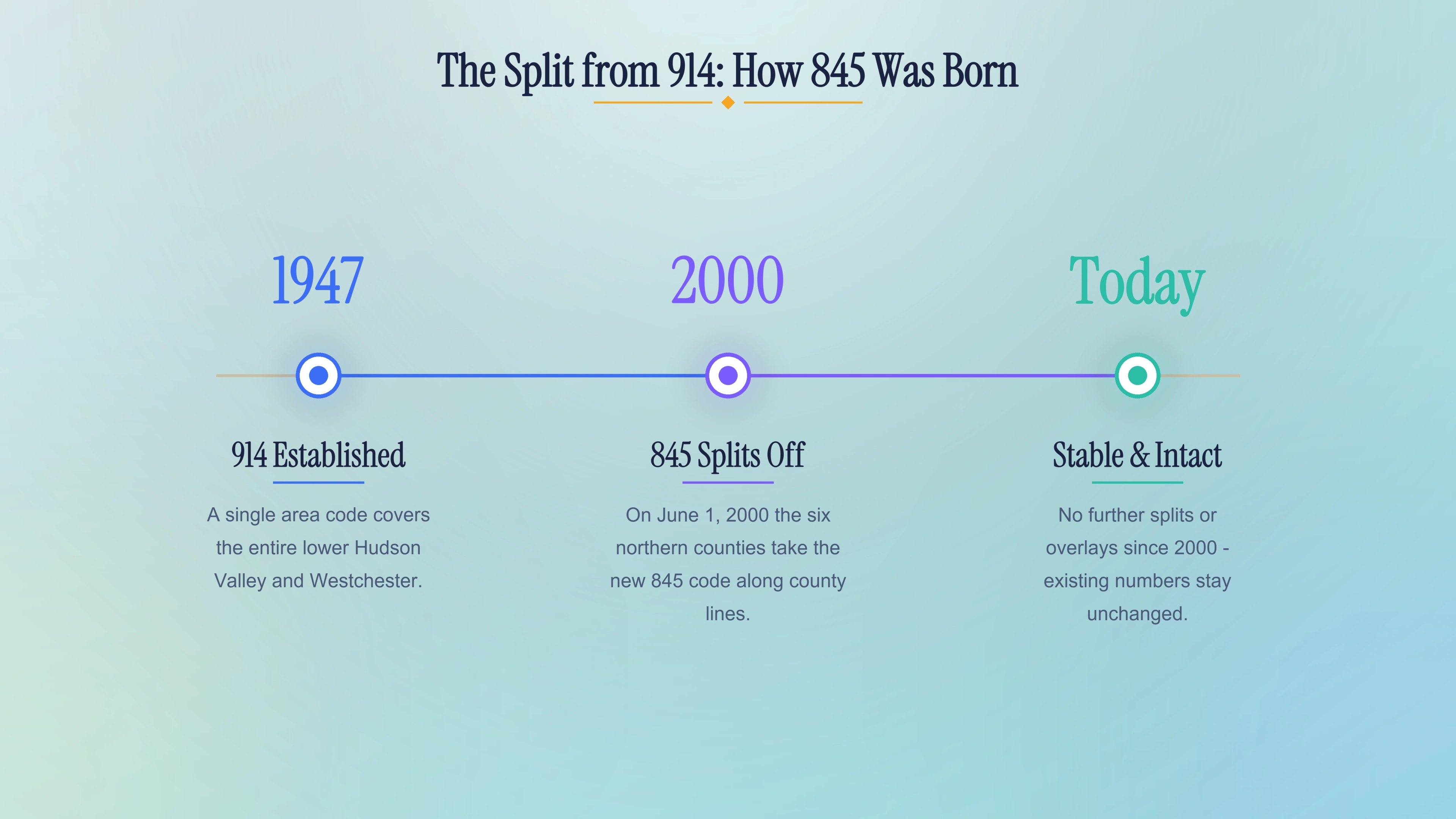
The boundary followed county lines rather than city limits, which meant communities on either side of a county border sometimes ended up in different codes overnight. The transition required businesses and residents to update marketing materials, stationery, and contact pages — a modest cost offset by a fresh supply of local numbers. Unlike the overlay approach used for Long Island's 631 code or several other New York regions, the 845 territory went more than two decades without further relief, until the 329 overlay arrived in March 2023.
Hudson Valley Clocks and Ten Digits When in Doubt
Poughkeepsie, Kingston, Newburgh, and the rest of the six-county 845 region keep Eastern Time. Clocks read UTC−5 (EST) in winter and move to UTC−4 (EDT) for daylight saving, which begins the second Sunday in March and ends the first Sunday in November. Hudson Valley businesses work the same hours as New York City, two to three hours ahead of the Mountain and Pacific states.
- Local calls within the region: dial all ten digits — 845-555-1234.
- Long-distance from elsewhere in the U.S.: add 1 — 1-845-555-1234.
- International: dial your country's exit code, then +1 (845) 555-1234.
Ten-digit dialing for local calls has been standard practice across New York as overlays have taken effect in neighboring regions. When in doubt, dial all ten digits — it connects correctly in every scenario.
Benefits of a Local 845 Number for Business
A Hudson Valley phone number is a quiet statement of local commitment. Residents and business owners in the region have a strong preference for working with neighbors they can reach on a familiar number.
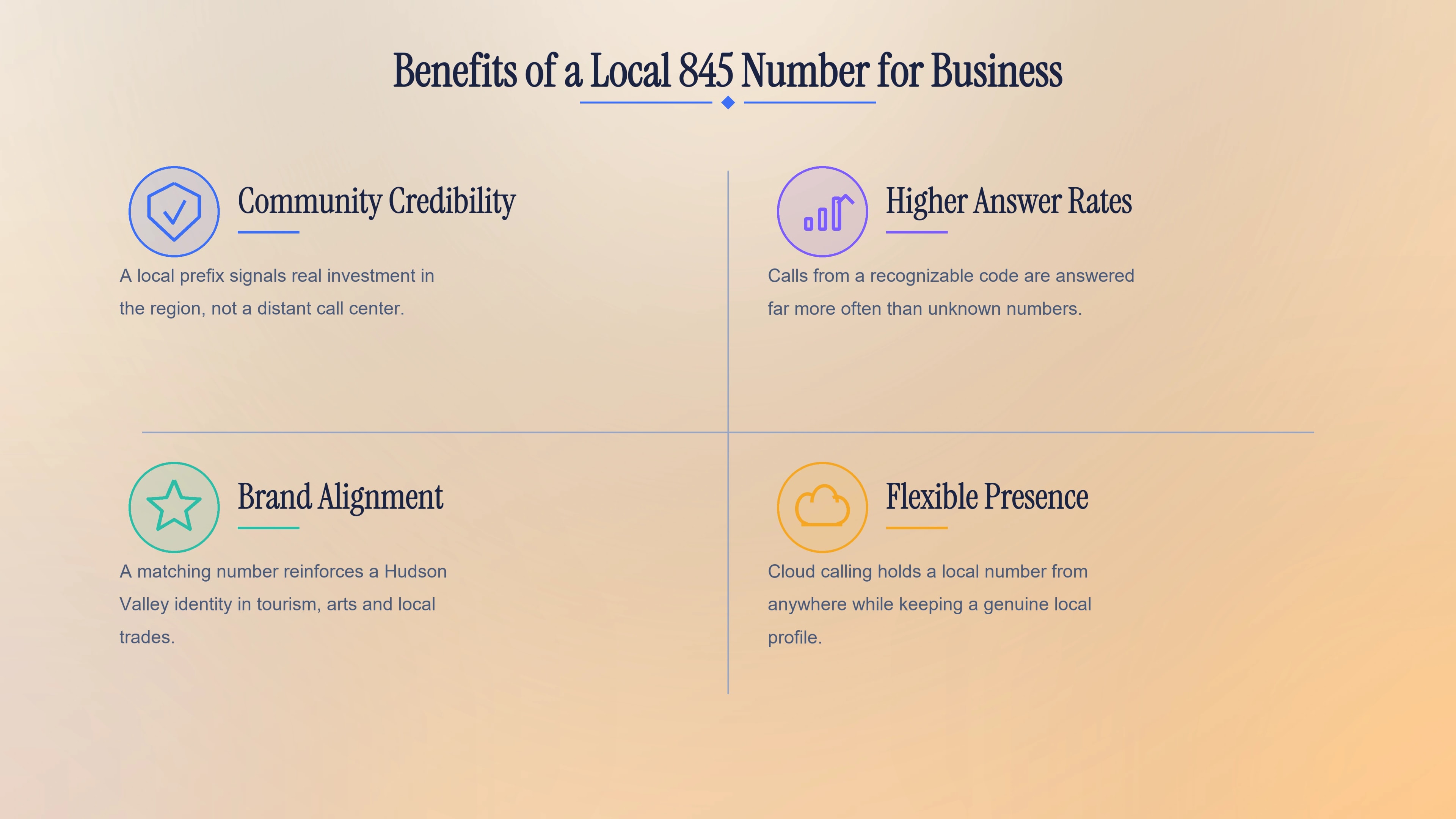
- Community credibility: a local prefix signals investment in the region, not a call from a distant national center.
- Higher answer rates: calls from recognizable area codes are answered far more often than unfamiliar numbers. A local code reduces the chance a customer screens the call.
- Brand alignment: for businesses built on Hudson Valley identity — tourism, agriculture, arts, local services — a matching phone number reinforces the brand story.
- Flexible presence: cloud calling lets a business or individual hold a local 845 number from anywhere while maintaining a genuine local profile.
Ready to establish a Hudson Valley presence?
Acepeak provides local numbers with instant activation and carrier-grade reliability — so any business can sound genuinely local from day one.
How to Get an 845 Phone Number
Whether a company works out of a Kingston storefront or serves Orange and Dutchess county customers from elsewhere, an 845 number comes together in four short steps.
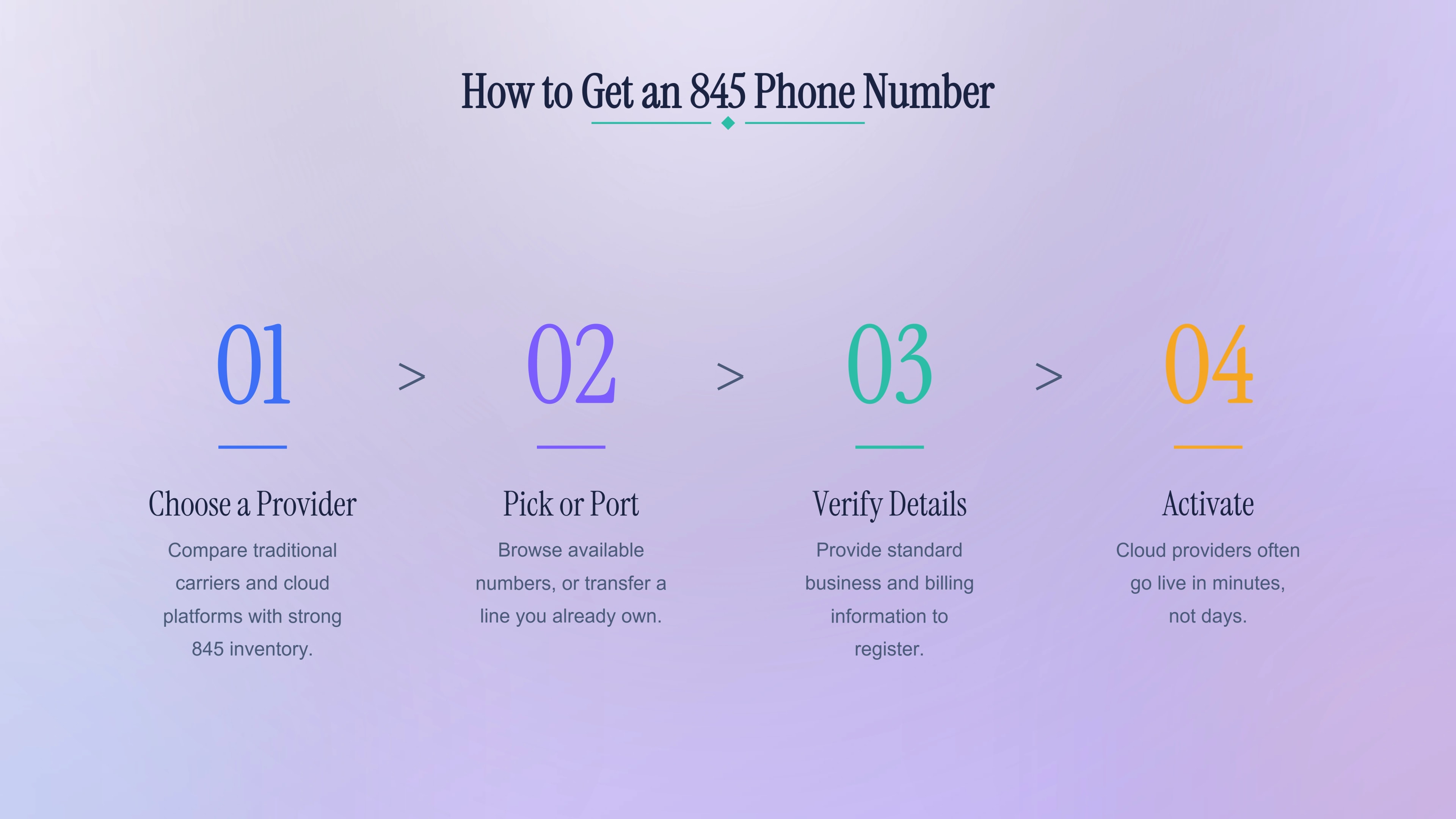
- Choose a provider: compare traditional carriers and cloud platforms. Look for one with a strong inventory of numbers in the 845 region.
- Pick or port a number: browse available numbers in the inventory, or transfer an existing line you already own.
- Verify your details: provide standard business and billing information to complete registration.
- Activate: cloud providers typically go live within minutes. Traditional carriers may take a few business days.
When a Hudson Valley Neighbor on Caller ID Isn't One
Because a local number looks trustworthy, scammers sometimes spoof the prefix to appear as a Hudson Valley neighbor. A local-looking call still deserves caution.
- Never share personal details — Social Security numbers, bank account information, or passwords — with an unexpected caller.
- If a caller creates urgency, hang up and call back on a published official number.
- Enable call-blocking and spam-detection tools through your carrier or device settings.
- Report suspicious calls to your provider so patterns can be flagged across the network.
The Future of the 845 Prefix
The Hudson Valley has not been split since its creation in 2000; instead, the 329 overlay began sharing the territory in March 2023, which opened a second pool of numbers while leaving every existing 845 line as it was. The New York State Department of Public Service monitors numbering supply across all New York codes and manages any future allocation changes. For residents and businesses, the practical takeaway is straightforward: the local identity is secure, and demand for a recognized Hudson Valley number is only growing.
A Clean Split, Six Counties and No Disruption Since
The 845 prefix is more than a routing number — it is a geographic identity that connects Catskill forests to commuter towns, university campuses to river waterfronts. It was shaped by a clean split from 914 in 2000 and has served its six counties without disruption since. For any business operating in or reaching into this market, a local Hudson Valley number is one of the simplest and most effective ways to signal genuine community presence.
Put a trusted Hudson Valley number to work.
Acepeak delivers local lines with smart routing, voicemail, and 24/7 support — everything a business needs to stay connected in the region.
Questions, answered.
It covers six counties in New York's Hudson Valley: Orange, Rockland, Sullivan, Ulster, Dutchess, and Putnam.
Major communities include Poughkeepsie, Newburgh, Kingston, Middletown, Spring Valley, Port Jervis, New City, Woodstock, New Paltz, Beacon, Saugerties, Rhinebeck, and many smaller towns across the six-county area.
No. The prefix covers the Hudson Valley counties north and west of New York City. NYC itself uses codes like 212, 646, 718, 917, and 332. Westchester County, the suburban border between the city and the 845 region, belongs to 914.
The split took effect on June 1, 2000. The North American Numbering Plan Administrator approved the change as 914's number supply was depleted by the growth of mobile phones and internet connections.
Yes — dial the full ten digits (area code plus seven-digit number) for any local call within the region. The leading 1 is only required when dialing from outside the area.
Signing up for an 845 area code number takes minutes with a cloud phone provider — no local office in New York required. Pick the number, connect it to your existing phone or app, and calls route in immediately. This keeps the 845 area code presence you already have while adding the local credibility New York customers respond to.