From Horse Farms to the Ohio River Bank
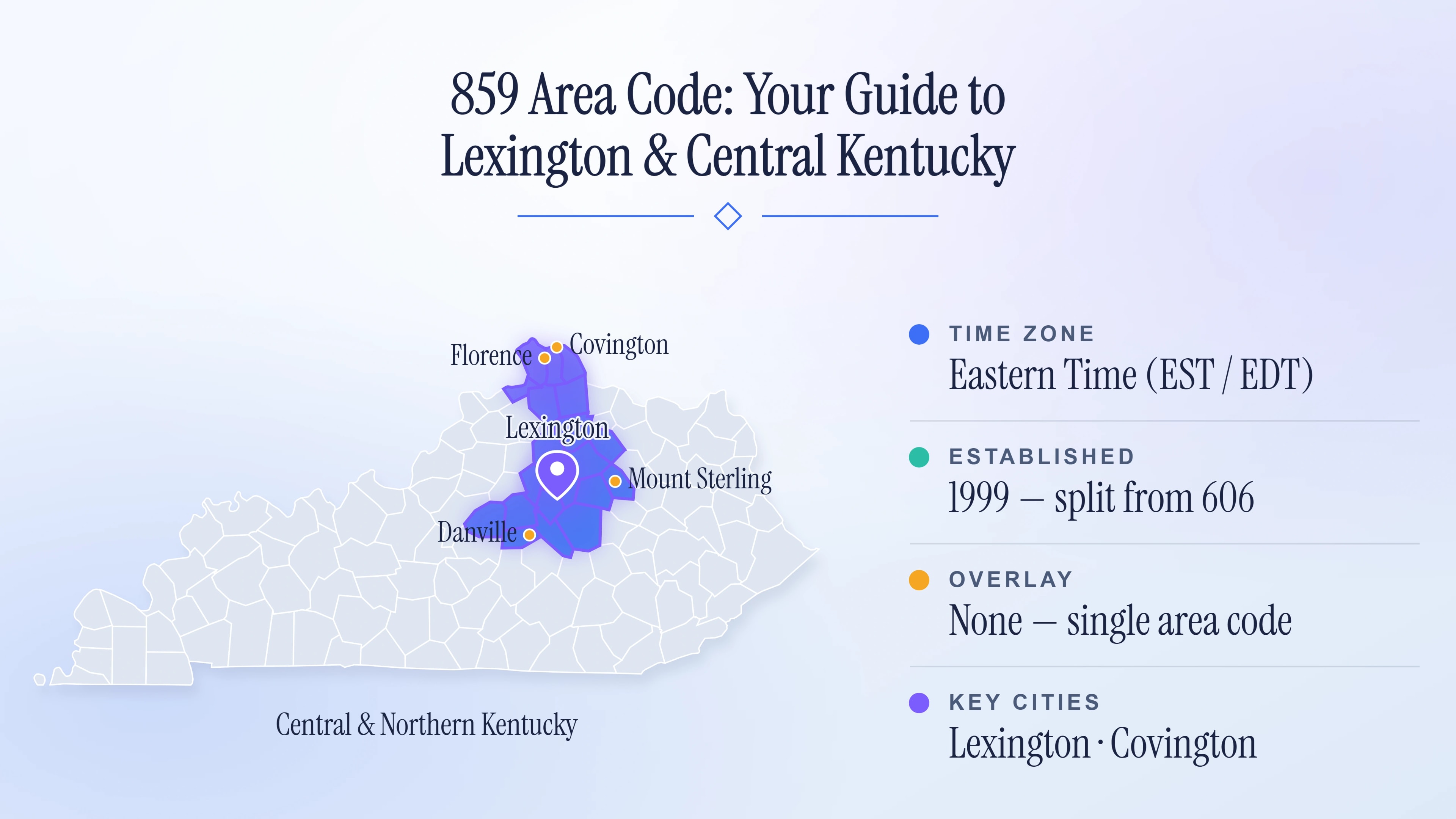
Horse farms outside Lexington, the University of Kentucky campus and the Covington and Newport riverfront across from Cincinnati all share one area code. Carved out of 606 in 1999 and never overlaid, 859 has stayed the only code for this fast-growing part of Kentucky for more than two decades, and on a phone keypad it even spells UKY. The sections below map the roughly 19 counties it covers, trace how the split happened, explain why no second code has been needed, and show how a business can put an 859 number to work.
Key Takeaways
- The 859 prefix serves Lexington and central Kentucky together with Northern Kentucky — the Commonwealth's side of the greater Cincinnati metro — across roughly 19 counties anchored by Fayette County.
- It was created in 1999 as a split from 606 and put into service on April 1, 2000, when the fast-growing Bluegrass and river-city region outgrew eastern Kentucky's single code.
- Regulators let rural eastern and southeastern Kentucky keep 606 and assigned the new 859 to the urbanizing Lexington and Northern Kentucky territory.
- The region sits entirely in the Eastern Time Zone, has never been overlaid, and still operates as a single area code — though ten-digit dialing has applied since 2021 because of the 988 hotline.
- On a phone keypad 859 spells UKY, a nod to the University of Kentucky — and a local 859 number still lifts answer rates for businesses across the Bluegrass.
What Is the 859 Area Code?
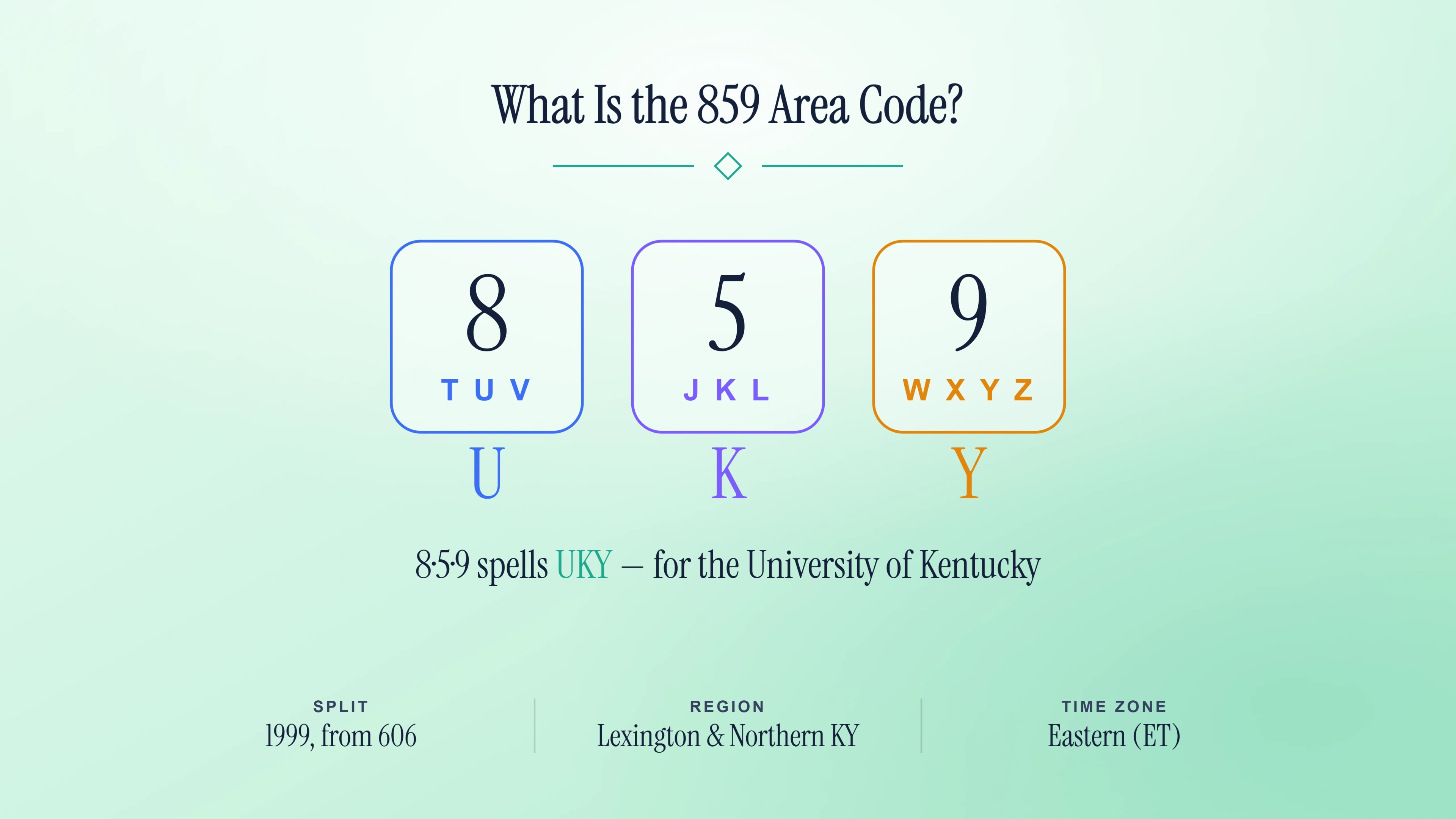
The prefix is the telephone area code for central Kentucky and the Commonwealth's northern tip. It was split from 606 — the original code for the entire eastern half of Kentucky — in 1999, taking the region's urban heart while the rural counties stayed behind. Centered on Lexington and reaching north to the Kentucky suburbs of Cincinnati, the code blends a major college city, established river towns and a fast-growing collar of Bluegrass communities. Much as Detroit's 313 area code reads as unmistakably local, 859 carries a recognizable Kentucky identity.
Because it covers Lexington, the Northern Kentucky river cities and the booming towns around them, the code carries real local weight. An 859 number reads as genuinely part of the Bluegrass — a useful credibility signal for any business serving central or Northern Kentucky.
Lexington, the River Cities and 19 Bluegrass Counties
The prefix spans roughly 19 counties, from Fayette and the surrounding Bluegrass out to Kenton, Boone and Campbell counties along the Ohio River. The major communities include:
- Lexington — the Bluegrass hub, Kentucky's second-largest city and home to the University of Kentucky (Fayette County)
- Covington, Florence and Newport — the Northern Kentucky river cities across from Cincinnati
- Richmond, Nicholasville and Georgetown — the fast-growing towns ringing Lexington
- Danville, Winchester, Versailles and Mount Sterling — the smaller established Bluegrass communities
It is a classic two-anchor region: a major college city in the Bluegrass and a dense band of suburbs on the Kentucky side of a larger out-of-state metro, with rolling rural counties filling the space between. One boundary is worth noting: the rural eastern and southeastern Kentucky coalfields are not part of this code — they kept 606 in the 1999 split, as explained below.
The Split from 606: How 859 Was Born
For decades a single code, 606, covered the entire eastern half of Kentucky. Through the 1990s the combination of fax lines, pagers and the first wave of mobile phones drained its number supply, and the pressure was heaviest around Lexington and the growing Cincinnati suburbs. Regulators reached for the standard fix of that era — a clean geographic split, the same tool that elsewhere carved new codes out of long-established ones like eastern Iowa's 319 area code.
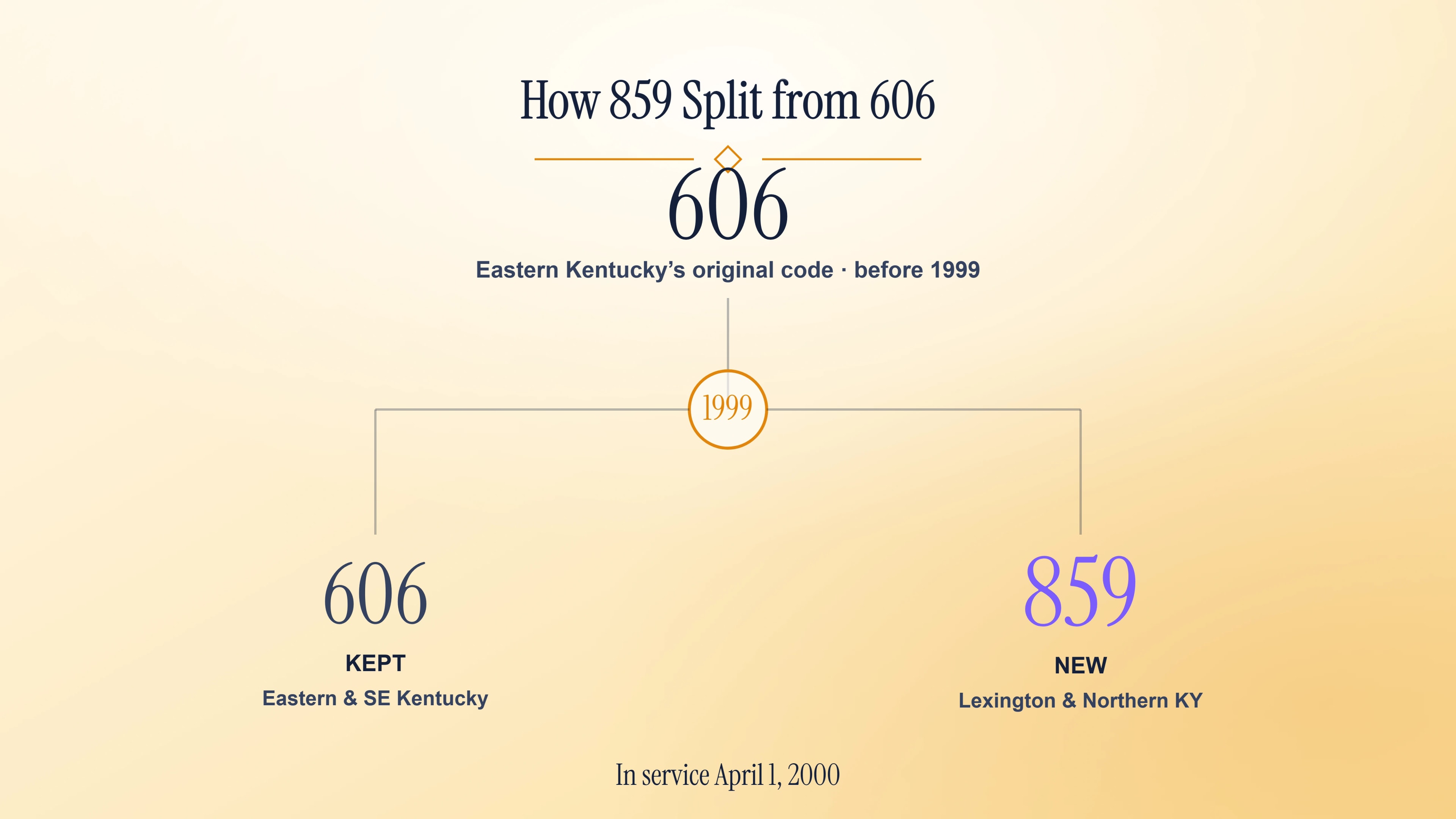
Created in 1999 and placed into service on April 1, 2000, 859 took the urbanizing center and north — Lexington, the Bluegrass and the river cities. The choice of which side kept the old code was deliberate: regulators left 606 with rural eastern and southeastern Kentucky to spare that region the cost and disruption of renumbering, and gave the brand-new 859 to the growing territory that was driving demand. What came next is unusual: nothing. No overlay has ever followed, and 859 has stayed a single code ever since.
Eastern Time and Ten Digits Without an Overlay
Every county in the 859 region, from Fayette to the Ohio River suburbs, keeps Eastern Time: EST, or UTC-5, during winter, and EDT, or UTC-4, from the start of daylight saving in March until November. There is still no overlay here, yet ten-digit dialing has been the rule since 2021, a change tied to the launch of the 988 mental-health hotline rather than to a second code:
- Local and regional calls: dial all ten digits — 859-555-1234.
- Long-distance from elsewhere in the U.S.: add a leading 1 — 1-859-555-1234.
- International: dial the exit code, then +1, then the number — +1 (859) 555-1234.
Benefits of an 859 Number for Business
An 859 caller ID tells someone in Lexington or the Northern Kentucky river cities that the business is part of their region, not a stranger dialing from another state. It is a small detail, yet it is among the easiest ways for a company to earn a hearing.
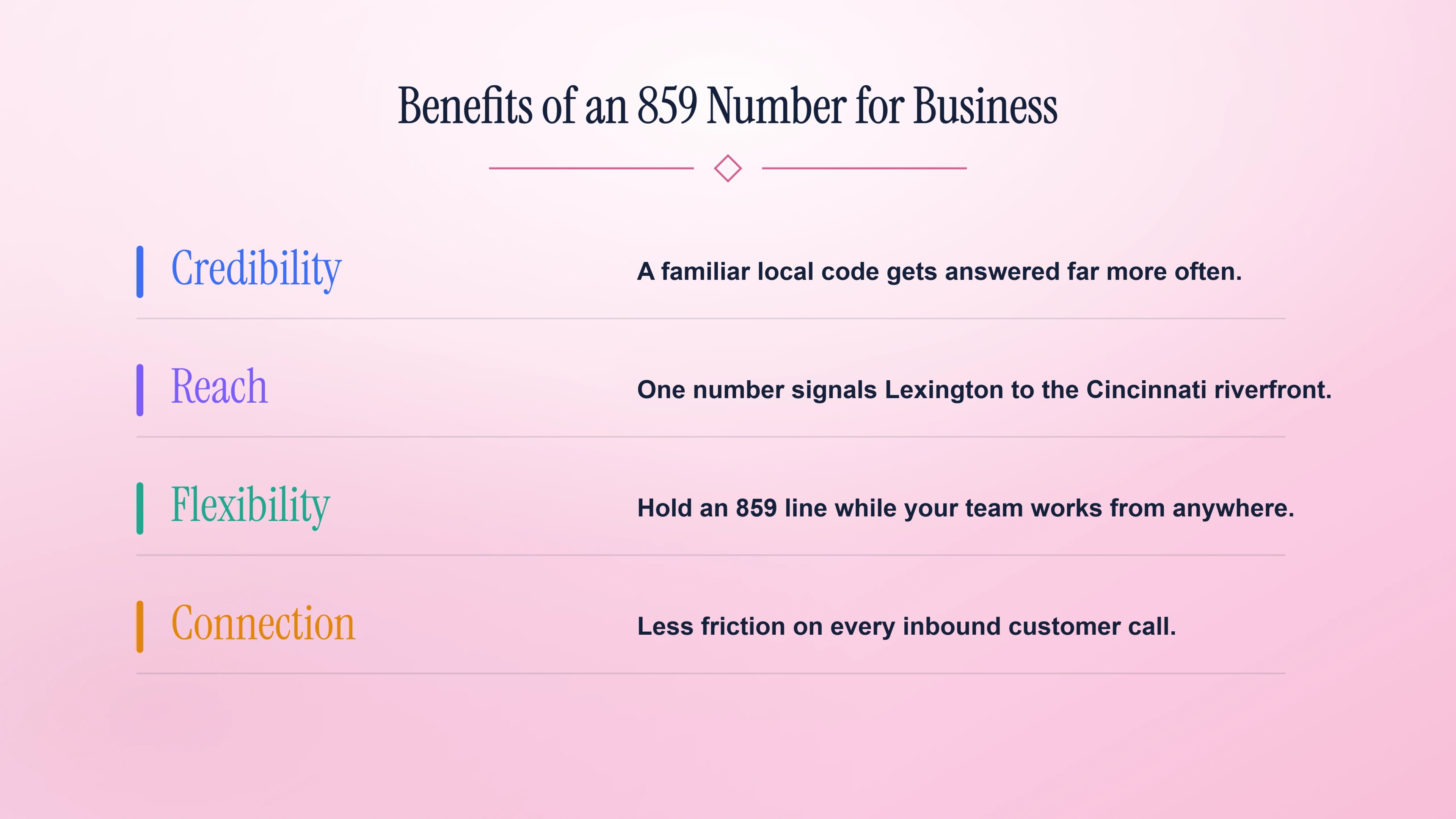
- Local credibility: people are far more likely to answer a call from a familiar local code.
- Bluegrass reach: an 859 number signals a presence from Lexington to the Cincinnati riverfront.
- Work from anywhere: cloud calling lets a company hold a local 859 line while operating from anywhere.
- Better customer connections: a local number lowers the friction of every inbound inquiry.
Ready to claim a Kentucky presence?
Acepeak provisions local numbers with carrier-grade routing and instant activation, so a business can sound local from day one.
How to Get an 859 Phone Number
No matter the size of a Lexington or Northern Kentucky operation, an 859 number is claimed the same way.
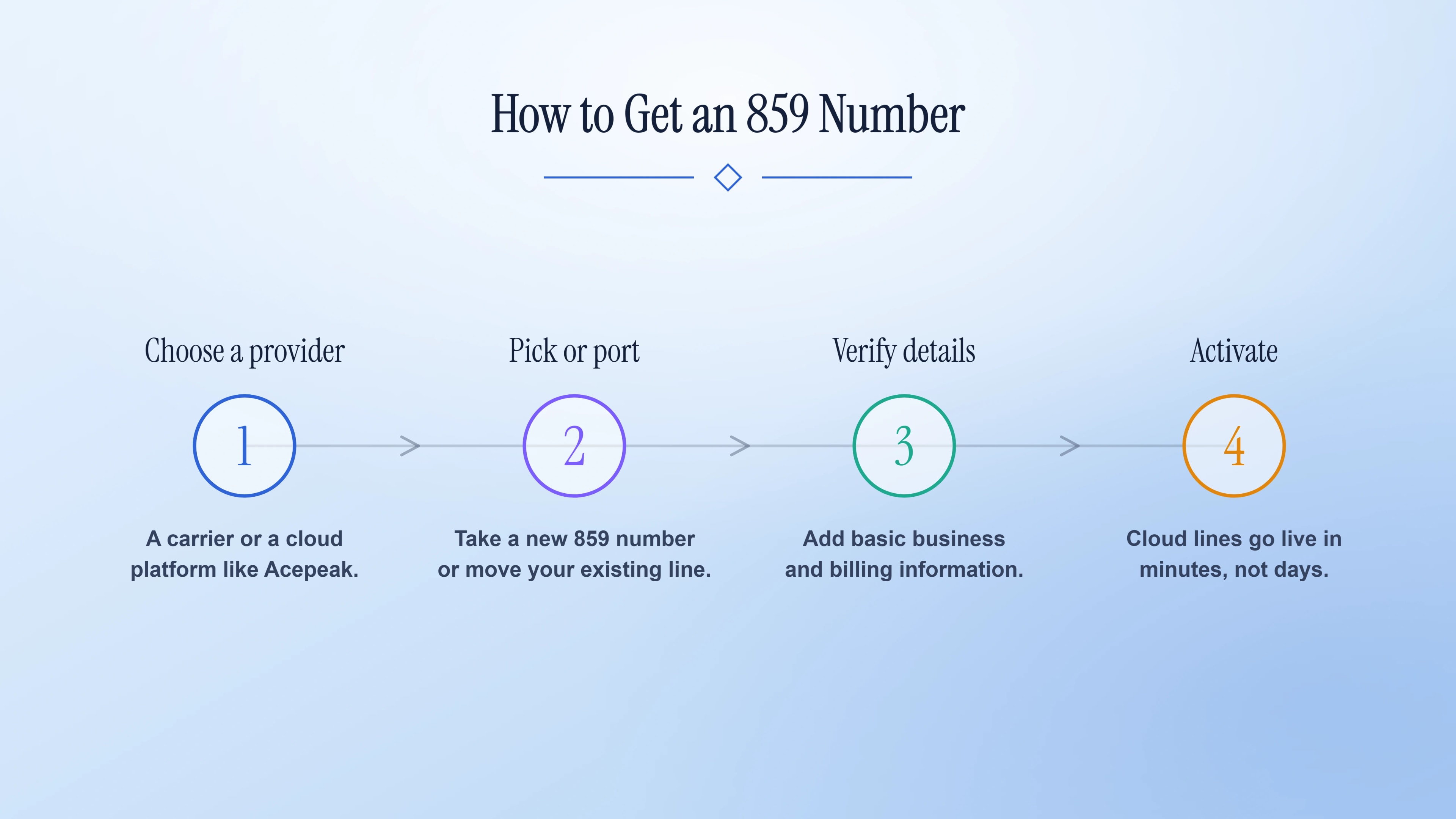
- Choose a provider: options range from traditional carriers to cloud platforms like Acepeak that assign numbers online.
- Pick or port a number: browse the available 859 inventory, or transfer an existing local line.
- Verify details: provide basic business and billing information.
- Activate: cloud providers often go live in minutes rather than days.
When a Familiar Kentucky Caller ID Is Spoofed
Faking an 859 caller ID lets a scammer pass as a Lexington business or a Covington neighbor. A Bluegrass prefix on the screen is no proof of a local caller, so an unexpected call deserves a careful response.
- Never share sensitive details — bank information or a Social Security number — with an unexpected caller.
- Verify urgent requests by hanging up and calling back on an official, published number.
- Use call-blocking and spam-filtering tools to screen unknown numbers.
- Report suspicious calls to the provider or the relevant authorities so others are protected.
The Future of the 859 Prefix
Kentucky's Bluegrass code still looks set to carry on alone. More than two decades after the 606 split, Lexington and the river cities continue to draw new numbers from a single prefix. If growth around Fayette County and the Cincinnati suburbs ever outran supply, the Kentucky Public Service Commission would most likely choose an overlay over another split, so no current number would change. Until then, an 859 line keeps its standing as a familiar local identity across central and Northern Kentucky.
A Single Code Still Uniting Central and Northern Kentucky
What 859 really carries is a sense of place, stretching from Lexington's horse country to the Ohio River cities. The code came out of the 1999 split with 606, has never been overlaid and still spells UKY on a keypad, one identity that held steady through the whole mobile era. An 859 number remains a budget-friendly, credible signal of Kentucky roots for any business, and cloud calling means that presence can be run from any location.
Put a trusted Kentucky number to work today.
Acepeak delivers local lines with smart routing, voicemail and 24/7 support — everything a business needs to stay reachable.
Questions, answered.
It covers central Kentucky and Northern Kentucky — Lexington and the Bluegrass region plus the river cities of Covington, Florence and Newport across from Cincinnati — spanning roughly 19 counties anchored by Fayette County.
It was split from 606, the original code for the entire eastern half of Kentucky, in 1999. The new 859 was placed into service on April 1, 2000, taking the urbanizing Lexington and Northern Kentucky territory.
No. 859 has never been overlaid and still operates as a single area code for its region — although ten-digit dialing has applied since 2021 because of the 988 hotline.
On the alpha-numeric telephone keypad the digits 8, 5 and 9 map to the letters U, K and Y — a fitting nod to the University of Kentucky, whose main campus is in Lexington at the heart of the 859 region.
Yes. Since 2021 the 859 region uses ten-digit dialing for local calls — the full area code plus the seven-digit number — a change tied to the rollout of the 988 hotline rather than to any overlay.
Yes. Cloud and hosted phone services let a business or individual hold a local 859 number from anywhere while keeping a central or Northern Kentucky identity.
Signing up for an 859 area code number takes minutes with a cloud phone provider — no local office in Lexington required. Pick the number, connect it to your existing phone or app, and calls route in immediately. This keeps the 859 area code presence you already have while adding the local credibility Kentucky customers respond to.