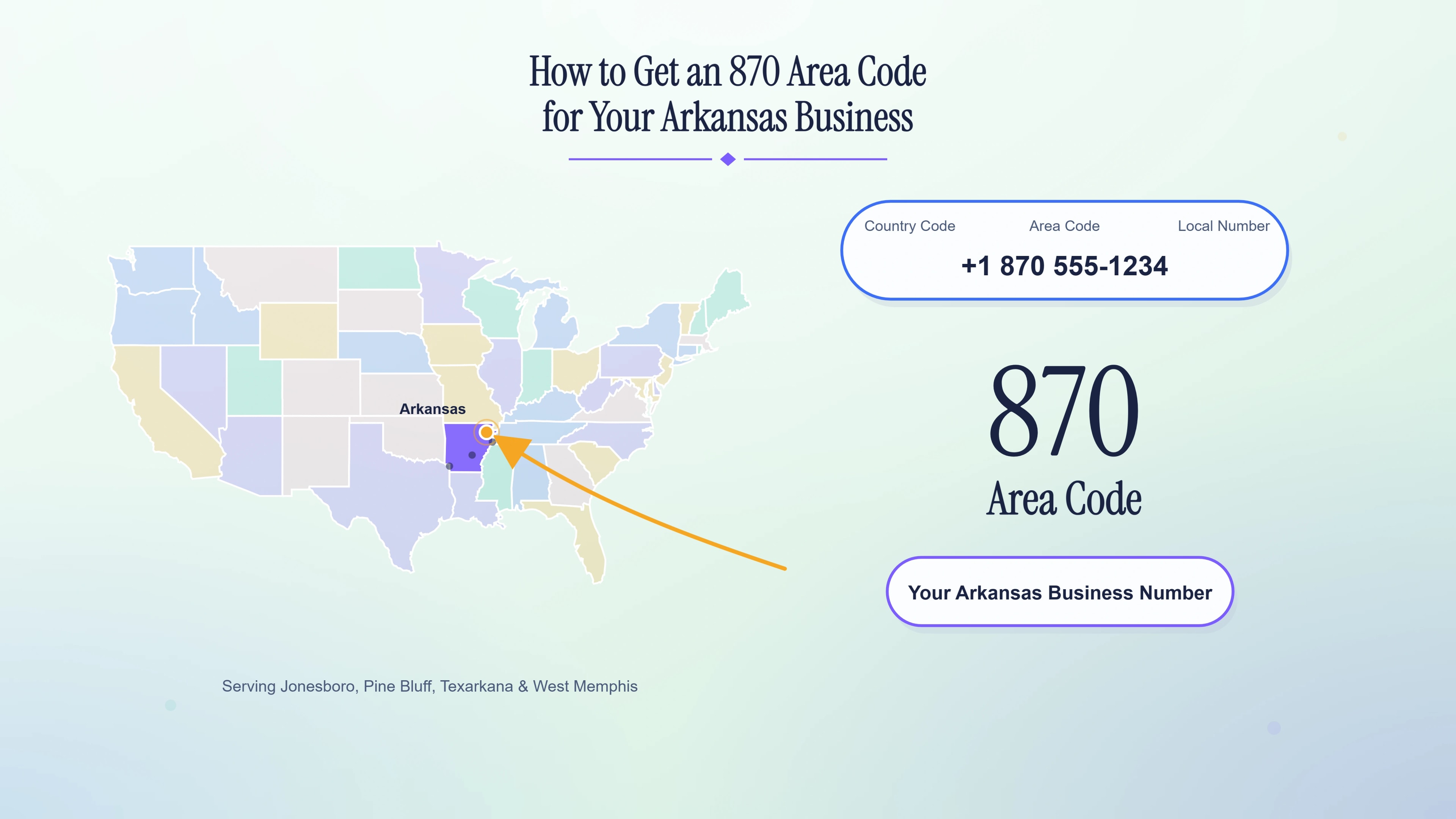
Same-Day Local Presence in Jonesboro and Pine Bluff
Arkansas businesses expanding into Jonesboro, Pine Bluff, Texarkana, or any of the other communities served by the 870 code have a simple way to establish a local presence: a dedicated Arkansas number. Unlike the older approach of waiting on a physical phone line, modern cloud providers let a company activate a local number the same day, from anywhere in the country.
Key Takeaways
- The 870 area code has served Arkansas since April 14, 1997, when it split from area code 501.
- An overlay code, 327, was added on February 20, 2024, and 10-digit local dialing has been required since January 19, 2024.
- The region covers most of Arkansas outside Little Rock, Hot Springs, Fort Smith, and Fayetteville, including Jonesboro, Pine Bluff, and Texarkana.
- A local Arkansas number improves recognition and answer rates for regional customers without requiring a physical office in the state.
- Pricing and availability vary by number type — standard numbers are inexpensive and widely available; vanity sequences cost more and disappear faster.
- Existing numbers can be ported to a new provider without downtime, so switching systems doesn't mean losing an established number.
What Is the 870 Area Code?
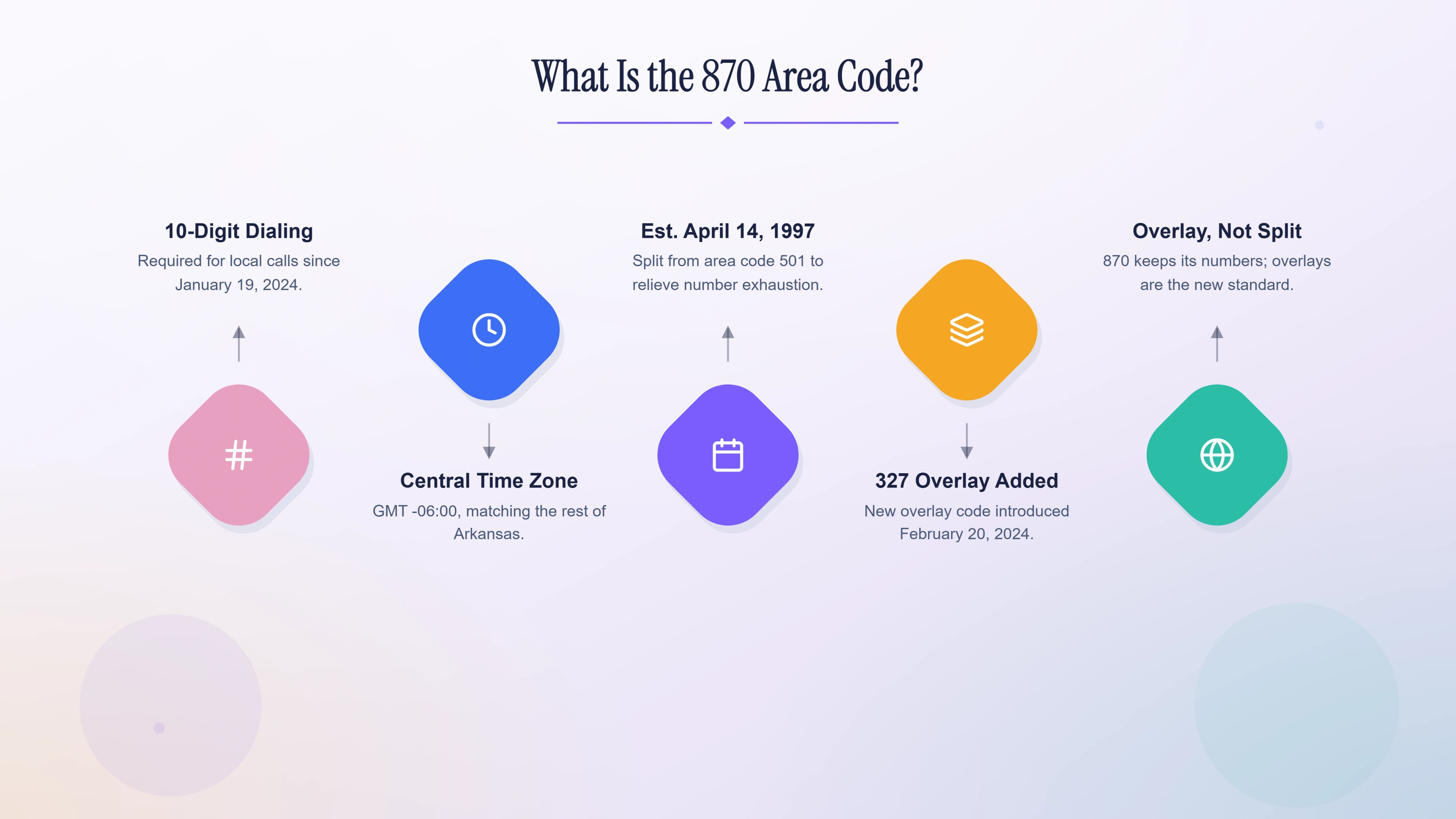
The 870 area code was put into service on April 14, 1997, when regulators split it from area code 501 to relieve exhausted number capacity across the state. It has served most of Arkansas ever since, with one recent change: on February 20, 2024, an overlay code, 327, was added to the same region to keep pace with demand for new numbers. Since January 19, 2024, all local calls placed to or from the area have required 10-digit dialing — area code plus the seven-digit number — rather than the older seven-digit format.
The region sits in the Central time zone (GMT -06:00), so businesses coordinating with call centers, vendors, or customers here should schedule around that zone rather than Eastern or Pacific hours. Because 870 and 327 now overlay the same geography, two neighboring businesses in the same town may have numbers that start with different digits, which makes the 10-digit dialing rule especially important to get right.
This overlay approach — adding a second code to the same footprint instead of splitting the state into new geographic zones — has become the standard way regulators handle rising demand for phone numbers nationwide. It avoids forcing existing businesses to change their number, but it does mean local dialing habits have to adjust, which is why providers and phone systems increasingly default to 10-digit dialing everywhere, not just in overlay regions.
Where the 870 Region Is Used
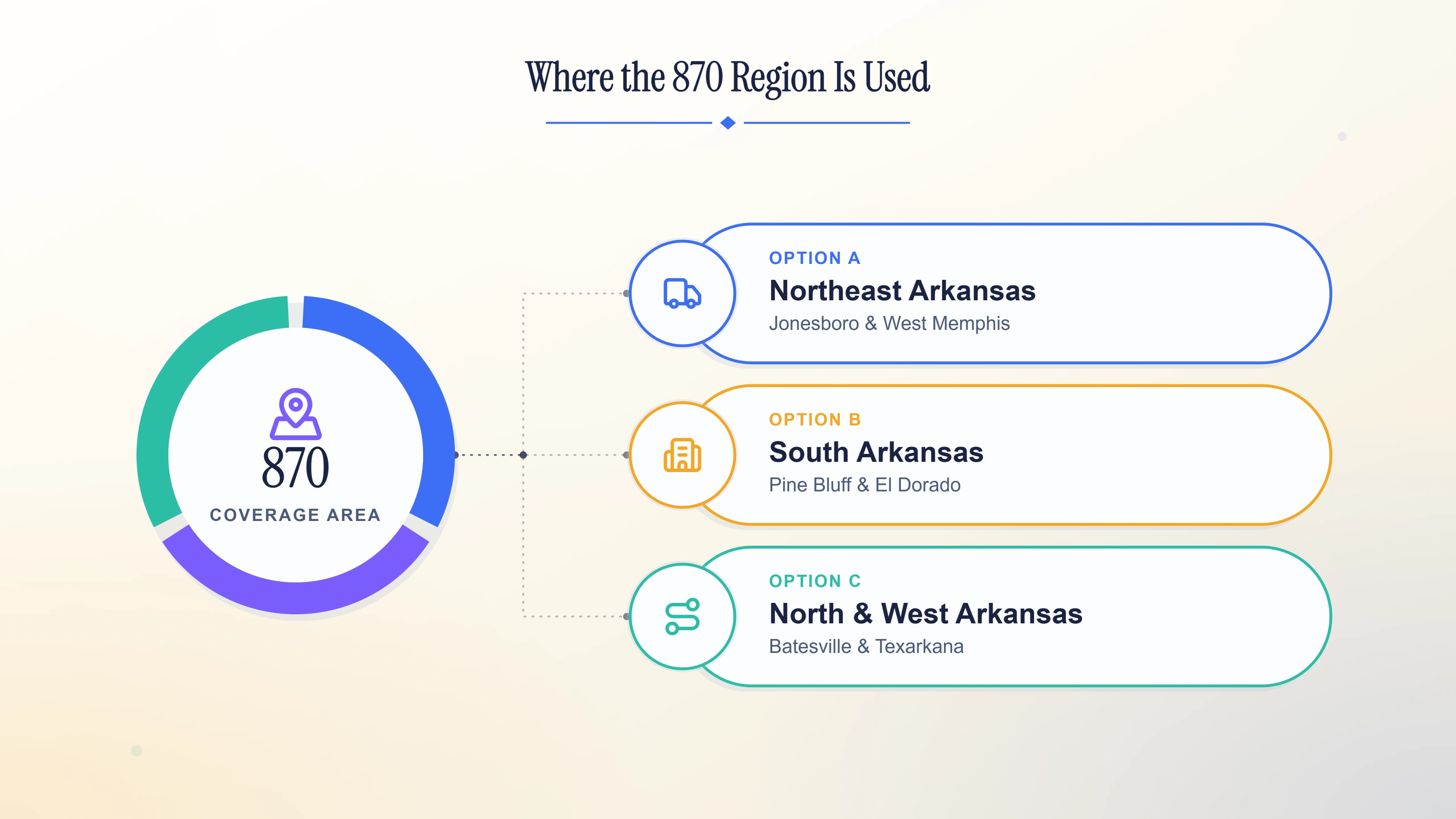
This area code covers the large majority of Arkansas, excluding the central and northwest corridors served by Little Rock, Hot Springs, Fort Smith, and Fayetteville. It spans dozens of counties and includes cities such as Jonesboro, Pine Bluff, Texarkana, West Memphis, Paragould, Mountain Home, El Dorado, and Batesville, along with many smaller towns across the eastern, southern, and northern parts of the state.
For a business, that footprint matters: a single local number can represent a company across a wide geographic area rather than just one city, which is useful for regional service providers, logistics companies, and retailers with multiple Arkansas locations. A trucking company based in West Memphis, for example, can use the same number to serve customers as far away as Texarkana or Batesville without those callers ever seeing a long-distance area code.
Why Businesses Choose a Local Arkansas Number
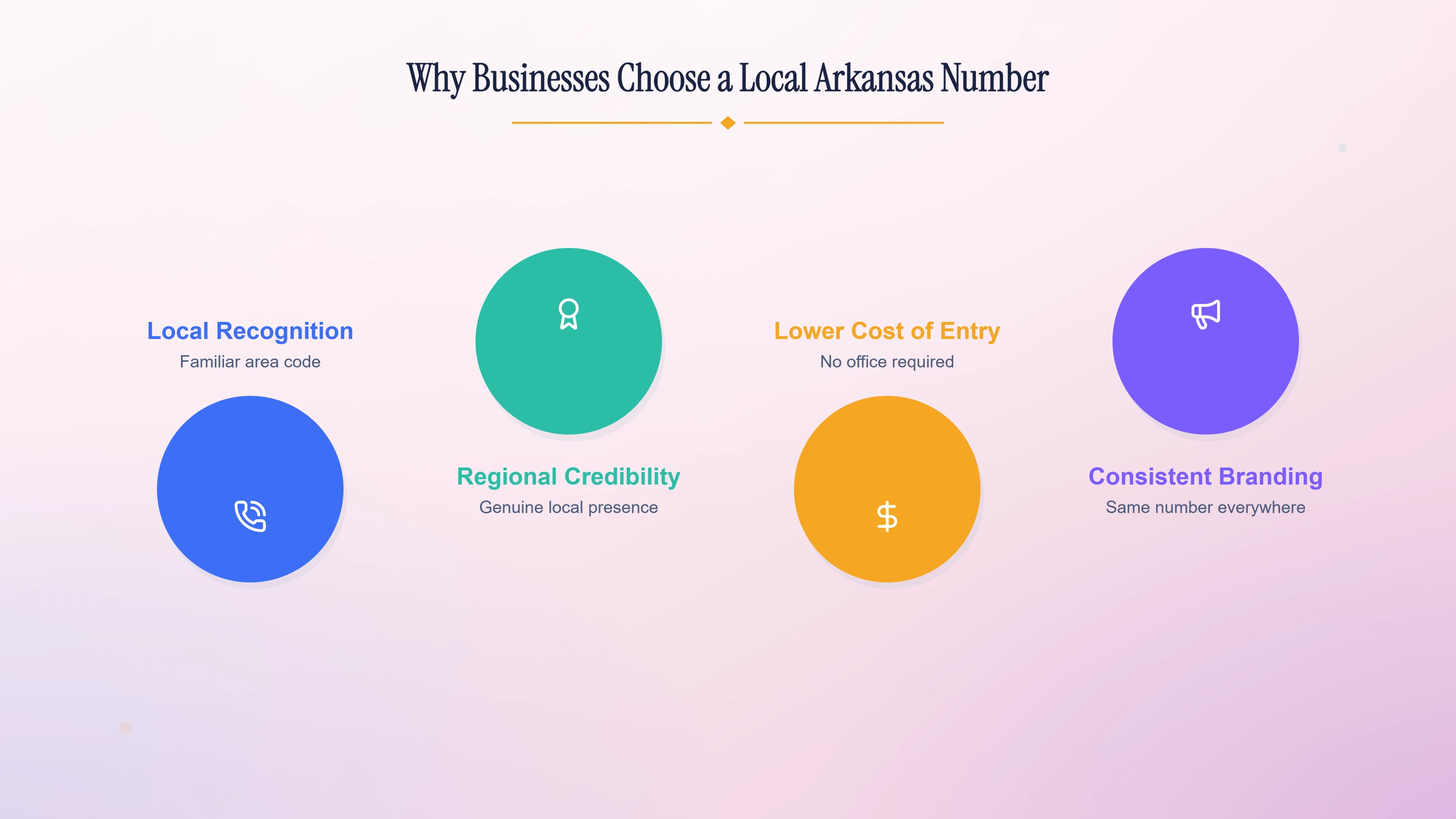
Companies that serve Arkansas customers pick up a local number for a few practical reasons:
- Local recognition: customers are more likely to answer or return a call from a number that matches their own area code rather than an unfamiliar one.
- Regional credibility: an Arkansas number signals that a business has a genuine presence in the state, which matters for local service, sales, and support calls.
- Lower cost of entry: a company does not need a physical office or landline in the state to get one — a cloud calling platform can provision a number instantly and route calls to any device, anywhere.
- Consistent branding: listing a local number on a website, invoices, and marketing material reinforces that a business understands and serves its Arkansas market specifically.
These same principles apply across other regional codes; a company juggling multiple markets can review Acepeak's 770 area code guide for a comparable example in the Atlanta suburbs.
Steps to Get an 870 Number
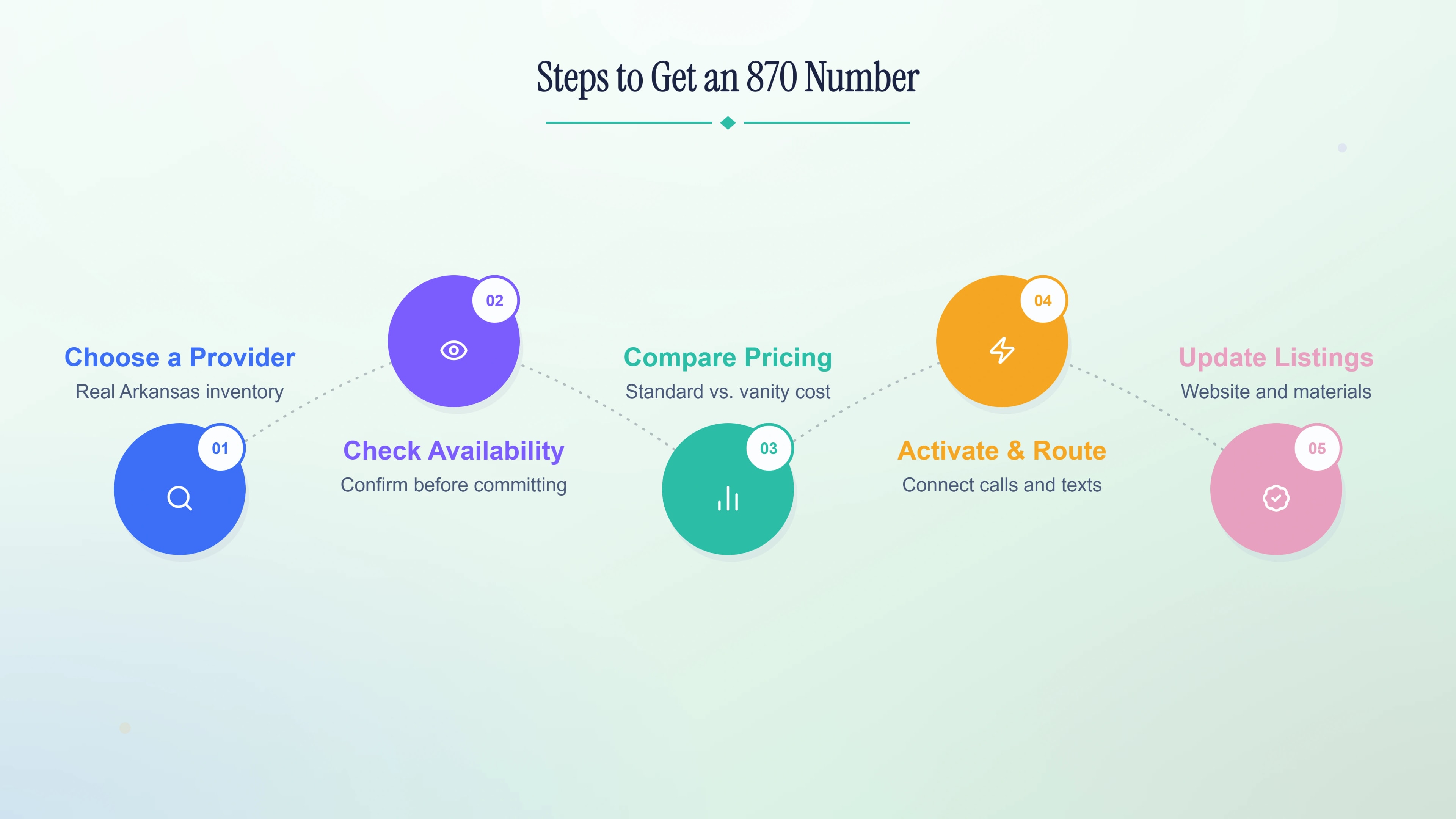
Getting a working number in this area code takes a few straightforward steps:
- Choose a provider: look for a cloud phone or virtual number provider with real Arkansas inventory and transparent pricing rather than a reseller with limited stock.
- Check live availability: number availability changes often, especially for easy-to-remember sequences, so confirm what's actually available before committing to a plan.
- Compare pricing: standard numbers typically cost far less than vanity or premium sequences; a business should weigh the price difference against how much a memorable number is actually worth to its marketing.
- Activate and route the number: once secured, connect it to a phone system so calls, texts, and voicemail route to the right team, whether that's a single phone or a full call center.
- Update listings and materials: add the new number to the website, Google Business Profile, email signatures, and any printed materials so customers see it consistently everywhere.
Ready to put a local Arkansas number to work?
Get set up with Acepeak and have a working 870 number active the same day, routed to any device or team.
Cost and Availability of 870 Numbers
Pricing for a number in this area code depends mostly on how specific a business needs to be. A standard number from a cloud provider typically runs a low monthly fee bundled into a phone plan, while a hand-picked vanity number — one that spells a word or repeats digits — can cost significantly more as a one-time or premium fee.
Availability also fluctuates. Because 870 covers such a wide, populous stretch of Arkansas, desirable number patterns can be claimed quickly, and the recent addition of the 327 overlay is itself a sign that demand for numbers in the region keeps climbing. Businesses that need a specific sequence should stay flexible on the exact digits and confirm inventory directly with their provider rather than assuming a number will still be open days later. It is also worth checking whether a provider charges extra for porting a number in later, since a business that starts with a standard number today may want to upgrade to a more memorable one once its Arkansas customer base grows.
Porting and Setting Up Your Number
Businesses that already have a working number, whether it's a legacy landline or a number from a previous provider, don't have to give it up to switch to a cloud system. Porting carries the existing number over to the new provider, usually without any downtime if it's scheduled correctly, and it works for numbers already assigned in this area code just as it does anywhere else in the country.
Once a number is active, whether ported or newly assigned, it should be connected to features that make it useful day to day: call routing to the right extension or team, voicemail-to-email or transcription, and basic call analytics so a business can see how many calls are coming from its Arkansas customer base and how quickly they are being answered.
Making the Most of Your Number
Once a business has a local number, the return comes from actually using it consistently. That means listing it as the primary contact number on the website, Google Business Profile, invoices, and local directories — not burying it behind a toll-free line. It also means routing the number into a real phone system with call recording, voicemail transcription, and analytics, so the company can track call volume and follow-up rates from Arkansas customers specifically.
Businesses running outbound campaigns into the region should also confirm their carrier supports proper caller ID authentication, since unauthenticated calls are increasingly flagged as spam by carriers and can undercut the trust a local number is meant to build. The FCC's official guidance explains the verification standard now required across the network.
A Statewide Arkansas Foothold Without a Physical Office
A local 870 number gives a business a genuine foothold across most of Arkansas without the overhead of a physical office in the state. With a cloud-based provider, activation takes minutes, and the number can be routed to any device or team. For companies serious about winning Arkansas customers, a local number is one of the simplest upgrades available.
Check live 870 availability today.
Talk to Acepeak to see which Arkansas numbers are open and get set up the same day.
Questions, answered.
It went into service on April 14, 1997, after being split from area code 501 to relieve number exhaustion in Arkansas.
It covers most of Arkansas outside Little Rock, Hot Springs, Fort Smith, and Fayetteville, including Jonesboro, Pine Bluff, Texarkana, West Memphis, and Batesville, among many others.
Yes. Since January 19, 2024, all local calls in the region require 10-digit dialing — area code plus the seven-digit number.
No. An overlay code, 327, was added to the same region on February 20, 2024, so both codes now serve overlapping areas.
Yes. Cloud phone providers can provision a number remotely and route calls, texts, and voicemail to any device, regardless of where the business is physically based.
Standard numbers are usually included in a low-cost monthly phone plan, while vanity or premium sequences can cost significantly more depending on demand.
Yes. Porting moves an existing number to a new provider, typically with no service interruption when it's scheduled properly.
Signing up for an 870 area code number takes minutes with a cloud phone provider — no local office in Jonesboro required. Pick the number, connect it to your existing phone or app, and calls route in immediately. This keeps the 870 area code presence you already have while adding the local credibility Arkansas customers respond to.