From the Port City of Elizabeth to Hunterdon's Hills
West of Newark and the Hudson, a band of New Jersey suburbs and small cities runs from the port city of Elizabeth out through the rolling hills of Hunterdon and Warren counties. A single prefix has tied this territory together for more than three decades. Split from the state's original code in 1991, trimmed once in 1997 to hand the Jersey Shore its own code, and never overlaid since, it remains the steady signature of north-central New Jersey. This guide explains exactly where it reaches, how it came to be, why it still has no second code, and how any business can claim a local presence here.
Key Takeaways
- The 908 prefix serves north-central and western New Jersey — Union, Somerset, Hunterdon and Warren counties, plus parts of Middlesex and Morris — anchored by Elizabeth, the state's fourth-largest city.
- It was created in 1991 as a split from 201, the original New Jersey code, to relieve a region running short of numbers.
- On January 1, 1997 the 732 code split off the eastern and Jersey Shore portion, leaving 908 with its western, interior territory.
- Unusually, 908 has never been overlaid — it and 856 are the only two New Jersey codes that still operate as a single area code.
- The region sits in the Eastern Time Zone, and ten-digit dialing has applied statewide since 2021 — and a local 908 number still lifts answer rates for businesses in the New York metro's western suburbs.
What Is the 908 Area Code?
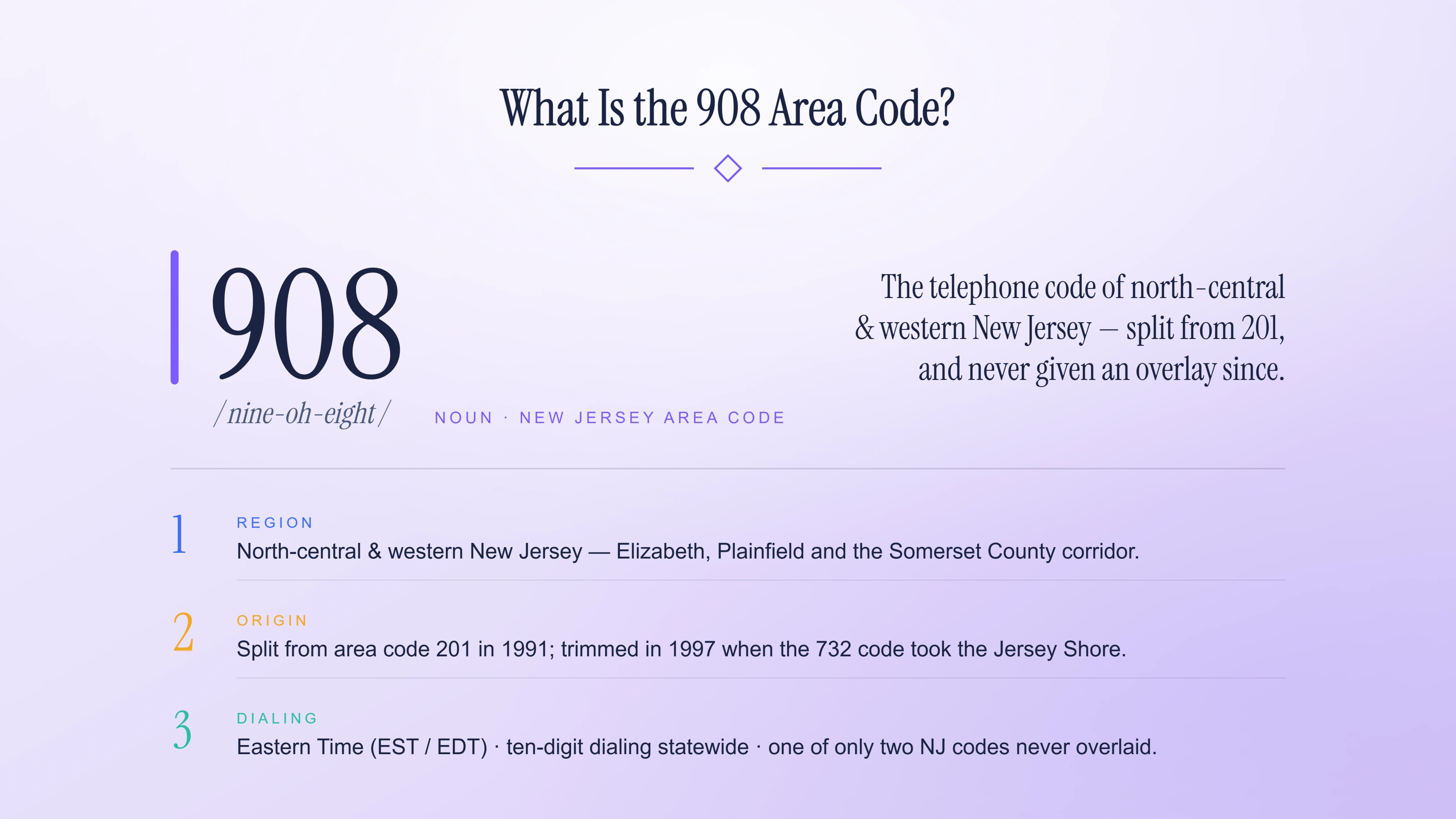
The prefix is one of New Jersey's established codes, covering the north-central and western part of the state. It was split from 201 — the original code for all of New Jersey — in 1991, taking a large stretch of the state's center and west. Sitting within the greater New York metropolitan area, just across the harbor from Manhattan and its 332 area code, the region blends dense commuter suburbs with corporate campuses and quiet rural counties.
Because it covers Elizabeth, Plainfield and the established suburbs of Union and Somerset counties, the code carries a recognizable local identity. A 908 number reads as genuinely part of the New York metro's New Jersey side — a useful credibility signal for any business serving the region.
A Commuter Belt Running Out to the Delaware River
The prefix covers Union, Somerset, Hunterdon and Warren counties in full or near-full, along with the northern edge of Middlesex County and a slice of Morris County. The major communities include:
- Elizabeth, Linden, Rahway and Plainfield — the dense urban core of Union County
- Westfield, Summit, Cranford and Scotch Plains — the established commuter suburbs
- Somerville, Bridgewater, Hillsborough and Bound Brook — the Somerset County corridor
- Flemington and Clinton in Hunterdon, with Phillipsburg and Hackettstown out in Warren County
The region is a classic built-out commuter belt ringing a major city — dense and developed near Newark, then turning increasingly rural toward the Delaware River. One boundary is worth noting: the Jersey Shore and the eastern suburbs around New Brunswick and the coast are not part of this code — they moved to 732 in 1997, as explained below.
The 1997 Split That Created 732
When 908 was first carved out of 201 in 1991, it covered a much larger swath of central New Jersey — reaching all the way east to the Atlantic coast. The combination of fax lines, pagers and the first wave of mobile phones drained that supply within a few years. Rather than overlay a second code, regulators chose another geographic split — the standard fix of that era nationwide, the same way Los Angeles carved its 323 area code out of 213.
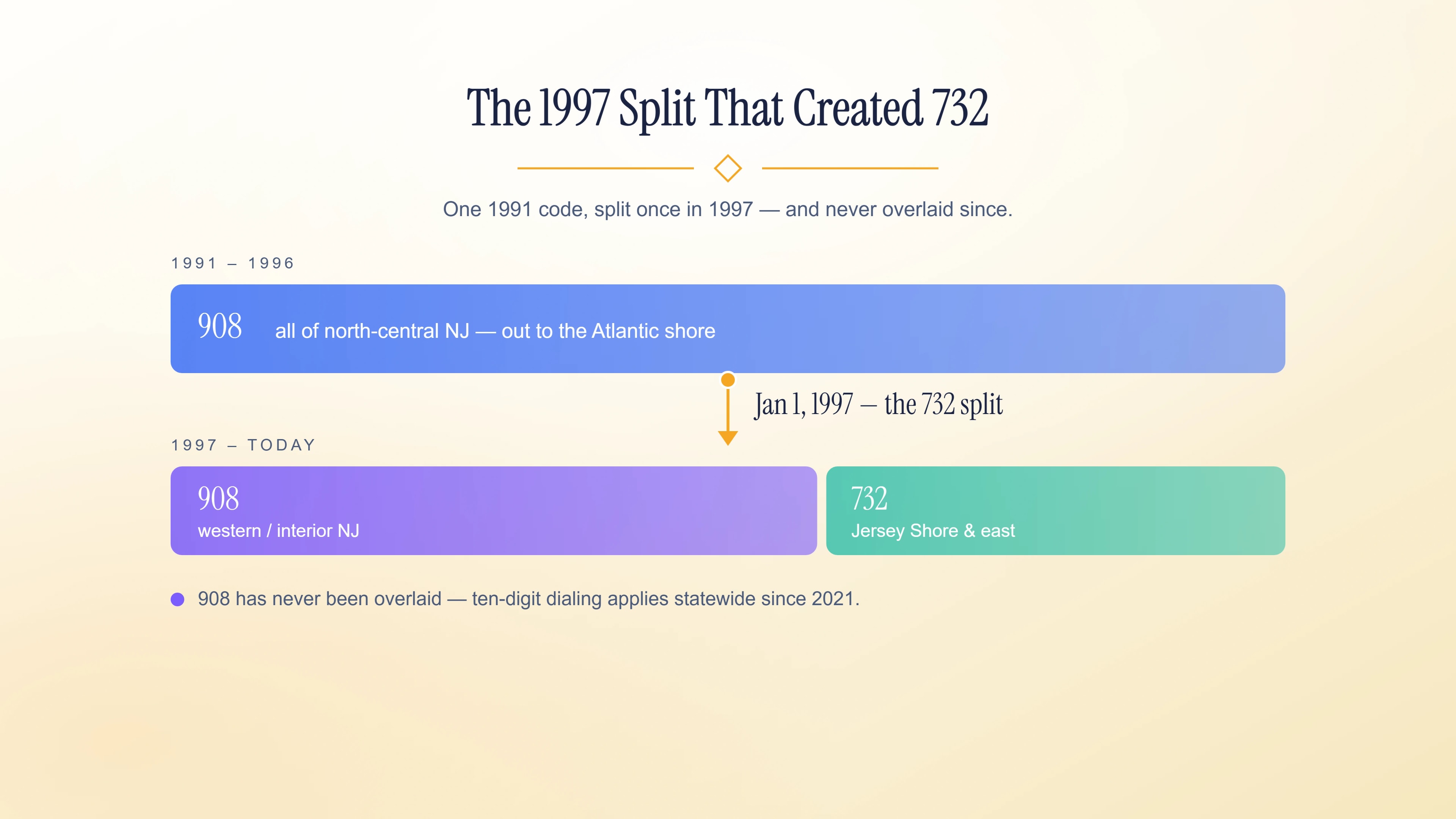
On January 1, 1997, the eastern and shore portion of the territory became the new 732 code, while 908 kept the western, interior counties. What is unusual is what came next: nothing. The pressure for an overlay never materialized here, and 908 has stayed a single code ever since. To this day it and 856 in South Jersey are the only New Jersey area codes that have never been overlaid.
New Jersey's 2021 Switch to Full Ten-Digit Calls
The entire region observes Eastern Time — UTC-5 in winter (EST) and UTC-4 during daylight saving (EDT), which runs from March to November. Because New Jersey adopted statewide ten-digit dialing in 2021, every local call uses the full number even though 908 has no overlay of its own:
- Local and regional calls: dial all ten digits — 908-555-1234.
- Long-distance from elsewhere in the U.S.: add a leading 1 — 1-908-555-1234.
- International: dial the exit code, then +1, then the number — +1 (908) 555-1234.
Benefits of a 908 Number for Business
Between Plainfield and Flemington, a 908 prefix points to a business on the New Jersey side of the metro, close to home. That is an easy form of credibility to claim, and it keeps an incoming call from looking like a cold call from another state.
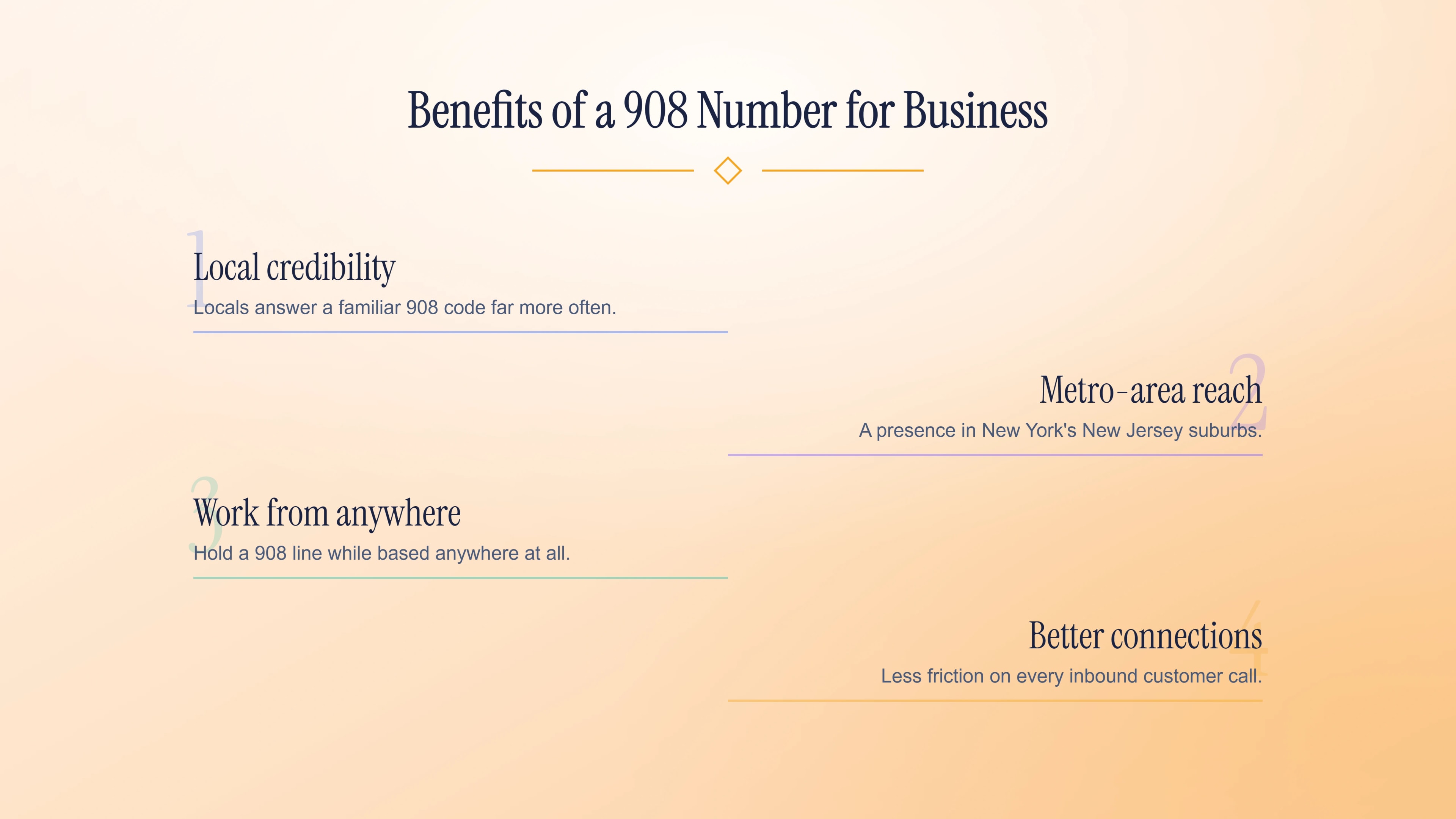
- Local credibility: an Elizabeth or Westfield customer answers a 908 call as a neighbor's, not an out-of-state cold call.
- Commuter-belt reach: a single 908 number spans the dense suburbs near Newark and the rural stretch out to Hunterdon and Warren counties.
- Work from anywhere: cloud calling lets a company hold a 908 line while its team operates from anywhere in the New York metro or beyond.
- Single-code stability: 908 is one of only two New Jersey codes, alongside 856, that has never needed an overlay since the 1991 split.
Ready to claim a New Jersey presence?
Acepeak provisions local numbers with carrier-grade routing and instant activation, so a business can sound local from day one.
How to Get a 908 Phone Number
Getting a 908 number takes four steps, for one Elizabeth desk or a Somerset County team.
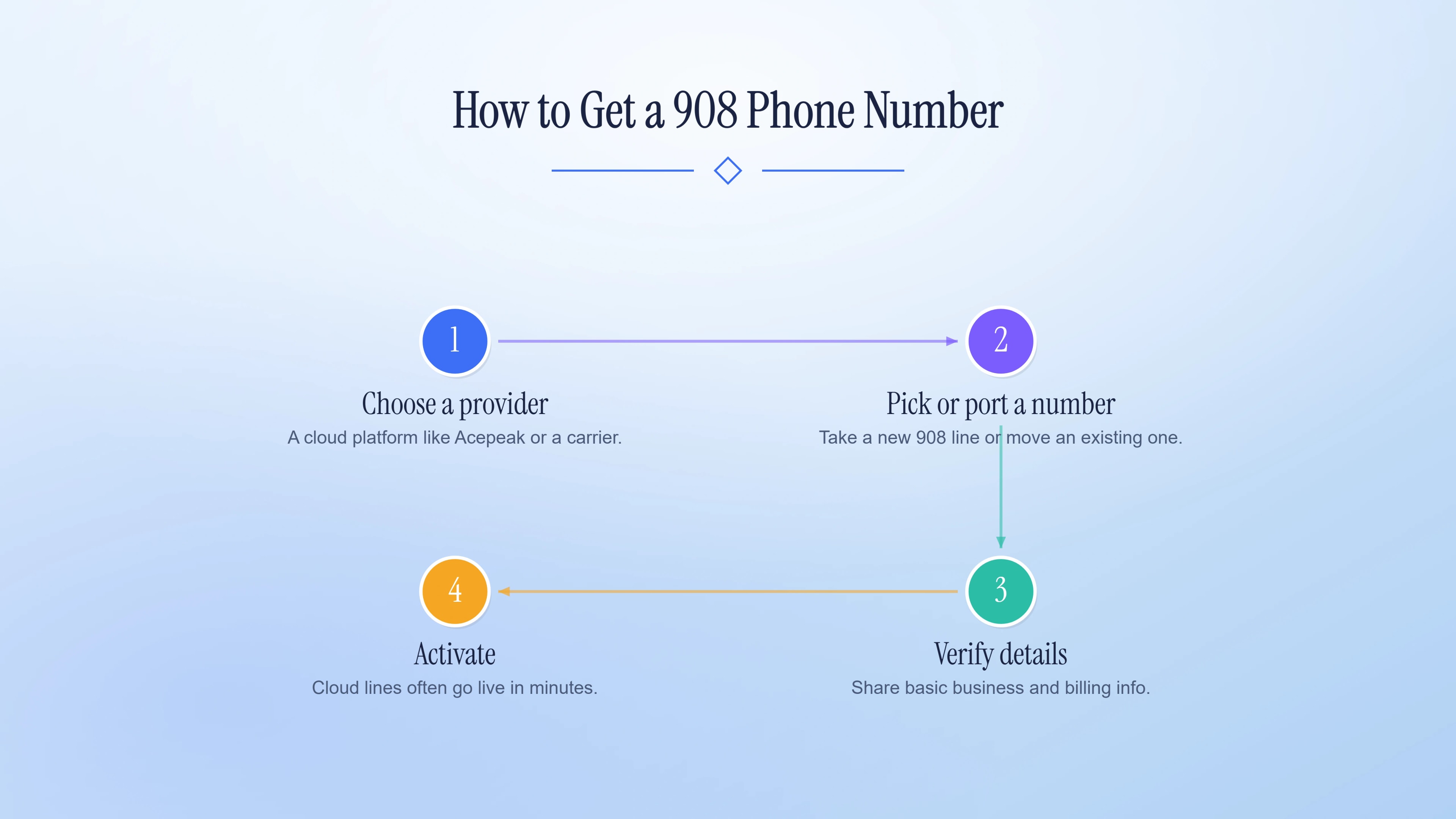
- Choose a provider: pick a cloud platform like Acepeak or a traditional carrier that can provision a number across Union, Somerset, Hunterdon or Warren counties.
- Pick or port a number: browse the available 908 inventory, or transfer an existing local line from Elizabeth, Westfield or Somerville.
- Verify details: provide basic business and billing information.
- Activate: cloud providers often go live within minutes rather than the days a traditional carrier might need.
A Neighbor's Number on Screen Can Still Be Fake
A scammer can disguise a call so it appears to come from a 908 number in Westfield or Somerville. Recognizable digits prove nothing about who is actually dialing, so give an unexpected call the caution you would give a stranger.
- Never share sensitive details — bank information or a Social Security number — with an unexpected caller.
- Verify urgent requests by hanging up and calling back on an official, published number.
- Use call-blocking and spam-filtering tools to screen unknown numbers.
- Report suspicious calls to the provider or the relevant authorities so others are protected.
The Future of the 908 Prefix
Among New Jersey codes, 908 and 856 alone have avoided an overlay, and that looks likely to hold for now. In the close to three decades since the 1997 split that created 732, the western counties have not needed a second code. If pressure did return, New Jersey utility regulators would probably overlay the region instead of carving it up again, and existing numbers from Elizabeth to Phillipsburg would not change. A 908 line, in other words, stays a dependable local identity for north-central New Jersey.
One of Two New Jersey Codes Never Overlaid
North-central New Jersey's prefix is more than a routing code; it is a marker of place in the western half of the New York metro. Born from a split in 1991, trimmed once in 1997, and never overlaid since, it has stayed singular through the mobile era. For a business, a 908 number remains one of the cheapest, most credible ways to signal local roots — and with cloud calling, that presence is available to anyone, anywhere.
Put a trusted New Jersey number to work today.
Acepeak delivers local lines with smart routing, voicemail and 24/7 support — everything a business needs to stay reachable.
Questions, answered.
It covers north-central and western New Jersey — Union, Somerset, Hunterdon and Warren counties, plus parts of Middlesex and Morris — anchored by Elizabeth, Plainfield and the suburbs west of Newark.
It was split from 201, the original New Jersey area code, in 1991. Later, on January 1, 1997, the 732 code split off the eastern and Jersey Shore portion of the 908 territory.
No. 908 has never been overlaid — it and 856 in South Jersey are the only two New Jersey area codes that still operate as a single code.
No. The Jersey Shore and eastern suburbs around New Brunswick moved to the 732 code in 1997. The 908 code covers the western, interior counties of north-central New Jersey.
Yes. Cloud and hosted phone services let a business or individual hold a local 908 number from anywhere while keeping a north-central New Jersey identity.
Signing up for a 908 area code number takes minutes with a cloud phone provider — no local office in New Jersey required. Pick the number, connect it to your existing phone or app, and calls route in immediately. This keeps the 908 area code presence you already have while adding the local credibility New Jersey customers respond to.