The Kansas Half of a Two-State Metro
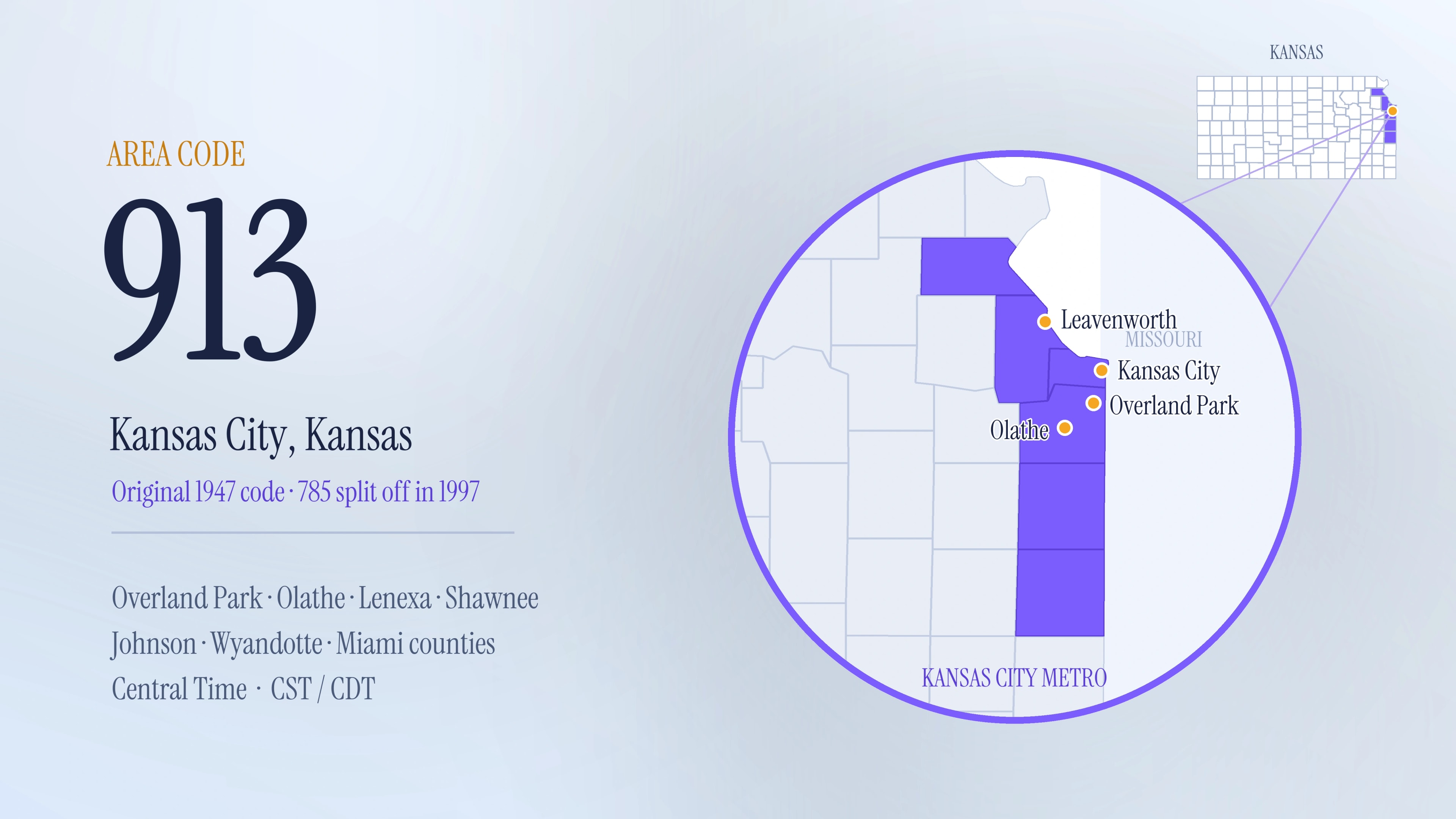
Say "913" anywhere around Kansas City and locals picture the Kansas side of the line: the office parks and corporate campuses of Overland Park, the booming suburbs of Olathe and Lenexa, the historic riverfront of Kansas City, Kansas, the Legends shopping district in Wyandotte County, and the Army town of Leavenworth to the north. This single code is the dial-tone identity of Johnson, Wyandotte, Leavenworth and Miami counties — the Kansas half of one of the country's great two-state metros.
It carries a deeper history than most suburban codes, though: 913 is an original 1947 area code that once blanketed all of northern Kansas before a 1997 split shrank it to the metro it serves today. This guide lays out exactly where 913 reaches, how it was reduced to the Kansas City area, the Central time zone and dialing rules, and how any business can claim a local Kansas presence with a number of its own.
Key Takeaways
- The 913 area code covers the Kansas side of the Kansas City metropolitan area — a compact ribbon of counties along the Missouri state line, including Overland Park, Olathe, Kansas City (Kansas), Shawnee, Lenexa, Leawood, Leavenworth, Bonner Springs, De Soto and Paola.
- It is one of the original 86 area codes assigned in 1947, when all of northern Kansas — from the Missouri line to the Colorado border — shared the single code 913.
- On July 20, 1997, most of that vast territory was split off into the new area code 785, leaving 913 with just the fast-growing Kansas City metro; permissive dialing of the old numbers continued until October 2, 1998.
- Because 913 has never needed an overlay, it remains a single, undivided code for the region — one of the reasons a 913 number still reads as an established local identity rather than a brand-new prefix.
- The entire 913 region runs on Central Time — UTC−6 in winter (CST) and UTC−5 in summer (CDT) — the same clock as Kansas City, Chicago and the rest of the central United States.
What Is the 913 Area Code?
The 913 prefix is the telephone identity of the Kansas side of metropolitan Kansas City — a geographic code covering a narrow band of counties pressed against the Missouri border. It is one of the oldest codes in the country, part of the original 1947 numbering plan, but today its footprint is tightly focused on the Kansas City suburbs rather than the wide rural sweep it once had. Directly across the state line, the Missouri half of the same metro runs on the 816 area code — so the two codes together map almost perfectly onto the state line that splits the Kansas City region in two.
Because it sits at the heart of a large, prosperous metro, a 913 number reads as unmistakably local to the more than one million people on the Kansas side of the line. To a customer in Overland Park, Olathe or Shawnee it looks like a neighbor on the caller ID rather than an out-of-state stranger — a small but real credibility signal for any business working the Kansas City market.
A Ribbon of Counties Along the Missouri State Line
The 913 code covers the Kansas portion of the Kansas City metropolitan area — a compact ribbon of counties running along the Missouri state line, a fraction of the enormous territory it held before 1997. It is one of the most densely populated and fastest-growing corners of Kansas, anchored by the affluent suburbs of Johnson County. The major communities include:
- Overland Park, Olathe, Lenexa, Shawnee, Leawood and De Soto (Johnson County) — the populous, fast-growing southern suburbs; Overland Park is the second-largest city in all of Kansas
- Kansas City and Bonner Springs (Wyandotte County) — the older industrial and riverfront core on the Kansas side, home to the Legends and the state's Unified Government
- Leavenworth and Lansing (Leavenworth County) — the historic river city north of the metro, home to Fort Leavenworth
- Paola and Louisburg (Miami County) — the smaller county-seat and commuter towns on the metro's southern edge
- Atchison (Atchison County) and the city of Elwood (Doniphan County) — the northern Missouri-River communities that round out the code's reach
Together these counties hold well over a million residents packed into the Kansas side of a single metro — a concentration of homes and businesses dense enough that the code was long ago carved down to fit it.
Central Time and Seven-Digit Calls That Still Connect
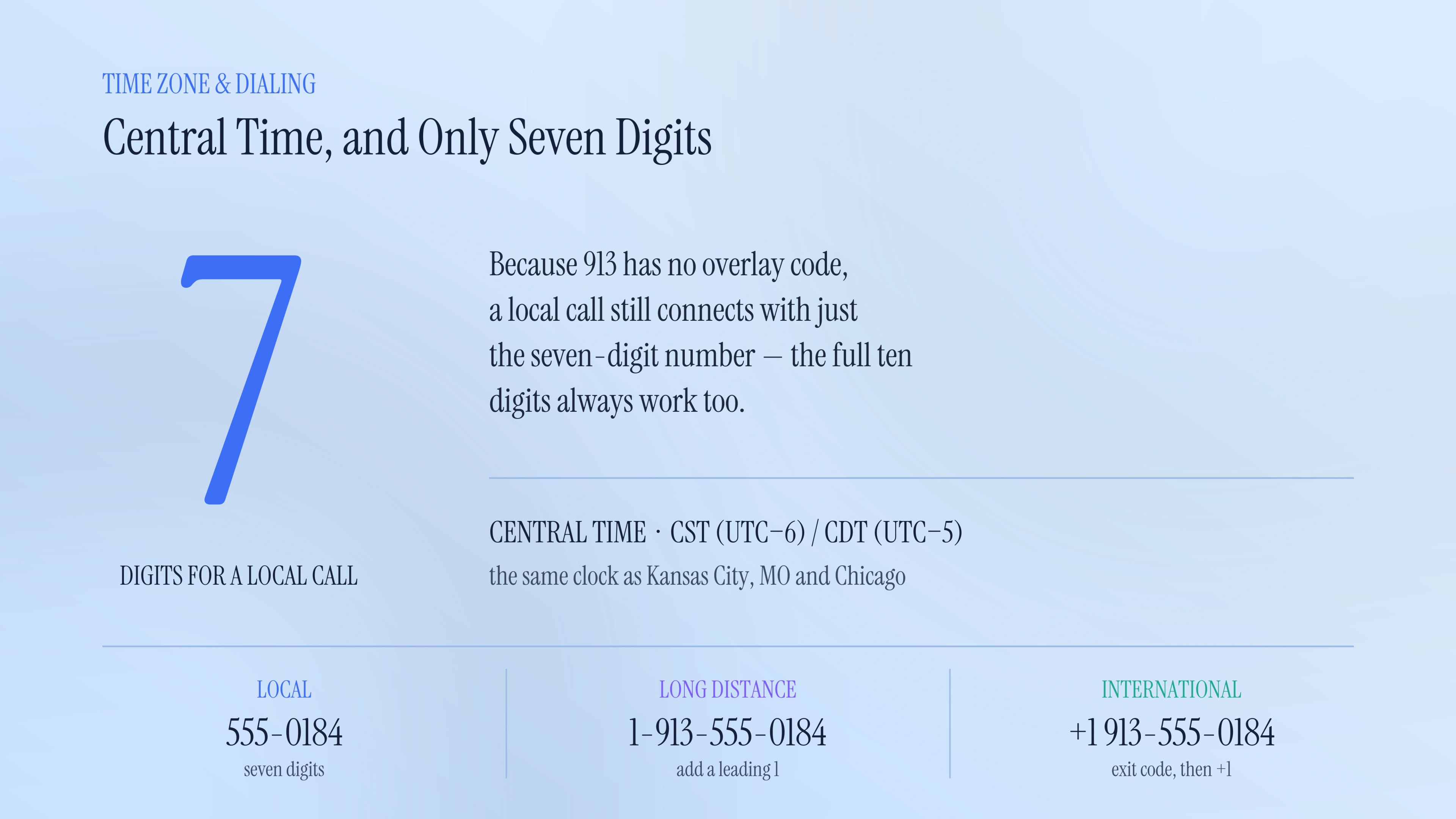
The entire 913 region sits within Central Time — UTC−6 in winter (CST) and UTC−5 in summer (CDT) — the same clock as Kansas City, Missouri, right across the river, along with Chicago, Dallas and the rest of the central United States. Because 913 has never been paired with an overlay code, the region has long been able to complete local calls with just seven digits, though ten-digit dialing works everywhere and is increasingly the everyday habit:
- Local calls within the metro: because 913 has no overlay, a local call can be dialed with the seven-digit number alone — 555-0184 — although dialing the full 913-555-0184 always works too.
- Long-distance from elsewhere in the U.S.: add a leading 1 — 1-913-555-0184.
- International: dial the exit code, then +1, then the number — +1 (913) 555-0184.
- On mobile phones: cell numbers are stored and dialed with all ten digits regardless, so most people already reach 913 lines the same way from anywhere.
How 913 Shrank: The 1997 Split That Created 785
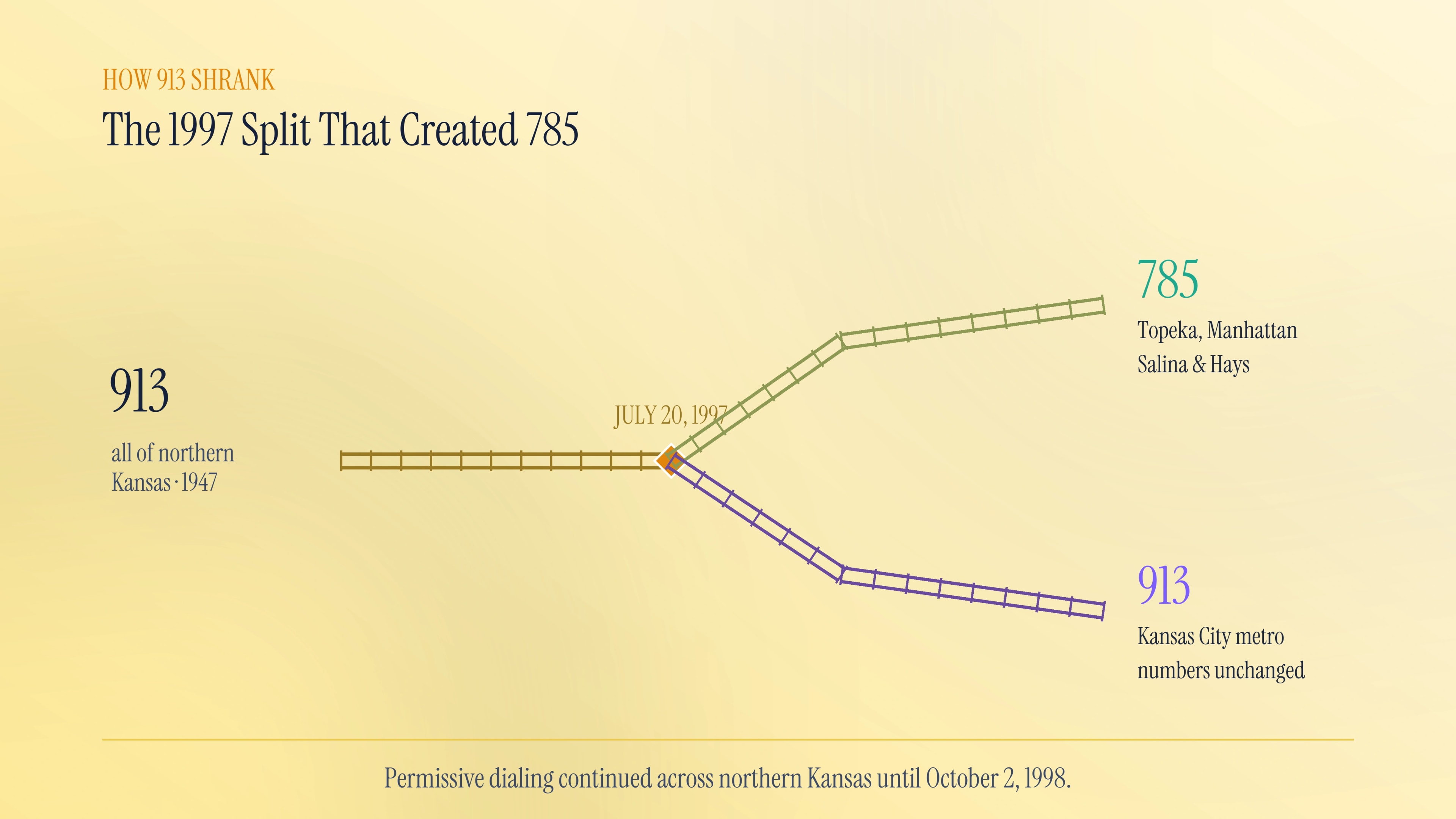
When the North American numbering plan launched in 1947, Kansas was divided into just two codes. The southern half around Wichita became 316, and everything north of it — a huge band running from the Missouri line all the way west to the Colorado border, taking in Topeka, Lawrence, Manhattan and Kansas City — became area code 913. For half a century that single prefix covered the whole northern half of Kansas. By the mid-1990s, though, the explosion of pagers, fax machines and second lines in the growing Kansas City suburbs had drained its supply of numbers, and most of its territory would soon become the new 785 area code — 913 was too big and too busy to survive intact.
On February 12, 1997, the numbering plan administrator approved a split, and on July 20, 1997, the change took effect. Everything from Lawrence westward — Topeka, Manhattan, Salina, Hays and the rest of northern and western Kansas — moved to the brand-new area code 785, while 913 was reduced to the Kansas City metropolitan area it still serves. To ease the transition, permissive dialing let callers reach the affected lines under either code until October 2, 1998. Kansas City residents kept their 913 numbers untouched; it was the wider region that changed prefixes. The result is the tightly drawn, metro-only 913 of today — and because no overlay has ever followed, it has stayed a single, undivided code ever since.
Benefits of a Local 913 Number for Business
A local number is one of the simplest trust signals a business can own, and in a competitive two-state metro like Kansas City, a 913 number tells customers exactly which side of the line you belong to. When someone in Overland Park or Olathe sees a 913 line calling, it reads as a neighbor rather than an out-of-state telemarketer.
- A single, undivided identity — 913 has never needed an overlay, so one clean prefix still covers Overland Park, Olathe and the rest of Johnson County without a second code muddying the picture.
- Clear Kansas-side signaling — in a metro split by a state line, a 913 number tells Overland Park and Shawnee customers you're on their side of the river, not calling from Missouri's 816.
- Credibility from the Legends to Fort Leavenworth — a 913 line reads as local from the Wyandotte County riverfront to the Army community up in Leavenworth.
- Flexibility without an office — cloud calling lets a business hold a 913 number from anywhere and still ring in as a Johnson County local.
- Room to add lines as Johnson County grows — scale routing and campaigns under the same recognized number as the fastest-growing suburbs expand.
Put a local 913 number to work
Give your business an authentic Kansas City presence with a 913 number that rings anywhere you do business.
How to Get a 913 Phone Number
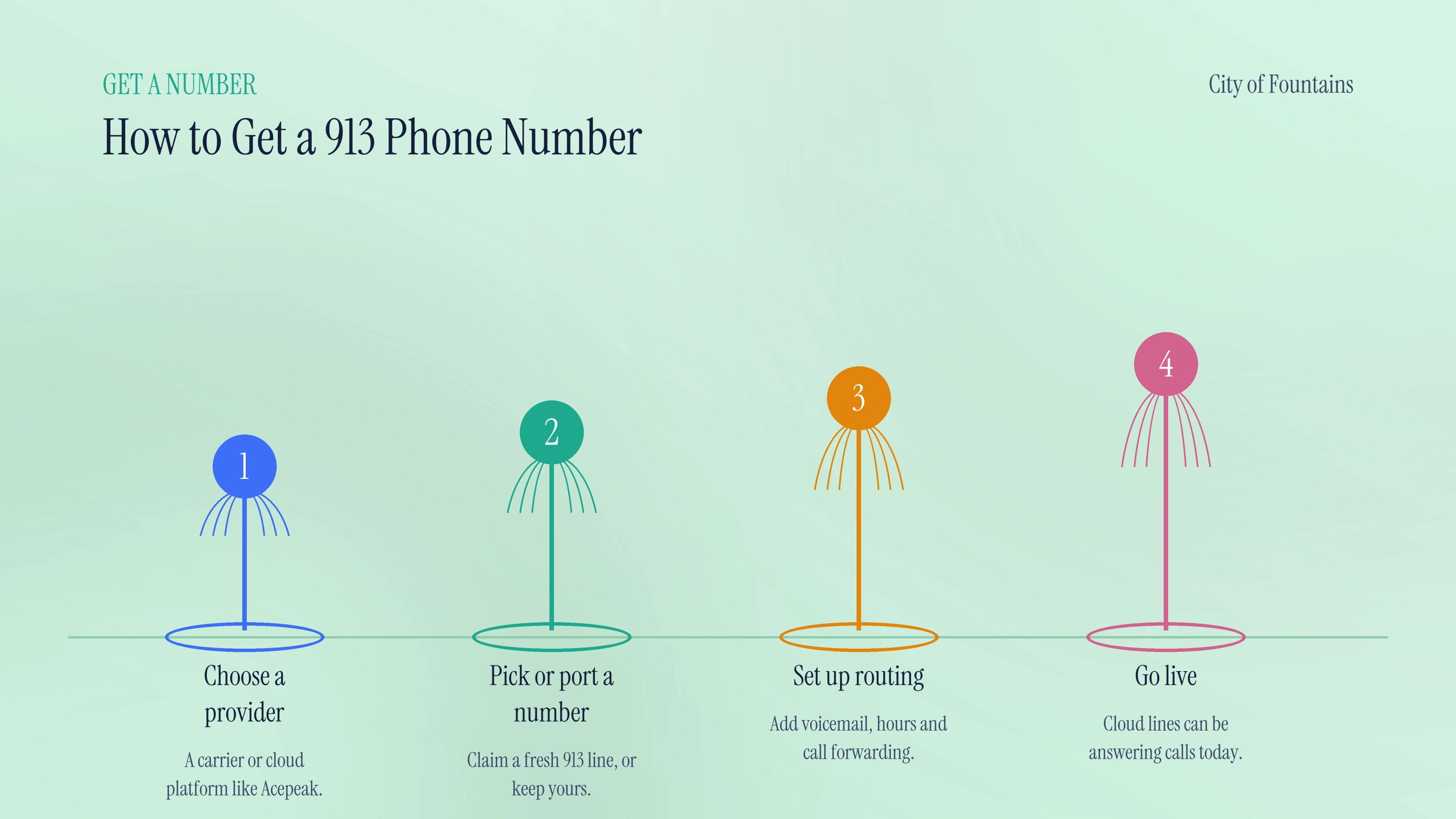
Businesses on the Kansas side can secure a 913 number without a technician's visit or an office park lease in Overland Park. A cloud phone provider handles setup online, and the line can be switched on the same day. The key is getting a genuine 913 rather than a Missouri 816 number, and the process goes like this:
- Pick a provider that lists true 913 stock — not a Missouri-side 816 number — so Kansas customers see the right state on caller ID.
- Search Johnson County inventory — since 913 has never split into an overlay, the number you claim or port stays a single, uncomplicated prefix.
- Configure routing and features — add voicemail, an auto-attendant, business hours and call forwarding to point calls at the right desk.
- Start taking calls — dial in from a laptop, desk phone or mobile app, with the 913 identity showing on outbound calls too.
Spotting and Avoiding 913 Scam Calls
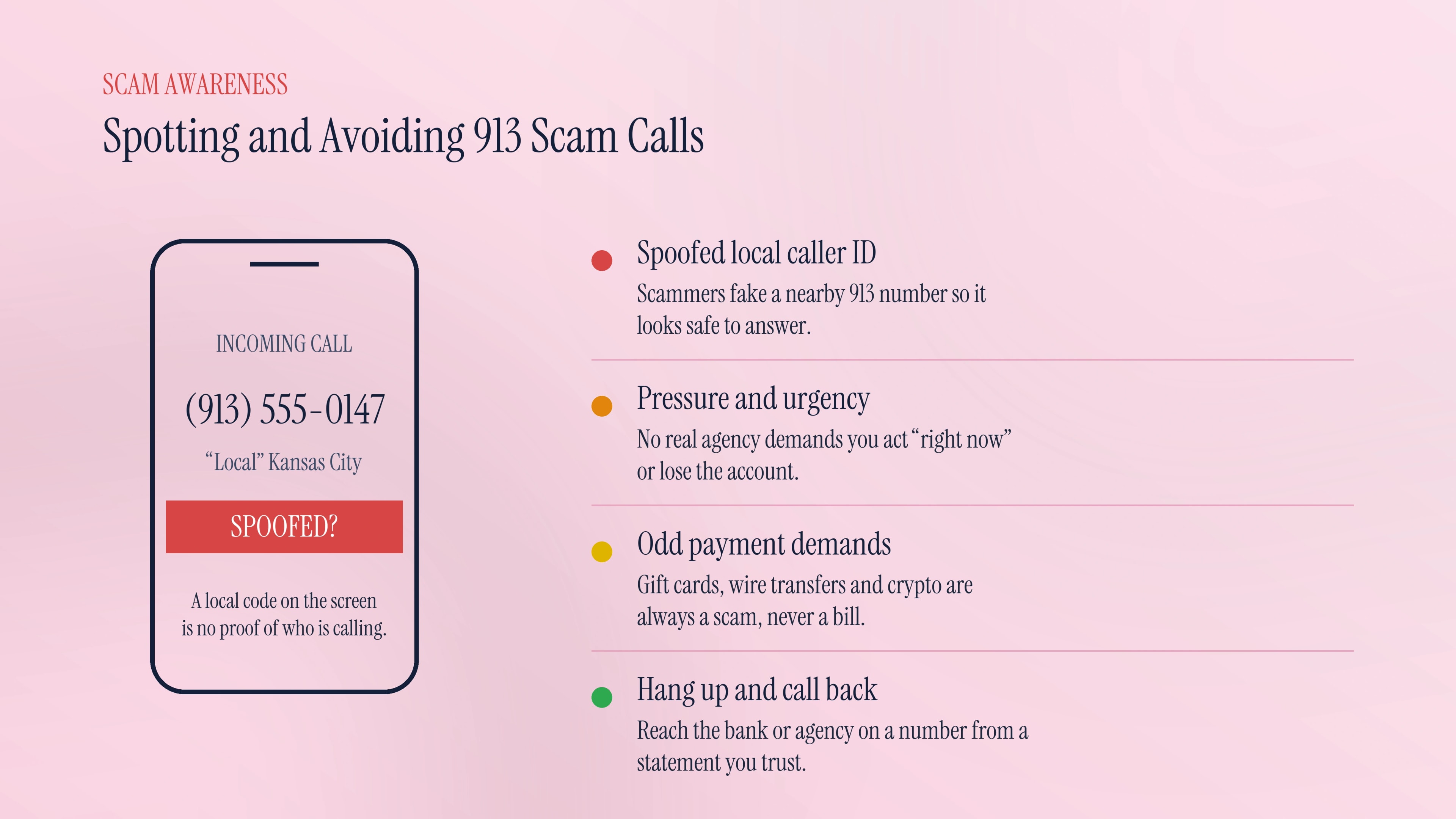
Olathe, Shawnee and Leavenworth residents are used to seeing 913 on incoming calls, and scammers take advantage of that familiarity. They spoof the caller ID so a fraudulent call displays a local Kansas-side number and seems safe to answer. Use these habits to screen them:
- Watch for pressure and urgency — real agencies and businesses do not demand that you act "right now" or the account will be closed.
- Be wary of odd payment demands — gift cards, wire transfers and cryptocurrency are the calling cards of a scam, never a legitimate bill.
- Do not trust caller ID alone — a 913 number on the screen can be faked; the local code is no guarantee the caller is who they claim.
- Hang up and call back on a number you trust — reach the bank, utility or agency directly using a number from a statement or official website.
- Report the call — logging unwanted calls with the authorities helps regulators track and shut down the operations behind them.
The Future of the 913 Area Code
For a code that once covered a third of a state, 913 has settled into a remarkably stable middle age. Since the 1997 split handed its rural territory to 785, the metro-only 913 has never needed an overlay or another split — a sign that, even with steady suburban growth, its number supply has kept pace with demand. The Kansas Corporation Commission, which oversees telecommunications in the state and requested the original 1997 relief, continues to monitor numbering across Kansas, and any future change for the Kansas City area would almost certainly arrive as an overlay rather than a disruptive split that alters existing numbers. Fast-growing Johnson County keeps adding lines every year, yet residents and businesses can expect their 913 numbers to stay exactly as they are.
The Simplest Way to Belong in the Kansas City Market
The 913 area code is far more than three digits — it is the shared phone identity of the Kansas side of Kansas City, from the corporate campuses of Overland Park to the riverfront of Kansas City, Kansas, the growing suburbs of Olathe and Lenexa, and the Army town of Leavenworth. One of the original codes of 1947, it once stretched across the whole northern half of the state before the 1997 split with 785 focused it on the metro it serves today. For any business hoping to connect with the Kansas City market, a local 913 number is one of the simplest and most authentic ways to belong.
Claim your Kansas City presence today
Acepeak makes it easy to get a 913 number and start taking calls across the Kansas side of the metro.
Questions, answered.
The 913 area code covers the Kansas side of the Kansas City metropolitan area — a compact band of counties along the Missouri state line, including Overland Park, Olathe, Kansas City (Kansas), Shawnee, Lenexa, Leawood, Leavenworth, Bonner Springs, De Soto and Paola across Johnson, Wyandotte, Leavenworth, Miami and Atchison counties.
On July 20, 1997, area code 913 was split to create the new area code 785. Everything from Lawrence westward — including Topeka, Manhattan, Salina and Hays — moved to 785, while 913 was reduced to the Kansas City metropolitan area. Permissive dialing continued until October 2, 1998.
Yes. 913 is one of the original 86 area codes assigned in 1947 under the first North American Numbering Plan, when it covered the entire northern half of Kansas. It was pared back to just the Kansas City metro in the 1997 split that created 785.
The 913 region runs on Central Time — UTC−6 during standard time (CST) and UTC−5 during daylight saving time (CDT) — the same clock as Kansas City, Chicago and the rest of the central United States.
Not necessarily. Because 913 has no overlay code, local calls can still be completed with just the seven-digit number in many cases, though dialing the full ten digits always works and is the standard way mobile phones store and place calls.
Absolutely. With a cloud phone provider you can choose a 913 number from anywhere and have it ring on your laptop, desk phone or mobile app. It gives your business an authentic Kansas City presence without needing a physical office on the Kansas side of the metro.
Signing up for a 913 area code number takes minutes with a cloud phone provider — no local office in Kansas City required. Pick the number, connect it to your existing phone or app, and calls route in immediately. This keeps the 913 area code presence you already have while adding the local credibility Kansas customers respond to.