Mississippi River to Mammoth Cave on One Kentucky Code
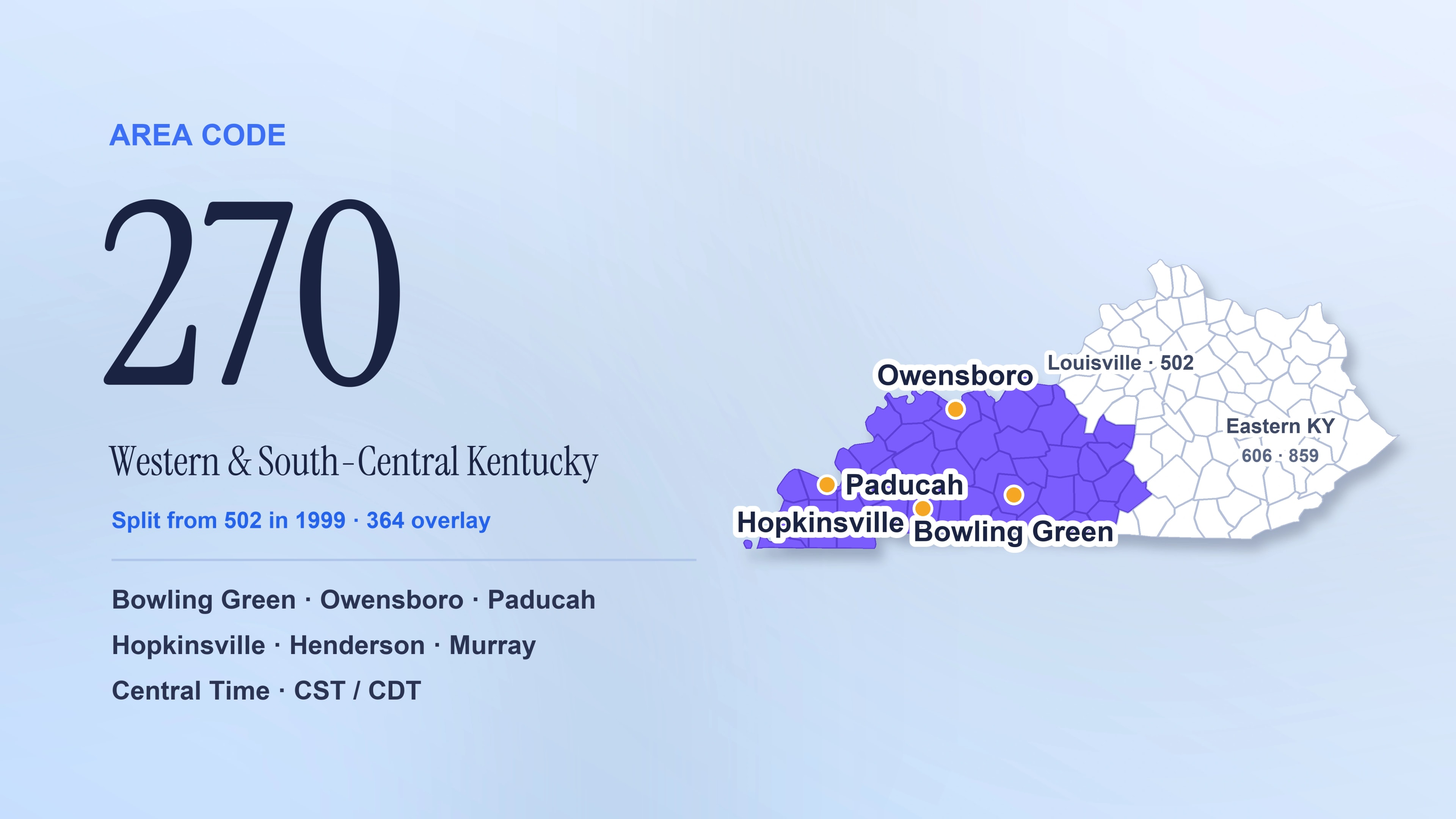
Say "270" anywhere from the Mississippi River to Mammoth Cave and locals picture the same broad sweep of Kentucky: the college town of Bowling Green, the Ohio River ports of Owensboro and Henderson, the Jackson Purchase around Paducah, and the tobacco-and-coal country of the Pennyrile in between. This single code has been the dial-tone identity of western Kentucky for more than 25 years, born when the sprawling old 502 code was carved in two to keep pace with a growing state. This guide lays out exactly where 270 reaches today, how it was split from 502, what the 364 overlay changed, the Central time zone and dialing rules, and how any business can claim a local western-Kentucky presence with a number of its own.
Key Takeaways
- The 270 area code covers the western and south-central third of Kentucky — Bowling Green, Owensboro, Paducah, Hopkinsville, Henderson, Madisonville, Elizabethtown and Murray — across roughly 45 counties.
- It was created on April 19, 1999, in a split from area code 502, when the old statewide Louisville code was divided to give the western half of the commonwealth its own numbers.
- Area code 364 was overlaid on the exact same territory on March 3, 2014, so ten-digit dialing has been the everyday standard across the region for more than a decade.
- Most of the 270 territory runs on Central Time, while a strip of south-central counties around Elizabethtown and Campbellsville keeps Eastern Time — a genuine split-clock region.
- A local 270 number reads as an authentic western-Kentucky identity — a real credibility advantage for any business serving Bowling Green, the Ohio River cities or the Pennyrile.
What Is the 270 Area Code?
The 270 prefix is the telephone identity of western and south-central Kentucky — a geographic code with its own defined territory carved out of the old 502 area code in 1999. It reaches from the Mississippi and Ohio rivers in the far west, across the Pennyrile and the Western Coal Field, up to the Barren River country around Bowling Green. Like the Louisville-anchored code it split from, it carries the identity of a broad region rather than a single city.
Because it blankets so many towns that share little except the region itself, a 270 number reads as unmistakably local across a wide slice of the state. To a customer in Owensboro, Paducah or Glasgow it looks like a neighbor on the caller ID rather than an out-of-state stranger — a small but real credibility signal for any business working western Kentucky.
Regional Cities, Not One Metro: Bowling Green to Paducah
The 270 code spans the western and south-central counties of Kentucky — roughly 45 of them, from the Jackson Purchase in the far west to the Barren River region in the south-central middle of the state. It is a big, mostly rural footprint anchored by a string of independent regional cities rather than one dominant metro. The major communities include:
- Bowling Green (Warren County) — the largest city in the region and Kentucky's third-largest, home to Western Kentucky University and the National Corvette Museum
- Owensboro (Daviess County) — the Ohio River city famous for its barbecue and bluegrass festivals, one of the state's biggest population centers
- Paducah (McCracken County) — the historic river port and UNESCO Creative City of Crafts and Folk Art at the western tip of the state
- Hopkinsville (Christian County) and Madisonville (Hopkins County) — the commercial hubs of the Pennyrile coal and farming country
- Henderson (Henderson County) — the Ohio River town just across the water from Evansville, Indiana
- Elizabethtown (Hardin County) and Murray (Calloway County) — the growing gateway city near Fort Knox and the university town of the far southwest
Together these counties hold well over a million people spread across a wide expanse of farmland, rivers and small cities — enough demand that a single code eventually needed reinforcement.
A Code Split by a Time-Zone Line, Dialed One Way
The 270 region is one of the few American area codes split by a time-zone line. Most of it — Bowling Green, Owensboro, Paducah, Hopkinsville and the whole western half — runs on Central Time, UTC−6 in winter (CST) and UTC−5 in summer (CDT), the same clock as Nashville and Chicago. A strip of south-central counties on the eastern edge, around Elizabethtown and Campbellsville, keeps Eastern Time instead, matching Louisville and the 502 region next door. Dialing, on the other hand, is uniform across the code, because the 364 overlay made ten digits mandatory years ago:
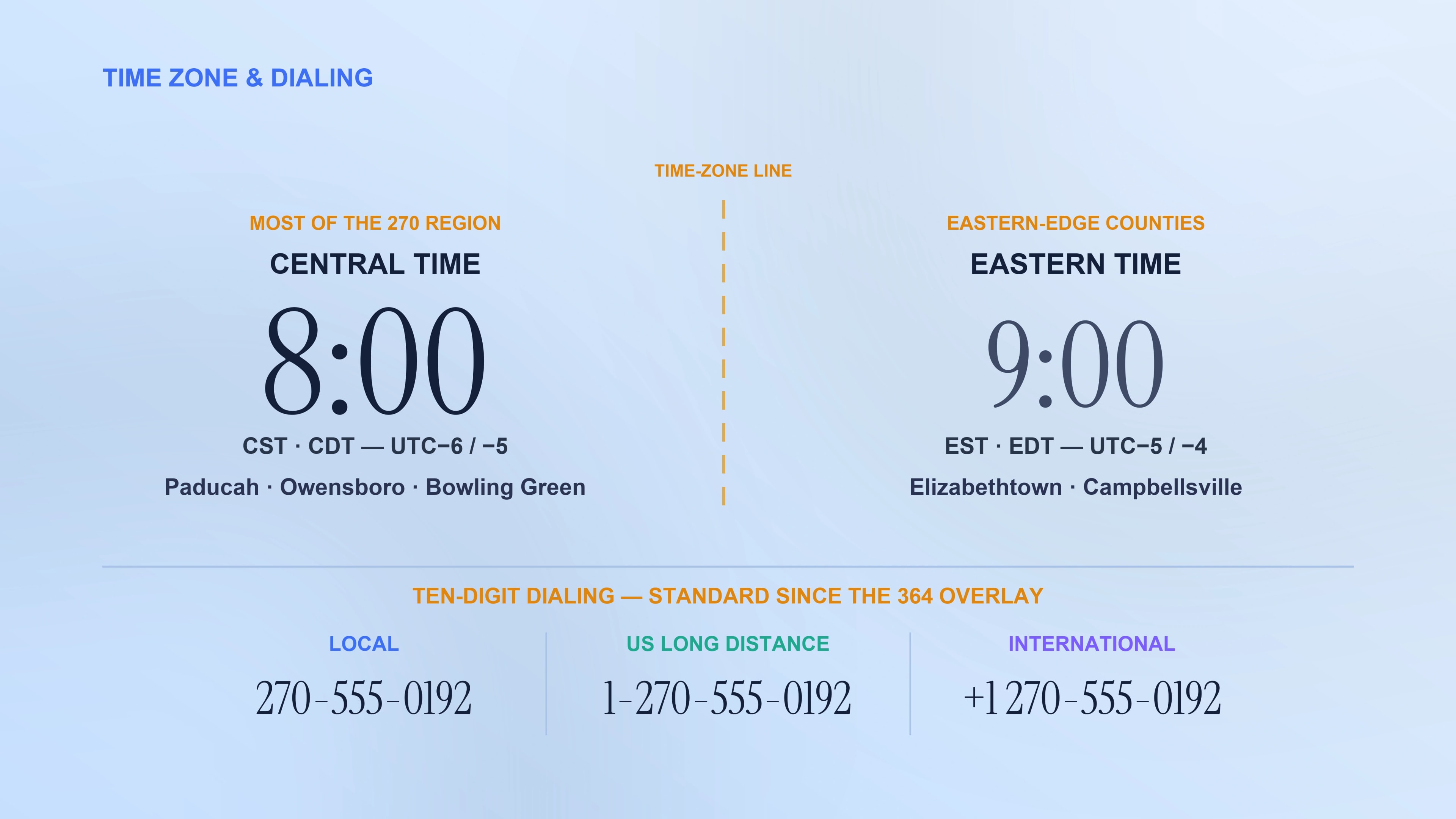
- Local calls within the region: dial all ten digits — 270-555-0192 — which has been required since the 364 overlay arrived.
- Long-distance from elsewhere in the U.S.: add a leading 1 — 1-270-555-0192.
- International: dial the exit code, then +1, then the number — +1 (270) 555-0192.
- Same rules for 364: because 364 overlays the same area, a call to either code from anywhere in the region is dialed exactly the same way.
From a 502 Split to the 364 Overlay
When the North American numbering plan launched in 1947, all of Kentucky shared a single code, 502. Growth chipped away at that footprint: eastern Kentucky broke off as 606 in 1954, and on April 19, 1999, the western and south-central counties became area code 270, leaving 502 with its Louisville-Frankfort core. The new Kentucky code was filling up within a decade too — the same growth pressure that shapes numbering across the commonwealth, from Louisville to the Lexington-area 859 area code — so regulators chose an overlay instead of another split.
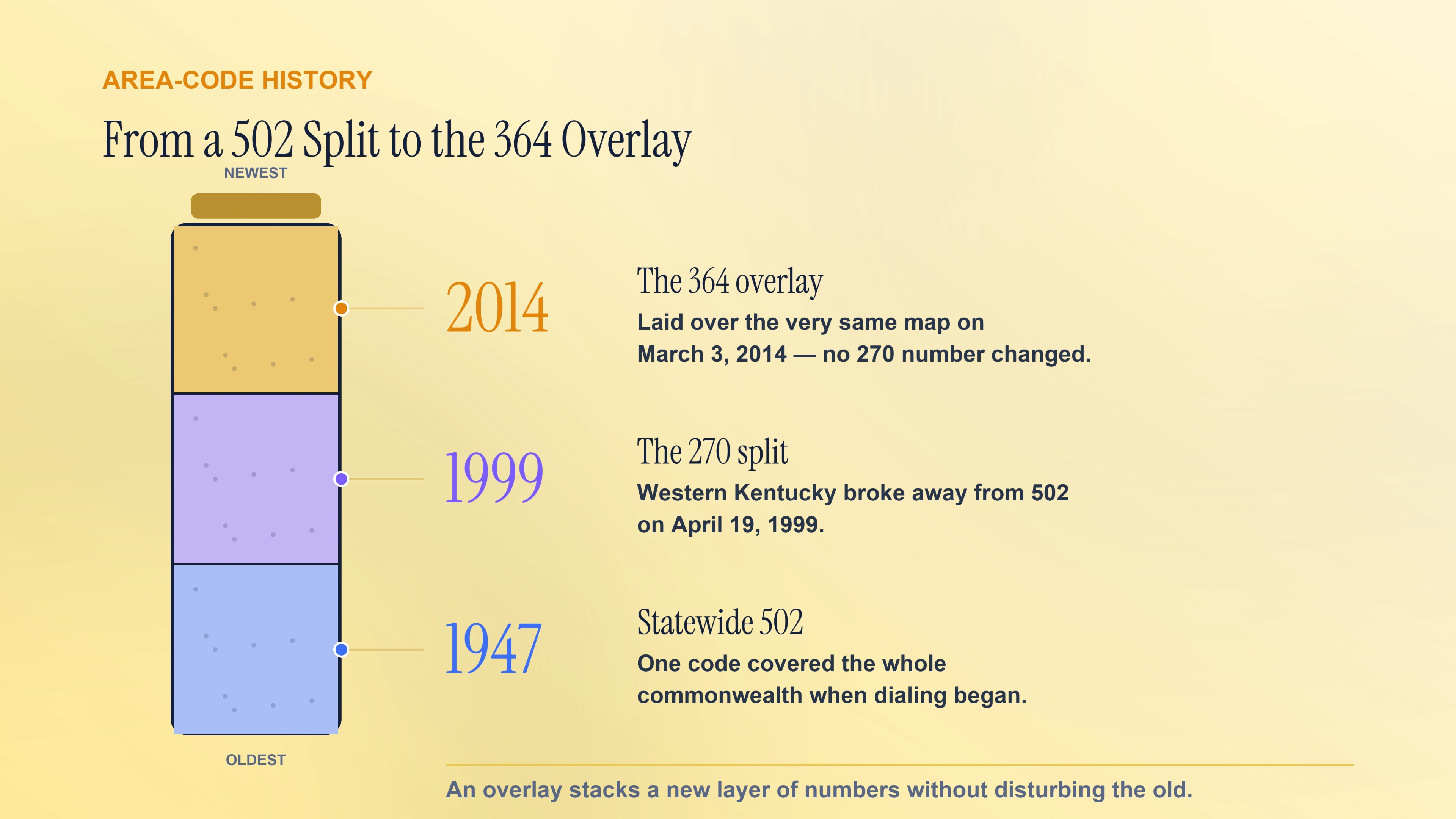
Area code 364 went into service on March 3, 2014, laid directly over the entire 270 territory. No existing number changed — an overlay simply adds a second prefix to the same map, so new lines can draw on fresh numbers while every established 270 line stays exactly as it is. The one trade-off, ten-digit dialing for local calls, had already been phased in ahead of the switch, which is why the whole region has dialed all ten digits as a matter of habit ever since.
Benefits of a Local 270 Number for Business
A local number is one of the simplest trust signals a business can own, and in a region as proud of its towns as western Kentucky, a 270 number carries real weight. When a customer in Bowling Green, Owensboro or Paducah sees a 270 line calling, it reads as a neighbor rather than an out-of-state telemarketer.
- Local trust across a big footprint: from the Barren River country to the Pennyrile, western Kentuckians answer a 270 call the way they would a neighbor's.
- One number, two time zones: because 270 spans both the Central and Eastern strips of the region, a single line can credibly reach Bowling Green and Elizabethtown alike.
- A foothold in specialty economies: whether it's Owensboro's barbecue and bluegrass scene or Paducah's UNESCO craft trade, a 270 number signals genuine regional roots.
- Work from anywhere: cloud calling lets a company hold a 270 or 364 line while its team operates from anywhere in the country.
Ready to claim a western-Kentucky presence?
Acepeak provisions local 270 numbers with carrier-grade routing and instant activation, so a business can sound local from day one.
How to Get a 270 Phone Number
Securing a 270 number is straightforward, whether a business is based in Kentucky or simply wants a foothold in the western half of the state.
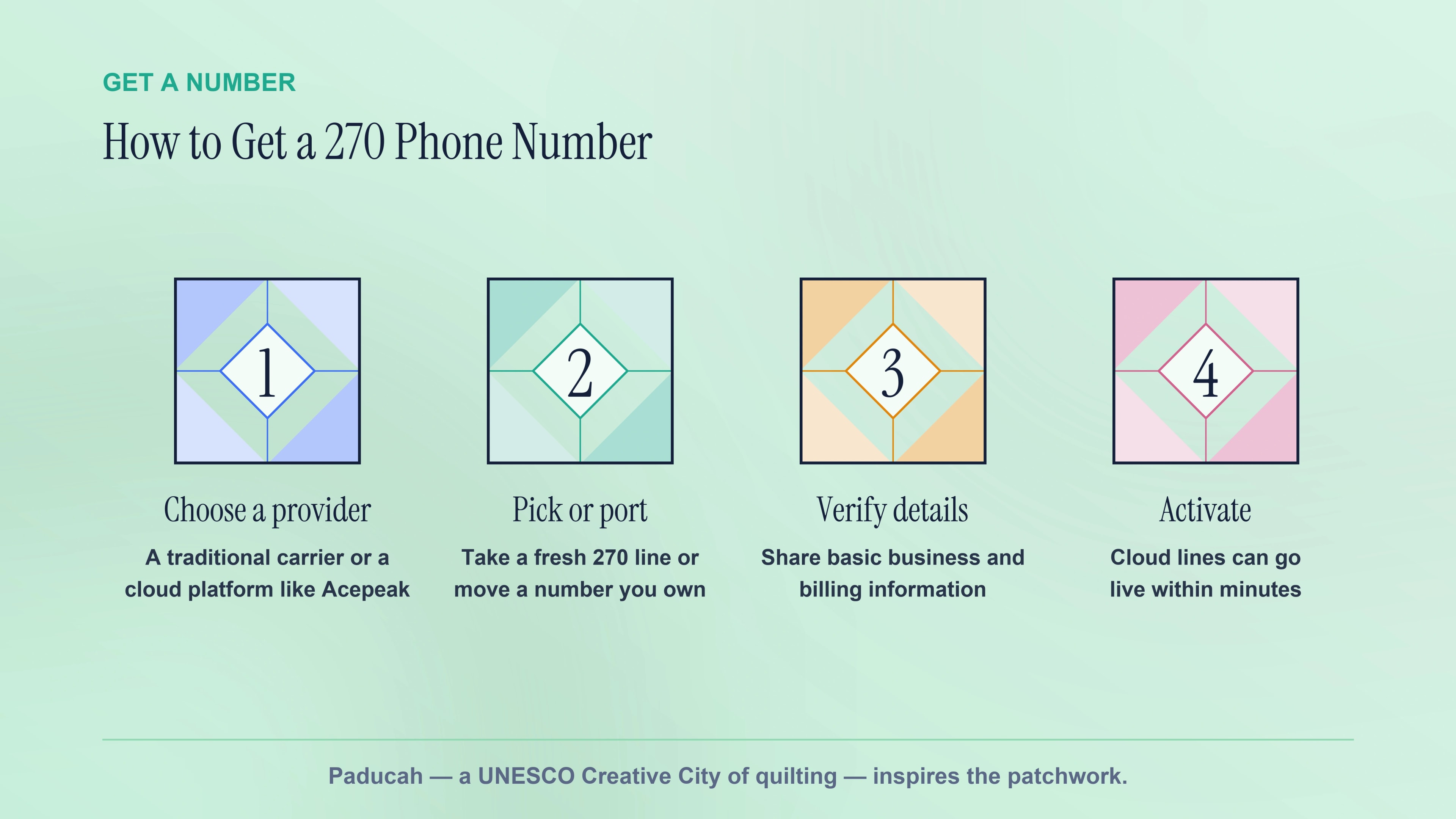
- Check both codes at once: because 364 overlays the entire region, a provider like Acepeak can show live 270 and 364 inventory together.
- Pick or port a number: browse what's available from the Mississippi River to Bowling Green, or transfer an existing western-Kentucky line.
- Verify your business details: share basic company and billing information to complete setup.
- Go live fast: cloud activation is typically a matter of minutes, not the days a traditional carrier might take.
Spotting and Avoiding 270 Scam Calls
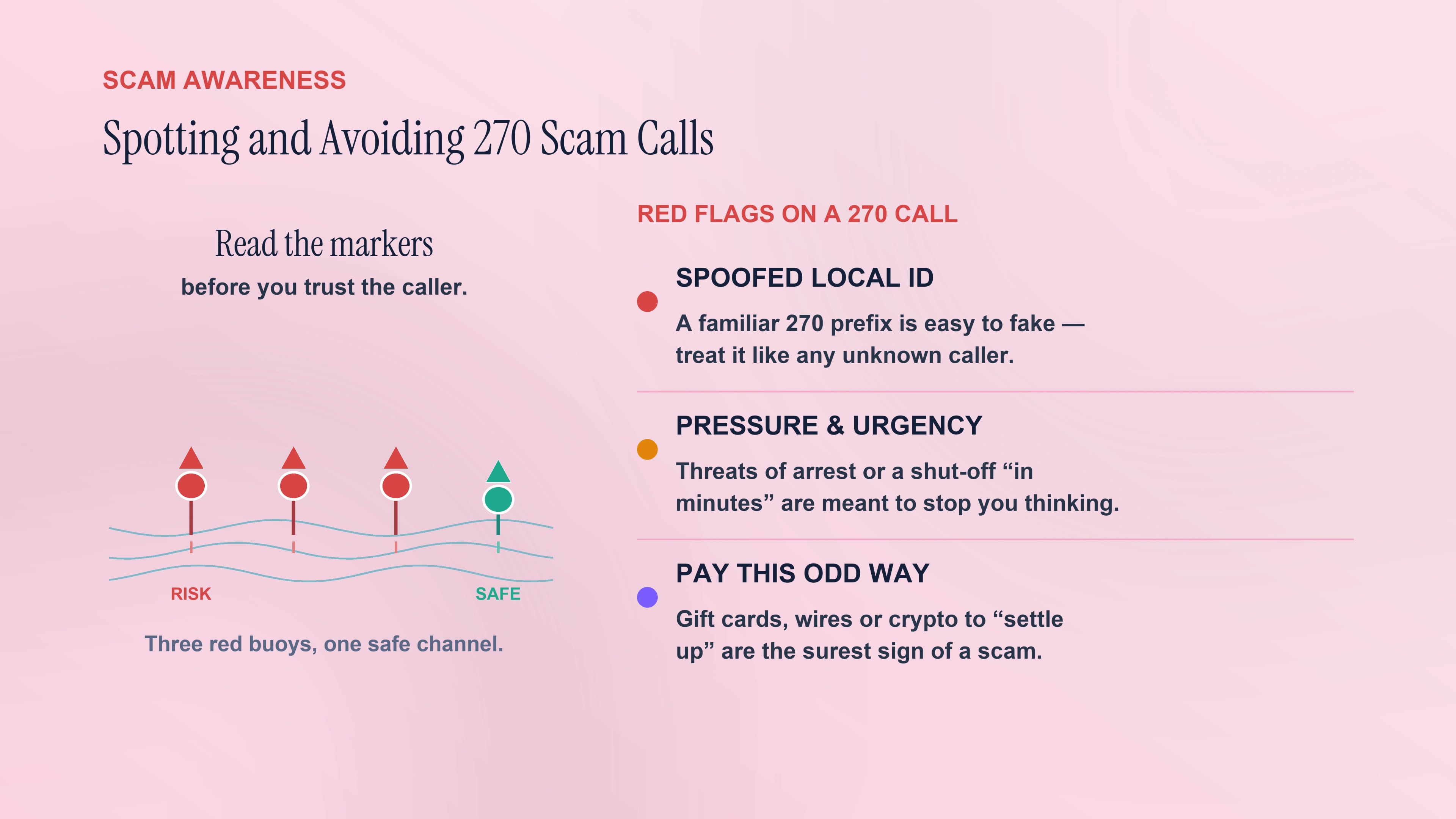
Caller ID is easy to fake, and scammers choose 270 because western Kentuckians tend to answer it like a call from a neighbor. Those digits, or a 364 number, prove nothing about whether the caller is really in Bowling Green or Paducah. Be as wary as you would with any unknown caller, especially one claiming to represent a utility, a bank, or a Kentucky state agency.
- Never share sensitive details — bank information or a Social Security number — with an unexpected caller.
- Verify urgent requests by hanging up and calling back on an official, published number.
- Use call-blocking and spam-filtering tools to screen unknown numbers.
- Report suspicious calls to your provider or the relevant authorities so others are protected.
The Future of the 270 Area Code
Western Kentucky keeps growing, and its numbering plan is already built for it. Bowling Green is one of the fastest-growing cities in the state, the Ohio River corridor around Owensboro and Henderson continues to add industry, and river cities like Paducah keep reinventing their downtowns. The City of Paducah and its neighbors now have room to grow for decades, because the 364 overlay doubled the pool of available numbers without touching a single existing line. The original code will keep its cachet — across western Kentucky, a 270 number quietly signals a business that was here first.
Cheap, Credible Proof of Western Kentucky Roots
Kentucky's 270 prefix is more than a routing code; it is the shared dial-tone identity of the western and south-central half of the commonwealth, from the rivers of the Jackson Purchase to the caves and college town of the Barren River country. Split from the old statewide 502 in 1999 and reinforced by the 364 overlay in 2014, it has always meant the same thing: western Kentucky, its river cities and its small-town heart. For a business, a 270 number remains one of the cheapest, most credible ways to signal roots in the region — and with cloud calling, that presence is available to anyone, anywhere.
Put a trusted western-Kentucky number to work today
Acepeak delivers local 270 lines with smart routing, voicemail and 24/7 support — everything a business needs to stay reachable.
Questions, answered.
It serves the western and south-central third of Kentucky — including Bowling Green, Owensboro, Paducah, Hopkinsville, Henderson, Madisonville, Elizabethtown and Murray — across roughly 45 counties.
It went into service on April 19, 1999, in a split from area code 502, which until then had covered the western half of Kentucky as part of the old statewide code.
Area code 364 is an overlay placed over the exact same western-Kentucky territory on March 3, 2014. It added a second prefix so the region would not run out of numbers; existing 270 numbers did not change.
Yes. Because 364 overlays the same area, ten-digit dialing is required for local calls throughout the region and has been the everyday standard since the overlay took effect in 2014.
Most of the region observes Central Time — CST (UTC−6) in winter and CDT (UTC−5) in summer. A strip of south-central counties on the eastern edge, around Elizabethtown and Campbellsville, keeps Eastern Time instead.
Yes. Cloud and hosted phone services let a business or individual hold a local 270 number from anywhere while keeping an authentic western-Kentucky identity.
Signing up for a 270 area code number takes minutes with a cloud phone provider — no local office in Kentucky required. Pick the number, connect it to your existing phone or app, and calls route in immediately. This keeps the 270 area code presence you already have while adding the local credibility Kentucky customers respond to.