A Steel-City Code That Survived Its Own Split
Pittsburgh has answered the phone with 412 since before most of its famous bridges carried modern traffic. The code has outlasted steel mills, survived a territorial split that could have erased it, and now shares its streets with two newer area codes without ever changing a single existing number.
This guide covers where 412 works today, how Pittsburgh ended up as a numbering enclave inside its own former territory, what the 878 overlay means for dialing, and the practical steps for putting a 412 number on your own business line.
Key Takeaways
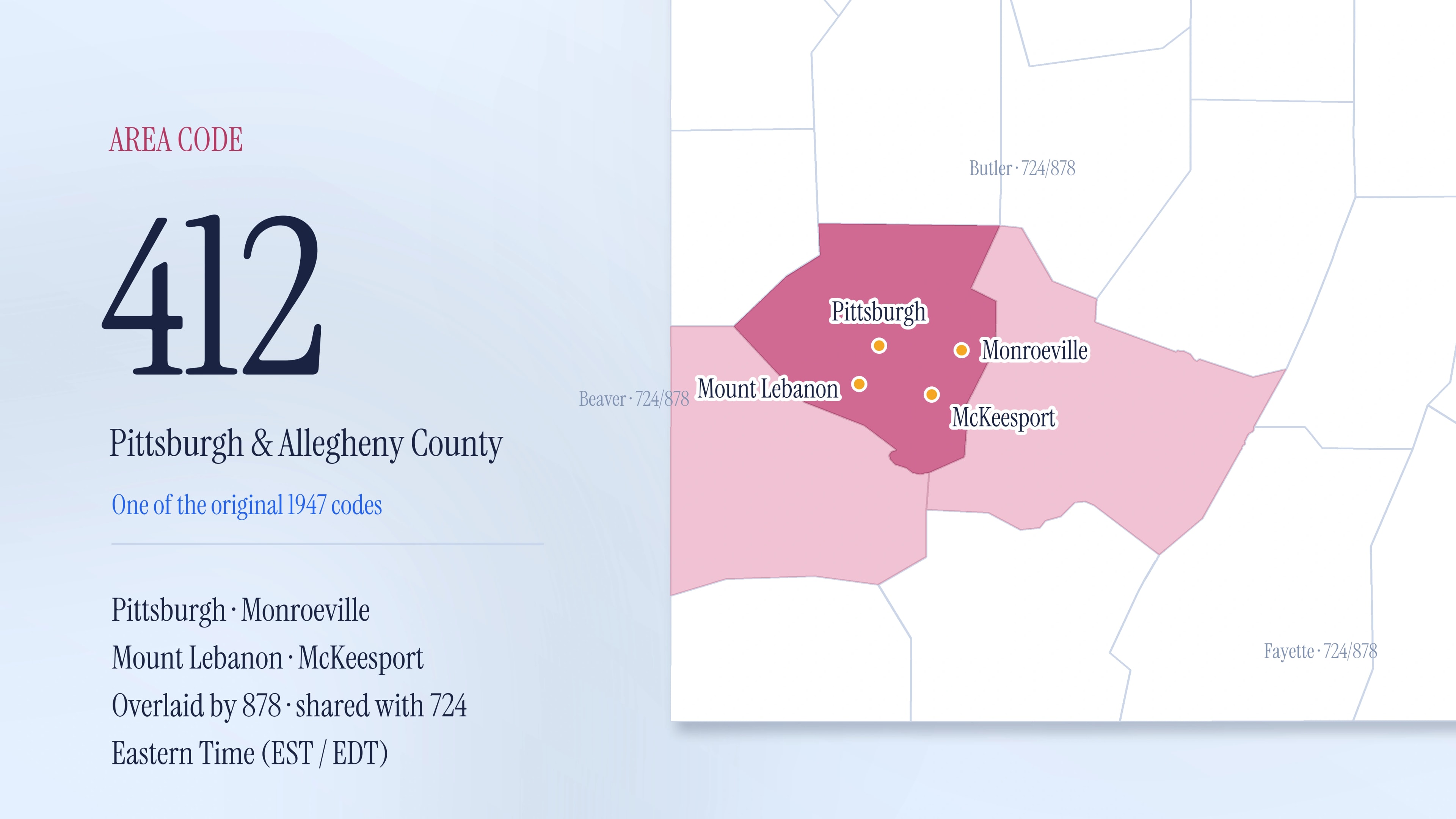
- The 412 area code covers Pittsburgh and most of Allegheny County, plus small overlapping slivers of Washington and Westmoreland counties.
- 412 was one of the original 86 North American area codes, assigned in 1947 to the entire southwestern corner of Pennsylvania.
- A 1998 split carved off the surrounding counties into area code 724, shrinking 412 down to an enclave centered on Pittsburgh itself.
- Since August 17, 2001, the 878 overlay has shared the same territory as both 412 and 724, and every local call requires all ten digits.
- The whole region runs on Eastern Time, and a cloud phone provider can activate a 412 number for any business, anywhere.
What Is the 412 Area Code?
The 412 area code is the North American Numbering Plan code for Pittsburgh and its immediate surroundings in southwestern Pennsylvania. It was assigned in 1947 as one of the original 86 area codes created for the first nationwide numbering plan — the same rollout that gave New York City 212 and Chicago 312 — and it originally covered the entire southwestern corner of the state.
That original footprint held for over four decades until growth forced a split, the same pressure that later carved a fresh code out of neighboring territory for the 724 area code in 1998 — a split that, unusually, took almost all of 412's old territory and left the city itself holding the original number.
Allegheny County from Mount Lebanon to Sewickley
Today the 412 footprint is compact by area-code standards: the city of Pittsburgh, most of Allegheny County, and small overlapping portions of Washington and Westmoreland counties. Communities using 412 numbers include:
- Pittsburgh — the region's anchor, built around the confluence of the Allegheny, Monongahela, and Ohio rivers
- Monroeville, Penn Hills, and Plum — Allegheny County's eastern suburbs
- Mount Lebanon, Bethel Park, and Carnegie — the county's southern and western suburbs
- McKeesport and West Mifflin — Mon Valley communities southeast of the city
- Sewickley, Coraopolis, and Bridgeville — river towns along the Ohio and its tributaries
Eastern Hours at the Point and No More Seven-Digit Calls
Pittsburgh and the rest of the 412 footprint keep Eastern Time: EST (UTC−5) in the colder months and EDT (UTC−4) under daylight saving. A 9 a.m. start at the Point lines up with 9 a.m. everywhere else on the East Coast, so Allegheny County's hospitals, universities, and robotics firms share a business day with partners up and down the Eastern seaboard.
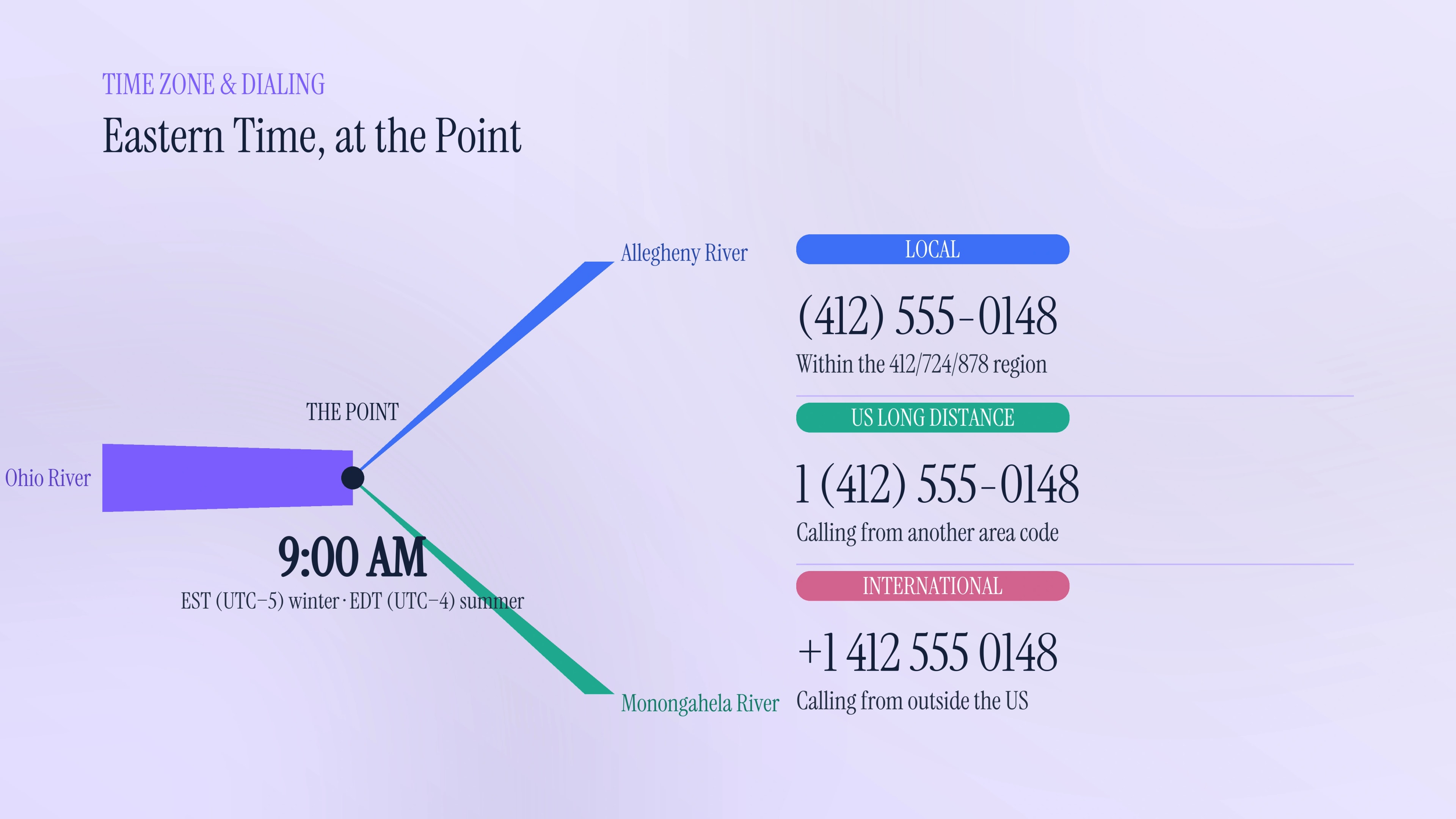
Dialing is simple but strict: every local call needs all ten digits — (412) 555-0148 — with a 1 in front for long distance, and +1 412 from abroad. Seven-digit dialing has not worked anywhere in the region since 2001.
Splits and the Overlay
The original 1947 territory covered every county in the southwestern corner of Pennsylvania. On February 1, 1998, that changed: the new 724 area code took over the outlying counties, and 412 shrank down to Pittsburgh and most of Allegheny County — a rare case where the split left the historic code as the smaller enclave rather than the city surrendering its number, much as Philadelphia's original 215 area code held its core while overlays and splits reshaped the territory around it.
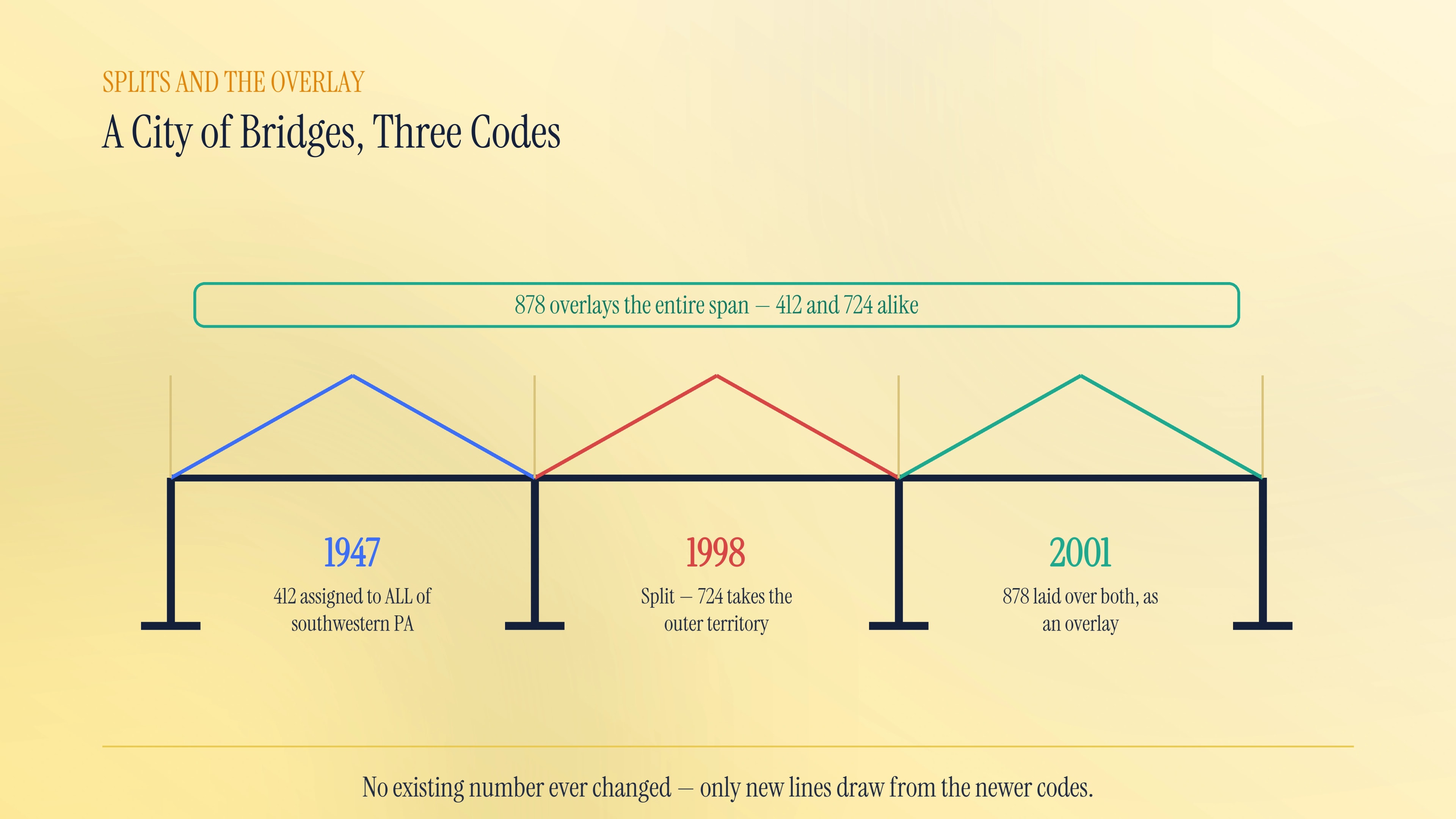
Three years later, on August 17, 2001, regulators chose an overlay instead of another split: area code 878 was laid across the entire combined 412 and 724 territory, so a single new code covers all of southwestern Pennsylvania alongside the two older ones. Actual 878 number assignment did not start until 2013, but the overlay itself — and the mandatory ten-digit dialing that came with it — has been in effect since 2001. No existing 412 number ever changed; new lines simply began drawing from the wider 878 pool.
Benefits of a Local 412 Number for Business
Pittsburgh is a market where a local number still carries real weight. A 412 number gives a business:
- A code that outlasted a split — 412 kept its original 1947 identity even after 724 took the surrounding counties, so it still reads as the historic Pittsburgh number.
- Coverage at the three-rivers core — one 412 line reaches downtown, the Mon Valley towns like McKeesport, and the river suburbs along the Ohio.
- A foothold in healthcare, robotics and higher ed — Pittsburgh's hospital systems, universities, and robotics startups keep call volume steady year-round.
- Location independence — cloud routing lets a team anywhere answer 412 calls as if they were sitting at the Point downtown.
Put a Pittsburgh number on your business
Acepeak provisions local 412 numbers with instant activation, smart routing, and crystal-clear voice quality.
How to Get a 412 Phone Number
You don't need a downtown Pittsburgh office to hold a 412 number. A cloud telephony provider can activate one in minutes:
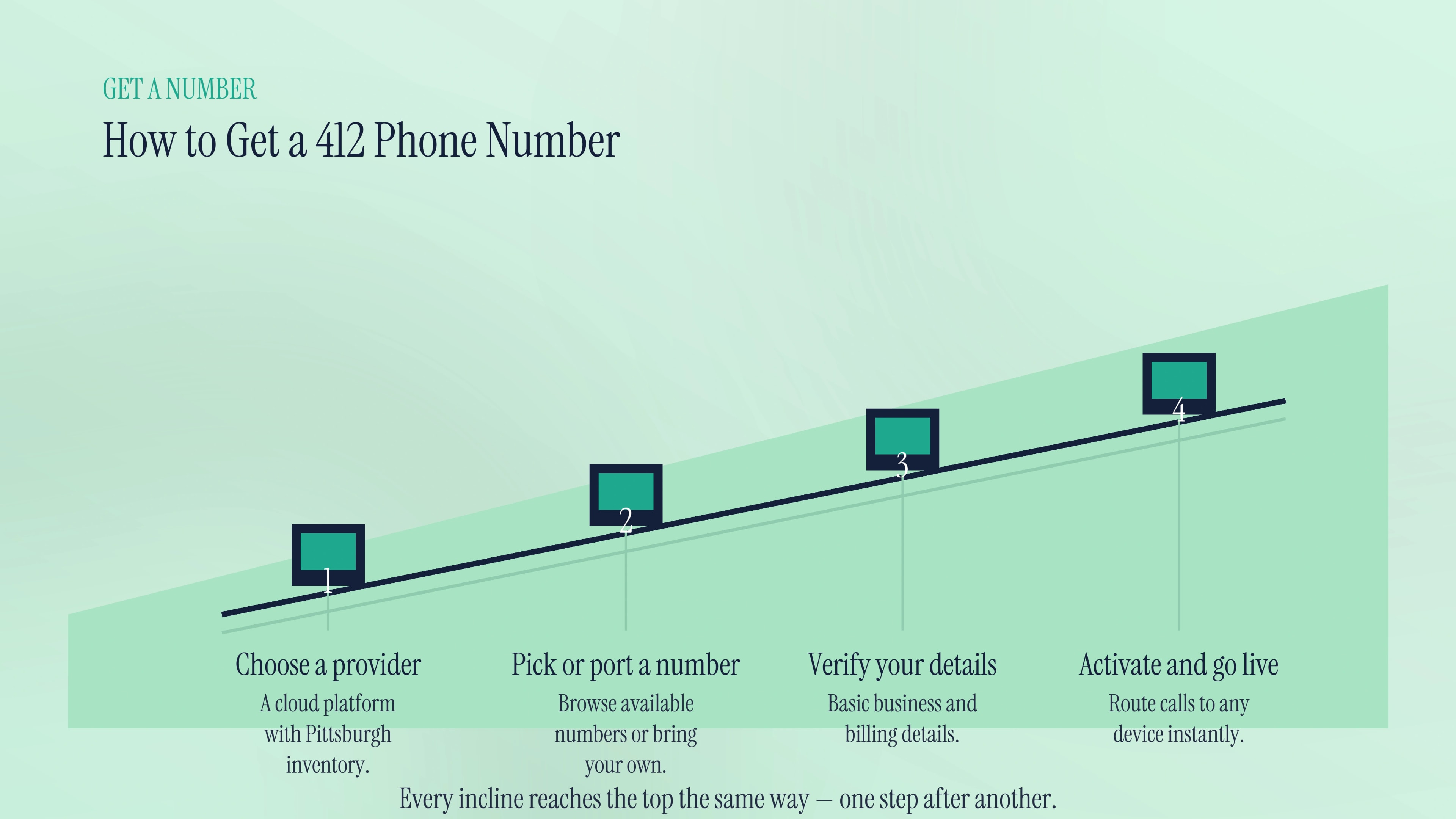
- Choose a provider — pick a cloud phone platform that lists real Allegheny County inventory, like Acepeak, not just the newer 878 pool.
- Pick or port a number — browse available 412 lines from the city core, or bring an existing Pittsburgh number with you.
- Verify your details — provide basic business and billing information so activation can proceed.
- Go live across the region — route calls to desk phones, mobiles, or softphone apps the moment setup finishes.
Spotting and Avoiding 412 Scam Calls
Because Pittsburgh residents trust a 412 caller ID, fraudsters copy it, posing as someone from the neighborhood, a local bank, or an Allegheny County office. Pausing before acting and confirming who is really calling stops most of these attempts:
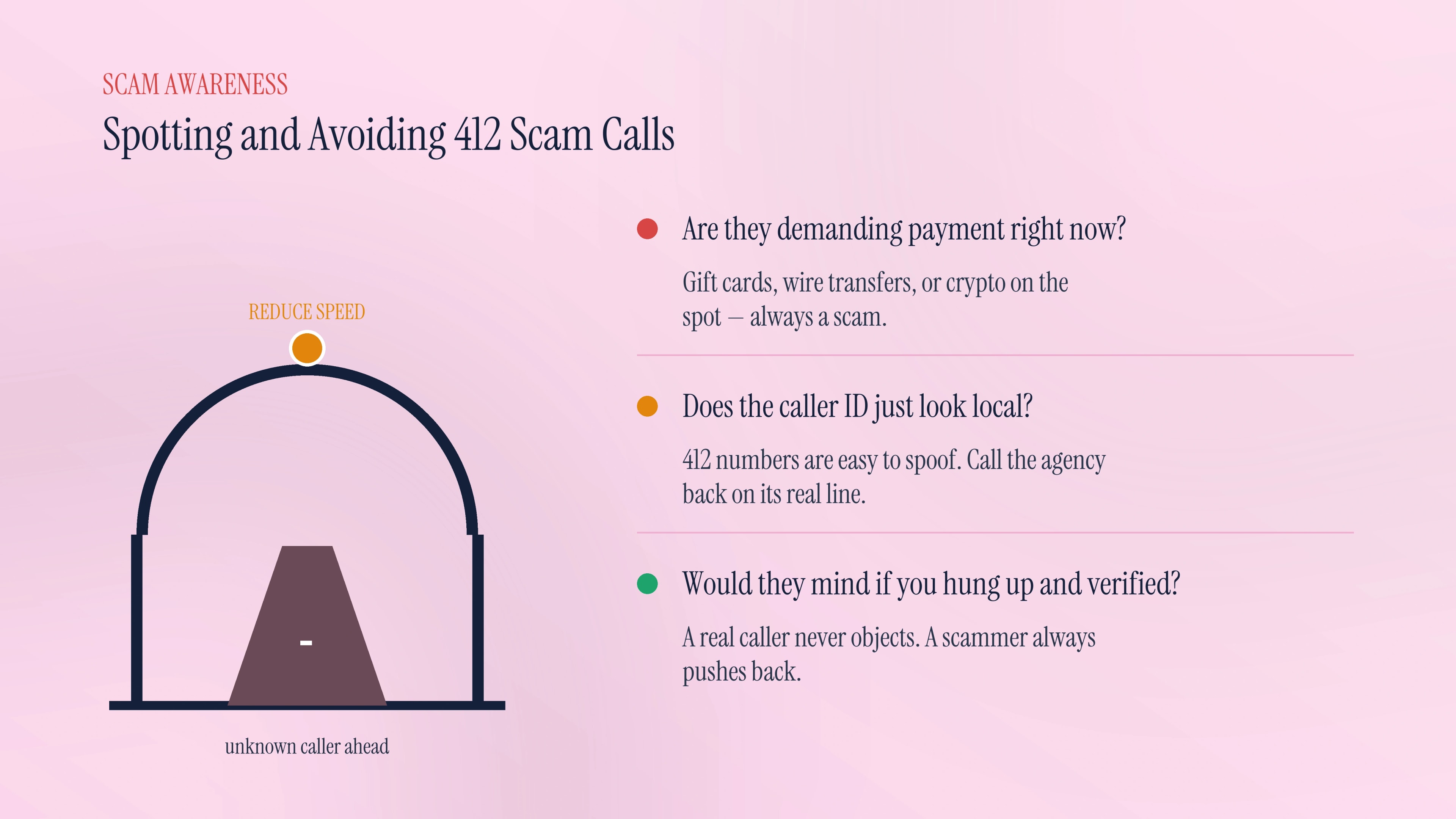
- Stop — hang up on any caller demanding gift cards, wire transfers, or immediate payment; no legitimate agency collects that way.
- Check — if caller ID claims a bank, a utility, or law enforcement, call the organization back on its published number.
- Go — block confirmed scam numbers and report them so carriers can act on the pattern.
- Never share one-time passcodes or account credentials with an inbound caller, no matter how local the number looks.
The Future of the 412 Area Code
The 878 overlay bought southwestern Pennsylvania's numbering plan decades of breathing room, and the region's steady growth shows why regulators moved when they did. The Commonwealth of Pennsylvania continues to see investment in Pittsburgh's downtown, riverfront, and technology corridors.
For businesses, the practical takeaway is simple. Existing 412 numbers keep working exactly as before, while 878 numbers cover the same ground for anyone activating a new line today. Whichever prefix you land, a Pittsburgh-area number keeps working unchanged for the foreseeable future.
Why Pittsburgh Callers Still Pick Up for This Prefix
Few area codes have as unusual a history as 412. Born in 1947 as the code for all of southwestern Pennsylvania, trimmed down to an enclave by the 1998 split to 724, and finally joined by the 878 overlay in 2001, it has tracked Pittsburgh's identity through steel, splits, and a second wave of growth without ever leaving the city's side. For any business that wants Pittsburgh-area customers to pick up the phone, a 412 — or its 878 and 724 neighbors — is still the strongest local signal you can send.
Ready for your 412 number?
Claim a Pittsburgh-area local number with Acepeak and start connecting with southwestern Pennsylvania today.
Questions, answered.
The 412 area code covers the city of Pittsburgh, most of Allegheny County, and small overlapping portions of Washington and Westmoreland counties in southwestern Pennsylvania.
Area code 412 entered service in 1947 as one of the original 86 North American area codes. It originally covered the entire southwestern corner of Pennsylvania before the 1998 split to 724 shrank its footprint.
Area code 878 is an all-services overlay covering the combined territory of both 412 and 724, in service since August 17, 2001 (though actual number assignment did not begin until 2013). An 878 number is just as local to Pittsburgh as a 412 number.
Yes. Since the 878 overlay took effect in 2001, all local calls in the region must be dialed with the full ten digits — area code plus the seven-digit number. Calls dialed with only seven digits will not connect.
The entire 412 region observes Eastern Time — Eastern Standard Time (UTC−5) in winter and Eastern Daylight Time (UTC−4) during daylight saving — the same clock as New York and Philadelphia.
Yes. Cloud telephony providers can assign a 412 (or 878) number to a business or individual located anywhere and route the calls to your existing phones or apps, giving you a local Pittsburgh presence without a physical office there.
Signing up for a 412 area code number takes minutes with a cloud phone provider — no local office in Pittsburgh required. Pick the number, connect it to your existing phone or app, and calls route in immediately. This keeps the 412 area code presence you already have while adding the local credibility Pennsylvania customers respond to.