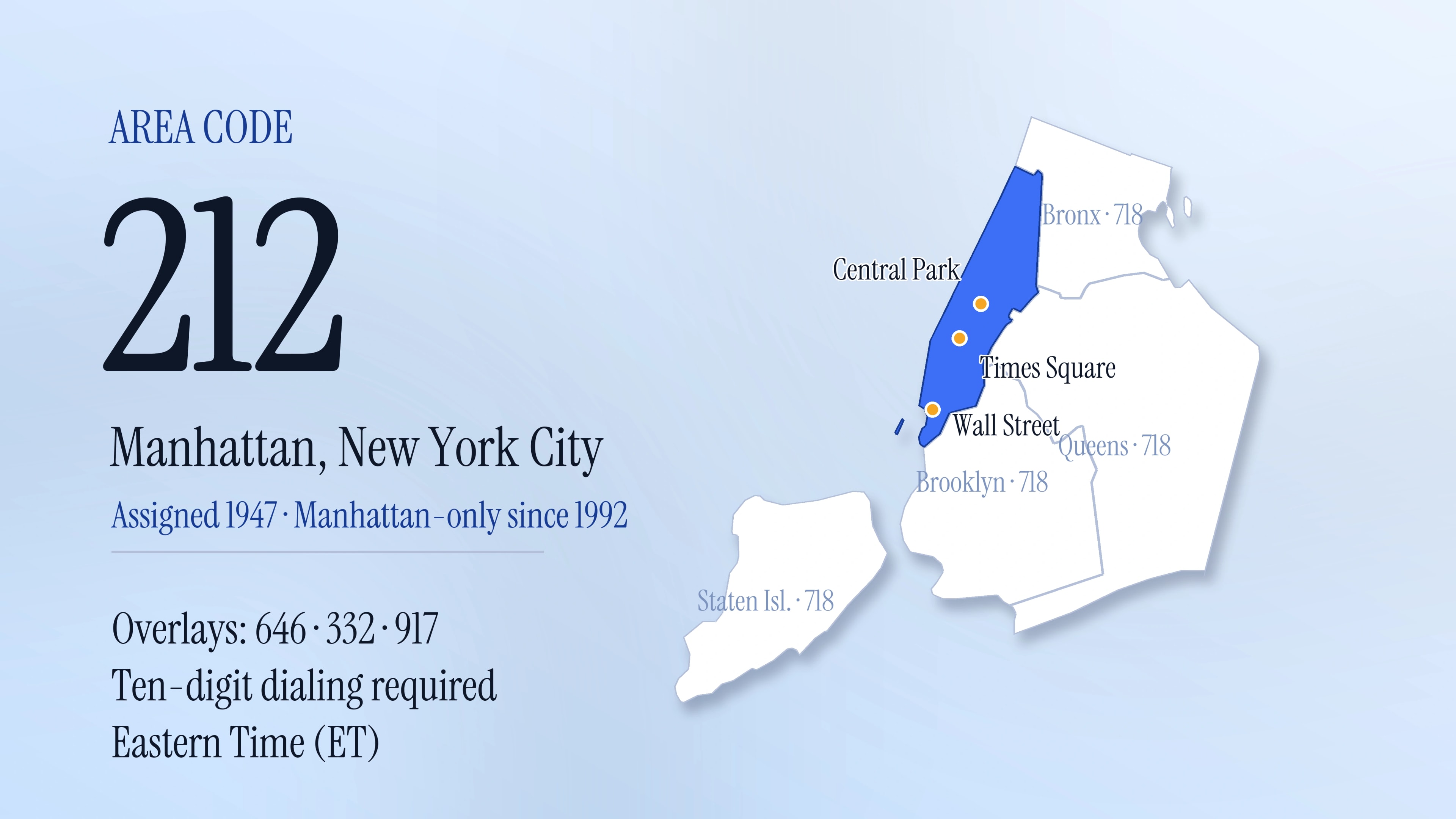
Midtown Offices, Wall Street Desks and Broadway Box Offices
Few area codes carry the cultural weight of 212. It is the telephone identity Manhattan has carried since the earliest days of the North American Numbering Plan — a three-digit shorthand for Midtown offices, Wall Street trading floors, and Broadway box offices alike, long before "New York, New York" ever needed a second area code.
This guide covers what the 212 area code is, how its territory shrank from all five boroughs down to Manhattan alone, the overlay codes that now share its numbers, and what it takes for a business to claim a 212 line of its own.
Key Takeaways
- The 212 area code was one of the original 86 North American area codes, assigned in 1947 to cover all five New York City boroughs.
- Brooklyn, Queens, and Staten Island moved to 718 in 1984, and the Bronx followed in 1992 — leaving 212 to serve only Manhattan today.
- Manhattan now shares its territory with two overlay codes, 646 (added 1999) and 332 (added 2017), plus the citywide 917 overlay — all four dial the same numbers with ten digits.
- Ten-digit dialing has been required for every Manhattan call since the 646 overlay activated in 1999.
- Manhattan runs on Eastern Time, and a 212 number remains one of the most recognized and requested area codes for any business with a New York presence.
What Is the 212 Area Code?
Area code 212 is a North American Numbering Plan code that today covers Manhattan, New York — but it started out far larger. When AT&T assigned the first area codes across the United States and Canada in 1947, 212 was handed the entire city of New York: Manhattan, Brooklyn, Queens, the Bronx, and Staten Island, all under one code. For 37 years it was one of the largest single-code calling zones in North America.
Codes like 212 were also deliberately practical: on the rotary phones of the era, digits closer to 1 took less time to dial, so the busiest cities were given the fastest-to-dial codes. New York, as the country's largest calling market, got 212 — quick to dial and quick to remember, a combination that helped cement its status decades later, much like the citywide 917 area code that now overlays it.
One Island, One County: Manhattan's Numbering Footprint
Today, 212 covers only Manhattan — New York County, one of the smallest and most densely used numbering plan areas in the country. Its footprint includes:
- Manhattan — every neighborhood from the Financial District and Tribeca to Midtown, the Upper East and West Sides, and Harlem
- New York County — Manhattan's formal county designation, coextensive with the borough itself
- Major business and cultural anchors — Wall Street, Times Square, the United Nations headquarters, and the Broadway theater district
- Manhattan's island geography — bounded by the Hudson, East, and Harlem Rivers, connected to the other boroughs by bridges, tunnels, and the subway
The other four boroughs that 212 once served now dial under different codes: Brooklyn, Queens, and Staten Island use 718 (plus its own overlays), and the Bronx does as well — though all of New York City, Manhattan included, also sits inside the citywide 917 overlay.
Wall Street Hours, Three Hours Ahead of the West Coast
Manhattan runs on Eastern Time — UTC−5 in winter as Eastern Standard Time and UTC−4 in summer as Eastern Daylight Time. That puts 212 on the same clock as Boston, Philadelphia, and Washington, D.C., three hours ahead of the West Coast.
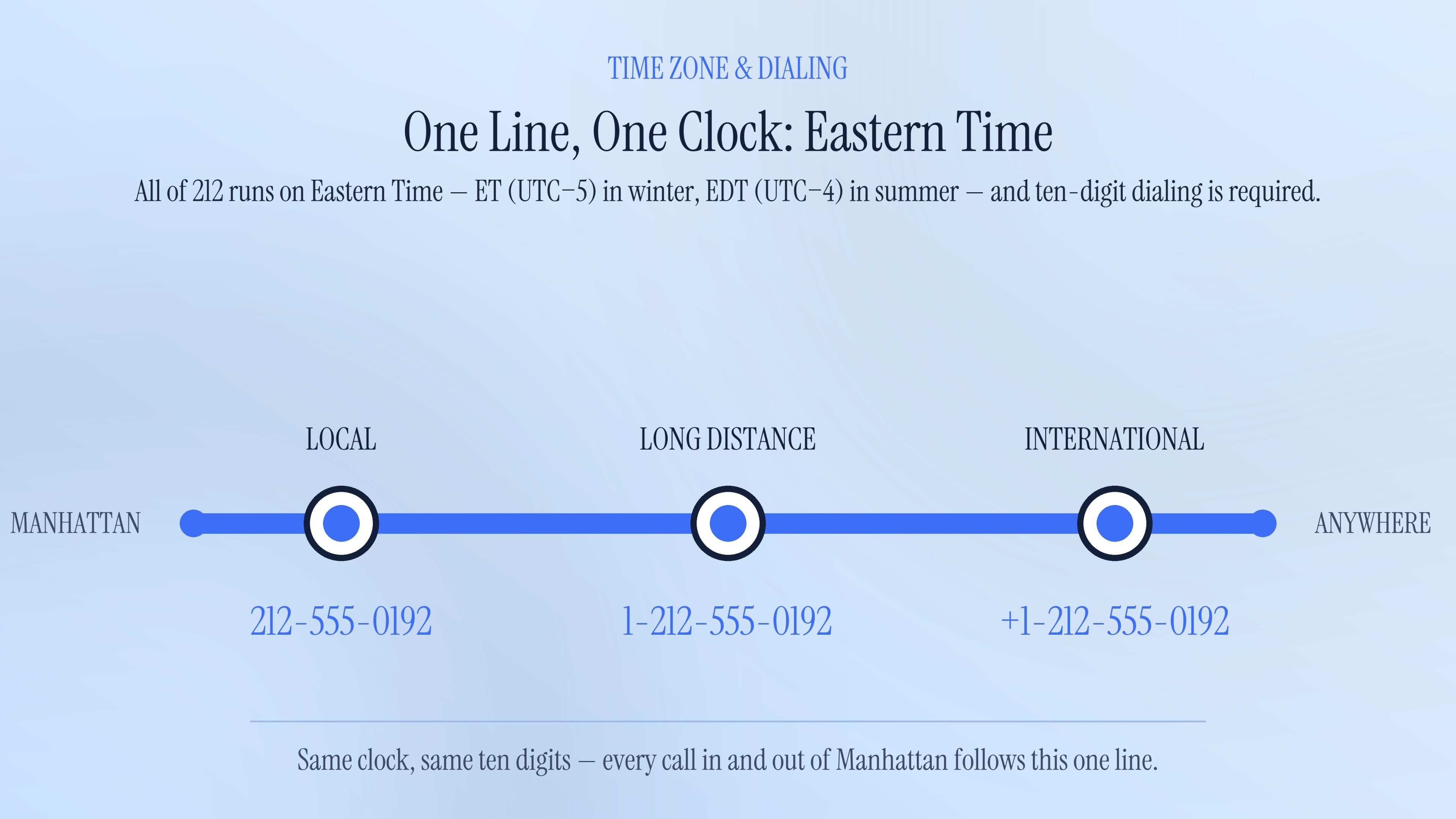
A single time zone across the borough keeps business hours simple: a Manhattan office, a Wall Street trading desk, and a SoHo retailer all open and close on the same clock, with no internal zone confusion to plan around.
From Five Boroughs to One: The 718, 646, 332, and 917 Story
New York City's numbering history is one of the most eventful in the country. On February 1, 1984, the New York Public Service Commission approved a second area code to relieve the strain of explosive growth on the original 212 territory. The new 718 area code launched September 1, 1984, taking over Brooklyn, Queens, and Staten Island, while Manhattan and the Bronx kept 212 — permissive dialing between the two codes ended January 1, 1985.
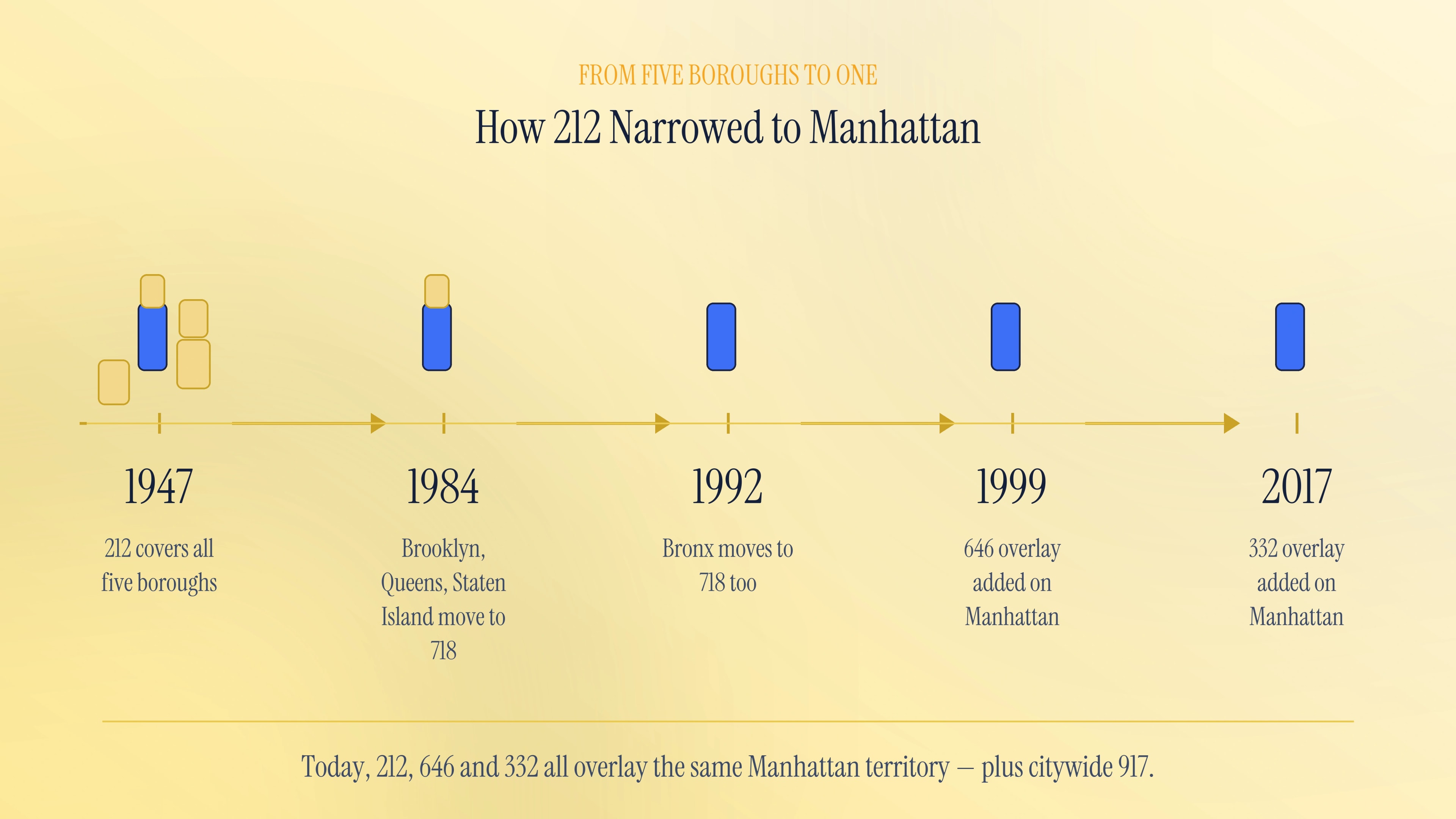
The Bronx followed on July 1, 1992, moving to 718 as well, with mandatory dialing taking effect May 16, 1993 — leaving 212 to serve Manhattan alone for the first time since 1947. That same year, New York introduced 917 as an overlay originally aimed at mobile phones and pagers before it grew into a citywide overlay reaching every borough. As Manhattan numbers ran short, 646 was added as a second Manhattan-only overlay on July 1, 1999, followed by a third, 332, on June 10, 2017. Because four codes now share the same Manhattan territory, ten-digit dialing (area code plus number) has been required for every local call since the 646 overlay activated in 1999.
Benefits of a 212 Number for Business
A 212 number carries a level of brand recognition few area codes can match. Here is what it does for a business:
- Outranks its own overlays — 212 predates 646 (1999), 332 (2017), and 917, so holding one means claiming Manhattan's original identity first.
- Trades on Wall Street and Broadway proximity — decades tied to the Financial District and Times Square give 212 more weight than a same-function 646 or 332 line.
- Covers the single densest numbering area in the country — one borough, New York County, packs in more business calls than almost anywhere else.
- Skips the office lease entirely — cloud routing lets a team based anywhere answer as though seated in Midtown, just like the citywide 917 overlay.
- Signals arrival before the crunch — as the scarcest of Manhattan's four overlay codes, holding a 212 number shows you claimed your spot early.
Put Manhattan's original number on your business
Acepeak activates local 212 numbers with call routing, IVR, and analytics built in — no New York office required.
How to Get a 212 Phone Number
Because 212 numbers are the scarcest in Manhattan's overlay complex, picking one up takes a bit more effort than a typical local number — but the process itself is still fast:
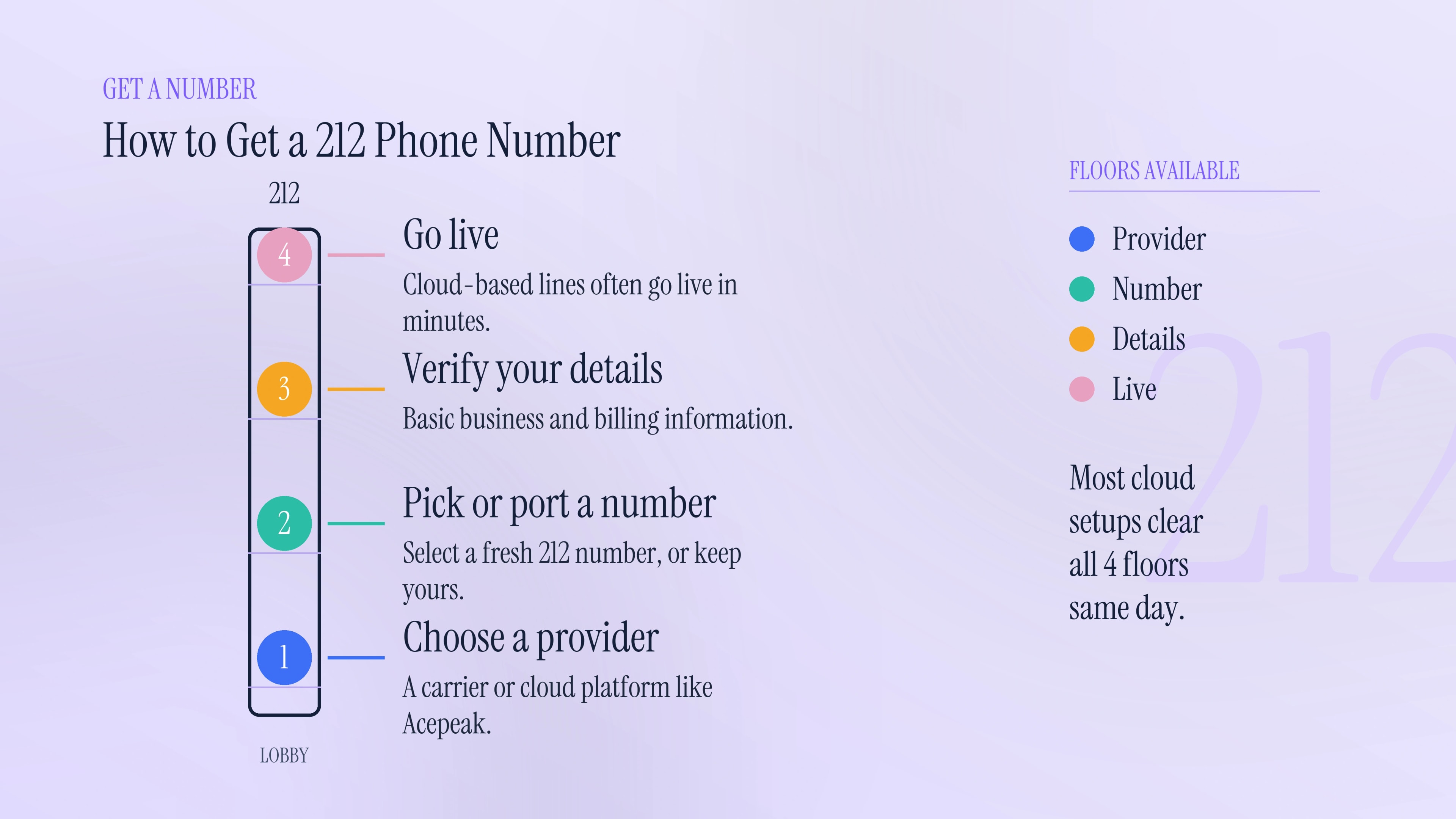
- Choose a provider that tracks the full overlay complex — a platform like Acepeak that monitors 212, 646, 332, and 917 together gives the best shot at catching a 212 number.
- Pick or port, with a fallback ready — request an available 212 number or port one you already use; be ready to accept a 646 or 332 line if 212 stock is tight.
- Verify business and billing details — providers collect standard account information before activating a New York County number.
- Go live the same day — cloud-based Manhattan lines typically start routing calls within minutes of verification, no presence on the island required.
Because 212, 646, 332, and 917 all dial identically with ten digits, a business loses no functionality by accepting any of the four — the difference is purely the number's appearance on caller ID.
Spotting and Avoiding 212 Scam Calls
A trusted code cuts both ways: scammers spoof 212 numbers precisely because people are more likely to answer a recognizable Manhattan prefix. A familiar area code on caller ID is not proof of a familiar caller.
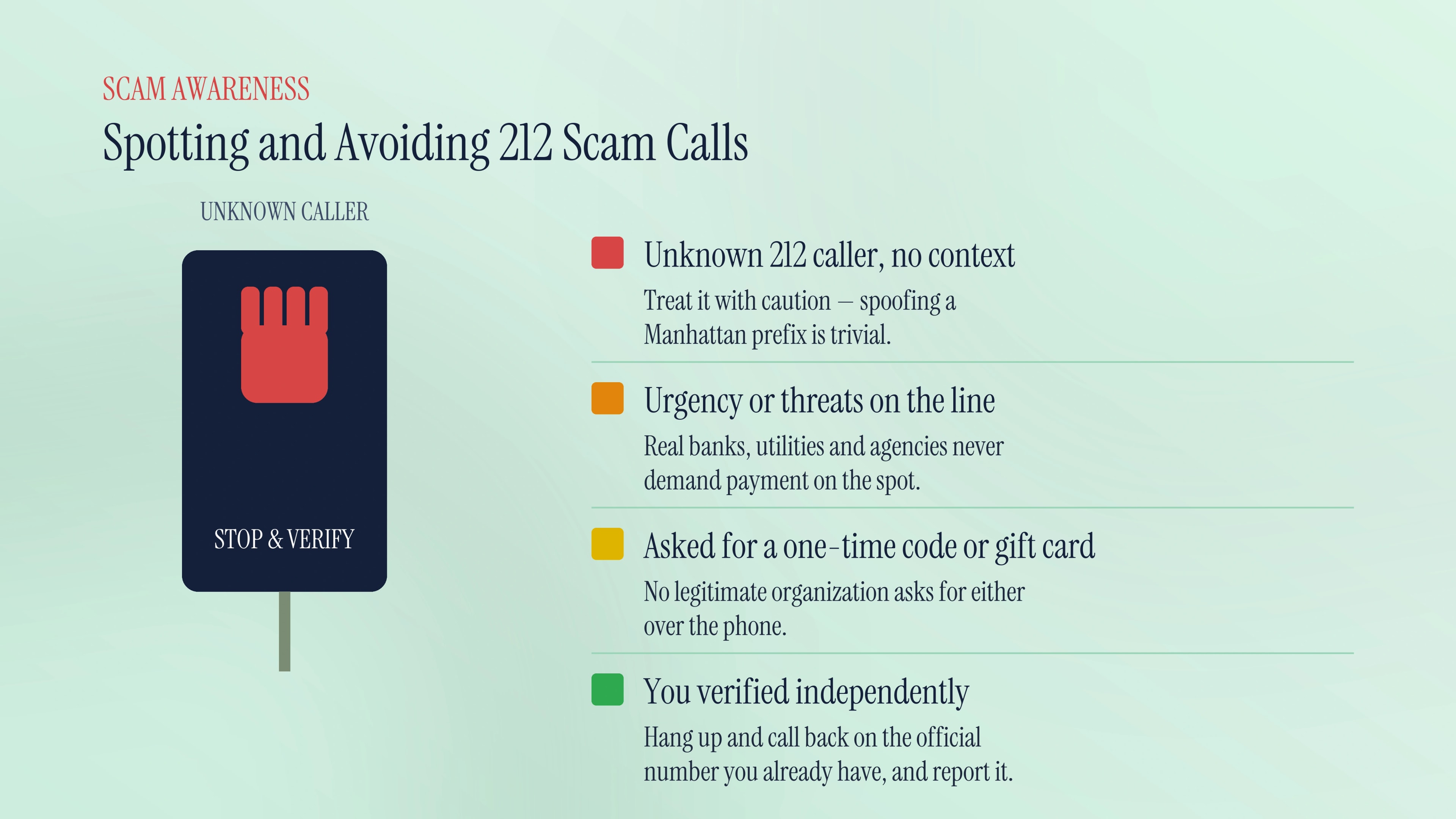
- Treat unknown 212 numbers like unknown callers — a Manhattan prefix is trivially easy to fake, so let strangers roll to voicemail.
- Watch for urgency and threats — real banks, utilities, and government agencies never demand payment on the spot.
- Never read out one-time codes or buy gift cards on request — no legitimate organization asks for either over the phone.
- Verify independently — hang up and call back on the official number printed on your card, bill, or the company's website.
- Report repeat offenders — file spoofing and robocall complaints so enforcement teams can trace the campaigns behind them.
Honest Manhattan callers face the reverse risk. A Midtown office or Wall Street desk that registers its 212 lines with caller-ID authentication, and places outbound calls from one steady set of numbers, gives carriers much less reason to label those calls as spam.
The Future of the 212 Area Code
With three Manhattan-specific codes now in rotation alongside citywide 917, regulators expect the overlay complex to comfortably supply the borough with new numbers for years to come — the kind of numbering relief the New York Attorney General's office also references when it reminds residents to stay alert for scam calls that ride along on trusted local codes as demand for them grows.
Manhattan itself keeps growing into its numbers. New residential towers, a steady return of office workers, and a constant churn of new small businesses all draw on the same shared pool of 212, 646, 332, and 917 lines — with 212 remaining the borough's most requested and most recognizable of the four.
Still the Code People Think of First for Manhattan
The 212 area code is Manhattan's original telephone identity, carried over from a time when one code covered the entire city of New York. Nearly 80 years, two splits, and three overlays later, it still belongs to the same island — now shared with 646, 332, and 917, but still the code most people think of first.
For businesses, that recognition is available on demand. A 212 number signals an established Manhattan presence in the country's biggest market — and with cloud telephony, it can ring a desk anywhere in the world.
Ready to sound like Manhattan?
Get a 212 number with enterprise-grade routing, IVR, and analytics — live in minutes with Acepeak.
If you route calls into the 212 area code at carrier volume, Acepeak publishes its wholesale voice termination rates per destination, with free test credits and no contract.
Questions, answered.
Manhattan, New York — formally New York County. It once covered all five NYC boroughs but has served Manhattan alone since the Bronx moved to 718 in 1992.
In 1947, as one of the original 86 North American area codes. It originally covered all five boroughs of New York City before Brooklyn, Queens, and Staten Island split off to 718 in 1984, followed by the Bronx in 1992.
They are an overlay complex that all share the same Manhattan territory. 212 is the original code, 646 was added in 1999, 332 in 2017, and 917 overlays the entire city. None indicates a different location within Manhattan or a different carrier.
Yes. Ten-digit dialing (area code plus the seven-digit number) has been required for every Manhattan call since the 646 overlay activated on July 1, 1999.
Available, but limited — 212 is the scarcest of Manhattan's four overlay codes. Providers can still supply 212 numbers as they open up, and will often offer 646, 332, or 917 as an alternative with identical functionality.
Yes. Cloud phone providers such as Acepeak can activate a 212 number and route it to phones anywhere in the world, so your team answers with a Manhattan presence whether they sit in the borough or overseas.
Signing up for a 212 area code number takes minutes with a cloud phone provider — no local office in New York required. Pick the number, connect it to your existing phone or app, and calls route in immediately. This keeps the 212 area code presence you already have while adding the local credibility New York customers respond to.