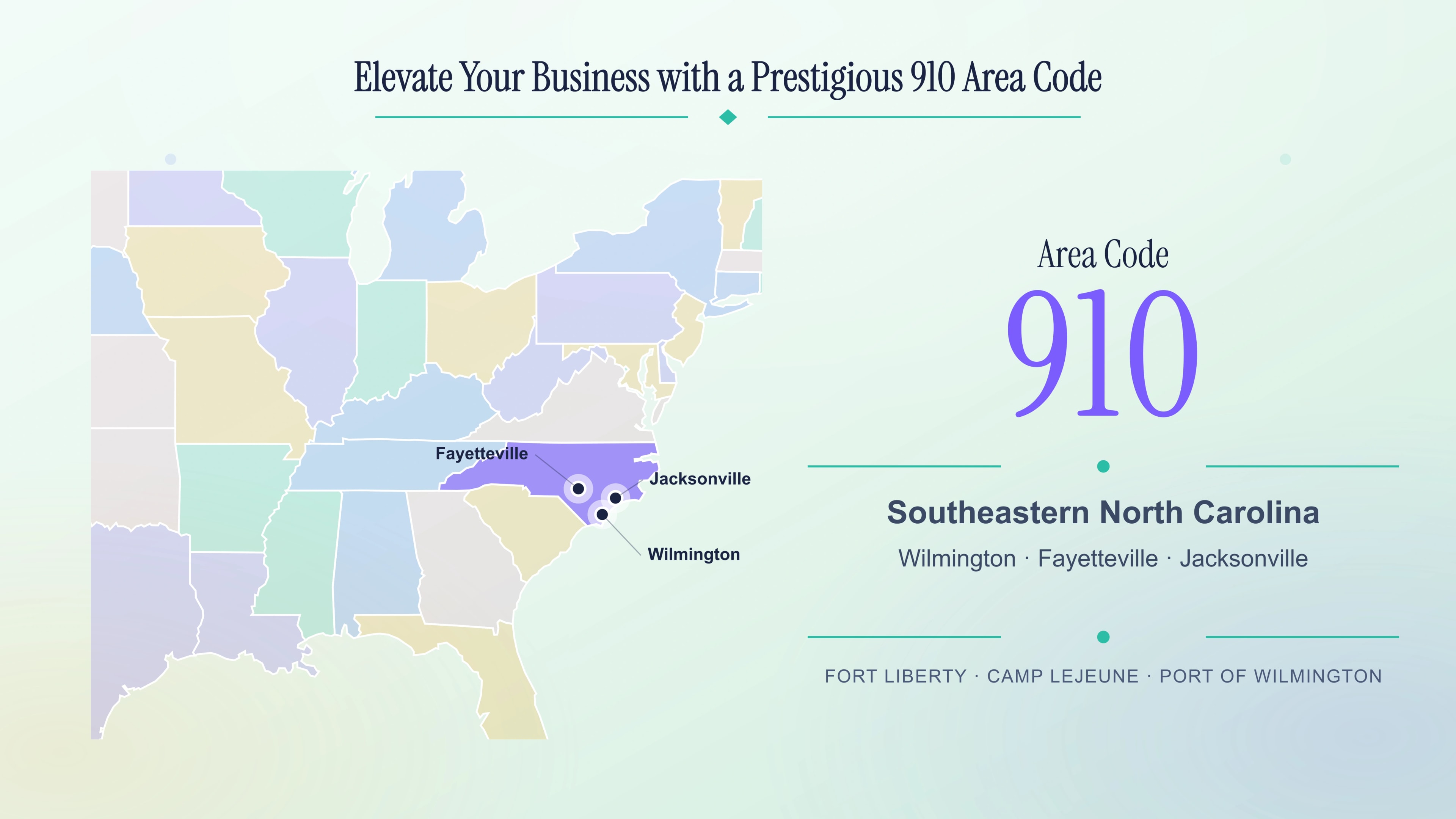
Sandhills, Military Bases and the Cape Fear Coast
The 910 area code has shaped southeastern North Carolina since 1993. It was split from 704 to serve the southern part of the state. It runs across 15 counties, from the Sandhills resorts out to the Atlantic shore. Inside that span sit two of the largest US military bases, a busy coastal tourism trade, and several of North Carolina's most commercial cities. For a business, a 910 number reads as local right across that range.
Key Takeaways
- Created in 1993, split from the 704 area code to serve southeastern North Carolina.
- Covers 15 counties, among them Cumberland, Onslow, New Hanover, Brunswick and Robeson, and more than 90 towns.
- Main cities are Wilmington, Fayetteville, Jacksonville, Lumberton, Rockingham and Pinehurst.
- Military — home to Fort Liberty (formerly Fort Bragg) and Marine Corps Base Camp Lejeune, two of the biggest US bases.
- Time zone is Eastern: EST (UTC−5), or EDT (UTC−4) in summer.
- No overlay — 910 is the only code on its ground, so seven digits still work for a local call.
What Is the 910 Area Code?
It is a numbering area for southeastern North Carolina under the North American Numbering Plan. When the plan started in 1947, the whole state ran on one code. The population grew, and the state was carved up step by step. In 1993 the 704 code was split, and the southeastern counties became 910.
The code spans a wide band. It starts in the Sandhills Piedmont in the north-west, crosses the Coastal Plain, and ends at the Cape Fear Coast and the Brunswick County barrier islands. Unlike most busy metro codes, it has no overlay, so it is still the only code on its ground. That keeps its local recognition strong. It sits well clear of the 336 area code, which covers Greensboro and Winston-Salem in the centre of the state, so each has its own patch.
Coverage and Cities
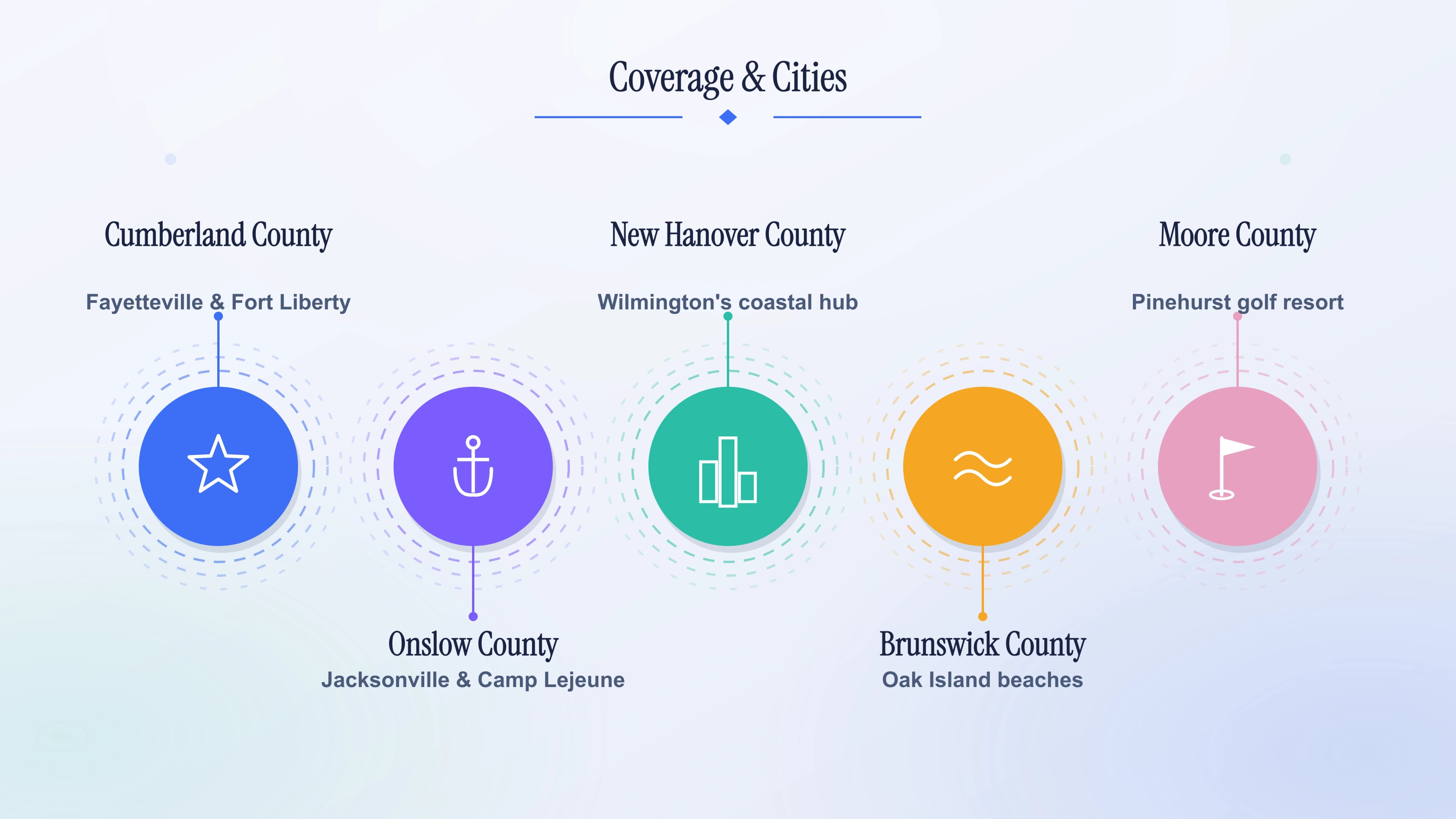
The code covers 15 counties. That takes in inland Piedmont towns, the zones around the military bases, the Sandhills resort belt, and a long stretch of the Atlantic coast.
- Cumberland County — Fayetteville, the largest city in the region, and home to Fort Liberty, one of the US Army's biggest bases.
- Onslow County — Jacksonville, built around Marine Corps Base Camp Lejeune and Marine Corps Air Station New River.
- New Hanover County — Wilmington, the commercial hub, plus Wrightsville Beach, Carolina Beach and Kure Beach on the coast.
- Brunswick County — Leland, Southport, Oak Island, Ocean Isle Beach, Sunset Beach and Calabash.
- Moore County — Pinehurst, Southern Pines and Aberdeen, home to the Pinehurst golf resort.
- Robeson County — Lumberton, Pembroke and Red Springs, a services and transport hub for the southern Coastal Plain.
Ten more counties fall inside it: Bladen, Columbus, Duplin, Harnett, Hoke, Montgomery, Pender, Richmond, Sampson and Scotland. All told the code serves over 90 towns. They range from Atlantic resorts to farming centres inland, and to the suburbs that have grown up beside the bases.
What Makes the 910 Area Code So Special?
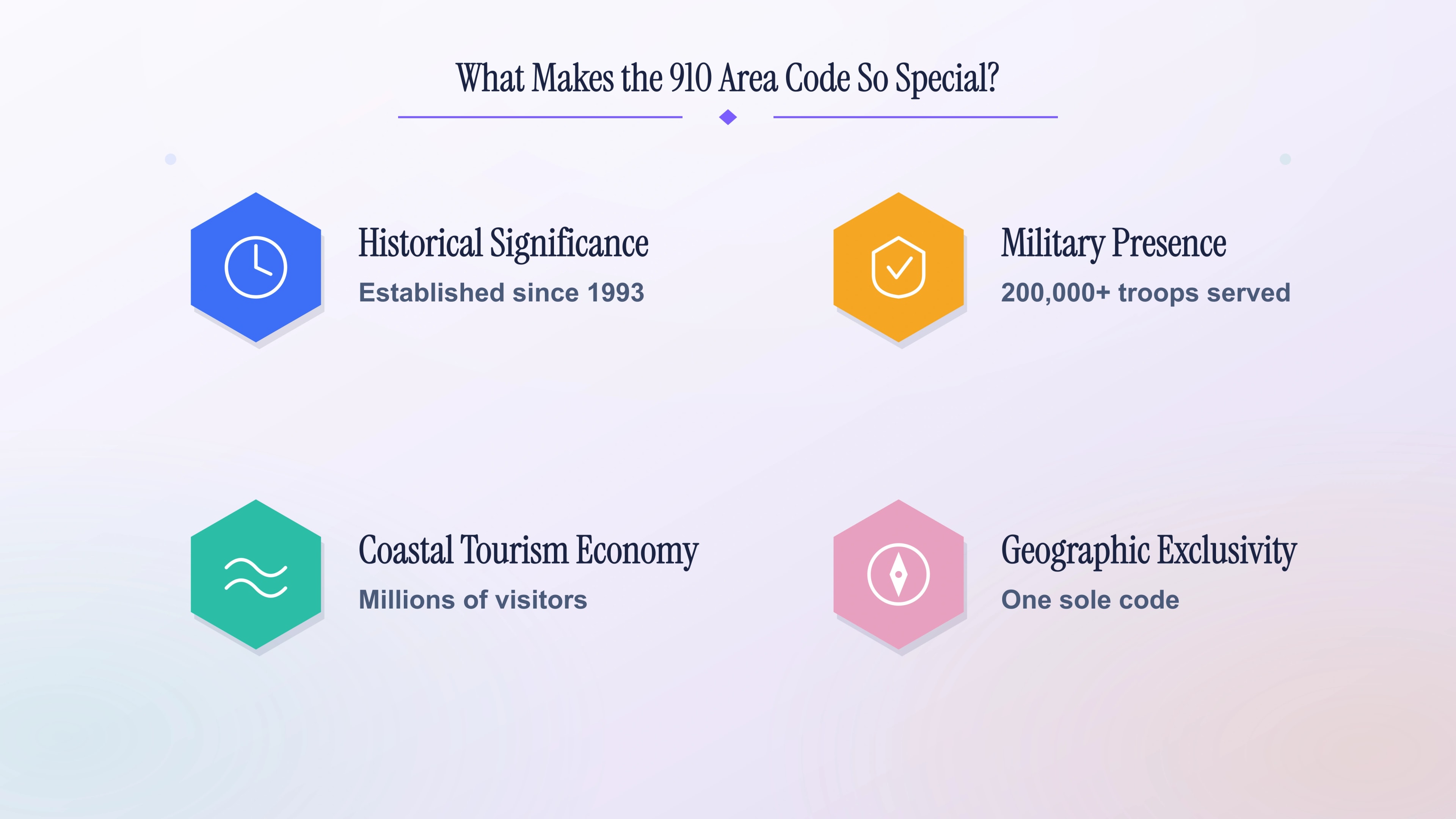
A few things set 910 apart from other codes in the Southeast.
- History. The code descends straight from North Carolina's original one. It has carried three decades of business growth. A firm holding a 910 number since 1993 reads as rooted in the region in a way newer codes cannot match.
- Military. No other code in the eastern US holds this many active bases. Fort Liberty and Camp Lejeune together support over 200,000 service members, civilian staff and families. Firms reaching past this corridor often add the 980 area code for Charlotte and the west of the state.
- Coast and tourism. Some of North Carolina's busiest beaches sit here. Wrightsville Beach, Oak Island and Ocean Isle Beach draw millions of visitors a year. Hotels, agents and shops lean on a local number to win trust from seasonal customers.
- Exclusivity. With no overlay, every local contact in the region carries a 910 number. That makes the code a cleaner geographic marker than any shared or overlaid one.
How a 910 Number Can Benefit Your Business
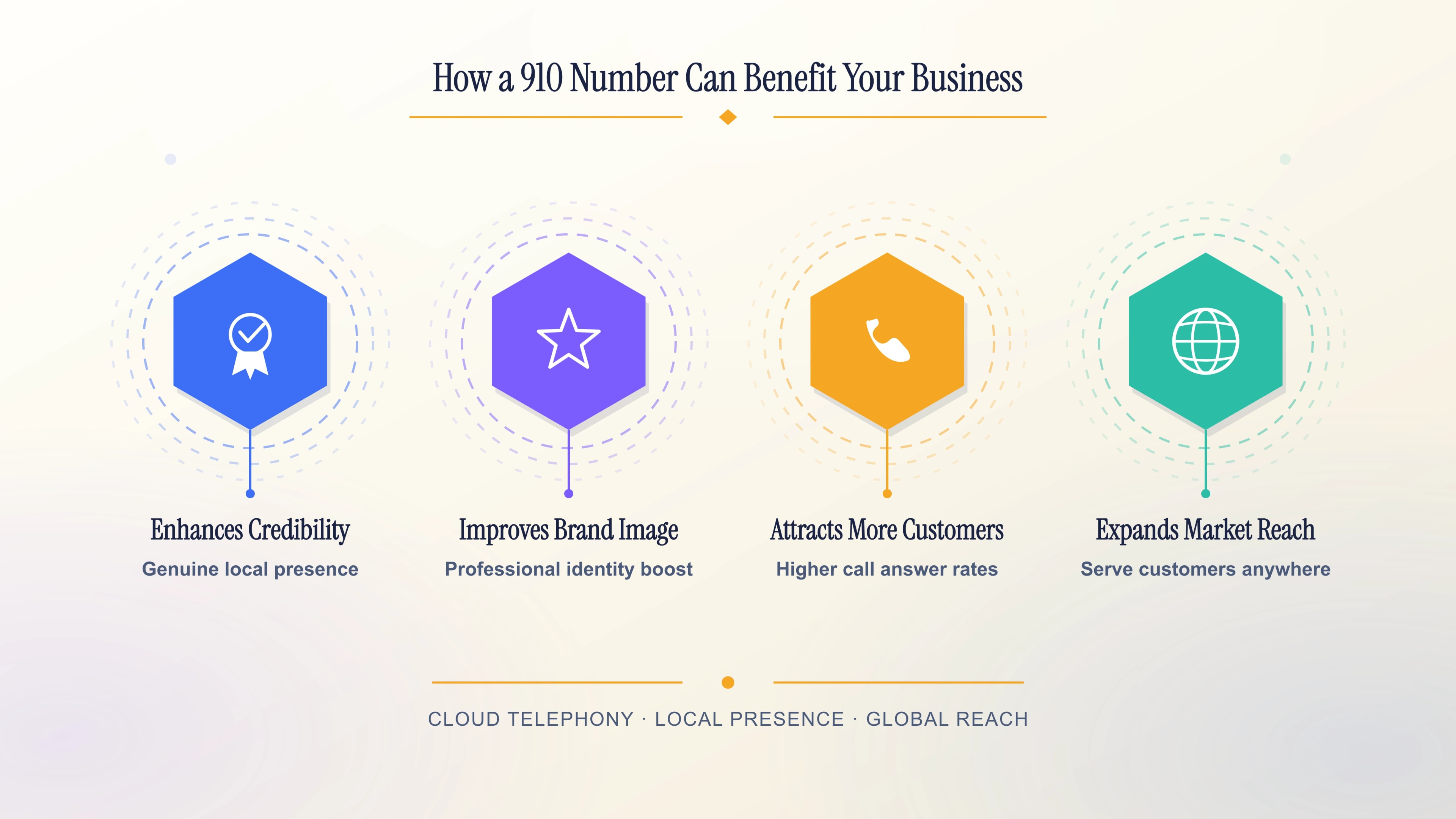
A local number pays off for any firm working in southeastern North Carolina, or selling into it.
- It reads as insider to two bases. A 910 number tells the 200,000-plus service members, civilian staff and families around Fort Liberty and Camp Lejeune you already operate in their world.
- It fits the region's split identity. One prefix works for a Wilmington hotel courting beach tourists and a Fayetteville firm serving the base economy alike.
- It still works in seven digits. With no overlay, local calls can be dialed the old way, reinforcing just how established the prefix is.
- It reaches fifteen counties from one line. Cloud routing lets one 910 number serve Pinehurst, Robeson County and coastal Brunswick County alike.
Establish your business in southeastern North Carolina
Activate a local 910 number through Acepeak and connect with customers across the region from anywhere in the world.
Strategies for Acquiring a 910 Area Code
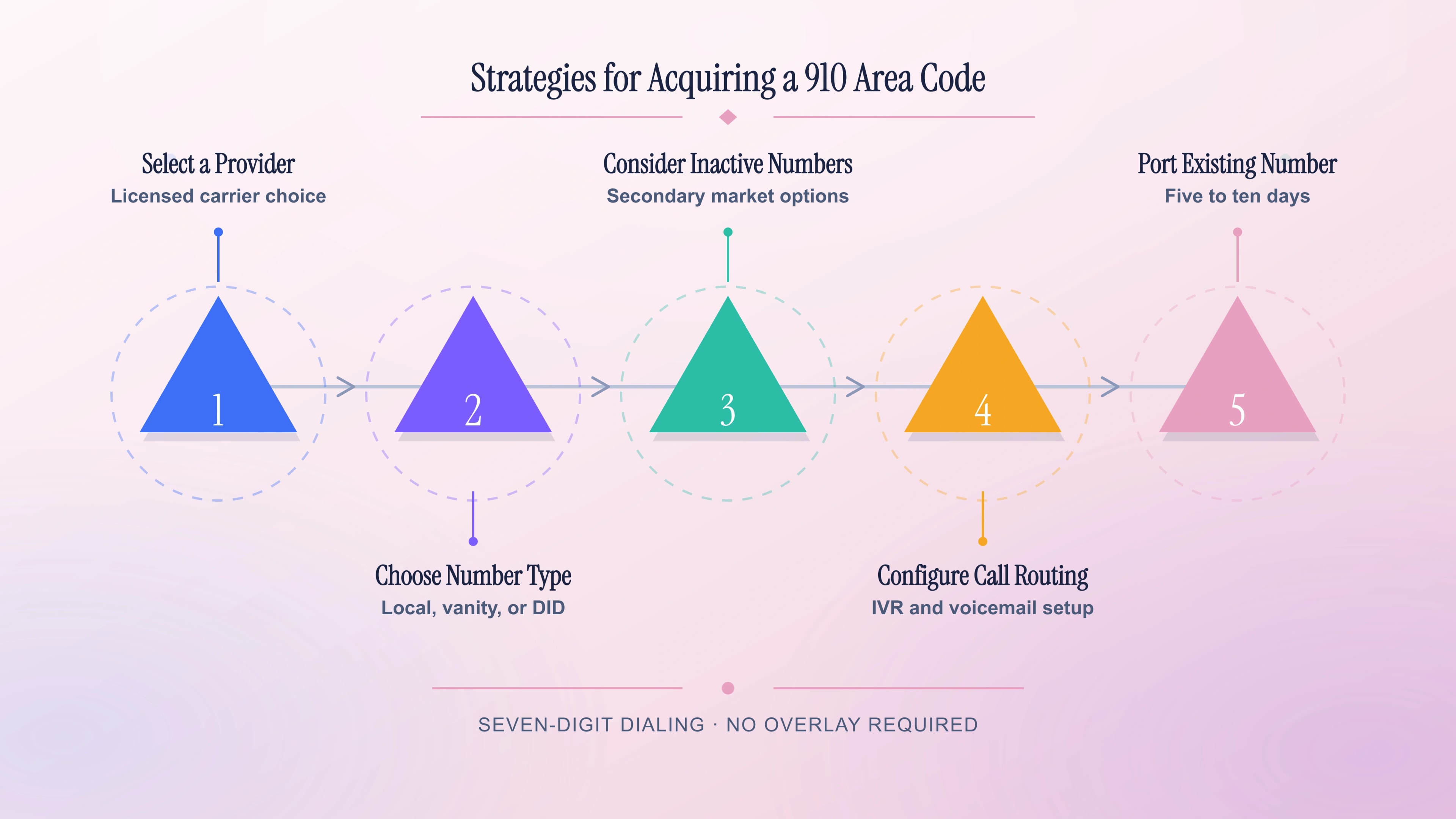
Any licensed carrier or cloud phone provider can issue one. Busy markets such as Wilmington and Fayetteville — where the City of Fayetteville anchors the Fort Liberty economy — run short on specific patterns, so move early if you want one.
- Pick a provider cleared for the Cape Fear region. Confirm the carrier or cloud platform is registered with NANPA to issue numbers across the full 910 territory, not just a generic North Carolina block.
- Match the number type to your customer base. A vanity line like 910-XXX-HOME suits a Fayetteville real estate firm, while a DID setup fits a Wilmington business fielding both coastal and inland calls.
- Check retired Wilmington or Fayetteville patterns. Numbers once held by closed businesses in the region's two largest cities occasionally resurface through brokers at prices tied to the pattern.
- Stay flexible across all 15 counties. A number from a Robeson or Moore County exchange reads just as authentically 910 as one tied directly to Cumberland County.
- Build routing around the base and tourist calendars. Set forwarding and time-of-day rules that account for both the steady military schedule and the seasonal swings of coastal tourism.
- Or port the number you have. Send a letter of authorisation to start. Portability is a federal right, so it usually takes five to ten business days, and carriers cannot block or stall a valid request.
Credibility With Military Families and Beach Visitors Alike
The 910 code covers one of the most varied regions in the Southeast. It runs from the military towns of Fayetteville and Jacksonville to the coastal trade of Wilmington and the golf corridor at Pinehurst. Few codes in the country stretch across that much difference.
For a firm working there, a local number buys immediate credibility with military families, coastal visitors, farming towns and city professionals alike. Cloud provisioning means any business can hold one, wire it into how the team already works, and build a local presence without an office in the region.
Claim your 910 number today
Talk to Acepeak about available numbers across Cumberland, New Hanover, Onslow, and Brunswick counties and establish your presence in this strategically vital market.
Questions, answered.
It serves more than 90 towns across 15 counties in southeastern North Carolina. The main ones are Wilmington, Fayetteville, Jacksonville, Lumberton, Rockingham, Pinehurst, Clinton, Whiteville, Laurinburg and Southport. On the coast it covers Wrightsville Beach, Kure Beach and Ocean Isle Beach.
No. As of 2026 it is still the only code on its ground. Local calls need seven digits, not ten, and the code keeps a clean geographic identity across all 15 counties.
Eastern Standard Time, or UTC−5. It shifts to Eastern Daylight Time, UTC−4, from the second Sunday in March to the first Sunday in November.
Yes. Cloud phone providers sell these numbers anywhere in the world. Calls still route through the local network, so the number reads as southeastern North Carolina no matter where your team sits.
In 1993. North Carolina had outgrown its 704 code, so the state split it. The southeastern counties became 910, while the west and centre kept 704.
The state runs several. 704 and 980 cover Charlotte and the west, 919 and 984 the Research Triangle, 336 Greensboro and Winston-Salem, and 252 the north-east coast. Only 910 covers the southeastern counties, and only 910 holds both major military bases and the Atlantic resort towns.
Signing up for a 910 area code number takes minutes with a cloud phone provider — no local office in Fayetteville required. Pick the number, connect it to your existing phone or app, and calls route in immediately. This keeps the 910 area code presence you already have while adding the local credibility North Carolina customers respond to.