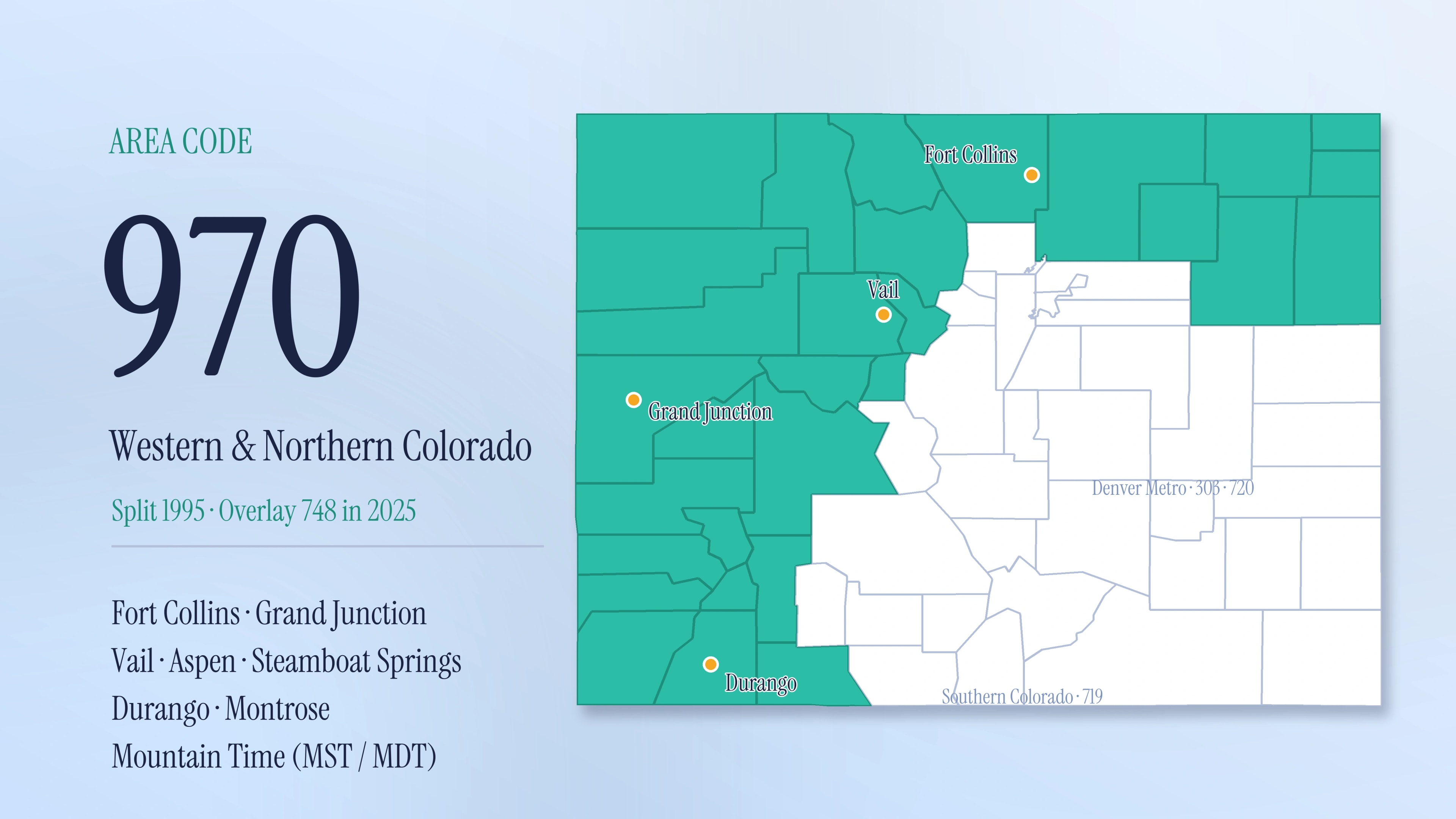
Fort Collins, Ski Resorts and the Red-Rock Western Slope
The 970 area code is the telephone identity of Colorado outside the Denver metro area — a single code stretched across the Rocky Mountains and the Western Slope, from the university town of Fort Collins to the ski resorts of Vail and Aspen, the red-rock canyons around Grand Junction, and the San Juan Mountains near Durango.
This guide covers what the 970 area code is, the cities and counties it reaches, how it split from 303 in 1995, why Colorado just added a second code to the region, and what it takes for a business to pick up a 970 number of its own.
Key Takeaways
- The 970 area code covers western and northern Colorado — Fort Collins, Greeley, Grand Junction, Vail, Aspen, Steamboat Springs, and Durango, spanning more of the state's land area than any other Colorado code.
- It was created on April 2, 1995, when Colorado's original 303 area code was split — Denver kept 303, and most of the rest of the state outside the 719 region became 970.
- On July 7, 2025, Colorado added 748 as an all-services overlay on top of 970, so every new line in the region can be assigned either code.
- Ten-digit dialing has been mandatory across 970 since October 24, 2021, ahead of the nationwide 988 crisis line.
- The entire 970 region runs on Mountain Time, and businesses anywhere can activate a local 970 number through a cloud phone provider in minutes.
Why Did Denver Keep 303 While the Rest of Colorado Moved?
The 970 area code is a North American Numbering Plan code covering western and northern Colorado. It is not tied to a single city the way many area codes are — instead it stretches across dozens of mountain, ranching, and river-valley communities, anchored by Fort Collins in the north and Grand Junction on the Western Slope. The code entered service on April 2, 1995.
Before 1995, Denver shared area code 303 with all of northern and western Colorado; only the southeast had already moved to 719, in 1988. Fast growth along the Front Range — the same pressure that later brought the 720 area code overlay to Denver in 1998 — forced regulators to divide the state. Denver and its immediate suburbs kept 303, while the rest of that territory, including every mountain resort town and the entire Western Slope, became the new 970.
Two-Thirds of Colorado's Land, a Fraction of Its People
The 970 region covers roughly two-thirds of Colorado by land area, though a much smaller share of its population. Major communities include:
- Fort Collins and Loveland — the northern Front Range, home to Colorado State University and a fast-growing tech and brewing economy
- Greeley — the seat of Weld County and a hub for agriculture and energy production on the eastern edge of the region
- Grand Junction — the largest city on the Western Slope, gateway to the Colorado National Monument and Palisade wine country
- Vail, Aspen, Breckenridge, and Steamboat Springs — the mountain resort towns that draw skiers and summer visitors from around the world
- Durango and Montrose — the southwestern gateway to Mesa Verde National Park and the San Juan Mountains
- Estes Park and Glenwood Springs — mountain gateway towns bordering Rocky Mountain National Park and the Colorado River canyon
Counties inside the 970 footprint include Larimer, Weld, Mesa, Garfield, Eagle, Summit, Routt, Pitkin, Delta, Montrose, La Plata, and Moffat, along with the smaller ranching counties of Colorado's eastern plains and northern mountains.
Time Zone — Mountain Standard and Daylight Time
The entire 970 territory runs on Mountain Time — UTC−7 in winter as Mountain Standard Time and UTC−6 in summer as Mountain Daylight Time. That keeps Fort Collins, Grand Junction, and every mountain town in the region on the same clock as Denver, one hour ahead of the West Coast and two hours behind the East Coast.
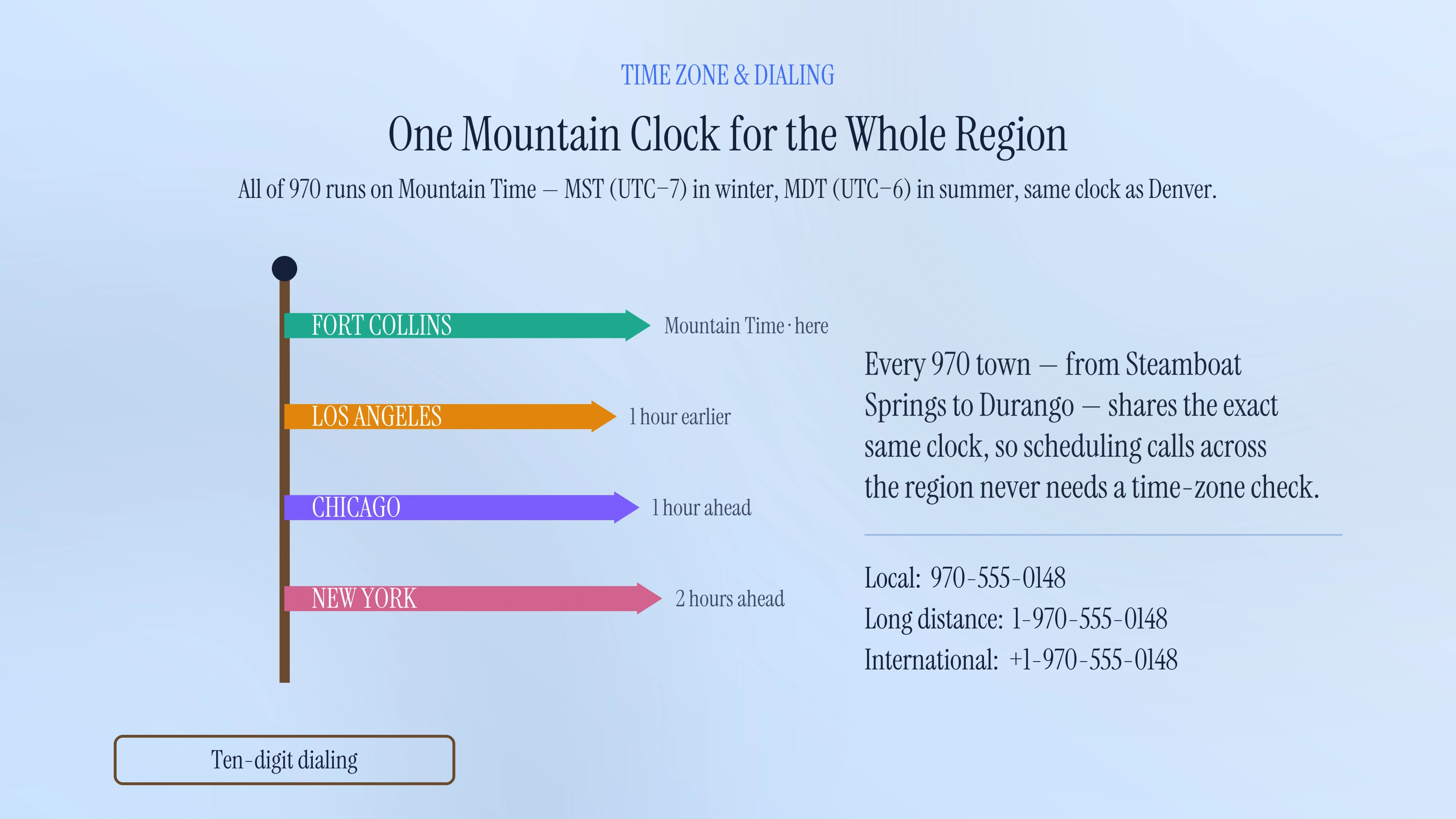
For businesses, a single time zone across such a large territory is a quiet advantage: one answering window covers Fort Collins ranchers, Vail ski shops, and Grand Junction wineries alike, with no internal zone confusion to manage.
The 970/748 Overlay: How Colorado Added a Second Code
By the early 2020s, regulators projected that 970 would run out of new number combinations by 2026 — the same kind of squeeze that has pushed ten-digit dialing and overlay codes across much of the country, including in places as different as Pennsylvania's 570 area code. Rather than split the territory again and force some towns to change their area code, the Colorado Public Utilities Commission approved an overlay on December 18, 2023.
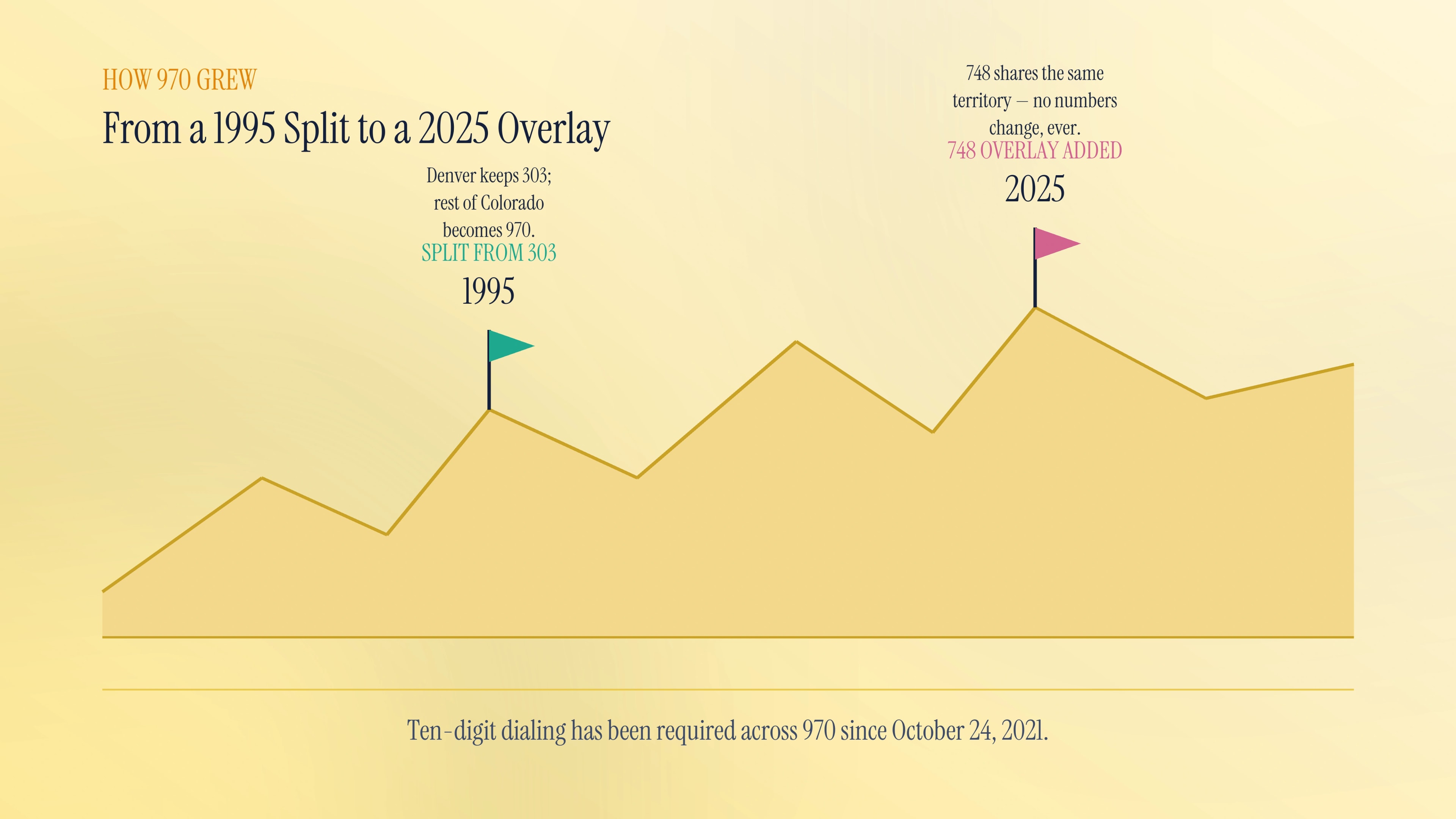
The new 748 code activated on July 7, 2025, as an all-services distributed overlay — meaning 748 shares the exact same geography as 970 rather than taking over part of it. Existing 970 numbers did not change; new lines requested from that date forward may simply be assigned a 748 number instead. Ten-digit dialing (area code plus number) was already required for every local call: 970 made that switch on October 24, 2021, ahead of the national 988 crisis line launch. NANPA projects the 748 overlay will supply the region with enough new numbers for roughly the next four decades.
Benefits of a 970 Number for Business
A 970 number gives a business instant local credibility across one of Colorado's largest and most varied markets. Here is what it does:
- Widest reach in the state — 970 covers roughly two-thirds of Colorado's land area, more than any other Colorado code, from Front Range farmland to the Western Slope.
- A built-in ski and national-park market — millions of annual visitors to Vail, Aspen, Steamboat, and Mesa Verde already expect a 970 number from the businesses that serve them.
- College-town-to-canyon-country reach — one code covers Colorado State University's home in Fort Collins as easily as the wineries around Grand Junction.
- Decades of headroom — with the 748 overlay sharing the same territory since 2025, a 970 number claimed today is backed by a numbering supply projected to last roughly 38 more years.
- No office required — cloud telephony routes a 970 number to phones anywhere, so a remote team can answer like a local Fort Collins or Grand Junction storefront.
Put a Colorado mountain-region number on your business
Acepeak activates local 970 numbers with call routing, IVR, and analytics built in — no hardware, no local office required.
How to Get a 970 Phone Number
Picking up a 970 number takes minutes, not weeks. The process looks like this:
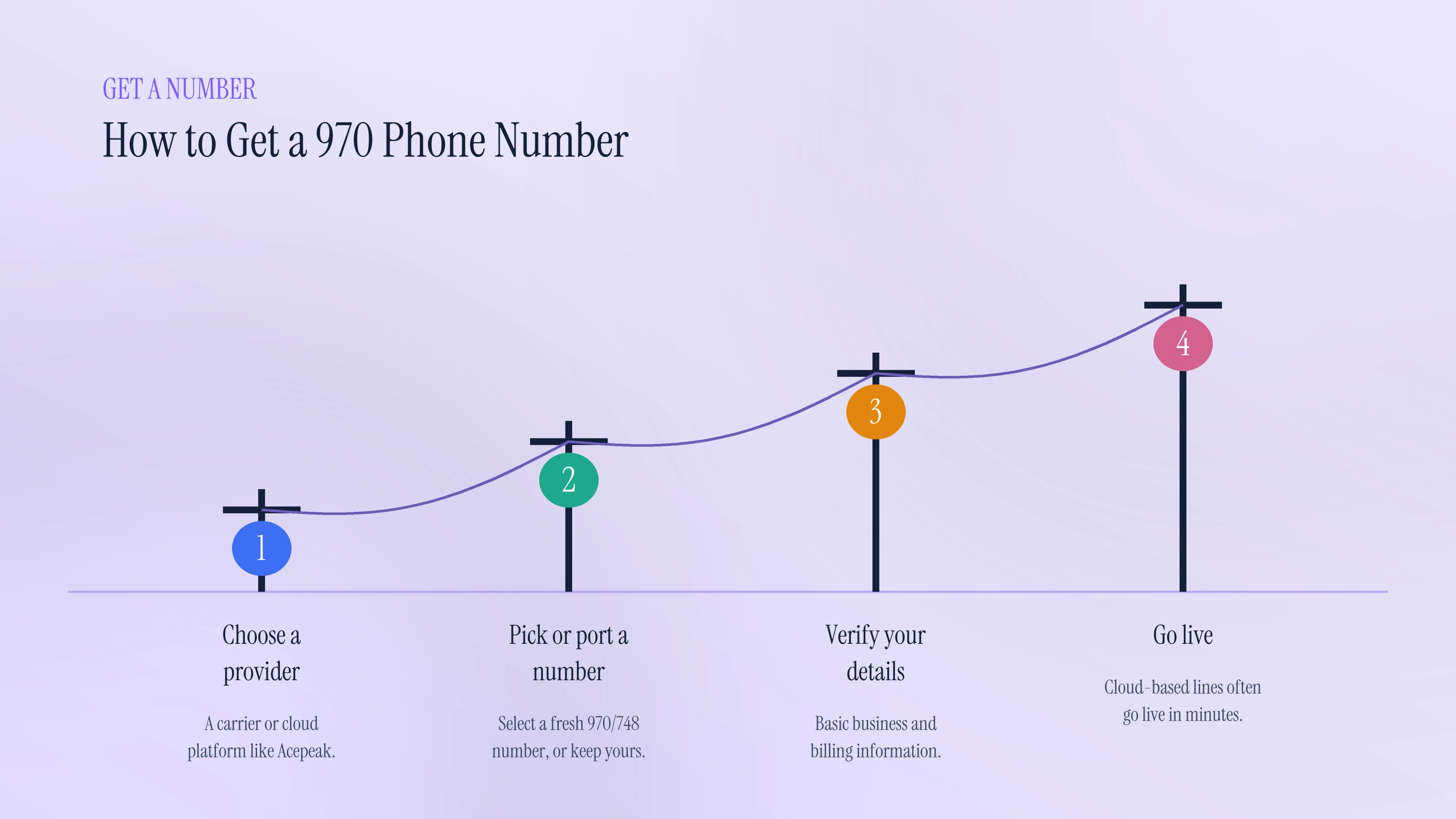
- Choose a provider — a traditional Colorado mountain-region carrier or a cloud phone platform like Acepeak.
- Pick or port a number — browse inventory spanning Fort Collins, Grand Junction, and the resort corridor, choosing between the original 970 code or the newer 748 overlay.
- Verify your details — providers collect basic business and billing information before activation.
- Go live — cloud-based 970 or 748 lines are typically routing calls the same day, often within minutes.
With the new 748 overlay adding fresh inventory, businesses now have more choice than ever when picking a number for the region — including options that were scarce in 970 alone.
Spotting and Avoiding 970 Scam Calls
Residents across the mountain region answer 970 calls readily, and that habit is why scammers imitate the code. Caller ID can display a Fort Collins or Grand Junction number even when the call originates somewhere else entirely.
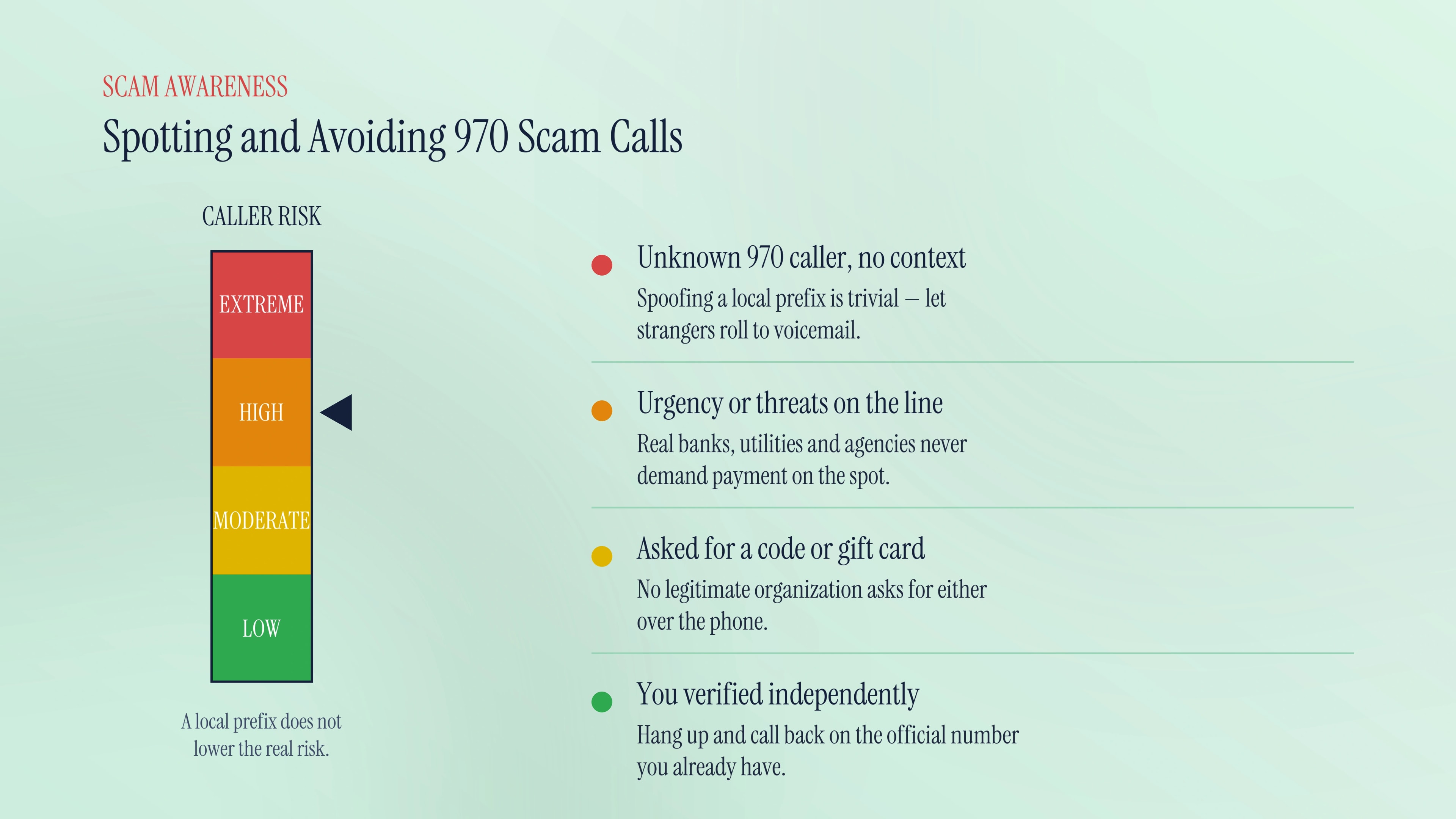
- Treat unknown 970 numbers like unknown callers — a local prefix is trivially easy to fake, so let strangers roll to voicemail.
- Watch for urgency and threats — real banks, utilities, and government agencies never demand payment on the spot.
- Never read out one-time codes or buy gift cards on request — no legitimate organization asks for either over the phone.
- Verify independently — hang up and call back on the official number printed on your card, bill, or the company's website.
- Report repeat offenders — file spoofing and robocall complaints so enforcement teams can trace the campaigns behind them.
Colorado businesses placing legitimate calls have their own reason to care. Vail ski shops and Grand Junction wineries that verify their 970 or 748 numbers through caller-ID authentication, and reach customers from the same lines every time, run a much smaller risk of carriers flagging them as spam.
A 38-Year Runway for New Mountain Region Numbers
The 748 overlay was built for the long haul — the Colorado Public Utilities Commission notes that pairing 970 with 748 is projected to supply roughly 38 years of new numbers, far longer than a simple geographic split would have lasted. That gives businesses and residents across the region a long runway before any further numbering changes are likely.
The region itself keeps growing into the code. Fort Collins and Loveland continue adding tech and biotech jobs, Grand Junction's wine and outdoor-recreation economy keeps expanding, and Colorado's mountain resort towns keep drawing year-round residents alongside their seasonal visitors. Every one of those new arrivals now answers on either 970 or 748.
A Mountain-Region Identity Available on Demand
The 970 area code is Colorado outside of Denver distilled into three digits: Fort Collins' college-town energy, Grand Junction's wine country, and the ski slopes of Vail, Aspen, Steamboat, and Breckenridge, all sharing one code since 1995 — and now a second one, 748, to carry the region into its next chapter.
For businesses, that shared identity is available on demand. A 970 number signals local presence across one of the country's most recognizable mountain and outdoor-recreation regions — and with cloud telephony, it can ring a desk anywhere in the world.
Ready to sound local across Colorado's mountain region?
Get a 970 number with enterprise-grade routing, IVR, and analytics — live in minutes with Acepeak.
Colorado also has the 719 area code, which serves Colorado Springs, Pueblo, and the southeastern part of the state.
Questions, answered.
Western and northern Colorado. The code covers Fort Collins, Greeley, Grand Junction, Vail, Aspen, Steamboat Springs, Durango, and Estes Park, spanning most of the state outside the Denver metro area.
April 2, 1995. It was split off from Colorado's original 303 area code after statewide growth exhausted the number supply. Denver and its immediate suburbs kept 303, while the rest of Colorado became 970.
No existing 970 number changes. On July 7, 2025, Colorado activated 748 as an all-services overlay on the 970 region — new lines requested from that date forward may be assigned either code, and everyone in the region now dials ten digits for local calls.
Mountain Time. The region observes Mountain Standard Time (UTC−7) in winter and Mountain Daylight Time (UTC−6) in summer, the same clock as Denver.
Yes. Ten-digit dialing (area code plus the seven-digit number) has been mandatory across the 970 region since October 24, 2021, ahead of the nationwide 988 crisis line, and remains required now that 748 shares the same territory.
Yes. Cloud phone providers such as Acepeak can activate a 970 number and route it to phones anywhere in the world. Your team answers with a local Colorado presence whether they sit in the state or overseas.
Signing up for a 970 area code number takes minutes with a cloud phone provider — no local office in Fort Collins required. Pick the number, connect it to your existing phone or app, and calls route in immediately. This keeps the 970 area code presence you already have while adding the local credibility Colorado customers respond to.