Choosing a Huntsville Number Is a Branding Decision
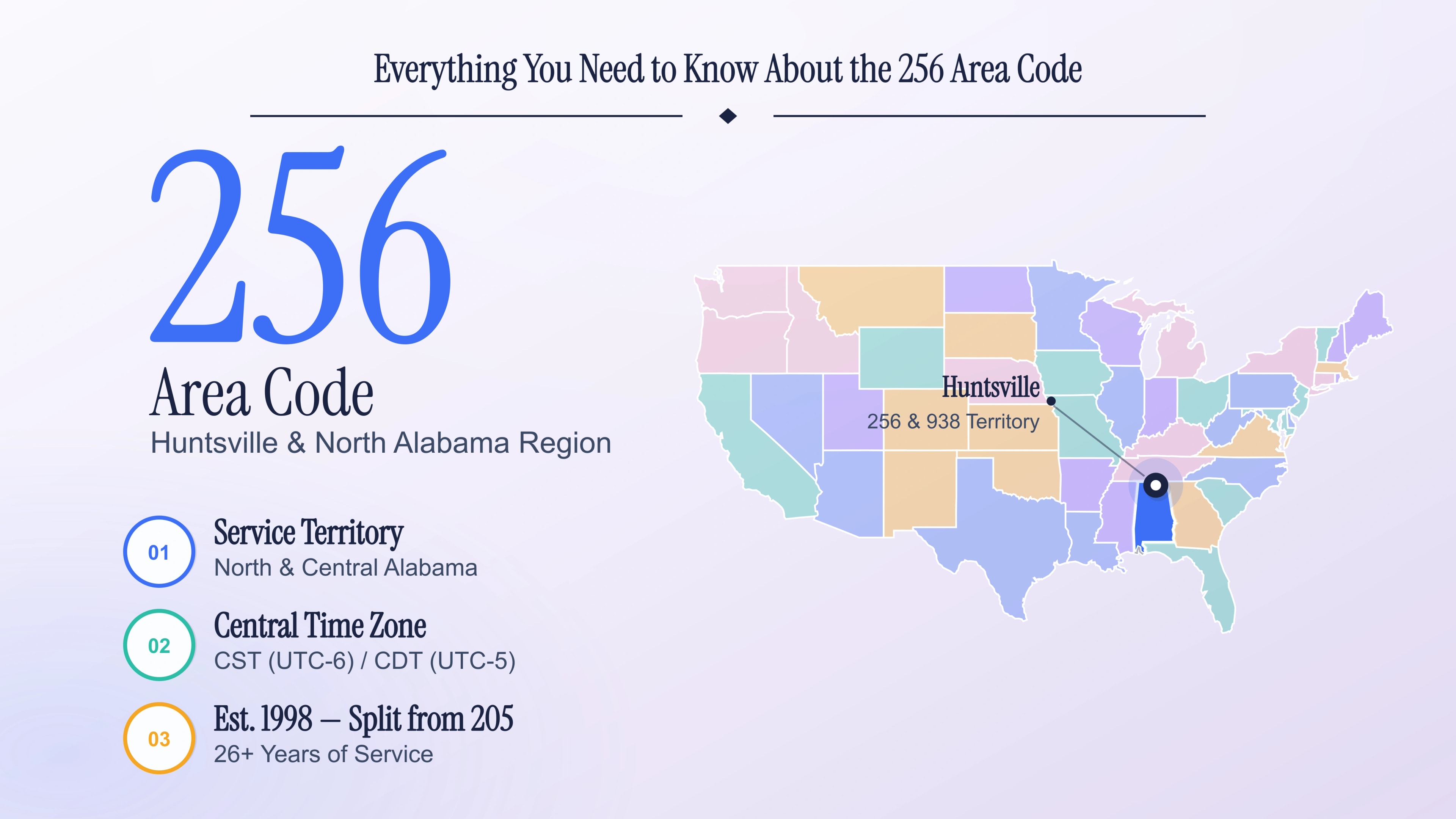
North Alabama's telephone prefix has represented Huntsville and the surrounding region since 1998. It remains one of the most requested three-digit codes in the state. The reason is simple: the area has a strong aerospace and technology reputation. A business choosing between a local number and an out-of-state one is making a branding decision. That choice shapes how customers see the business before the call is even answered. This guide covers what the code represents today, where it reaches, what it costs, and how a business puts one to work.
Key Takeaways
- Origin — the 256 area code went into service on March 23, 1998, created by splitting off the northern half of the 205 territory.
- Coverage — northern and central Alabama anchored by Huntsville, including Decatur, Madison, Gadsden, Florence, Cullman, and dozens of surrounding communities across more than 20 counties.
- Overlay partner — the 938 code was added in 2010 so both prefixes now share the same territory.
- Time zone — Central Time (CST, UTC−6 / CDT, UTC−5).
- Typical cost — a standard local number runs from a few dollars a month with a cloud provider up to several hundred dollars for a premium vanity pattern.
The Value of a Huntsville-Area Prefix
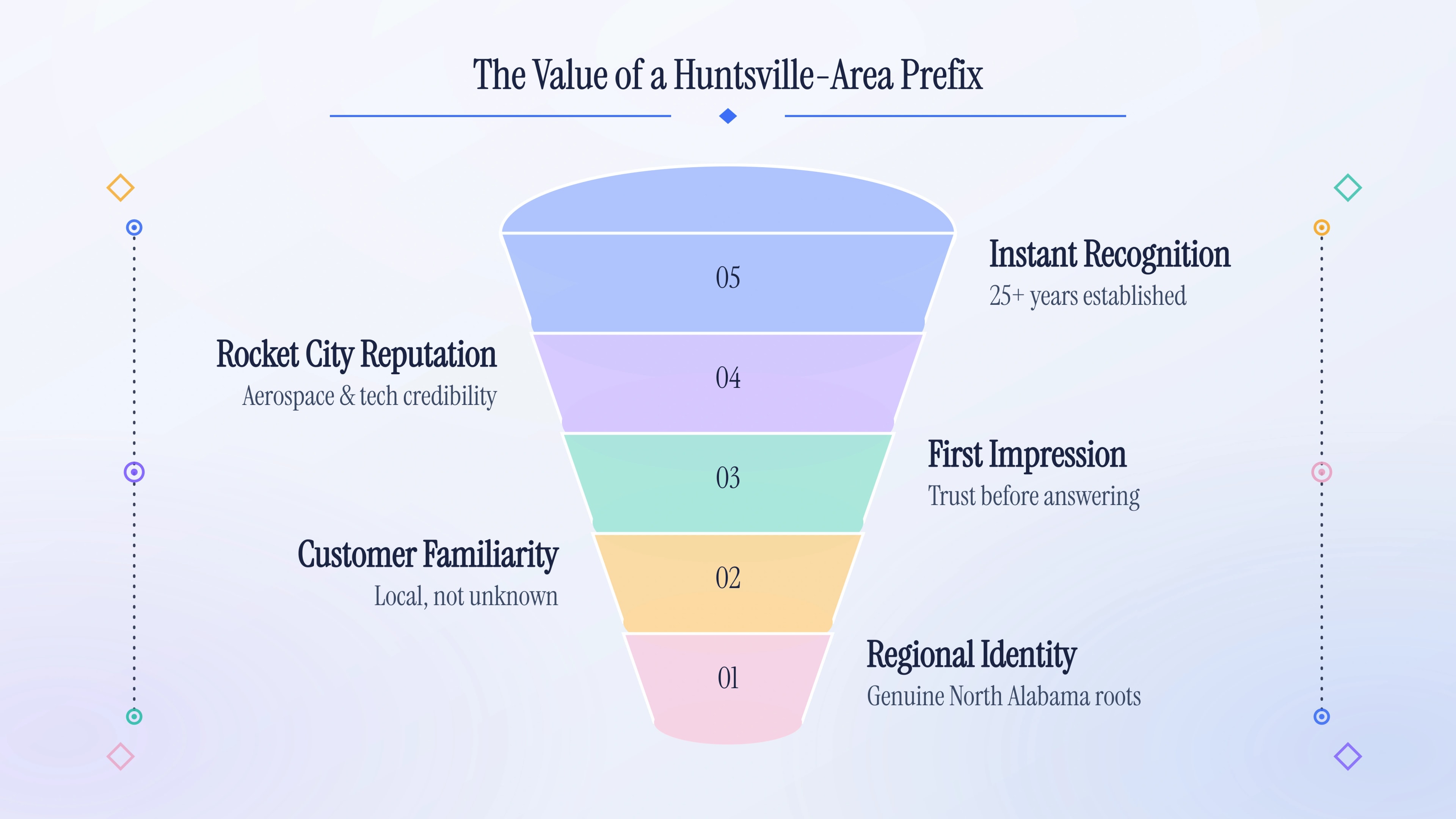
A local prefix does more than route calls. It is often the first signal a customer reads about where a business is based. North Alabama's designation has represented the region for over 25 years. It carries strong recognition tied to Huntsville's identity as "Rocket City," home to major aerospace, defense, and advanced-manufacturing employers. Companies courting customers in Huntsville, Decatur, or Florence can shape a first impression before a single word is spoken. All it takes is listing a familiar area code alongside an out-of-state one.
Was 256 Ever One of Alabama's Original Codes?
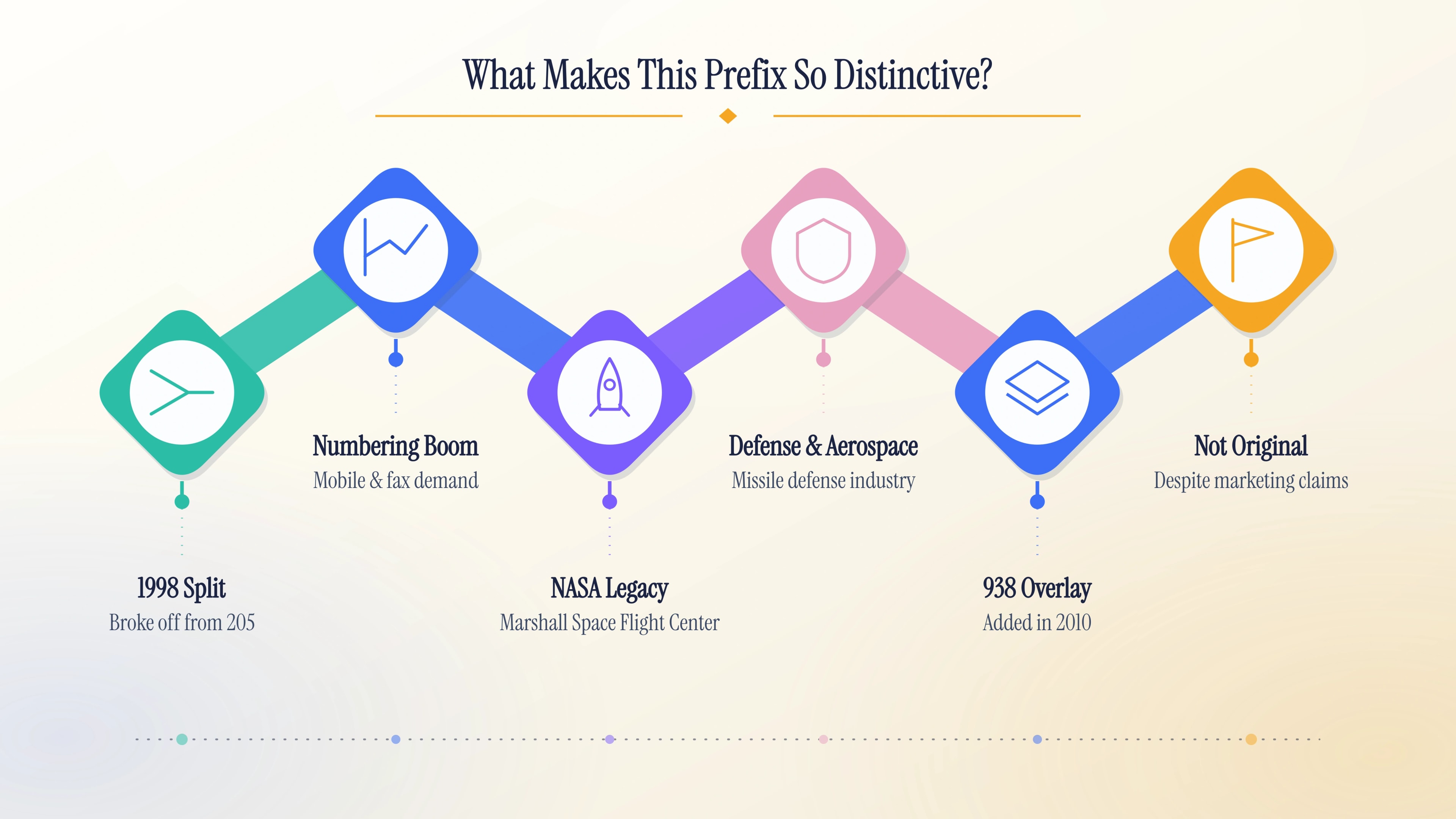
The code was created on March 23, 1998. Before that, the original 205 area code covered the entire northern half of Alabama. Regulators split it, and the newly formed 256 took over the northern and central portion of the state on its own. That split reflected a simple problem: telephone demand grew fast in the 1990s. Mobile service, fax lines, and dial-up internet all needed more numbers. Some marketing claims 256 was one of the state's original codes, but that is not true — it is a split-off territory. That distinction matters less to callers than something else: Huntsville's decades-long run as a hub for NASA, missile defense, and private aerospace firms. That history gives the prefix a reputation for technical credibility a newer code cannot match.
Twenty-Plus Counties Sharing Territory With the 938 Overlay
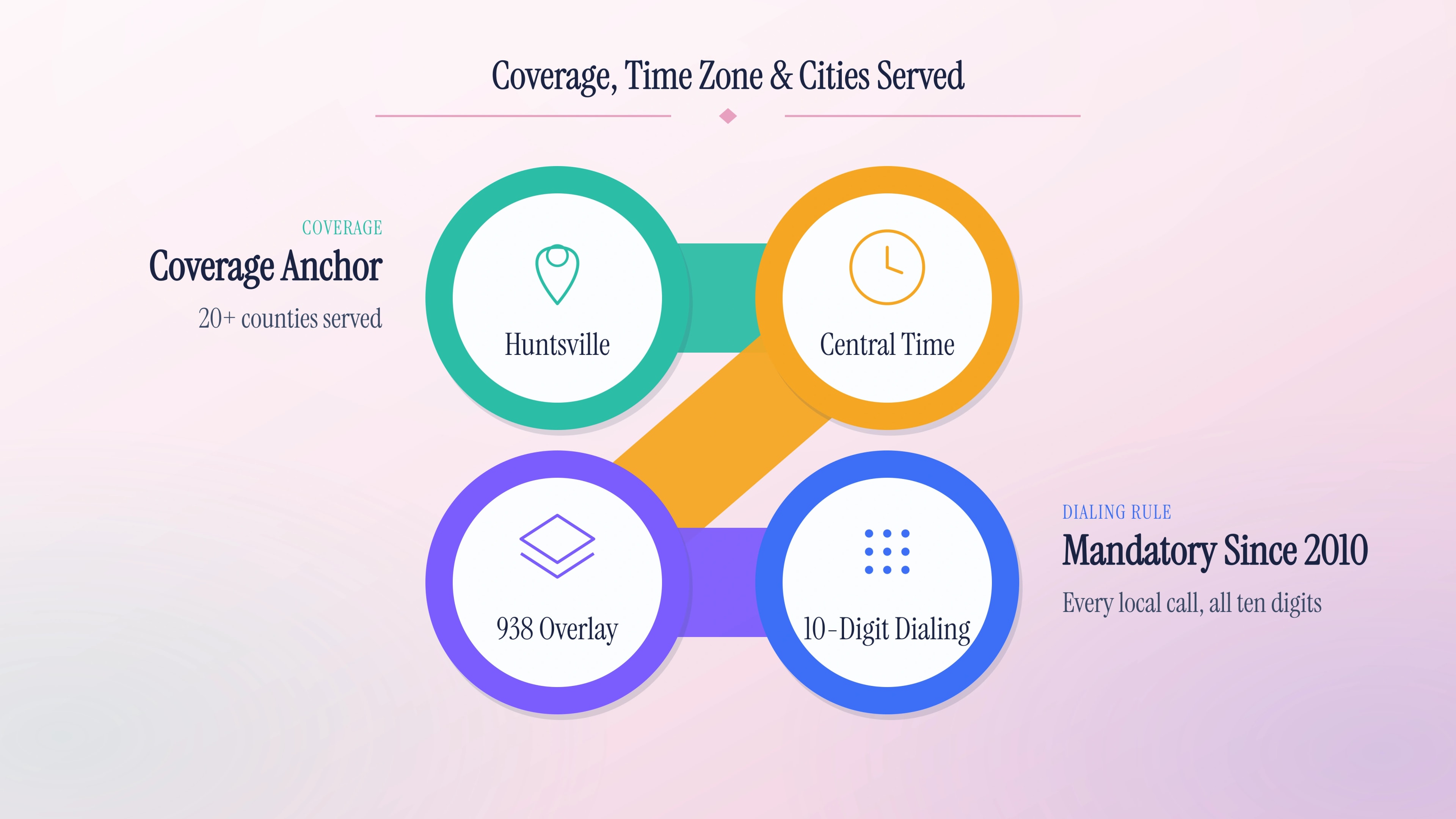
The service territory spans more than 20 counties across northern and central Alabama, anchored by Huntsville and Madison County. The area includes Decatur, Madison, Gadsden, Florence, Cullman, Anniston, Athens, Fort Payne, Talladega, and Scottsboro, along with dozens of smaller communities. The entire footprint sits in the Central Time zone. It observes CST in winter and CDT during daylight saving. Since 2010, the area has shared its territory with the 938 overlay. Both prefixes require ten-digit dialing for every local call.
Business Benefits of a Local Alabama Number
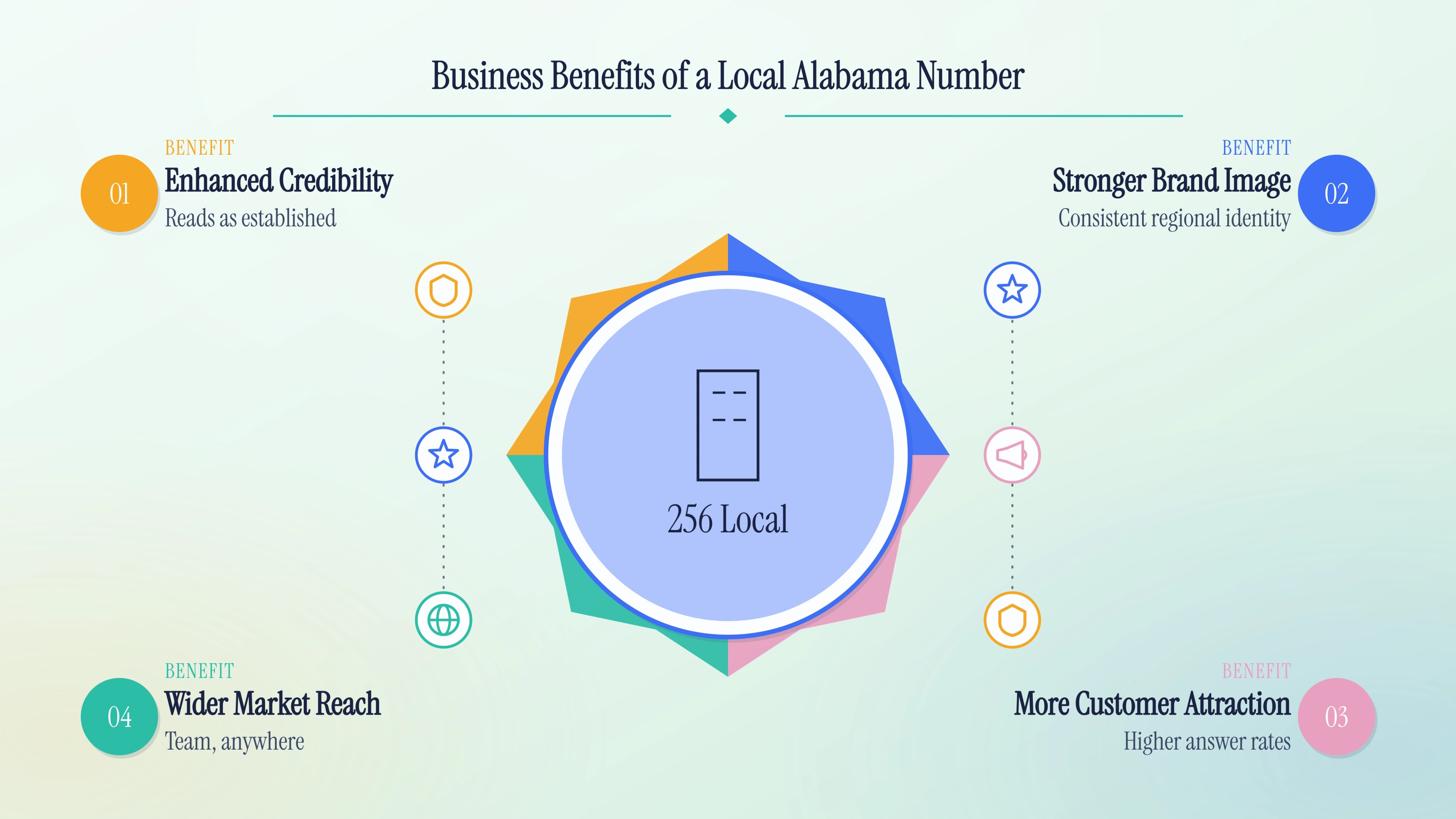
Businesses cite four consistent advantages to carrying a recognizable North Alabama number:
- Rocket City credibility — a 256 prefix ties a business to Huntsville's NASA, missile-defense, and aerospace reputation instead of reading as an unfamiliar out-of-state vendor.
- Consistent identity across the overlay — pairing a 256 number with listings across Huntsville, Decatur, and Madison keeps a business recognizable across the same footprint the 938 overlay now shares.
- Higher answer rates despite the overlay — because 256 and 938 numbers now dial alongside each other, a recognizable 256 prefix still outperforms an out-of-area or toll-free number when Huntsville and Decatur customers decide whether to pick up.
- Reach without a Huntsville office — a virtual 256 line lets a team anywhere serve the aerospace and advanced-manufacturing corridor this code split from. Acepeak covers that comparison in its 205 area code guide to the Birmingham territory.
Sequential or Vanity: Working With Shifting Inventory
Availability shifts constantly. Existing numbers get released, ported, or reassigned all the time. So a practical acquisition plan matters more than chasing a specific digit pattern. Most businesses start by checking what a provider currently has in inventory. Next, they weigh a plain sequential number against a memorable vanity pattern. Then they confirm the number can be activated without long lead times.
Vehicle Wraps, Business Profiles and Consistent Listings
Once secured, a number earns its value only when customers actually see it. List it consistently — on the website header, Google Business Profile, email signatures, vehicle wraps, and print materials. Businesses that do this get more benefit than those that treat it as a back-office detail. Consistency across every channel also keeps call-tracking data clean when a company later wants to measure results.
Reading the Call Data After a Huntsville Rollout
After rollout, most businesses track three signals: incoming call volume, lead conversion from those calls, and any shift in how quickly customers respond to outreach. Compare a few months of data against the previous number's performance. That gives a clear read on whether the switch is paying off.
Ready for a local North Alabama number?
Acepeak activates 256-area numbers in minutes on a cloud platform — no Huntsville office required. Explore plans and route calls to any device.
A Few Dollars a Month Versus a Broker's Vanity Premium
What a North Alabama number costs depends mostly on the digits and where they come from. Through a cloud phone provider, a plain 256 line normally rides along with a business plan and adds a few dollars to each monthly bill. Memorable vanity patterns sit in a different price range, since brokers charge a single up-front price for them that can reach the hundreds or even low thousands of dollars. For most Huntsville and Decatur businesses, the plain line already carries the Rocket City recognition, so a standard number captures most of the credibility without the premium.
Aerospace Hiring Keeps Huntsville Numbers in Demand
Demand for Huntsville-area numbers has stayed high. The metro keeps growing in aerospace and technology employment, and popular sequential blocks and easy-to-remember patterns often get claimed quickly. Businesses that need a specific pattern should work with a provider that can flag inventory as it becomes available. Those flexible on the exact digits will rarely wait long. Neighboring markets just across the state line follow a similar availability pattern, as covered in Acepeak's 931 area code guide to Middle Tennessee.
A Number Can't Make Up for Weak Service Elsewhere
A 256 prefix can open the door with a Huntsville or Florence prospect, but it cannot carry the rest of the relationship. The number does its best work alongside a professional website, branding that stays consistent across listings, and quick replies to every inquiry. If service lags, a local area code will not cover for it. The businesses that gain the most treat the number as one part of a well-presented North Alabama brand rather than a tactic that stands alone.
Reach Beyond Alabama: The Global Angle
The underlying numbers route over standard telecom and VoIP infrastructure. Because of that, a business anywhere in the world can activate a Huntsville-area line. It can present a local identity to callers no matter where staff are physically located.
Why Callers Pick Up When the Area Code Matches Theirs
When a phone rings in Decatur or Gadsden, the three digits on the screen often decide whether anyone answers. North Alabama residents pick up a call showing a familiar local code considerably more often than one tagged with an out-of-state prefix or a toll-free number, because a matching number looks like someone nearby with a real reason to call. For sales and outreach teams working the counties around Huntsville, that gap repeats on every call list.
Defense and Manufacturing Growth Across Madison County
Huntsville has grown to become one of Alabama's largest cities. Expansion continues, tied to aerospace, defense, and advanced-manufacturing investment across Madison County and the surrounding region. As long as that growth continues, demand for recognizable local numbers in the 256/938 territory is likely to stay elevated rather than fade.
An Edge Newer Overlay Codes Have Not Yet Built
Its long association with Huntsville's technology and defense sector gives it a layer of credibility newer overlay codes have not yet built up. Businesses in aerospace, manufacturing, healthcare, and professional services lean on it as a signal of genuine local roots. That matters most when competing for customers who default to trusting a recognizable regional number over an unfamiliar one.
Research, Compare, Confirm: The Four-Step Path
The process generally follows four steps. First, research providers that offer numbers in this territory. Then check live availability for the pattern desired. Next, compare pricing across a standard versus vanity option. Finally, confirm the number before final activation.
Your Federal Right to Keep a Ported Number
Businesses porting a number from an existing carrier retain a federally protected right to keep it. This protection is outlined in the federal number portability rules maintained by the Federal Communications Commission. Providers cannot delay a valid request without documented cause. A business ready to move forward can request a quote, compare available numbers, and have a new line active well within a business week.
Modest Cost, Real Credibility in the Rocket City's Orbit
North Alabama's telephone prefix has carried Huntsville's identity through more than 25 years of growth. It still functions as shorthand for a genuine presence in the Rocket City's orbit. From its 1998 origins splitting off from 205 to today's ten-digit dialing alongside the 938 overlay, it has adapted to a region built on aerospace, defense, and technology. A business deciding between a local number and an unfamiliar one faces an easy trade-off: the modest cost of the former is a small price for the credibility it buys with North Alabama customers.
Add a local North Alabama number to your business
Explore virtual number options through Acepeak and get a line activated today.
Questions, answered.
The territory covers Huntsville and the surrounding North Alabama region, including Decatur, Madison, Gadsden, Florence, Cullman, Anniston, Athens, Fort Payne, and Scottsboro.
No, but the two share identical geography through an overlay introduced in 2010. Both can be dialed and received anywhere within the shared territory. Every local call requires all ten digits.
Central Time. That is CST (UTC−6) in winter, shifting to CDT (UTC−5) during daylight saving. Daylight saving runs from the second Sunday in March to the first Sunday in November.
Yes. Cloud communications providers issue virtual numbers in this territory to businesses located anywhere. Calls route through the standard telecom network while presenting a local Huntsville-area identity to callers.
A standard number typically costs a few dollars monthly through a business phone plan. A distinctive vanity sequence sourced through a number broker can cost anywhere from roughly $150 to several thousand dollars as a one-time fee, depending on demand.
Consumers can report suspected scam or spoofed calls directly to the FCC and FTC. Both agencies track patterns of abuse tied to specific number ranges and can direct carriers to block confirmed offenders.
Signing up for a 256 area code number takes minutes with a cloud phone provider — no local office in Alabama required. Pick the number, connect it to your existing phone or app, and calls route in immediately. This keeps the 256 area code presence you already have while adding the local credibility Alabama customers respond to.