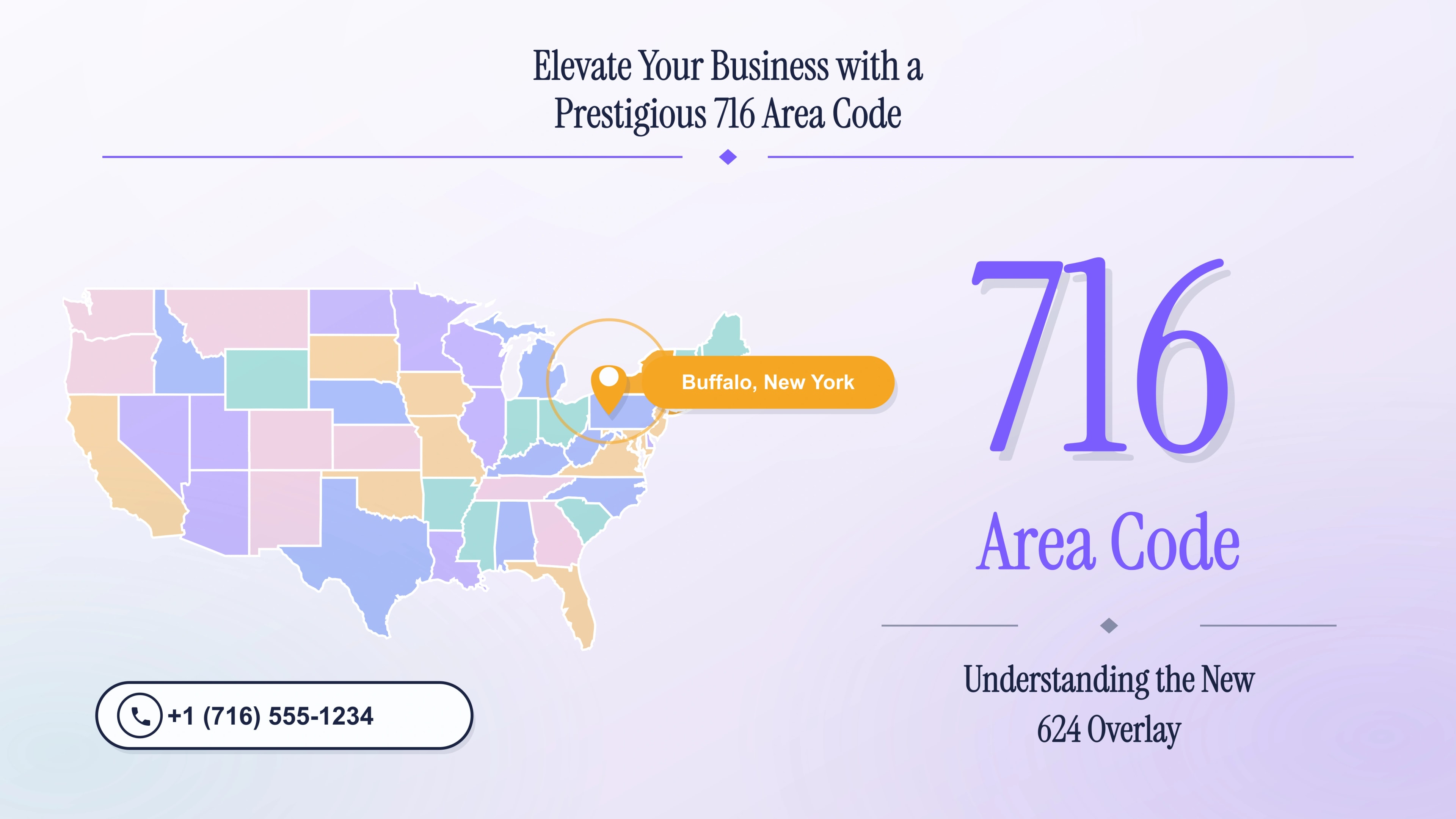
First Impressions Start with the Prefix
Customers in Western New York size up a company the moment its number appears on their screen, and the digits they know best are 716, in use since 1947. With the 624 overlay now sharing the territory, a business setting up in Cheektowaga, Tonawanda, or Jamestown also has to decide which of the two codes will represent it. This guide explains how the region's numbering changed, where the code reaches, what a line costs, and the practical steps to getting one live.
Key Takeaways
- Origin — the 716 area code was one of the original 86 area codes created in 1947, and it originally served all of Western New York, including Rochester.
- Coverage — after a single split, the territory now centers on Buffalo, Niagara Falls, and the surrounding Western New York communities.
- Overlay partner — the 624 code was added in November 2023, so both prefixes now share the same territory and require ten-digit dialing.
- Time zone — Eastern Time (EST, UTC−5 / EDT, UTC−4).
- Typical cost — a standard local number runs from a few dollars a month with a cloud provider up to several hundred dollars, or more, for a premium vanity pattern.
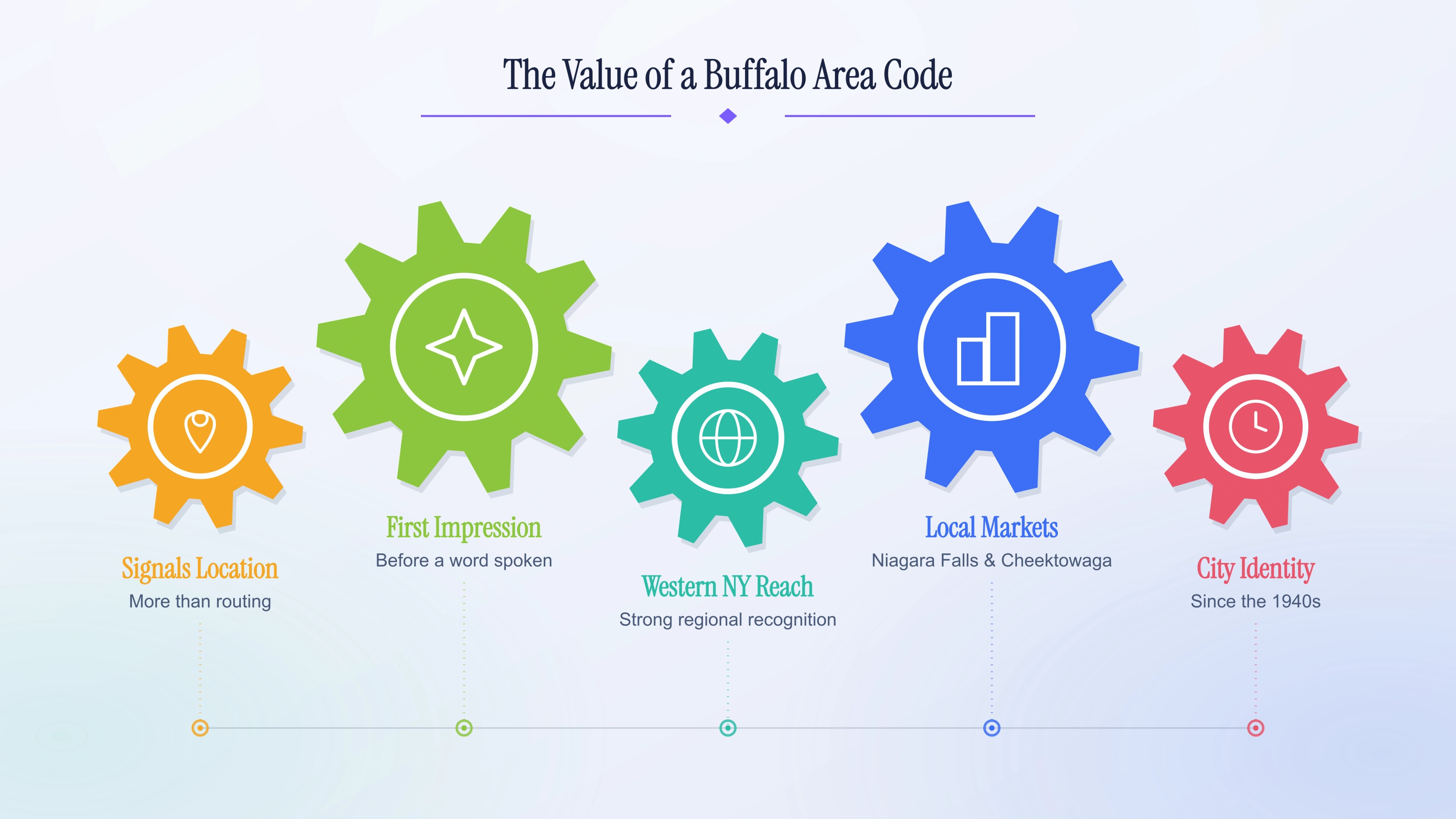
The Value of a Buffalo Area Code
In Niagara Falls, Lockport, and the towns around them, 716 is the code people associate with home. A business calling from it registers as part of Western New York right away, while a number from another state can give the person on the other end a moment of doubt. That recognition rests on more than seven decades of the same digits standing for Buffalo, a record no newly issued number can match.
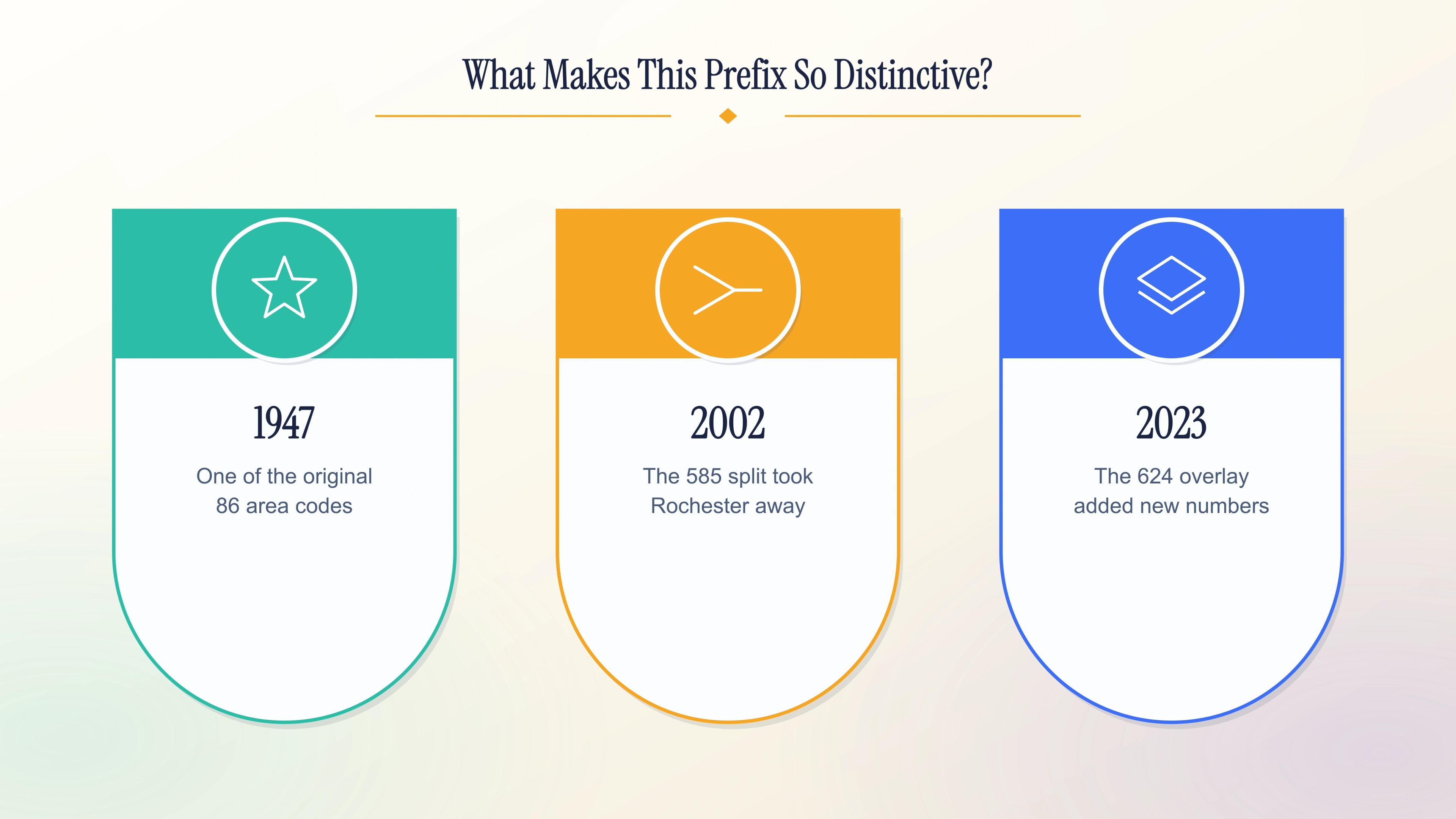
How the Territory Shrank and Then Gained a Second Code
The code dates to 1947, when it was one of the original area codes and covered all of Western New York, Rochester included. Growing demand led regulators to split the territory in 2001, moving Rochester and the surrounding Finger Lakes area to 585 and leaving Buffalo and the state's western edge on the original prefix. When the remaining supply ran low again, planners chose an overlay instead of a second split, and 624 arrived in November 2023. Seven decades on the same digits, in a Great Lakes port and rail city, is why a 716 number still reads as homegrown rather than newly issued.
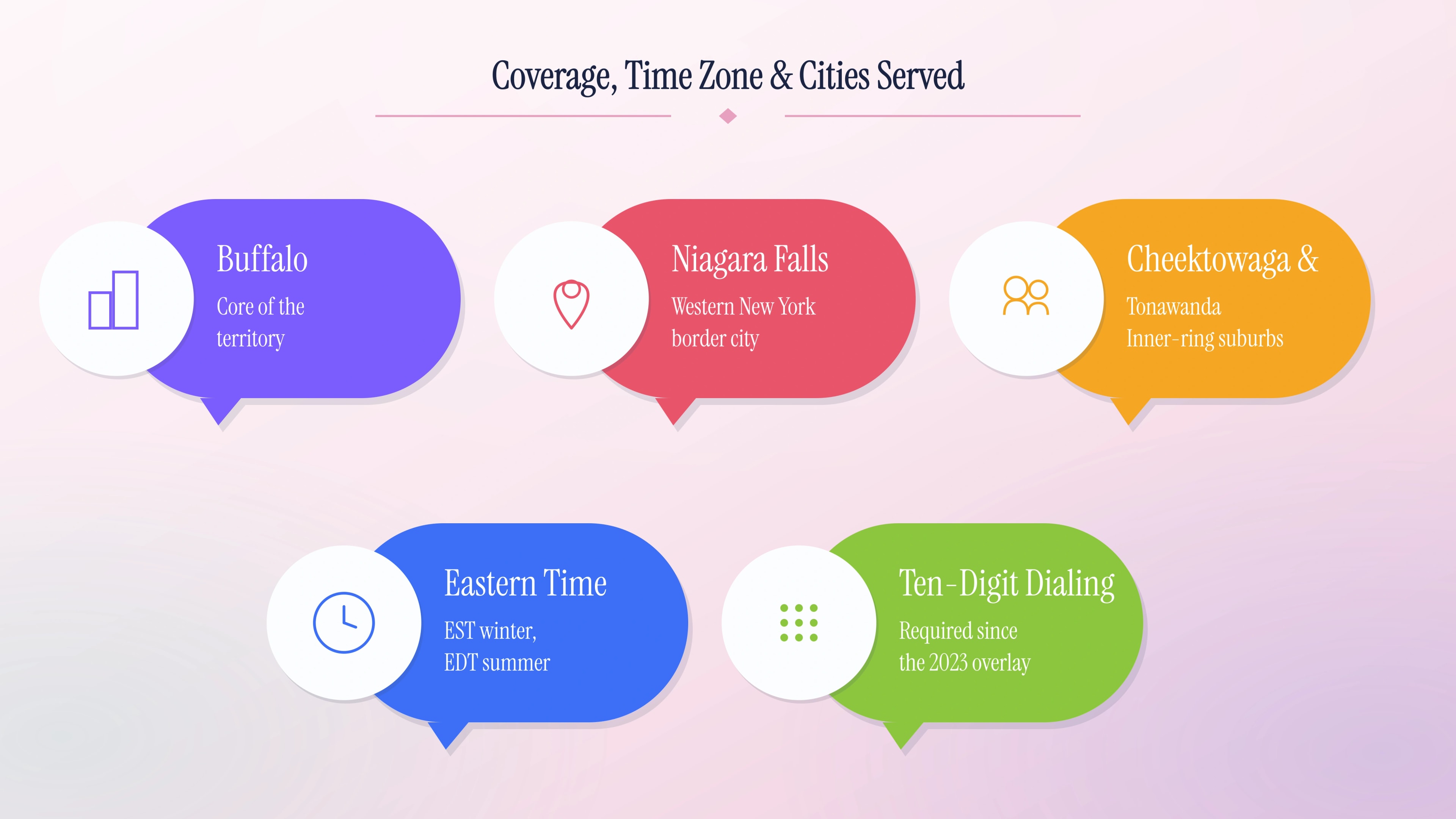
Communities Served, Eastern Time and Dialing Rules
The service territory now centers on Buffalo and extends across Western New York, including Niagara Falls, Cheektowaga, Lockport, Tonawanda, Orchard Park, Hamburg, and Jamestown. The entire footprint sits in the Eastern Time zone, observing EST in winter and EDT during daylight saving. Since the 624 overlay took effect in 2023, every local call in the territory requires all ten digits, even calls between two 716 numbers.
Business Benefits of a Local Buffalo Number
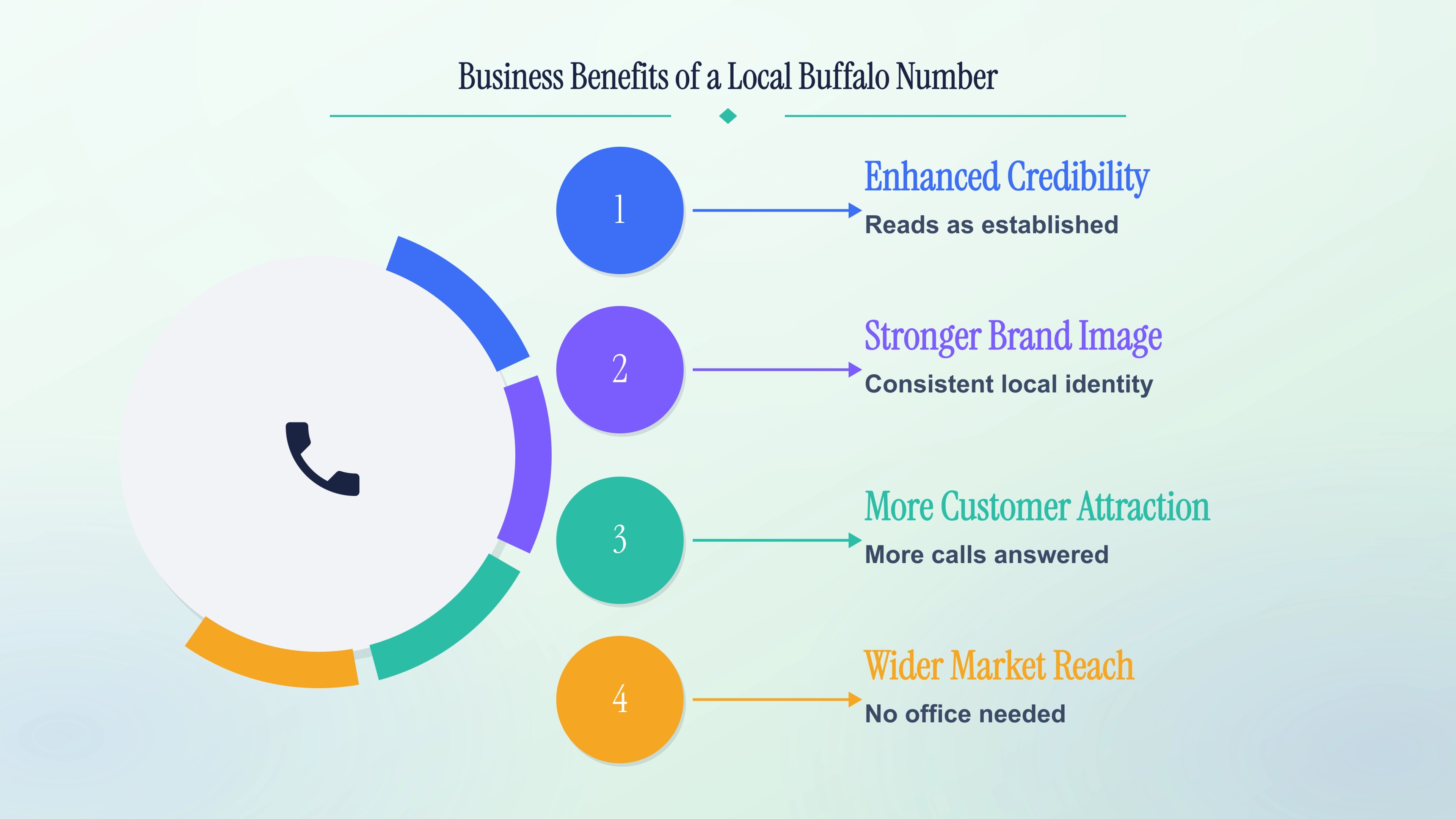
Businesses cite four consistent advantages to carrying a recognizable Buffalo number:
- Great Lakes credibility — a 716 prefix reads as a genuine Buffalo presence tied to the city's history as a Great Lakes port and rail hub, not an unfamiliar caller from outside Western New York.
- Consistent identity across the overlay — pairing a 716 number with listings in Niagara Falls, Cheektowaga, and Lockport keeps a business recognizable now that the 624 overlay shares the same territory.
- Higher answer rates from cross-border trade contacts — outbound calls to manufacturing and healthcare clients across the region get picked up more often on a familiar 716 number than on an unfamiliar out-of-area line.
- Reach into Western New York without local rent — a virtual 716 line lets a team based anywhere maintain a Buffalo identity, the same approach Acepeak covers for Northeast Pennsylvania in its 570 area code guide.
Deciding Whether a 624 Number Will Do
Since November 2023, a new number in Western New York can come from either of two codes covering the same ground: 716 or the 624 overlay. A business therefore starts with one decision, whether to hold out for the original 716 prefix or accept a 624 number that works identically across the territory. After that, inventory keeps moving as lines are released, ported, or reassigned, so check a provider's current stock, choose a sequential or vanity pattern, and confirm the line can be activated quickly. Loose requirements on the exact digits shorten the wait.
Displaying All Ten Digits Everywhere Customers Look
Because every local call in the territory now needs all ten digits, a new 716 number should be shown in full, area code included, everywhere it appears. That covers the Google Business Profile, the top of the website, staff email signatures, wraps on company vehicles, and printed pieces handed out in Cheektowaga, Tonawanda, or Orchard Park. A line that customers never see brings in nothing, and keeping the identical format on every channel also leaves call-tracking data tidy for later measurement.
Three Measures That Show the Line Is Working
Once the 716 line is live, watch three measures: how many calls come in, how many of those turn into leads, and whether manufacturing and healthcare contacts respond to outreach faster than before. A few months of that data set against the old number's history shows whether the change is earning its place. Most call-tracking tools can attribute results to the new line automatically, which also helps if the business keeps a separate 624 number.
Ready for a local Buffalo number?
Acepeak activates 716-area numbers in minutes on a cloud platform — no Western New York office required. Explore plans and route calls to any device.
Why the Standard Monthly Number Is Usually Enough
Costs swing with the provider and the type of number chosen. On a cloud communications platform, an ordinary 716 number is typically folded into a business phone plan for a few dollars a month. Vanity sequences are priced differently, since brokers sell the most memorable ones for a one-time fee that ranges from the hundreds into the low thousands of dollars. A company courting clients in Lockport or Jamestown will usually get nearly the full benefit of a recognizable Buffalo presence from the standard monthly number, without paying a premium for particular digits.
Border-Economy Demand and Inventory Alerts
Manufacturers, healthcare providers, and logistics companies along the Canadian border keep requests for Buffalo numbers coming, and memorable sequential 716 blocks tend to be claimed early. A business that insists on a certain pattern is best served by a provider that monitors releases and reports matches as they appear. One that can live with any open digits, or with a 624 number, seldom has to wait. Acepeak's 347 area code guide shows a similar availability pattern in a different market, New York City's outer boroughs.
Credibility Needs More than a Familiar Prefix
A 716 number works as supporting evidence, not the whole case, when a manufacturing or healthcare client in Western New York sizes up a new vendor. Together with a professional website and branding that stays consistent from one channel to the next, a Buffalo number reinforces the impression of a dependable company. It cannot rescue poor service on its own. The payoff is greatest when the line sits inside a brand that already looks coherent and well run, rather than being used as a lone tactic.
Reach Beyond New York: The Global Angle
A Buffalo number goes wherever the team goes. Because the line is carried over standard telecom networks, staff in another state or across the border in Ontario can answer it, and the caller ID in Western New York still shows 716. A manufacturer or healthcare supplier can use that to start serving clients around Buffalo and Niagara Falls before it takes on office space in the region.
How Recognition Differs Between the Two Codes
Between Buffalo's two codes, 716 likely holds more recognition, since it has decades of history behind it and the 624 overlay only arrived in 2023. That matters because people are noticeably more willing to pick up when an incoming number matches the area code on their own phone than when it comes from a distant region or a toll-free line, as a familiar prefix looks relevant rather than cold. Sales and outreach teams calling across Niagara Falls, Hamburg, and the rest of the territory stand to gain the most from it.
Cross-Border Trade and Overlay Headroom
The region's economy continues to lean on advanced manufacturing, healthcare systems, and cross-border trade with Ontario, all of which draw new business formation into Buffalo and its surrounding counties. As long as that activity continues, demand for a recognizable local number is likely to stay elevated, and the added 624 overlay means the combined pool has more headroom than a single-code territory facing renewed exhaustion.
From Dialing Code to Civic Emblem
When Rochester moved to 585 in 2001, Buffalo and the western edge of the state kept 716, and the code has stayed closely tied to that corner of New York ever since. Firms in manufacturing, healthcare, and professional services display a 716 number as a sign of Western New York roots. That helps when they compete for clients who put more faith in a regional number they recognize than in one they have never seen.
Four Steps, Including a Choice of Code
Western New York businesses can work through setup in four steps. Identify providers with inventory in the territory, then run a live search for the digit pattern you have in mind, deciding along the way whether a 624 number is acceptable. Compare what a standard line costs against a vanity pattern, and confirm your pick before it is activated. When an existing number is being ported in from another carrier, expect the transfer to take several business days.
Keeping Your Current Number When You Switch
Moving an existing number to a new carrier does not mean giving it up. The federal number portability rules administered by the Federal Communications Commission protect a customer's right to keep it, and providers cannot hold up a valid request without a documented cause. Buffalo businesses ready to proceed can ask for a quote, review which 716 and 624 numbers are open, and usually have the new line working in less than a business week.
An Original Code Whose Recognition Outweighs Its Cost
From a code that once reached Rochester to a territory now shared with 624, 716 has changed shape without losing its meaning: it still marks a caller as part of Buffalo and Western New York. If anything, the arrival of a second code has made the original digits stand out more. On a cloud phone plan, a standard 716 line typically costs a few dollars monthly, making it one of the least expensive ways for a business to be recognized as local by customers from Niagara Falls to Jamestown.
Add a local Buffalo number to your business
Explore virtual number options through Acepeak and get a Buffalo line activated today.
Questions, answered.
The territory covers Buffalo and Western New York, including Niagara Falls, Cheektowaga, Lockport, Tonawanda, Orchard Park, Hamburg, and Jamestown.
No, but the two share identical geography through an overlay introduced in November 2023. Both can be dialed and received anywhere within the shared territory, and every local call requires all ten digits.
Eastern Time — EST (UTC−5) in winter, shifting to EDT (UTC−4) during daylight saving, which runs from the second Sunday in March to the first Sunday in November.
Yes. Cloud communications providers issue virtual numbers in this territory to businesses located anywhere, and calls route through the standard telecom network while presenting a local Buffalo identity to callers.
A standard number typically costs a few dollars monthly through a business phone plan, while a distinctive vanity sequence sourced through a number broker can cost anywhere from roughly $150 to several thousand dollars as a one-time fee, depending on demand.
Consumers can report suspected scam or spoofed calls directly to the FCC and FTC, both of which track patterns of abuse tied to specific number ranges and can direct carriers to block confirmed offenders.
Signing up for a 716 area code number takes minutes with a cloud phone provider — no local office in Buffalo required. Pick the number, connect it to your existing phone or app, and calls route in immediately. This keeps the 716 area code presence you already have while adding the local credibility New York customers respond to.