Coffee Shops, Tech Campuses and the Silicon Forest
Walk into a Portland coffee shop, a Beaverton tech campus, or a Salem government office and you will spot a local number that starts with 503. That prefix has represented Oregon's most densely populated corridor for nearly eight decades. It has carried the region through the rise of the silicon forest, the boom in Willamette Valley tourism, and the growth of remote work that made Portland one of the West Coast's most sought-after business addresses.
You might be a startup founder eyeing Portland's innovation district, a retailer targeting Salem shoppers, or a professional services firm serving Hillsboro's semiconductor belt. Either way, understanding the 503 area code helps you communicate with — and within — one of the Pacific Northwest's most dynamic regions.
Key Takeaways
- One of the originals — area code 503 is one of North America's first 1947 telephone codes, first assigned to cover the entire state of Oregon.
- Coverage today — it now serves Portland, Salem, Beaverton, Hillsboro, Gresham, and the broader northwestern Oregon corridor.
- The 1995 split — on November 5, 1995, area code 541 was split from 503 to cover southern and eastern Oregon.
- The 971 overlay — introduced as a full overlay by April 27, 2008, it requires ten-digit dialing for every local call.
- Time zone — every community in the 503 service area observes Pacific Time: UTC−8 in winter and UTC−7 during daylight saving.
What Is the 503 Area Code?
Area code 503 is a North American Numbering Plan (NANP) prefix for the northwestern quadrant of Oregon. It is anchored by the Portland metropolitan area, the state capital of Salem, and much of the Willamette Valley. It is one of the original 86 area codes created in 1947, when AT&T and Bell System engineers first divided the continent into telephone dialing zones. At that time, 503 covered the entire state. After a 1995 geographic split and a 1999–2008 overlay, it now shares the Portland metro with area code 971.
Businesses that want a recognizable local footprint in Oregon consistently choose 503 numbers, because the prefix carries a distinct Portland identity rooted in technology, culture, and community. For a look at how another long-established California code handled similar growth pressures, see the 661 area code in the Central Valley.
Astoria to Salem, with Nike and Intel in Between
The 503 footprint stretches across the northwestern corner of Oregon. It runs from the Pacific coast beaches of Clatsop and Tillamook counties, inland through the Tualatin Valley, and down the Willamette Valley to Polk and Marion counties. Key communities include:
- Portland — Oregon's largest city and the Pacific Northwest's second-largest metro.
- Salem — the state capital, home to state agencies and Willamette University.
- Beaverton — headquarters of Nike and a hub of Oregon's technology corridor.
- Hillsboro — the center of Oregon's semiconductor industry, home to major Intel campuses.
- Gresham — Oregon's fourth-largest city, east of Portland on the Columbia Gorge approach.
- Lake Oswego — an affluent suburb known for healthcare and professional services.
- Tigard, Tualatin, West Linn, Wilsonville, Oregon City, Sherwood, and Canby — growing Clackamas and Washington County communities.
- Astoria — the oldest American settlement west of the Rockies, at the mouth of the Columbia River in Clatsop County.
- Tillamook — a coastal dairy and tourism center in Tillamook County.
Time Zone — Pacific Standard and Daylight Time
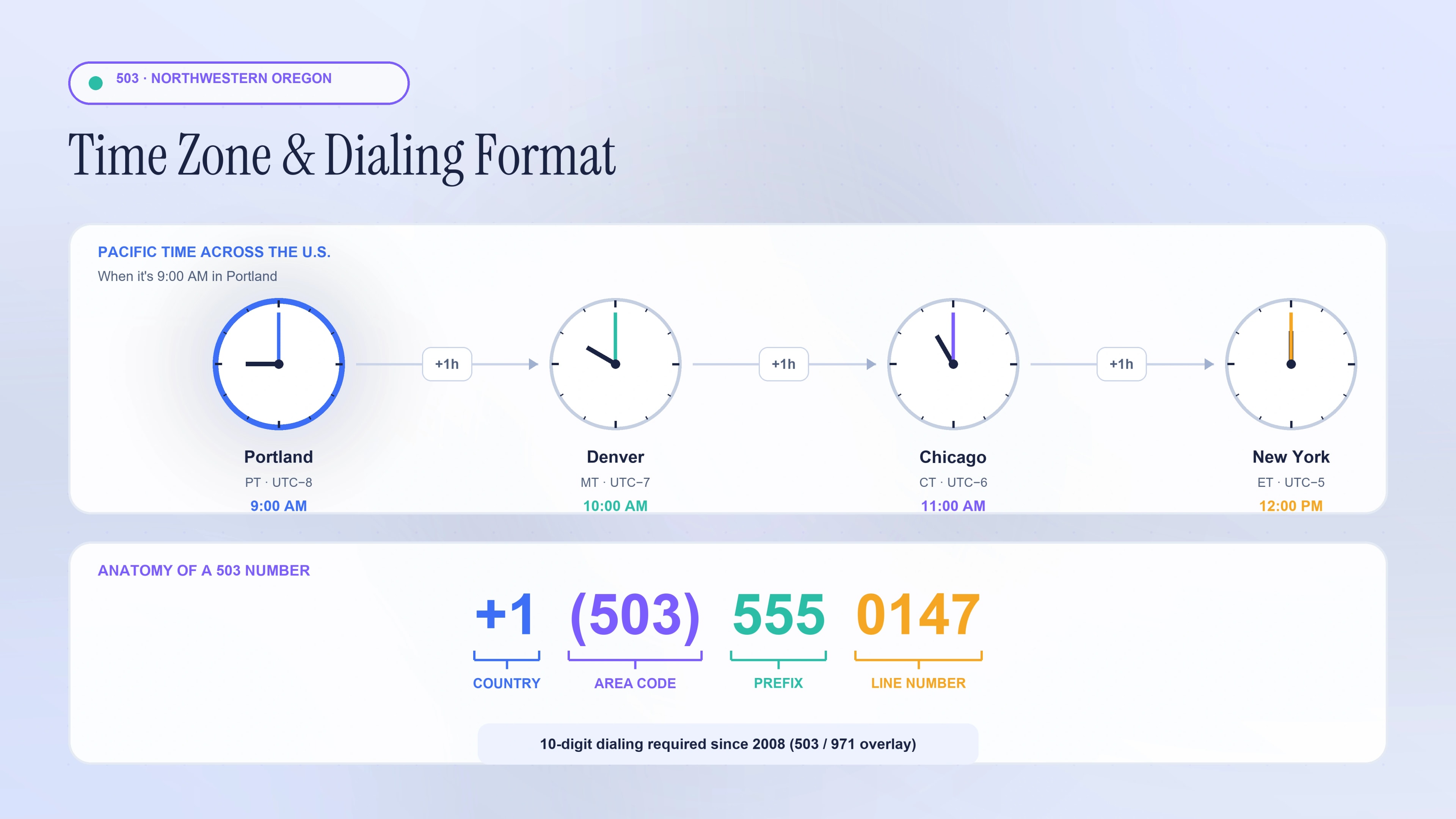
Every community in the 503 service area observes Pacific Time. During standard time — the first Sunday of November through the second Sunday of March — clocks run at UTC−8 (PST). From the second Sunday of March through the first Sunday of November, daylight saving shifts clocks to UTC−7 (PDT). Portland opens for business three hours behind New York and eighteen hours behind Tokyo. That matters for any company coordinating calls across coasts or with Asia-Pacific partners.
The Pacific time zone boundary runs well east of the 503 footprint. Area code 541, which covers eastern Oregon, also observes Pacific Time, so there is no time-zone crossing anywhere within the state.
From Statewide to Regional: The 1995 Split and the 971 Overlay
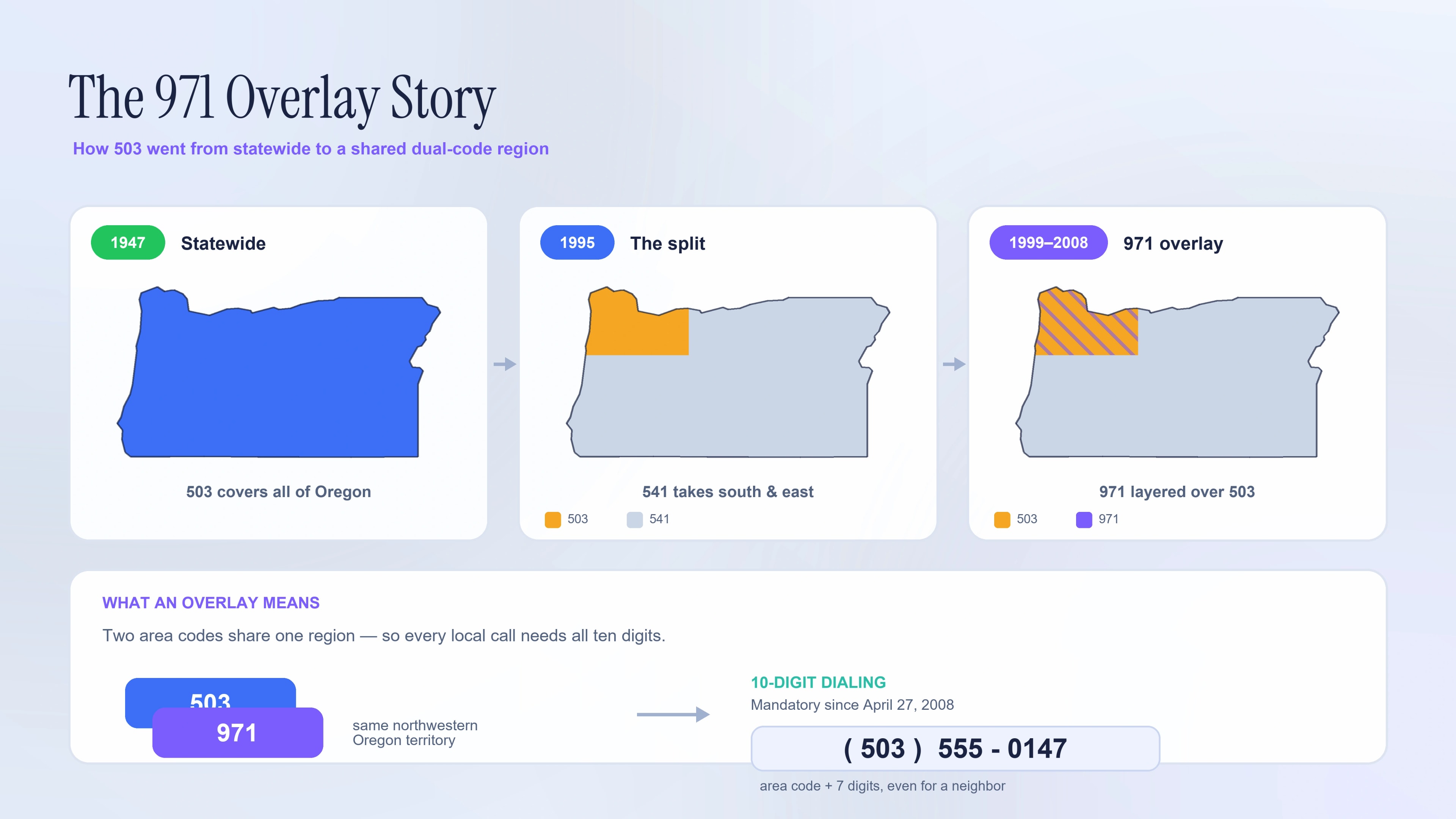
Oregon's population and business growth in the early 1990s used up telephone numbers faster than forecasters expected. On November 5, 1995, regulators split 503 by assigning area code 541 to the southern and eastern two-thirds of the state. That covered the coast south of Lincoln City, the Cascade Range communities, the high desert, and the Rogue Valley. Portland and the northwestern corridor kept the 503 prefix. Four years later, continued demand in the Portland metro forced a second change.
On July 1, 1999, area code 971 was introduced as an overlay for most of the 503 numbering plan area. On April 27, 2008, the overlay was extended to the remaining coastal rate centers in Clatsop and Tillamook counties, completing a full 503/971 overlay across all of northwestern Oregon. Since 2008, ten-digit dialing has been required for every local call within the overlay. Callers must include the area code even when reaching a neighbor on the same block.
For another example of a high-demand urban market managing a full overlay, see how the 917 area code handles dense demand in New York City.
Benefits of a Local 503 Number for Business
A 503 phone number gives instant geographic credibility to Portland-area customers. People are far more likely to answer calls from a locally recognizable prefix, and a 503 number signals real community investment rather than a distant call center. Specific advantages include:
- Trust signals — Portland consumers associate 503 with established local businesses, law firms, and healthcare providers.
- Tech-corridor credibility — the 503 prefix is recognized throughout Oregon's semiconductor and software community in Hillsboro and Beaverton.
- Salem government contacts — state agencies and contractors rely on 503 numbers for official correspondence.
- Tourism and hospitality visibility — hotels, tour operators, and Willamette Valley wineries attract visitors who search for local contact numbers.
- Remote-team presence — distributed companies can project a Portland address using a virtual 503 number while staff work anywhere.
- Higher answer rates — local caller ID consistently outperforms toll-free numbers when a business is calling a customer back.
Get your 503 number today.
Establish a Portland-area presence with a local 503 number that Oregon customers recognize and trust.
How to Get a 503 Phone Number
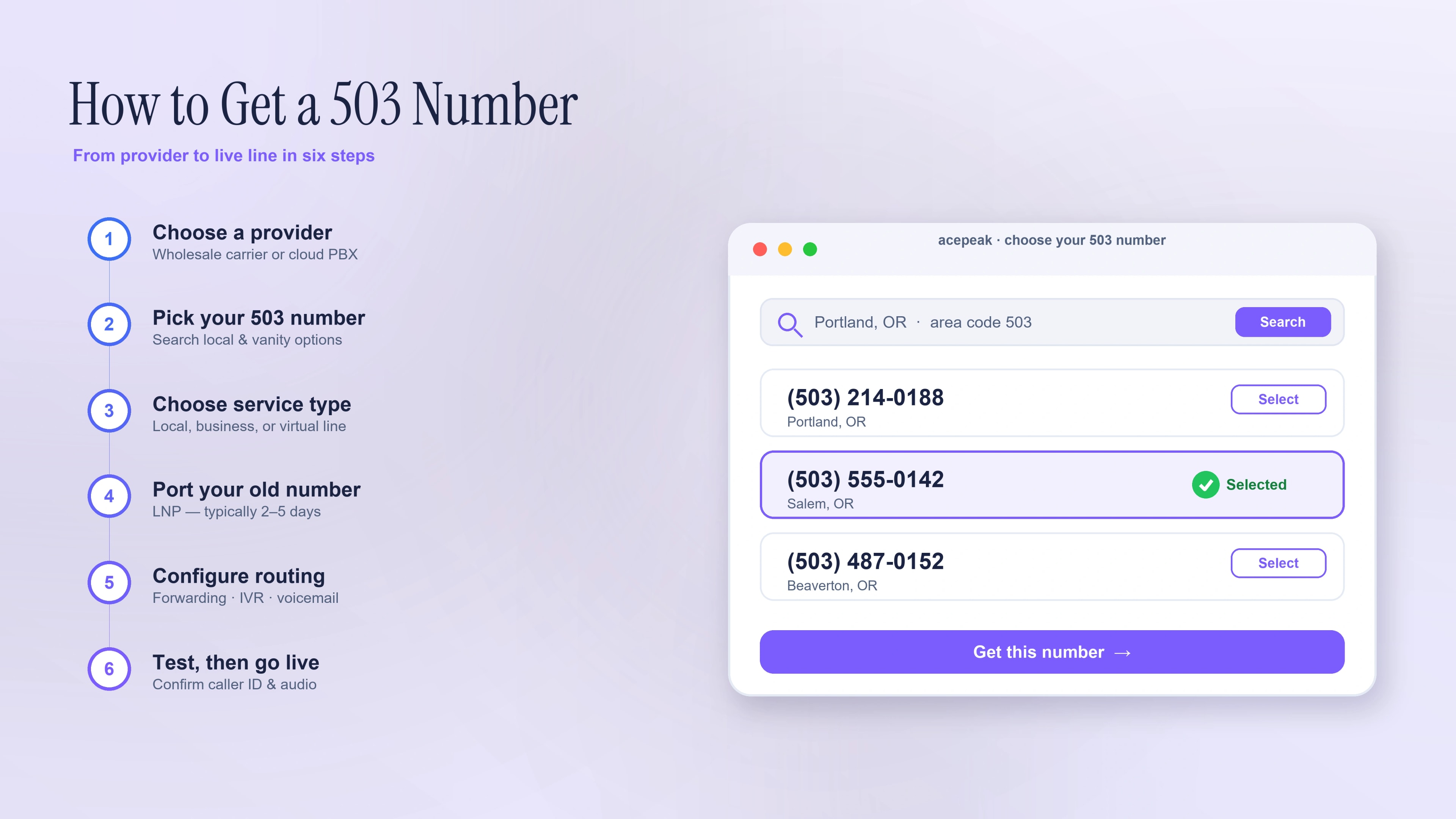
Getting a 503 number is straightforward, whether your business is based in Portland or operating remotely. The process typically involves:
- Choose a provider — a wholesale voice carrier or cloud PBX platform with Oregon number inventory.
- Select your number — search available 503 numbers, including vanity options if a memorable sequence fits your brand.
- Verify service type — decide between a dedicated local line, a multi-extension business line, or a virtual number tied to an existing device.
- Complete porting if needed — if you already hold a 503 number with another carrier, most providers can port it over within two to five business days.
- Configure routing — set up call forwarding, IVR menus, voicemail-to-email, and business-hours rules through your provider's portal.
- Test before going live — place inbound and outbound test calls to confirm caller ID, audio quality, and all routing rules work correctly.
Scam Awareness: Protecting Yourself from 503 Fraud
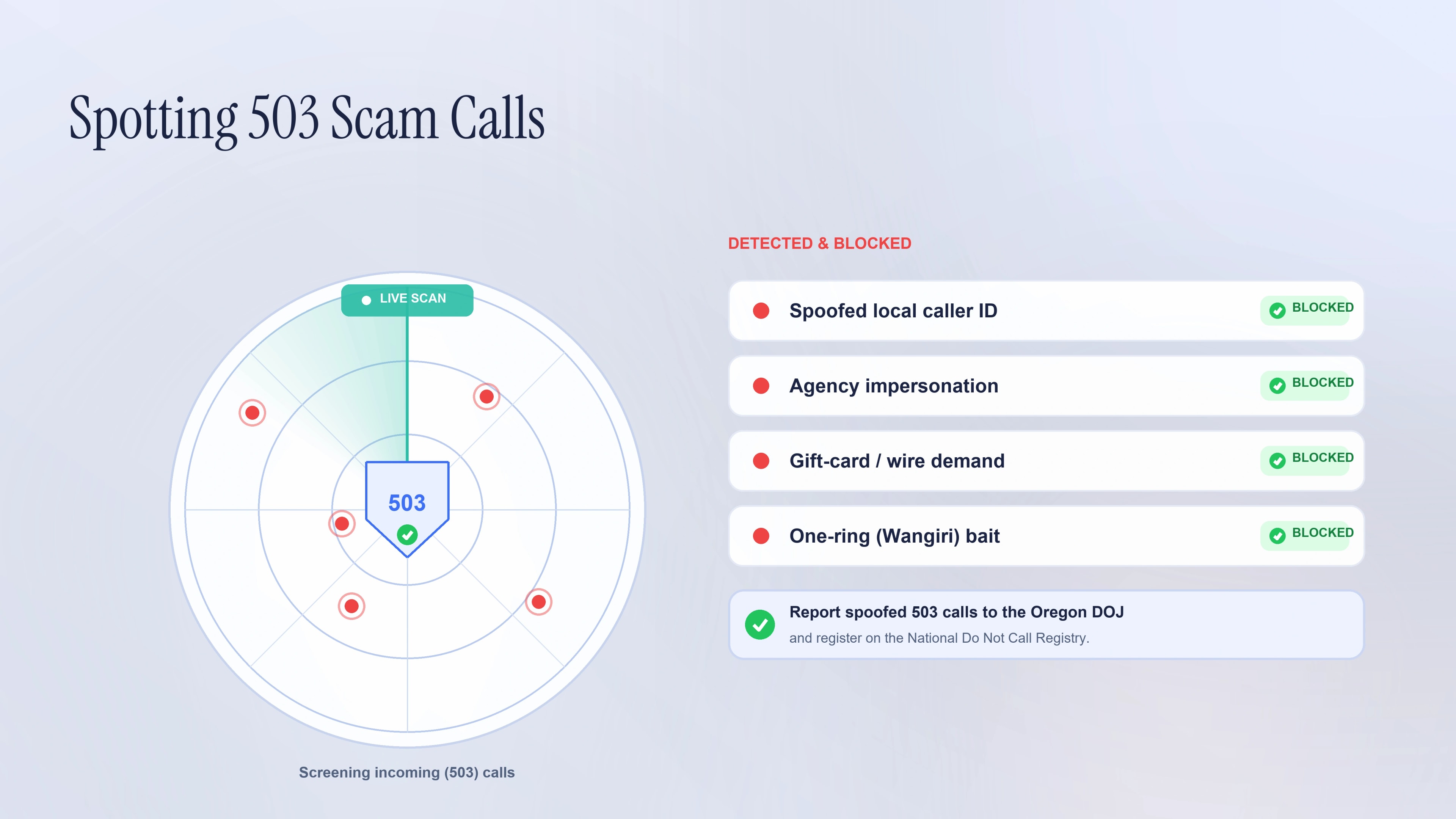
Because 503 is one of Oregon's most recognized and trusted prefixes, fraudsters use it as spoofing camouflage. Neighbor spoofing — where a robocall appears to come from a local 503 number — is the most common tactic. Watch for:
- Unexpected callers claiming to be Portland utilities, ODOT, or Oregon state agencies demanding immediate payment.
- Pressure to pay fast — a call that pushes you to pay fines via gift cards, wire transfers, or cryptocurrency.
- Too-good offers — robocalls offering free travel packages, lottery winnings, or unsolicited medical device giveaways.
- Wangiri-style calls — a single ring then a hang-up, meant to prompt a costly callback to a premium-rate number.
- Protect yourself by registering on the National Do Not Call Registry and using a carrier-level call-blocking service.
- Report it — send suspicious 503-spoofed calls to the Oregon Department of Justice Consumer Protection division.
The Future of the 503 Area Code
The 503/971 overlay has managed northwestern Oregon's phone number demand for more than two decades. But the region keeps growing — driven by people moving in from California and Washington, the expansion of Oregon's semiconductor manufacturing base, and steady remote-work adoption. That growth is expected to speed up number consumption through the late 2020s. Once the pool of 503 and 971 numbers runs low enough, the state's utility regulator will decide whether a new overlay is needed, or whether better number-conservation measures can stretch the current supply.
The Oregon Public Utility Commission tracks numbering resource data and works with NANPA to project depletion timelines and approve any future code additions for the Portland metro region.
From Portland Headquarters to a Salem Remote Team
Area code 503 is far more than a dialing prefix. It is a mark of identity for one of the West Coast's most vibrant regions. It started as Oregon's only telephone code in 1947. The 1995 split created 541. The 1999–2008 rollout added the 971 overlay. Through all of it, 503 kept adapting to serve a growing, changing population. Whether you need a number for a Portland headquarters, a Beaverton satellite office, or a remote team building a Salem presence, a 503 number connects you to a region that values community, innovation, and authenticity.
Claim your 503 number.
Ready to connect with Oregon's most dynamic market? Get a 503 number and start building your Portland-area presence.
Questions, answered.
The 503 area code serves Portland, Salem, Beaverton, Hillsboro, Gresham, Lake Oswego, Tigard, Tualatin, West Linn, Wilsonville, Oregon City, Sherwood, Canby, Astoria, and Tillamook, plus many other communities in northwestern Oregon.
Area code 503 was established in 1947 as one of the original North American Numbering Plan codes. It covered all of Oregon until November 5, 1995, when area code 541 was split off to serve the southern and eastern parts of the state.
Both 503 and 971 serve the same geographic area in northwestern Oregon. Area code 971 was introduced as an overlay in July 1999 and fully extended by April 2008, because 503 numbers were running low. New subscribers may get either prefix, and both require ten-digit dialing for all local calls.
No. Area code 503 is a standard geographic code for northwestern Oregon. Toll-free prefixes in North America are 800, 833, 844, 855, 866, 877, and 888.
The 503 area code observes Pacific Time: Pacific Standard Time (PST, UTC−8) in winter and Pacific Daylight Time (PDT, UTC−7) during daylight saving. Daylight saving runs from the second Sunday of March to the first Sunday of November.
Yes. Cloud telephony providers and wholesale voice carriers can assign a 503 number to a business located anywhere, and route calls to your existing phones, mobile devices, or softphone apps. This lets companies outside Oregon keep a recognizable local presence in the Portland metro market.
Signing up for a 503 area code number takes minutes with a cloud phone provider — no local office in Portland required. Pick the number, connect it to your existing phone or app, and calls route in immediately. This keeps the 503 area code presence you already have while adding the local credibility Oregon customers respond to.