East of the Cascades, Where Washington Turns to Orchards
Say "509" anywhere east of the Cascades and locals picture a very different Washington from the rainy Seattle coast: the pine-clad hills and river gorges around Spokane, the apple orchards of Wenatchee, the vineyards of the Yakima and Walla Walla valleys, the nuclear-and-agriculture economy of the Tri-Cities, and the wheat country rolling out toward the Idaho line. This single code stretches across the entire eastern and central portion of the state — one of the largest areas any American area code still serves on its own.
It is the telephone identity of a region defined by farmland, rivers and wide open distance rather than one dense downtown. This guide lays out exactly where 509 reaches, how it split from 206 back in 1957 and then never split again, the Pacific time zone and dialing rules, and how any business can claim a local eastern-Washington presence with a number of its own.
Key Takeaways
- The 509 area code covers all of eastern and central Washington — everything east of the Cascade Mountains — including Spokane, Spokane Valley, Yakima, the Tri-Cities of Kennewick, Pasco and Richland, Wenatchee, Walla Walla, Pullman, Moses Lake and Ellensburg.
- It was created on January 1, 1957, when the eastern half of the state split away from area code 206, Washington's original 1947 code, to form its own numbering region.
- 509 is unusually stable: nearly seventy years on it has never been split again or overlaid, making it one of the geographically largest single-code regions left in the country, spanning roughly twenty counties.
- Ten-digit dialing has been required across 509 since October 24, 2021 — not because a new area code arrived, but to clear the way for the nationwide 988 Suicide and Crisis Lifeline.
- The whole region runs on Pacific Time — UTC-8 in winter (PST) and UTC-7 in summer (PDT) — the same clock as Seattle and the rest of the West Coast.
How Does the Cascade Crest Divide Washington's Phones?
The 509 prefix is the telephone identity of eastern and central Washington — a geographic code covering every community east of the Cascade crest, from the Canadian border down to the Columbia River gorge and across to the Idaho state line. It is one of the older codes in the West, created in 1957, and it has served the same broad territory ever since. Where the western third of the state built up into the dense Seattle metro, the 509 side is a landscape of mid-sized cities separated by farmland, orchard and high desert. Down in California's Central Valley, another largely agricultural inland region is served by the 209 area code — like 509, a code defined by food-growing valleys and the towns between the mountains rather than a single big-city core.
Because it blankets such a large, distinct region, a 509 number reads as unmistakably local to anyone in Spokane, the Tri-Cities or the Yakima Valley. To a customer in eastern Washington it looks like a neighbor on the caller ID rather than a caller from the Seattle side of the mountains or out of state — a small but real credibility signal for any business working this market, and one reason 509 numbers stay in steady demand.
Twenty Counties from Spokane to Walla Walla
The 509 code covers the whole of Washington east of the Cascade Mountains — roughly the eastern two-thirds of the state by land area, though a much smaller share of its population than the Seattle-anchored western side. Spread across some twenty counties, it serves a string of regional hubs and the farm and river towns between them, including:
- Spokane and Spokane Valley (Spokane County) — the largest city in the region and the commercial capital of the "Inland Northwest," near the Idaho border
- The Tri-Cities — Kennewick, Pasco and Richland (Benton and Franklin counties) — the fast-growing hub where the Columbia, Snake and Yakima rivers meet
- Yakima (Yakima County) — the center of a valley famous for apples, hops and wine
- Wenatchee (Chelan County) — the self-styled "Apple Capital of the World" on the Columbia River
- Walla Walla (Walla Walla County) — a historic wheat-and-wine town in the state's southeastern corner
- Pullman (Whitman County) — home of Washington State University, plus Moses Lake, Ellensburg and Ephrata across the central basin
From the forests of the far northeast to the shrub-steppe of the Columbia Basin, these communities are bound together by a single area code — a reminder of just how much ground 509 quietly covers compared with the compact urban codes elsewhere in the country.
Pacific Time and the End of Seven-Digit Calls in 2021
The entire 509 region sits within Pacific Time — UTC-8 in winter (PST) and UTC-7 in summer (PDT) — the same clock as Seattle, Portland and the rest of the West Coast. For most of its history, callers within 509 could reach a neighbor by dialing just seven digits, because there was no overlapping code to confuse. That changed in 2021: ten-digit dialing is now required for every call.
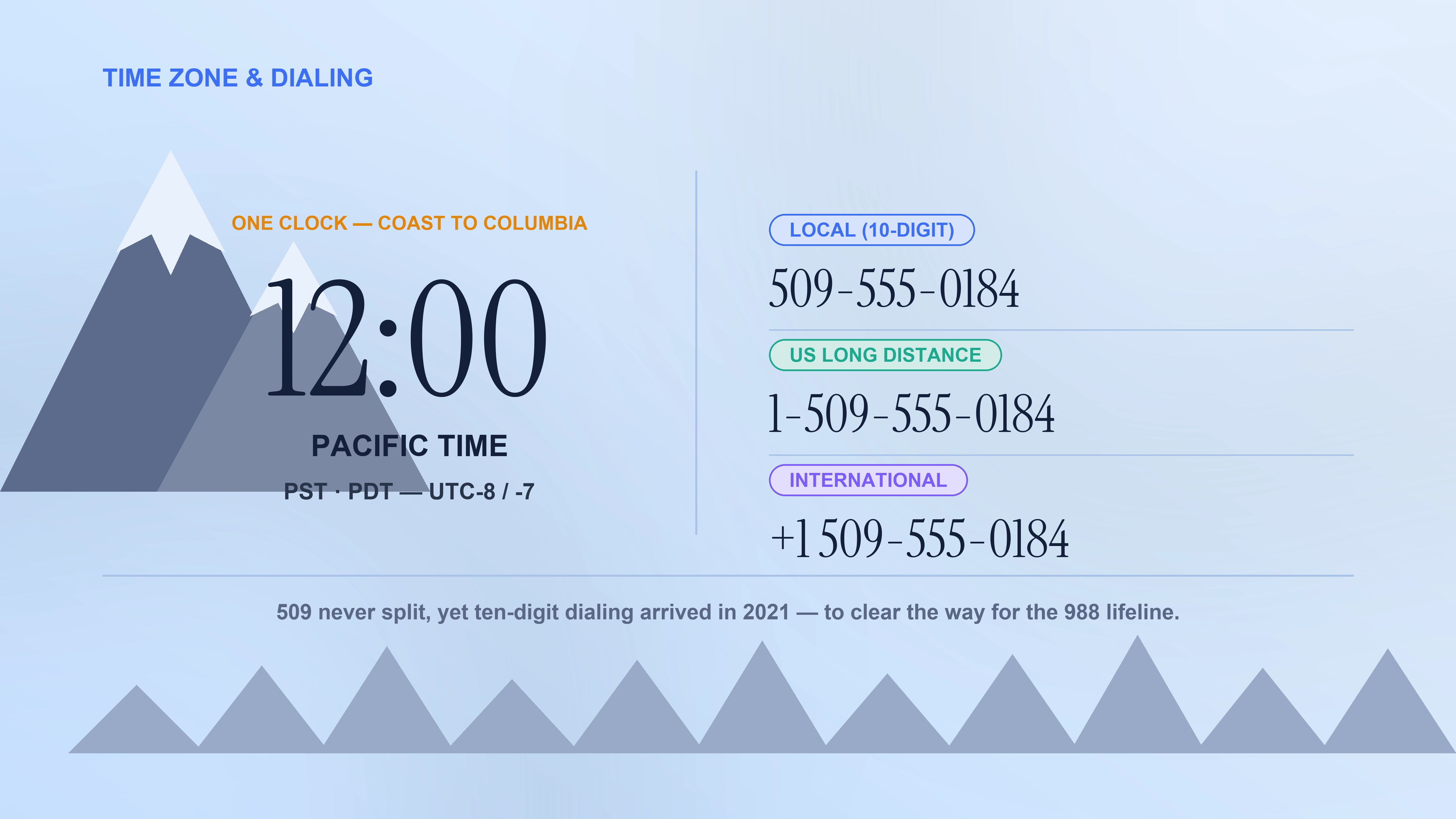
- Local calls within the region: dial all ten digits — 509-555-0184 — required across 509 since October 24, 2021.
- Long-distance from elsewhere in the U.S.: add a leading 1 — 1-509-555-0184.
- International: dial the exit code, then +1, then the number — +1 (509) 555-0184.
- On mobile phones: cell numbers are stored and dialed with all ten digits anyway, so most people already reach 509 lines the same way from anywhere.
The Split from 206 — and Why 509 Never Split Again
When the North American numbering plan launched in 1947, the entire state of Washington was assigned a single area code: 206. Within a decade the postwar boom had filled it, and on January 1, 1957, the state was divided. The densely settled western third around Seattle and Tacoma kept 206, while everything east of the Cascade Mountains was carved off into a brand-new code — 509. From that day, eastern and central Washington had a telephone identity of its own.

What makes 509 remarkable is what happened next: nothing. While the Seattle side kept subdividing — 206 spun off 360, then 425 and 253, and later took on the 564 overlay — the eastern code has never been split or overlaid in nearly seventy years. Its huge but lightly populated territory simply never burned through numbers fast enough to force a change. That makes 509 one of the last big single-code regions in the country. Other codes serve everything outside a state's metros in much the same way: Oklahoma's 580 area code, for instance, covers the rural remainder of that state just as 509 covers Washington beyond the Cascades. The one modern change came in 2021, when ten-digit dialing was introduced — not for a new area code, but so the three-digit 988 crisis line could work everywhere.
Benefits of a Local 509 Number for Business
East of the Cascade crest, the area code on an incoming call tends to get noticed. Orchard growers in Wenatchee, wheat farmers around Walla Walla and families in Spokane think of the Inland Northwest as its own place, separate from Seattle, and a 509 number tells them your business works in their part of the state rather than phoning from the coast or from out of state.
- Instant local credibility — a 509 caller ID signals that you belong to the Inland Northwest, whether you are based in Spokane or serving the region from afar.
- Higher answer rates — people are far more likely to pick up a call from a familiar local code than an unknown or toll-free number.
- A single regional identity — one 509 number reads as local everywhere from Spokane to Yakima to Walla Walla, across the whole eastern half of the state.
- Flexibility without an office — cloud calling means you can hold a 509 number from anywhere and still ring and receive calls as a local business.
- Easy tracking and scaling — add lines, route calls and measure campaigns without ever changing the local number your customers already know.
Put a Local 509 Number to Work
Give your business an authentic eastern-Washington presence with a 509 number that rings anywhere you do business.
How to Get a 509 Phone Number
Opening a 509 line does not require a service call or an office lease in Spokane anymore. Everything is handled in a cloud phone provider's online account, and a number that looks local in Yakima, the Tri-Cities or Pullman can be active by the end of the day. Here is the order to follow:
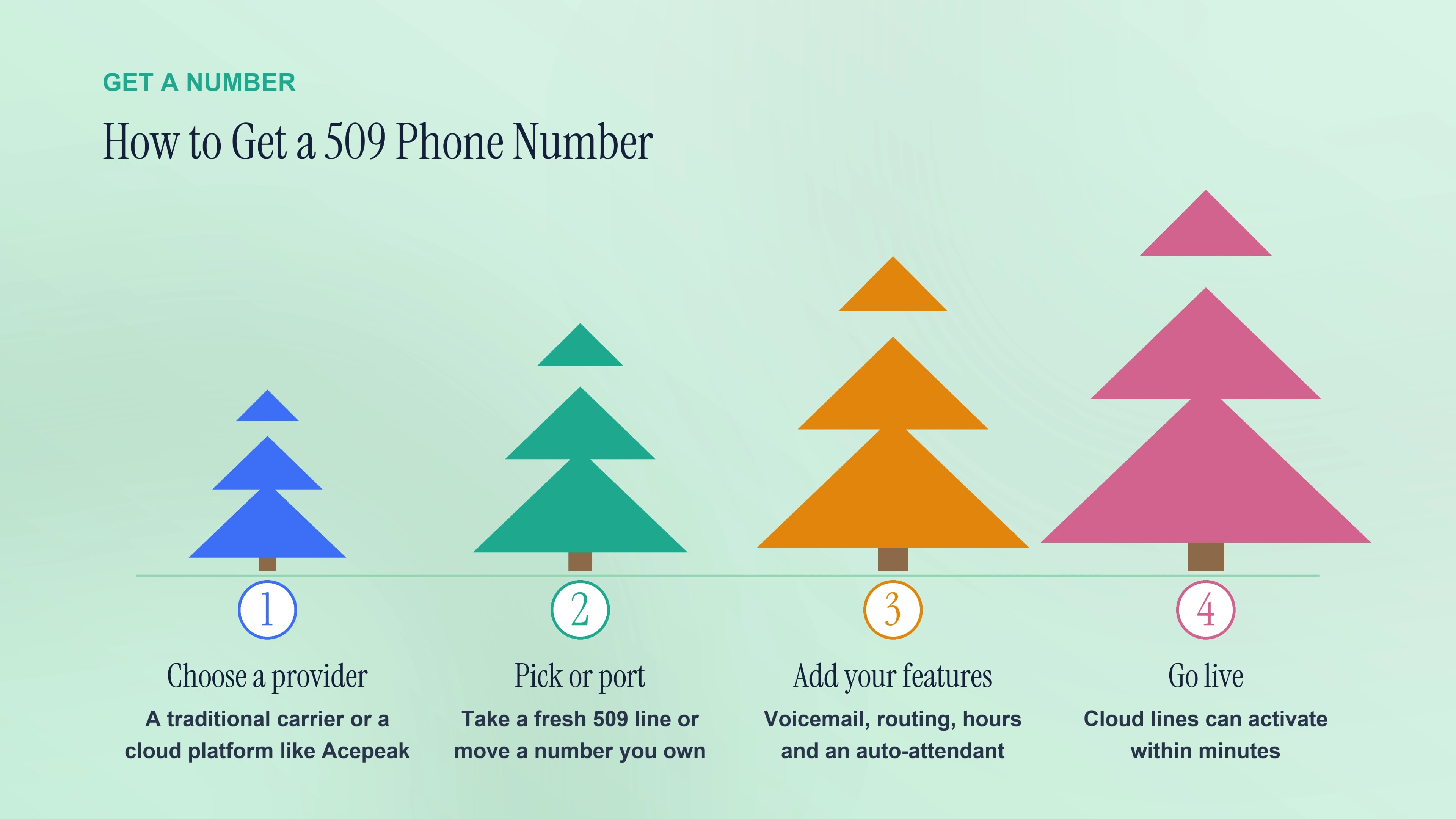
- Choose a cloud phone provider — pick a virtual phone service that offers 509 numbers and the features your team needs.
- Select your 509 number — search the available inventory and claim a number that suits your business, or port one you already use.
- Set up routing and features — point calls to your team, add voicemail, an auto-attendant, business hours and call forwarding.
- Start calling — make and receive calls from a laptop, desk phone or mobile app, showing your local 509 identity every time.
Spotting and Avoiding 509 Scam Calls
Because a 509 caller ID looks like a call from Spokane, Yakima or a farm town nearby, scammers imitate it. They fake the display so a fraudulent call carries a local eastern Washington number and seems worth answering. Keep these habits in mind:
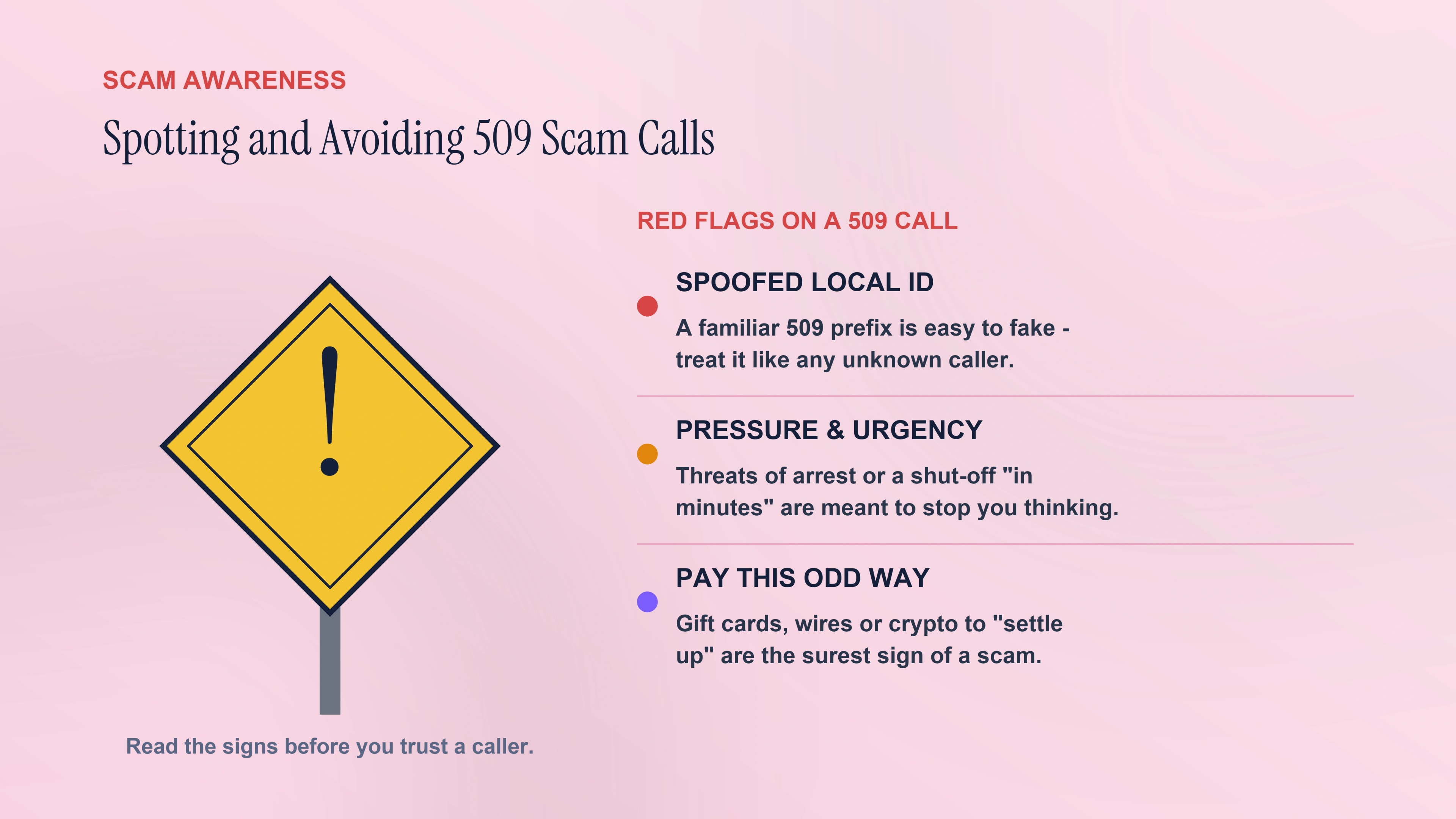
- Watch for pressure and urgency — real agencies and businesses do not demand that you act "right now" or the account will be closed.
- Be wary of odd payment demands — gift cards, wire transfers and cryptocurrency are the calling cards of a scam, never a legitimate bill.
- Do not trust caller ID alone — a 509 number on the screen can be faked; the local code is no guarantee the caller is who they claim.
- Hang up and call back on a number you trust — reach the bank, utility or agency directly using a number from a statement or official website.
- Report the call — logging unwanted calls with the authorities helps regulators track and shut down the operations behind them.
Tri-Cities Growth Without the Need for a New Code
After nearly seven decades without a split or an overlay, 509 is in no hurry to change. Its vast, lightly populated territory still has room in its number pool, and the region's growth — real as it is in Spokane and the booming Tri-Cities — is not on the scale that forces new codes onto dense urban metros. Washington's utilities commission, which oversees telephone numbering in the state, has kept the single-code region intact even as it coordinated the 2021 move to ten-digit dialing for the 988 lifeline. For anyone doing business here, that stability is a quiet asset: a 509 number is one of the most recognizable and durable local identities in the West, and one you print today will still read as authentically eastern-Washington for many years to come.
An Inland Northwest Identity Undivided Since 1957
The 509 area code is far more than three digits — it is the shared phone identity of eastern and central Washington, from the pine hills of Spokane to the orchards of Wenatchee, the wine country of Yakima and Walla Walla, and the rivers of the Tri-Cities. Split from 206 in 1957 and never divided since, it covers one of the largest single-code regions in the nation on a single, stable prefix. For any business hoping to connect with the Inland Northwest, a local 509 number is one of the simplest and most authentic ways to belong.
Claim Your Eastern-Washington Presence Today
Acepeak makes it easy to get a 509 number and start taking calls across the Inland Northwest.
Questions, answered.
The 509 area code covers all of eastern and central Washington, east of the Cascade Mountains, including Spokane, Spokane Valley, the Tri-Cities of Kennewick, Pasco and Richland, Yakima, Wenatchee, Walla Walla, Pullman, Moses Lake and Ellensburg, across roughly twenty counties.
Area code 509 was created on January 1, 1957, when Washington's original 1947 area code, 206, was split. The Seattle-Tacoma west kept 206, while everything east of the Cascades became the new 509.
No. Unlike the Seattle side of the state, 509 has never been split again or given an overlay in nearly seventy years. Its large but lightly populated territory has never exhausted its supply of numbers, making it one of the last big single-code regions in the country.
Yes. Ten-digit dialing has been required across the 509 area code since October 24, 2021. The change was not caused by a new area code but was made so the three-digit 988 Suicide and Crisis Lifeline could work everywhere, so you must always include 509 when dialing.
The entire 509 region observes Pacific Time — UTC-8 in winter (PST) and UTC-7 in summer (PDT) — the same time zone as Seattle, Portland and the rest of the West Coast.
Absolutely. With a cloud phone provider you can choose a 509 number from anywhere and have it ring on your laptop, desk phone or mobile app. It gives your business an authentic eastern-Washington presence without needing a physical office in the region.
Signing up for a 509 area code number takes minutes with a cloud phone provider — no local office in Spokane required. Pick the number, connect it to your existing phone or app, and calls route in immediately. This keeps the 509 area code presence you already have while adding the local credibility Washington customers respond to.