When Triangle Growth Reached the Phone System
Few American metros have grown as fast as the stretch of North Carolina between Raleigh, Durham, and Chapel Hill. Universities, research labs, and a steady wave of tech and biotech employers have turned the Triangle into one of the country's most closely watched job markets — and all that growth eventually shows up in something as ordinary as the phone system. When the original area code ran short of fresh numbers, regulators reached for a newer kind of fix: instead of carving out new territory, they layered a second code directly over the first.
That second code is 984. It rings phones across the same cities and the same neighborhoods as its older sibling, which can confuse callers used to the idea that a new area code means a new region. This guide explains exactly how the 984 overlay works, which counties and cities it reaches, how dialing changed because of it, and the practical steps for a business to claim a Triangle number of its own.
Key Takeaways
- The 984 area code took effect on April 30, 2012, as an overlay for 919 — it did not split off any territory, so both codes cover the exact same footprint.
- Coverage spans all or parts of thirteen North Carolina counties, serving Raleigh, Durham, Cary, and Chapel Hill/Carrboro across the Research Triangle.
- 10-digit dialing became mandatory across the region on March 31, 2012, before the first 984 numbers went into service.
- The Triangle sits in the Eastern Time Zone, observing daylight saving with the rest of North Carolina.
- A 984 number carries the same standing as 919 for local businesses — the two codes are functionally interchangeable, not a senior and junior line.
What Is the 984 Area Code?
Area code 984 is an overlay code for the Raleigh-Durham-Chapel Hill Research Triangle in North Carolina. It shares its entire service area with area code 919, which was created in 1954 when the state's original 704 code — assigned to the whole of North Carolina in 1947 — was split to cover the eastern and central regions. As pagers, fax lines, and eventually cell phones multiplied through the 1990s, regulators first floated a 984 overlay in 2001, but deferred it after number pooling freed up enough capacity to last a little longer.
Growth caught up regardless. The North Carolina Utilities Commission authorized the overlay in September 2011, and 984 numbers began reaching customers on April 30, 2012. Unlike a split, which reassigns some existing customers to a new code, an overlay leaves every current 919 number untouched — it simply opens a second pool of numbers for the same territory, the same approach used for other growing metros, such as the 331 area code overlay outside Chicago.
The Same Thirteen Counties Its Older Sibling Serves
Because 984 mirrors 919 exactly, its footprint follows the same thirteen-county Research Triangle region rather than any smaller carve-out. Coverage includes:
- Core Triangle: Raleigh, Durham, Cary, Chapel Hill, and Carrboro
- Wake County suburbs: Apex, Garner, Holly Springs, Fuquay-Varina, and Morrisville
- Outer counties: Mebane, Sanford, Smithfield, Goldsboro, and Roxboro
In total, the region touches Wake, Durham, Orange, Chatham, Johnston, Franklin, Granville, Person, Harnett, Lee, Alamance, Wayne, and Duplin counties. It is home to Research Triangle Park, three major research universities, and a fast-growing base of tech, biotech, and healthcare employers — all of it reachable through either a 919 or a 984 line.
Time Zone — Eastern Time
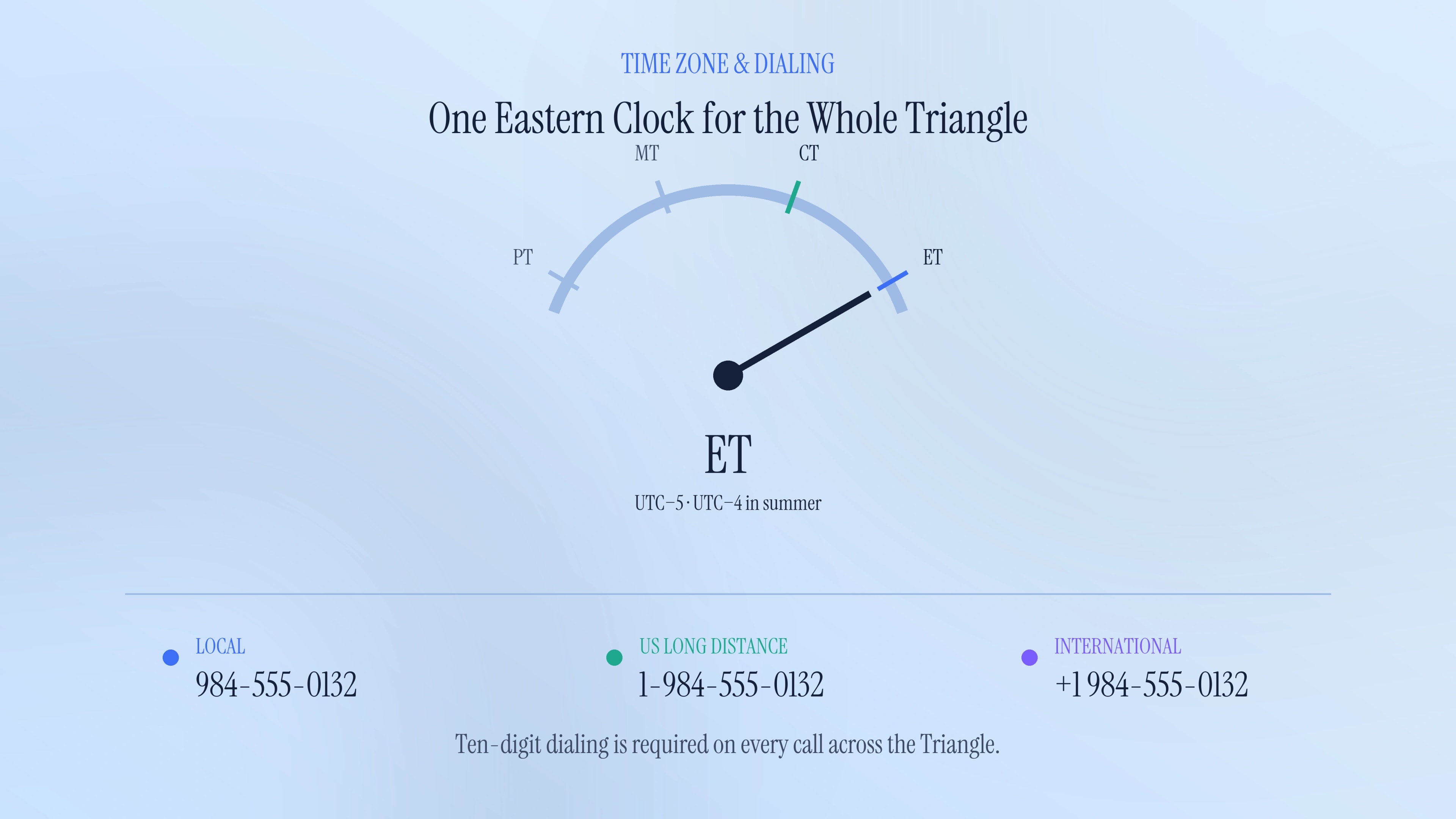
The entire Research Triangle observes Eastern Time (UTC−5), shifting to Eastern Daylight Time (UTC−4) from spring through fall — the same clock used by New York, Atlanta, and Washington, D.C. Businesses staffing support lines or scheduling callbacks into the Triangle should plan around Eastern hours, not the Pacific or Central schedules more common at national call centers. Getting that detail right keeps a Triangle number feeling genuinely local to the people answering and receiving calls.
Dialing and the 919 Overlay
Before 2012, Triangle residents could dial a local call with just seven digits. That changed once the overlay took effect. Because 919 and 984 cover the identical territory, the phone network can no longer assume which code a local number belongs to — so regulators required 10-digit dialing across the region during a permissive period from October 1, 2011 through March 31, 2012, ahead of the April 30, 2012 overlay date.
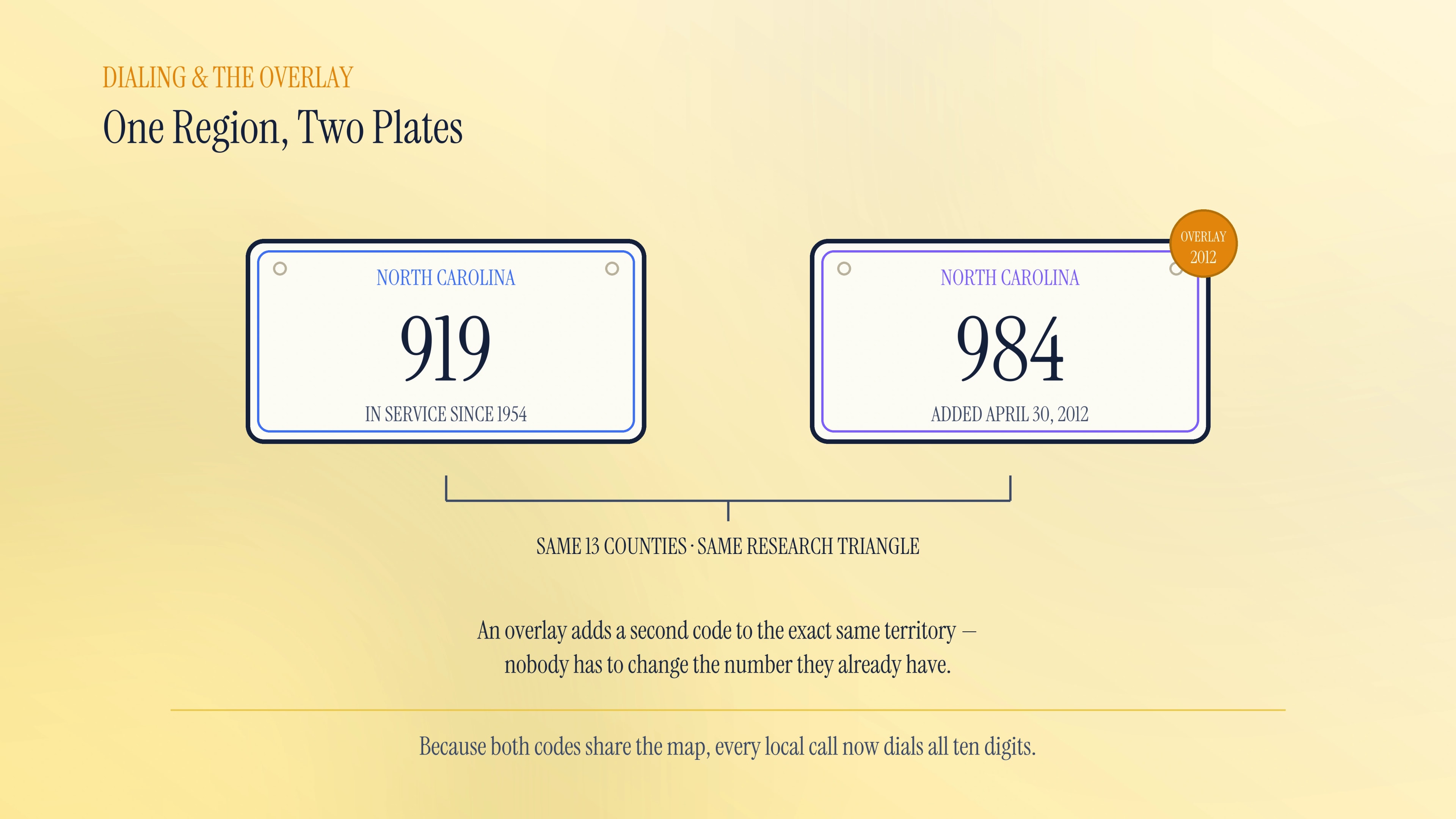
The practical result is simple: every local call in the Triangle — even between two neighbors on the same street — now needs the full area code plus the seven-digit number. For businesses, that makes it worth publishing every phone number in complete 10-digit form on websites, invoices, and signage, so no customer misdials a call that should have gone through on the first try.
How a 984 Number Benefits Your Business
A Triangle-rooted phone number does more than mark a location on a map; it shapes how a call is received before anyone even answers. Key advantages include:
- Stronger credibility: A local 984 or 919 number reassures Triangle customers that a business understands their market and is easy to reach.
- Higher answer rates: People are more likely to pick up a call from a recognizable regional code than an out-of-state or unfamiliar number.
- Brand presence: For national companies, a Triangle line establishes a real Research Triangle footprint without the cost of leasing local office space.
- Wider reach: Paired with a cloud phone system, one local number can route to a distributed team while still looking local to the caller.
Ready to Claim Your Research Triangle Line?
Acepeak makes it simple to activate a 984 number and connect it to a modern business phone platform — no hardware, no local office required. Set up call routing, voicemail, and analytics in one place, and start taking Triangle calls the same day.
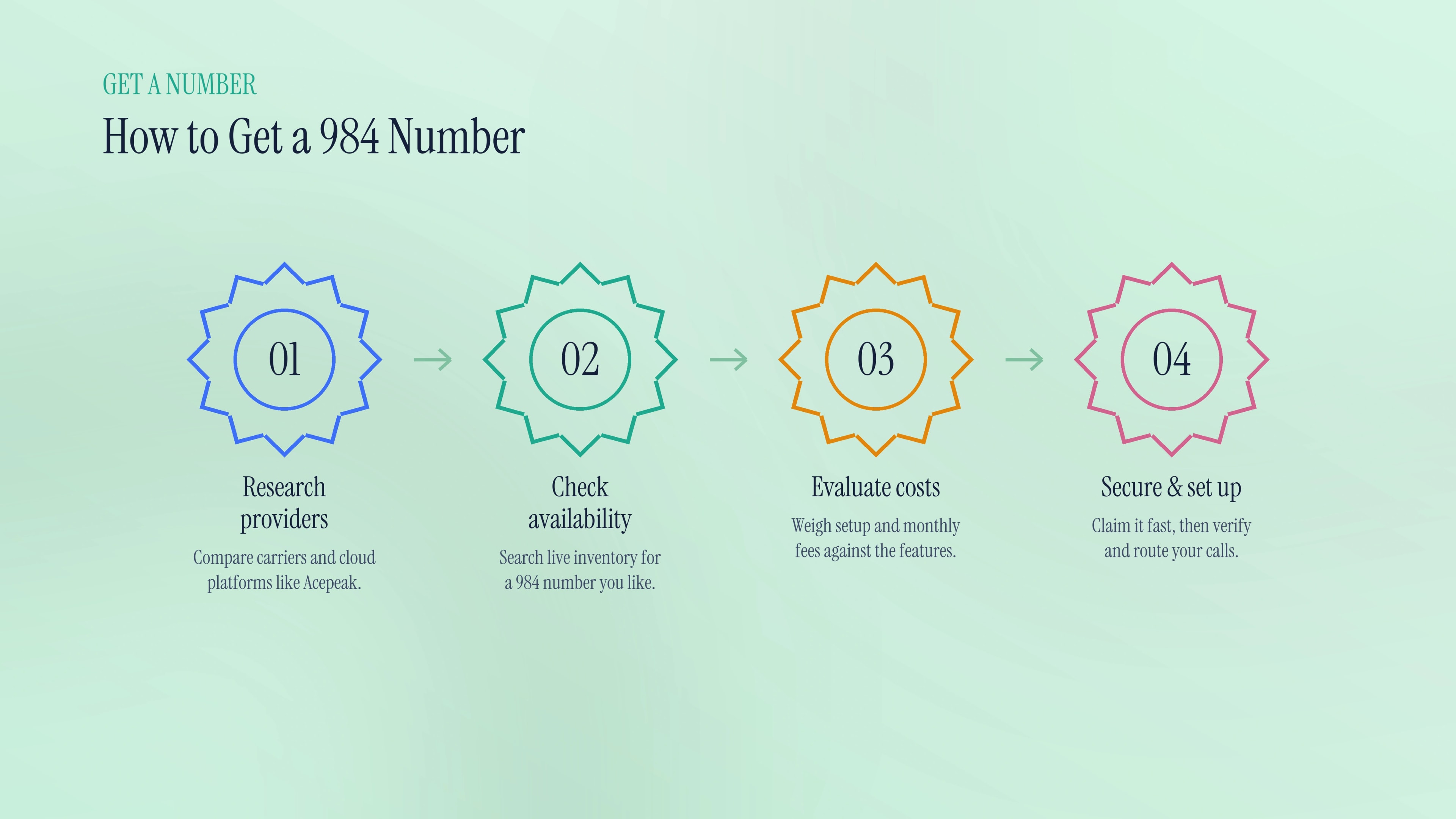
How to Get a 984 Number
Claiming a Research Triangle number follows a short, predictable sequence. Taking the steps below in order makes it easier to land a line that Raleigh and Durham callers find simple to recall and pass along:
- Research providers. Compare reputable phone-service providers that offer 984 numbers, checking reviews, uptime, and support quality.
- Check availability. Search current inventory for the exact prefix and ask about alerts when fresh numbers are released.
- Evaluate costs. Weigh upfront and recurring fees against included features like routing, voicemail-to-email, and analytics.
- Secure the number. Act quickly once a strong option appears, since desirable Triangle numbers move fast, then complete setup and verification.
Staying Aware of Scam Calls
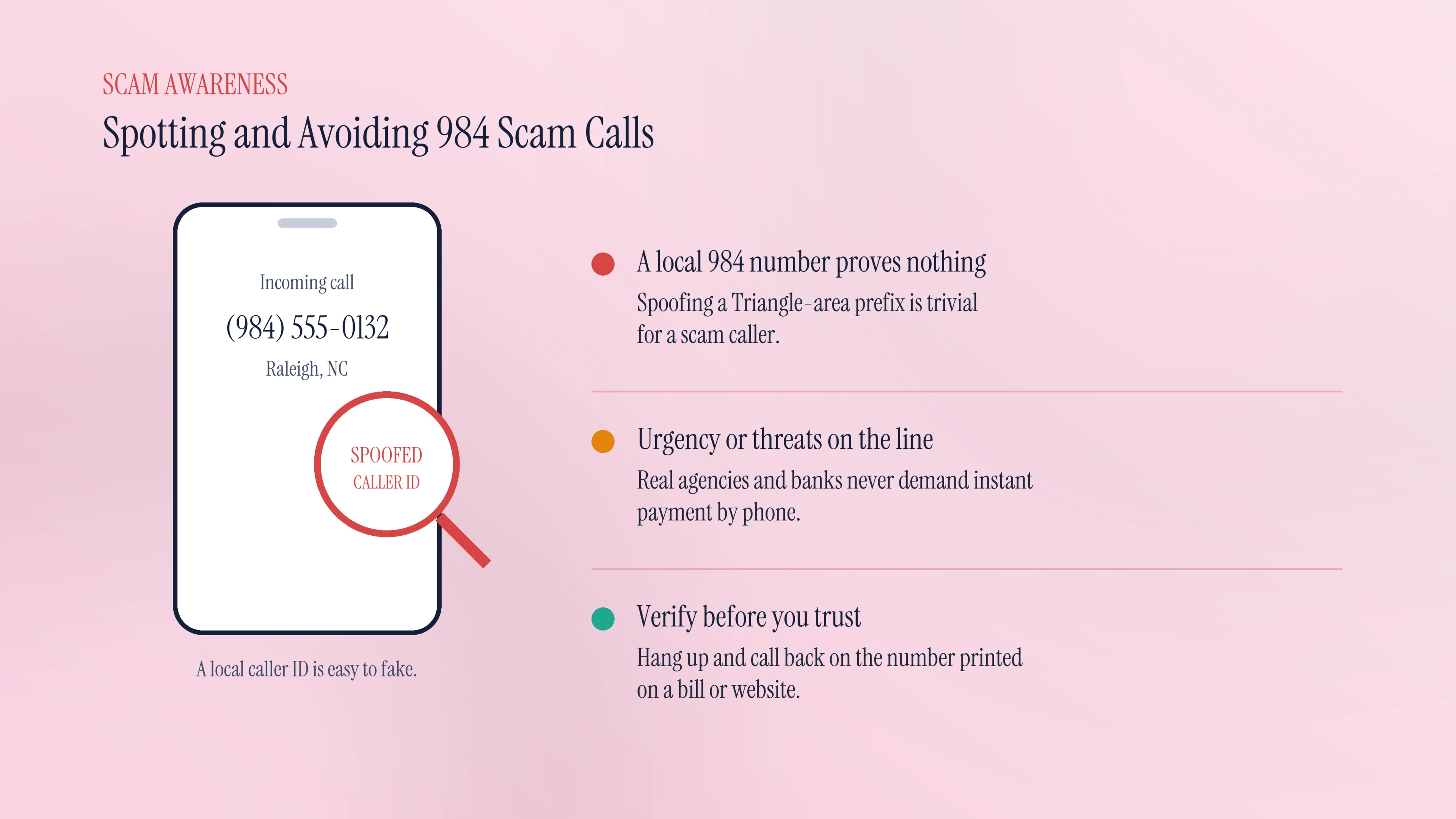
The same local familiarity that helps legitimate Triangle businesses can be abused by bad actors who spoof a 984 or 919 number to appear trustworthy. A few habits help customers and teams stay protected:
- Be wary of urgency. Threats, prizes, or "act now" pressure are classic warning signs, regardless of the code on the screen.
- Never share sensitive data on inbound calls. Verify the caller through an official number before giving any account or payment details.
- Confirm the source independently. Look up a company's published contact line rather than trusting a number that called you.
- Report and block. Flag suspicious calls so carriers and regulators can track spoofing patterns.
The Future of the 984 Area Code
Numbering projections from 2019 suggested the combined 919/984 pool would not need further relief for at least thirty years, even accounting for the Triangle's rapid growth. Regulation of that supply, along with the rest of the state's phone and utility infrastructure, falls to the North Carolina Utilities Commission, the same agency that authorized the 984 overlay in the first place.
That long runway matters for anyone setting up a Triangle line. An overlay leaves existing numbers untouched, so a 984 number claimed now is likely to keep serving a Raleigh or Durham business for years, and on a cloud phone system it can ring through to staff at home, a second office, or a team in another state without losing its Research Triangle character.
A Small Step Toward Trust in the Raleigh-Durham Market
More than a set of digits, 984 is a sign of how much the Research Triangle has grown since 919 first covered the whole region on its own. It offers businesses the same local credibility and higher answer rates as its older sibling, all without the overhead of a physical storefront. With modern cloud calling, claiming and running a Triangle line has never been easier. For any company serious about the Raleigh-Durham market, a local number is a small step that pays off in trust.
Take the Next Step with Acepeak
Give your business an authentic Research Triangle presence today. Acepeak activates local numbers fast and pairs them with a full-featured cloud phone system — routing, analytics, and support included.
Questions, answered.
No. 984 is an overlay for 919 — the two codes cover the exact same Research Triangle territory, and neither replaced or split off from the other's existing customers.
The overlay took effect on April 30, 2012, after the North Carolina Utilities Commission authorized it in September 2011.
The region follows Eastern Time (UTC−5), moving to Eastern Daylight Time (UTC−4) during daylight saving months.
Yes. Because 919 and 984 share the same territory, every local call requires the full 10-digit number, even between two nearby lines.
It reaches Raleigh, Durham, Cary, Chapel Hill, and Carrboro along with surrounding communities across thirteen counties, including Wake, Durham, Orange, and Chatham.
No. The two codes have identical standing — 984 was added purely to expand the number supply, not to signal a lesser or newer service area.
Signing up for a 984 area code number takes minutes with a cloud phone provider — no local office in North Carolina required. Pick the number, connect it to your existing phone or app, and calls route in immediately. This keeps the 984 area code presence you already have while adding the local credibility North Carolina customers respond to.