Raleigh, Durham and the Research Triangle
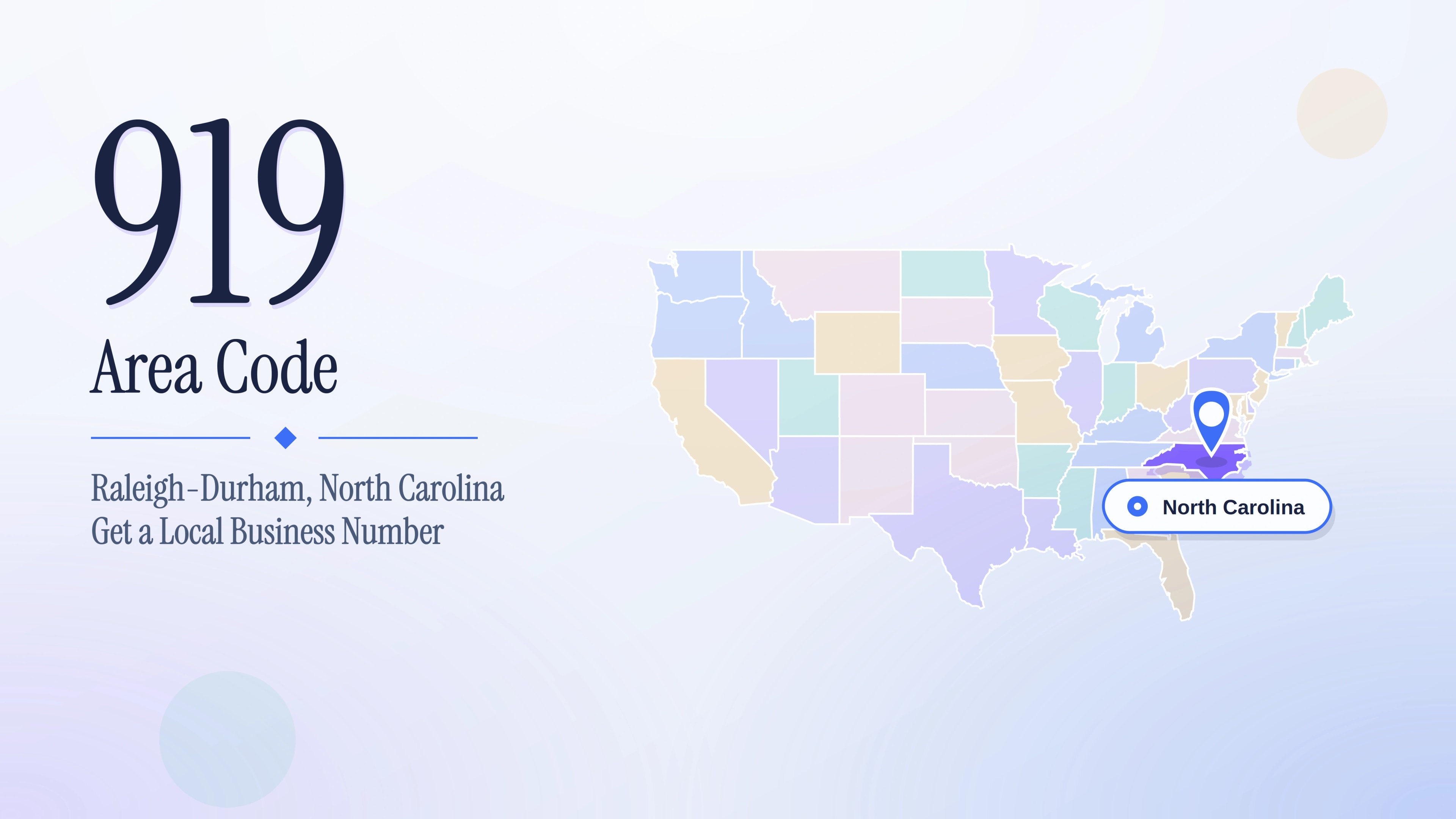
Area code 919 is one of North Carolina's original telephone prefixes, anchoring the Raleigh-Durham-Chapel Hill region known as the Research Triangle. For businesses and residents alike, understanding how this code works — its coverage, history, and dialing rules — makes it easier to recognize legitimate calls and decide whether a local number is worth getting.
Key Takeaways
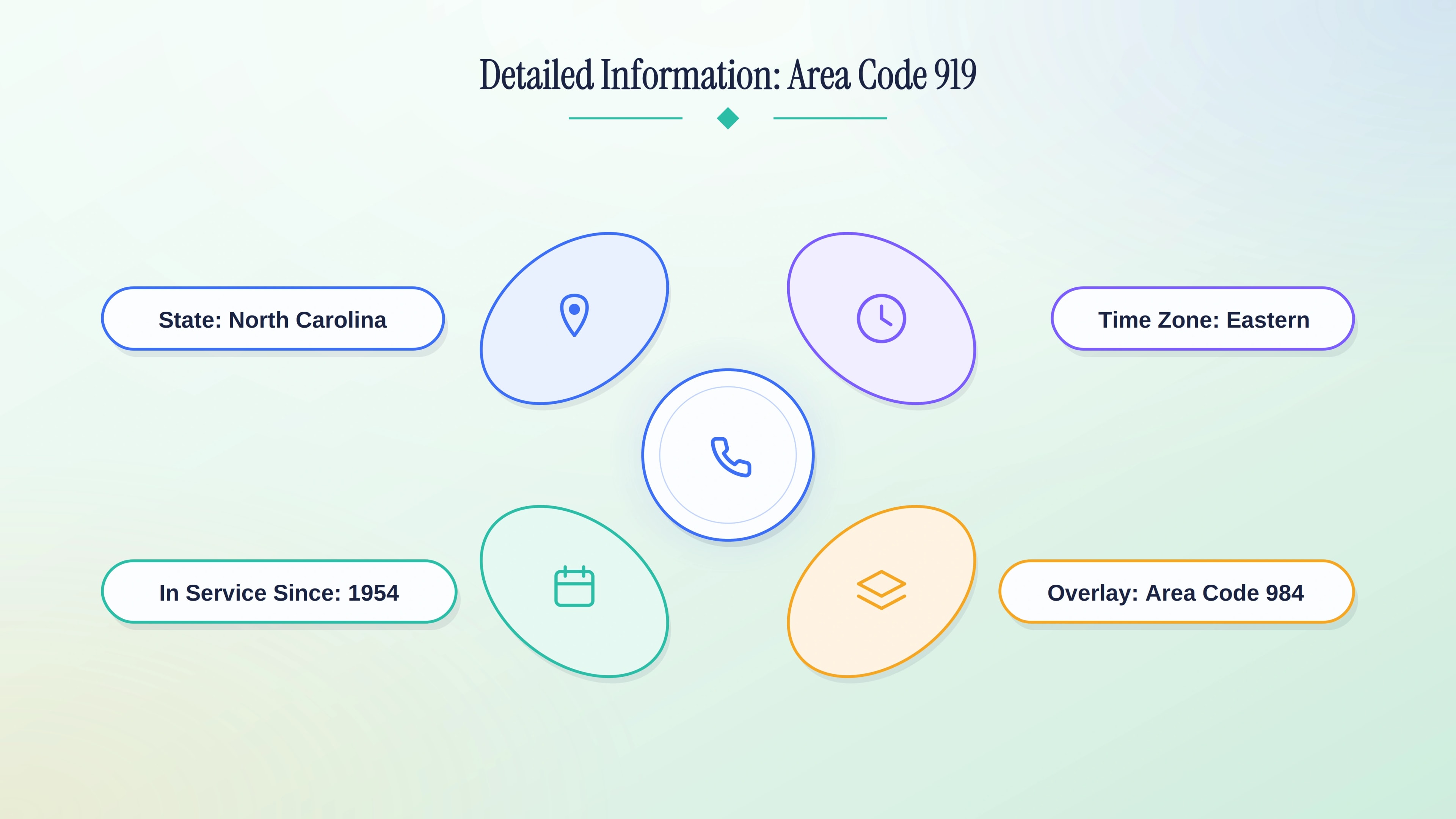
- Area code 919 was established in 1954 and serves central North Carolina, centered on the Research Triangle.
- It covers Raleigh, Durham, Cary, Chapel Hill, and dozens of surrounding communities across roughly a dozen counties.
- The 984 overlay was added in 2012, making 10-digit dialing mandatory for every local call.
- A local number in this prefix signals genuine presence in one of the Southeast's fastest-growing tech and research hubs.
- Scammers spoof this code like any other; legitimate callers never demand payment or personal data over the phone.
Where Is This Central North Carolina Code Centered?
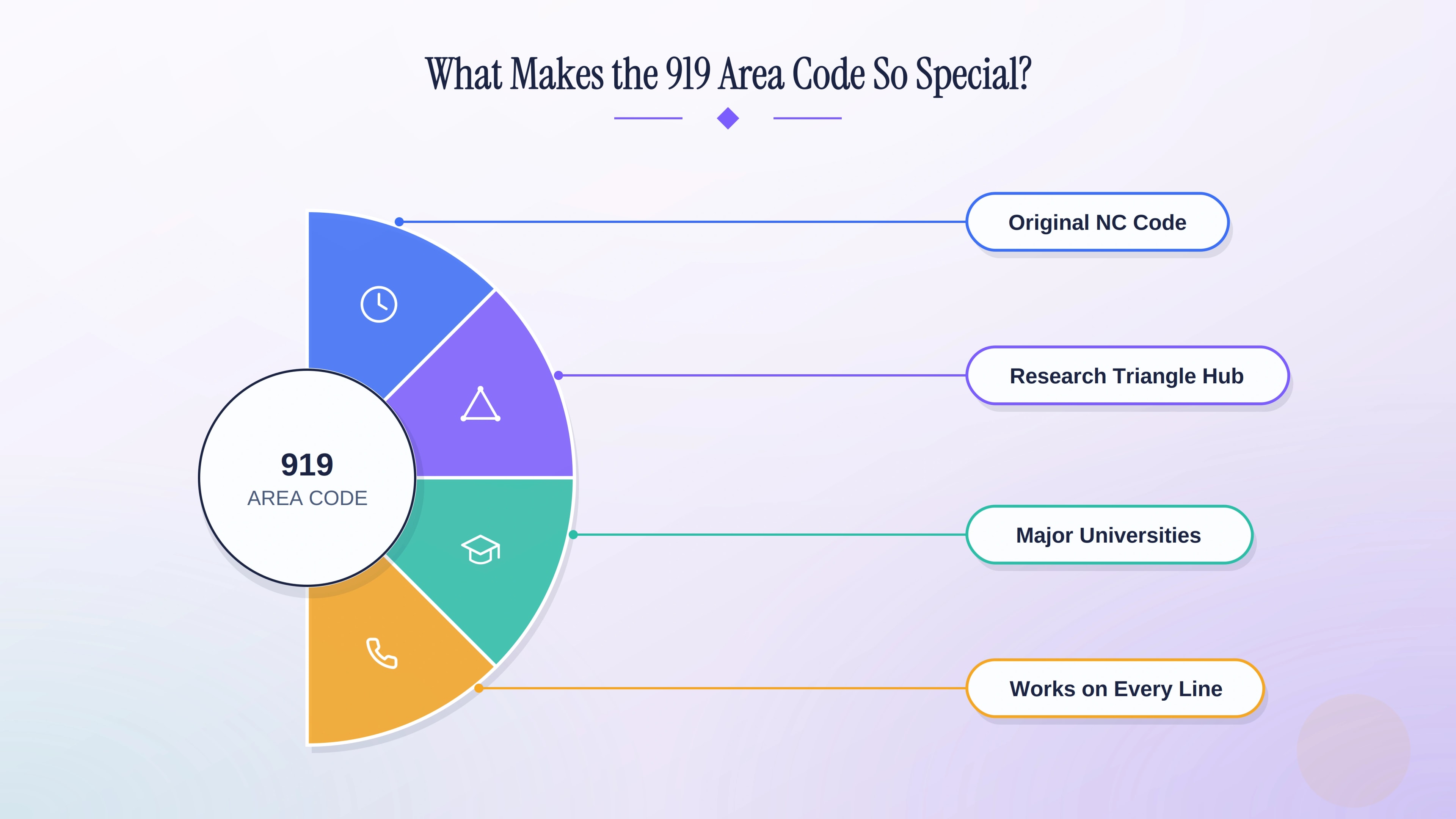
The 919 area code is a North American Numbering Plan (NANP) prefix for central North Carolina. Its commercial and population center is the Research Triangle Park (RTP) region. The code covers Raleigh — the state capital — along with Durham, Cary, and Chapel Hill. It also reaches a ring of smaller cities, including Apex, Wake Forest, Morrisville, Goldsboro, Clayton, and Hillsborough.
The region sits entirely in the Eastern Time Zone (UTC-5, UTC-4 during daylight saving). It is home to North Carolina State University, Duke University, and the University of North Carolina at Chapel Hill — three major research institutions that, alongside RTP's technology and biotech employers, give the area its reputation as one of the country's leading innovation corridors. A number with this prefix is now used across landline, mobile, and cloud-based business phone systems.
History of This Prefix
North Carolina was originally served by a single area code, 704, when the NANP launched in 1947. As the state's population grew, regulators split the eastern and central portions off into a new code, 919, on January 1, 1954 — making it the 95th area code activated in North America and one of five introduced that year.
Demand kept climbing through the second half of the century. In 1998, the northeastern part of the original 919 territory — including Rocky Mount and Greenville — split off to form area code 252, shrinking 919 to roughly its present footprint. By the early 2000s, the Triangle's population boom and the rise of cell phones and pagers had exhausted much of the remaining number supply. Rather than splitting the region again, the North Carolina Utilities Commission introduced an overlay: area code 984 went into effect on April 30, 2012, after a permissive dialing period that ran from October 2011 through March 2012.
For a broader look at how regional codes evolve as metro areas expand, this 470 area code guide covers a comparable overlay story out of Atlanta.
Cities and Counties Covered by the 919 Area Code
The 919/984 complex spans roughly 12 to 19 counties, depending on how ZIP-code overlap is counted. Estimates put the combined population between 1.9 million and 2.5 million. The core counties are Wake, Durham, Orange, Chatham, and Johnston. Partial coverage extends into Alamance, Cumberland, Granville, Harnett, Lee, and Person counties.
Major cities and towns served include Raleigh, Durham, Cary, Chapel Hill, Carrboro, Apex, Wake Forest, Morrisville, Garner, Knightdale, Clayton, Goldsboro, Smithfield, Hillsborough, Pittsboro, Fuquay-Varina, Zebulon, Oxford, Louisburg, Sanford, and Mebane.
This footprint makes 919 one of the more economically significant area codes in the Southeast — the Triangle's combination of state government, two major research universities, and a dense biotech and software employer base drives consistent population and business growth in the region.
How a 919 Number Benefits Your Business
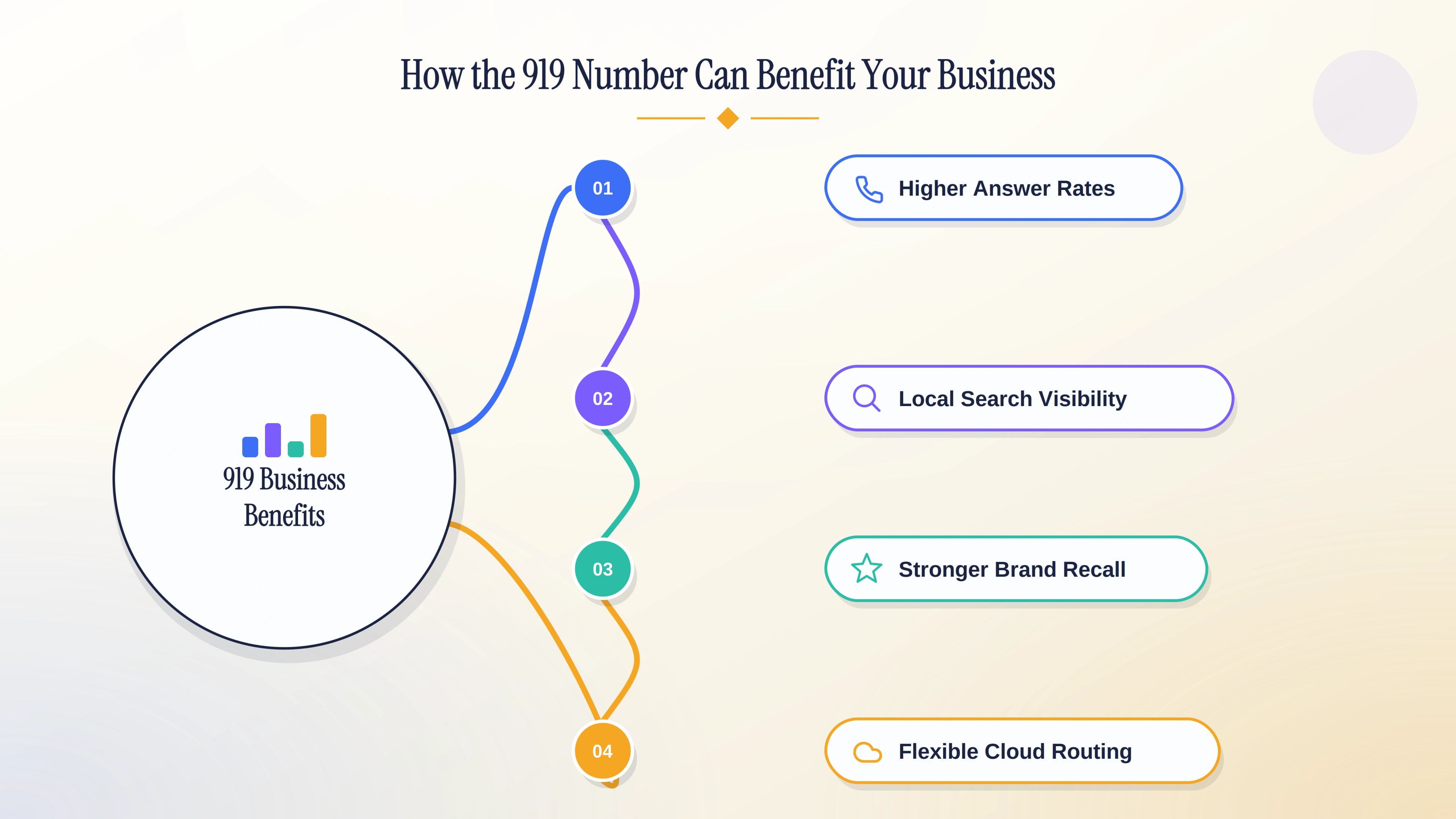
A local 919 number gives a business an instant signal of Triangle-area presence. That matters: customers are far more likely to answer a recognizable regional prefix than an out-of-state or toll-free number. A higher answer rate means more completed sales calls, faster customer service, and stronger response to local marketing campaigns.
A regional number brings more than answer rates. It supports local search and directory listings that expect a matching area code. It also aids brand recall for customers already familiar with Raleigh-Durham businesses. And it lets you route calls anywhere through a cloud phone system. A company does not need a physical Triangle office to use a 919 line. Modern platforms can ring any device or team member, wherever staff are located.
Establish a credible Research Triangle presence in minutes.
Acepeak makes it simple to provision, port, and manage a Raleigh-Durham business number from anywhere — no office required.
How to Get a 919 Area Code Number
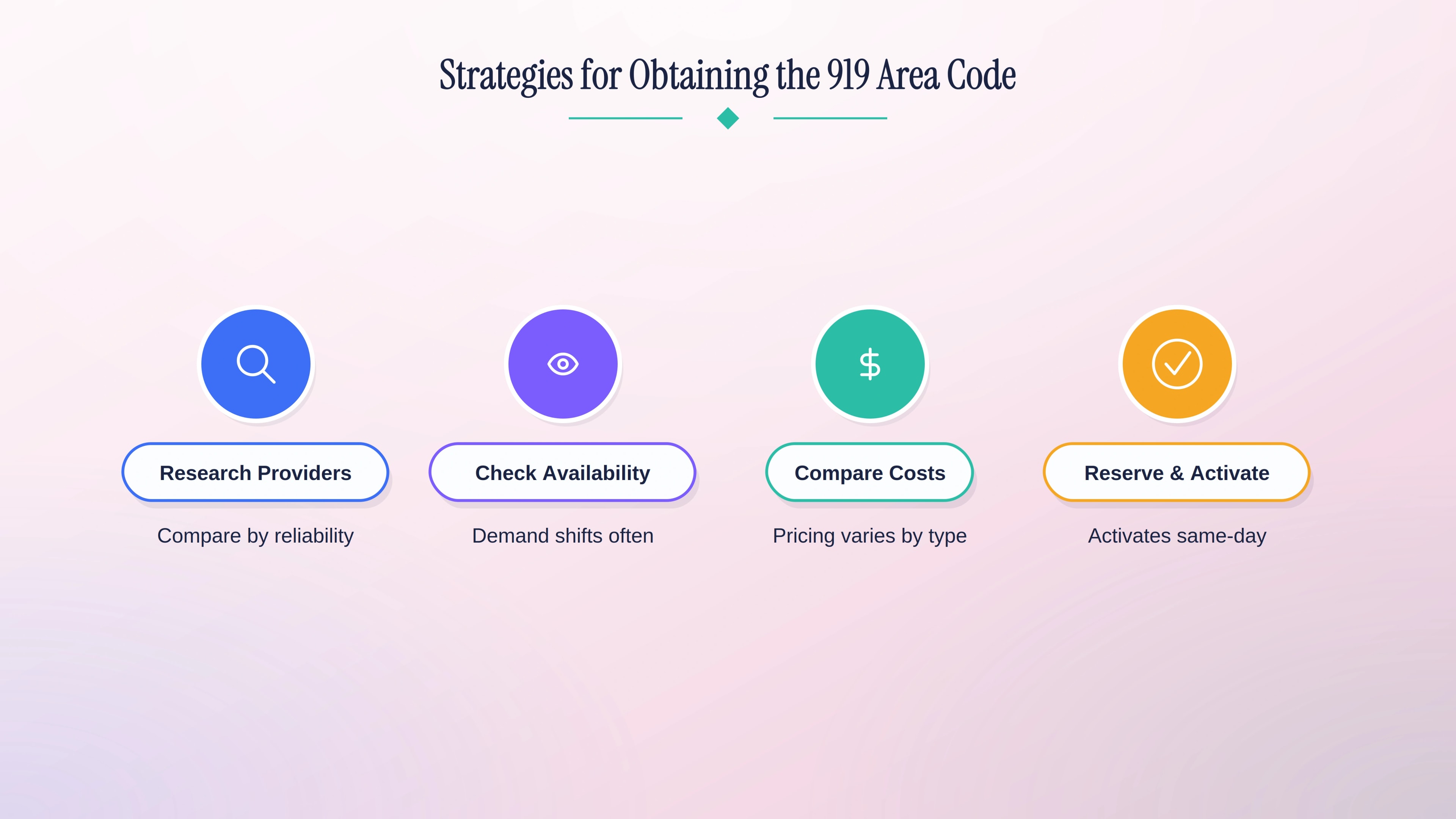
Acquiring a number in this prefix follows the same general process used across most U.S. area codes:
- Research providers: compare traditional carriers, mobile providers, and cloud phone platforms that offer Triangle-area numbers, checking reviews and reliability track records.
- Check availability: because demand for memorable or vanity numbers is high, availability shifts regularly; some providers offer alerts when new numbers open up.
- Compare costs: pricing varies by provider and number type — standard numbers are typically inexpensive, while premium or vanity numbers can cost more.
- Reserve and activate: once a suitable number is found, most cloud-based providers complete activation the same day, with no physical address or hardware required.
For comparison, a similarly structured university-and-tech-hub market is covered in this 706 area code guide, which walks through the same acquisition steps for northern Georgia.
Dialing Rules for the 919 Area Code
Because 919 shares its territory with the 984 overlay, 10-digit dialing is required for every call in the region. There is no 7-digit local option, even between two numbers in the same town. The standard formats are:
- Local: 919-XXX-XXXX
- Domestic long distance: 1-919-XXX-XXXX
- International: country exit code + 1 + 919-XXX-XXXX (for example, 011-1-919-555-1234 from many countries)
Businesses should always print the full 10-digit number, including the area code, on websites, invoices, and marketing materials to avoid confusion.
919 Area Code Scams to Watch For
Like any recognizable prefix, 919 numbers are often spoofed. Scammers hope a local-looking caller ID makes someone more likely to pick up. Common schemes include callers posing as government agencies or utilities and demanding immediate payment. Others run fake tech-support calls claiming a device is infected, or robocalls pushing health products, car warranties, or prize offers.
Legitimate organizations do not demand payment by gift card, wire transfer, or cryptocurrency, and they do not threaten immediate arrest over the phone. Recipients of suspicious calls should avoid sharing personal or financial information, hang up, and verify the caller independently using an organization's official published number. Area codes across the state are administered by the North Carolina Utilities Commission, which oversaw the 984 overlay.
Ready to put a Research Triangle number to work?
Acepeak activates 919 business lines with call routing, analytics, and CNAM caller ID — same-day, no hardware.
Triangle Presence Without a Triangle Office
The 919 area code has anchored central North Carolina's telecommunications network since 1954, growing alongside the Research Triangle into one of the Southeast's most recognizable regional prefixes. Between its deep roots in Raleigh, Durham, and Chapel Hill and the steady economic growth driven by RTP's tech and research base, a 919 number still carries real local weight — whether the goal is establishing business credibility, staying connected to home, or simply recognizing a legitimate call when one comes in.
Questions, answered.
It identifies a phone number as originating from central North Carolina's Research Triangle region, covering Raleigh, Durham, and Chapel Hill.
No. It is a standard geographic area code; toll-free codes include 800, 833, 844, 855, 866, 877, and 888.
Area code 984, introduced in 2012, shares the exact same territory and requires 10-digit dialing.
Yes. Numbers can typically be ported to a new carrier or location without changing the prefix.
File a report with the FTC at reportfraud.ftc.gov, or report it directly to your phone service provider.
Population growth and the proliferation of mobile and internet-based lines exhausted the original 919 supply, so regulators added 984 rather than redrawing geographic boundaries again.
Signing up for a 919 area code number takes minutes with a cloud phone provider — no local office in Raleigh-Durham required. Pick the number, connect it to your existing phone or app, and calls route in immediately. This keeps the 919 area code presence you already have while adding the local credibility North Carolina customers respond to.