Identifying Callers and Building Trust in Northern Georgia
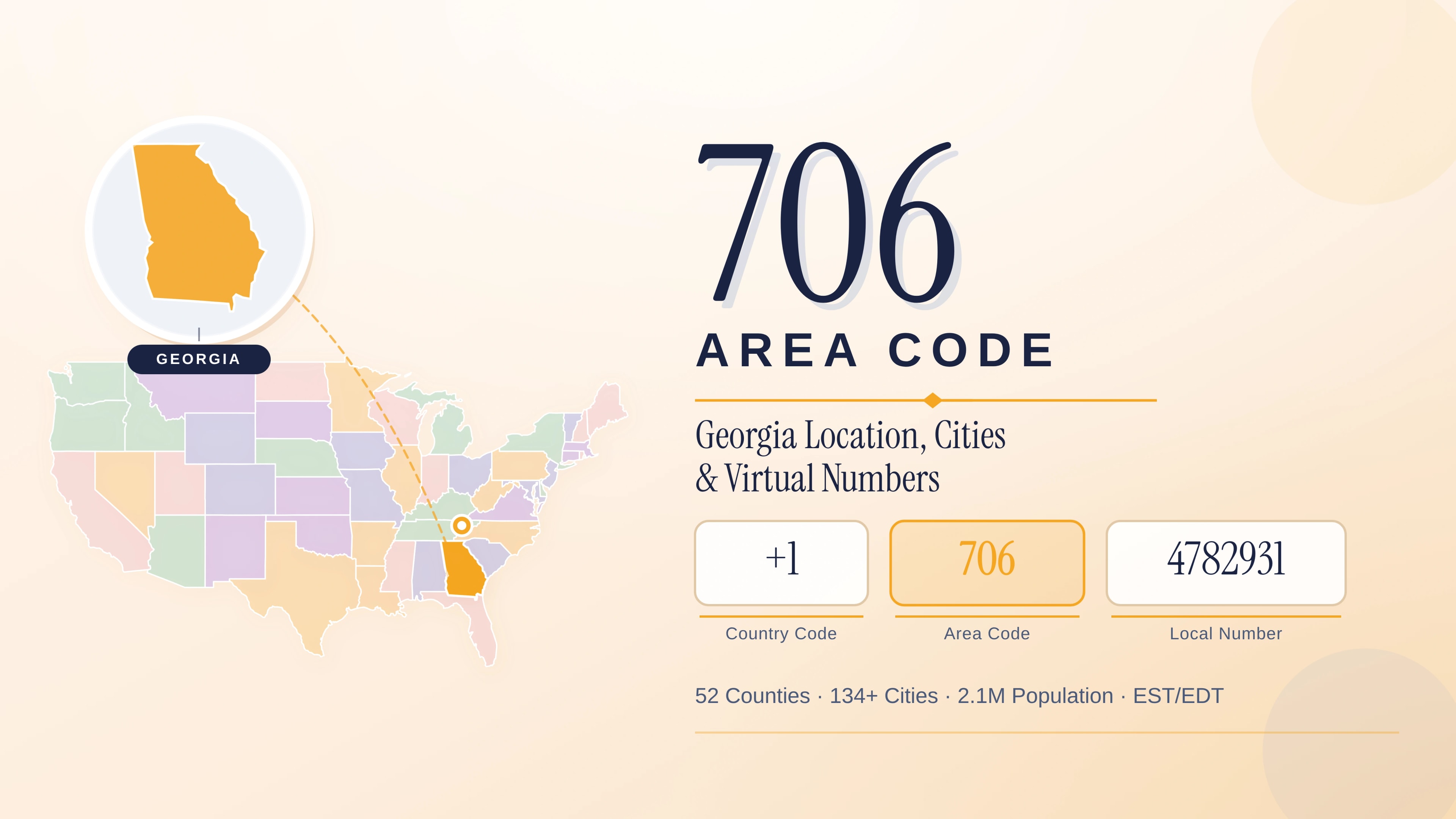
If you have received a call from a 706 number — or you are a business owner looking to build a credible local presence in northern Georgia — this guide covers everything you need to know. This prefix serves a large portion of the Peach State, spanning major cities like Augusta, Columbus, and Athens, plus dozens of smaller communities across more than 52 counties.
Assigned in 1992 as a split from the original 404 Georgia area code, 706 has grown into one of the state's most recognized regional codes. Whether you are trying to identify an unknown caller, understand how 706 relates to its 762 overlay, protect yourself from neighbor-spoofing scams, or secure a virtual 706 phone number for business outreach — this post gives you clear, accurate answers you can act on.
Key Takeaways
- The 706 area code covers northern and west-central Georgia, including Augusta, Columbus, Athens, Rome, and Dalton — across 52+ counties.
- It was created on May 3, 1992, as a geographic split from Georgia's original 404 area code.
- The overlay area code 762 was added in 2005 and serves the exact same region; calls between them are local.
- The 706 region operates entirely in the Eastern Time Zone (UTC-5/UTC-4 DST), serving a combined population of ~2.1 million.
- Roughly 71% of spam calls spoofing this prefix use neighbor spoofing — always verify unsolicited callers before sharing any information.
- Businesses can get a virtual 706 number from Acepeak to establish instant local trust in Georgia — no physical office required.
What Is the 706 Area Code?
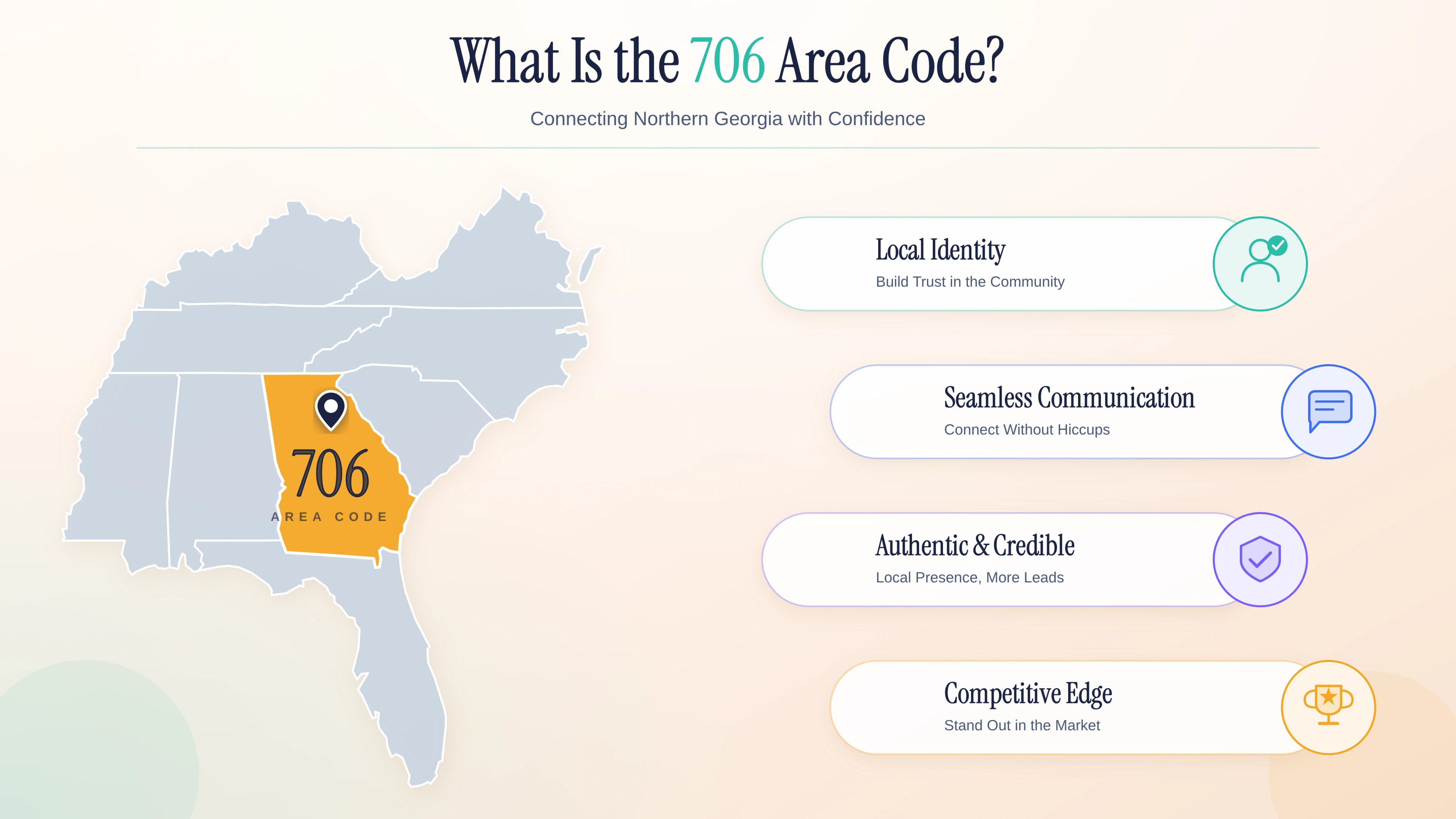
This prefix is a North American Numbering Plan (NANP) telephone area code assigned to the northern and west-central regions of Georgia — specifically excluding the Atlanta metropolitan area. It spans 52 counties and serves more than 2.1 million people across 134+ cities.
The three major population centers in the 706 region are Augusta — home to the Masters golf tournament and the military installation at Fort Eisenhower (formerly Fort Gordon); Columbus — Georgia's second-largest city and gateway to Fort Moore (formerly Fort Benning); and Athens — a vibrant university town and home of the University of Georgia.
The area code operates entirely within the Eastern Time Zone, meaning business calls to 706 numbers follow Eastern Standard Time (UTC-5) or Eastern Daylight Time (UTC-4) depending on the season. One key distinction: this prefix is not a toll-free number — calls are billed as standard local or long-distance depending on your phone plan.
History of the 706 Area Code
This prefix was born out of necessity. In the early 1990s, the 404 area code covered virtually all of Georgia, and rapid population growth was exhausting the available pool of phone number combinations. To keep up with demand, the North American Numbering Plan Administrator (NANPA) approved a geographic split.
On May 3, 1992, area code 706 went live, taking over number assignments for all of Georgia outside the Atlanta metro area — making it one of the largest single-state code splits in U.S. telephony history.
Key milestones in the life of 706:
- 1992 — 706 area code activated; splits from the 404 area code
- 1995 — Area code 770 created to further relieve Atlanta-area numbering pressure
- 2005 — NANPA assigns area code 762 as an overlay for the 706 region
- 2006 — Mandatory 10-digit dialing begins across the 706/762 numbering plan area
For businesses, this history matters: this prefix is a mature, well-established code — not some obscure or recently spun-up prefix. Customers in northern Georgia recognize it immediately as local.
Cities and Counties the 706 Area Code Covers
Unlike area codes tied to a single metro, this prefix covers three geographically distinct, non-contiguous regions of Georgia:
- Northeast Georgia — including Augusta, Athens, Gainesville corridor communities, and Toccoa
- Northwest Georgia — including Rome, Dalton, and Calhoun
- West-Central Georgia — including Columbus and LaGrange
Here are the most populous cities in the 706 region:
| City | County | Region |
|---|---|---|
| Augusta | Richmond | Northeast GA |
| Columbus | Muscogee | West-Central GA |
| Athens | Clarke | Northeast GA |
| Rome | Floyd | Northwest GA |
| Dalton | Whitfield | Northwest GA |
| LaGrange | Troup | West-Central GA |
| Gainesville | Hall | Northeast GA |
| Toccoa | Stephens | Northeast GA |
| Calhoun | Gordon | Northwest GA |
| Cornelia | Habersham | Northeast GA |
Combined, this prefix covers more than 52 counties and — together with the 762 overlay — serves a total population of approximately 2.1 million people. That is a substantial Georgia market for any business looking to build a regional footprint.
Get a 706 Georgia Number That Builds Local Trust
A virtual 706 number gives your business instant credibility with Georgia customers — no relocation required. Acepeak's 706 virtual numbers include full cloud phone features and same-day activation.
The 762 Overlay — What You Need to Know
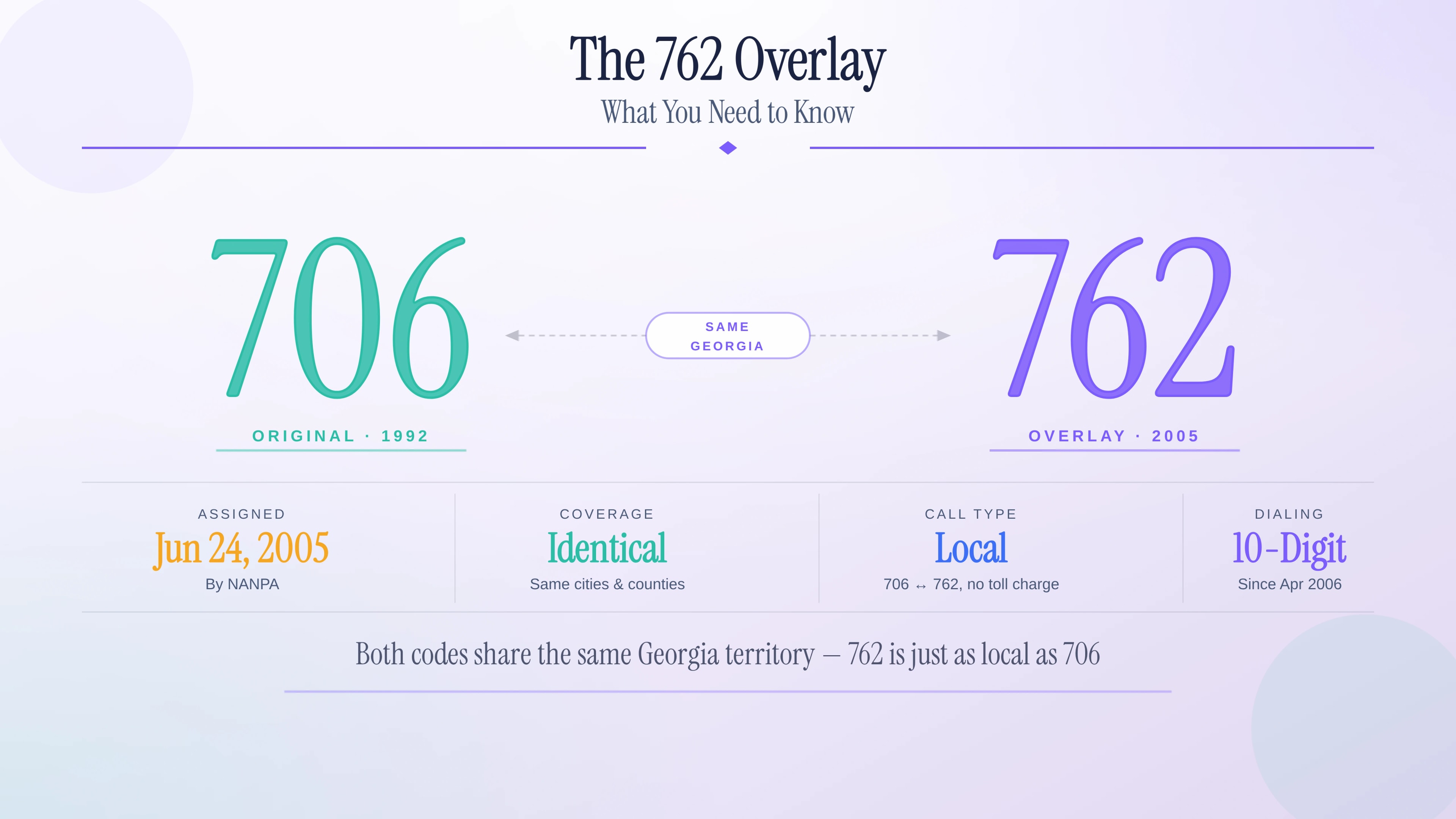
When an area code runs out of available number combinations, regulators add an overlay code — a second area code that covers the identical geographic territory. For the 706 region, that overlay is area code 762.
NANPA assigned 762 on June 24, 2005, to handle growing phone number demand across northern and west-central Georgia. Since then, both 706 and 762 numbers have been issued to the same cities and counties.
What this means practically for callers and businesses:
- Calls between 706 and 762 numbers are treated as local calls, not long-distance.
- Both area codes carry equal geographic identity — customers recognize 762 as Georgia just as readily as 706.
- Since April 2006, 10-digit dialing is mandatory in the region — you must always include the area code, even for local calls.
- Businesses acquiring a new Georgia number may receive either 706 or 762 — both signal the same local presence.
If you are specifically targeting Augusta, Columbus, or Athens customers, both codes work. That said, 706 carries the longer brand history and is the code most people associate with northern Georgia.
Is the 706 Area Code a Scam?
This prefix is a completely legitimate Georgia phone code used by millions of residents, businesses, and government institutions. However, scammers have increasingly exploited it through a tactic called neighbor spoofing — faking a caller ID that matches your local area code to trick you into picking up.
Approximately 71% of reported spam calls from 706 numbers use neighbor spoofing. Here is a breakdown of the most common scam types:
| Scam Call Type | Share of Reports |
|---|---|
| Auto Warranty | 14.08% |
| Medicare / Medicaid | 12.98% |
| Health Insurance | 11.60% |
| Home Improvement | 5.25% |
| Credit Card Debt | 4.14% |
How to protect yourself:
- Never provide personal or financial information to unsolicited callers.
- Use your phone's built-in spam detection or a third-party call-blocking app.
- Report suspected scam calls to the FTC at reportfraud.ftc.gov.
- If in doubt, hang up and call the organization back using its official published number.
A real call from a business or individual in the 706 region is nothing to fear. Staying aware of these patterns simply helps you tell the difference between a genuine Georgia caller and a spoofed fraud attempt.
How to Get a 706 Virtual Phone Number for Your Business
For businesses targeting customers in Augusta, Columbus, Athens, or anywhere else in the 706 region, a virtual phone number offers a powerful credibility boost — without requiring you to physically relocate to Georgia.
Virtual phone numbers are cloud-based numbers that route incoming and outgoing calls to any device or team member, anywhere in the world. Customers see a familiar local Georgia number on caller ID, which increases answer rates and builds confidence from the very first ring.
Key Benefits of a 706 Virtual Number for Business
- Local trust — Georgia customers are significantly more likely to answer a call from a local area code they recognize.
- CNAM caller ID — display your business name (not just a number) on outbound calls.
- Call routing flexibility — forward calls to mobile, desk phone, or a full call center queue.
- Scalability — add lines, extensions, or IVR menus as your team grows.
- No hardware required — entirely cloud-based; go live from any internet connection.
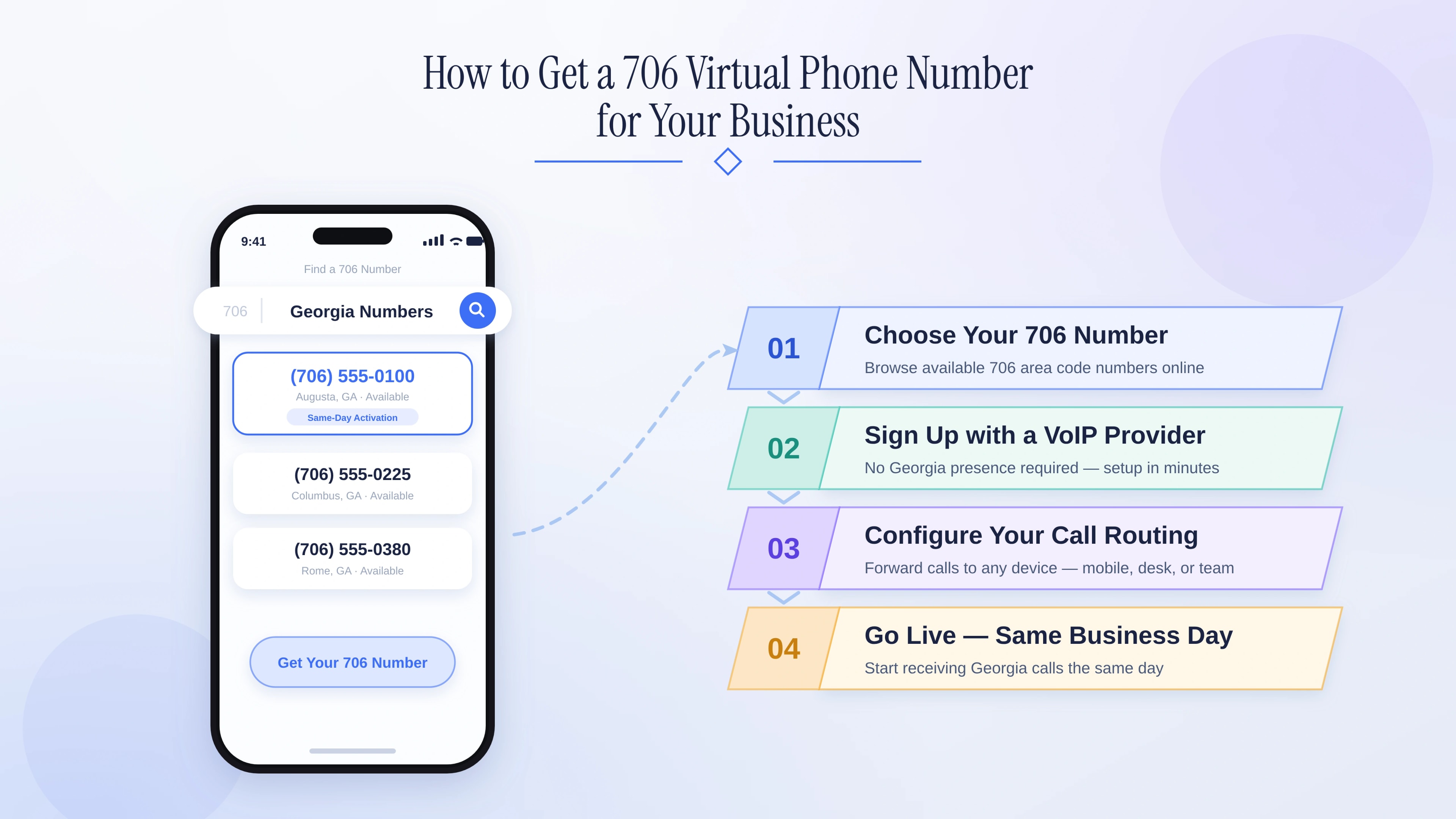
Getting started with Acepeak is straightforward: choose your preferred 706 number, configure your call routing, and activate — often within the same business day. Whether you are a solo consultant testing the Georgia market or a growing sales team building regional coverage, a virtual 706 area code number is one of the fastest, lowest-cost ways to establish a credible local presence, backed by verified caller ID and CNAM on every outbound call.
Ready to Establish Your Georgia Presence?
Get a virtual 706 area code number from Acepeak — same-day activation, CNAM caller ID, and full cloud phone features. No office. No hardware.
Same-Day Georgia Presence with No Relocation or Hardware
This prefix is one of Georgia's most established regional codes, covering a vast stretch of northern and west-central Georgia — from the university town of Athens to the historic city of Augusta to the industrial hub of Columbus. Created in 1992 and joined by the 762 overlay in 2005, it serves over 2.1 million people across 52+ counties and operates entirely in the Eastern Time Zone.
Whether you are decoding an unknown incoming call, mapping the 706/762 overlay relationship, or protecting yourself from neighbor-spoofing scams, this guide gives you the full picture. And for businesses ready to tap into the Georgia market, a virtual 706 number from Acepeak is the fastest way to build local trust — no relocation, no hardware, same-day setup.
Questions, answered.
This prefix is in Georgia, covering the northern and west-central regions of the state — including cities like Augusta, Columbus, and Athens.
This prefix covers over 134 cities. The most populous are Augusta, Columbus, Athens, Rome, Dalton, and LaGrange.
Area code 762 is the overlay assigned in 2005 to handle new number demand in the same geographic region as 706. Calls between the two codes are treated as local calls.
Not necessarily — 706 is a legitimate Georgia area code. However, scammers do spoof 706 numbers using neighbor spoofing, so be cautious with unsolicited calls requesting personal or financial details.
You can get a virtual 706 number through a VoIP provider like Acepeak — no physical presence in Georgia required, and setup typically completes within one business day.
Signing up for a 706 area code number takes minutes with a cloud phone provider — no local office in Georgia required. Pick the number, connect it to your existing phone or app, and calls route in immediately. This keeps the 706 area code presence you already have while adding the local credibility Georgia customers respond to.