Introduction
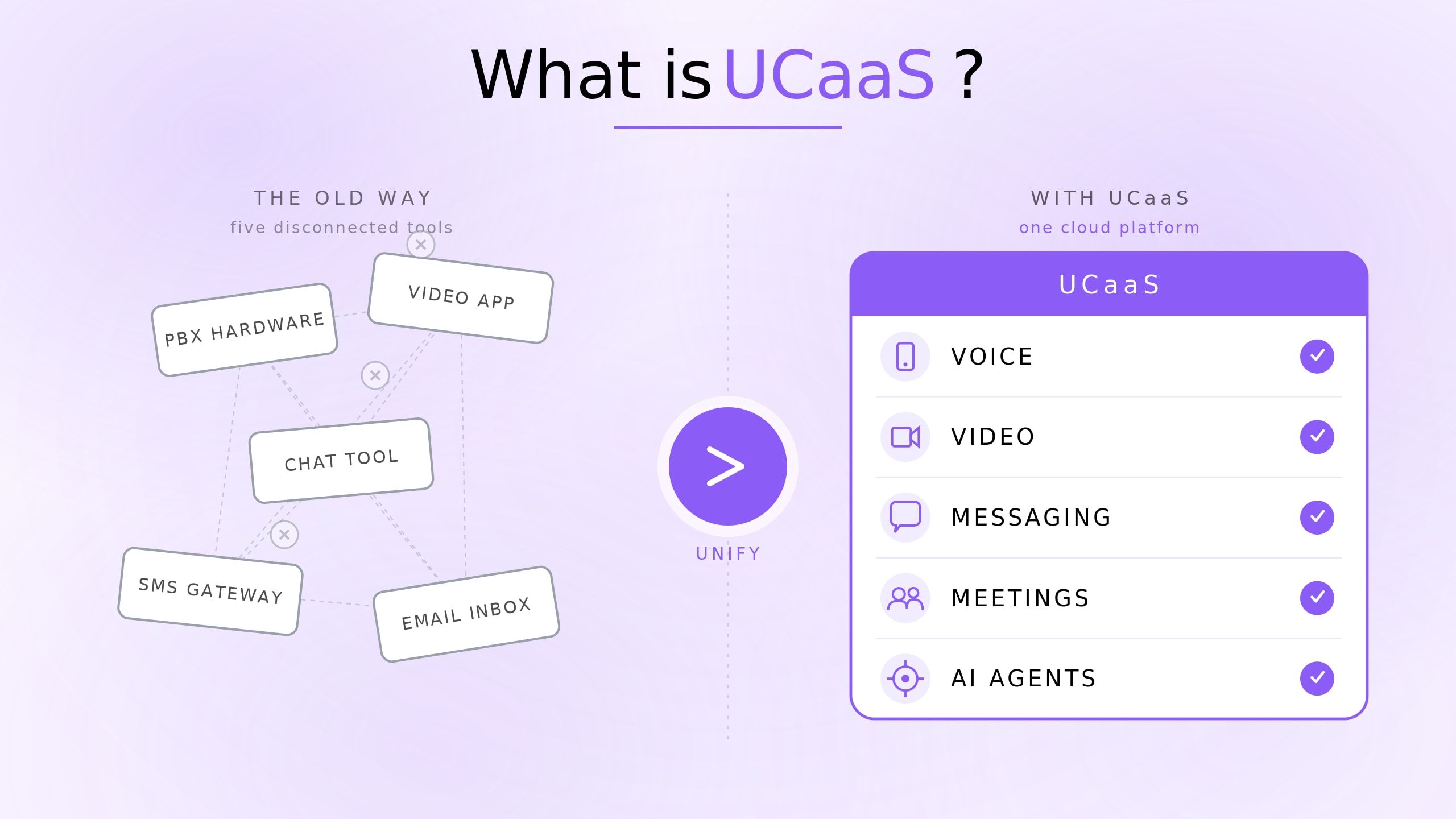
If your team still juggles a phone system, a video app, a chat tool, an SMS gateway, and a customer inbox — UCaaS is the layer that collapses them into one. Unified Communications as a Service delivers every channel your business needs to talk, internally and externally, from a single cloud platform. In 2026, the best UCaaS platforms also ship an AI receptionist that picks up every call in under half a second. Here’s what it is, how it works, and what to look for.
Key Takeaways
- UCaaS = cloud-delivered business communications on one platform — voice, video, SMS, meetings, messaging, AI agents.
- One vendor, one invoice, one login. No PBX in a closet, no stitched-together stack.
- Modern UCaaS is AI-native. AI receptionists, real-time transcription, sentiment, and auto-CRM updates are baseline in 2026, not upgrades.
- UCaaS isn’t VoIP. VoIP is the protocol for cloud calling. UCaaS is the full platform that uses VoIP plus everything else.
- Look for Tier 1 carrier networks, SOC 2 Type II, native CRM integrations, and AI included by default — not as an upsell.
What does UCaaS actually mean?
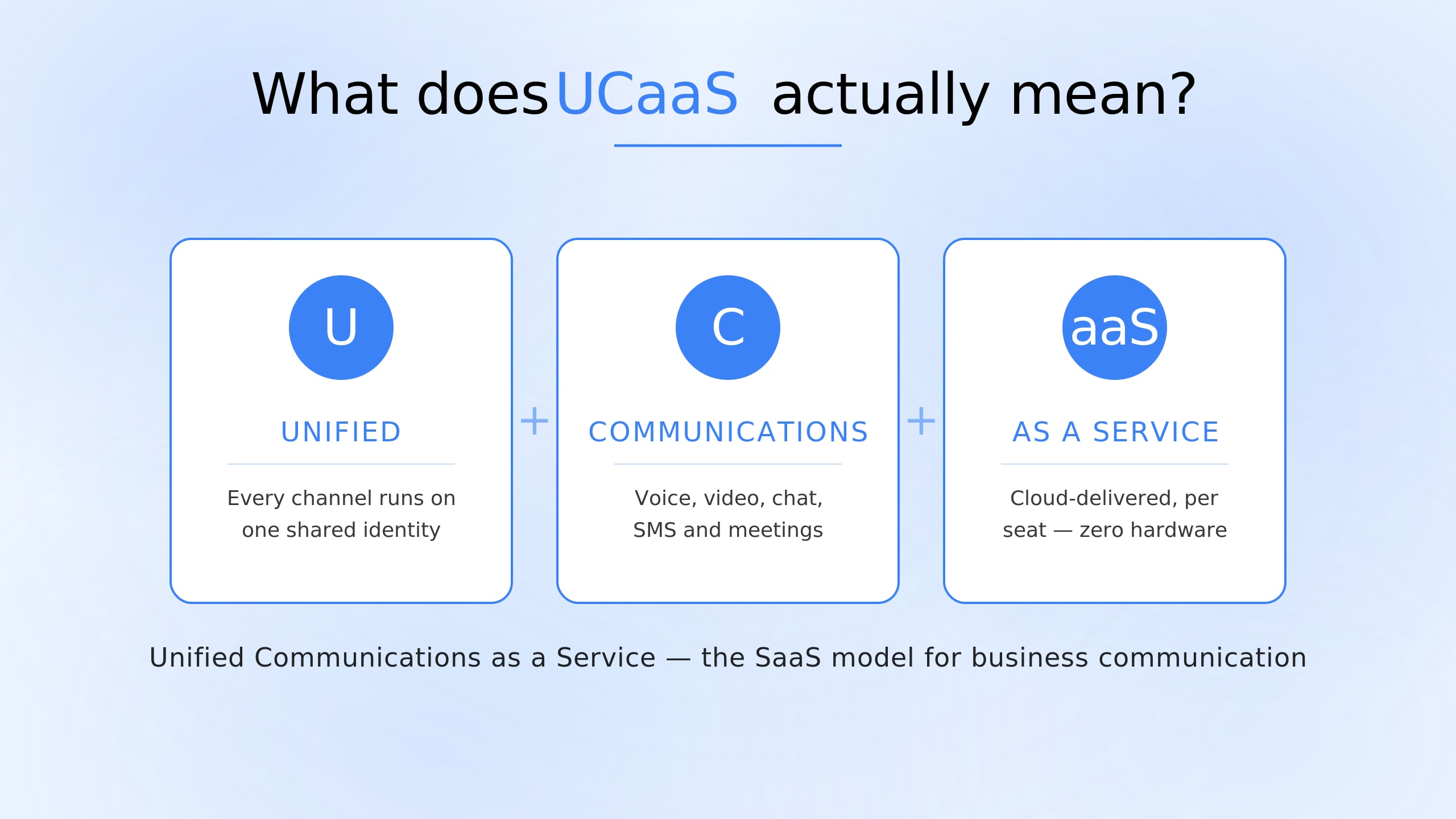
UCaaS stands for Unified Communications as a Service. It’s the SaaS model applied to business communication.
Instead of buying a PBX, racking it, paying for SIP trunks, and bolting on separate video and chat tools, you subscribe to one cloud platform that ships all of it as a single service. Your provider runs the network, the redundancy, the failover, the upgrades. You pay per seat, log in from a browser, and you’re live in under an hour.
The unified part is the point. Every channel — voice, SMS, video, team chat, customer messaging — runs on the same identity, the same routing rules, the same recording stack, the same analytics. A call that becomes an SMS that becomes a video meeting is one conversation — not three disconnected events across three tools.
How UCaaS works
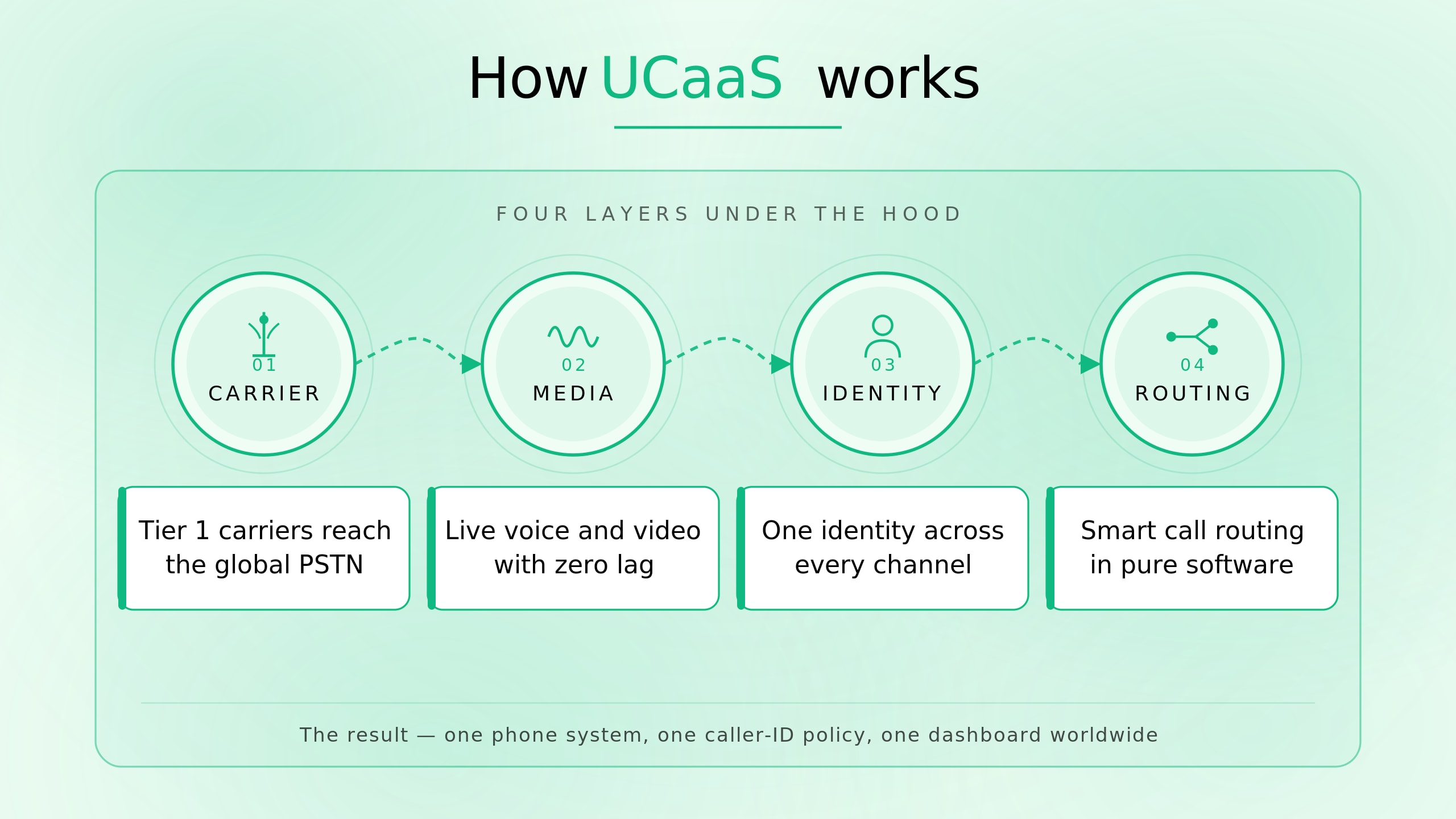
Under the hood, a UCaaS platform is doing four things at once:
- Carrier interconnect. It connects to the global PSTN through Tier 1 carriers, so your numbers ring anywhere in the world.
- Real-time media. Voice and video travel over the public internet using SIP, WebRTC, and Opus codecs — engineered to survive packet loss.
- Unified identity. One user account owns a phone extension, a video room, a chat handle, and a CRM record at the same time.
- Programmable routing. IVR menus, auto-attendants, skills-based routing, business-hours logic, overflow rules — all configured in software, no hardware required.
The result: your sales rep in Singapore, your support agent in São Paulo, and your CEO in New York are on the same phone system, with the same caller ID rules, the same recording policy, and the same dashboard.
Ready to see UCaaS that actually feels unified?
Acepeak ships cloud phone, AI receptionist, and contact center on a single Tier 1 platform — across 60+ countries.
What’s included in a modern UCaaS platform
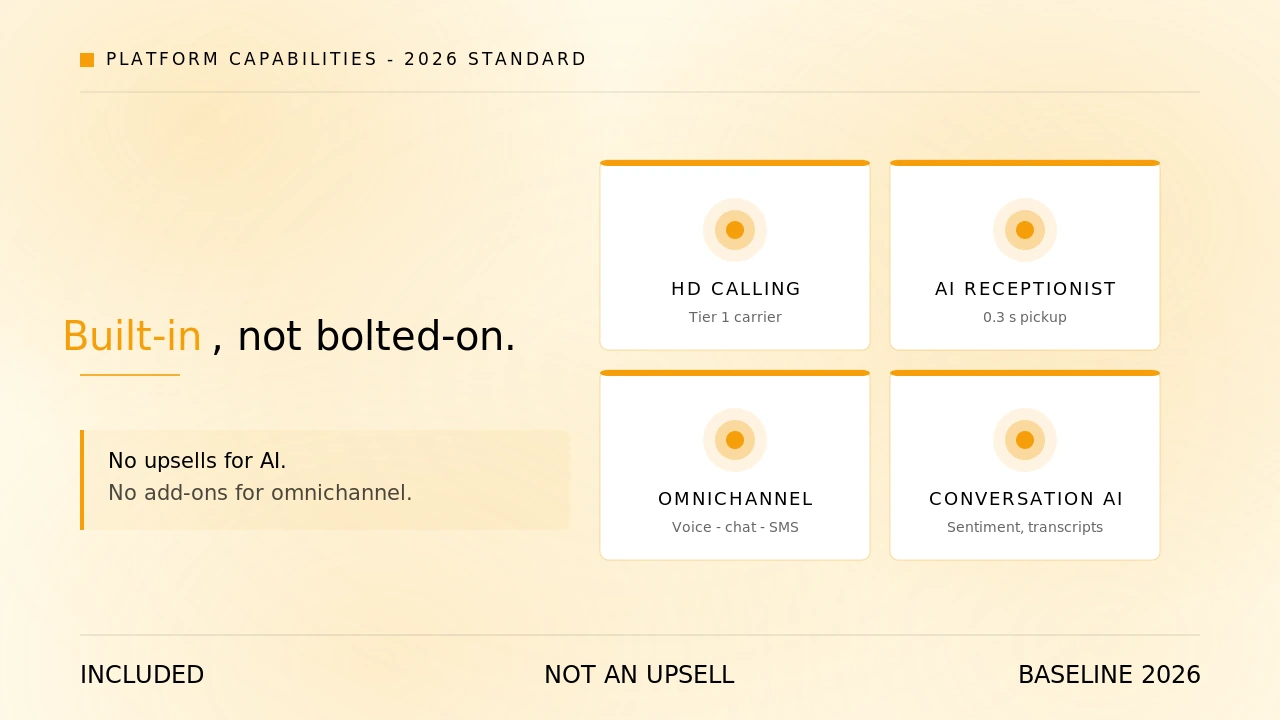
In 2020, “UCaaS” mostly meant a cloud PBX with a video tab nailed on. In 2026, the bar is higher. A modern UCaaS stack ships:
- HD cloud calling on a Tier 1 carrier network, with global DIDs in 60+ countries.
- Business SMS and MMS, 10DLC-ready, with shared inboxes.
- Native HD video meetings with breakouts, recording, and live transcripts.
- AI receptionist that answers every call in under half a second, qualifies the caller, books the meeting, and updates your CRM — in 32+ languages.
- Omnichannel messaging — WhatsApp, Messenger, Instagram, webchat, email — in one inbox.
- Conversation intelligence — automatic transcripts, sentiment, deal-risk alerts, auto-QA.
- Contact center capabilities — ACD, IVR, skills routing, predictive dialer, real-time coaching.
- Native CRM integrations — HubSpot, Salesforce, Zoho, Pipedrive — two-way, no Zapier tax.
- Security and compliance — SOC 2 Type II, STIR/SHAKEN, E911, GDPR, POPIA.
UCaaS vs the alternatives
It helps to know what UCaaS isn’t.
- UCaaS vs VoIP. VoIP is just voice over IP — the underlying technology. UCaaS includes VoIP plus video, messaging, meetings, and AI. VoIP is a feature; UCaaS is a platform.
- UCaaS vs PBX. A PBX is the on-premises phone box racked in a closet. UCaaS is the cloud replacement — no hardware, no maintenance contract, no forklift upgrades.
- UCaaS vs CCaaS. CCaaS (Contact Center as a Service) is purpose-built for high-volume customer interactions — queues, dialers, agent desktops. UCaaS is for everyone in the business. Modern platforms ship both on one stack, so the line is blurring.
- UCaaS vs CPaaS. CPaaS gives developers APIs to build their own communication features. UCaaS gives end-users a finished product. Same plumbing, different layer.
| Technology | What It Is | Best For |
|---|---|---|
| VoIP | The protocol carrying voice calls over the internet | The calling layer inside a larger UCaaS platform |
| PBX | On-premises phone hardware racked on-site | Businesses not yet ready to move calling to the cloud |
| UCaaS | One cloud platform for voice, video, messaging, and AI | Any team wanting every channel unified under one login |
| CCaaS | Cloud contact center software for high-volume queues | Dedicated support or sales teams handling large call volumes |
| CPaaS | Developer APIs for building custom communication features | Engineering teams building communication into their own product |
Downsides of UCaaS to Consider
UCaaS isn't free of trade-offs. Call quality depends entirely on internet connectivity, so a business on an unreliable connection needs backup internet or a failover plan before switching. Ongoing per-seat subscription costs can exceed the amortized cost of aging on-premises hardware over a long enough timeline, even though upfront costs are far lower. And moving providers later means renegotiating contracts, re-training staff, and porting numbers — real switching costs that make the initial vendor choice worth getting right. None of this makes UCaaS the wrong choice for most businesses; it just means the decision deserves the same diligence as any other core infrastructure purchase.
Why UCaaS in 2026 looks nothing like UCaaS in 2020
The big shift isn’t the cloud — that battle was won years ago. The shift is AI-native architecture.
In a 2020 UCaaS stack, a call rang, a human picked up, and the system recorded the audio. The AI was a transcription afterthought.
In a 2026 UCaaS stack, the AI is the front door. It picks up every call in 0.3 seconds, even during a spike. It speaks the caller’s language. It qualifies the lead, books the meeting, and writes the CRM task — before a human is involved. When a human does pick up, the AI is still on the line: coaching in real time, flagging deal risk, summarizing on hangup.
Who needs UCaaS?
Short answer: any business with more than five people who answers customer calls.
- SaaS and tech teams — fast deployment, deep CRM integration, developer APIs.
- Healthcare practices — secure voice, AI receptionists for booking, HD video for telehealth.
- Financial services — call recording, compliance, conversation intelligence for QA.
- Retail and eCommerce — omnichannel customer messaging, predictable per-seat pricing.
- Enterprise IT — SSO, dynamic E911, multi-region data residency, audited posture.
- SMB — one invoice, no IT team required, ports existing numbers.
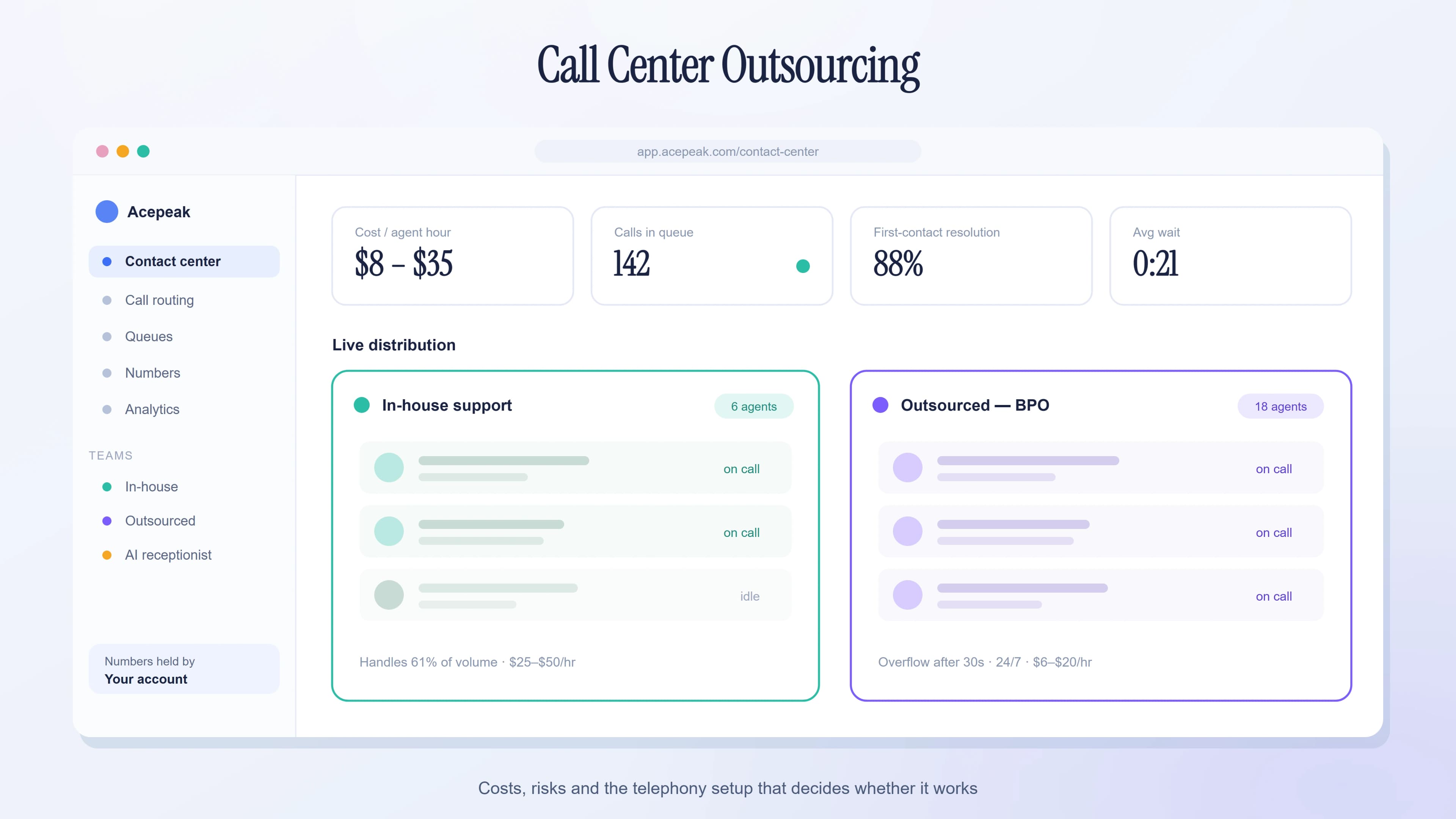
It also matters for teams that do not answer their own calls. If you are weighing call center outsourcing, the UCaaS layer is what keeps the numbers, routing rules and caller ID in your own hands while a vendor supplies the agents — which is what makes changing vendor later a routing edit rather than a migration.
How to evaluate a UCaaS provider in 2026
A short checklist that filters out 80% of the field:
- Tier 1 network — not a reseller stack.
- 99.99% uptime SLA, published status page.
- AI receptionist included, not an upsell.
- Contact center and cloud phone on the same platform.
- Global DIDs in the countries you operate in.
- SOC 2 Type II, available under NDA.
- Native CRM integrations (no Zapier middleware).
- One invoice. One renewal. One login.
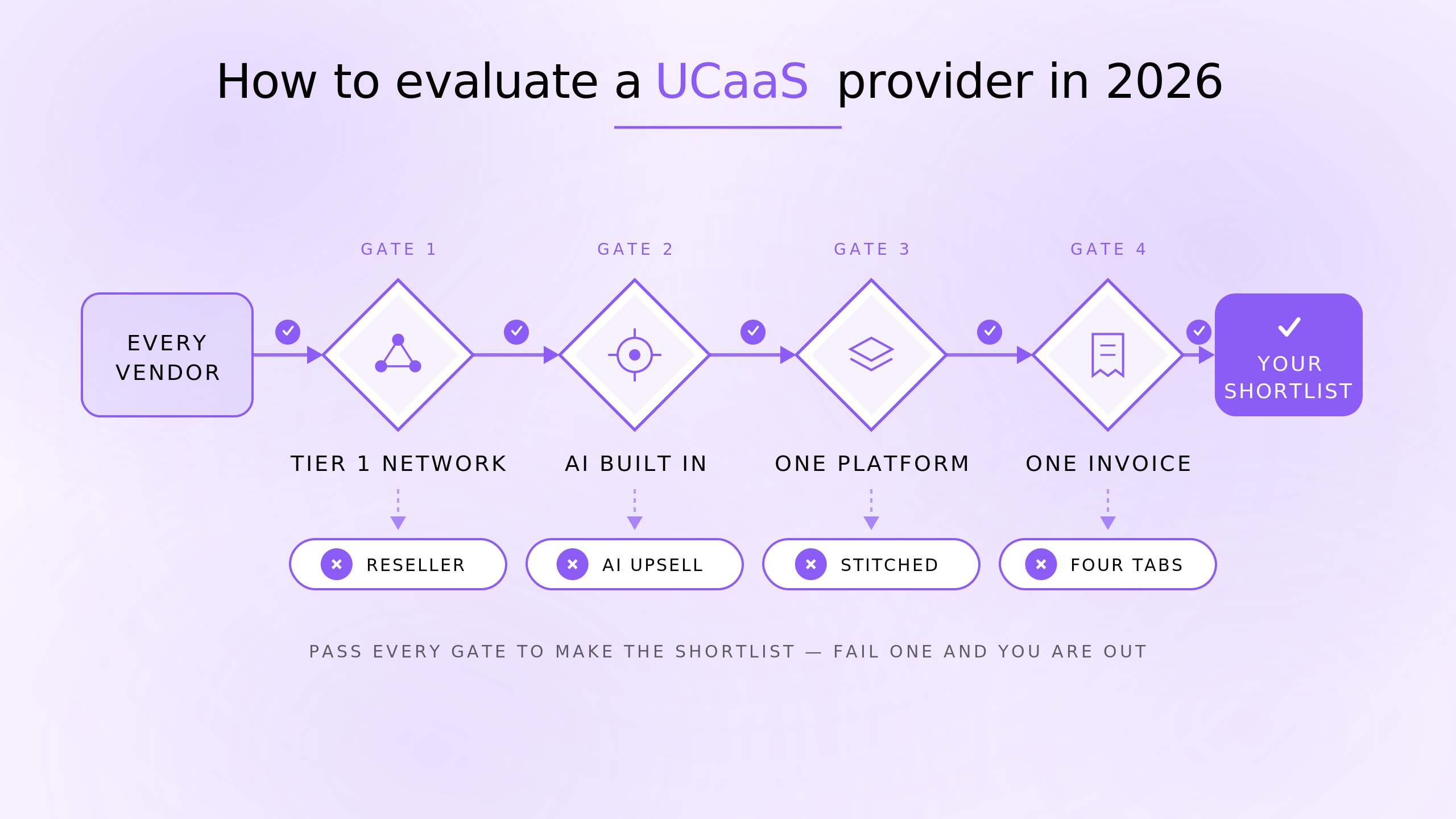
If a vendor needs four tabs to show you “their” platform, it isn’t one.
See the checklist in action.
Acepeak ticks every box on a single platform — and you can be live before lunch.
Conclusion
UCaaS in 2026 is one platform for every way your team and your customers talk — voice, video, messaging, AI agents, contact center — running on a single network with a single invoice. The vendors still selling 2020-era stacks (cloud PBX plus a video tab) are about to lose to the vendors shipping AI-native platforms.
If you’re evaluating today, the question isn’t whether to move to UCaaS. It’s which UCaaS will still be the right one in 2027.
Questions, answered.
No. VoIP is the protocol for voice calls over the internet. UCaaS is a platform that uses VoIP for calling, but also includes video, messaging, meetings, AI, and integrations.
Yes — if the provider is SOC 2 Type II audited and runs STIR/SHAKEN call authentication. Verify each control before signing.
On a modern platform, under an hour for a small team. Number porting takes longer (typically 2–4 weeks), but you can run in parallel during the cutover.
Yes. The best platforms ship local DIDs in 60+ countries and route calls through Tier 1 partners worldwide.
Increasingly, yes. Modern UCaaS platforms include ACD, IVR, dialer, and omnichannel — so small contact center teams no longer need a separate CCaaS purchase.
Most providers price per seat, per month — typically $20–$50 depending on feature depth. Watch for hidden add-ons (AI features, recording storage, international minutes) that inflate the real bill.
UCaaS (Unified Communications as a Service) covers internal team communication — calling, chat, video, and file sharing. CCaaS (Contact Center as a Service) is built specifically for customer-facing support and sales queues. Many providers, Acepeak included, offer both on one platform so the two aren't run as separate systems.
The main trade-offs are dependency on a stable internet connection, ongoing per-seat subscription costs that can add up over time, and switching costs if you change providers later. For most businesses these are outweighed by the lower upfront cost and flexibility, but they're worth weighing before signing a multi-year contract.
Well-known UCaaS platforms include RingCentral, Zoom Phone, Microsoft Teams Phone, 8x8, Nextiva, Vonage, and Acepeak. Most compete on the same core feature set — cloud calling, video, messaging, and increasingly AI — and differ mainly on network quality, integrations, and how much AI capability is included by default rather than sold as an add-on.