Introduction
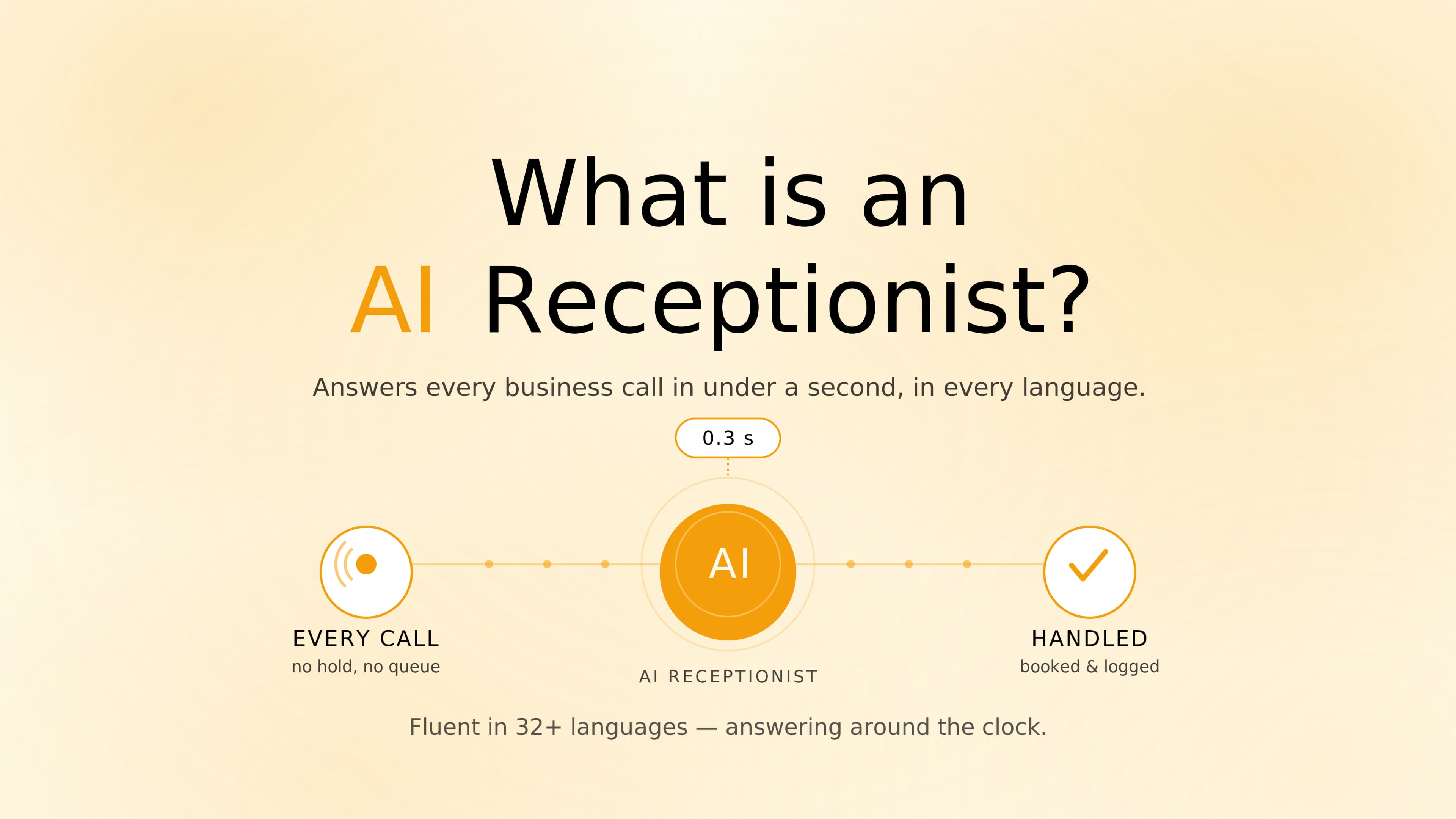
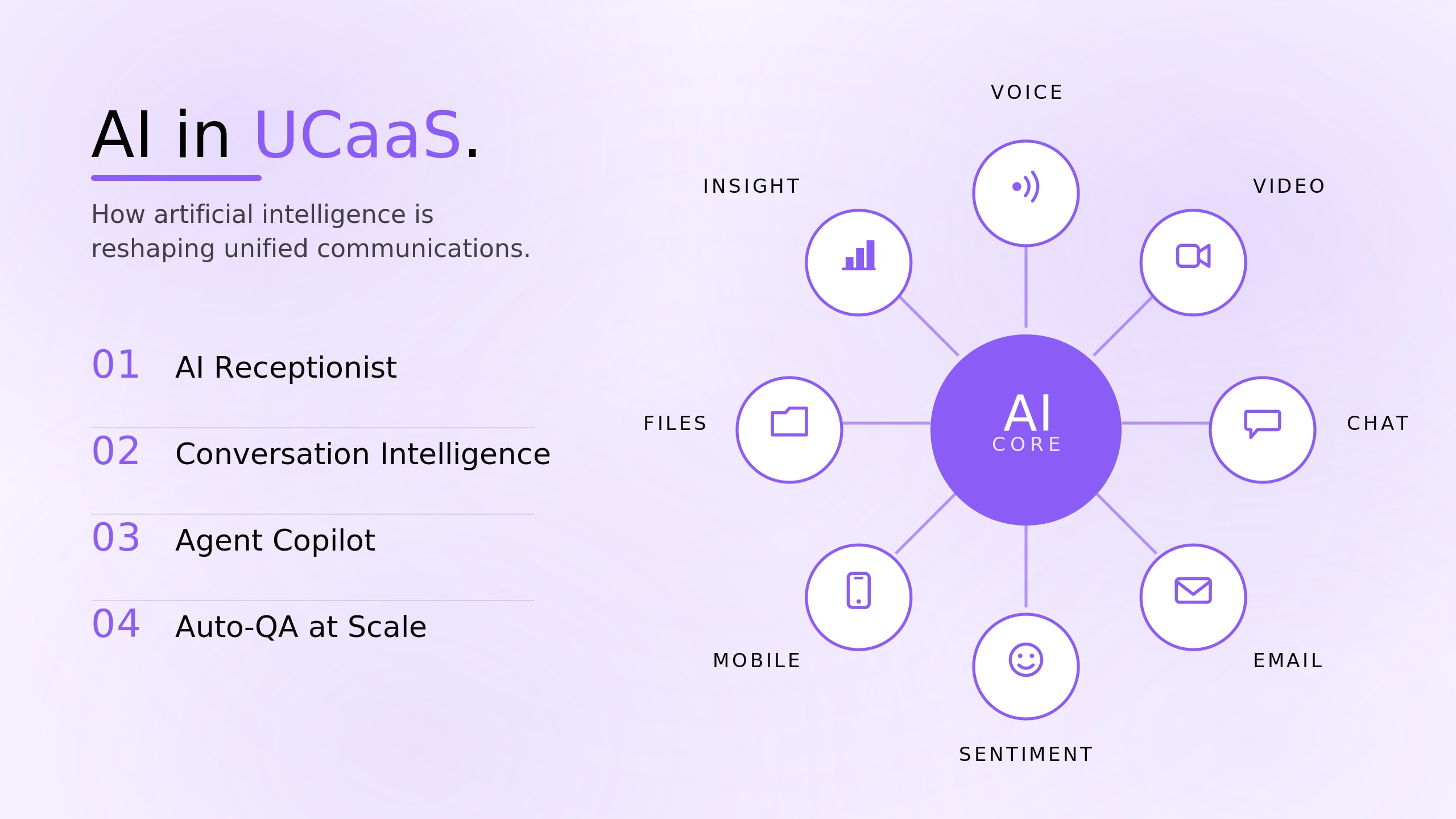
Five years ago, AI in business phone systems meant call transcription — a nice-to-have buried in a settings menu. Today, AI sits at the front door of UCaaS. It answers calls in under half a second, qualifies leads in 32+ languages, books meetings, updates CRMs, and coaches agents in real time. This isn’t an upgrade to the old model. It’s a different category of platform. Here’s what AI in UCaaS actually does in a modern stack, where it creates real business value, and how to tell genuine AI-native UCaaS from a feature retrofit.
Key Takeaways
- AI in UCaaS = artificial intelligence woven into every part of business communications — answering calls, routing, transcribing, summarizing, coaching, and analyzing.
- AI receptionists are the new front door. They pick up every inbound call instantly, qualify the caller, and hand off only when a human is needed.
- Real-time conversation intelligence is now baseline. Transcripts, sentiment, deal-risk alerts, and auto-QA happen during the call, not after.
- AI-native UCaaS is different from “AI added to UCaaS.” Native platforms are architected around AI; retrofits bolt it on and break under load.
- The business impact is concrete: lower abandon rates, faster qualification, automatic CRM hygiene, and consistent coverage 24/7 without staffing it.
What does “AI in UCaaS” actually mean?
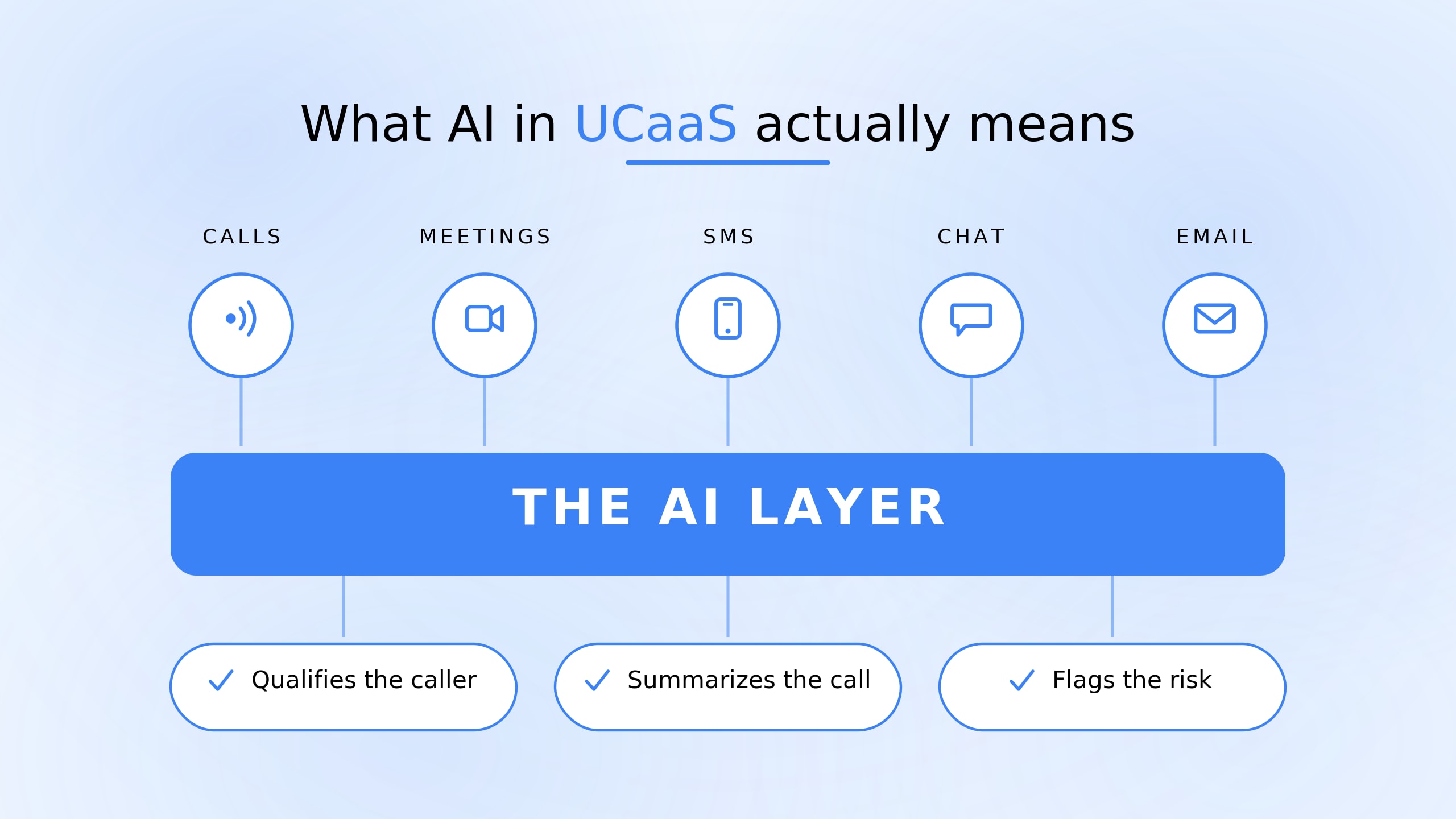
“AI in UCaaS” is the layer of artificial intelligence that sits across every interaction your business has — voice calls, video meetings, SMS conversations, chat, email — and acts on them in real time.
In a traditional UCaaS stack, the platform’s job was to transport a conversation: ring the phone, route the call, record the audio. Anything beyond that — qualifying the caller, summarizing the meeting, flagging the angry customer — required a human.
In an AI-native UCaaS stack like Acepeak’s, those tasks move to the platform itself. The AI is not a feature in a settings panel. It’s the architecture. Every call, message, and meeting passes through a layer that understands what’s being said and acts on it.
How AI fits into a modern UCaaS stack
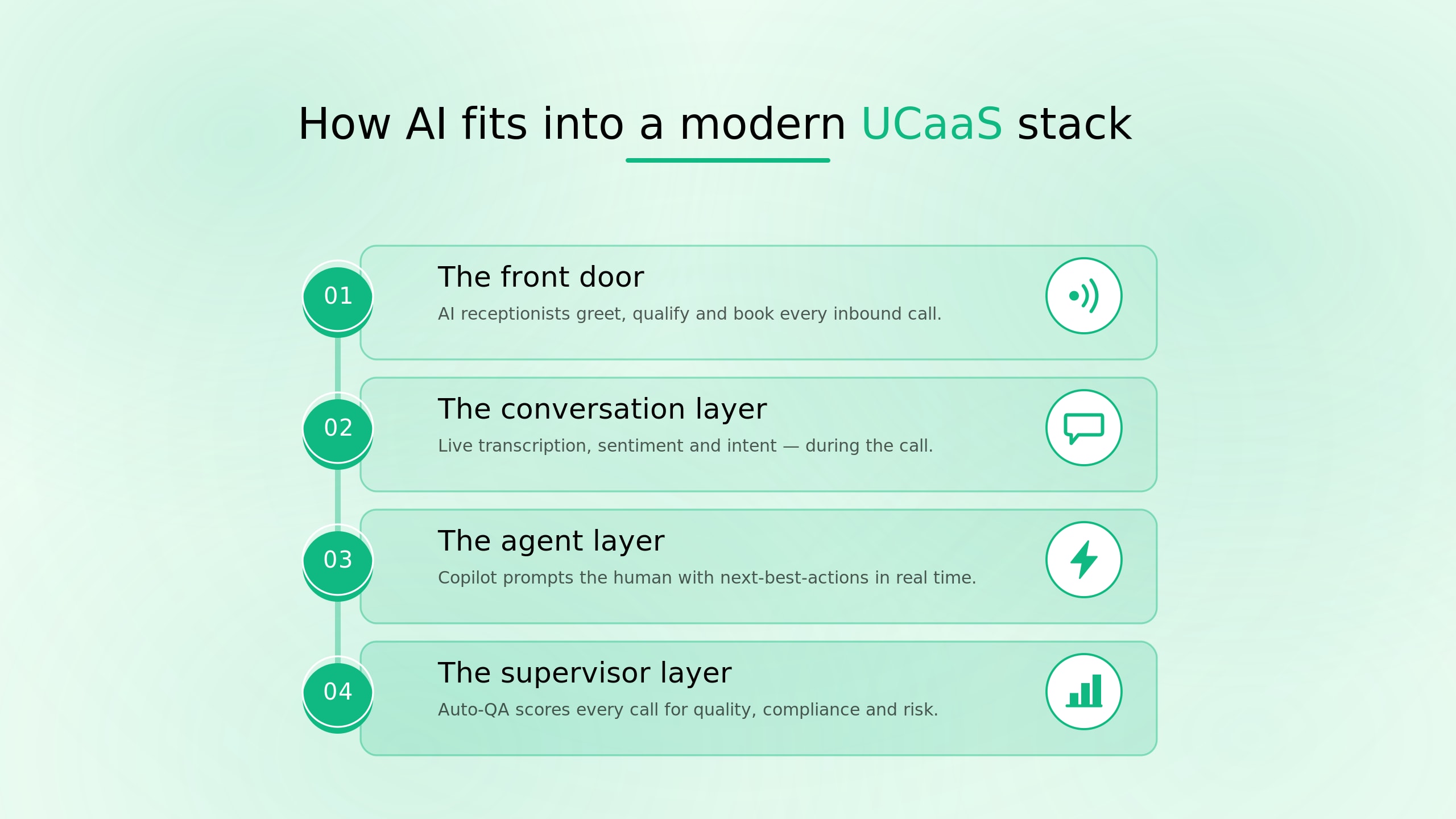
A well-designed AI-native UCaaS platform applies AI at four distinct layers:
- The front door — AI receptionists. Every inbound call hits an AI agent first. It greets in the caller’s language, qualifies intent, books appointments, and either resolves the call autonomously or warm-transfers to the right human.
- The conversation layer — real-time intelligence. Live transcription, sentiment analysis, intent detection, and automatic CRM logging happen during the conversation, not in a batch job at midnight.
- The agent layer — copilot and coaching. AI prompts human agents in real time with next-best-actions, objection responses, and compliance reminders. When a call ends, AI writes the summary and the follow-up task.
- The supervisor layer — auto-QA and analytics. Every call is automatically scored for quality, compliance, and risk. Supervisors stop sampling 2% of calls; they review 100% — surfaced by AI.
The point isn’t any single feature. The point is that AI runs across every channel and every stage of every conversation.
Curious what AI-native UCaaS feels like in practice?
Acepeak ships AI receptionist, conversation intelligence, and live agent coaching on the same platform as your cloud phone.
The AI capabilities you should expect in modern UCaaS
Here’s the short list of AI features Acepeak treats as table-stakes — not premium add-ons:
- AI receptionist that answers every call in under half a second, in 30+ languages, with a brand-tuned voice.
- Real-time transcription with speaker diarization, accurate enough for legal and compliance use.
- Live sentiment and intent detection that flags at-risk customers before the call ends.
- Automatic call summaries delivered to email and CRM the moment the call hangs up.
- Conversation intelligence that scores every call for quality, script adherence, and risk.
- AI-powered routing that listens to the first sentence and routes to the right team — no more 8-option IVR menus.
- Auto-QA so 100% of calls are reviewed, not the 2% your supervisor has time for.
- Real-time agent coaching that prompts the human with next-best-actions while the customer is still on the line.
- Predictive dialer with AI cadence that maximizes connect rates without crossing TCPA lines.
- Multilingual conversation handling so a single platform serves global teams.
If your shortlisted vendor charges separately for any of the first four, the AI is bolted on. Keep looking.
The business impact, in plain numbers
Vendors love to throw around AI metrics. Here’s what actually moves a P&L:
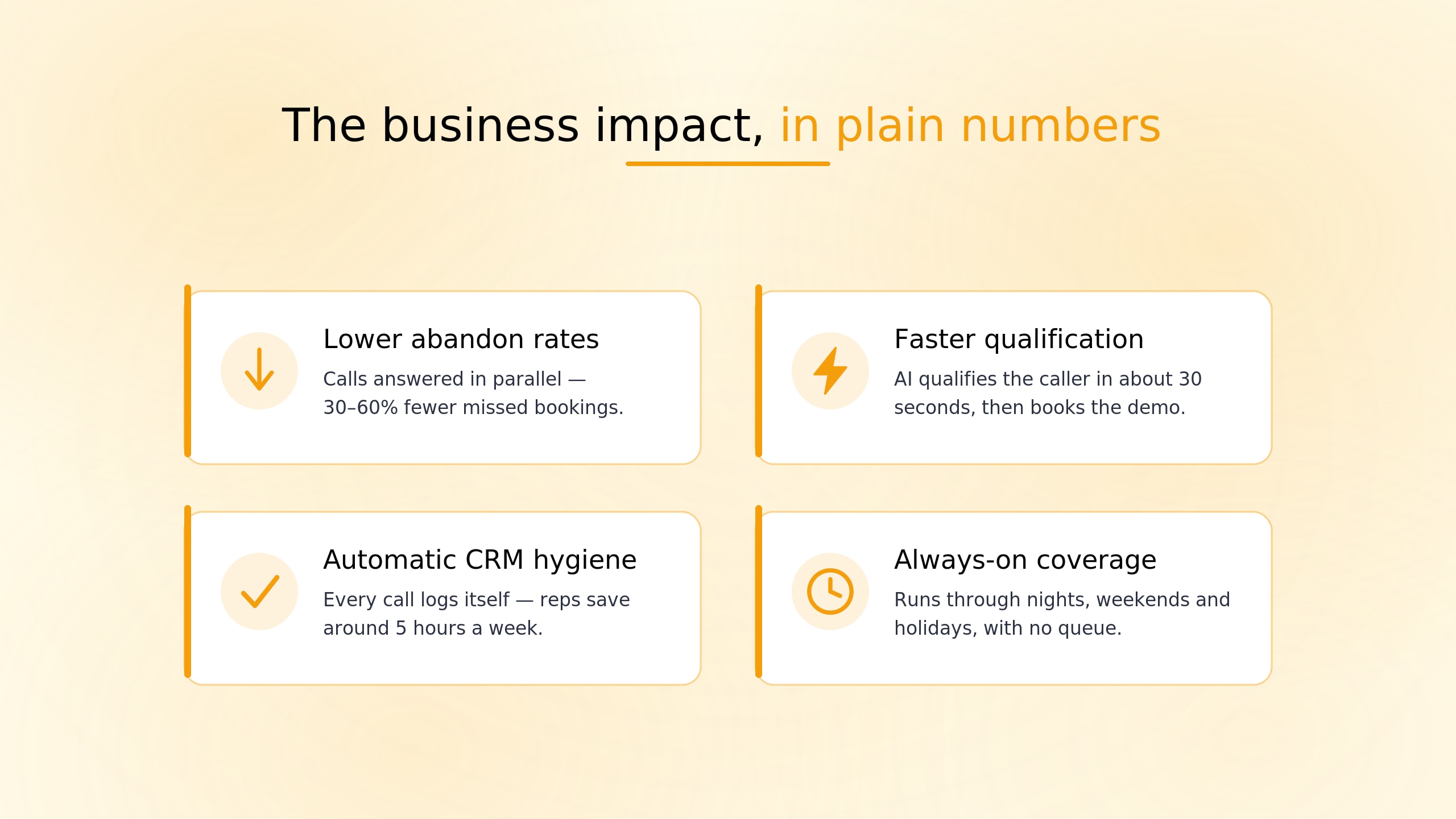
- Lower call abandon rates. AI receptionists eliminate hold time — every call is answered in parallel. Practices in healthcare and home services see 30–60% drops in missed bookings.
- Faster lead qualification. AI qualifies a caller in 30 seconds and books the demo before a human ever picks up. Sales cycles compress.
- Automatic CRM hygiene. Every call writes its own activity log. Reps stop spending 5 hours a week on data entry. Pipeline data stops being a fiction.
- 24/7 coverage without 24/7 staffing. AI runs through the night, the weekend, and the holiday. No queue.
- Coaching scale. Managers used to sample 2% of calls; with AI, they see every one — and only the ones that need attention surface to them.
The pattern is consistent: AI here doesn’t make calls slightly better. It removes whole categories of work.
AI-native vs. AI-bolted-on: how to tell
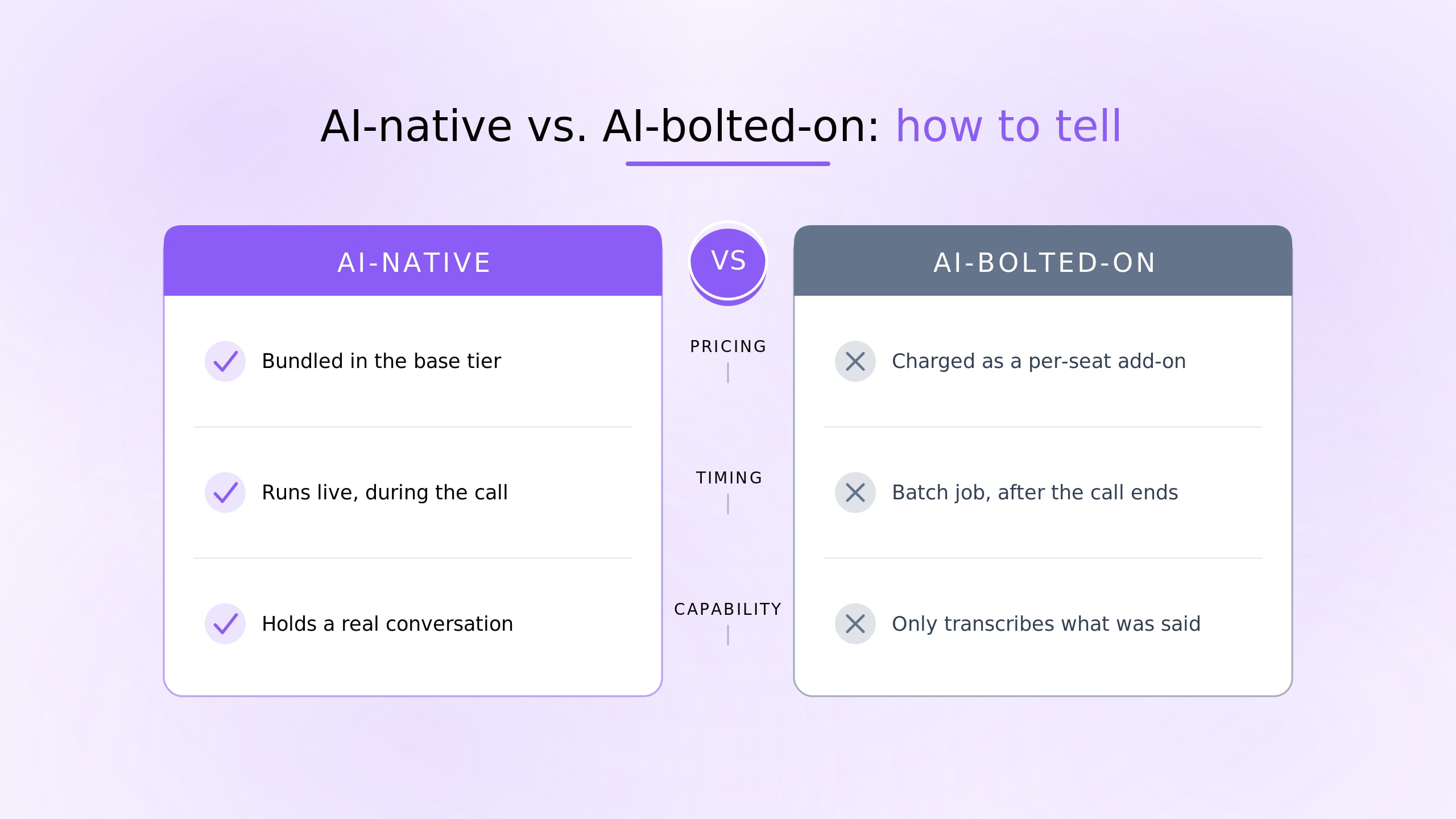
Every vendor now claims “AI features.” The real question is architecture. Three quick tests:
- Is the AI part of pricing or an add-on? Native platforms bundle AI in the base tier. Retrofits charge for it per-seat.
- Does AI run in real time or after the call? Real-time is native; batch is a retrofit.
- Can the AI hold a conversation, or only transcribe one? A platform that ships an AI receptionist — talking, qualifying, booking — is operating at a different level than one that ships a transcription engine.
If the demo only shows the AI after the call ends, you’re looking at a retrofit dressed up for a sales cycle.
Where AI in UCaaS is going next
The AI layer is moving past front-door automation toward full agentic communications. Soon, AI agents will handle entire workflows — taking a call, looking up the customer record, processing the refund, sending the confirmation SMS, and updating four systems — without a human ever touching the conversation.
Acepeak and the other vendors building toward that today treat AI as infrastructure, not as a marketing tab. The ones still selling cloud PBX with a transcription tool stapled on are going to feel the gap widen quickly.
Build on the AI-native stack, not the retrofit.
Acepeak runs AI across the full stack — receptionist, routing, coaching, QA — on one cloud platform.
Conclusion
This approach isn’t a feature you turn on. It’s the architecture the next generation of business communication platforms is built around. The companies winning with this shift aren’t the ones who added AI summaries to their existing tool — they’re the ones whose platforms put AI at the front of every interaction.
If you’re evaluating UCaaS today, the AI question isn’t “do they have it?” — every vendor checks that box. The question is “is it native, real-time, and included?” The answer to that determines whether your team gets 2020-era UCaaS with AI features or the platform that’s actually going to handle your customers in three years.
Questions, answered.
It answers calls, transcribes conversations, analyzes sentiment, summarizes meetings, coaches agents in real time, and routes interactions intelligently across voice, SMS, chat, and email — all from one platform.
No. A chatbot is one narrow application. AI in UCaaS spans voice, video, messaging, and analytics — it’s the platform-wide layer that intelligent communication runs on.
Top-tier UCaaS platforms hit 95%+ word accuracy with speaker separation. Accuracy degrades with heavy accents, background noise, or rare technical jargon — verify with a free trial on your real calls.
Not for high-stakes or complex calls — but they handle the 60–80% of routine inbound that doesn’t actually need a human. Humans then focus on the calls where they create real value.
Yes — when the provider is SOC 2 Type II audited and runs encryption end-to-end. Always confirm AI training data handling and whether your conversations are used to train shared models.
On a true AI-native platform like Acepeak, no. AI receptionists, transcription, and conversation intelligence should be in the base tier. If a vendor lists them as add-ons, you’re paying twice — once for the platform and once for the features that should already be in it.
Look for a provider where AI call routing and voice-agent features are native to the platform rather than a bolt-on add-on — that's what actually improves answer rates and reduces manual triage. Acepeak builds AI directly into call routing, summarization, and sentiment detection across the same UCaaS platform.