An Original 1947 Code, Still on Its First Map
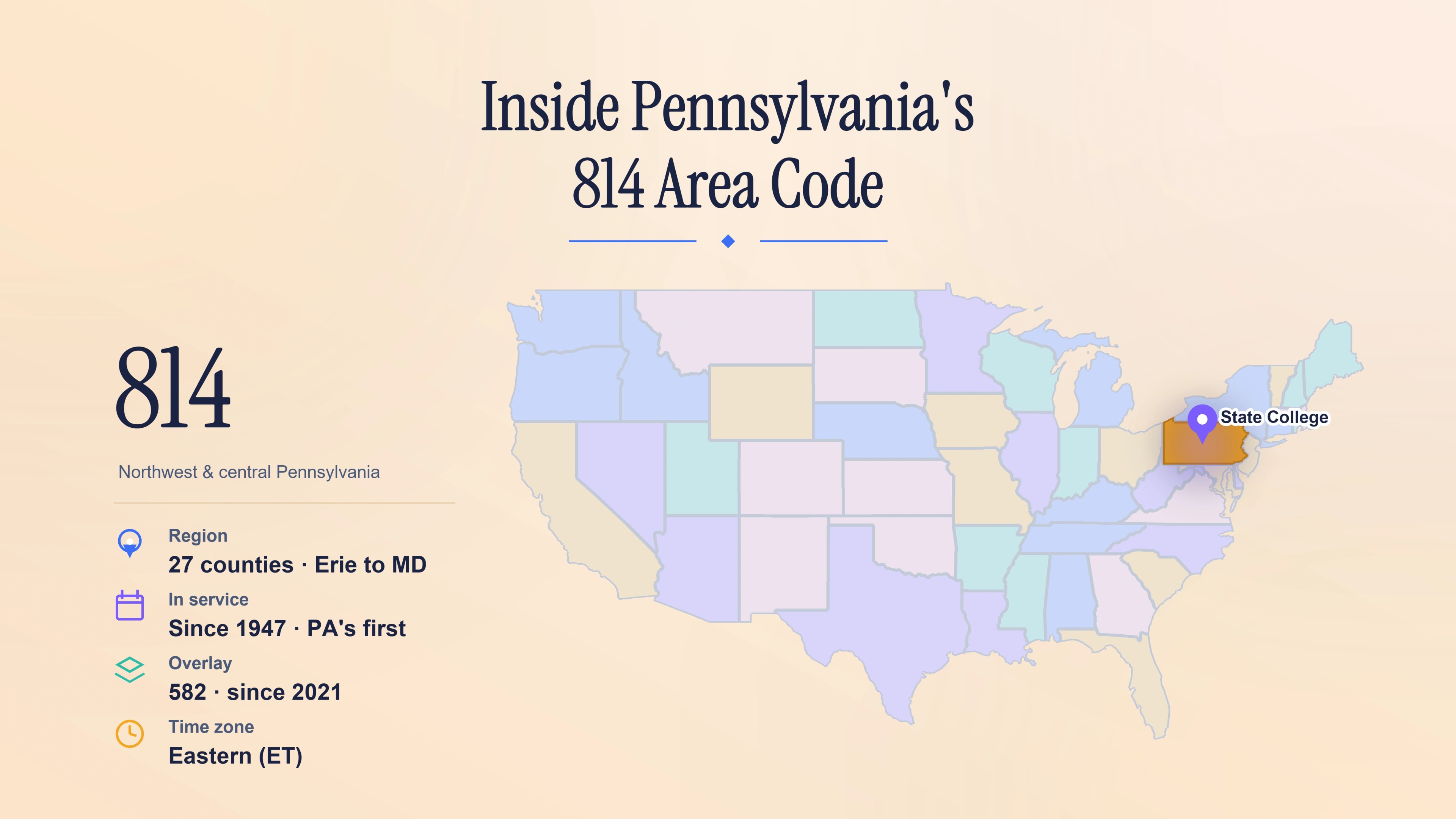
Since the North American Numbering Plan took effect in 1947, northwestern and central Pennsylvania have dialed 814. It started as one of the state's four original codes, and it is now the only one of the four that still covers the territory it was given, serving the same rural counties between the Lake Erie shore and the Maryland line for close to eighty years.
This guide covers where 814 works today, why it never split when the state's bigger cities did, what the 582 overlay means for dialing, and the practical steps for putting an 814 number on your own business line.
Key Takeaways
- The 814 area code was established in 1947 as one of the original 86 North American area codes, and one of Pennsylvania's four.
- It is the only one of Pennsylvania's four original codes (215, 412, 717, 814) that still keeps its 1947 boundaries — 814 has never been split.
- It covers all or part of 27 largely rural counties across northwestern and central Pennsylvania, from Lake Erie south to the Maryland line.
- Major cities include Erie (the largest), Altoona, Johnstown, and State College, home of Penn State, along with Meadville, DuBois, Bradford, and Warren.
- The 582 overlay entered service on May 1, 2021 across the same 27 counties, making ten-digit dialing mandatory; the region runs on Eastern Time.
What Is the 814 Area Code?
The 814 area code is the North American Numbering Plan code for northwestern and central Pennsylvania. It was assigned in 1947 as one of the original 86 area codes created for the first nationwide numbering plan, and it holds a distinction none of the state's other codes can claim: alongside Philadelphia's 215, Harrisburg's 717, and Pittsburgh's 412 area code, 814 was one of Pennsylvania's four original 1947 codes — and the only one that has never been split.
That longevity is part of its character. While the state's metros carved off new codes and layered on overlays over the decades, 814 kept its original boundaries across a mostly rural region, which is a large part of why the prefix still reads as a settled, long-established local identity to anyone who lives there.
Lake Erie Port, Railroad Cities and Penn State Country
The 814 footprint is one of the largest in the state by land area, covering all or part of 27 counties from the Lake Erie shore down through the Allegheny highlands to the Maryland border. Communities using 814 numbers include:
- Erie — the region's largest city and a Great Lakes port on Pennsylvania's only stretch of Lake Erie shoreline
- Altoona and Johnstown — the historic railroad and steel cities of the southern Alleghenies
- State College — home to Penn State's main campus and one of the region's fastest-growing corners
- Meadville, Bradford, Warren, and DuBois — the northern-tier manufacturing and timber towns
- Bedford and Somerset — the southern county seats along the Pennsylvania Turnpike toward the Maryland line
Erie Bayfront Mornings and the Post-Overlay Dialing Rule
All 27 counties in the 814 territory, from Erie down to Bedford and Somerset, observe Eastern Time, switching from EST (UTC−5) in winter to EDT (UTC−4) for daylight saving. Morning on the Erie bayfront is morning across the rest of the Eastern zone too, so an office in State College or Altoona works on the same clock as the customers and suppliers it deals with in other Eastern states.
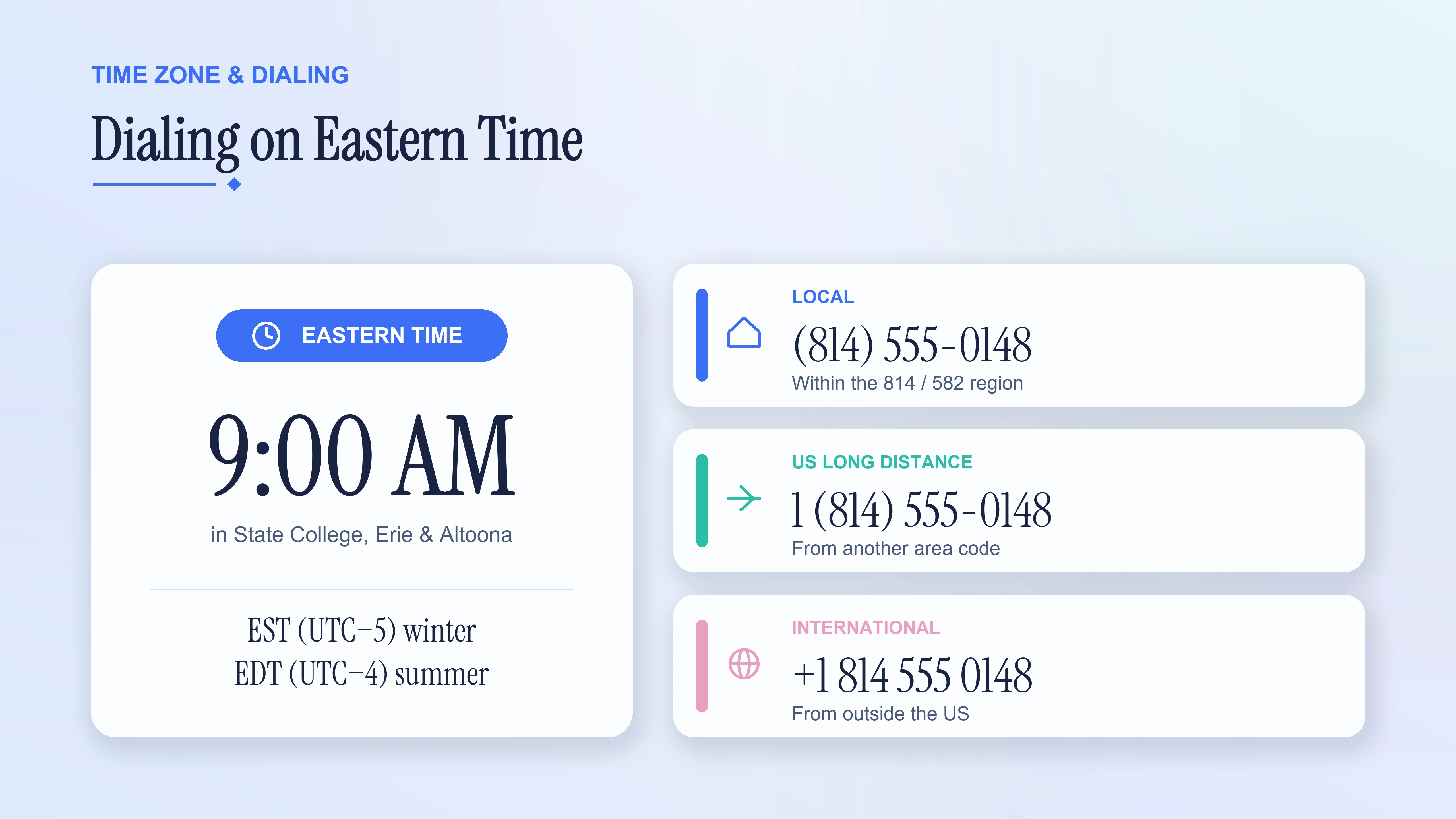
Dialing is simple but strict: since the 582 overlay arrived, every local call needs all ten digits — (814) 555-0148 — with a 1 in front for long distance, and +1 814 from abroad. Seven-digit dialing no longer completes a call anywhere in the region.
The 582 Overlay and 10-Digit Dialing
For more than seven decades, 814 needed no relief at all — a remarkable run for an original 1947 code. But cell phones, second lines, and steady demand for new numbers eventually drew down even a large rural pool. Rather than split the territory and force part of the region to change its area code, regulators chose an overlay: on May 1, 2021, area code 582 went into service across the exact same 27 counties, much as neighboring 570 area code in northeastern Pennsylvania managed its own growth without redrawing the map.
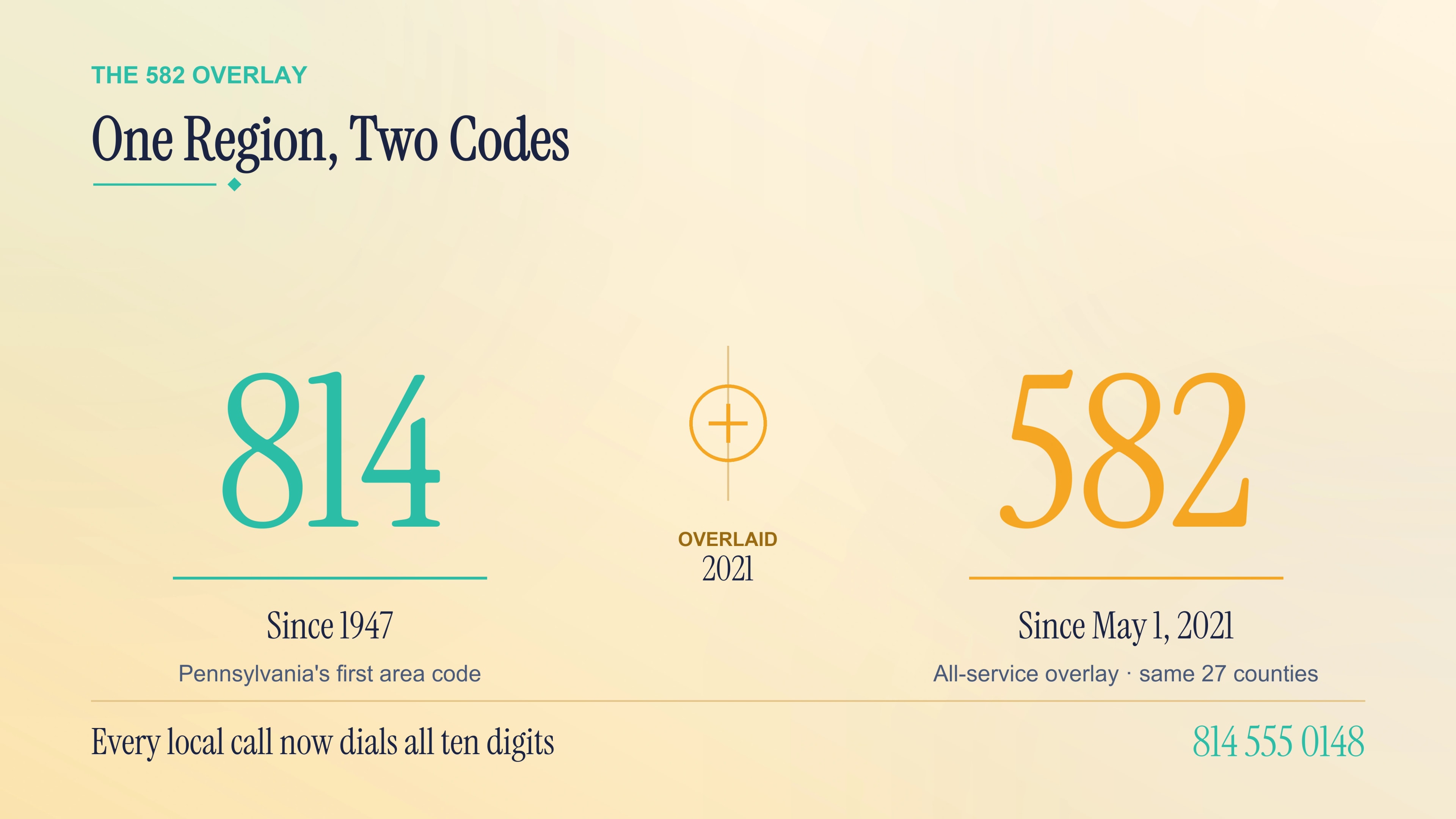
No existing 814 number changed when 582 arrived. New lines simply began drawing from the 582 pool, and the one everyday adjustment — mandatory ten-digit dialing for local calls — took effect alongside it. For a business, that means an 814 number claimed today keeps working exactly as it always has, now with a second code quietly sharing the same ground.
Benefits of a Local 814 Number for Business
Across northwestern and central Pennsylvania, a local number still carries real weight. An 814 number gives a business:
- The only unsplit original code — 814 is the sole one of Pennsylvania's four 1947 prefixes never divided, so it still reads as the region's longest-standing number.
- One line for 27 counties — a single 814 number reaches from the Erie bayfront down through the Alleghenies to the Maryland line without sounding out of area anywhere in between.
- A foothold in Penn State and the northern tier — State College's university economy and the manufacturing and timber towns around Meadville and DuBois both expect a local 814 or 582 contact.
- Location independence — cloud routing lets a team anywhere answer 814 calls as if they were in downtown Altoona or Johnstown.
Put a central Pennsylvania number on your business
Acepeak provisions local 814 numbers with instant activation, smart routing, and crystal-clear voice quality.
How to Get an 814 Phone Number
You don't need an office in Erie or State College to hold an 814 number. A cloud telephony provider can activate one in minutes:
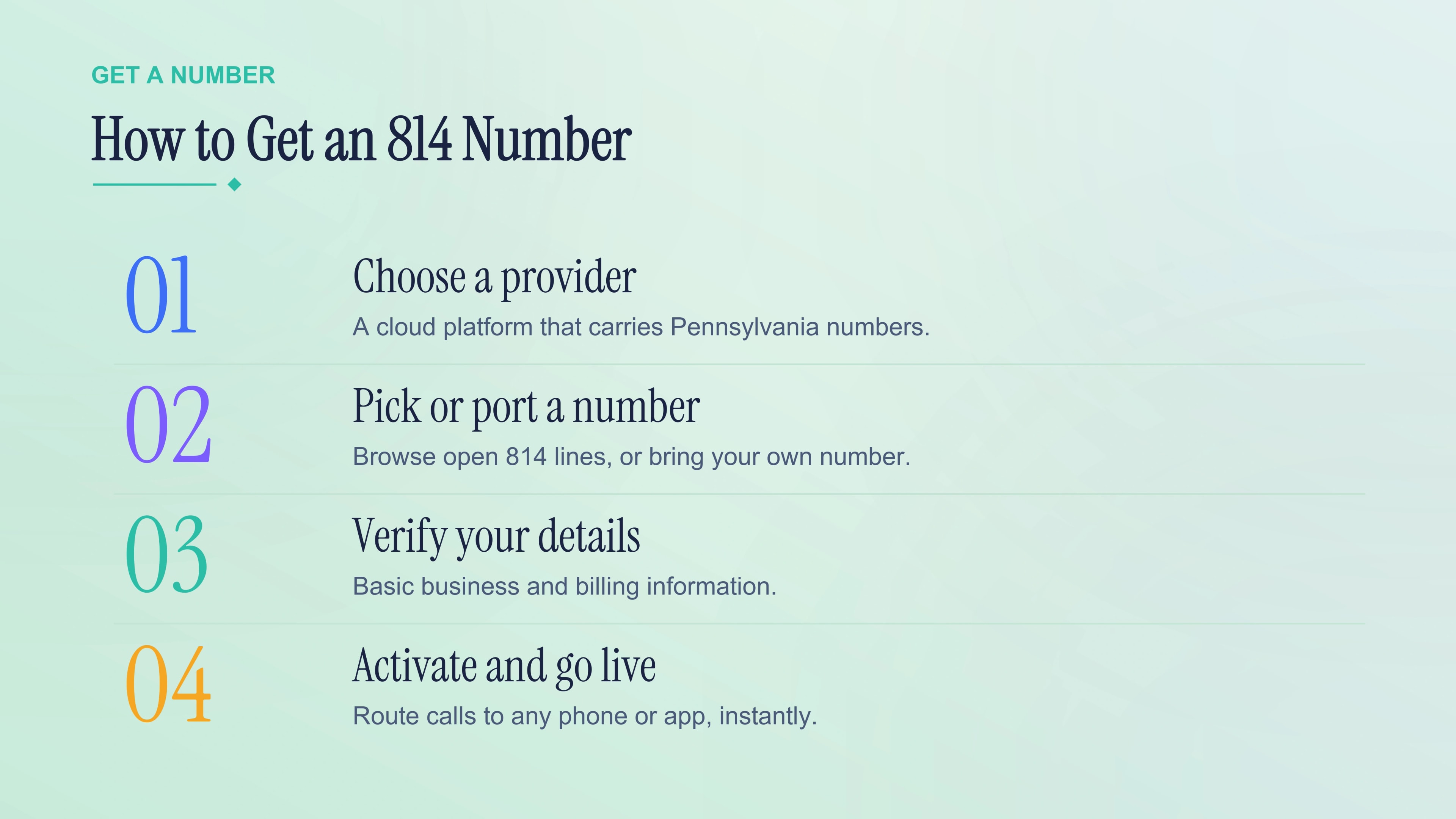
- Choose a provider — pick a cloud phone platform that lists inventory across all 27 counties of the 814 territory, like Acepeak.
- Pick or port a number — browse available 814 lines from Erie to Bedford, or bring an existing number with you.
- Verify your details — provide basic business and billing information so the 582-shared pool can activate your line.
- Go live across the region — route calls to desk phones, mobiles, or softphone apps the moment setup finishes.
Spotting and Avoiding 814 Scam Calls
Across the region, from Bradford to Johnstown, an 814 number on the screen looks like someone local, which is exactly the impression spoofers exploit when they pose as a neighbor, a bank, or a county agency. Slowing down and checking before responding screens out nearly all of it:
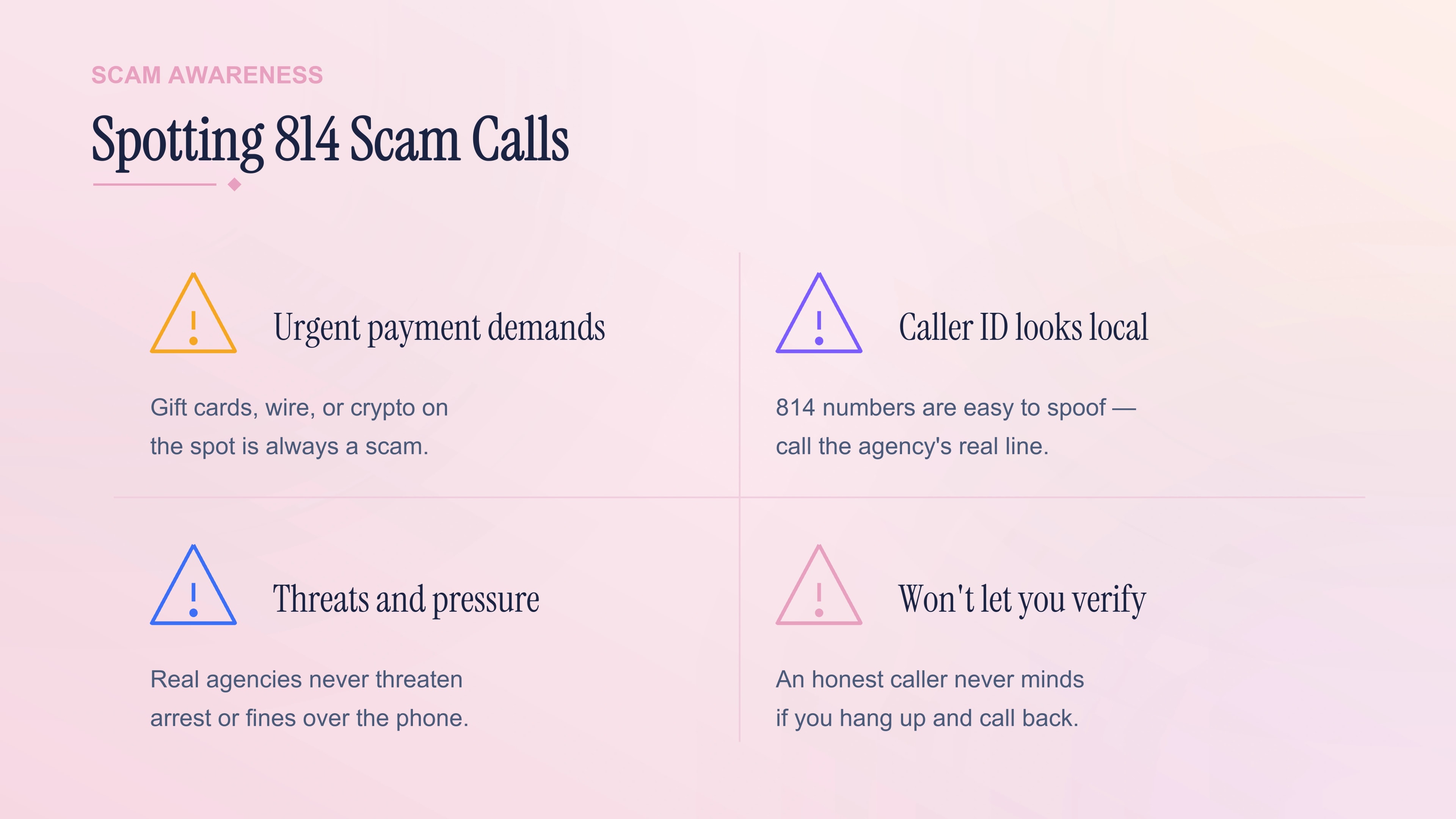
- Stop — hang up on any caller demanding gift cards, wire transfers, or immediate payment; no legitimate agency collects that way.
- Check — if caller ID claims a bank, a utility, or law enforcement, call the organization back on its published number.
- Go — block confirmed scam numbers and report them so carriers can act on the pattern.
- Never share one-time passcodes or account credentials with an inbound caller, no matter how local the number looks.
The Future of the 814 Area Code
The 582 overlay gave northwestern and central Pennsylvania decades of numbering headroom, so existing 814 lines are safe from any forced change for the foreseeable future. The region keeps evolving around them: Centre County, home to Penn State and State College, remains one of the fastest-growing corners of the 814 territory, adding students, residents, and businesses that steadily draw on the shared 814/582 pool. Whichever prefix a new line lands on, an established 814 number remains the one that reads as here first.
Generations of Stability From Lake Erie to Maryland
Very few codes can match the steadiness of 814. It began in 1947 as one of Pennsylvania's four original codes, stayed intact while the state's cities split off new ones, and took on the 582 overlay in 2021, all without changing the rural counties it serves from Lake Erie to the Maryland line. A business that wants callers in Erie, Altoona or State College to answer will still find an 814 number, or a 582 on the same map, the most convincing local signal available.
Ready for your 814 number?
Claim a northwestern or central Pennsylvania local number with Acepeak and start connecting with the region today.
Questions, answered.
The 814 area code covers northwestern and central Pennsylvania — all or part of 27 counties from the Lake Erie shore down to the Maryland line — including Erie, Altoona, Johnstown, State College, Meadville, DuBois, Bradford, and Warren.
It was established in 1947 as one of the original 86 North American area codes. It is the only one of Pennsylvania's four original codes that has never been split.
Area code 582 is an all-service overlay of 814, in service since May 1, 2021. It covers exactly the same 27 counties, so a 582 number is just as local as an 814 number. It was added because 814 was running low on available numbers.
Yes. Since the 582 overlay took effect in 2021, all local calls in the region must be dialed with the full ten digits — area code plus the seven-digit number. Calls dialed with only seven digits will not connect.
No. Pittsburgh uses area code 412 (and its overlays). The 814 territory covers the rural counties of northwestern and central Pennsylvania around it, not the Pittsburgh metro itself.
Yes. Cloud telephony providers can assign an 814 (or 582) number to a business or individual located anywhere and route the calls to your existing phones or apps, giving you a local Pennsylvania presence without a physical office there.
Signing up for an 814 area code number takes minutes with a cloud phone provider — no local office in Pennsylvania required. Pick the number, connect it to your existing phone or app, and calls route in immediately. This keeps the 814 area code presence you already have while adding the local credibility Pennsylvania customers respond to.