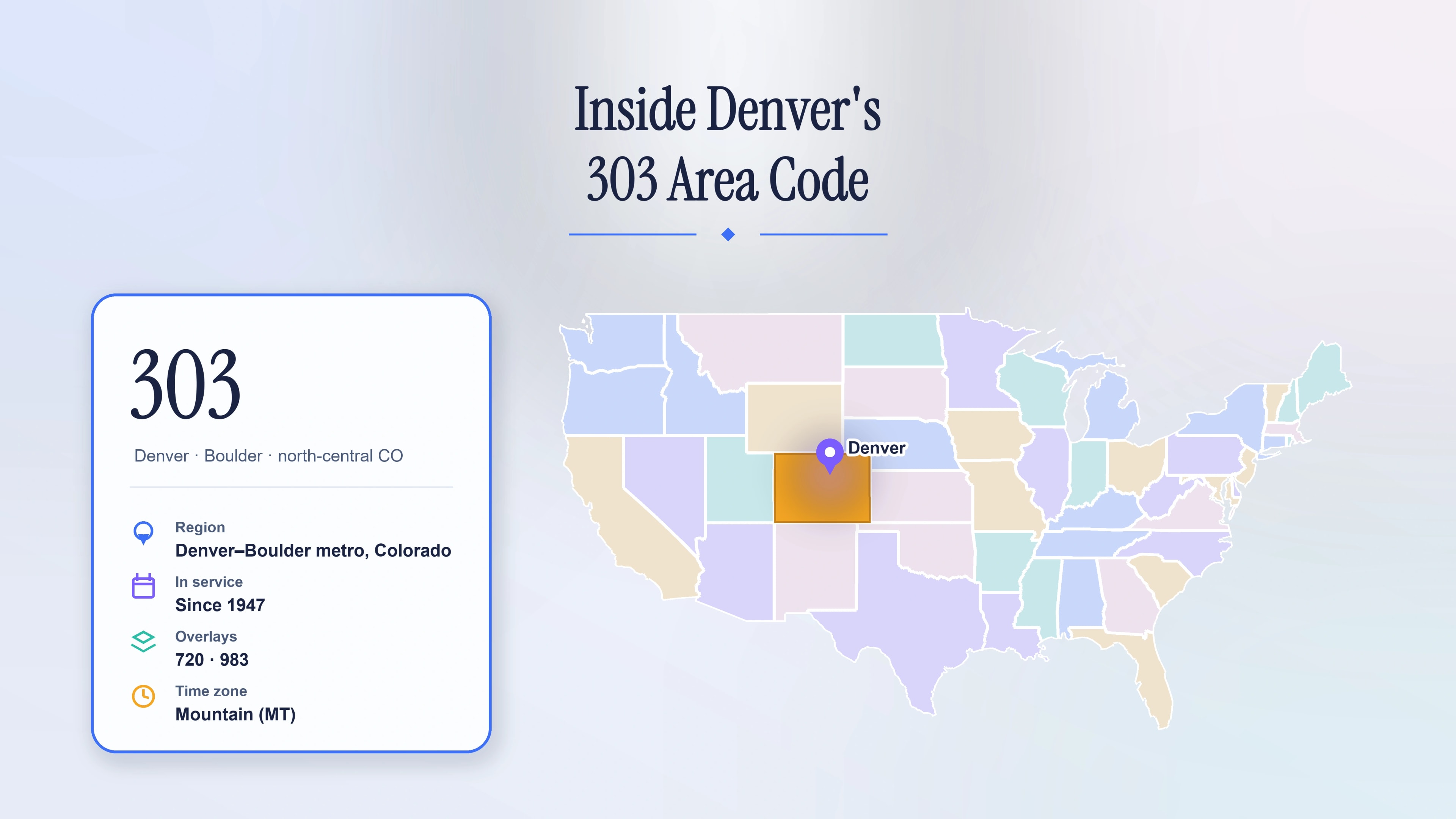
Here First: Metro Denver's Original Telephone Identity
Say "303" anywhere along Colorado's Front Range and locals picture the Mile-High City and everything around it: downtown Denver and the Union Station district, the tech offices of Boulder, the sprawling suburbs of Aurora and Lakewood, the breweries of Longmont and the foothills towns tucked against the Rockies. This is the original telephone identity of metropolitan Denver — a code that once stretched across the entire state before decades of growth carved it down to the metro it serves today. For anyone doing business in Colorado's largest market, 303 carries a weight that newer prefixes simply do not: it says established, local and here first. This guide lays out exactly where 303 reaches, how the 719 and 970 splits and the 720 and 983 overlays reshaped it, the Mountain time zone and dialing rules, and how any business can claim a local Denver presence with a number of its own.
Key Takeaways
- The 303 area code covers the heart of Colorado's Front Range — the Denver–Boulder metropolitan area, including Denver, Aurora, Lakewood, Boulder, Longmont, Broomfield, Arvada, Westminster, Thornton, Centennial, Golden and Littleton.
- It is one of the original 86 area codes assigned in 1947, when the single code 303 covered the entire state of Colorado for four decades.
- Two splits shrank it: area code 719 broke away for southern Colorado on March 5, 1988, and 970 took the northern and western parts of the state on April 2, 1995, leaving 303 with just the Denver metro.
- Rather than split again, the region was given overlays — 720 was added over the same territory on September 1, 1998, and a second overlay, 983, followed on June 17, 2022 — so 303, 720 and 983 now share one map.
- Because of the overlay, ten-digit dialing is required for every local call, and the whole region runs on Mountain Time — UTC−7 in winter (MST) and UTC−6 in summer (MDT).
What Is the 303 Area Code?
The 303 prefix is the telephone identity of metropolitan Denver — a geographic code covering the north-central Front Range of Colorado, from the plains east of the city to the foothills of the Rocky Mountains. It is one of the oldest codes in the country, part of the original 1947 numbering plan, and for forty years it was the only area code in all of Colorado. Today its footprint is focused tightly on the Denver–Boulder metro, and it shares that ground with its own 720 area code overlay — a newer code layered over the same streets as the metro filled up.
Because it sits at the heart of a large, fast-growing metro of more than three million people, a 303 number reads as unmistakably local across the Front Range. To a customer in Denver, Boulder or Aurora it looks like a neighbor on the caller ID rather than an out-of-state stranger — a small but real credibility signal for any business working the Colorado market, and one reason 303 numbers remain in high demand even though newer prefixes are readily available.
Where the Great Plains Meet the Rockies, Denver to Boulder
The 303 code covers the Denver–Boulder metropolitan area — the dense band of cities and suburbs where the Great Plains meet the Rocky Mountains, a fraction of the statewide territory it held before the splits of 1988 and 1995. It is the most populous corner of Colorado, and the code (together with its 720 and 983 overlays) serves communities across several counties, including:
- Denver — the state capital and largest city, the commercial and cultural core of the entire Rocky Mountain region
- Aurora and Centennial (Arapahoe County) — the large eastern and southeastern suburbs that make up much of the metro's population
- Boulder, Longmont and Louisville (Boulder County) — the university town and tech corridor northwest of Denver
- Lakewood, Arvada, Golden and Wheat Ridge (Jefferson County) — the western suburbs running up to the foothills
- Westminster, Thornton, Northglenn, Broomfield and Brighton — the fast-growing northern suburbs across Adams and Broomfield counties
- Littleton, Englewood, Lone Tree and Highlands Ranch — the southern suburbs stretching toward Douglas County
Together these communities hold well over three million residents packed into a single metro — a concentration of homes and businesses dense enough that the code needed both a pair of splits and, later, two overlays to keep up with demand for new numbers.
Mountain Time and Three Codes on the Same Street
The entire 303 region sits within Mountain Time — UTC−7 in winter (MST) and UTC−6 in summer (MDT) — the same clock as Salt Lake City, Albuquerque and the rest of the Mountain West. Unlike a single-code region, the 303 area has been overlaid twice, which means ten-digit dialing is mandatory: every local call must include the area code, because the same street could hold a 303, a 720 and a 983 number side by side.
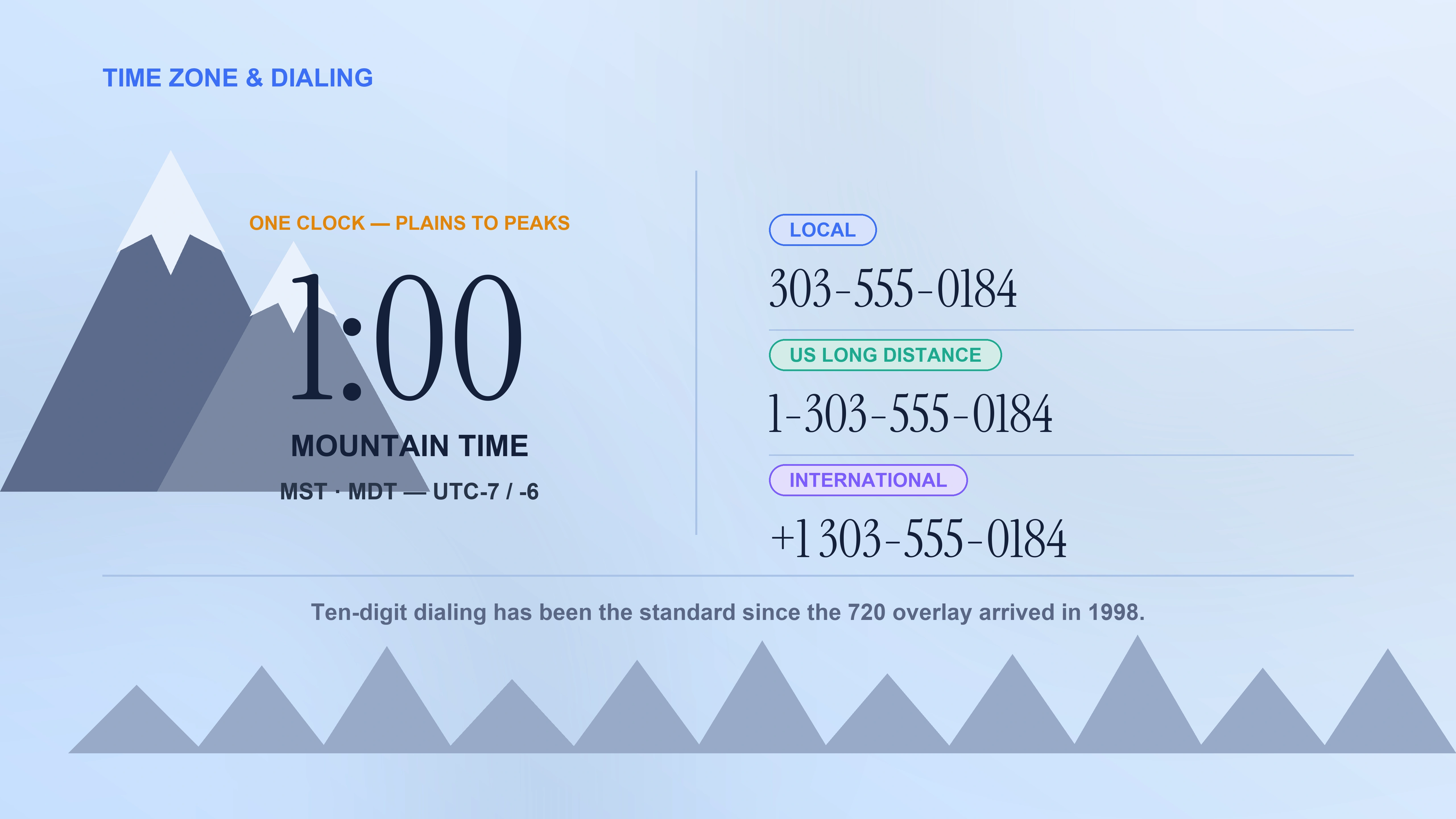
- Local calls within the metro: because 303 shares its territory with the 720 and 983 overlays, you must dial all ten digits — 303-555-0184 — even for a call across the street.
- Long-distance from elsewhere in the U.S.: add a leading 1 — 1-303-555-0184.
- International: dial the exit code, then +1, then the number — +1 (303) 555-0184.
- On mobile phones: cell numbers are stored and dialed with all ten digits anyway, so most people already reach 303 lines the same way from anywhere.
The Splits and the 720 Overlay
When the North American numbering plan launched in 1947, the whole of Colorado was assigned a single area code: 303. For forty years that one prefix served everyone from Denver to Grand Junction to Pueblo. By the late 1980s, though, the state's booming population had exhausted its numbers, and the code was split for the first time. On March 5, 1988, southern Colorado — Colorado Springs, Pueblo and the southeastern plains — broke away as area code 719. Seven years later, on April 2, 1995, a second split created the 970 area code for the northern and western reaches of the state, including Fort Collins, Greeley, Grand Junction and the mountain resorts. What remained of 303 was the Denver metropolitan area alone.
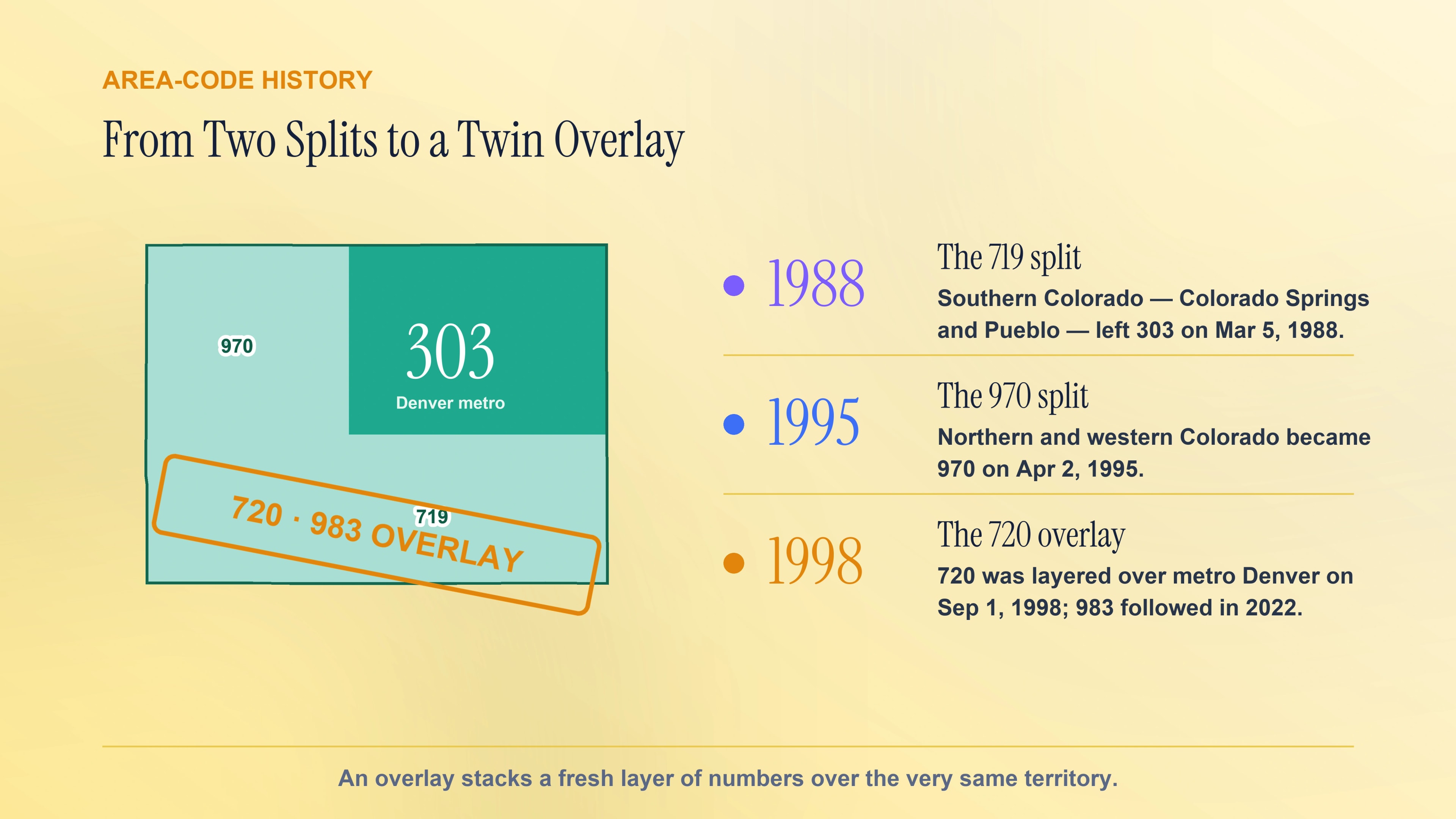
Even that trimmed-down metro kept growing, and by the late 1990s regulators chose a different tool. Instead of splitting Denver again and forcing anyone to change their number, they added an overlay: on September 1, 1998, area code 720 was laid over the exact same territory as 303. A second overlay, 983, joined the pair on June 17, 2022, when the two codes together began to run low. Denver was hardly alone in taking this route — fast-growing metros across the country have chosen overlays over splits precisely because no existing customer has to give up a number. The trade-off is mandatory ten-digit dialing, but every 303 holder kept their number exactly as it was.
Benefits of a Local 303 Number for Business
A local number is one of the simplest trust signals a business can own, and in a market as competitive as Denver, a 303 number carries an extra layer of meaning: because it predates the 720 and 983 overlays, it quietly signals a business that has been part of the community for years. When someone along the Front Range sees a 303 line calling, it reads as an established neighbor rather than an out-of-state telemarketer.
- Original-code prestige — 303 is the last of Colorado's founding 1947 prefix still doing its first job, so it reads as more established than the newer 720 and 983 overlays sharing the map.
- Front Range-wide reach — one 303 line credibly covers Denver, the Boulder tech corridor, and suburbs from Aurora to Golden without sounding out of area.
- Better answer rates — Front Range callers are quicker to pick up a number carrying the code their own phone already uses.
- No office required — cloud calling lets a business hold a 303 number from anywhere and still ring in as a Denver local.
- Room to scale with the metro — add lines and routing as the Front Range keeps growing, all under the one number your customers already recognize.
Put a local 303 number to work
Give your business an authentic Denver presence with a 303 number that rings anywhere you do business.
How to Get a 303 Phone Number
Claiming a 303 line no longer involves an installer's visit or signing a lease near Union Station. A cloud phone provider takes care of the search, order and setup online, and a Denver number can be ringing the same day you choose it. Since 303 shares the metro with 720 and 983, the process runs like this:
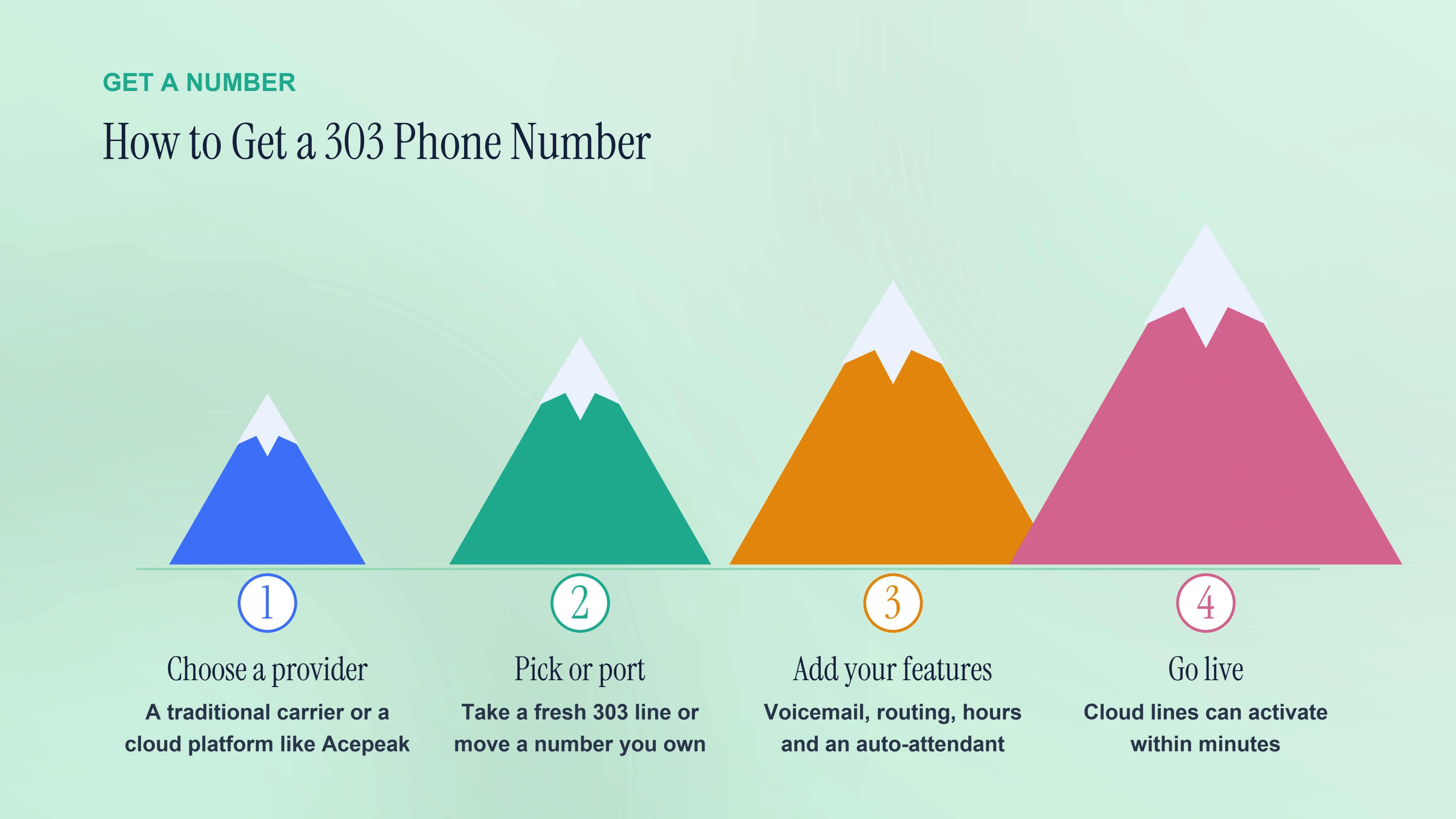
- Confirm which code fits — a cloud provider can show live inventory across 303, 720 and 983, since all three now serve the identical Denver-metro footprint.
- Claim or port a number — search current 303 stock or transfer a Front Range line you already hold, since ten-digit dialing makes the exact prefix less critical than it once was.
- Build out routing and features — assign voicemail, an auto-attendant, business hours and call forwarding so the metro-wide number reaches the right desk.
- Go live across Denver — take calls from a laptop, desk phone or mobile app the moment setup finishes, with the same 303 identity every time.
Spotting and Avoiding 303 Scam Calls
Front Range residents tend to trust a 303 on the screen, and fraudsters count on that reflex. Through neighbor spoofing, a scam call is disguised as a local number from somewhere between Aurora and Boulder, which makes picking up feel harmless. These habits help you catch it:
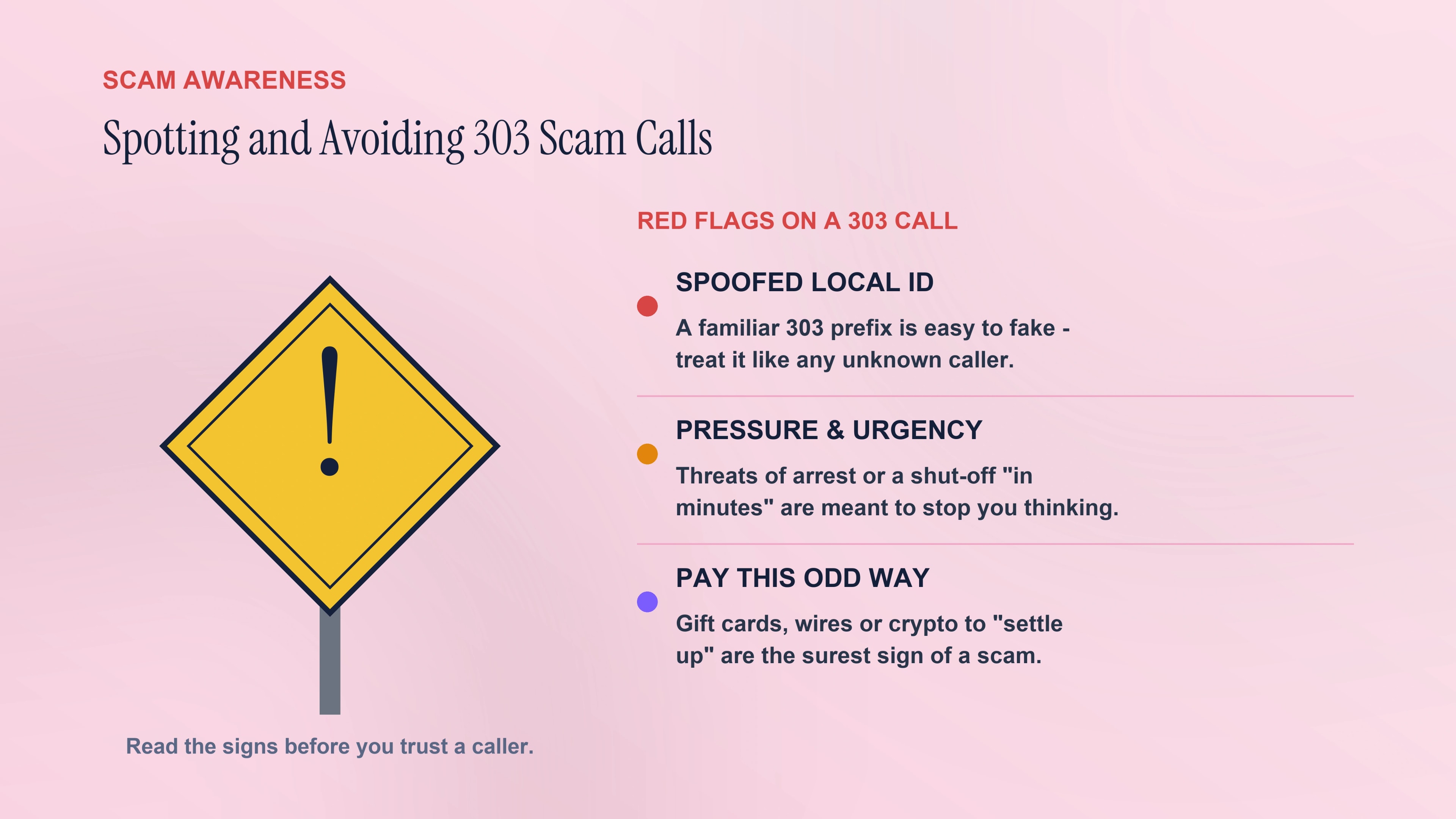
- Watch for pressure and urgency — real agencies and businesses do not demand that you act "right now" or the account will be closed.
- Be wary of odd payment demands — gift cards, wire transfers and cryptocurrency are the calling cards of a scam, never a legitimate bill.
- Do not trust caller ID alone — a 303 number on the screen can be faked; the local code is no guarantee the caller is who they claim.
- Hang up and call back on a number you trust — reach the bank, utility or agency directly using a number from a statement or official website.
- Report the call — logging unwanted calls with the authorities helps regulators track and shut down the operations behind them.
The Future of the 303 Area Code
For a code that once covered an entire state, 303 has grown into something rarer: a prestige prefix. Two splits and two overlays later, its geographic footprint is settled, and regulators have made clear that any future relief for the Denver metro will come as another overlay rather than a disruptive split — so existing 303 numbers are safe. Meanwhile the region keeps booming; the City and County of Denver remains one of the fastest-growing large cities in the country, adding residents and businesses that steadily draw down the supply of new numbers across the 303, 720 and 983 pool. That growth is exactly why a 303 line has held its cachet: with three codes now serving the same streets, the original prefix is the one that signals you were here first.
The Simplest Authentic Way to Belong in the Colorado Market
The 303 area code is far more than three digits — it is the shared phone identity of metropolitan Denver, from the downtown skyline to the Boulder foothills, the suburbs of Aurora and Lakewood, and the growing towns of the northern and southern Front Range. One of the original codes of 1947, it once covered all of Colorado before the 719 and 970 splits narrowed it to the metro and the 720 and 983 overlays layered new numbers over the same ground. For any business hoping to connect with the Colorado market, a local 303 number is one of the simplest and most authentic ways to belong.
Claim your Denver presence today
Acepeak makes it easy to get a 303 number and start taking calls across the Colorado Front Range.
Looking at Colorado more widely? The 719 area code covers Colorado Springs, Pueblo, and the southern part of the state.
Questions, answered.
The 303 area code covers the Denver–Boulder metropolitan area in north-central Colorado, including Denver, Aurora, Lakewood, Boulder, Longmont, Broomfield, Arvada, Westminster, Thornton, Centennial, Golden and Littleton across Denver, Boulder, Broomfield, Adams, Arapahoe, Jefferson and Douglas counties.
Area code 303 originally covered all of Colorado. It was split twice: 719 broke away for southern Colorado (Colorado Springs and Pueblo) on March 5, 1988, and 970 was created for the northern and western parts of the state (Fort Collins, Greeley and Grand Junction) on April 2, 1995, leaving 303 with just the Denver metro.
720 and 983 are overlay codes that cover the exact same Denver-metro territory as 303. Rather than split the region again, regulators added 720 on September 1, 1998, and a second overlay, 983, on June 17, 2022. All three codes serve the same area, which is why ten-digit dialing is required.
Yes. 303 is one of the original 86 area codes assigned in 1947 under the first North American Numbering Plan, when it covered the entire state of Colorado. It was narrowed to the Denver metro by the 1988 and 1995 splits that created 719 and 970.
Yes. Because 303 shares its territory with the 720 and 983 overlays, ten-digit dialing is mandatory for all local calls — you must always include the area code, even when calling a number on the same block.
Absolutely. With a cloud phone provider you can choose a 303 number from anywhere and have it ring on your laptop, desk phone or mobile app. It gives your business an authentic Denver presence without needing a physical office along the Front Range.
Signing up for a 303 area code number takes minutes with a cloud phone provider — no local office in Denver required. Pick the number, connect it to your existing phone or app, and calls route in immediately. This keeps the 303 area code presence you already have while adding the local credibility Colorado customers respond to.