Pear Orchards, Shakespeare Stages and High-Desert Bend
Say "541" almost anywhere in Oregon outside of Portland and locals picture the same enormous sweep of the state: the college city of Eugene, the wine-and-farm country of the Willamette Valley, the high-desert boom town of Bend, the pear orchards and Shakespeare stages around Medford and Ashland, the fishing ports of the coast, and the wheat and cattle country east of the Cascades. This single code has been the dial-tone identity of nearly all of Oregon for three decades, born when the sprawling statewide 503 code was carved in two to keep pace with a growing state. This guide lays out exactly where 541 reaches today, how it was split from 503, what the 458 overlay changed, the Pacific time zone and dialing rules, and how any business can claim a local Oregon presence with a number of its own.
Key Takeaways
- The 541 area code covers most of Oregon — everything outside the Portland–Salem corner — including Eugene, Springfield, Corvallis, Albany, Bend, Medford, Ashland, Roseburg, Grants Pass, Klamath Falls, Coos Bay, The Dalles and Pendleton across roughly 30 counties.
- It was created on November 5, 1995, in a split from area code 503, when the old statewide Oregon code was reduced to just the populous northwestern corner around Portland.
- Area code 458 was overlaid on the exact same territory on February 10, 2010, so ten-digit dialing has been the everyday standard across the region for more than fifteen years.
- The entire 541 region runs on Pacific Time — UTC-8 in winter (PST) and UTC-7 in summer (PDT) — the same clock as Portland, Seattle and the rest of the West Coast.
- A local 541 number reads as an authentic Oregon identity — a real credibility advantage for any business serving Eugene, the Willamette Valley, the coast, the high desert or the mountain towns.
What Is the 541 Area Code?
The 541 prefix is the telephone identity of central, southern, eastern and coastal Oregon — a geographic code with its own vast territory carved out of the old statewide 503 area in 1995. It reaches from the Pacific shoreline and the Willamette Valley in the west, across the Cascade crest and the high desert of central Oregon, all the way to the Idaho line in the far east. Right across that eastern border, Idaho's 208 area code plays the same role for its own state — one code carrying the identity of a huge, mostly rural region rather than a single city.
Because it blankets so much of the state, a 541 number reads as unmistakably Oregonian across everything but the Portland metro. To a customer in Eugene, Bend or Medford it looks like a neighbor on the caller ID rather than an out-of-state stranger — a small but real credibility signal for any business working the valley, the coast or the high country.
Two-Thirds of Oregon from Coos Bay to Baker City
The 541 code spans roughly two-thirds of Oregon by land area — some thirty counties reaching from the coast to the Idaho border — while the far northwestern corner around Portland and Salem keeps 503 and its 971 overlay. It is a big, geographically varied footprint anchored by a string of independent regional cities rather than one dominant metro. The major communities include:
- Eugene and Springfield (Lane County) — the largest population center in the region and home to the University of Oregon; Eugene is the state's third-largest city
- Corvallis (Benton County) and Albany (Linn County) — the Willamette Valley college and manufacturing towns, with Corvallis home to Oregon State University
- Bend and Redmond (Deschutes County) — the fast-growing high-desert recreation hub on the east side of the Cascades
- Medford, Ashland and Grants Pass (Jackson and Josephine counties) — the Rogue Valley cities famous for pears, wine and the Oregon Shakespeare Festival
- Roseburg (Douglas County), Coos Bay (Coos County) and Klamath Falls (Klamath County) — the timber, coastal and high-plateau hubs of southern Oregon
- Pendleton (Umatilla County), The Dalles (Wasco County), Ontario (Malheur County) and Baker City (Baker County) — the wheat, river and ranching towns of eastern Oregon
Together these counties hold well over a million people spread across coastline, valley, desert and mountains — enough demand that a single code eventually needed reinforcement.
Pacific Time, a Malheur County Quirk and Ten Digits
Unlike some sprawling area codes that straddle a time-zone line, the 541 region sits entirely within Pacific Time — UTC-8 in winter (PST) and UTC-7 in summer (PDT), the same clock as Portland, Seattle and the rest of the West Coast. (A tiny slice of far-eastern Malheur County near the Idaho border unofficially keeps Mountain Time for daily life, but the telephone region as a whole is Pacific.) Dialing is uniform across the code, because the 458 overlay made ten digits mandatory years ago:
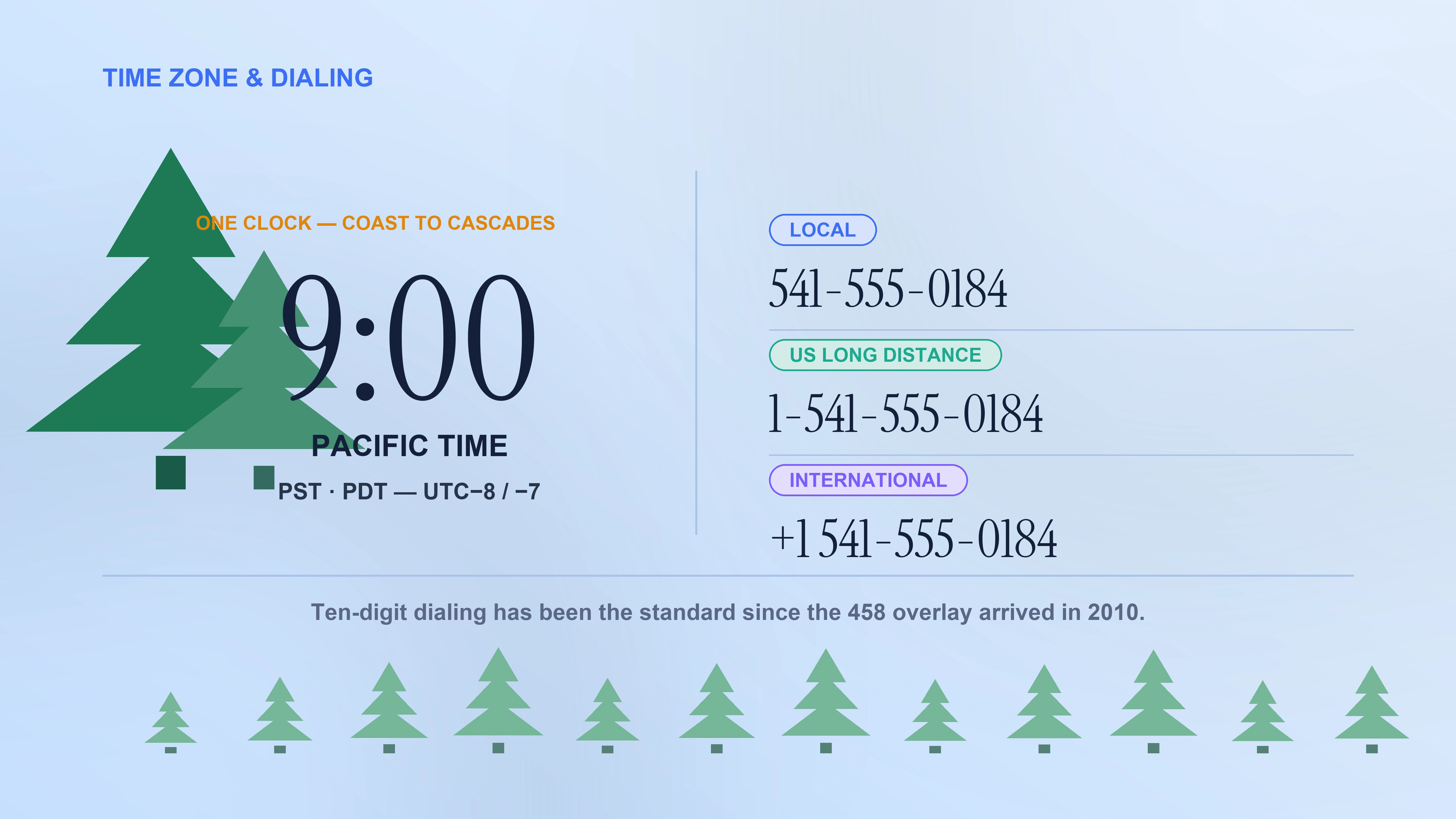
- Local calls within the region: dial all ten digits — 541-555-0184 — which has been required since the 458 overlay arrived.
- Long-distance from elsewhere in the U.S.: add a leading 1 — 1-541-555-0184.
- International: dial the exit code, then +1, then the number — +1 (541) 555-0184.
- Same rules for 458: because 458 overlays the same area, a call to either code from anywhere in the region is dialed exactly the same way.
From a 503 Split to the 458 Overlay
When the North American numbering plan launched in 1947, all of Oregon shared a single code, 503. For nearly fifty years that one prefix covered the entire state, but the surge of fax machines, pagers and second lines finally outgrew it. On November 5, 1995, the numbering plan was split: the busy northwestern corner around Portland kept 503, and everything else — the valley, the coast, the desert and the mountains — became area code 541. Much as Seattle's 206 area code later gained an overlay when its numbers filled up, the new Oregon code was running short within a decade too — and regulators chose an overlay instead of another split.
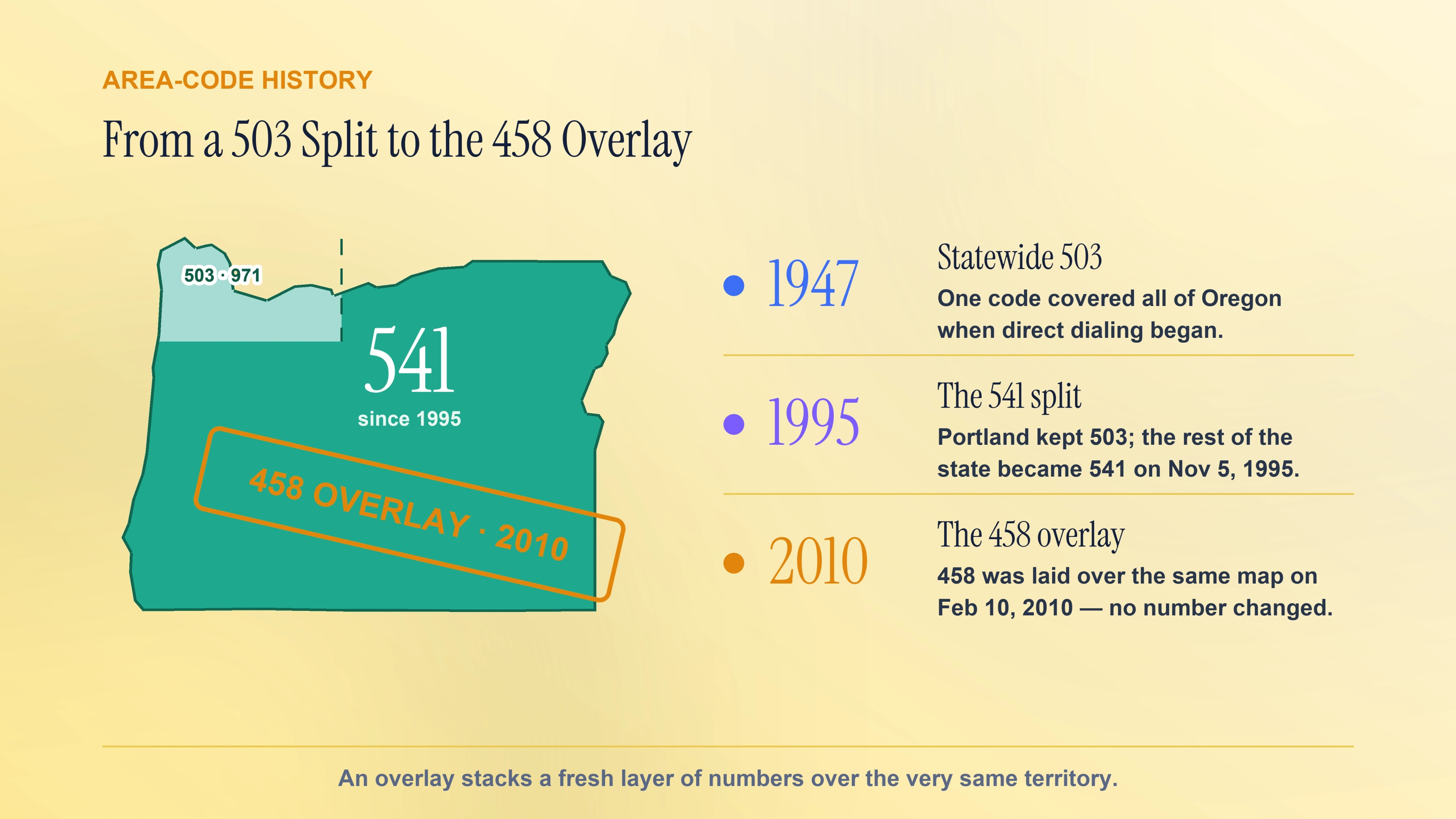
Area code 458 went into service on February 10, 2010, laid directly over the entire 541 territory. No existing number changed — an overlay simply adds a second prefix to the same map, so new lines can draw on fresh numbers while every established 541 line stays exactly as it is. Choosing an overlay spared residents, especially those in the far-flung towns east of the Cascades, the cost and hassle of reprinting every business card and sign. The one trade-off, ten-digit dialing for local calls, had been phased in just ahead of the switch, which is why the whole region has dialed all ten digits as a matter of habit ever since.
Benefits of a Local 541 Number for Business
A local number is one of the simplest trust signals a business can own, and in a state as attached to its regional identity as Oregon, a 541 number carries real weight. When a customer in Eugene, Bend or Medford sees a 541 line calling, it reads as a neighbor rather than an out-of-state telemarketer.
- Reads as Oregon, not Portland — a 541 caller ID tells someone in Eugene, Bend, or Medford that a business belongs to the two-thirds of the state outside the Portland metro, where 503 and 971 rule instead.
- Covers wildly different local economies on one line — the same 541 number works for the University of Oregon crowd in Eugene, the high-desert recreation trade around Bend, and the Rogue Valley's wine and Shakespeare Festival visitors.
- Outlasts a doubling of the number pool — because the 458 overlay added a second layer of numbers back in 2010 without touching a single existing line, a 541 number claimed today keeps the same weight it had before the overlay arrived.
- Reaches the timber coast and the wheat country alike — a single prefix connects a business to Coos Bay and Roseburg on one side of the region and Pendleton and the eastern wheat towns on the other.
- Scales without a new number — cloud routing lets a company add lines, track campaigns, and grow from Lane County to the whole 30-county 541 footprint under the number customers already recognize.
Put a local 541 number to work.
Give your business an authentic Oregon presence with a 541 number that rings anywhere you do business.
How to Get a 541 Phone Number
Nobody has to wait on a technician or rent space in Eugene or Bend to get a 541 number now. A cloud phone provider manages the order and configuration online, and a line that reads as Oregon from the coast to the high desert can be taking calls the same day. The sequence is short:
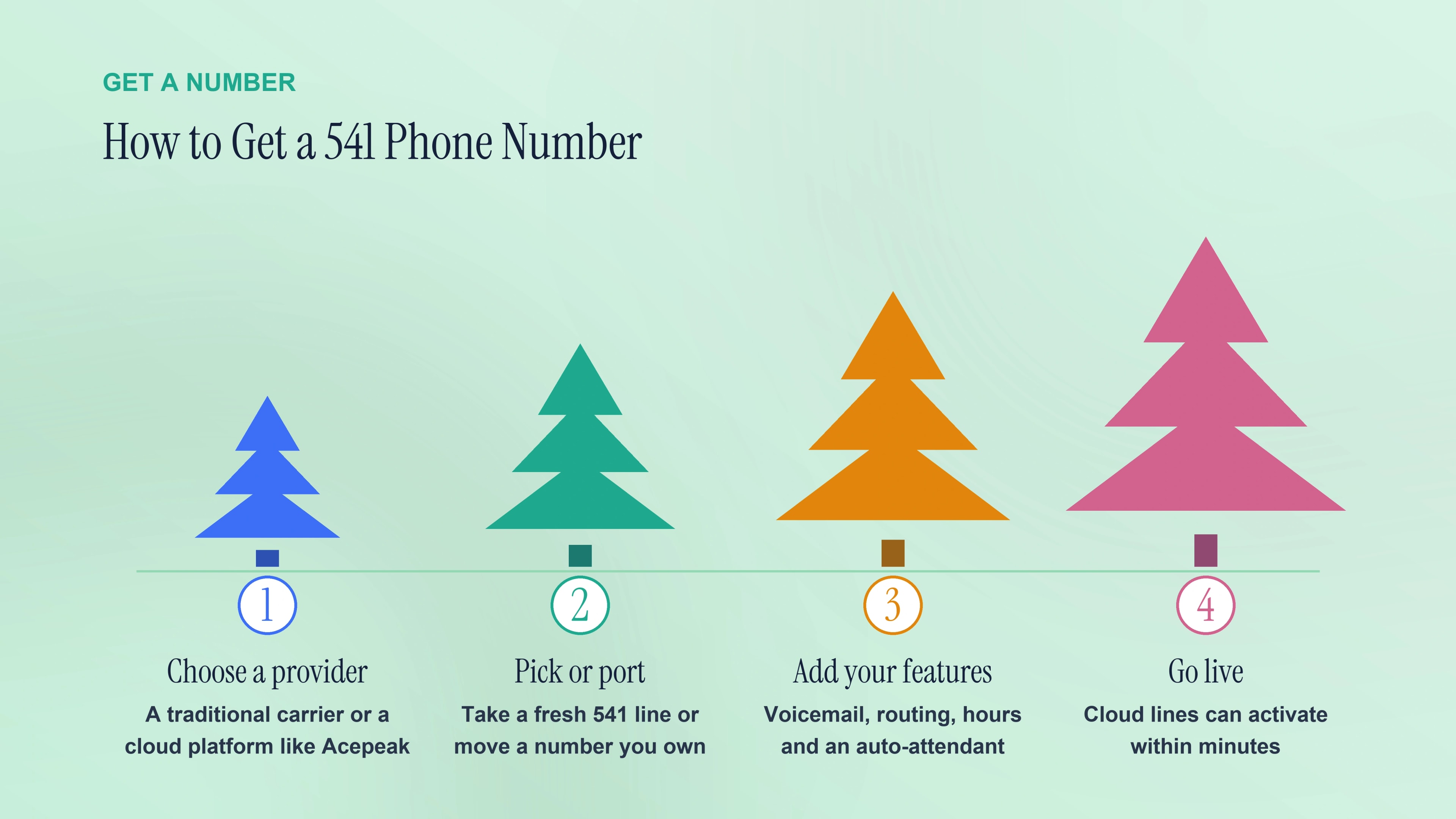
- Choose a cloud phone provider — pick one that lists inventory across the region, from Eugene and Bend to the smaller Rogue Valley and eastern Oregon exchanges.
- Select your 541 number — search live availability and claim one, or port an existing line, keeping in mind ten-digit dialing has applied here since the 458 overlay arrived in 2010.
- Set up routing and features — point calls to your team, add voicemail, an auto-attendant, and business hours that match Pacific Time.
- Start calling — make and receive calls from a laptop, desk phone, or mobile app, showing the same Oregon identity whether the call reaches Corvallis or Klamath Falls.
Spotting and Avoiding 541 Scam Calls
A 541 or 458 prefix on the screen suggests someone between Coos Bay and Pendleton, and con artists lean on that. Spoofing lets them dress a fraudulent call up as a nearby Oregon line that seems safe to answer. A few habits help you see through it:
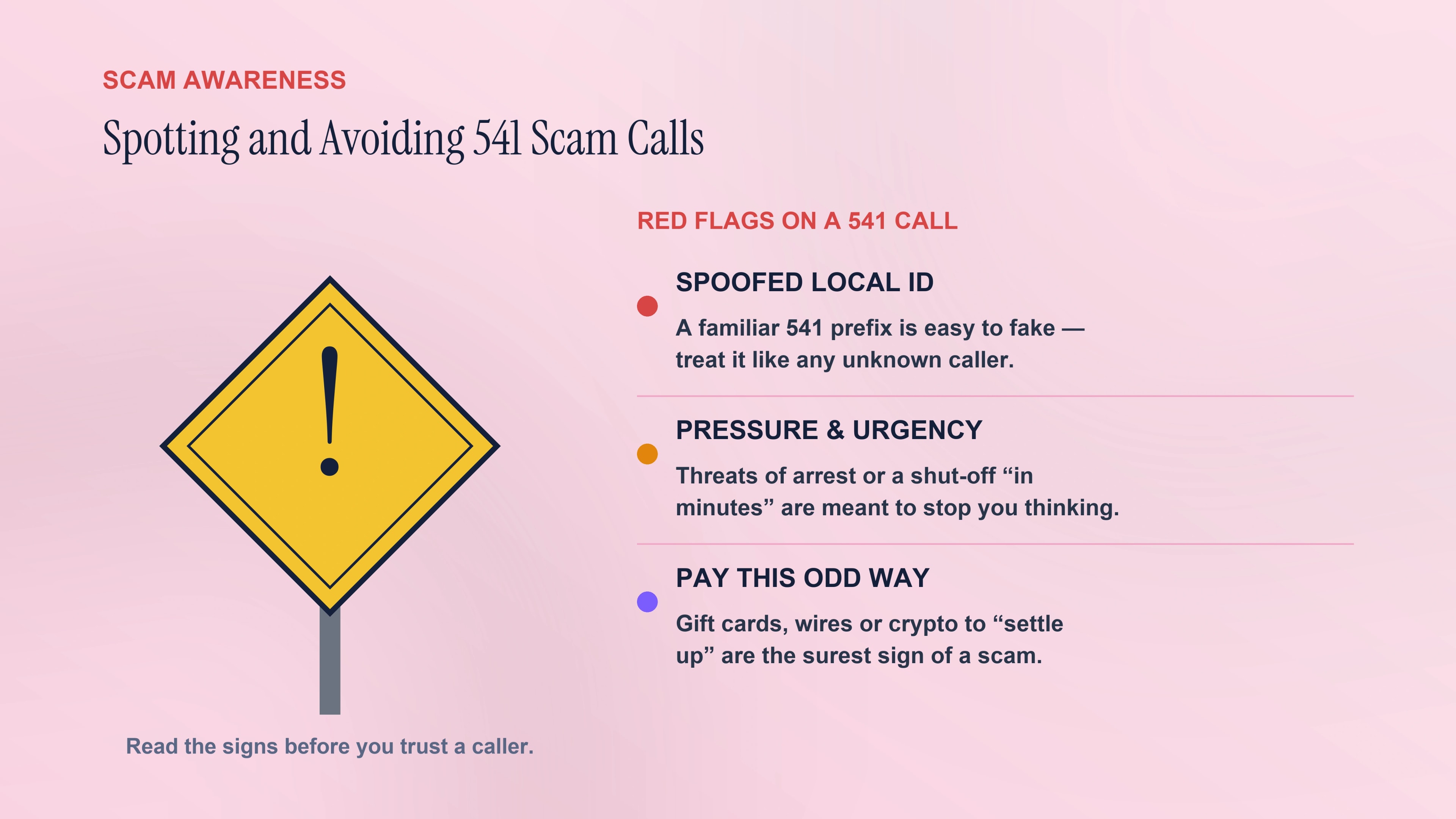
- Watch for pressure and urgency — real agencies and businesses do not demand that you act "right now" or the account will be closed.
- Be wary of odd payment demands — gift cards, wire transfers and cryptocurrency are the calling cards of a scam, never a legitimate bill.
- Do not trust caller ID alone — a 541 number on the screen can be faked; the local code is no guarantee the caller is who they claim.
- Hang up and call back on a number you trust — reach the bank, utility or agency directly using a number from a statement or official website.
- Report the call — logging unwanted calls with the authorities helps regulators track and shut down the operations behind them.
The Future of the 541 Area Code
The 541/458 overlay was built to last, and it has: because 458 doubled the pool of available numbers across the region back in 2010, the area is not facing the kind of exhaustion pressure that forces a new code every few years. Steady growth in Bend, Redmond and the Rogue Valley keeps demand rising, but planners at the state and federal level track that usage closely, and any future relief would almost certainly come as another overlay rather than a disruptive split that changes existing numbers. Fast-growing communities like the City of Eugene continue to add lines every year, yet residents can expect their 541 numbers to stay exactly as they are. For businesses, that stability is a quiet advantage — a 541 number you print today will still read as authentically Oregonian for many years to come.
Three Decades as Oregon's Voice Beyond Portland
The 541 area code is far more than three digits — it is the shared phone identity of nearly the entire state of Oregon outside Portland, from the University of Oregon in Eugene to the high desert of Bend, the Rogue Valley vineyards, the fishing docks of the coast and the wheat fields of the east. Born from the 1995 split of the old statewide 503 code and reinforced by the 458 overlay in 2010, it has anchored the region's calls for three decades. For any business hoping to connect with Oregonians beyond the Portland metro, a local 541 number is one of the simplest and most authentic ways to belong.
Claim your Oregon presence today.
Acepeak makes it easy to get a 541 number and start taking calls across central, southern and eastern Oregon.
Questions, answered.
The 541 area code covers most of Oregon outside the Portland–Salem area, including Eugene, Springfield, Corvallis, Albany, Bend, Medford, Ashland, Roseburg, Grants Pass, Klamath Falls, Coos Bay, The Dalles and Pendleton — roughly the central, southern, eastern and coastal two-thirds of the state.
Area code 541 was created on November 5, 1995, in a split from area code 503, which had covered the entire state of Oregon since 1947. After the split, 503 kept the northwestern corner around Portland and 541 took the rest of the state.
Yes, in practice. Area code 458 was added on February 10, 2010, as an overlay covering the exact same territory as 541. Both codes serve the same region; 458 simply provides additional numbers, which is why ten-digit dialing is required for local calls.
The 541 region runs on Pacific Time — UTC-8 during standard time (PST) and UTC-7 during daylight saving time (PDT) — the same clock as Portland, Seattle and the rest of the West Coast.
Yes. Because 458 overlays the same area as 541, ten-digit dialing has been mandatory for local calls since the overlay took effect in 2010. You dial the full area code plus the seven-digit number for every local call.
Absolutely. With a cloud phone provider you can choose a 541 number from anywhere and have it ring on your laptop, desk phone or mobile app. It gives your business an authentic central-and-southern-Oregon presence without needing a physical office in the region.
Signing up for a 541 area code number takes minutes with a cloud phone provider — no local office in Central Oregon required. Pick the number, connect it to your existing phone or app, and calls route in immediately. This keeps the 541 area code presence you already have while adding the local credibility Oregon customers respond to.