Hometown Pride and the Seattle Digital Handshake
In a world where everyone's cell phone number seems to come from a different state, there is still a massive amount of hometown pride baked into the 206. It is more than just three digits you dial; it is a digital handshake that says you are part of the Seattle community.
Since it was first rolled out in 1947, the 206 has evolved from a standard prefix into a badge of local credibility. For businesses, it is the difference between looking like a 1-800 corporation and looking like a neighbor. For residents, it is a connection to the culture, the tech scene, and the unique energy of the Pacific Northwest.
Key Takeaways
- The 206 prefix was Washington's original 1947 area code and still anchors Seattle's identity.
- It covers Seattle plus Shoreline, Mercer Island, Bainbridge Island, Vashon Island, and parts of King County.
- The 564 overlay went into service June 10, 2025 — existing 206 numbers stay the same, but all local calls now need ten digits.
- A local Seattle number lifts answer rates, trust, and brand recognition for businesses.
- VoIP providers like Acepeak issue these numbers in minutes, with scam-safety tools built in.
What Is the 206 Area Code?
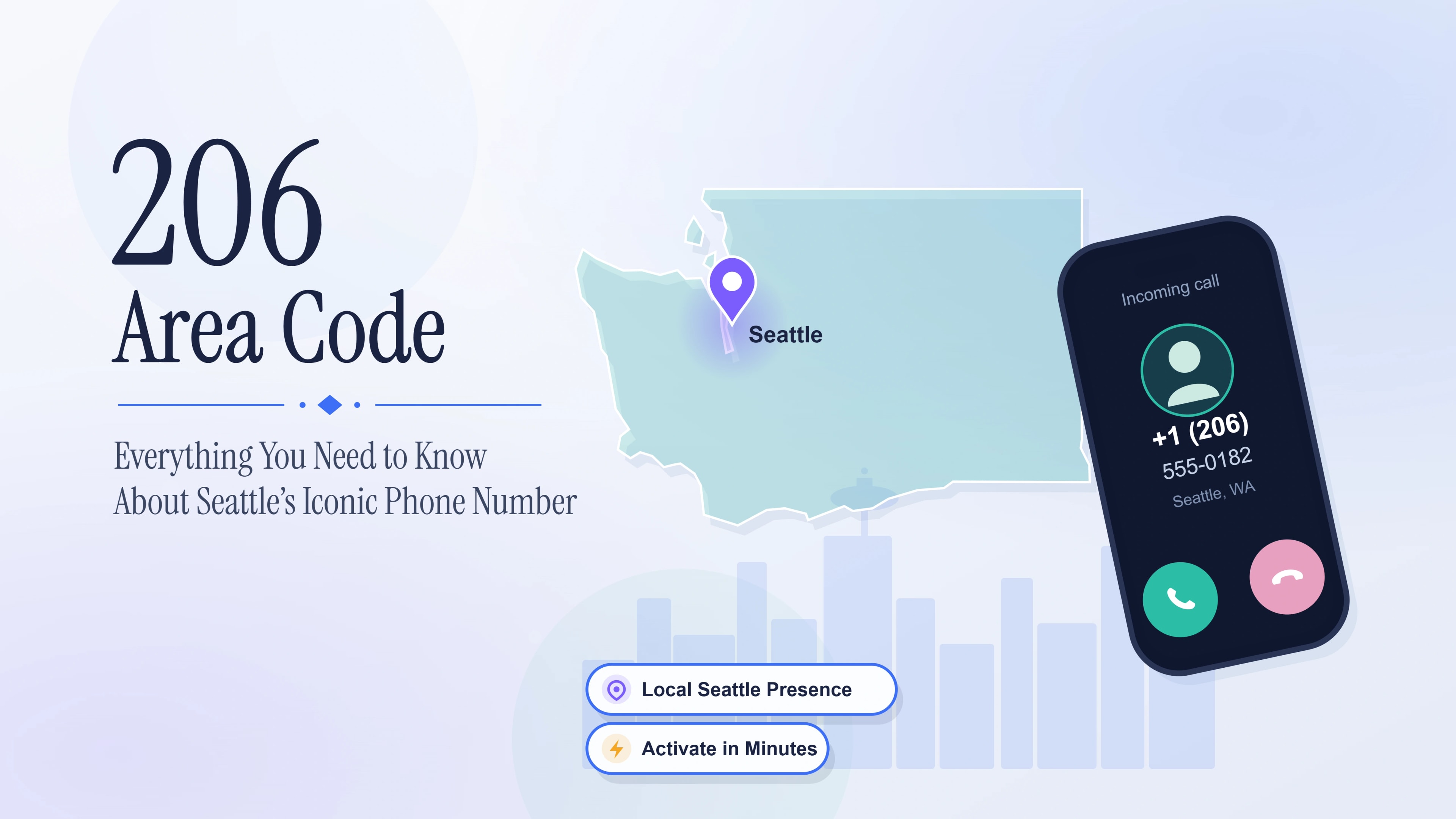
The 206 area code serves Seattle and surrounding communities in Washington State. It was Washington's first area code, assigned to the region in 1947 and remaining a cornerstone of local telecommunications. It covers Seattle proper, along with nearby cities like Shoreline, Mercer Island, Bainbridge Island, and Vashon Island.
Originally the prefix blanketed the entire state, but rapid growth forced a three-way split on April 25, 1997, when 253 took the Tacoma area and 425 took the Eastside and Everett. What remained — the dense Seattle core — kept the original digits. That history is part of why the 206 carries significant cultural weight, linked to Seattle's identity as a tech hub and home to major companies and startups that have shaped the modern economy.
Why Businesses Choose a Local Number
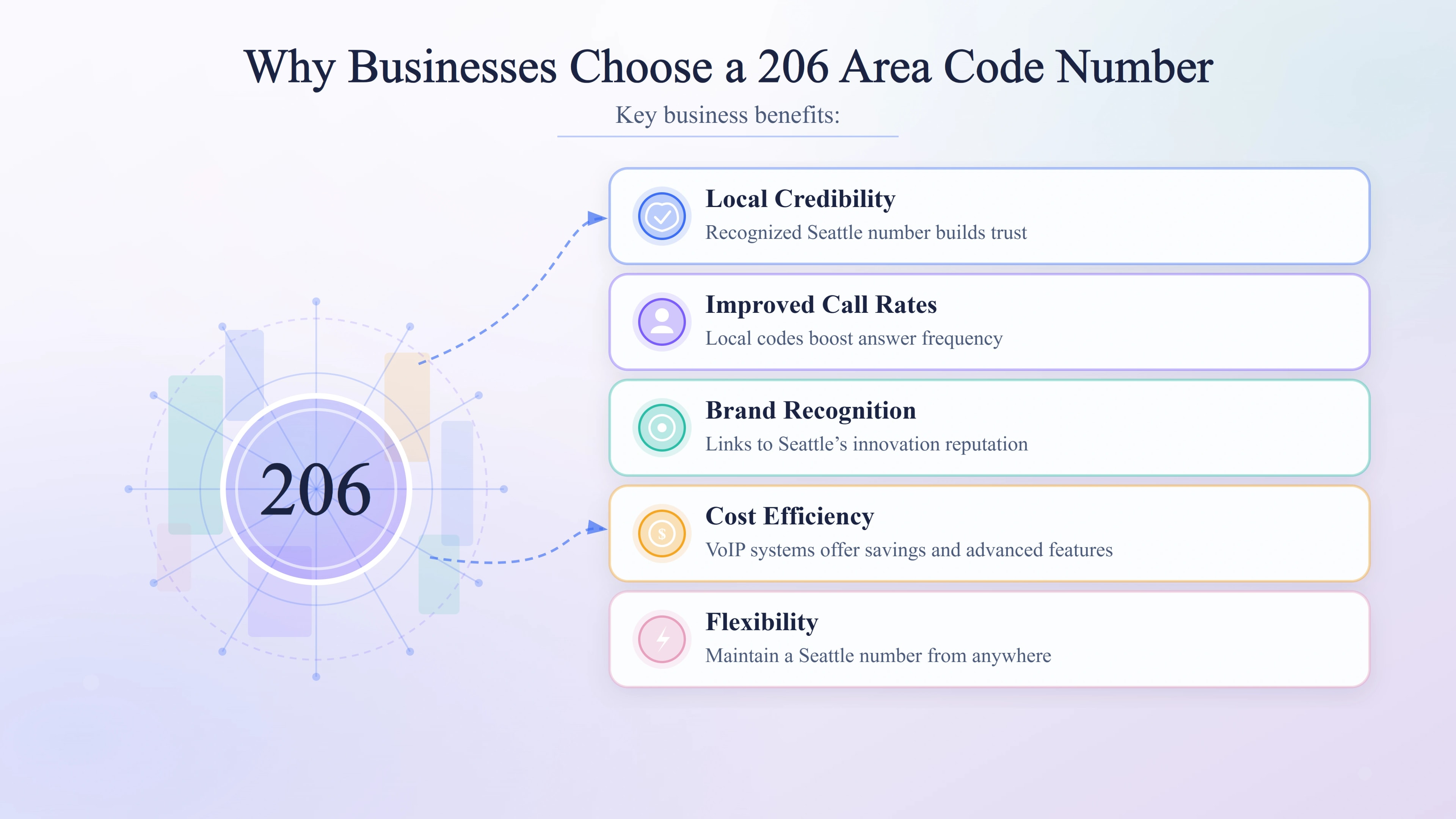
- Local credibility: Customers recognize the prefix as a Seattle number, making a business appear established and trustworthy within the region.
- Improved call connection rates: Local numbers tend to increase answer rates compared to out-of-state numbers.
- Brand recognition: The 206 connects a business to Seattle's reputation for innovation and quality.
- Cost efficiency: Virtual phone systems offering 206 numbers often cost less than traditional landlines while providing advanced features.
- Flexibility: Modern VoIP providers let a business keep a Seattle number regardless of physical location — ideal for remote teams.
The same tech-hub logic applies across the West Coast — businesses bridging Seattle and the Bay Area often pair a 206 line with a 669 area code number to anchor a presence in both innovation centers.
Geographic Coverage and Service Area
The prefix primarily serves King County's western portions, including Seattle and its immediate suburbs. Understanding the exact coverage helps businesses and individuals determine whether a 206 number suits their needs.
- Seattle (downtown, neighborhoods, and surrounding areas)
- Shoreline
- Mercer Island
- Bainbridge Island (in neighboring Kitsap County)
- Vashon Island
- Parts of unincorporated King County
Due to population growth, the Washington Utilities and Transportation Commission introduced the 564 overlay, placed in service on June 10, 2025. New numbers in the region may receive 564 designations, though existing 206 numbers remain unchanged. Both area codes now serve the same geography, requiring ten-digit dialing for all local calls.
How to Dial Numbers in the 206 Area Code
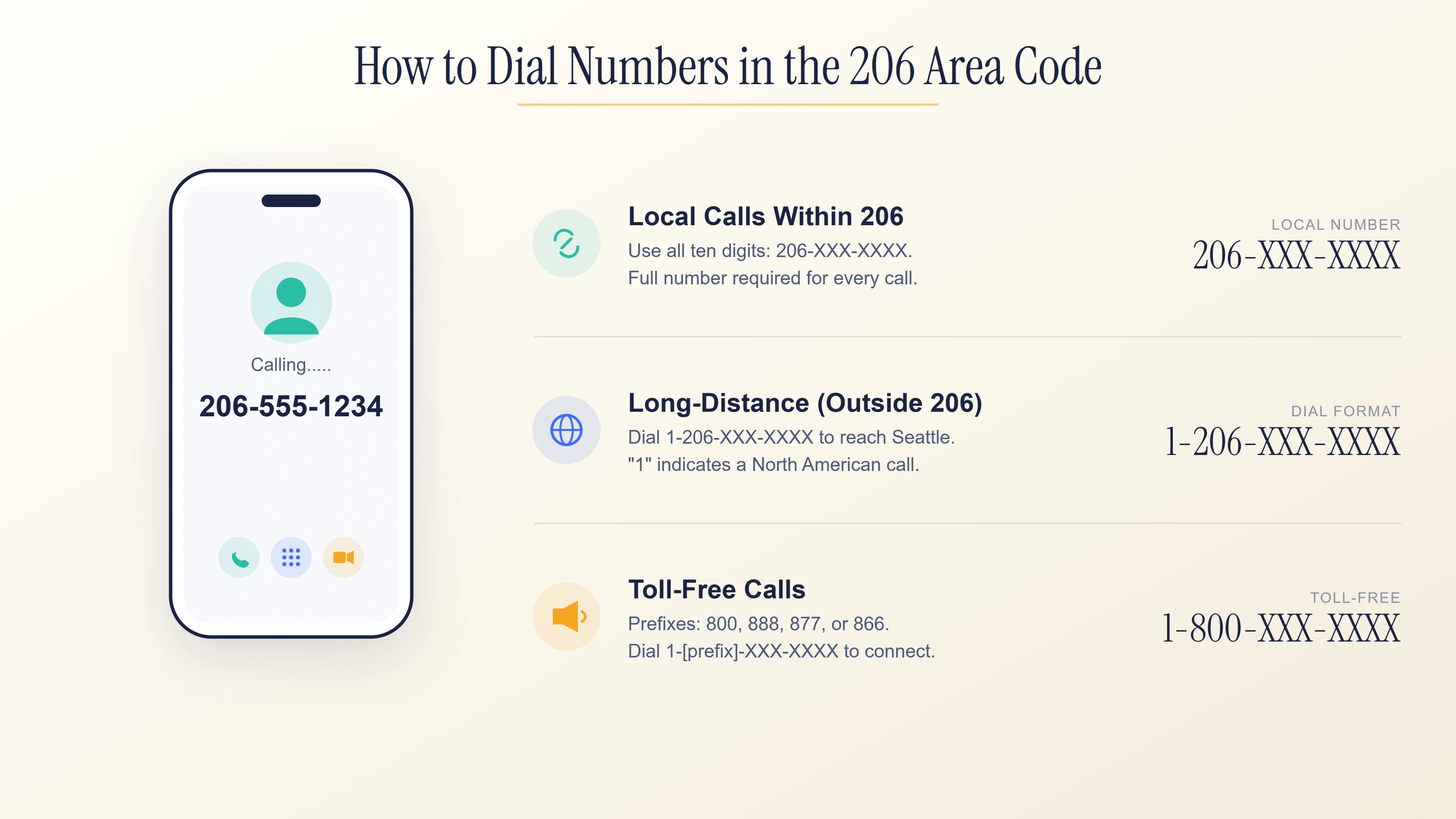
- Local calls within 206: use all ten digits — 206-XXX-XXXX. Even for nearby calls, the full number is required.
- Long-distance calls from outside 206: dial 1-206-XXX-XXXX. The leading 1 indicates a long-distance call within North America.
- Toll-free calls: prefixes like 800, 888, 877, or 866 — dial 1 followed by the toll-free prefix and seven-digit number.
- Emergency services: always dial 911, regardless of area code.
- Directory assistance: call 411 for local directory services or 1-800-555-1212 for toll-free directory help.
Phone Number Structure Explained
North American phone numbers follow a standardized format that applies to the 206 area code. The first three digits (206) identify the geographic region; the next three identify the local switching office; and the final four identify the individual line. This structure (206-XXX-XXXX) has remained consistent for decades, making numbers easy to recognize and remember.
Advantages of Getting a Local Number
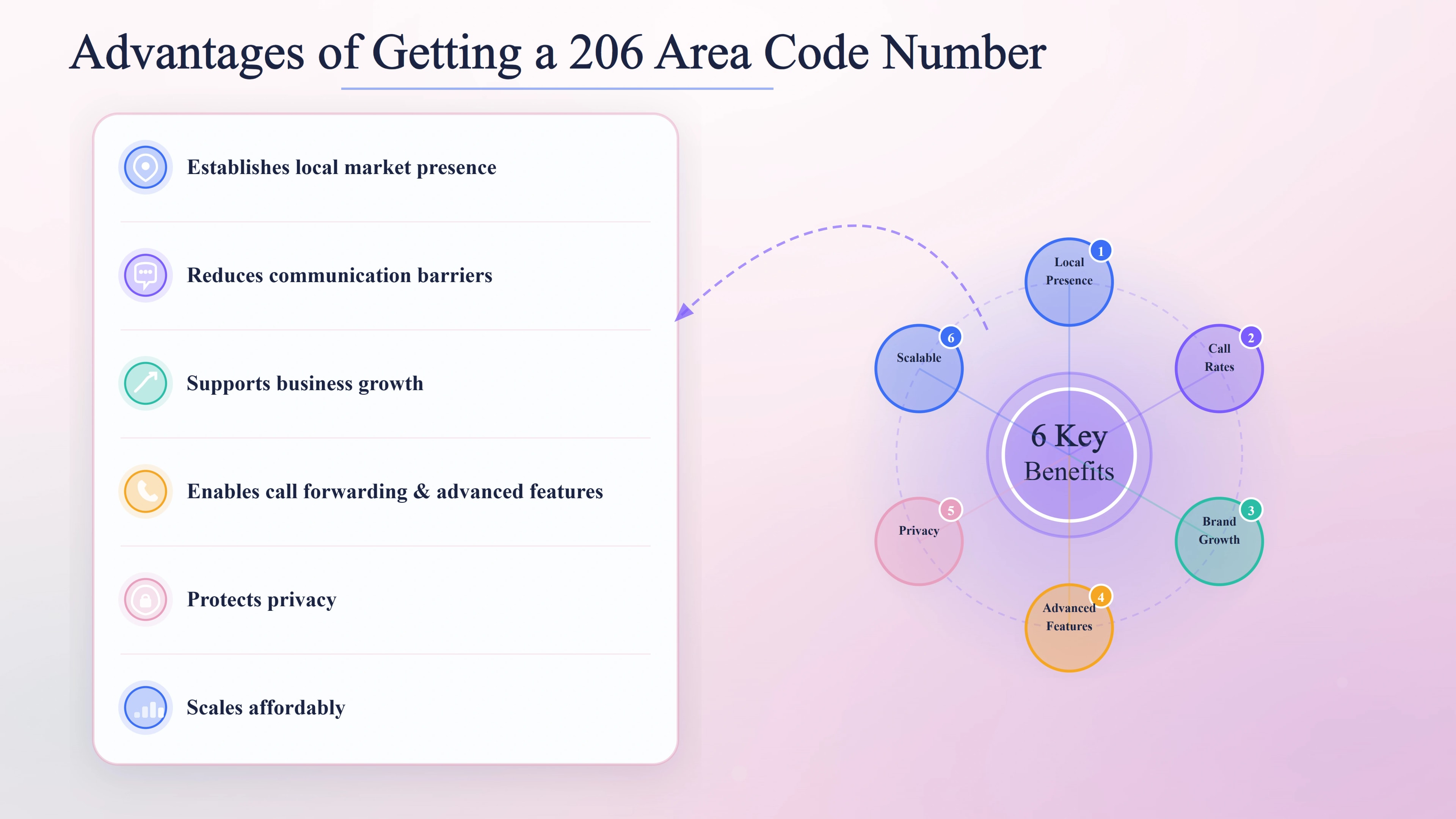
- Establishes local market presence: a Seattle number signals that a business operates in or serves the city, building immediate rapport with local customers.
- Reduces communication barriers: people are more likely to answer calls from familiar area codes, removing the hesitation some feel toward unfamiliar prefixes.
- Supports business growth: keeping a Seattle number as a company expands preserves the original market connection — the same loyalty that makes New Yorkers favor the 347 area code applies to Seattle's signature digits.
- Enables advanced features: modern VoIP systems include voicemail transcription, call recording, IVR, and detailed analytics.
- Protects privacy: a dedicated business number keeps a personal phone number private and maintains professional boundaries.
- Scales affordably: virtual systems let a team add multiple 206 numbers without proportional cost increases.
Ready to Claim a Seattle Line?
Acepeak activates local 206 numbers in minutes — no contracts, no hardware.
Selecting a Reliable Phone Provider for 206 Numbers
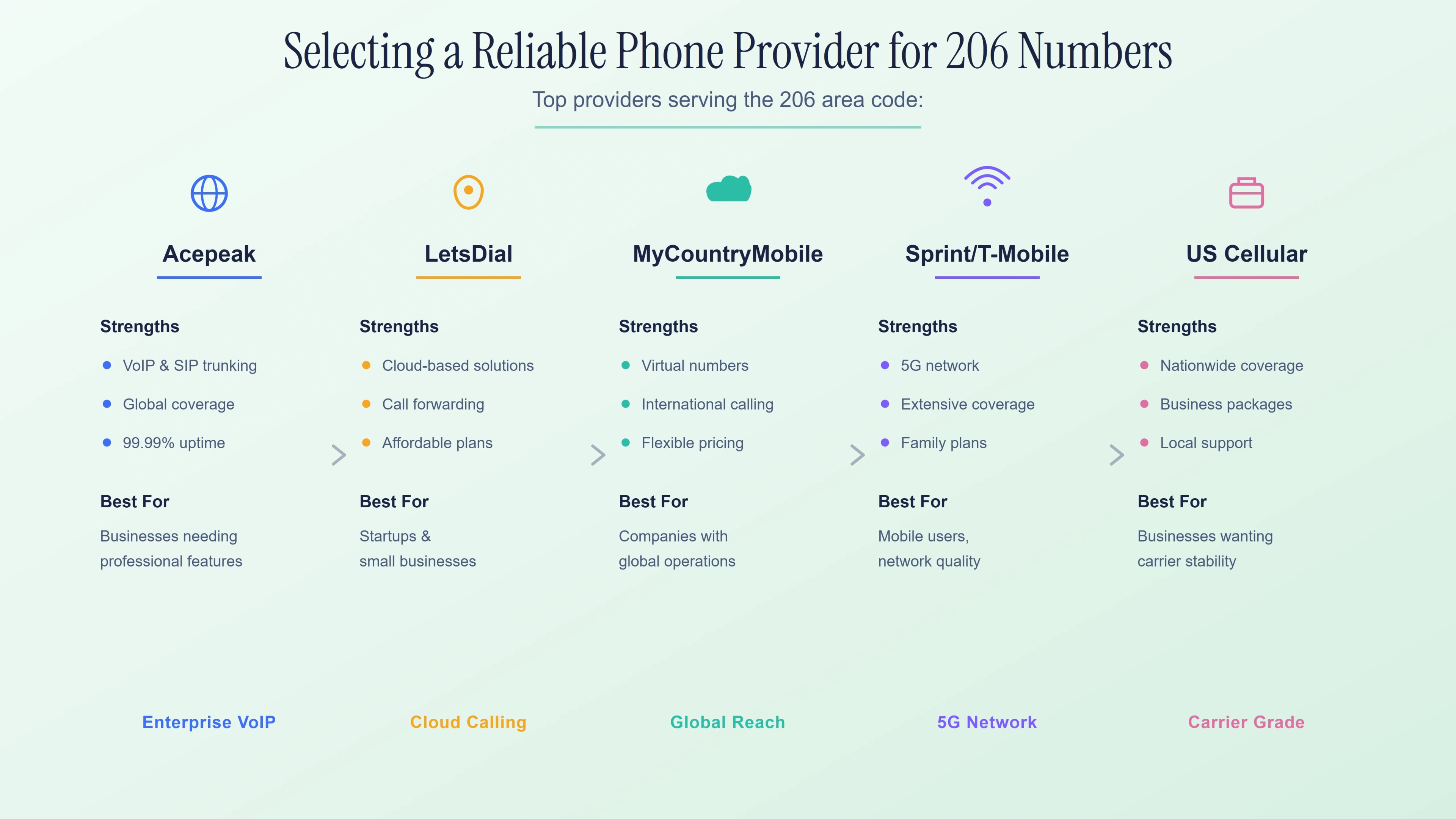
Choosing the right provider ensures quality service, reliable connectivity, and features that match your needs. Weigh these criteria before committing:
- Network reliability: check uptime guarantees and customer reviews for consistency.
- Feature set: ensure the provider offers call forwarding, voicemail, IVR, and analytics.
- Pricing transparency: avoid providers with hidden fees or complex billing.
- Customer support: 24/7 availability matters when issues arise.
- Scalability: choose a provider that grows with your business without service disruptions.
Acepeak stands out for combining affordability with enterprise-grade features and 99.99% uptime, making professional communication accessible to businesses at any stage.
Common Scams Targeting Local Users
The Seattle region is a target for various scams, including phishing calls and fake tech support. Scammers often impersonate local businesses or government agencies to steal personal information or money.
- Caller ID spoofing: scammers manipulate caller ID to appear as trusted contacts, banks, or government agencies.
- Automated call scams: pre-recorded messages claim you have won prizes, owe taxes, or face legal action.
- Phishing messages: fraudulent emails impersonate legitimate businesses requesting personal or financial information.
- Tech support scams: fake support calls claim your device has problems and request remote access.
To stay protected, register with the National Do Not Call Registry, never share personal information over the phone, verify caller identity independently, and enable carrier or third-party call-blocking tools.
The Future of the 206 Area Code
The introduction of the 564 overlay marks a significant transition for the region. As Seattle continues growing, demand for phone numbers will eventually exhaust the original supply — just as it did before the 1997 split. Both designations now carry equal weight and credibility in the Seattle market, and all local calls require ten-digit dialing.
The original Seattle prefix will remain available and desirable for years to come. For background on the city, its economy and its neighborhoods, the City of Seattle overview is a helpful reference for new market entrants.
Why Seattle Freelancers and Startups Win With Local Digits
Seattle is a thriving, competitive market where local credibility matters most for freelancers and startups. Securing a local Seattle number helps establish presence, strengthen brand identity, and show customers a real commitment to doing business locally. People prefer familiar local codes over toll-free or unknown prefixes — and with VoIP solutions like Acepeak, businesses gain flexibility, privacy, and a professional image without physical offices.
Questions, answered.
Area code 206 covers Seattle and surrounding communities in Washington State, including Shoreline, Mercer Island, Bainbridge Island, Vashon Island, and parts of King County.
Area code 206 was Washington's original area code, assigned in 1947. A three-way split in 1997 created 253 (Tacoma) and 425 (Eastside/Everett), leaving 206 for the Seattle core.
The 564 overlay went into service on June 10, 2025, covering the same geography as 206. Existing 206 numbers are unchanged, but all local calls now require ten-digit dialing.
The 206 area code is in the Pacific Time Zone (PST/PDT) — the same as the rest of Washington State, Oregon, and California.
Yes. Cloud phone providers like Acepeak provision 206 numbers for businesses and individuals anywhere in the world. No Washington address or residency is required.
Signing up for a 206 area code number takes minutes with a cloud phone provider — no local office in Seattle required. Pick the number, connect it to your existing phone or app, and calls route in immediately. This keeps the 206 area code presence you already have while adding the local credibility Washington customers respond to.