Introduction
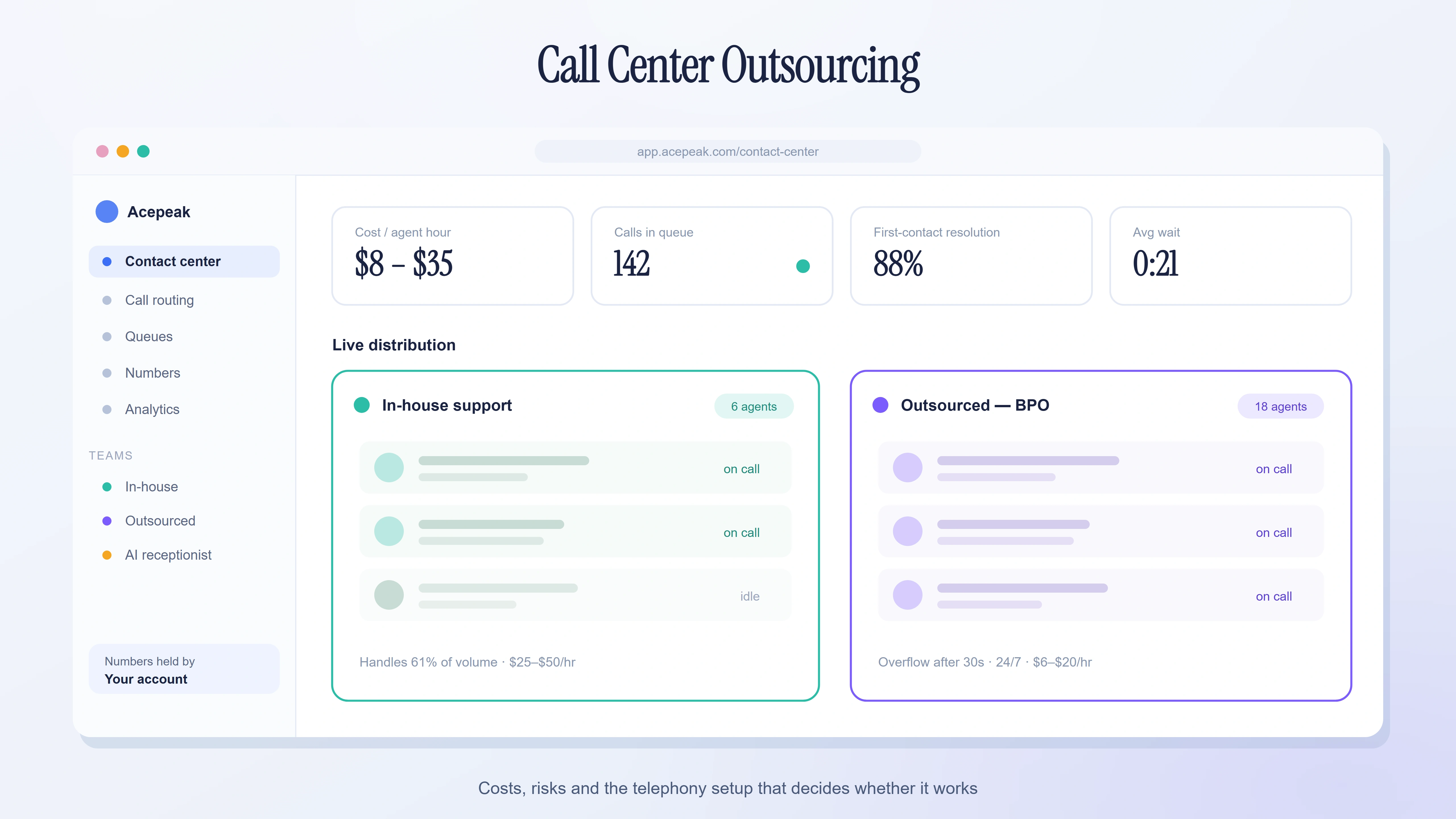
Call center outsourcing means handing your inbound or outbound customer conversations to a third-party provider that supplies the agents, the management layer, and usually the workspace. In 2026 it costs between $8 and $35 per agent hour depending on where those agents sit — a spread wide enough that the decision is rarely about price alone.
Most guides on this topic are written by outsourcing vendors, so they tend to stop at cost comparisons and vendor checklists. This one covers the part that gets skipped: what happens to your phone numbers, your call routing, and your caller ID the day you hand the queue over. Those decisions are usually made in week one of a transition, by someone who was not in the vendor selection meetings — and they are the ones that quietly determine whether outsourcing improves your customer experience or damages it.
Key Takeaways
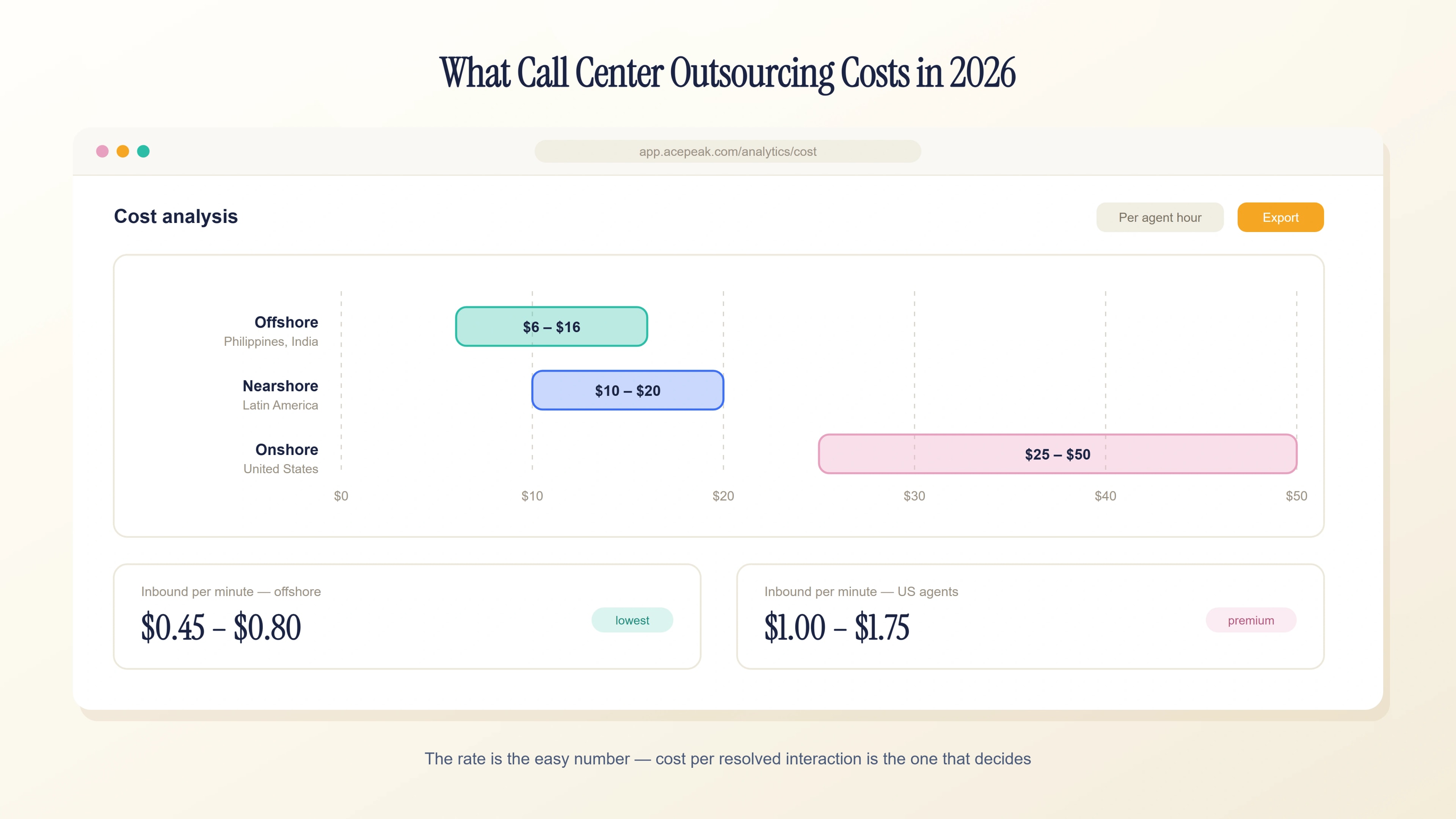
- Call center outsourcing costs $6–$16 per agent hour offshore, $10–$20 nearshore, and $25–$50 onshore in the US.
- Inbound per-minute pricing runs $0.45–$0.80 offshore against $1.00–$1.75 for US-based agents.
- Offshoring can cut costs 40–70%, but accent gaps and time-zone mismatches raise escalation rates and quietly erode the saving.
- Three pricing models dominate: pay-per-hour, pay-per-resolution, and fixed monthly. Fixed monthly is the most predictable for stable volumes.
- Keep ownership of your phone numbers. Porting them into a vendor account is the most common route to lock-in.
What Call Center Outsourcing Actually Covers
Not every outsourcing arrangement is the same, and the label hides meaningful differences. At the lightest end, an overflow or after-hours contract routes only the calls your in-house team cannot take. At the heaviest, a fully managed contract hands over the entire queue, the workforce management, the QA function, and the reporting.
Between those sit the arrangements most mid-market companies actually buy: a dedicated team that works only your account and learns your workflows, or a shared team that handles several clients at once. Dedicated costs more per hour and performs better on complex products. Shared is cheaper and works for high-volume, low-complexity queues — order status, appointment confirmation, basic troubleshooting.
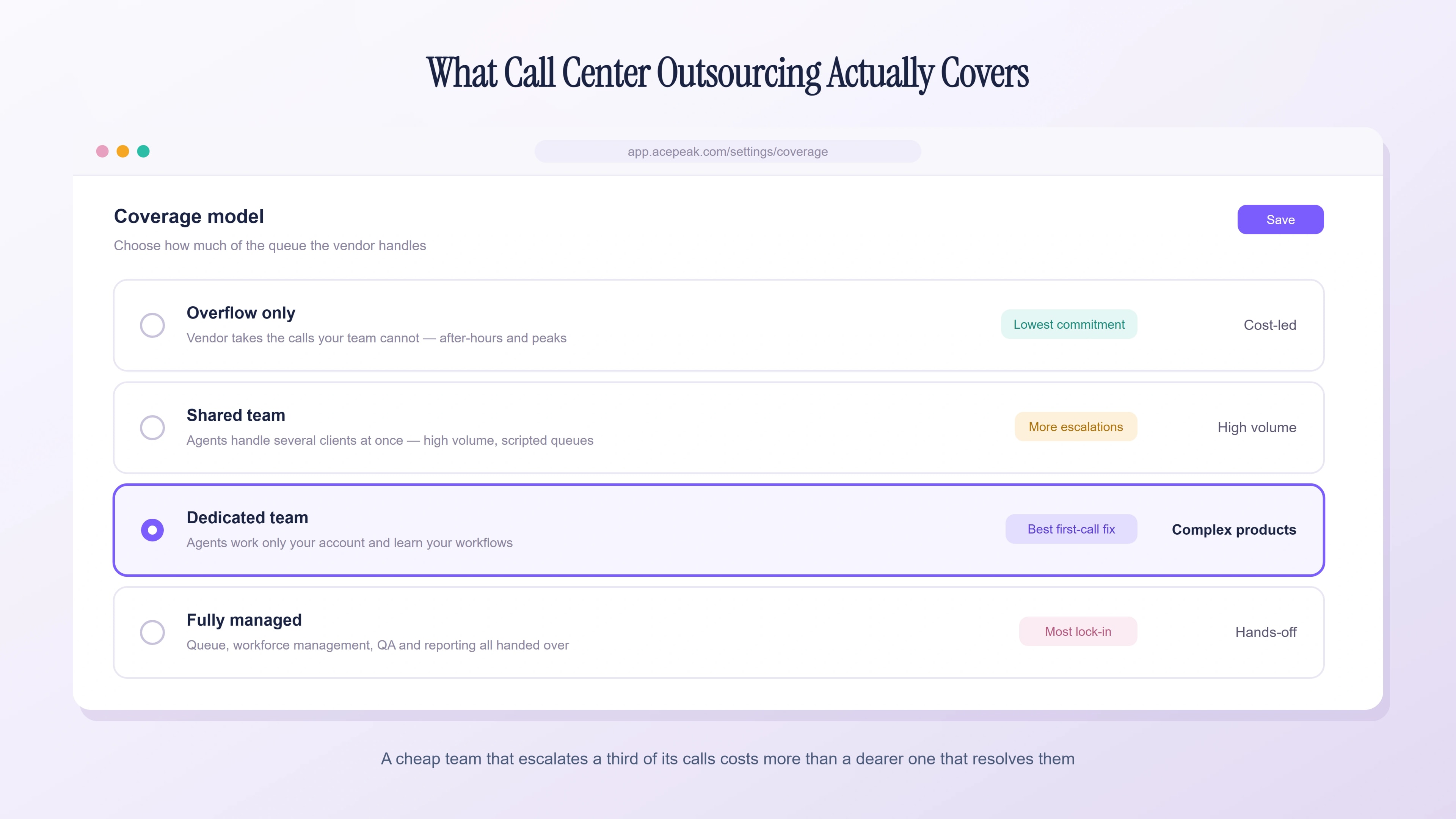
The distinction matters more than the headline rate. A shared team at $9 an hour that escalates a third of its calls to your internal staff is more expensive than a dedicated team at $16 that resolves 90% on first contact. When comparing quotes, ask for first-contact resolution figures on accounts similar to yours, not just the hourly rate.
What Call Center Outsourcing Costs in 2026
Pricing splits cleanly by geography, and the gap is the whole reason the industry exists.
| Delivery model | Hourly rate | Per-minute (inbound) | Best fit |
|---|---|---|---|
| Offshore (Philippines, India) | $6–$16 | $0.45–$0.80 | High volume, scripted, cost-led |
| Nearshore (Latin America) | $10–$20 | — | Time-zone overlap, Spanish support |
| Onshore (United States) | $25–$50 | $1.00–$1.75 | Complex, regulated, premium brands |
Three pricing models sit on top of that geography. Pay-per-hour is the default and the easiest to compare. Pay-per-resolution shifts risk to the vendor and suits predictable, transactional queues — but vendors price defensively, so it is not automatically cheaper. Fixed monthly buys a dedicated team for a set fee and gives the cleanest budgeting, which is why mature businesses with stable volumes tend to land there.
Whichever model you choose, the number that matters is cost per resolved interaction, not cost per hour. That single reframe changes most vendor comparisons.
The Risks Vendors Don't Put in the Proposal
Offshoring can reduce costs by 40–70%, and that figure is real. What it omits is the effective cost once quality effects are priced in.
Three risks recur. Time-zone gaps mean escalations to your internal team land overnight and sit unanswered until morning, which stretches resolution time even when the vendor's own metrics look fine. Accent and cultural mismatch raises escalation and repeat-contact rates on complex products — each repeat contact is a cost you pay twice. Hidden costs — onboarding, training, agent turnover, and the management overhead of running a vendor relationship — routinely add 10–20% to the modelled saving.
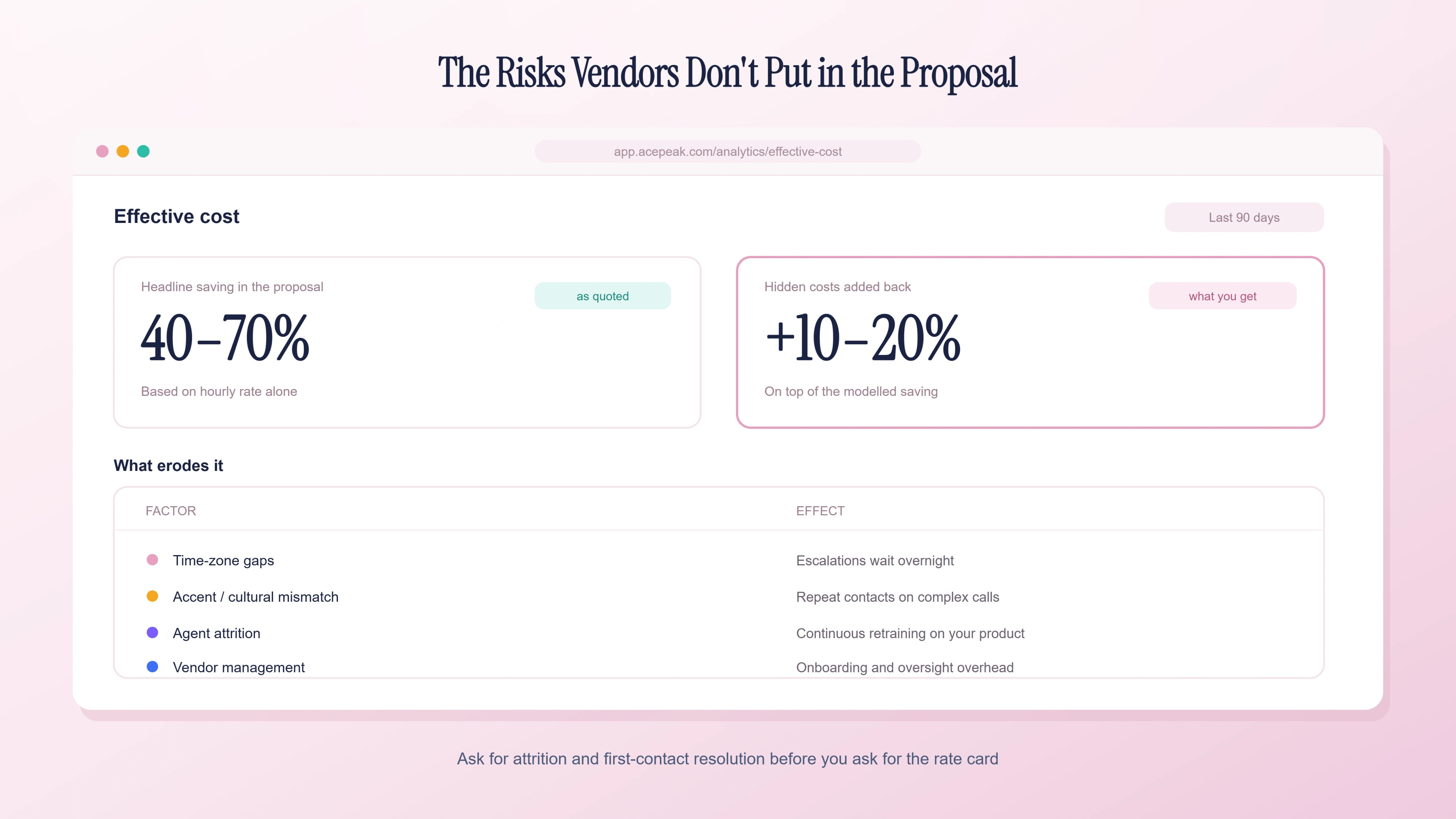
None of this argues against outsourcing. It argues for measuring the right thing. Ask any prospective vendor for their attrition rate and their first-contact resolution on comparable accounts. High attrition means you are re-training agents on your product continuously, on your budget, forever.
Keep your numbers when you change providers
Acepeak provisions the DIDs and SIP trunks your outsourced team runs on — held in your account, so switching vendors never means switching phone numbers.
The Telephony Decisions That Decide Success
This is the part that gets settled in a transition kickoff rather than a boardroom, and it has more effect on customer experience than the hourly rate.
- Number ownership — if you port your main numbers into the vendor's carrier account, they control them. Leaving that vendor then means either a contentious port-out or reprinting every number you have published. Keep the numbers in your own account and point them at the vendor.
- Caller ID and CNAM — outbound calls from an outsourced team frequently display as an unknown number, which collapses answer rates. Registering your business name and ensuring calls are properly attested keeps them out of the "Spam Likely" bucket. See wholesale VoIP termination for how STIR/SHAKEN attestation works.
- Routing control — whoever owns the call routing and auto-attendant layer controls how fast you can change things. If every IVR change is a vendor ticket, you will stop making changes.
- Overflow paths — decide in advance where calls go when the vendor is at capacity: back to you, to voicemail, or to an AI receptionist that captures the intent. Unplanned overflow is where abandonment spikes.
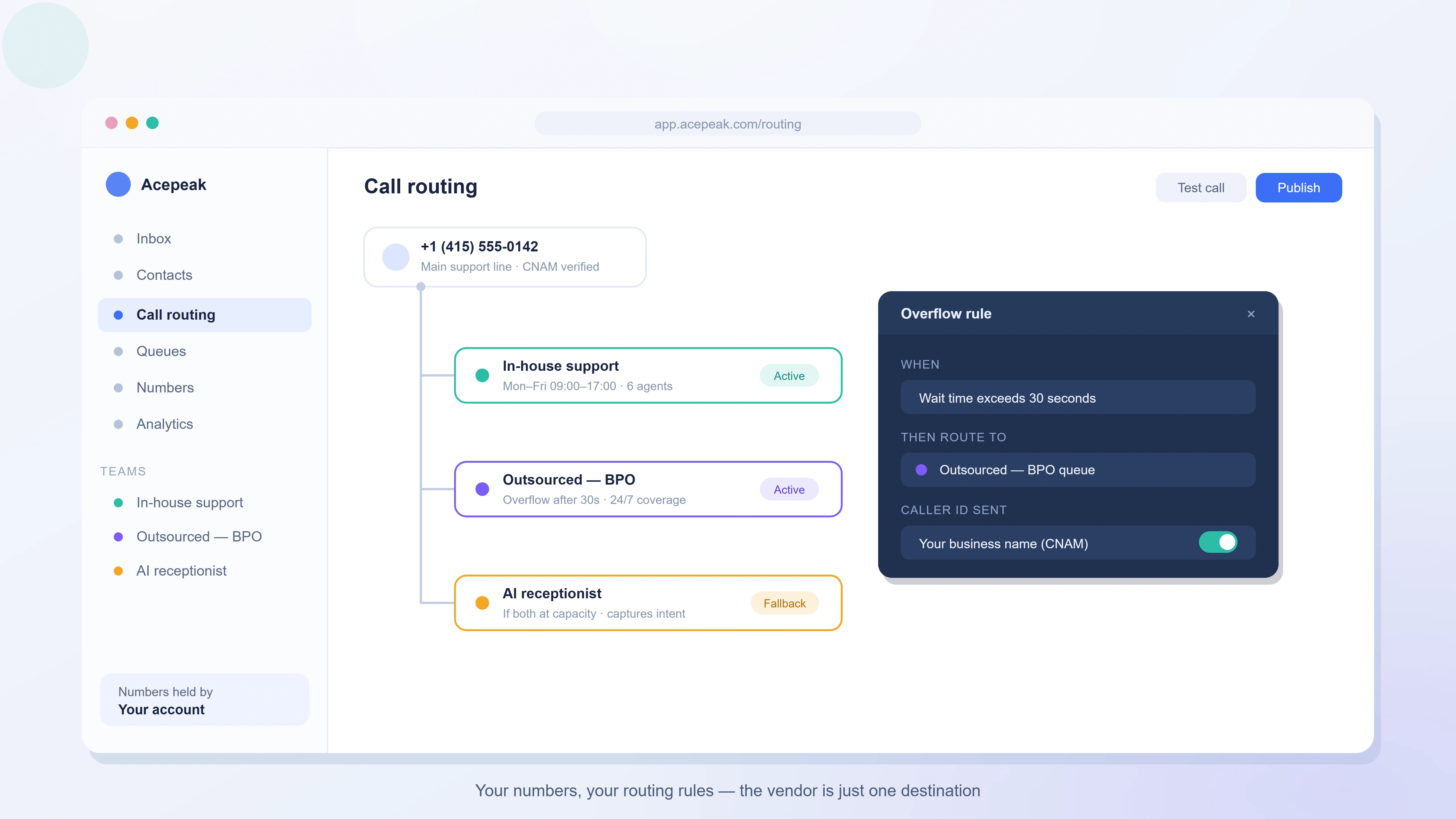
Set up this way, the vendor is one destination among several rather than the owner of your voice presence. Calls arrive on a number you hold, hit your routing rules first, overflow to the outsourced queue on your terms, and fall back to an AI receptionist when both are at capacity — with your business name on caller ID throughout. Changing vendor later becomes a routing edit rather than a migration project.
How to Choose a Provider
Run the evaluation on evidence, not on the pitch deck. Start with SLA specifics. Baseline agreements cover answer rate, average handle time, and abandonment rate. Mid-market contracts add CSAT minimums, first-contact resolution targets, and escalation response times. Enterprise agreements add financial penalties for breaches, attrition caps, and audit rights — and if a vendor resists penalties, that tells you what they expect their performance to be.
Then check references on comparable accounts — similar product complexity, similar volume, similar regulatory exposure. A vendor excellent at retail order status may be poor at regulated financial support. Finally, run a paid pilot on a real queue segment before committing to a full transition, and measure first-contact resolution and cost per resolved interaction rather than CSAT alone, which is easy to flatter with sampling.
Confirm in writing who holds the phone numbers, who can change the IVR, and where calls route when the vendor hits capacity. All three are cheap to agree up front and expensive to renegotiate later.
Build the voice layer before the transition
Acepeak supplies carrier-grade SIP trunking, DIDs, and routing that sit under your outsourced team — Tier-1 routes across 185+ countries with 99.99% uptime.
Conclusion
Call center outsourcing is a genuine lever — 40–70% cost reduction is achievable, and for high-volume, well-defined queues it is often the right structural decision. But the saving is only real if you measure cost per resolved interaction rather than cost per hour, and if you go in with attrition and first-contact resolution figures in hand rather than a rate card.
The infrastructure decisions deserve equal weight. Keep your numbers in your own account, keep control of routing, register your caller ID, and define overflow paths before day one. Vendors change; your phone numbers should not have to. Get the voice layer right and you can switch providers on your own terms — which is ultimately the position every outsourcing arrangement should leave you in.
Questions, answered.
Between $8 and $35 per agent hour depending on location — $6–$16 offshore, $10–$20 nearshore, and $25–$50 onshore in the US. Inbound per-minute pricing runs $0.45–$1.75.
On paper yes, by 40–70%. But higher escalation and repeat-contact rates can narrow that gap significantly once you measure cost per resolved interaction.
No. Keep the numbers in your own carrier account and route them to the vendor. Porting them into their account is the most common cause of vendor lock-in.
At minimum answer rate, average handle time, and abandonment rate. Add CSAT minimums, first-contact resolution targets, and financial penalties for anything above entry level.
Typically 4–12 weeks depending on product complexity — longer if numbers need porting or IVR flows must be rebuilt, which is why the telephony layer should be settled first.