Cable Cars, Fog and the Towns Across the Golden Gate
Few three-digit numbers carry as much weight as 415. Say it anywhere in the country and people picture San Francisco — the hills and cable cars, the Golden Gate, the tech companies and the fog rolling in off the Pacific. For locals it means something more specific still: the city itself and the towns of Marin County just across the bridge, from the houseboats of Sausalito to the redwoods above Mill Valley and the windswept beaches of Point Reyes.
A 415 number is a genuine piece of San Francisco identity, and one of the most sought-after area codes anywhere. This guide lays out exactly where 415 reaches today, how it was carved down from a sprawling 1947 original to the tight San Francisco–Marin footprint it now holds, the Pacific time zone and ten-digit dialing rules, and how any business can claim a local 415 presence of its own.
Key Takeaways
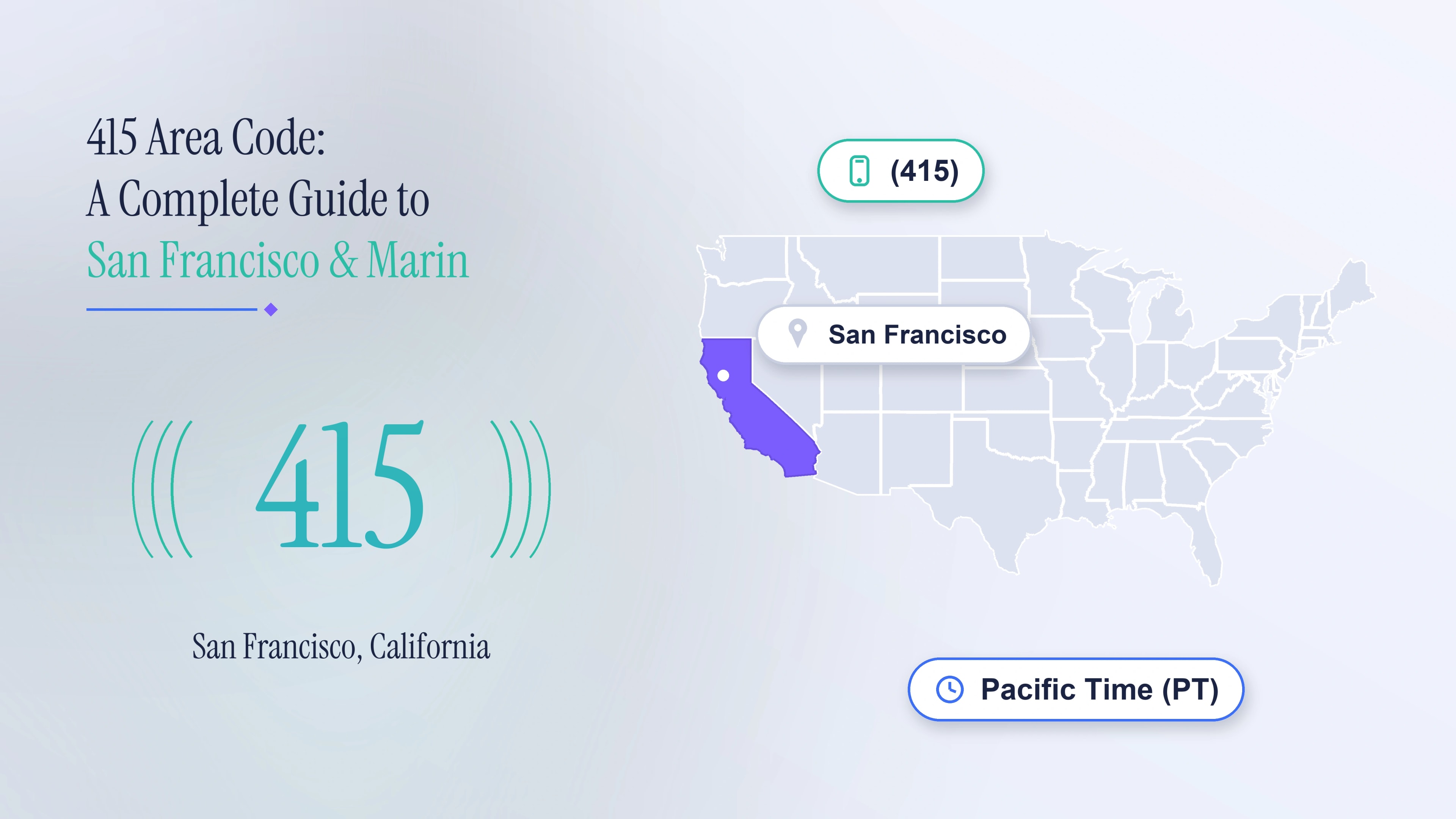
- The 415 area code covers the city of San Francisco and all of Marin County across the Golden Gate — a compact, prestigious footprint that includes San Rafael, Novato, Sausalito, Mill Valley, Tiburon and the West Marin coast, plus the northeast corner of San Mateo County.
- It is one of the original 86 area codes assigned in 1947, when 415 covered a huge stretch of central California from the Bay Area down toward the Monterey coast.
- The code was pared back twice — the East Bay split off as 510 in 1991, and the San Mateo Peninsula became 650 in 1997 — leaving 415 with just San Francisco and Marin.
- In 2015 the 628 area code was added as an overlay covering the same territory, which means every local call must now be dialed with all ten digits.
- The entire 415 region runs on Pacific Time — UTC−8 in winter (PST) and UTC−7 in summer (PDT) — and a 415 number remains one of the most recognizable and desirable prefixes in the United States.
What Is the 415 Area Code?
The 415 prefix is the telephone identity of San Francisco and Marin County — the city on the tip of the peninsula and its northern suburbs across the Golden Gate Bridge. It is one of the oldest codes in the country, part of the original 1947 numbering plan, but its footprint today is far smaller and far more exclusive than the wide central-California territory it once covered. Alongside the Peninsula's 650 area code in Silicon Valley, 415 is one of the Bay Area prefixes that instantly signals a specific, prestigious place — and unlike a brand-new overlay, it carries decades of built-in recognition.
Few prefixes are as closely tied to a single city, so a 415 number is recognized as San Francisco well beyond California. On a Bay Area caller ID, whether the phone sits in SoMa or San Rafael, it shows up as a local call instead of an unknown one. For a client in New York, it points to a company with a genuine foothold in one of the country's most important business markets, and that recognition quietly strengthens every call a business places.
San Francisco, Marin and a Sliver of San Mateo County
The 415 code covers the city and county of San Francisco together with all of Marin County to the north — a small, densely populated and highly desirable slice of the Bay Area, plus a sliver of the northeast corner of San Mateo County. It is one of the most compact major-metro codes in the country, and every community inside it shares in the San Francisco identity. The major communities include:
- San Francisco — the entire city and county, from the Financial District and SoMa to the Mission, the Sunset, the Richmond and the neighborhoods in between.
- San Rafael, Novato and San Anselmo (Marin County) — the larger inland towns of central and northern Marin, the county's civic and commercial hubs.
- Sausalito, Mill Valley, Tiburon, Belvedere and Corte Madera — the affluent bayside and hillside communities just across the Golden Gate.
- Larkspur, Greenbrae, Ross, Kentfield and Fairfax — the smaller residential towns of the Ross Valley and the Highway 101 corridor.
- Point Reyes Station, Inverness, Bolinas, Stinson Beach and Nicasio — the rural coastal and ranch communities of West Marin.
- Brisbane and the northeast tip of San Mateo County — the small area just south of the city line that shares the 415 code.
Packed into that small footprint are roughly 1.1 million residents plus one of the densest concentrations of business, technology and tourism anywhere in the country — which is exactly why the region has needed extra numbering capacity even after two major splits.
Pacific Time and Ten Digits Under the 628 Overlay
The entire 415 region sits within Pacific Time — UTC−8 in winter (PST) and UTC−7 in summer (PDT) — the same clock as Los Angeles, Seattle and the rest of the West Coast, three hours behind New York. Unlike many regions, 415 shares its territory with the 628 overlay code, and that changes one everyday habit: ten-digit dialing is mandatory for every call, even a call to your next-door neighbor.

- Local calls within San Francisco and Marin: because 415 shares its area with the 628 overlay, you must dial all ten digits — 415-555-0184 — for every local call.
- Long-distance from elsewhere in the U.S.: add a leading 1 — 1-415-555-0184.
- International: dial your country's exit code, then +1, then the number — +1 (415) 555-0184.
- On mobile phones: cell numbers are already stored and dialed with all ten digits, so most people reach 415 lines the same way from anywhere.
How 415 Was Divided: The 510 and 650 Splits and the 628 Overlay
When the North American numbering plan launched in 1947, California was divided into just three codes: 213 for the south, 916 for the far north, and 415 for a broad central band that took in the entire San Francisco Bay Area and reached down the coast. For decades that single prefix covered the city, the East Bay, the Peninsula and the South Bay all at once. The Bay Area's explosive growth eventually made that impossible — the region was burning through numbers faster than almost anywhere in the country, and 415 had to be broken up.
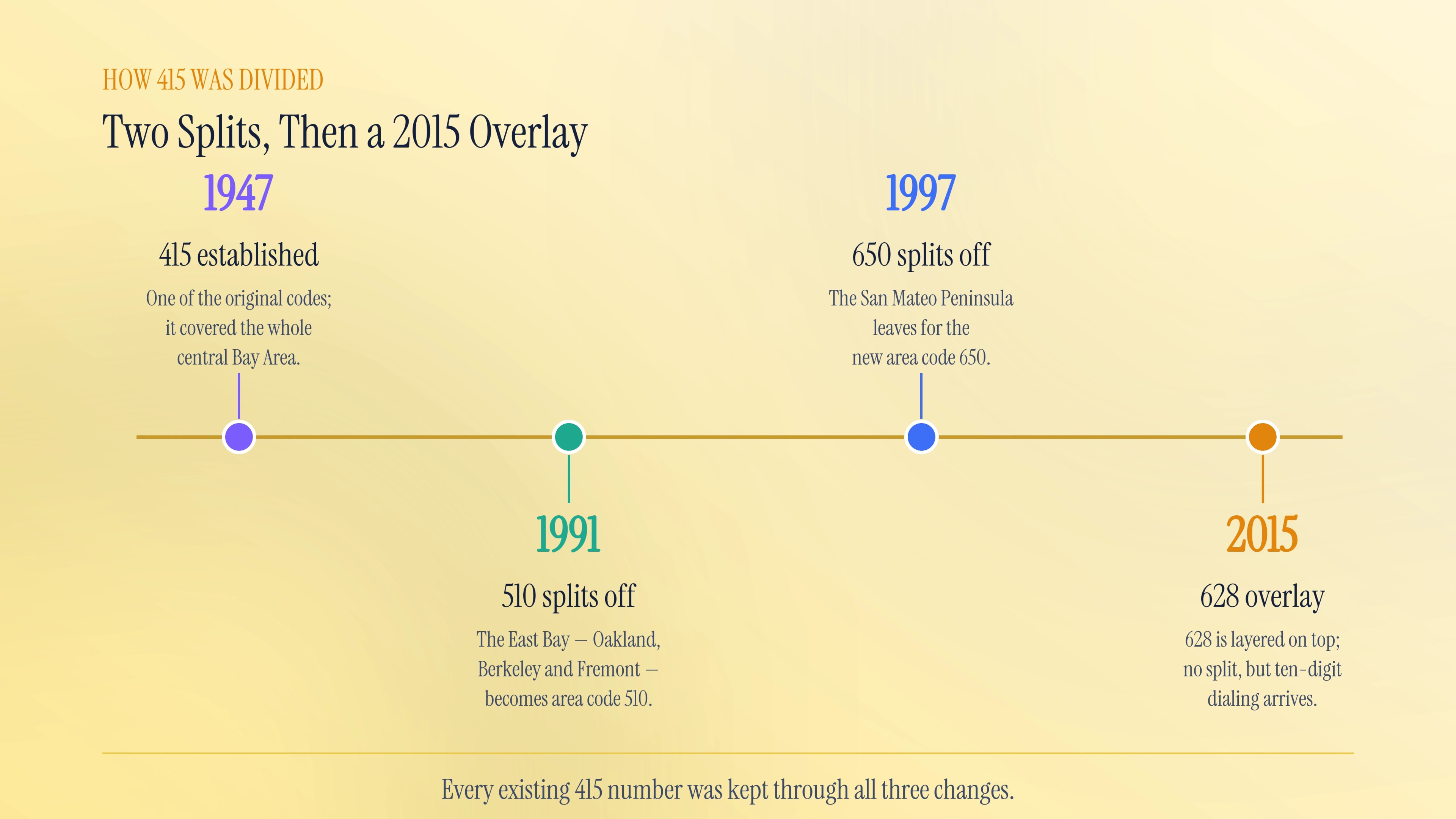
The changes came in three waves. On September 2, 1991, the East Bay — Oakland, Berkeley, Fremont and the inland valleys — split off into the new 510 area code. On August 2, 1997, most of San Mateo County and the Peninsula became 650, following the line between San Francisco and its southern suburbs. Those two splits left 415 with just San Francisco and Marin. Then, rather than split the region a third time, regulators chose an overlay: in 2015 the 628 area code was layered on top of the exact same territory, adding a fresh supply of numbers without forcing anyone to change theirs.
The trade-off is that every local call now takes ten digits — but no existing 415 number was ever disturbed, which is a big part of why the code still reads as authentically San Francisco today.
Benefits of a Local 415 Number for Business
A local number is one of the simplest trust signals a business can own, and few carry the weight of 415. When someone anywhere in the country sees a 415 line calling, it reads as an established San Francisco presence — not an out-of-area cold caller. In one of the world's most competitive business markets, that instant recognition is worth a great deal.
- A prefix two splits couldn't shrink away — after giving up the East Bay to 510 and the Peninsula to 650, 415 kept only San Francisco and Marin, which is exactly why it still reads as the genuine article.
- Recognition across the Golden Gate — from the Financial District to Sausalito and Mill Valley, a 415 number is understood as local on both sides of the bridge.
- Built-in prestige — because original 415 numbers are scarce enough that new lines now draw from the 628 overlay, holding one signals a business that got here early.
- No downtown lease required — cloud calling lets a team anywhere ring in on a 415 line and still sound like they're on Market Street.
- Scale without losing the number — add lines and routing as a company grows, all under the one San Francisco identity customers already recognize.
Put a local 415 number to work
Give your business an authentic San Francisco presence with a 415 number that rings anywhere you do business.
How to Get a 415 Phone Number
A 415 line no longer depends on a technician's visit or a lease near Market Street. Cloud providers process the whole order online, and a San Francisco number can be in service that same day. Original 415 inventory is scarce, with new lines increasingly issued under the 628 overlay, so it pays to act early. The process itself is simple:

- Search both codes at once — a provider like Acepeak can show what's left in true 415 inventory alongside the newer 628 overlay pool.
- Claim or port quickly — desirable 415 numbers move fast, so grab an open one or transfer a San Francisco line you already hold.
- Build out routing and features — add voicemail, an auto-attendant, business hours and call forwarding for your Bay Area team.
- Start taking calls — dial in from a laptop, desk phone or mobile app, with the same San Francisco identity showing every time.
Spotting and Avoiding 415 Scam Calls
Scammers know a 415 caller ID reads as a San Francisco or Marin neighbor. By spoofing that prefix, they can make a fraudulent call to a phone in the Mission or Mill Valley look like an ordinary local one. Some simple habits help:
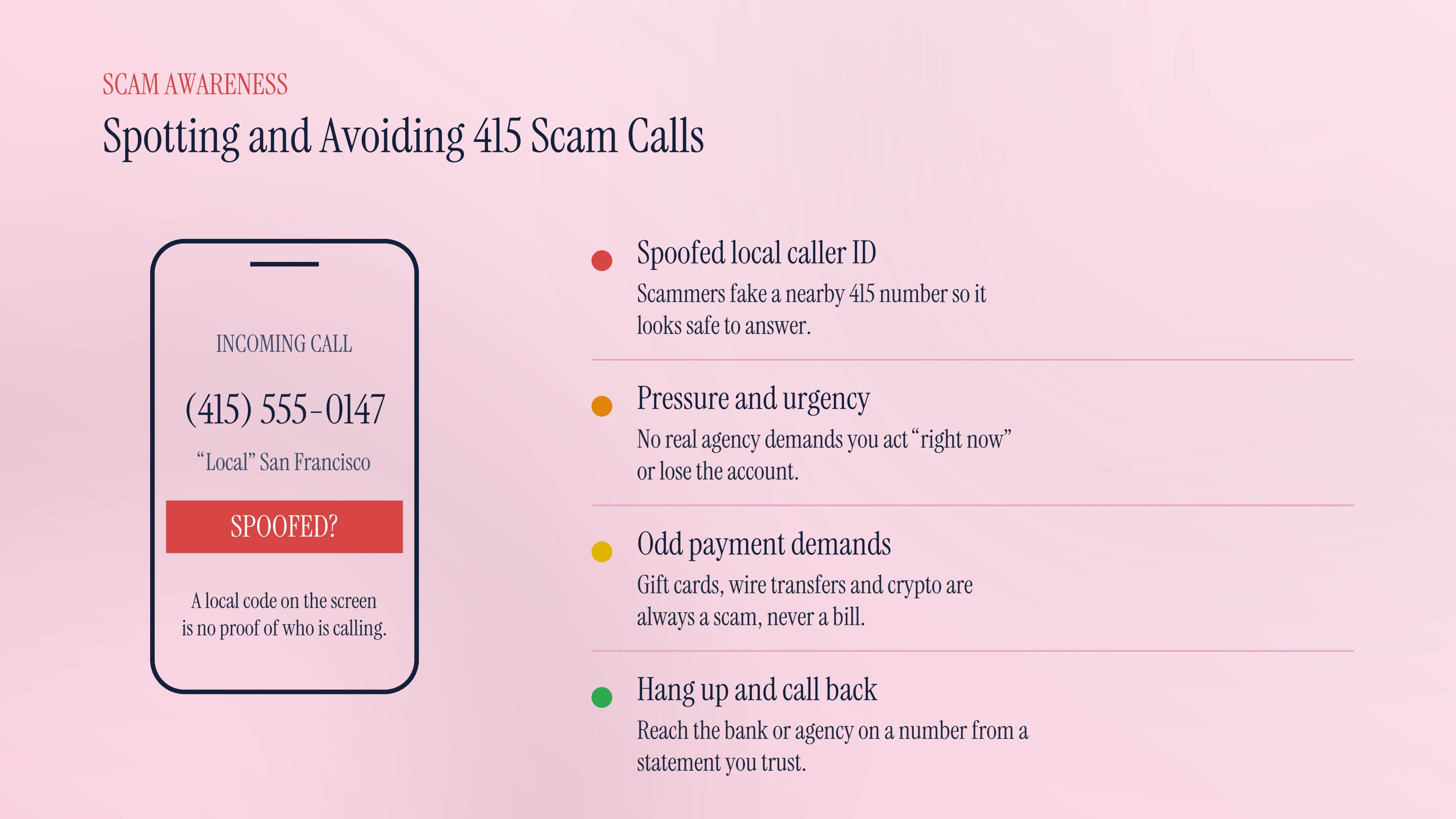
- Watch for pressure and urgency — real agencies and businesses do not demand that you act "right now" or the account will be closed.
- Be wary of odd payment demands — gift cards, wire transfers and cryptocurrency are the calling cards of a scam, never a legitimate bill.
- Do not trust caller ID alone — a 415 number on the screen can be faked; the local code is no guarantee the caller is who they claim.
- Hang up and call back on a number you trust — reach the bank, utility or agency directly using a number from a statement or official website.
- Report the call — logging unwanted calls with the authorities helps regulators track and shut down the operations behind them.
The Future of the 415 Area Code
With the 628 overlay in place since 2015, the San Francisco–Marin region now has a deep, shared pool of numbers to draw on, so another split is off the table — 415 will keep its exact footprint indefinitely. The bigger story is demand: because 415 is so desirable, the original numbers are scarce, and new lines are increasingly issued under 628 instead. San Francisco remains one of the densest business and technology hubs in the world — a city whose landmarks, from downtown to the Golden Gate National Recreation Area spanning the coast on both sides of the bridge, draw residents and visitors alike — and its appetite for phone numbers keeps growing, which is exactly why the overlay was needed.
For a business, the takeaway is simple: a genuine 415 number is a limited and prestigious asset, and one you print today will read as authentically San Francisco for many years to come.
A Tighter Footprint That Still Says San Francisco
The 415 area code is far more than three digits — it is the shared phone identity of San Francisco and Marin, from the Financial District and the Mission to the houseboats of Sausalito, the redwoods of Mill Valley and the beaches of Point Reyes. One of the original codes of 1947, it gave up the East Bay to 510 and the Peninsula to 650 before the 628 overlay secured its future, leaving it focused on the city and county it has always defined. For any business hoping to connect with the San Francisco market, a local 415 number is one of the most recognizable and authentic ways to belong.
Claim your San Francisco presence today
Acepeak makes it easy to get a 415 number and start taking calls across San Francisco and Marin.
Questions, answered.
The 415 area code covers the city and county of San Francisco and all of Marin County across the Golden Gate Bridge — including San Rafael, Novato, Sausalito, Mill Valley, Tiburon, Corte Madera and the West Marin coast — plus the northeast corner of San Mateo County. It runs on Pacific Time.
The East Bay split off as area code 510 on September 2, 1991, and most of San Mateo County and the Peninsula became area code 650 on August 2, 1997. Those two splits left 415 with just San Francisco and Marin County. In 2015 the 628 overlay was added on top of the same territory.
Yes. 415 is one of the original 86 area codes assigned in 1947 under the first North American Numbering Plan, when it covered a broad central band of California including the entire Bay Area. It was pared back to San Francisco and Marin by the 1991 and 1997 splits.
The 415 region runs on Pacific Time — UTC−8 during standard time (PST) and UTC−7 during daylight saving time (PDT) — the same clock as Los Angeles, Seattle and the rest of the West Coast, three hours behind New York.
Yes. Because the 628 overlay shares the same territory as 415, ten-digit dialing is mandatory for every call in the region, including local calls within San Francisco and Marin. Dialing just seven digits will not complete the call.
Absolutely. With a cloud phone provider you can choose an available 415 number from anywhere and have it ring on your laptop, desk phone or mobile app. It gives your business an authentic San Francisco presence without needing a physical office in the city.
Signing up for a 415 area code number takes minutes with a cloud phone provider — no local office in San Francisco required. Pick the number, connect it to your existing phone or app, and calls route in immediately. This keeps the 415 area code presence you already have while adding the local credibility California customers respond to.