Stanford, Menlo Park and the Peninsula's Quiet Prestige
Few three-digit prefixes carry as much quiet weight as the one stamped across the San Francisco Peninsula. It reaches Stanford University, the search-and-software corridor around Mountain View, the venture-capital offices of Menlo Park and the bayside downtowns of San Mateo and Redwood City. Carved out of San Francisco's original 415 code in 1997, it has — almost uniquely among major American metros — never needed an overlay, keeping its identity clean and singular for nearly three decades. This guide explains exactly where the prefix reaches, how it came to be, why it still has no second code, and how any business can claim a Peninsula presence of its own.
Key Takeaways
- The 650 prefix serves the San Francisco Peninsula — most of San Mateo County plus the northwestern edge of Santa Clara County, including Palo Alto, Mountain View, Redwood City, San Mateo and Daly City.
- It was created on August 2, 1997 as a split from 415, the original San Francisco code, to relieve a region running short of numbers.
- Unusually for a major metro, 650 has never been given an overlay — it remains a single-code region, which is part of why the prefix carries real prestige in the tech world.
- The territory sits entirely in the Pacific Time Zone (PST/PDT), and ten-digit dialing applies across California.
- It is the everyday code of Silicon Valley institutions — Stanford University, and the headquarters corridor that runs from Mountain View to Menlo Park — so a local 650 number signals real proximity to the Valley.
What Is the 650 Area Code?
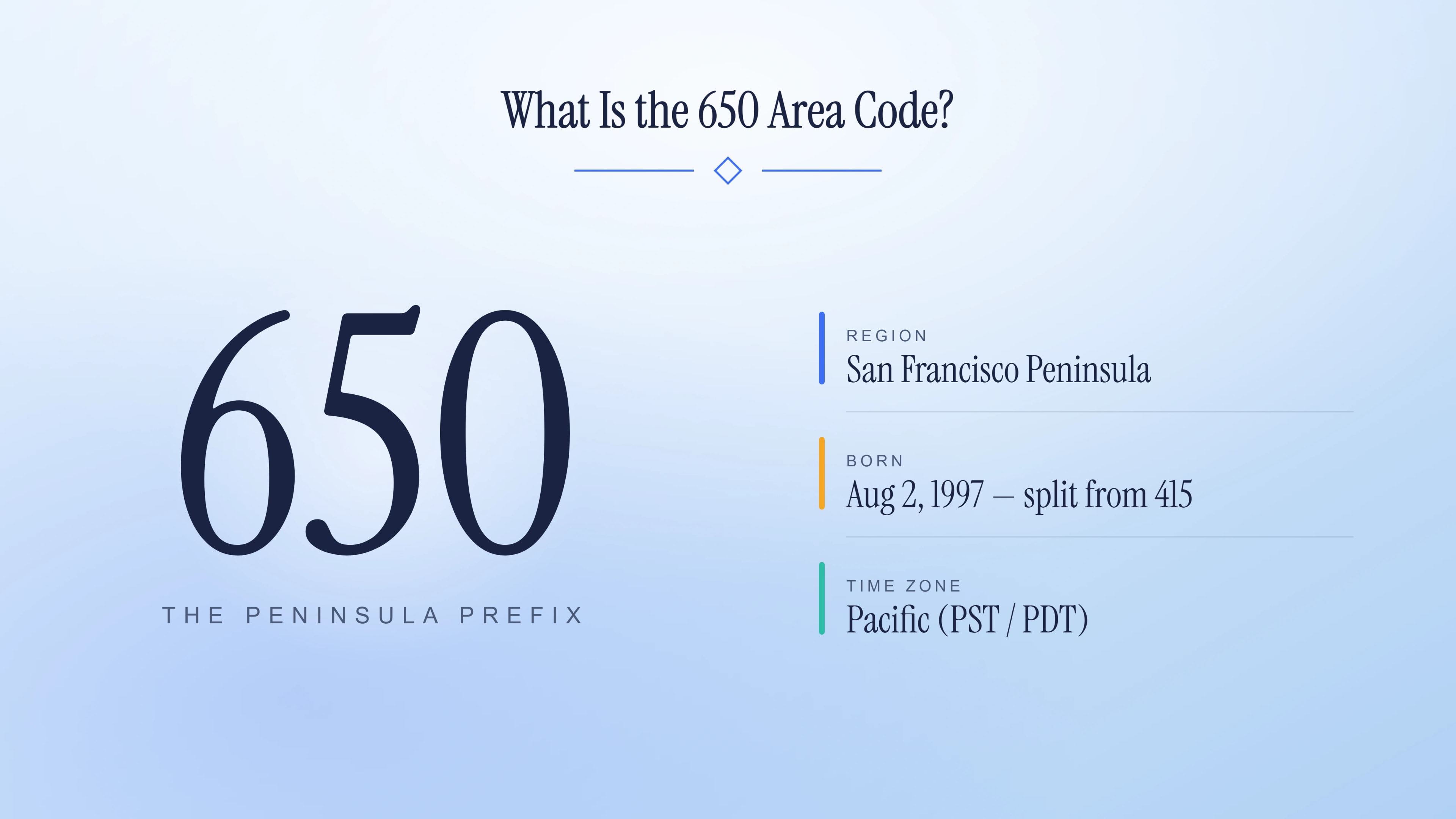
The prefix is the telephone code of the San Francisco Peninsula — the band of cities running south from the San Francisco county line down toward the northern edge of Silicon Valley. It was split from San Francisco's original 415 code in 1997, taking the suburban Peninsula with it while 415 stayed inside the city. From the start it has been tied to a specific, well-defined stretch of the Bay Area rather than a sprawling region, and that tight footprint is a big part of why the code reads as distinctly "Peninsula" to locals.
Because it sits at the heart of the technology industry, the code also carries an outsized reputation. A 650 number is read as a Silicon Valley number — a small but genuine credibility signal in a region where being "local" to the Valley means something to customers, partners and investors alike.
Where the Peninsula Ends and the 408 Region Begins
The prefix covers most of San Mateo County and the northwestern corner of Santa Clara County, along with a thin sliver of southern San Francisco. The major communities include:
- Daly City, South San Francisco, San Bruno and Pacifica — the northern Peninsula, closest to the city
- San Mateo, Burlingame, Millbrae, Foster City, Belmont and San Carlos — the bayside core of San Mateo County
- Redwood City, Menlo Park, Atherton and East Palo Alto — the mid-Peninsula and venture-capital corridor
- Palo Alto, Stanford, Mountain View and Los Altos — the northwestern Santa Clara County gateway to Silicon Valley
- Half Moon Bay, Pacifica and the coastside towns of Pescadero, La Honda and Moss Beach along the Pacific
One boundary is worth clearing up: the heart of Silicon Valley to the south is not part of this code. San Jose, Santa Clara and Sunnyvale belong to the 408 region and its 669 area code overlay, while San Francisco proper stays in 415 and Fremont across the bay sits in the 510 region. Many phone-lookup sites blur these lines, so anyone choosing a number for a specific city should confirm the boundary first.
How 650 Was Born: The Split from 415
For most of the twentieth century the entire San Francisco Bay region was covered by 415. By the mid-1990s, fax machines, pagers, second lines and the first wave of mobile phones had drained the available numbers, and regulators chose a geographic split rather than an overlay. On August 2, 1997, the Peninsula suburbs were carved off into the new 650 code while the city of San Francisco and Marin County kept 415 — the same parent code that had already spun off the East Bay's 510 area code six years earlier. It was a clean break: each side kept seven-digit dialing within its own code, and the new boundary followed the familiar line between the city and its southern suburbs.
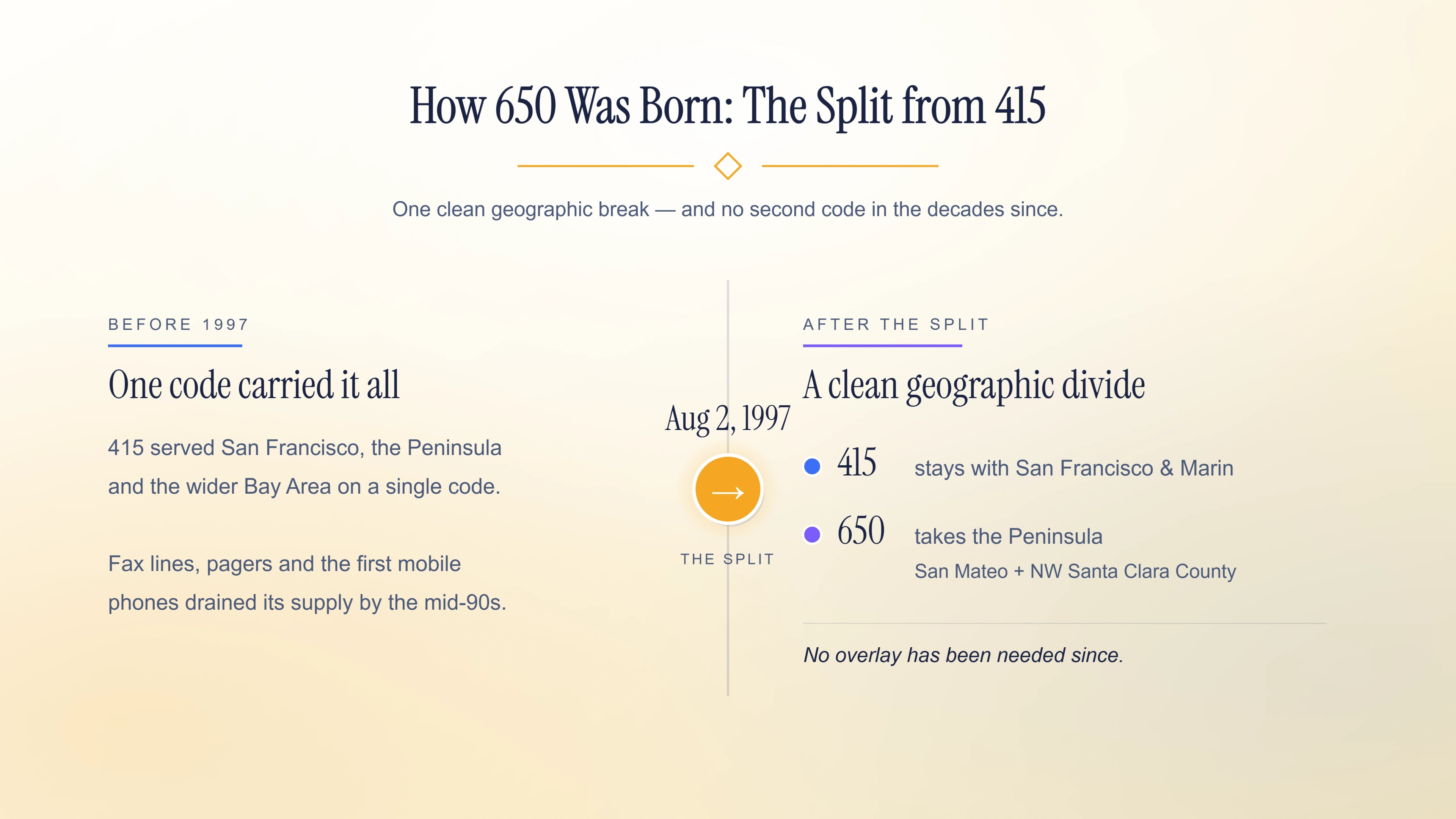
What happened next is the unusual part. Most metros that split eventually need an overlay — a second code layered on the same ground — within a decade or two. The Peninsula never did. Number pooling and the slowing of landline growth eased the pressure, so 650 has remained a single-code region ever since. That rarity is precisely why the prefix still feels exclusive.
Ten-Digit Dialing Despite Having No Overlay
The entire region observes Pacific Time — UTC-8 in winter (PST) and UTC-7 during daylight saving (PDT), which runs from March to November. That places it three hours behind the East Coast, the detail most worth remembering when scheduling calls with Peninsula offices. Although 650 has no overlay of its own, ten-digit dialing is the statewide norm in California, so callers dial the full number every time:
- Local and regional calls: dial all ten digits — 650-555-1234.
- Long-distance from elsewhere in the U.S.: add a leading 1 — 1-650-555-1234.
- International: dial the exit code, then +1, then the number — +1 (650) 555-1234.
Benefits of a 650 Number for Business
A local number is one of the simplest trust signals a business can own, and few carry the cachet of a Peninsula prefix. When a Bay Area customer or a prospective partner sees a 650 number, it reads as someone embedded in the Valley rather than an out-of-town caller.
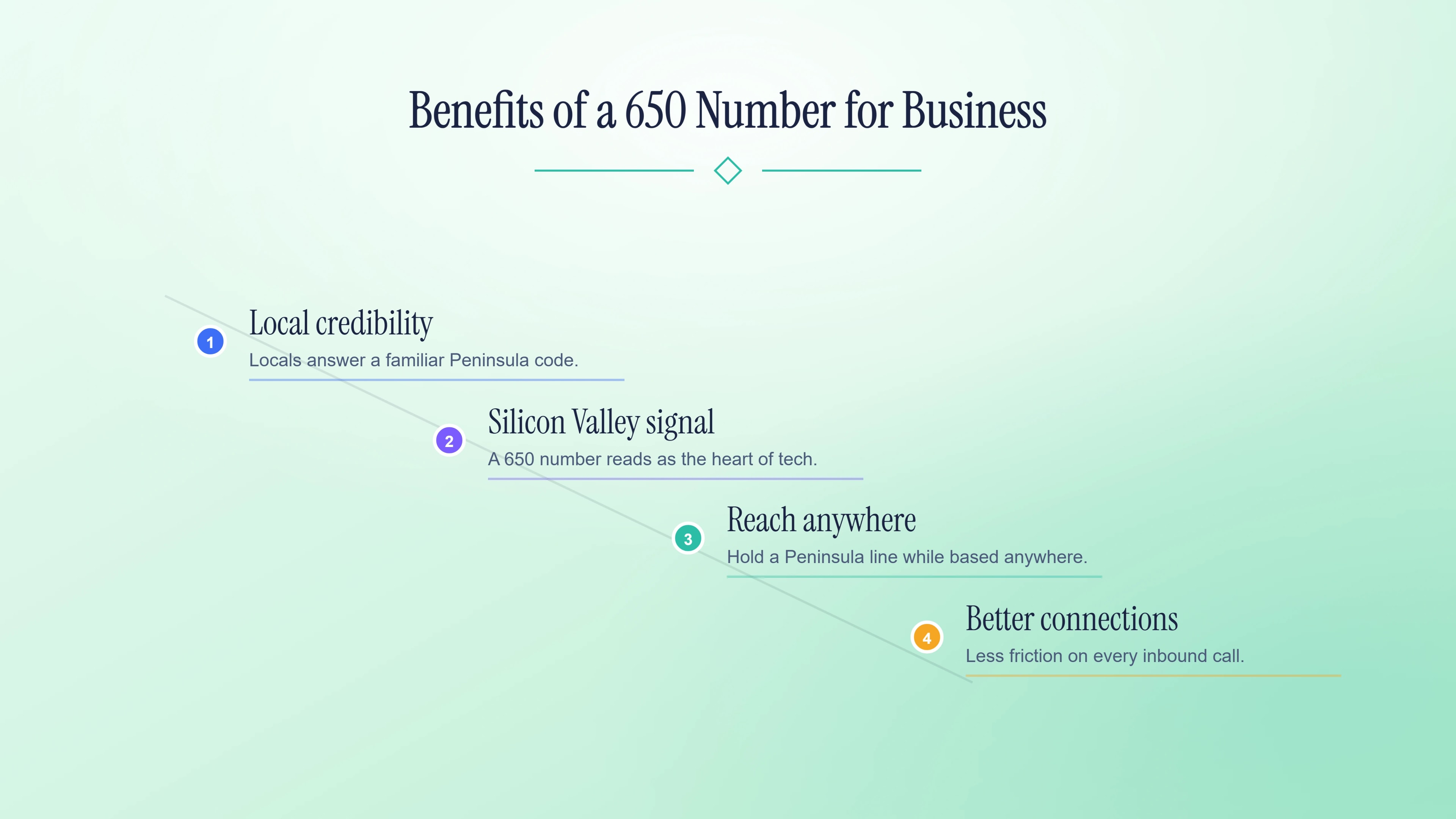
- Local credibility: a Palo Alto or Menlo Park customer answers a 650 call faster than one from an unfamiliar prefix.
- Silicon Valley signal: a 650 number ties a business to the Stanford-to-Menlo Park corridor rather than San Jose's 408 or San Francisco's 415.
- Reach anywhere: cloud calling lets a business hold a Peninsula presence while operating from anywhere.
- Single-code prestige: because 650 has never needed an overlay, the number itself signals nearly three decades of unbroken Peninsula stability.
Ready to claim a Silicon Valley presence?
Acepeak provisions local numbers with carrier-grade routing and instant activation, so a business can sound local to the Peninsula from day one.
How to Get a 650 Phone Number
Four steps put a 650 number in service, for a lone Palo Alto desk or an entire Menlo Park team.
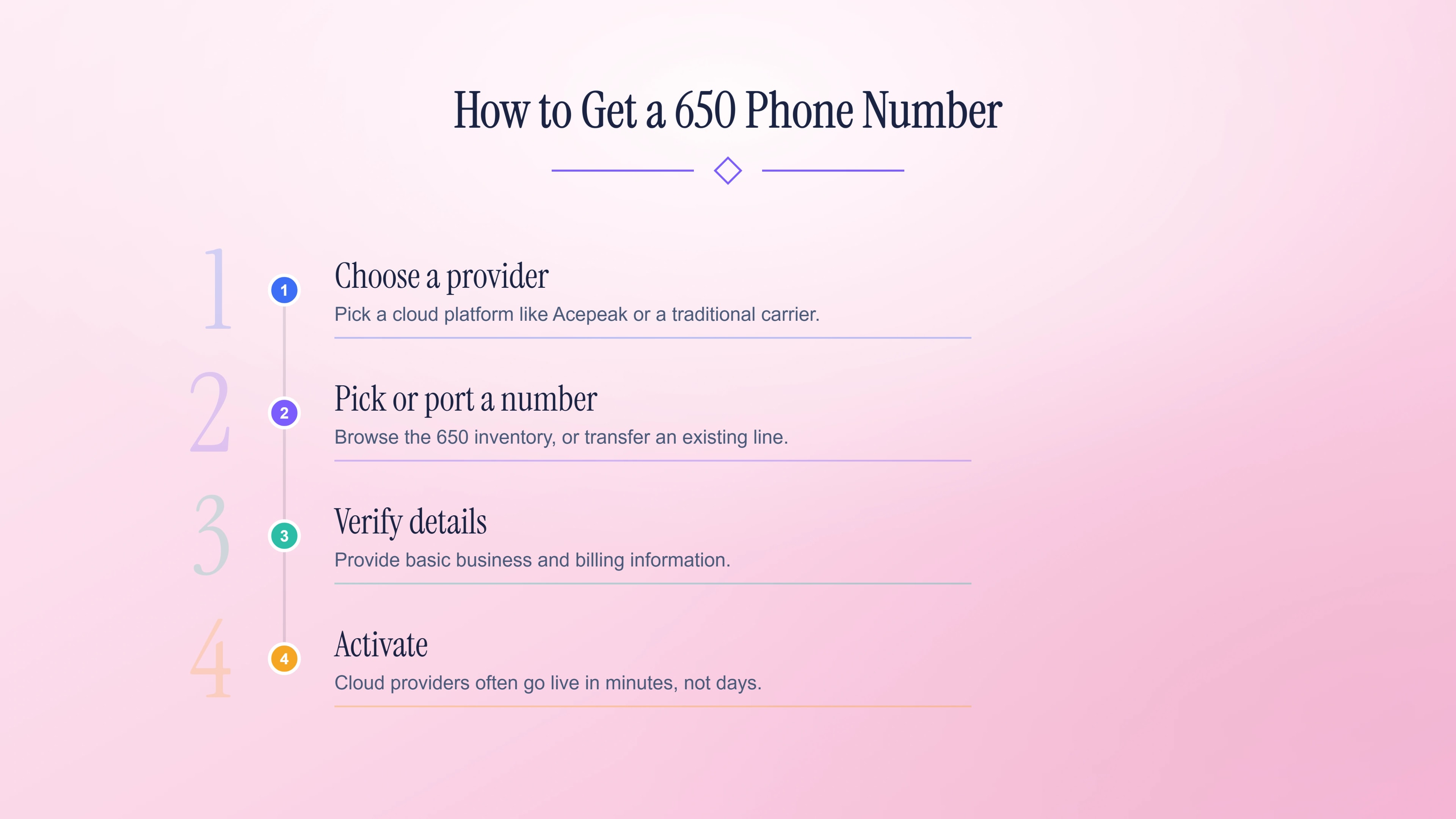
- Choose a provider: pick a cloud platform like Acepeak or a traditional carrier that can provision a number across the Peninsula's single 650 code.
- Pick or port a number: browse the available 650 inventory from Palo Alto to San Mateo, or transfer an existing Peninsula line.
- Verify details: provide basic business and billing information.
- Activate: cloud providers often go live within minutes rather than the days a traditional carrier might need.
When a Trusted Peninsula Code Is Spoofed
Because a Peninsula code looks trustworthy, scammers sometimes spoof it to appear local. A 650 number on the caller ID still deserves the same scrutiny as any other.
- Never share sensitive details — bank information or a Social Security number — with an unexpected caller.
- Verify urgent requests by hanging up and calling back on an official, published number.
- Use call-blocking and spam-filtering tools to screen unknown numbers.
- Report suspicious calls to the provider or the relevant authorities so others are protected.
The Future of the 650 Prefix
For now, the Peninsula's single code looks secure. The region has gone nearly three decades without needing an overlay — a stability the area's steady, built-out population helps explain, as the county's own San Mateo County demographics show. Should demand ever spike again, regulators would most likely add an overlay rather than re-split, leaving every existing number untouched. The practical takeaway is unchanged: a 650 number remains one of the most recognizable local identities in American business.
The Overlay That Never Came
There is an odd footnote in this code's history that explains why it still stands alone. 650 was split from 415 on August 2, 1997, carving the Peninsula out of San Francisco's numbering plan. Ten months later, in June 1998, the numbering plan administrator projected that 650 would exhaust by the third quarter of 2001 — barely four years after it was created — and that yet another code would be needed. An overlay was duly planned.
It never happened. The overlay was suspended in 1999 and has still not been implemented. Two things intervened: the dot-com contraction took the edge off demand, and more importantly the industry moved to thousand-block number pooling, which let carriers draw numbers in blocks of a thousand instead of ten thousand. Overnight, the vast reserves of unused numbers sitting idle inside carrier allocations came back into circulation. A code forecast to run dry in 2001 is still issuing numbers today, nearly three decades after it launched.
That matters for anyone choosing a Peninsula number now. Most comparable American tech regions are overlay territories where two or three codes share the same streets and the prefix no longer identifies a place. 650 has never been overlaid, so it maps one-to-one onto San Mateo County and the northern edge of Santa Clara County — Palo Alto, Menlo Park, Redwood City, Mountain View. When a 650 number appears on a caller ID it means the Peninsula specifically, with no second code diluting the association.
Proximity to Silicon Valley, Available from Anywhere
The Peninsula's prefix is more than a routing code; it is a marker of place at the center of the technology economy. Born from a single clean split in 1997 and never needing a second code since, it has stayed singular while the industry around it exploded. For a business, a 650 number remains one of the cheapest, most credible ways to signal proximity to Silicon Valley — and with cloud calling, that presence is available to anyone, anywhere.
Put a trusted Peninsula number to work today.
Acepeak delivers local lines with smart routing, voicemail and 24/7 support — everything a business needs to stay reachable across the Bay Area.
Questions, answered.
It covers the San Francisco Peninsula — most of San Mateo County and the northwestern corner of Santa Clara County, including Palo Alto, Mountain View, Redwood City, San Mateo and Daly City — plus a small slice of southern San Francisco.
It was split from 415, the original San Francisco code, on August 2, 1997, when the Peninsula suburbs were separated from the city to relieve a shortage of numbers.
No. Unusually for a major metro, 650 has never been assigned an overlay and remains a single-code region — one reason the prefix is seen as prestigious in the tech world.
No. San Jose, Santa Clara and Sunnyvale belong to the 408 region and its 669 overlay. The 650 code covers the Peninsula to the north and west, not the South Bay.
Yes. Cloud and hosted phone services let a business or individual hold a local 650 number from anywhere while keeping a Silicon Valley identity.
Signing up for a 650 area code number takes minutes with a cloud phone provider — no local office in Silicon Valley required. Pick the number, connect it to your existing phone or app, and calls route in immediately. This keeps the 650 area code presence you already have while adding the local credibility California customers respond to.