Farm Towns, Oil Patches and a Single Statewide Code
Few phone prefixes cover as much ground, or as much history, as the one that serves North Dakota. Stretching from the Red River Valley on the Minnesota border to the Badlands near Montana, a single set of three digits ties together every city, farm town, and oil patch in the state. It has done so since the earliest days of nationwide dialing, outlasting the splits and overlays that have fractured almost every other original code. This guide explains where it reaches, how its unusual two-time-zone geography works, why it has never had to divide, and how any business can claim a local presence across the Peace Garden State.
Key Takeaways
- The 701 prefix is the single area code for the entire state of North Dakota — one of only about eleven U.S. states still served by one code.
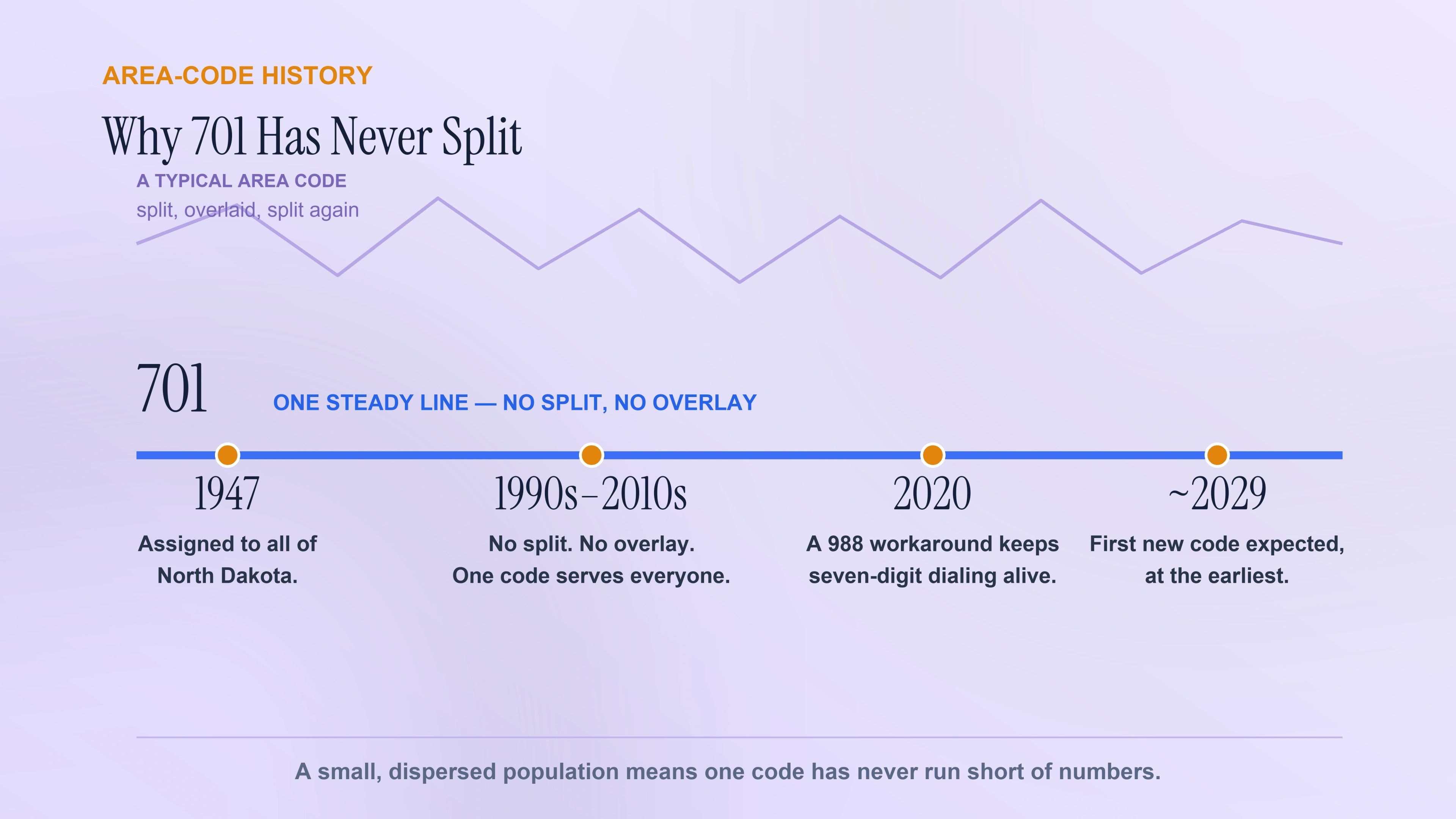
- It is an original 1947 assignment, one of the 86 area codes AT&T created when the North American Numbering Plan began, and it has never been split or overlaid.
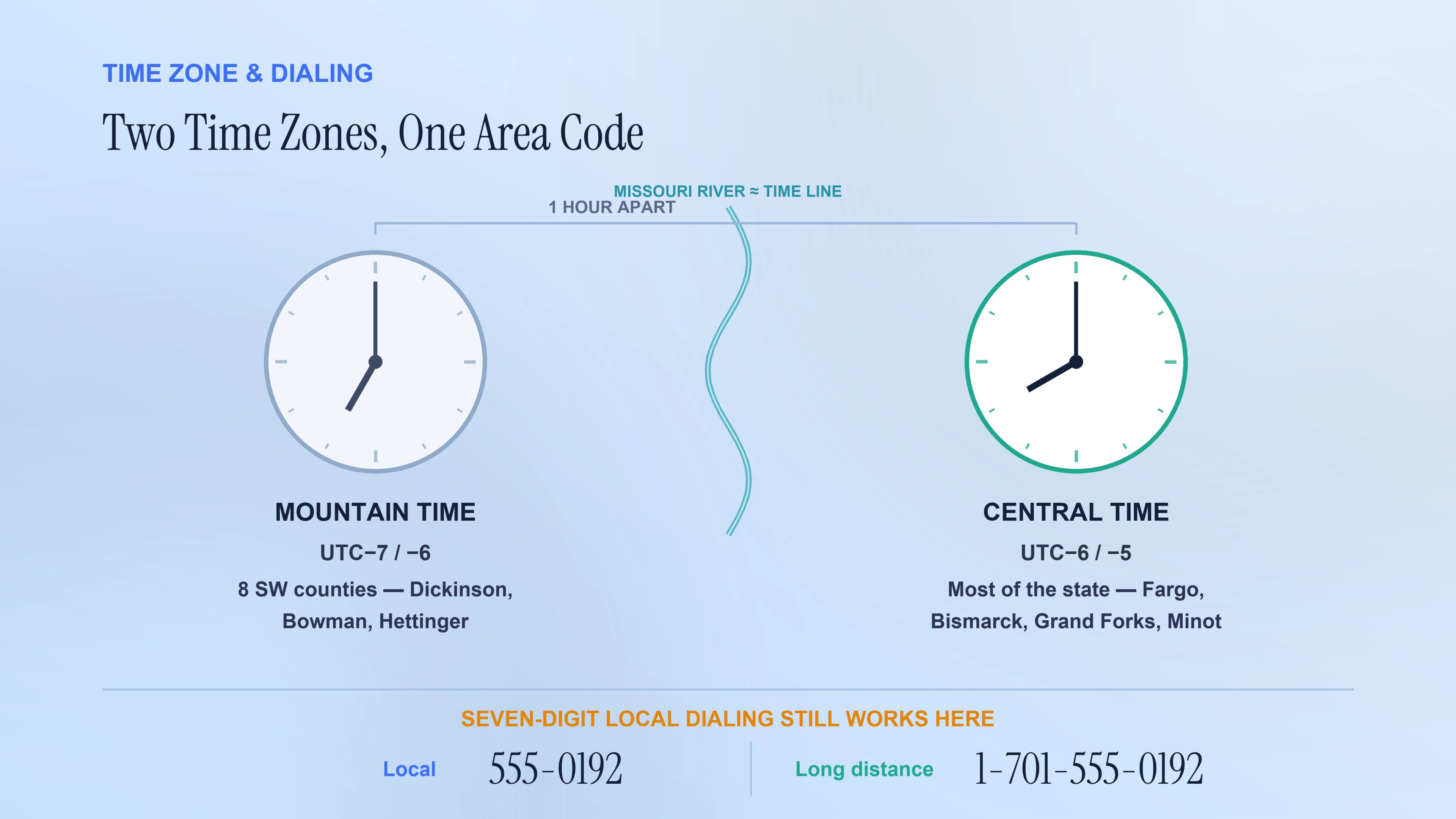
- North Dakota straddles two time zones: most of the state runs on Central Time, while eight southwestern counties observe Mountain Time, roughly along the Missouri River.
- The region is one of the few places in the country where seven-digit local dialing still works, preserved even after the 988 crisis line launched nationwide.
- A recognizable North Dakota number builds local trust, and a cloud provider can activate one anywhere in minutes.
What Is the 701 Area Code?
It is one of the original North American area codes, assigned by AT&T in 1947 when the continent was first carved into numbering regions. From that first day it covered the whole of North Dakota, and it still does — making it one of a small club of statewide codes that have never been divided. That longevity puts it in rare company: Vermont's 802 area code has served its entire state under a single original prefix in exactly the same way.
For nearly eight decades the North Dakota code has remained a fixed point on the map while faster-growing regions were split again and again to keep up with demand for numbers.
Fargo, Bismarck, Minot and Every Prairie Village Between
The code blankets all fifty-three North Dakota counties and every community within them — well over 300 cities and towns, from major regional hubs to prairie villages of a few hundred people. The major population centers include:
- Fargo and West Fargo — the state's largest metro, anchoring the Red River Valley in the east
- Bismarck and Mandan — the capital and its twin city on the Missouri River
- Grand Forks and Grand Forks AFB — the northern Red River Valley and university corridor
- Minot and Minot AFB — the north-central hub near the Canadian border
- Dickinson, Williston, Jamestown, and Devils Lake — the western oil country and central lake region
Time Zone — Central and Mountain
Unlike most single-state codes, this one spans two time zones. The great majority of North Dakota — Fargo, Bismarck, Grand Forks, Minot, and the eastern and central counties — observes Central Time, UTC-6 in winter and UTC-5 during daylight saving. But eight sparsely populated southwestern counties, including Stark, Bowman, and Hettinger counties around Dickinson, sit in the Mountain Time zone, an hour behind the rest of the state. The dividing line roughly follows the Missouri River. For a business scheduling callbacks, it is a detail worth remembering: a number in the same area code can ring an hour apart depending on which end of the state it reaches.
Dialing and Why 701 Has Never Split
Most original codes eventually ran short of numbers and were relieved by a split or an overlay. North Dakota never had to. With a small, dispersed population spread across a large state, demand for numbers has stayed low enough that one code still comfortably serves everyone — much like Idaho's 208 area code, another original 1947 prefix that carried an entire low-density state on its own for generations. That stability has a rare side effect: North Dakota is one of the last places in the United States where seven-digit local dialing still works. When the 988 Suicide and Crisis Lifeline launched nationwide, many seven-digit regions were forced to ten-digit dialing to free up the 988 prefix; North Dakota regulators instead found only a few dozen existing numbers that began with 988, retired the conflicting prefix, and kept seven-digit dialing intact for the whole state.
Benefits of a 701 Number for Business
A number that matches the region it serves does quiet, steady work. When a North Dakota customer sees the familiar statewide prefix, the call reads as a neighbor rather than an out-of-state stranger.
- Statewide familiarity: since 701 is the only area code North Dakota has ever had, a local number reads the same way in Fargo as it does in Williston or Devils Lake.
- Old-code trust: as one of the original 1947 assignments that has never split or overlaid, a 701 number carries decades of unbroken regional identity newer codes elsewhere can't match.
- Works across two time zones: whether calling into the Central Time majority of the state or the Mountain Time counties near Dickinson, a single 701 line covers both without a second number.
- Fits the oil-patch and prairie economy: from Bismarck's government offices to Williston's oil fields, a familiar statewide prefix lowers the friction of reaching customers spread across 300-plus towns.
Ready to claim a North Dakota presence?
Acepeak provisions local numbers with carrier-grade routing and instant activation, so a business can sound local from day one.
How to Get a 701 Number
Securing a number in the state is straightforward, whether for a single line or a full team.
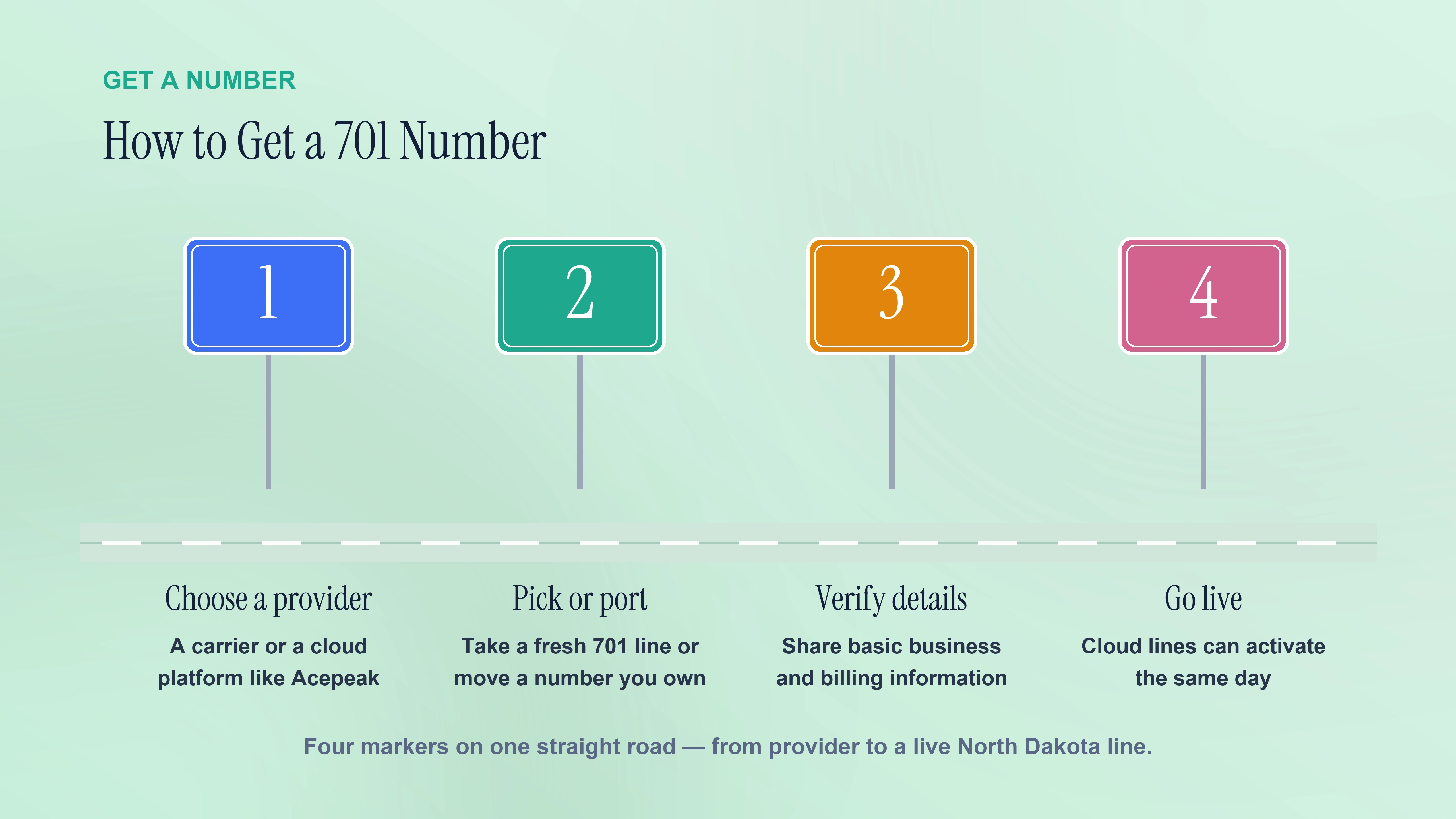
- Choose a provider with statewide inventory: confirm it can issue a 701 number whether the destination is Fargo's Central Time zone or the Mountain Time counties near Dickinson.
- Pick or port a number: choose a new North Dakota line or transfer one you already own, since the state has never needed a split or overlay to free up fresh digits.
- Route your calls: send them to any phone, app, or call center your team uses, even across a state where towns can sit a hundred miles apart.
- Go live: provisioning is often same-day, with no hardware to install, and no risk of the number changing since a second code isn't projected until around 2029.
Gift-Card Demands and Other Spoofed-Call Red Flags
North Dakotans tend to trust the 701 prefix, since it is the only area code the state has ever had, and scammers take advantage by faking it. Treat an unexpected 701 call that pushes for money or personal details with caution, even when it appears to come from Fargo or Bismarck.
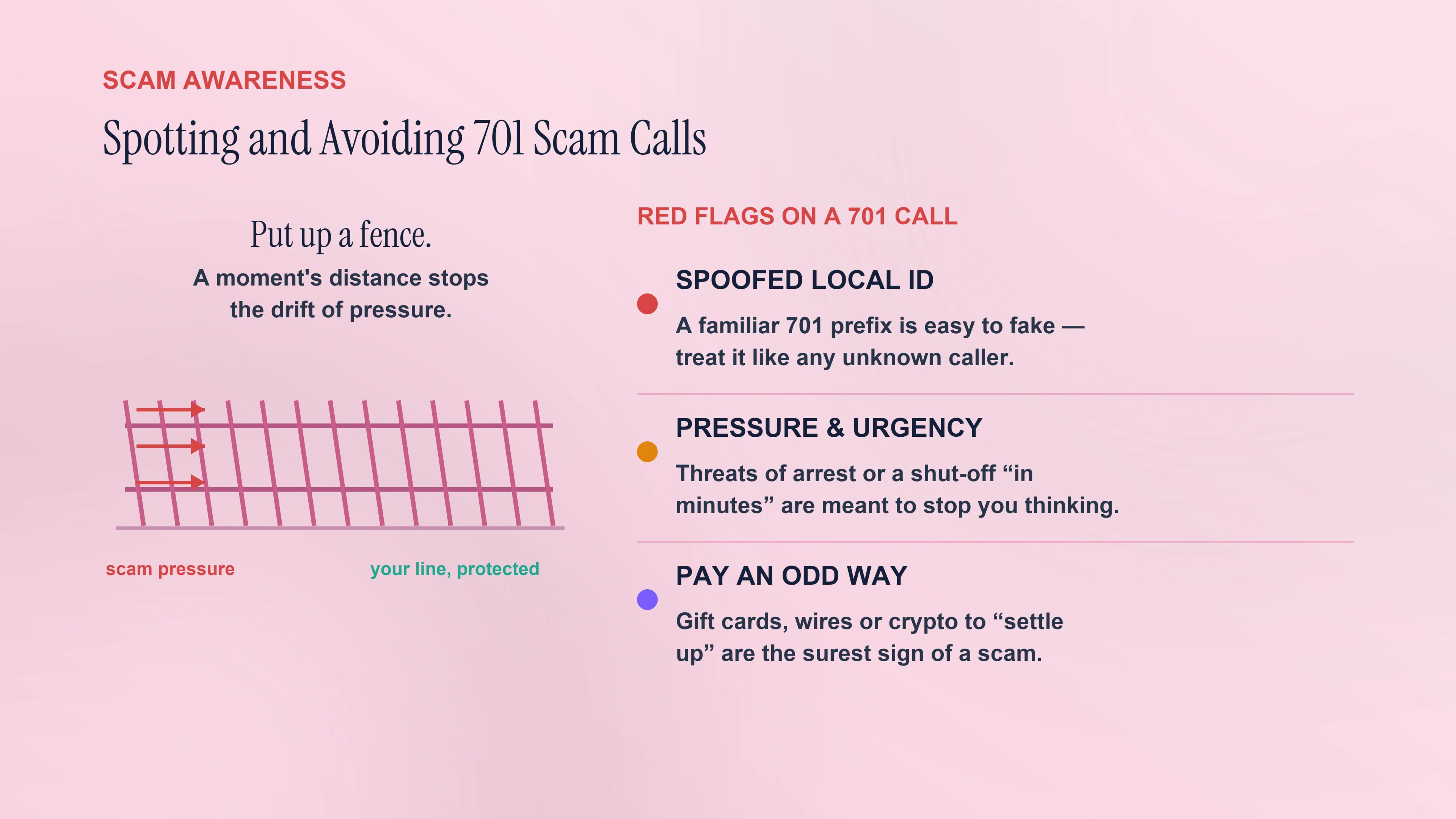
- Ignore urgent demands for payment by gift card or wire — they are classic red flags.
- Never share personal or financial details on a call you did not place.
- Block and report suspected spoofed numbers to your carrier.
- Heed the spam labels many carriers now add to suspicious calls.
The Future of the 701 Area Code
North Dakota's single code has plenty of room left. Roughly 730 of the nearly 800 available prefixes have been assigned, and current projections say the state will not need a second area code until around 2029 — and even then, relief would likely come as an overlay that leaves every existing number untouched. The North Dakota Public Service Commission, which manages the state's numbering resources, has already shown its preference for keeping dialing simple, as its work to preserve seven-digit calling during the 988 rollout demonstrated. For businesses and residents alike, the outlook is stable: one familiar code, no forced renumbering on the horizon, and a local identity available through any cloud provider today.
A Whole State's Telephone Signature, Open to Any Business
The North Dakota prefix is more than a routing code; it is the telephone signature of an entire state, unchanged since the dawn of nationwide dialing. It has spanned two time zones, weathered nearly eight decades of growth without a single split, and held onto seven-digit dialing when almost everyone else let it go. For a business, a local number remains one of the cheapest, most credible ways to signal local roots — and with cloud calling, that presence is available to anyone, anywhere.
Put a trusted North Dakota number to work today.
Acepeak delivers local lines with smart routing, voicemail, and 24/7 support — everything a business needs to stay reachable.
Questions, answered.
It covers the entire state of North Dakota — every county and community, from Fargo and Grand Forks in the east to Bismarck, Minot, Dickinson, and Williston in the central and western parts of the state.
Most of the state observes Central Time (UTC-6 in winter, UTC-5 in summer), but eight southwestern counties — including Stark, Bowman, and Hettinger, around Dickinson — are in the Mountain Time zone, an hour behind the rest of North Dakota.
No. It is an original 1947 code that has served the whole state without a single split or overlay, thanks to the state's small, dispersed population.
Yes. North Dakota is one of the few remaining regions where seven-digit local dialing still works, preserved even after the 988 crisis line launched nationwide.
It was one of the 86 original North American area codes established by AT&T in 1947, and it has covered North Dakota ever since.
Yes. Cloud and hosted phone services let a business hold a local North Dakota number from anywhere while keeping a local presence.
Signing up for a 701 area code number takes minutes with a cloud phone provider — no local office in North Dakota required. Pick the number, connect it to your existing phone or app, and calls route in immediately. This keeps the 701 area code presence you already have while adding the local credibility North Dakota customers respond to.