Introduction
Every wholesale VoIP provider says the same four things: Tier-1 routes, competitive rates, 24/7 support, carrier-grade quality. None of it can be checked from a website, and all of it is on every website, which makes the claims useless for choosing between two vendors.
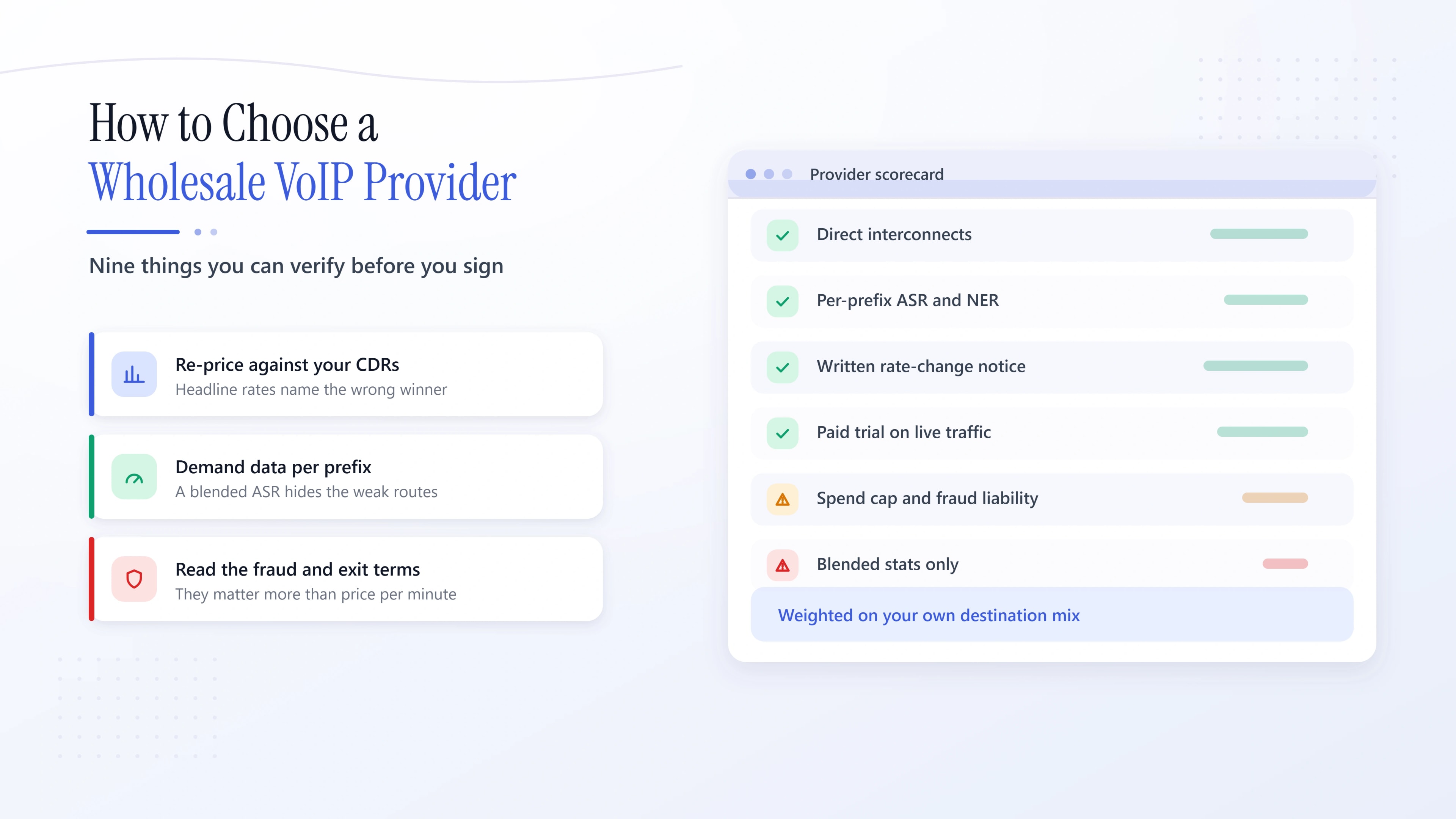
What follows is nine things you can verify before you sign, in the order they are worth doing. The first takes an afternoon with a spreadsheet and settles more than the other eight combined.
Key Takeaways
- Compare providers by re-pricing your own call records against each rate deck. Headline rates routinely point at the wrong winner.
- Ask for quality figures per destination prefix. A single network-wide ASR number hides exactly the routes you are buying.
- The terms that hurt a year in are fraud liability, rate-change notice and the dispute window — not the price per minute.
Start Here: Know Your Own Traffic
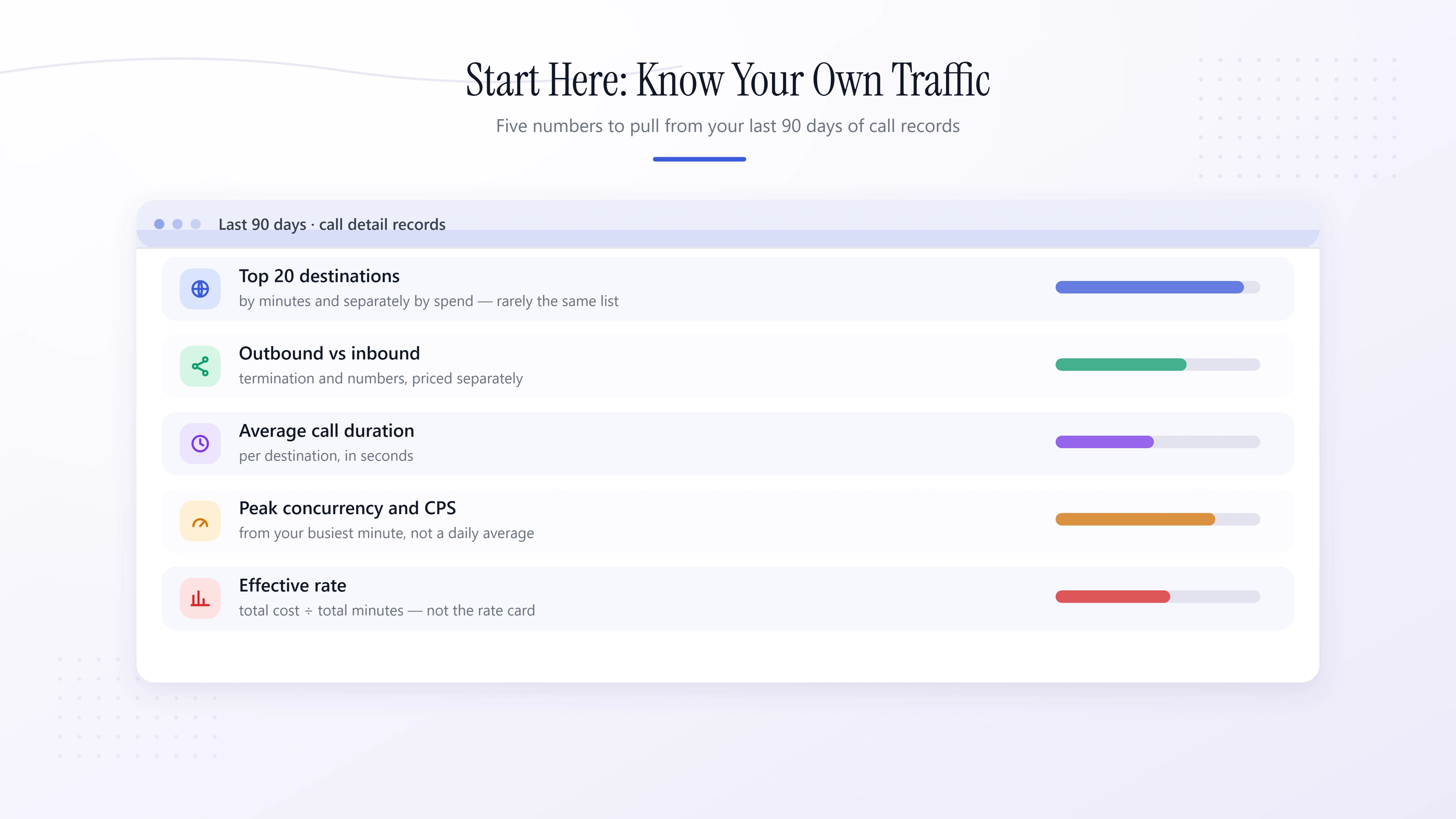
You cannot evaluate a provider in the abstract. Pull the last 90 days of call detail records and write down five things:
- Your top 20 destinations, ranked by minutes and separately by spend. They are rarely the same list.
- The split between outbound termination and inbound numbers, priced separately.
- Average call duration per destination, in seconds.
- Peak concurrent calls and peak calls per second, taken from your busiest minute rather than a daily average.
- Your current effective rate per destination — total cost divided by total minutes, not the number on your rate card.
That effective rate is the figure to beat, and it is usually worse than the contracted rate once rounding and surcharges are included. Most buyers who feel they are overpaying find the gap concentrated in one or two destinations rather than spread across the book, which changes what a good deal looks like.
1. Are They a Carrier, or a Reseller of a Reseller?
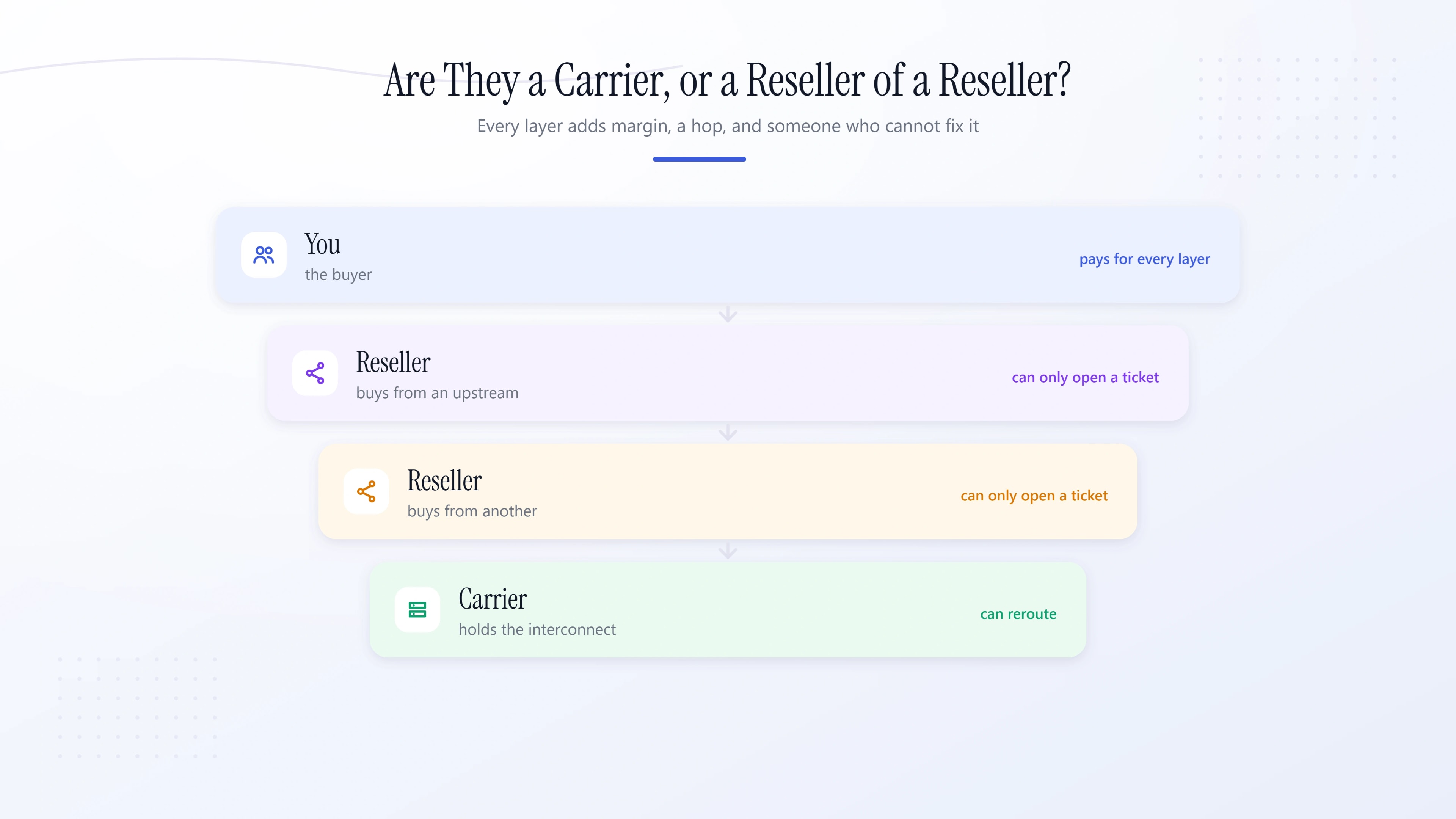
Wholesale voice has layers. Somebody holds the interconnect with the destination operator; somebody else buys from them; somebody else buys from that party and sells to you. Every layer adds margin and a hop, and removes the ability to fix anything.
Three questions separate them. Which destinations do you hold direct interconnects on, and which do you buy from an upstream? Do you operate your own switching and your own network, and under what AS number? When a route degrades at 3am, who do you escalate to, and do they answer to you?
A provider that runs its own network can reroute; one sitting three layers down can only open a ticket and wait. Neither is disqualifying — transit is a normal part of how global voice works — but the price should reflect which one you are buying, and you should know before something breaks.
2. Re-price Your Own Traffic Against Each Deck
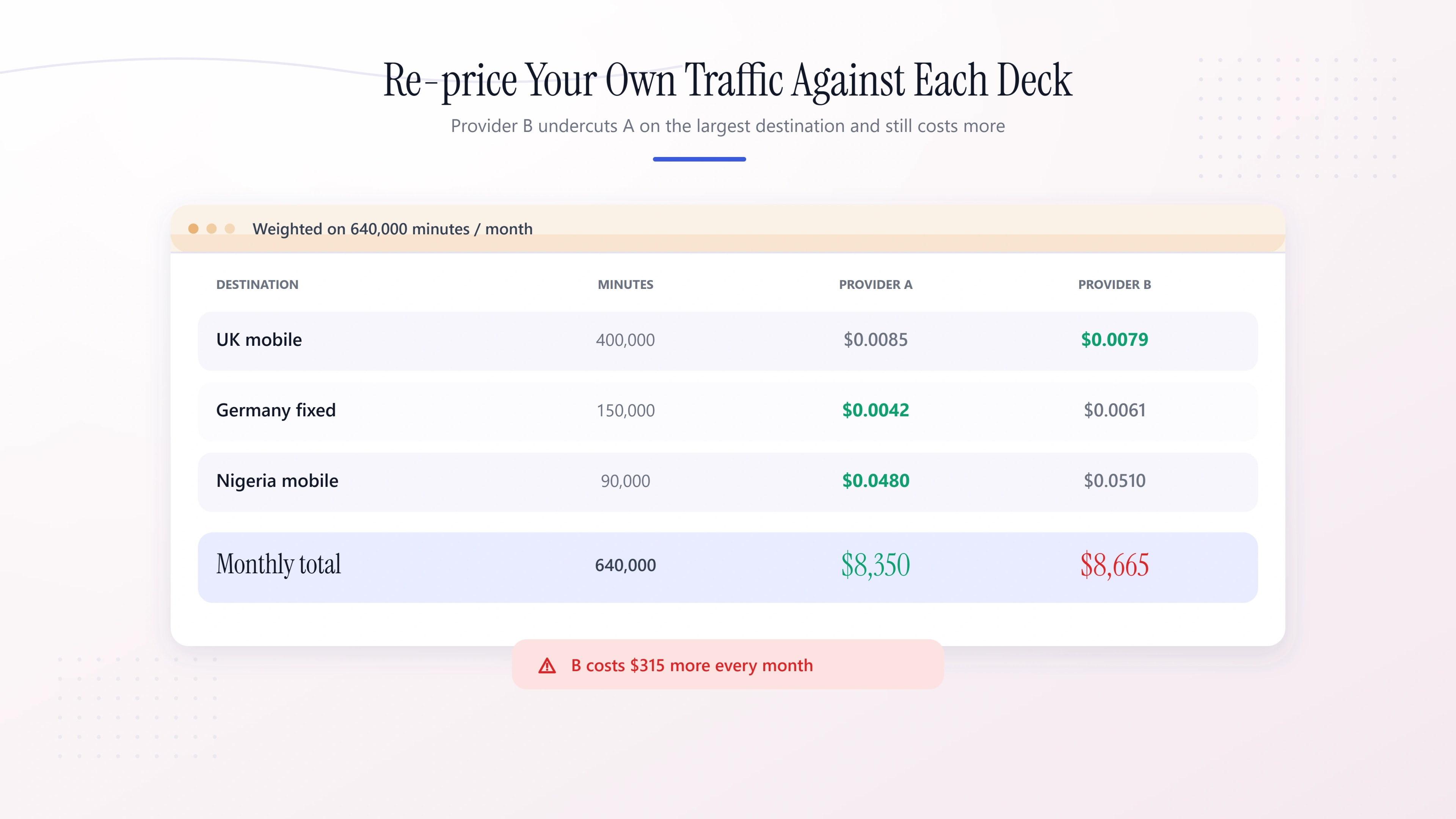
This is the step that decides the contract, and the one almost nobody does. Take your destination mix from the exercise above and apply each candidate rate deck prefix by prefix. The result frequently reverses the ranking you would get from scanning headline rates.
| Destination | Your minutes/month | Provider A | Provider B |
|---|---|---|---|
| UK mobile | 400,000 | $0.0085 | $0.0079 |
| Germany fixed | 150,000 | $0.0042 | $0.0061 |
| Nigeria mobile | 90,000 | $0.0480 | $0.0510 |
| Monthly total | 640,000 | $8,350 | $8,665 |
Provider B undercuts A by 7% on the single largest destination, which is the number a sales deck will lead with. Weighted across the real mix, B costs $315 more every month. Neither provider is lying; the comparison was just being done on the wrong basis.
Then adjust for rounding. Billing increments can move an effective rate by more than the difference between two decks, and they hit short-duration traffic hardest — the arithmetic is worked through in the guide to specifying and testing a wholesale SIP trunk.
Price a deck against your real destination mix
Send us your top destinations and monthly minutes and we will come back with prefix-level wholesale rates you can drop straight into this comparison.
3. Demand Quality Data Per Prefix
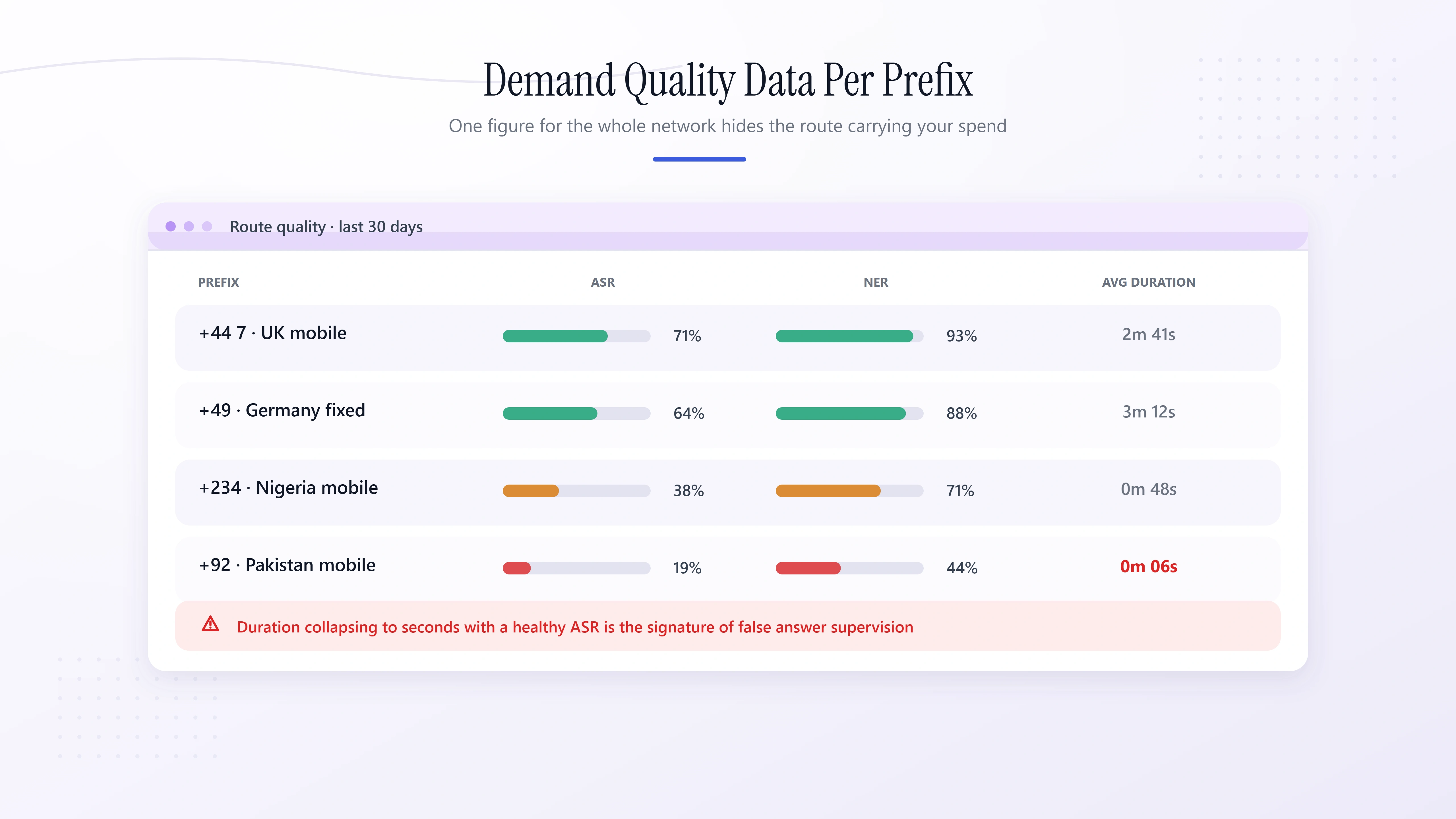
A provider quoting one answer-seizure ratio for its whole network is telling you nothing. ASR varies enormously by destination, and a strong average across easy routes can conceal a broken one on the destination carrying half your spend.
Ask for ASR, NER and average call duration for the specific prefixes you buy, over the last 30 days, with the sample size attached. A provider with real network visibility can produce that in a day. One that cannot produce it either lacks the monitoring or would rather you did not see it, and both answers are useful.
Watch for average call duration that collapses to a few seconds on one route while ASR stays high. That pattern is the signature of false answer supervision — calls billed as answered that never reached a person.
4. Test With Live Traffic Before You Commit
Never switch on the strength of a rate deck and a reference. Route a genuine 2% to 5% slice of production traffic for at least seven days, covering a weekend, and compare prefix by prefix against your incumbent over identical hours. Hand-dialled test calls prove nothing — test traffic is easy to route well.
A provider who refuses a paid trial on commercial grounds is telling you something about how the routes will perform. A full test plan, including which metrics to capture, is set out in the wholesale SIP termination buyer's guide.
5. Support You Can Actually Reach
Round-the-clock support is claimed universally and delivered unevenly. The specifics worth pinning down:
- A named network operations contact and a written escalation path, not a shared inbox.
- Response targets in the contract, and what happens when they are missed.
- Whether first-line staff can change routing themselves or only log the fault and wait for a second team.
- Coverage in your time zone, by people rather than an auto-responder.
- A ticketing system that issues reference numbers. Support conducted only over chat has no audit trail and no escalation.
Test it before you sign. Open a low-priority ticket at 2am on a Saturday and see what comes back, and how fast. It is the cheapest diligence available.
6. Fraud Posture
International revenue share fraud works by generating traffic to premium ranges that pay the fraudster a share of the termination fee. A compromised account can run up a five-figure bill over a weekend, and the question of who pays is settled by the contract, not by fairness.
Ask whether there is a per-account spend cap you can set yourself, whether high-risk and premium ranges are blocked by default and how an exception is requested, what anomaly detection runs and how fast it escalates to a phone call, and — plainly — where liability sits when fraud happens. Wangiri and traffic-pumping patterns should be things they can describe from experience, not terms they have to look up.
7. Redundancy That Means Something
"Redundant network" needs unpacking into specifics: multiple points of presence you can be homed to, more than one upstream carrier per major destination, automatic failover on SIP 503 and 408 responses rather than manual rerouting, and a stated uptime figure with the measurement window and the remedy attached. Acepeak publishes 99.99% across 185+ countries; whatever number a provider quotes, ask what it is measured on and what happens when it is missed.
8. Compliance and Licensing
For US traffic, confirm STIR/SHAKEN signing, the attestation level your traffic will receive, and what the provider needs from you to sign at the highest level. Low-attestation traffic increasingly gets labelled or blocked downstream, which surfaces as an unexplained ASR decline.
Elsewhere, ask which markets they are licensed to terminate in, how calling line identity is handled where local rules require a reachable in-country number, and — if you operate in the EU — what the retention period and processing terms are for call records under the GDPR.
9. References, and the Way Out
Ask for two reference customers with a traffic profile close to yours, and ask them one question: what broke, and how did the provider handle it? Every carrier has outages. The useful signal is whether anybody picked up the phone.
Then read the exit terms while you still have leverage. Notice period, what happens to an unused prepay balance, which numbers you would need to port and how long a port takes in each market. If you plan to build a customer base on top of this — the economics of that are covered in the VoIP reseller guide and on the reseller programme page — portability is not a detail, it is the whole asset.
Red Flags
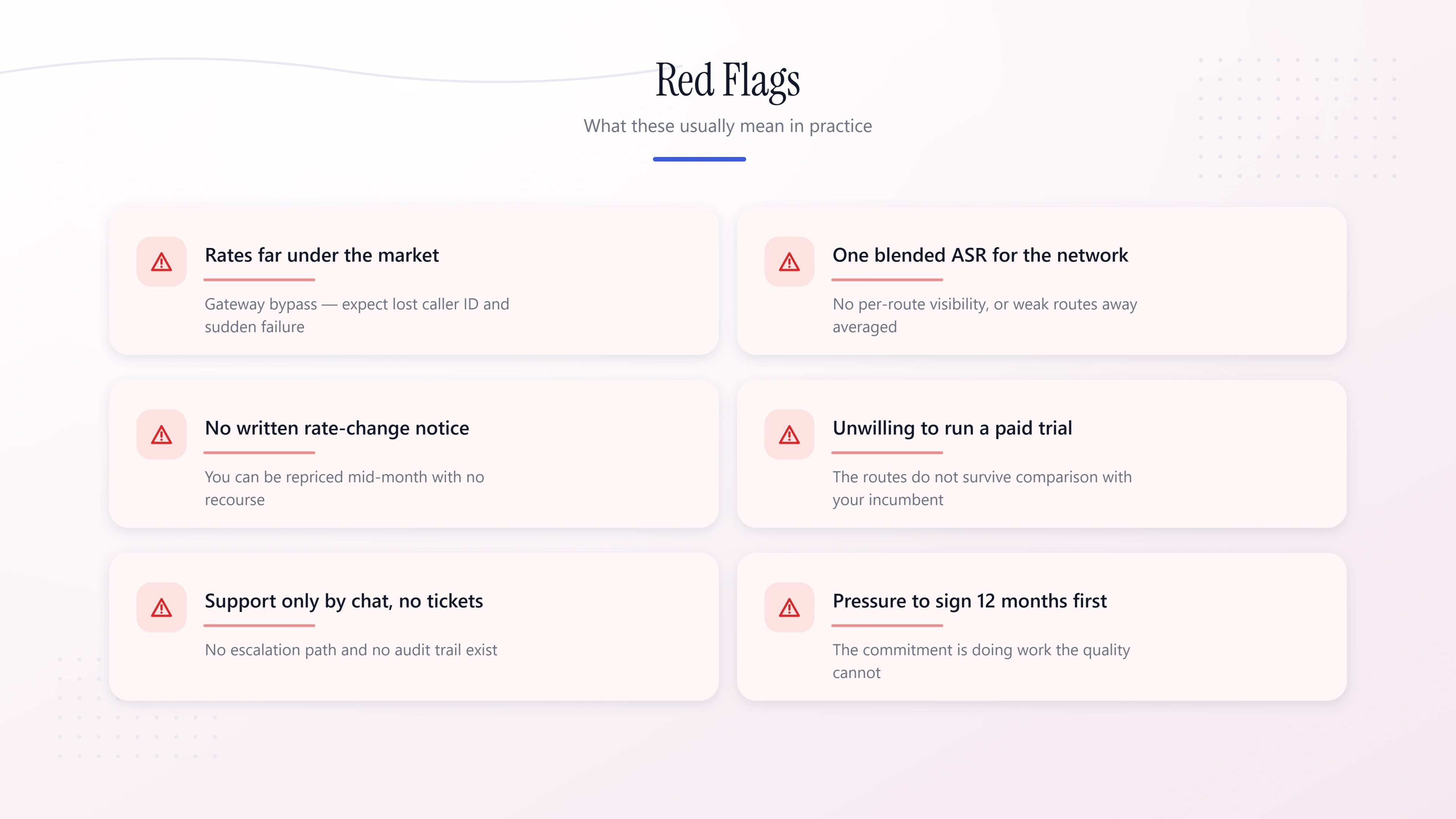
| What you see | What it usually means |
|---|---|
| Rates far under the market on a hard destination | Gateway bypass. Expect lost caller ID and sudden route failure |
| One blended ASR figure for the whole network | No per-route visibility, or weak routes being averaged away |
| No written notice period for rate changes | You can be repriced mid-month with no recourse |
| Unwilling to run a paid trial | The routes do not survive comparison with your incumbent |
| Support only by chat, no ticket references | No escalation path and no audit trail exist |
| Pressure to sign 12 months before testing | The commitment is doing work the quality cannot |
Conclusion
Choosing a wholesale VoIP provider is mostly an exercise in refusing to compare the wrong things. Re-price your own call records against each deck rather than reading headline rates. Insist on quality data for the prefixes you actually buy. Test with live traffic before you commit, and read the fraud, notice and exit clauses more carefully than the price list.
Work through those nine steps and the shortlist tends to resolve itself. For the technical specification that sits underneath the commercial decision, continue with how to spec and test a wholesale SIP trunk, or see Acepeak's wholesale VoIP services for termination, DIDs and trunks on one network.
Questions, answered.
Re-price your own call records against each provider's rate deck, prefix by prefix, then add the rounding each billing increment produces. Headline rates and blended averages routinely identify the wrong winner — a provider cheaper on your largest destination can still cost more across your real traffic mix.
Which destinations they hold direct interconnects on versus buy from upstream, ASR and NER for your specific prefixes over the last 30 days, their billing increments and short-duration surcharge thresholds, where fraud liability sits and whether you can set a spend cap, the rate-change notice period, and the exit and porting terms.
It is quoted per minute and varies by destination prefix rather than by country. Domestic and Tier-1 international routes are cheapest, with harder markets costing considerably more. Ask for a full A-Z rate deck by prefix with effective dates, not a single blended figure.
A provider running its own network can reroute around a problem; one buying several layers up can only raise a ticket. Transit is a normal part of global voice and not disqualifying, but the price should reflect which you are buying. Ask directly which destinations are direct and which are bought in.
At least seven days on a real 2% to 5% slice of production traffic, covering a weekend, compared against your incumbent over the same hours and destinations. Anything shorter misses the weekly pattern, and hand-dialled test calls do not reflect how production traffic gets routed.
Whatever the contract says, which is why it needs reading before signing. Ask whether you can set your own per-account spend cap, whether premium and high-risk ranges are blocked by default, how quickly anomalies trigger a phone call rather than an email, and where liability sits once fraud has occurred.
Choosing on headline rate without weighting it against their own destination mix and billing increments, then committing to twelve months before testing live traffic. Both are avoidable in an afternoon, and both are the usual reason a wholesale contract is regretted.