Introduction
Most articles about wholesale SIP termination stop at the definition. If you are reading this, you already know that SIP sets up the call and that a wholesale carrier hands it off to the destination network. What you need is everything that comes after: how to write the spec, how to read the rate deck, and how to prove a route works before your customers find out that it does not.
This guide is written for the person who has to sign the contract and then live with it. It assumes you are bringing your own switch and your own traffic, and that nobody is going to hold your hand at 3am when a destination starts failing.
Key Takeaways
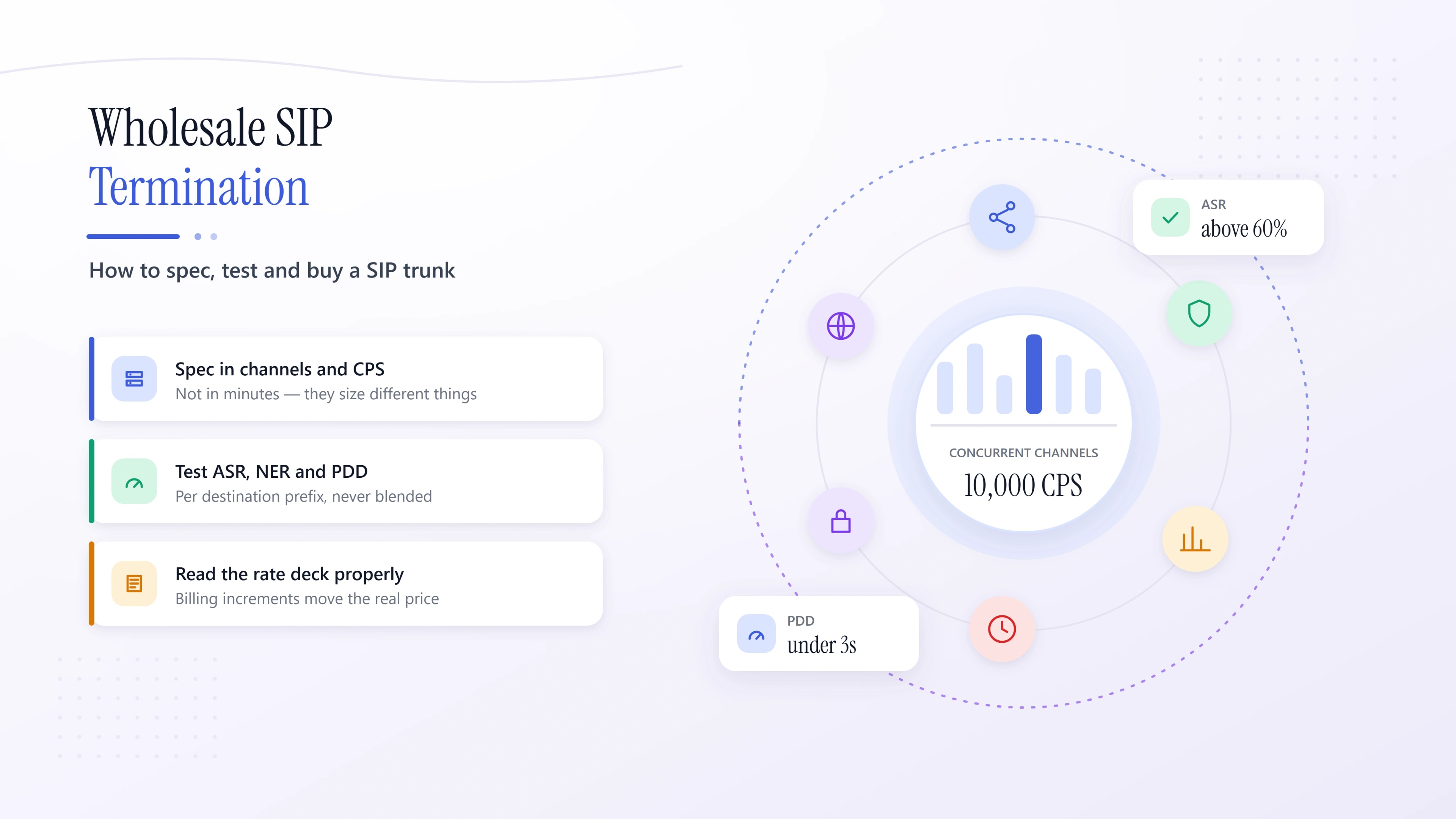
- Size the SIP trunk in concurrent channels and calls per second. Billed minutes are what you pay for; channels and CPS are what you have to engineer.
- A blended ASR figure tells you nothing. Test the destinations you actually call, one prefix at a time.
- Billing increments and short-duration surcharges move the effective rate more often than the headline price per minute does.
Wholesale SIP Termination Is Not SIP Trunking
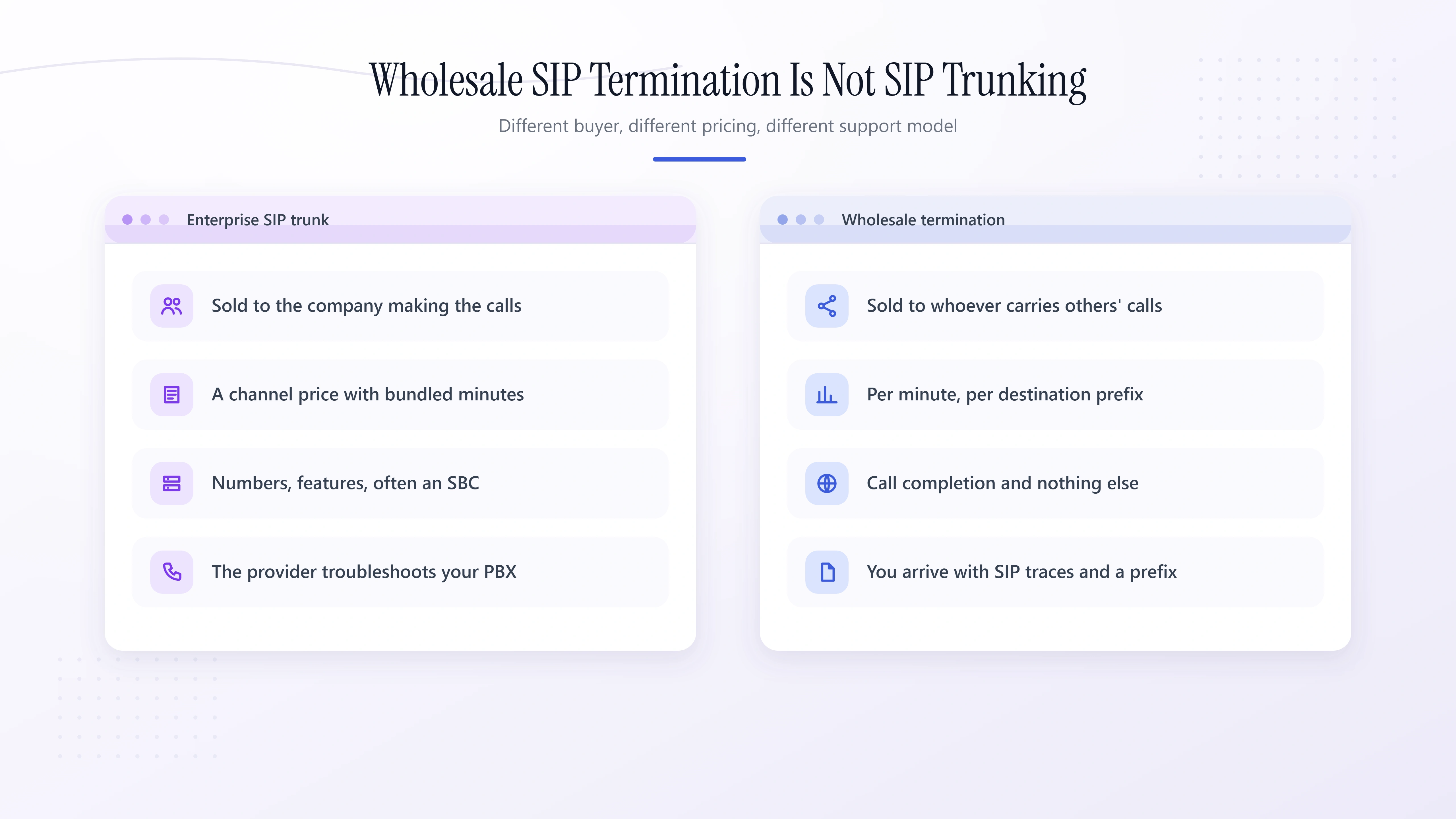
The two get used interchangeably and they are not the same purchase. A SIP trunk sold to an enterprise replaces the PSTN lines feeding one company's PBX. It arrives with numbers attached, an emergency-services registration, a fixed channel count, and a support desk that expects to talk about handsets.
Wholesale SIP termination sells outbound call completion in bulk to whoever is carrying somebody else's calls — other carriers, resellers, contact-centre platforms, CPaaS vendors. You bring the switch, the numbers, the customers and the fraud controls. The differences that matter in practice:
- Who the buyer is. Enterprise trunking sells to the company making the calls. Wholesale termination sells to the company carrying calls for other people.
- How it is priced. A channel price with bundled minutes, versus a per-minute price that changes with every destination prefix on an A-Z rate deck.
- What is bundled. Enterprise trunks include numbers, features and often an SBC. Wholesale termination includes call completion and nothing else.
- Who owns a problem. On an enterprise trunk the provider troubleshoots your PBX with you. On a wholesale SIP trunk you are expected to arrive with SIP traces and a prefix.
Where inbound fits
Termination is outbound only. Inbound is a separate purchase and a separate rate card — you buy numbers in each market, with a monthly rental plus an inbound per-minute charge. If you need both sides, price them separately and read the guide to buying wholesale DID numbers alongside published DID coverage and rates. Treating inbound as a line item on a termination deal is how buyers end up with numbers they cannot port out.
Spec the SIP Trunk Before You Ask for a Quote
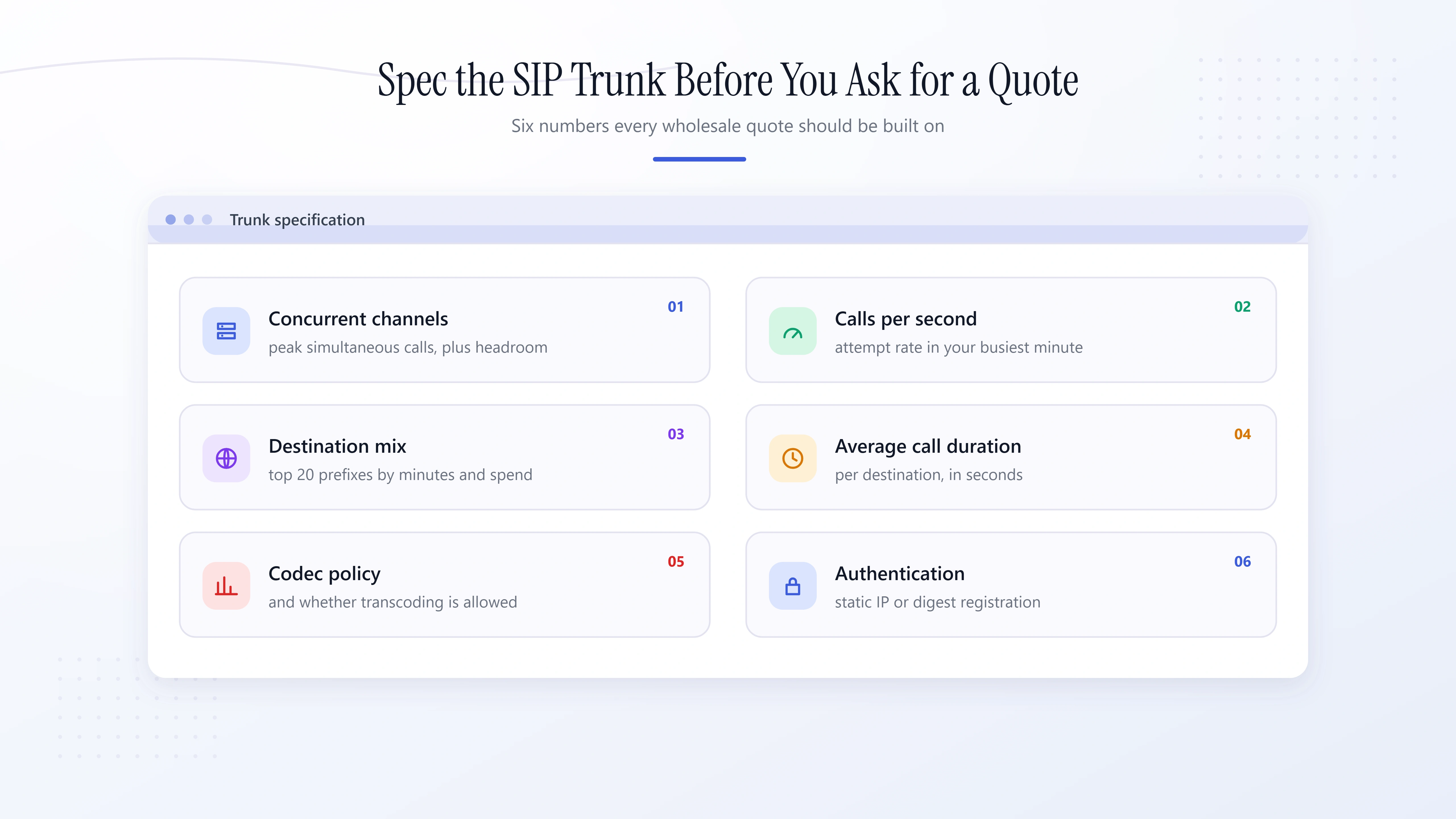
No vendor can quote you properly, and you cannot compare two quotes honestly, until you can state six numbers. Write them down before the first call.
| Spec | What to state | Why it decides something |
|---|---|---|
| Concurrent channels | Peak simultaneous calls, plus headroom | Sets the port count and the circuit size |
| Calls per second (CPS) | Attempt rate in your busiest minute | Dialler traffic hits a CPS ceiling long before a channel ceiling |
| Destination mix | Top 20 prefixes by minutes and by spend | Decides which rate deck is actually cheaper for you |
| Average call duration | Per destination, in seconds | Drives increment choice and short-duration surcharges |
| Codec policy | G.711, G.729 or Opus, and whether transcoding is allowed | Affects bandwidth, MOS and whether fax and DTMF survive |
| Authentication | Static IP or SIP digest registration | Determines your fraud exposure if credentials leak |
Channels and CPS are different constraints
Concurrent channels measure how many calls can be live at once. CPS measures how fast you are allowed to start new ones. They are not correlated, and confusing them is the most common sizing mistake in wholesale.
A contact centre with 200 agents on long consultative calls needs plenty of channels and very little CPS. A predictive dialler working a cold list needs the opposite: most attempts never connect, so concurrency stays modest while the attempt rate spikes hard. Traffic like that dies against a CPS limit while the channel count sits half empty, and the symptom — 503s in bursts, clean in between — looks nothing like congestion. Acepeak's wholesale voice network is specified at 10,000 CPS for exactly this reason; ask any provider for their figure in writing, per account rather than per platform.
Then size the circuit
G.711 carries 64 kbit/s of payload in each direction and lands near 85–90 kbit/s per call once IP, UDP, RTP and Ethernet headers are counted. Three hundred concurrent G.711 calls is roughly 25–30 Mbit/s each way, before anything else on the link. G.729 compresses to about 8 kbit/s of payload, closer to 25 kbit/s with headers, and costs you some audio quality and most of your fax reliability.
Undersized circuits produce jitter and packet loss that look exactly like a bad route. Measure your own link before you open a ticket blaming the carrier.
IP authentication or registration
Most wholesale SIP trunks authenticate on a static IP address. It is simpler, there are no credentials to leak, and it requires fixed addressing on your session border controller. SIP digest registration suits dynamic addresses but turns a leaked password into a fraud incident that runs until somebody notices the bill.
Either way, terminate the SIP trunk on an SBC rather than exposing your softswitch directly. An SBC gives you topology hiding, rate limiting and a place to enforce a per-destination spend cap — which is the control that actually saves money when something goes wrong.
How to Read a Wholesale Rate Deck
The rate deck decides the money, and the headline rate is close to the least useful number on it.
Prefix level, not country level
"France" is not a rate. France fixed, France mobile and France special-services are different prices, sometimes by an order of magnitude, and a deck that quotes one number per country is either incomplete or keeping the expensive breakouts out of sight until the first invoice. Insist on a deck keyed by dialling prefix, with an effective date on every row.
Billing increments
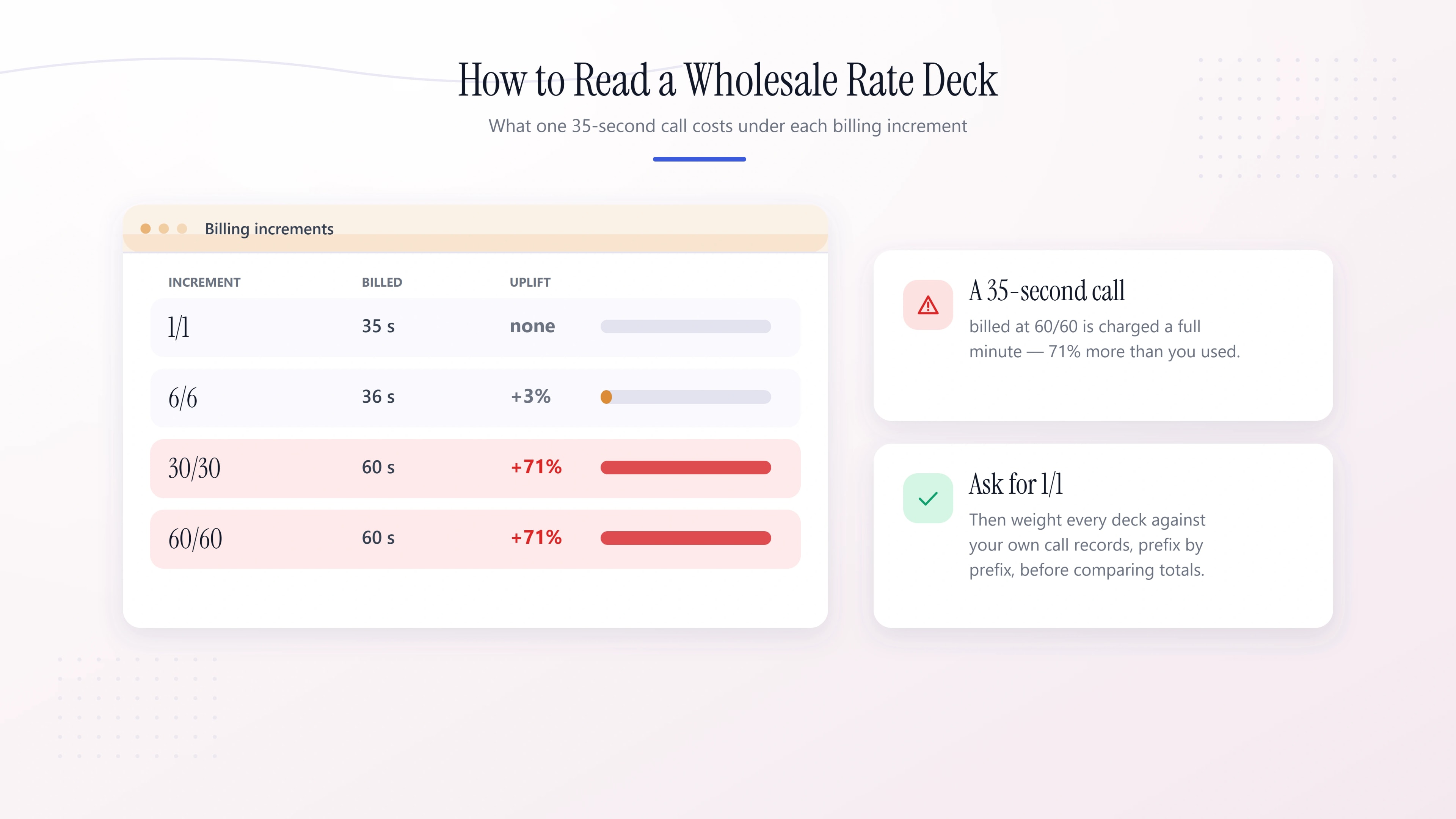
Increments describe how a partial minute is rounded. They are written as two numbers: the first billable block, then the block used after it. On a 35-second call the difference is not small.
| Increment | Seconds billed | Uplift over usage |
|---|---|---|
| 1/1 | 35 | none |
| 6/6 | 36 | +3% |
| 30/30 | 60 | +71% |
| 60/60 | 60 | +71% |
If your average call runs two minutes, increments barely register. If you are carrying verification calls, missed-call alerts or dialler traffic where most connects last under a minute, a 60/60 deck priced 10% below a 1/1 deck is the more expensive one. Work it out on your own average duration, per destination, before you compare anything else.
The charges that appear after you sign
- Short-duration surcharge. Triggered when your average call duration on a route falls below a threshold, commonly somewhere between 10 and 30 seconds. Ask for the threshold, the surcharge, and the window it is measured over.
- Quality-based penalties. Some decks penalise low ASR or low NER because failed attempts still cost the carrier signalling. Reasonable in principle; ask what the trigger is.
- Per-call setup fees. Uncommon at wholesale but they exist, and they hit short-duration traffic hardest.
- Rate change notice. Destinations reprice constantly and short notice is normal in wholesale — 24 hours is standard practice, not a warning sign. No stated notice period at all is.
- Minimum commit and shortfall. If there is a monthly commit, find out whether unused value rolls forward or is simply billed and lost.
Compare decks on your traffic, not theirs
Export a full month of call records, apply each candidate deck prefix by prefix, add the rounding each increment scheme produces, and compare the totals. Two decks that look 8% apart on headline rates routinely land within 1% of each other once weighted — and occasionally the cheaper-looking one comes out 20% more expensive. This single exercise is worth more than every other step in this guide.
Compare a deck against your own traffic
Acepeak quotes wholesale voice termination by destination prefix, with the increments and surcharges stated up front rather than discovered on the first invoice.
The Test Plan: Ten Days Before You Commit
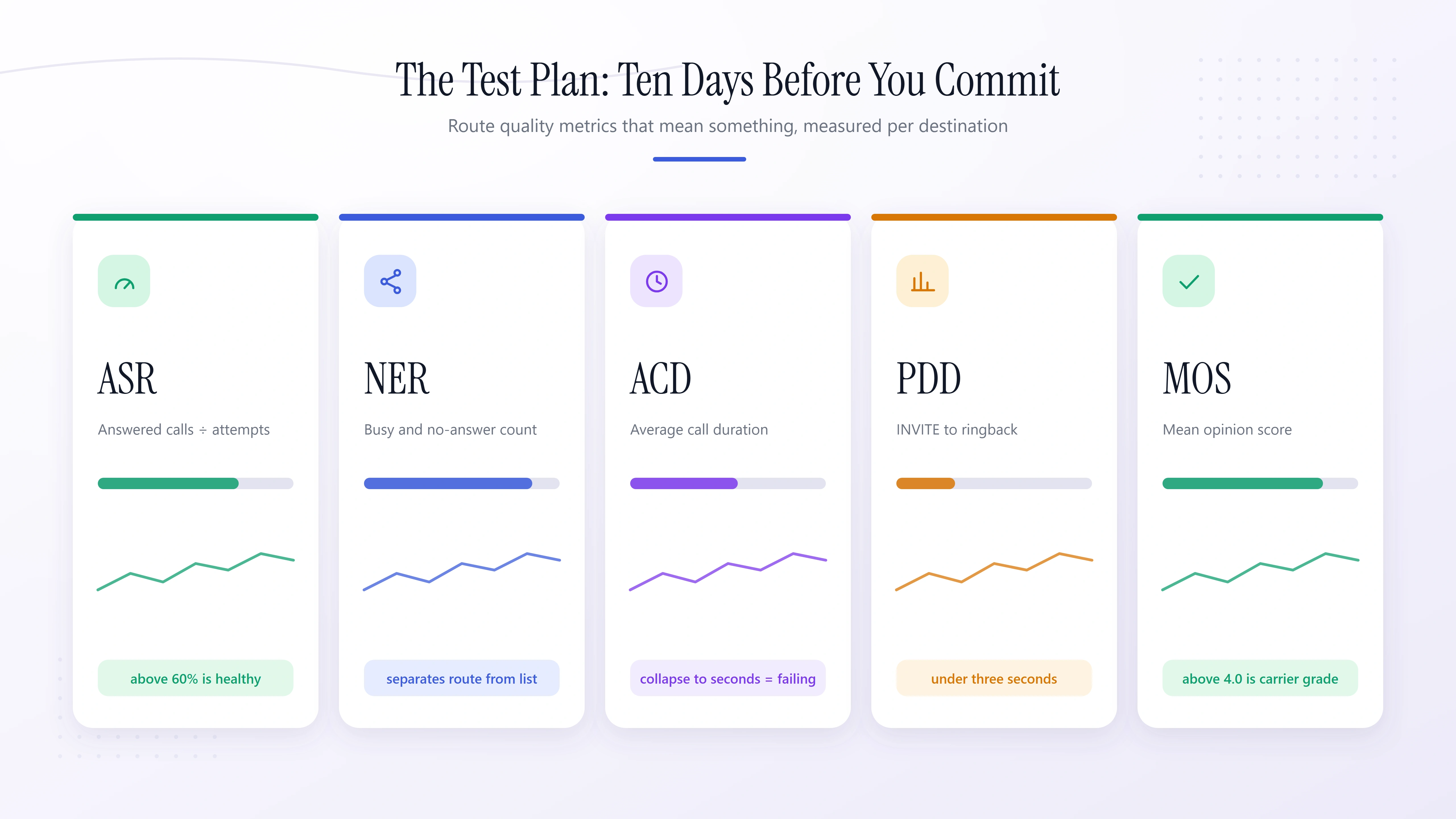
Never move production traffic on the strength of a rate deck. Route quality varies by destination, by time of day and by week, and the only evidence that counts is your own traffic on your own destinations.
The metrics that mean something
- ASR (Answer-Seizure Ratio). Answered calls divided by attempts. Above 60% is healthy on most routes — but the figure is only meaningful per destination, and a network-wide average is marketing rather than data.
- NER (Network Efficiency Ratio). The same idea, except user-busy and no-answer count as network successes. NER is what separates "this route is broken" from "nobody picked up." High NER with low ASR usually means your calling list, not the carrier.
- ACD (Average Call Duration). A route whose ACD collapses to a few seconds is failing even when ASR looks excellent. Those are connects to dead air.
- PDD (Post-Dial Delay). Time from INVITE to ringback. Under three seconds is good. Past six suggests one transit hop too many, and callers start hanging up before the phone rings.
- MOS (Mean Opinion Score). Above 4.0 is carrier grade; see the Mean Opinion Score scale for how the rating is derived.
- False answer supervision. The route returns an answer for a call that never reached a human, and the meter starts. Watch for ACD clustering at suspiciously tight low values on one destination while every other route behaves normally.
How to run the test
- Choose your five highest-spend destinations and the two that give you the most trouble today.
- Send a real slice of live traffic — 2% to 5% — rather than hand-dialled test calls. Test calls get routed well; that is the problem with them.
- Run for at least seven days so the window crosses a weekend and a full business cycle.
- Compare per prefix against your incumbent over the same window. Same days, same hours, same destinations, or the comparison proves nothing.
- Place manual calls to a handset you control on each destination and listen. Check the calling number arrives intact, check the audio in both directions, and check how long the far end takes to ring.
Direct, Transit and Grey Routes
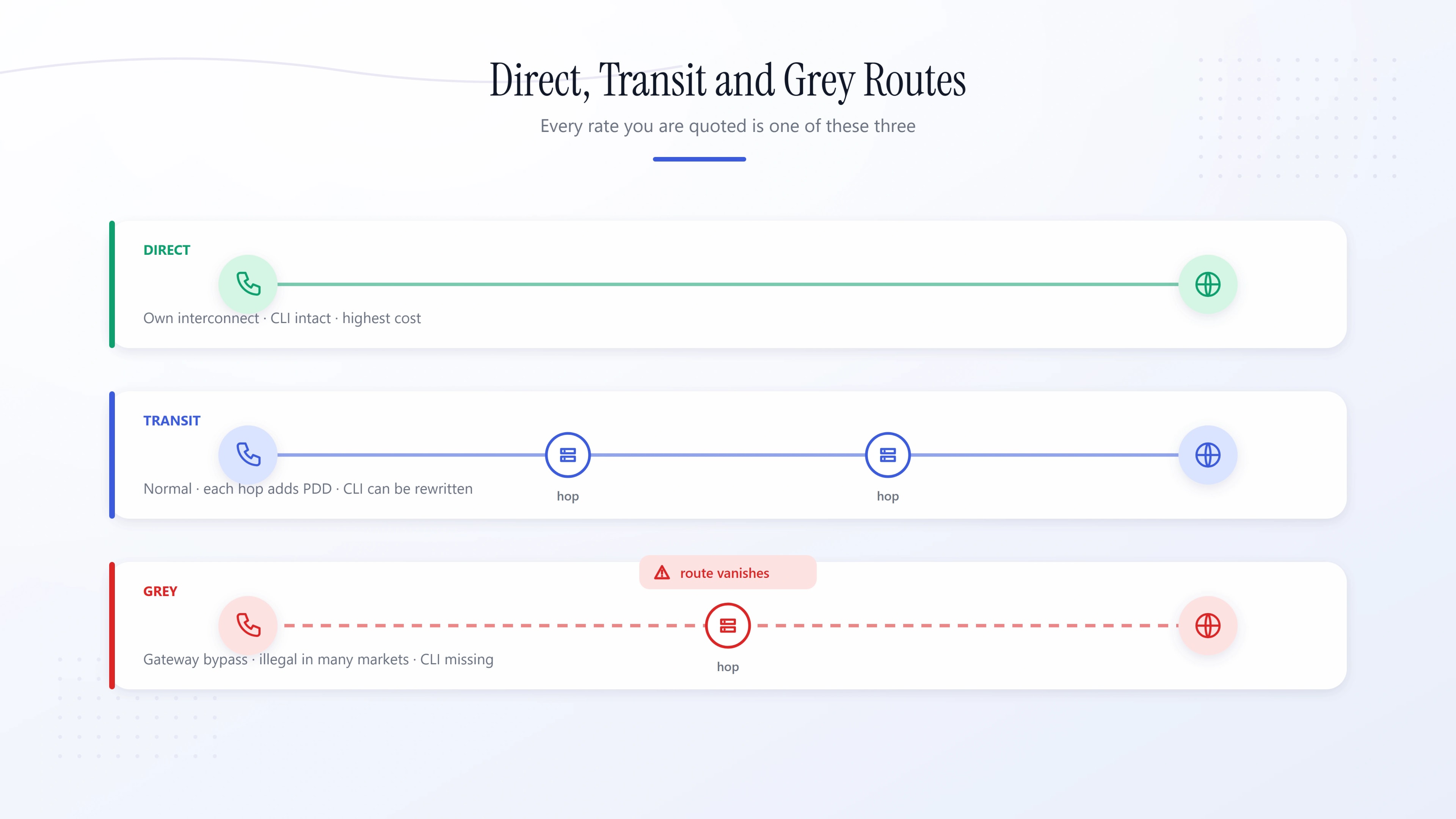
Every wholesale rate you are quoted sits in one of three categories, and the price usually tells you which.
- Direct. The provider holds its own interconnect with the destination operator. Best quality, calling line identity passes intact, highest cost.
- Transit. One or more wholesale carriers sit in between. Entirely normal and usually fine, but every hop adds post-dial delay and another place where the calling number can be rewritten or stripped.
- Grey. Traffic delivered by bypassing the destination operator's international gateway, typically through banks of SIM cards. Cheapest by a wide margin, illegal in many countries, the calling number is wrong or missing, and the route vanishes without notice the moment the operator detects it.
The test for grey routing is simple: call a handset you own on that destination network and look at the screen. A calling number that arrives consistently mangled, replaced with a local mobile number, or absent altogether — combined with a rate well under what everyone else quotes — is the answer. Grey routes are not a bargain you are clever enough to get away with; they are a dependency that fails during your busiest week.
Compliance You Inherit From Your Carrier
For US-bound traffic, STIR/SHAKEN caller-ID authentication applies and attestation level matters. Establish whether your provider signs traffic on your behalf, at what attestation, and what they require from you to sign at the highest level. Traffic signed with low attestation is increasingly likely to be labelled or blocked at the terminating carrier, which shows up as an ASR problem nobody can explain.
Outside the US, calling-line-identity rules vary by country and several require the presented number to be a real, reachable number in that market. In the EU, call records are personal data under the GDPR, so retention periods and processing terms belong in the contract rather than in a later conversation.
Contract Terms Worth Slowing Down For
- Fraud liability. International revenue share fraud can generate a five-figure bill over a single weekend. Ask where liability sits, whether there is a per-account spend cap, whether premium and high-risk ranges are blocked by default, and how quickly an anomaly triggers a human phone call rather than an email.
- Dispute window. How many days after an invoice can you dispute call records, and what evidence is accepted? A short window plus a slow CDR export is a bad combination.
- Rate change mechanics. Notice period, how it is delivered, and whether in-progress commitments are protected.
- Prepay, postpay and credit. Prepay is normal for new wholesale accounts. Establish what happens to an unused balance if you leave.
- Exit. Notice period, any numbers you would need to port, and how long a port takes in each market. Confirm this before you sign, not when you want to leave.
Ask for a deck by prefix, not by country
Tell us your top destinations and average call duration and we will quote the routes you actually use, with increments and surcharges on the page.
Conclusion
Buying wholesale SIP termination well comes down to three habits. Spec the SIP trunk in channels and CPS before anyone quotes you. Weight every rate deck against your own call records rather than reading the headline. Prove the routes with live traffic on your real destinations before you commit volume.
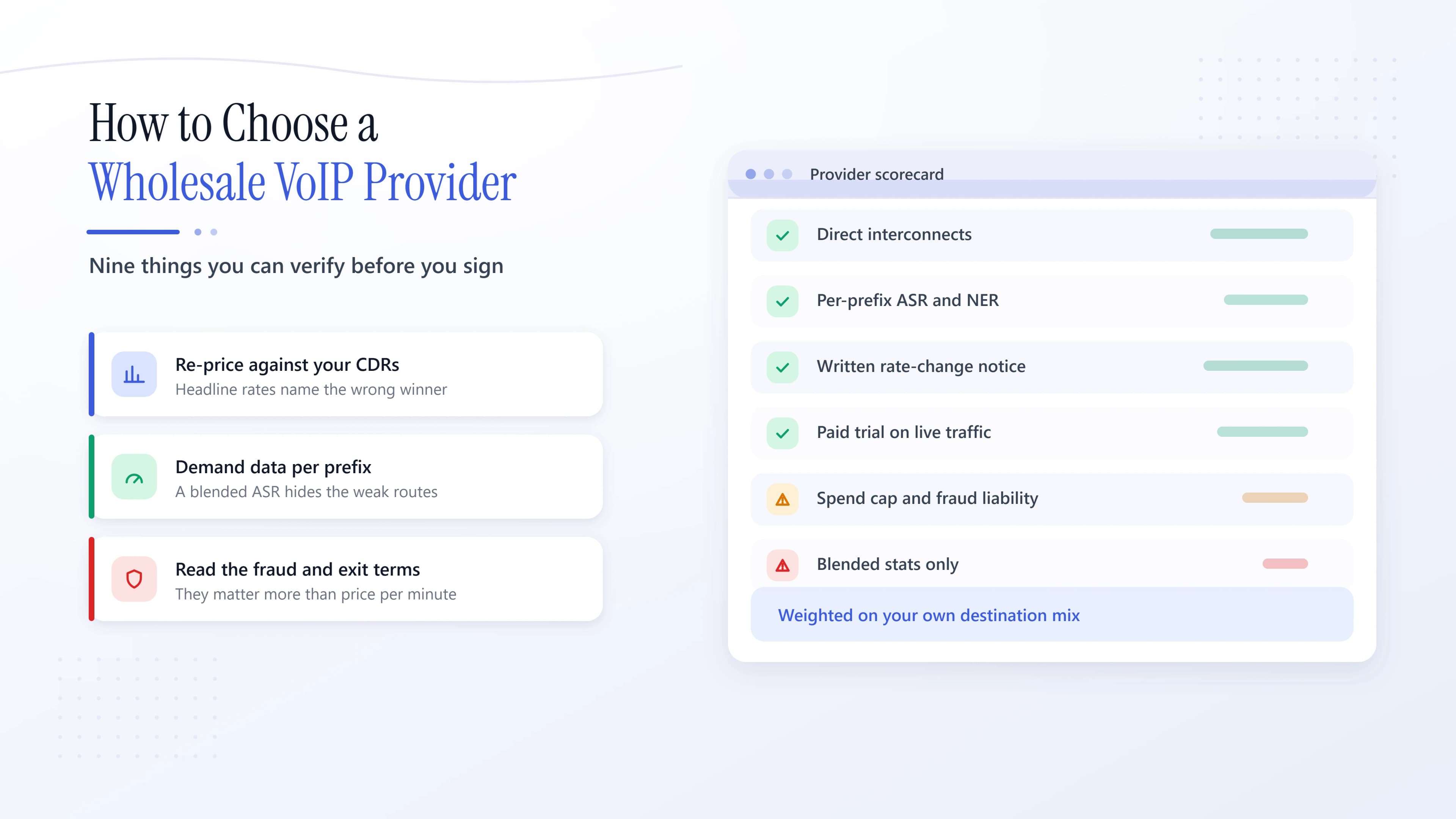
Do those three and the remaining decision is about the company rather than the technology — which is a different evaluation, covered in the nine things to verify when choosing a wholesale VoIP provider. For the background on how call completion works underneath all of this, start with wholesale VoIP termination.
Questions, answered.
It is the bulk purchase of outbound call completion over SIP, sold to carriers, resellers and platforms rather than to end businesses. You connect your own switch to the provider, send calls over SIP, and pay a per-minute rate that varies by destination prefix. Numbers, features and end-customer support are not included.
An enterprise SIP trunk replaces PSTN lines for one company and comes with numbers, emergency registration and a fixed channel count for a bundled price. Wholesale SIP termination sells outbound completion only, priced per minute per destination on an A-Z rate deck, and assumes the buyer operates their own softswitch and SBC.
Channels should cover your peak simultaneous calls plus headroom. CPS should cover your attempt rate in the busiest minute, which is a separate number entirely. Dialler and verification traffic typically needs high CPS with modest concurrency; long consultative calls need the reverse. Quote both to every provider.
Ask for 1/1 where you can get it. The shorter your average call duration, the more increments cost you — a 35-second call billed at 60/60 is charged as a full minute, a 71% uplift over what you used. On two-minute average calls the difference is minor.
Above 60% is generally healthy, but the figure only means something per destination. Look at NER alongside it: NER counts busy and no-answer as network successes, so a high NER with a low ASR points at your calling list rather than the route.
Call a handset you own on that destination and check what calling number arrives. Consistently missing, mangled or replaced caller ID, combined with rates well below every other quote, indicates gateway bypass. Those routes carry legal risk and disappear without notice when the destination operator detects them.
At least seven days on a genuine 2% to 5% slice of live traffic, covering a weekend, compared prefix by prefix against your incumbent over the same hours. Hand-dialled test calls are not sufficient — test traffic is easy to route well.