Scottsdale, Tempe and Mesa Credibility for a Remote Team
A local telephone prefix does more than route calls — it signals where a business is rooted. In Arizona's fast-growing East Valley, the 480 prefix has become shorthand for Scottsdale, Tempe, and Mesa credibility, giving companies a way to look local even when their team is spread across the country. This guide covers where the number comes from, which cities it reaches, and how a business can put one to work.
Key Takeaways
- The 480 prefix was created in a 1999 split from Arizona's original 602 code and now anchors the East Valley, including Scottsdale, Tempe, Mesa, and Chandler.
- It runs on Mountain Time year-round, since Arizona does not observe daylight saving.
- A local prefix measurably improves answer rates and reads as more established to Arizona-based callers.
- Standard numbers start around $150; short or pattern-based sequences cost more due to demand.
- Cloud phone providers can provision a 480 number for a business located anywhere, not just Arizona.
Power of a New 480 Number
Securing a 480 number puts a business inside one of Arizona's most recognized dialing regions, alongside an image of stability, professionalism, and East Valley roots.
What Makes the 480 Area Code So Special?
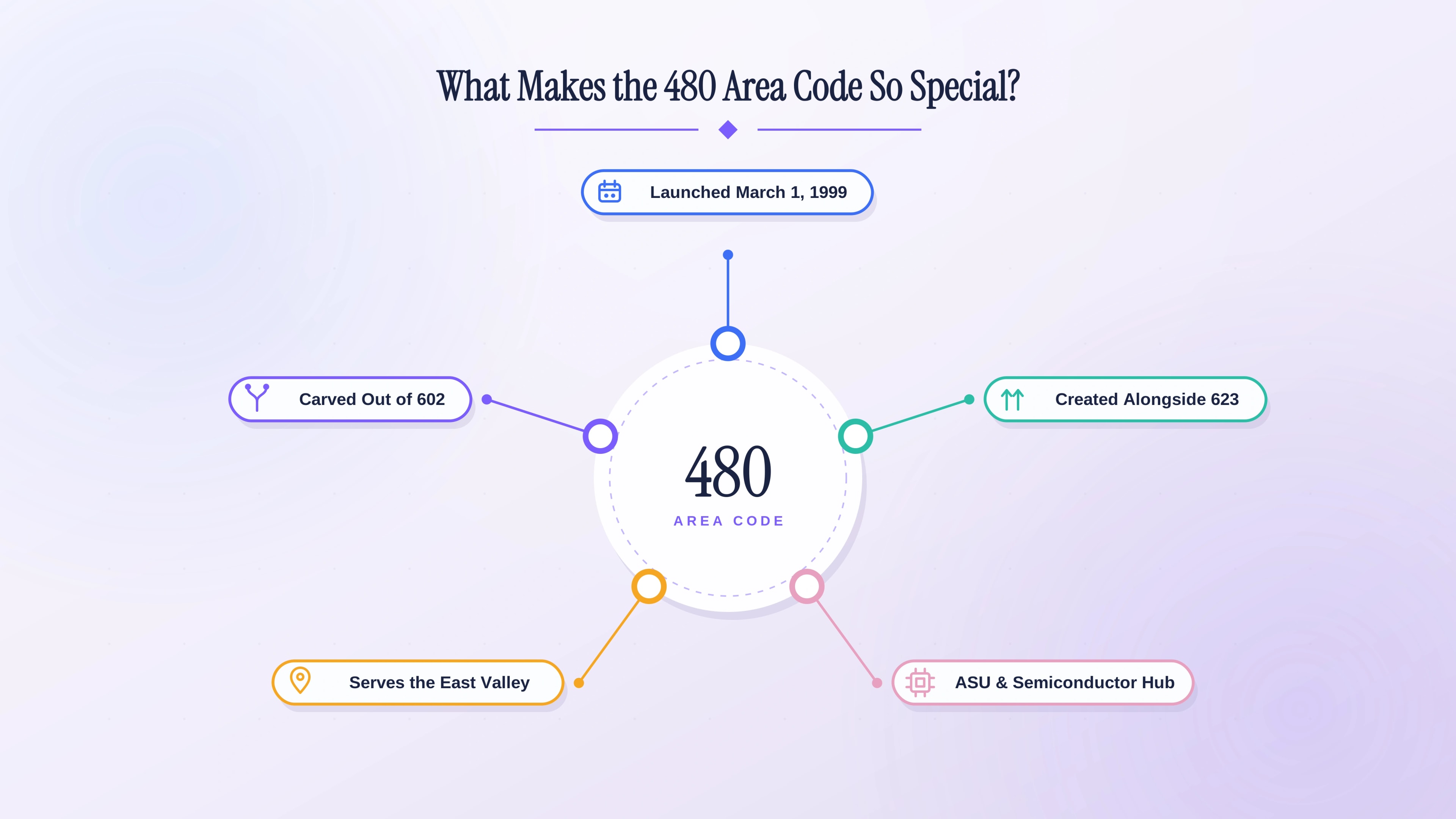
480 was carved out of the original 602 region on March 1, 1999, when the Arizona Corporation Commission split the fast-growing Phoenix market into three codes — 602, 480, and 623 — to keep pace with population growth and the 1990s mobile-phone boom. Despite newer overlays added since, 480 has kept its reputation as the East Valley's signature prefix, tied to Scottsdale, Tempe, and Chandler's business growth through the 2000s.
Details About The 480 Area Code
State
Arizona.
Time Zone
Mountain Time (UTC-7) — observed year-round, since Arizona does not use daylight saving.
Cities Served
Phoenix (east side), Mesa, Chandler, Maricopa, Higley, Apache Junction, Scottsdale, Casa Grande, Tempe, Cave Creek, New River, Gilbert, San Tan Valley, Queen Creek, Fountain Hills, Rio Verde, and Chandler Heights.
This coverage overlaps with 480's sister prefix from the same 1999 split — for the West Valley side of that history, see the 623 area code guide — and together the two codes still carry most of metro Phoenix's local call traffic.
How a 480 Number Can Benefit Your Business
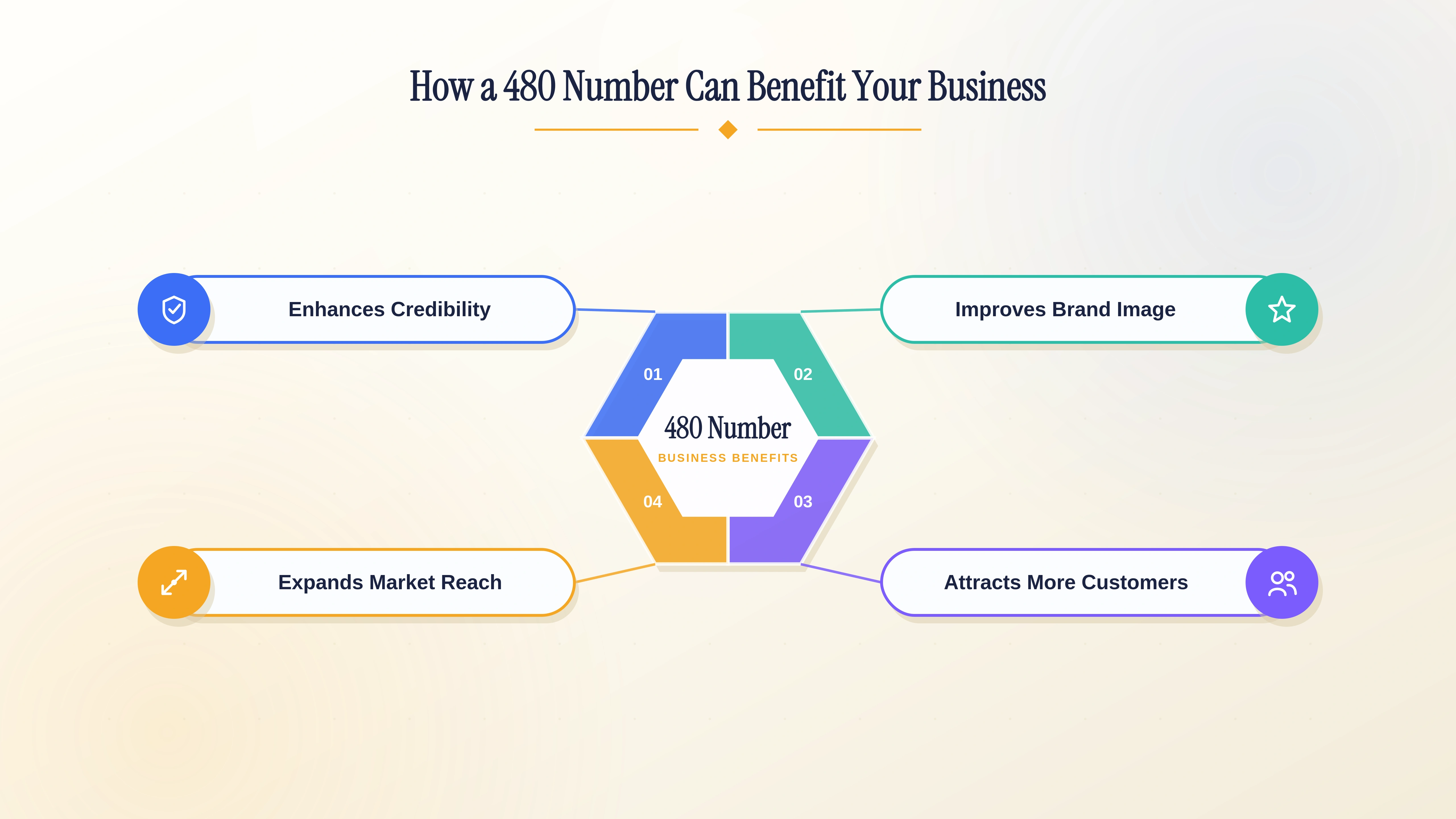
Enhances Credibility
Answering with a 480 prefix reads as established rather than transient to East Valley callers, particularly in Scottsdale and Chandler where competition among local vendors runs high.
Improves Brand Image
The prefix carries specific East Valley associations — Scottsdale's retail corridor, Tempe's university and startup scene, Chandler's tech employers — that can rub off on a brand in ways a 602 downtown Phoenix number cannot.
Attracts More Customers
Local callers pick up local numbers more often, and across a footprint stretching from Gilbert to Fountain Hills that difference shows up directly in connect rates for sales and support lines.
Expands Market Reach
A cloud-based 480 line lets a team based anywhere still answer, route, and follow up on calls from Mesa, Queen Creek, and the rest of the East Valley without covering 623's West Valley footprint separately.
Strategies for Acquiring a 480 Area Code
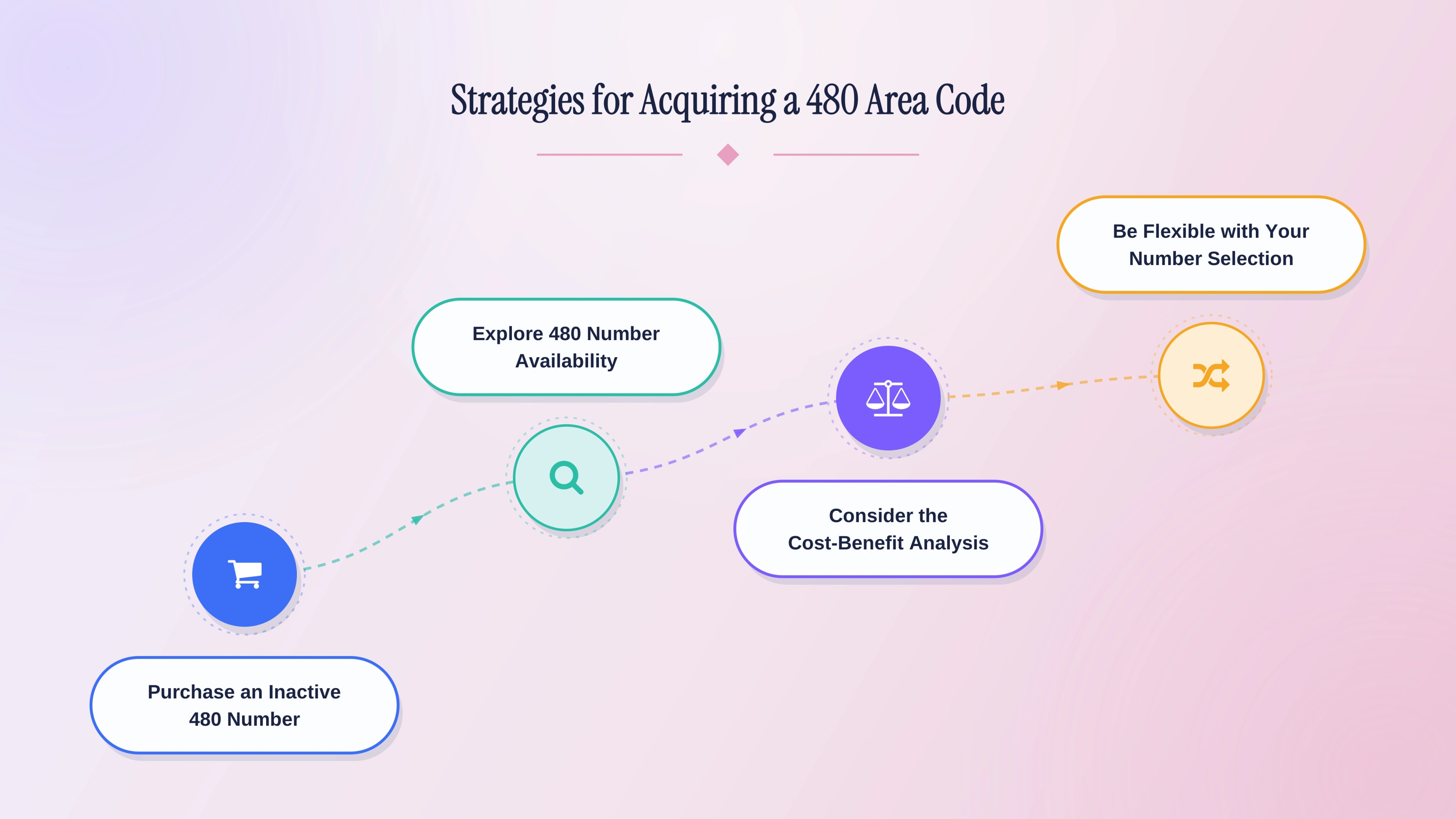
Because desirable 480 numbers are limited, businesses generally choose between porting an inactive number from a broker, requesting a fresh assignment from a provider, or provisioning one directly through a cloud phone system.
Purchase an Inactive 480 Number
Buying a dormant 480 number and porting it to a chosen provider is the fastest route to a specific, memorable digit sequence, though pricing rises with how easy the number is to recall.
Explore 480 Number Availability
Inventory shifts often, so it helps to check a provider's live availability list rather than relying on a single search — standard numbers typically restock faster than premium or vanity sequences.
Consider the Cost-Benefit Analysis
Prices for a 480 number span roughly $150 for a standard listing to several thousand dollars for a short or repeating-digit sequence. Weighing that cost against the expected gain in answer rate and local trust is worth doing before committing.
Be Flexible with Your Number Selection
If a first-choice number is taken or priced out of budget, staying open to nearby digit combinations keeps the search from stalling — most of the credibility benefit comes from the prefix itself, not the exact sequence.
Integrating Your 480 Number into Your Marketing
Once assigned, the number should appear everywhere a customer looks — website header, email signature, Google Business Profile, and print materials — so the local association actually reaches the audience it's meant to reach.
Measuring the Impact of Your 480 Area Code
Tracking call volume, lead source, and caller feedback before and after the switch shows whether the local prefix is actually moving the needle, and makes it easier to adjust marketing spend accordingly.
Ready to add a 480 number to your business line?
Acepeak provisions East Valley numbers on a cloud phone system with call routing, voicemail, and analytics built in.
The Cost of a 480 Area Code
Cost depends mainly on number type and provider — a plain, unlisted digit sequence sits at the low end, while short or pattern-based numbers command a premium. The right call comes down to whether the credibility gain justifies the markup for a given budget.
The Availability of 480 Numbers
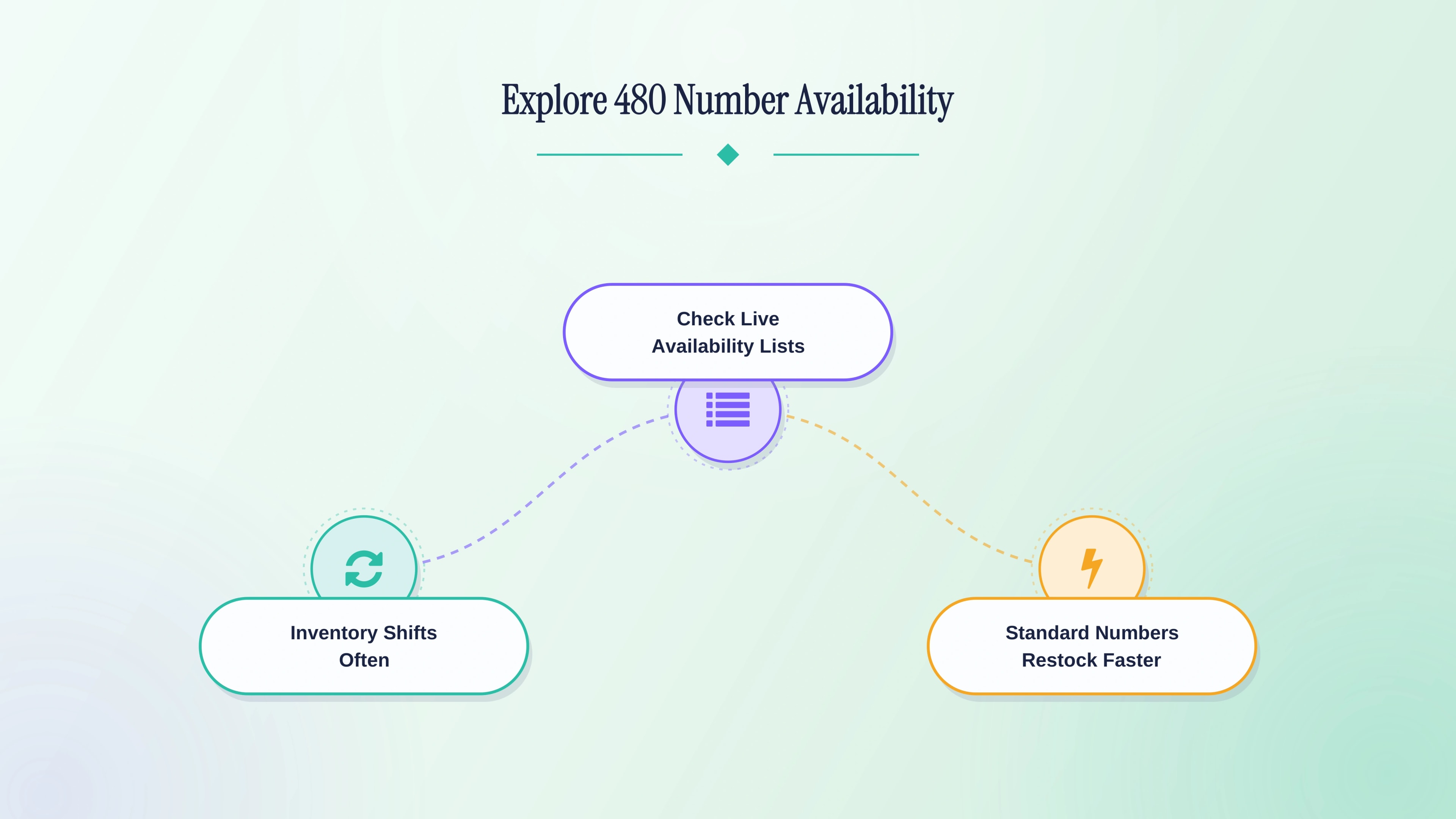
High demand keeps easy-to-remember 480 numbers scarce, so providers that refresh their inventory often — and flag new releases — give a business the best shot at a strong number.
Matching the Prefix to Your Listing and Contact Details
A recognizable local prefix is a small detail that adds up: paired with a proper business listing and consistent contact information, it signals a company that has invested in how it presents itself.
User-Friendly Guide to Acquiring a 480 Number
Securing a 480 number for a business is straightforward with the right approach. Whichever provider a business chooses, it is worth vetting them the way regulators recommend vetting any calling service — the FTC's Do Not Call data is a useful reference point for how numbers and carriers get flagged for abuse, and a provider with a clean record is one less thing to worry about.
| Step | Description |
|---|---|
| 01 — Research Providers | Look for vendors with 480 inventory spanning both the Scottsdale/Tempe core and outlying communities like San Tan Valley and Rio Verde, not just the busiest rate centers; Acepeak is one option to start with. |
| 02 — Check Availability | Since 480 and its sister code 623 split off from 602 the same year, availability in the East Valley moves quickly — checking regularly or setting up alerts helps catch new releases before Scottsdale or Chandler competitors do. |
| 03 — Evaluate Costs | Compare upfront and ongoing fees across available numbers, weighing a standard sequence near $150 against a short or repeating one that can run into the thousands given East Valley demand. |
| 04 — Secure the Number | Once a fitting number turns up, complete the provider's purchase process promptly — desirable East Valley sequences move fast given how tightly 480 and 623 split the market in 1999. |
Get started today.
Contact Acepeak to check current 480 availability and get a local East Valley line running.
Removing the Hesitation Before Someone Picks Up
A 480 number will not replace a good product or fast support, but it removes one small friction point: the moment before someone decides whether to pick up. For businesses courting Phoenix's East Valley — or simply borrowing its reputation — that is a reasonable trade for the cost of a local line.
Questions, answered.
Standard numbers generally start around $150, with short or pattern-based sequences running into the thousands depending on demand.
Phoenix's east side, Mesa, Chandler, Scottsdale, Tempe, Gilbert, Maricopa, Apache Junction, Casa Grande, Cave Creek, Fountain Hills, Queen Creek, San Tan Valley, Rio Verde, Chandler Heights, Higley, and New River.
Mountain Time year-round — Arizona does not observe daylight saving, so the offset from UTC never changes.
Yes. Cloud phone providers can provision and route a 480 number remotely, without a physical Arizona office.
No. All three trace back to the same 1999 split of Arizona's original telephone region, but each is a distinct, independently assigned code today.
Signing up for a 480 area code number takes minutes with a cloud phone provider — no local office in Arizona required. Pick the number, connect it to your existing phone or app, and calls route in immediately. This keeps the 480 area code presence you already have while adding the local credibility Arizona customers respond to.
480 was split from 602 in 1999 to cover Phoenix's East Valley — Scottsdale, Tempe, Mesa, and Chandler — while 602 kept the city of Phoenix itself.