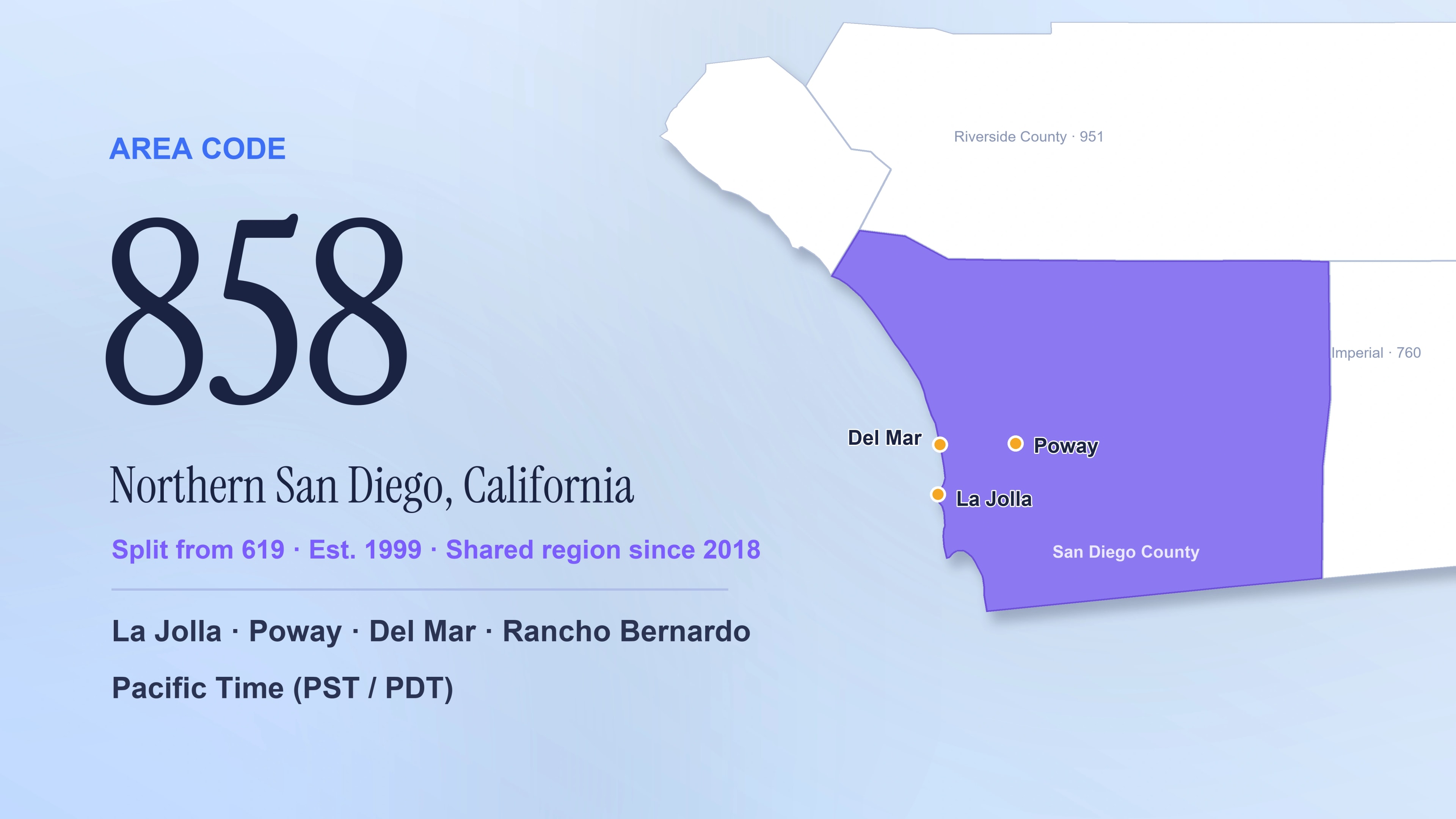
Where Surf Culture and Science Share the Same Streets
Some area codes cover half a state. The 858 area code covers something more specific: the stretch of northern San Diego, California, where surf culture and science share the same streets. From the tide pools of La Jolla to the business parks of Rancho Bernardo, 858 is the number attached to one of the most productive corners of the American economy.
This guide explains where the 858 area code works, how it was carved out of 619 in 1999, why the boundary between the two codes was erased in 2018, and what it takes to claim an 858 number for your own business — wherever you happen to be based.
Key Takeaways
- The 858 area code serves northern San Diego, California, including La Jolla, Del Mar, Solana Beach, Poway, Rancho Bernardo, and Mira Mesa.
- 858 was created on June 12, 1999, when it was split from the 619 area code to relieve number shortages in San Diego County.
- Since June 2018 the boundary between 619 and 858 has been eliminated — both codes now serve one shared San Diego region.
- All 858 communities sit in the Pacific Time Zone, and every local call requires 10-digit dialing.
- An 858 number gives businesses a local identity in one of America's strongest biotech and technology corridors.
A Young Code for UC San Diego, Torrey Pines and Qualcomm
The 858 area code is the telephone prefix for the northern half of the city of San Diego and several neighboring communities in San Diego County. It was created on June 12, 1999, when the North American Numbering Plan split it off from area code 619, which had served the region for decades before that.
A code this young carries surprising weight. Much like Nevada's 775 area code defines everything beyond Las Vegas, 858 quickly became shorthand for a specific identity — the coastal, research-driven north of San Diego, home to UC San Diego, the Torrey Pines biotech mesa, and the headquarters of Qualcomm.
Coastal Research Corridors, Beach Cities and Inland Hills
The 858 area code operates entirely within San Diego County in Southern California. Its historic footprint is the northern city of San Diego and the suburbs around it:
- La Jolla and University City — the coastal research corridor around UC San Diego
- Del Mar and Solana Beach — beach cities along the North County coast
- Poway — "The City in the Country" in the inland hills
- Rancho Bernardo, Rancho Peñasquitos, and Carmel Mountain Ranch — planned communities along Interstate 15
- Mira Mesa, Scripps Ranch, Sorrento Valley, and Kearny Mesa — the tech and biotech employment hubs
- Carmel Valley, Torrey Pines, and Rancho Santa Fe — coastal canyons and estate communities
Since 2018 the picture has one important nuance: 858 and 619 now share a single service region, so a new number in either code can appear anywhere across the combined San Diego territory.
Scheduling Around the Three-Hour Gap With East Coast Clients
Every 858 community keeps Pacific Time — UTC−8 in winter (PST) and UTC−7 during daylight saving (PDT). When it's 9:00 a.m. in San Diego, it's already 11:00 a.m. in Chicago and noon in New York, a gap worth remembering when you schedule calls with East Coast clients.
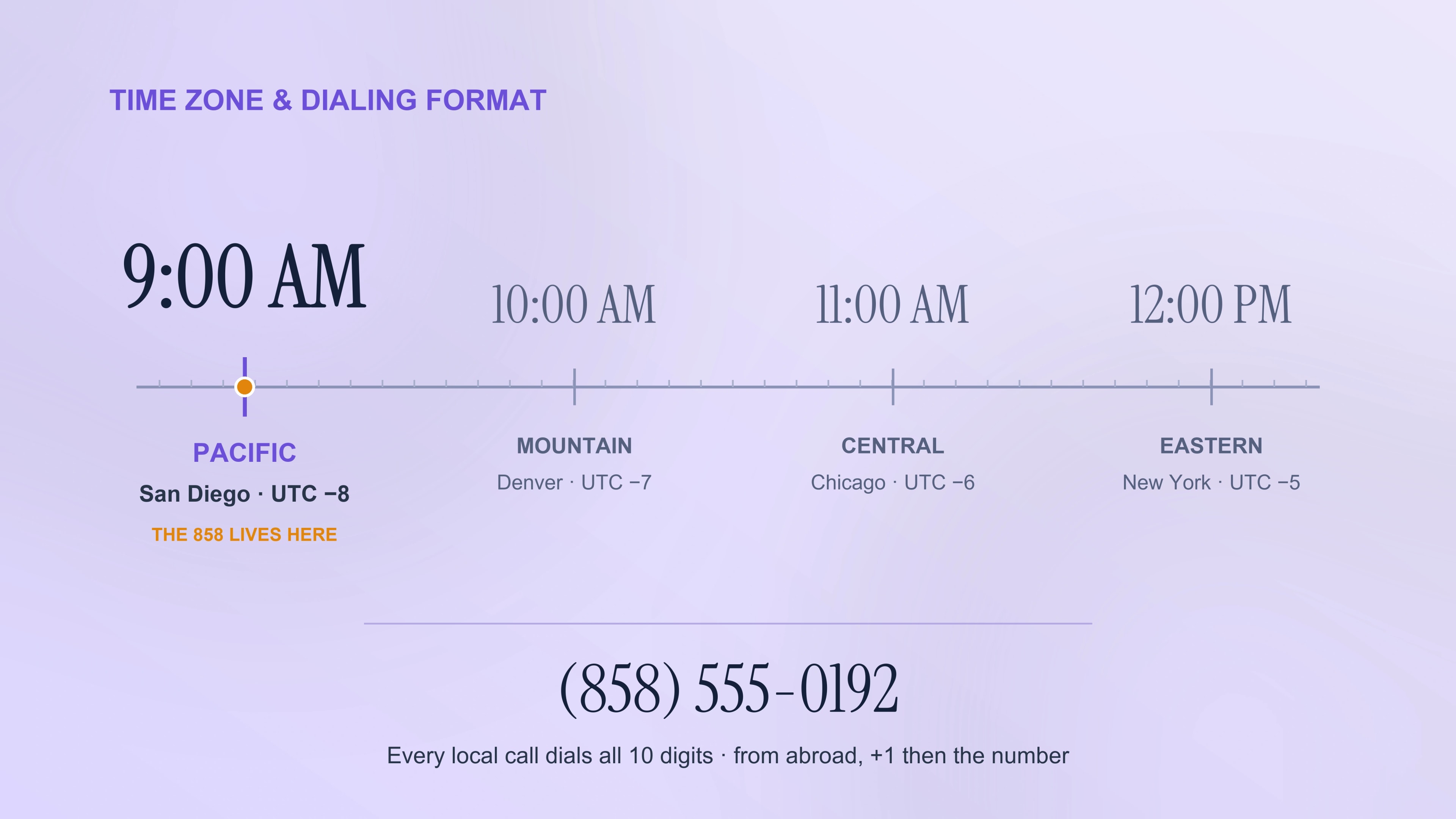
Dialing is straightforward: every local call is 10 digits — 858 plus the seven-digit line. From elsewhere in the US, add the 1 country code first, and from abroad dial +1, then 858 and the number.
From Split to Shared: 858 and the 619 Boundary Elimination
Few area codes have a stranger history. In the late 1990s San Diego's explosive growth was draining 619 of numbers, so regulators approved a split: on June 12, 1999, the northern communities became 858. A second phase would have created a third code — 935 — for the southern and eastern county in 2000, but public backlash against that era's wave of splits killed the plan, and 935 never entered service.
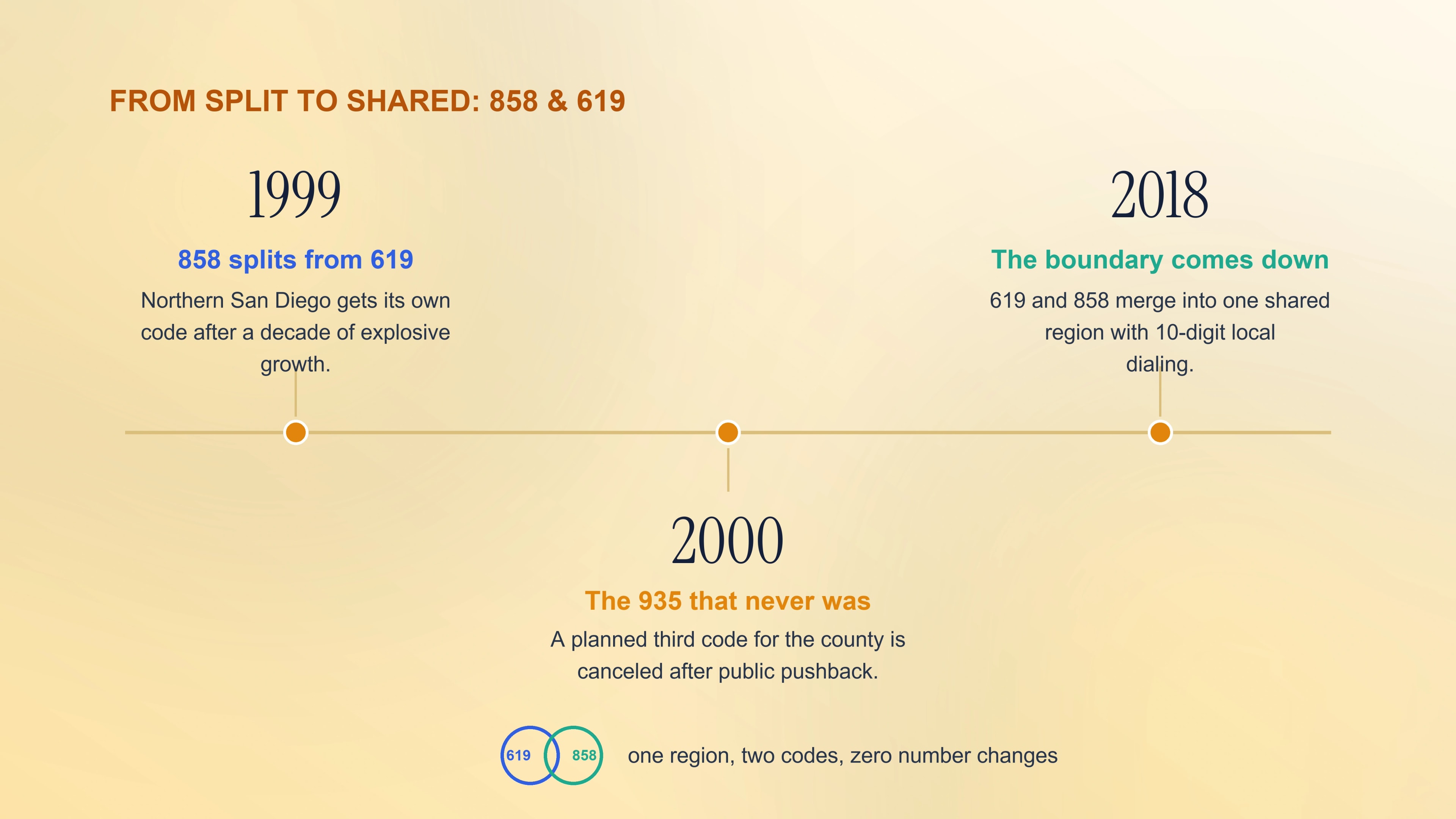
Then, in 2018, California did something rare: instead of splitting again, it erased the line. Regulators eliminated the boundary between 619 and 858, turning two neighboring codes into one shared overlay region. Compare that with Texas's 830 area code, which still keeps its classic single-split geography — San Diego's merged model shows how far modern number planning has moved past the map.
Benefits of an 858 Number for Business
An 858 number is a local handshake in a market where identity matters. Here's what it buys a growing company:
- Instant local credibility — a call from Sorrento Valley or Rancho Bernardo reads as a neighbor, not an unfamiliar outside number.
- A biotech and tech address — 858 is the prefix tied to Qualcomm, UC San Diego, and the Torrey Pines research mesa, so the number itself signals the innovation corridor.
- One shared pool, more inventory — because 619 and 858 merged into a single region in 2018, providers have a deeper number pool to search for a fitting 858 line.
- A single identity across scattered teams — pair one 858 line with staff spread from Mira Mesa to a remote support desk overseas, all under one San Diego number.
- A multi-decade runway — with the combined pool not expected to need a new code until roughly 2043, an 858 number claimed now keeps its geographic meaning for years.
Claim your 858 number today
Give your business a San Diego presence with a local 858 number backed by Acepeak's cloud platform.
How to Get an 858 Phone Number
You don't need a Del Mar address to carry a Del Mar number. Cloud telephony providers can activate an 858 line in minutes and route it to any phone you already use. The process:
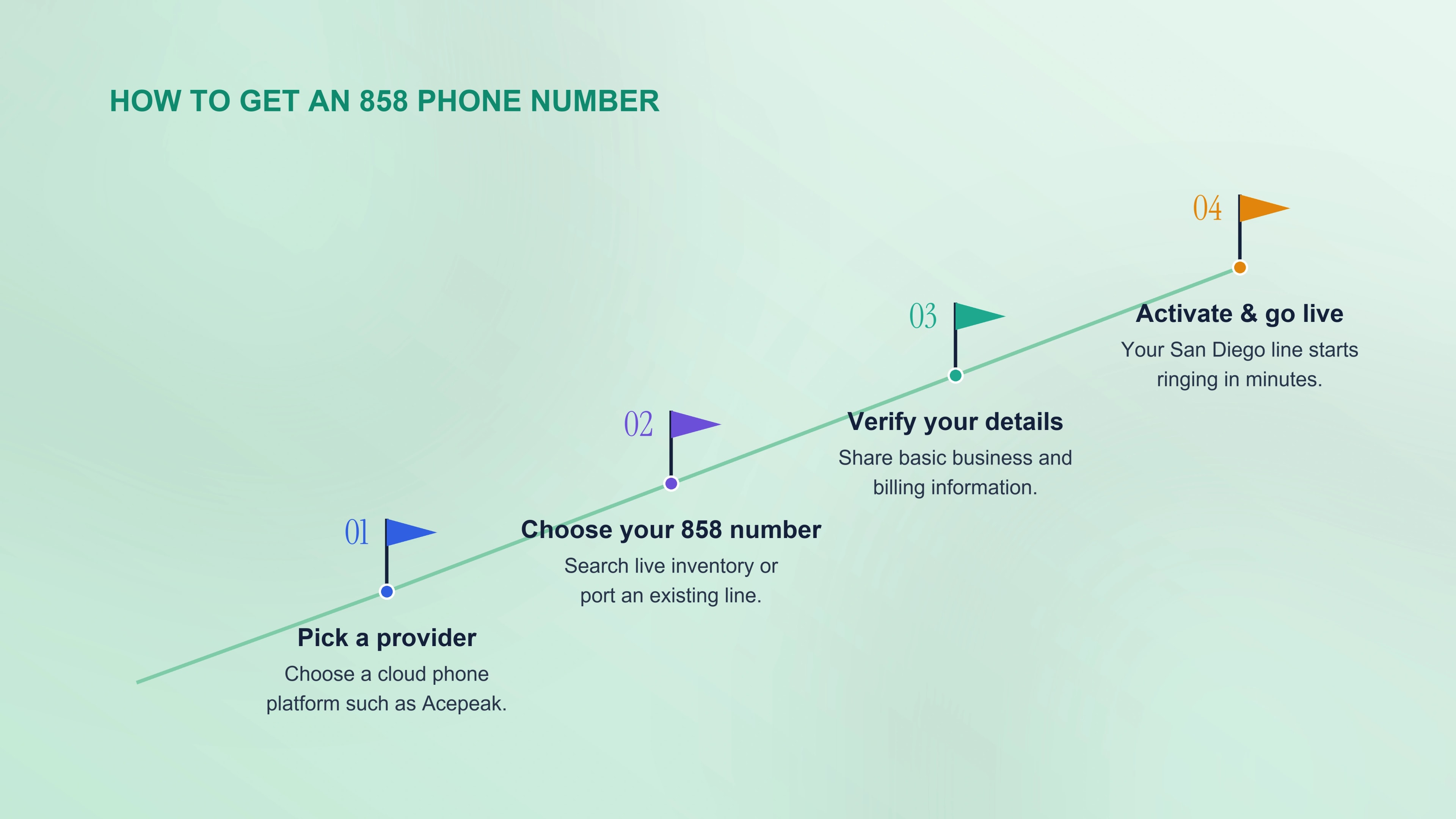
- Pick a provider with real 858 inventory — because 619 and 858 now draw from one combined pool, confirm a platform like Acepeak can actually search across both before you commit.
- Search La Jolla- or Poway-style patterns — reserve a sequence that fits the neighborhood you're targeting, or port an 858 number you already hold.
- Verify your business details — providers collect basic business and billing information up front, a standard step under US numbering compliance rules.
- Route it and go live — forward the new 858 line to mobiles, desk phones, or softphone apps, and your San Diego presence is active the same day.
Because 619 and 858 now draw from one shared regional pool, availability is healthy — but memorable 858 combinations still go quickly, so it pays to search early.
Spotting and Avoiding 858 Scam Calls
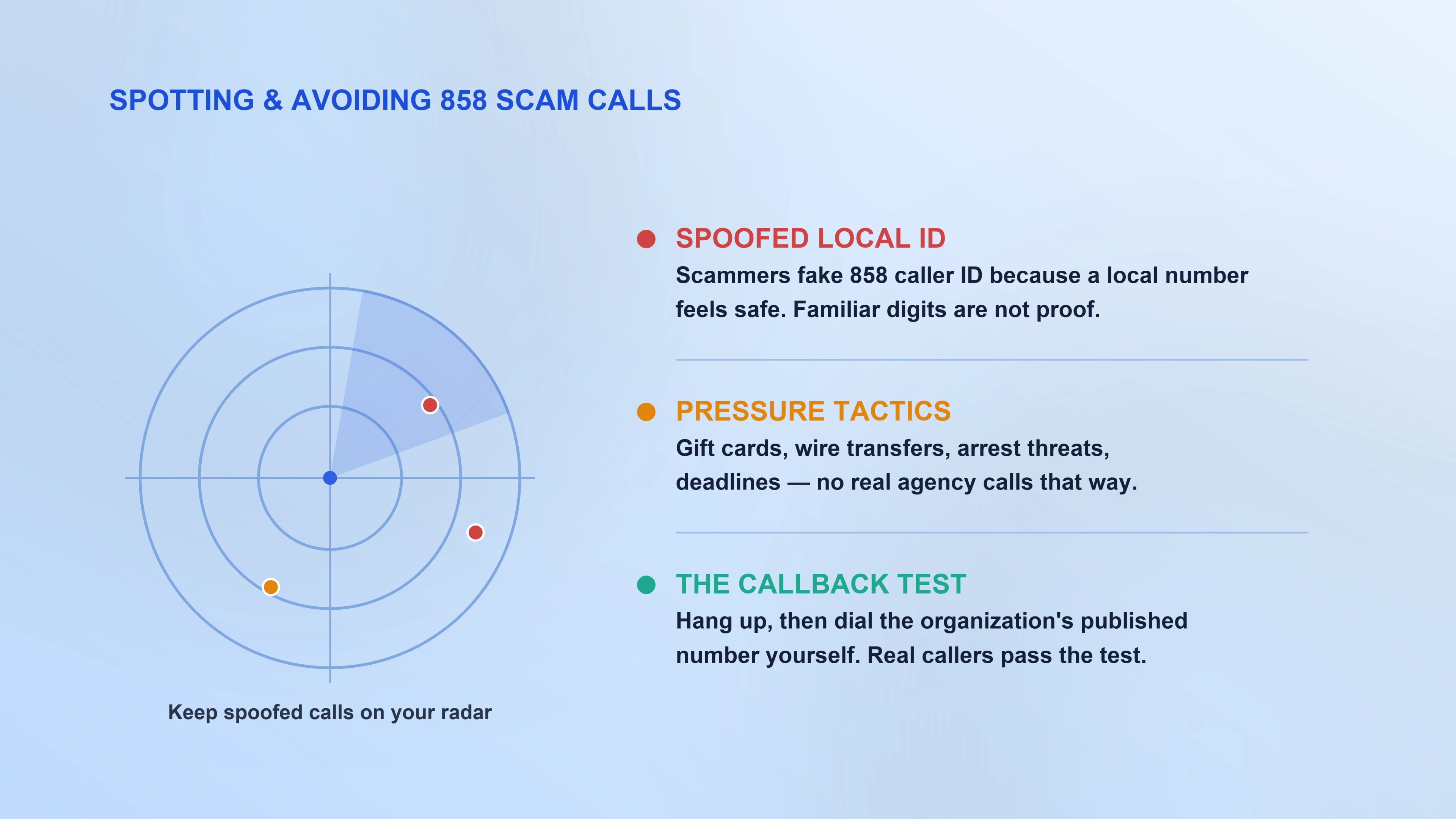
Like every recognizable American area code, 858 gets spoofed. Scammers fake local caller ID precisely because a San Diego number feels safe to San Diegans. The defense is a simple three-way triage:
- Answer freely when the number is saved in your contacts or the call is expected.
- Verify first when an unknown 858 number rings — let it reach voicemail, then call the organization back on its published line.
- Hang up immediately on gift-card demands, arrest threats, or "urgent" payment deadlines; no legitimate agency operates that way.
If a suspicious call slips through, report it. The California Attorney General maintains consumer-protection resources and complaint channels for phone fraud targeting California residents.
No New San Diego Code Expected Until Around 2043
The outlook is unusually calm. The 2018 boundary elimination extended the life of the combined 619/858 number pool by roughly two decades, and current projections suggest San Diego won't need another new code until around 2043. For businesses, that means an 858 number claimed today should keep its geographic meaning — and its cachet — for many years to come.
Quiet Marketing Work on Every Outbound Call
The 858 area code tells a compact story of modern San Diego: born from 1990s growth, spared a messy second split, and finally merged back into a shared region engineered for the mobile era. For residents it's home; for businesses it's one of the most valuable local prefixes in California. Claim one, answer it well, and 858 does quiet marketing work on every outbound call.
Sound local in San Diego
Acepeak provisions 858 numbers with enterprise-grade routing, so you can serve the San Diego market from anywhere.
Questions, answered.
Area code 858 serves northern San Diego, California, including La Jolla, University City, Del Mar, Solana Beach, Poway, Rancho Bernardo, Mira Mesa, Scripps Ranch, Sorrento Valley, Carmel Valley, and Rancho Santa Fe. Since 2018 it has shared a single combined region with area code 619.
Historically 619 covered central and southern San Diego while 858 covered the north. In June 2018 the boundary between them was eliminated, so both codes now serve the same San Diego region, and new numbers from either code can be issued anywhere within it.
On June 12, 1999, when it was split from area code 619. A planned companion code, 935, was scheduled to cover southern and eastern San Diego County in 2000, but the plan was canceled and 935 never entered service.
Pacific Time — Pacific Standard Time (UTC−8) in winter and Pacific Daylight Time (UTC−7) during daylight saving, matching the rest of California.
No. 858 is a standard geographic area code for San Diego, California. Toll-free prefixes in North America are 800, 833, 844, 855, 866, 877, and 888. Calls to 858 numbers are billed like any other domestic call.
Yes. Cloud telephony providers can assign an 858 number to a business located anywhere, routing calls to your existing phones, mobile devices, or softphone apps. This gives you a recognizable San Diego identity without opening a local office.
Signing up for an 858 area code number takes minutes with a cloud phone provider — no local office in Northern San Diego required. Pick the number, connect it to your existing phone or app, and calls route in immediately. This keeps the 858 area code presence you already have while adding the local credibility California customers respond to.