Ports, Casinos and Shipyards Along the Mississippi Coast
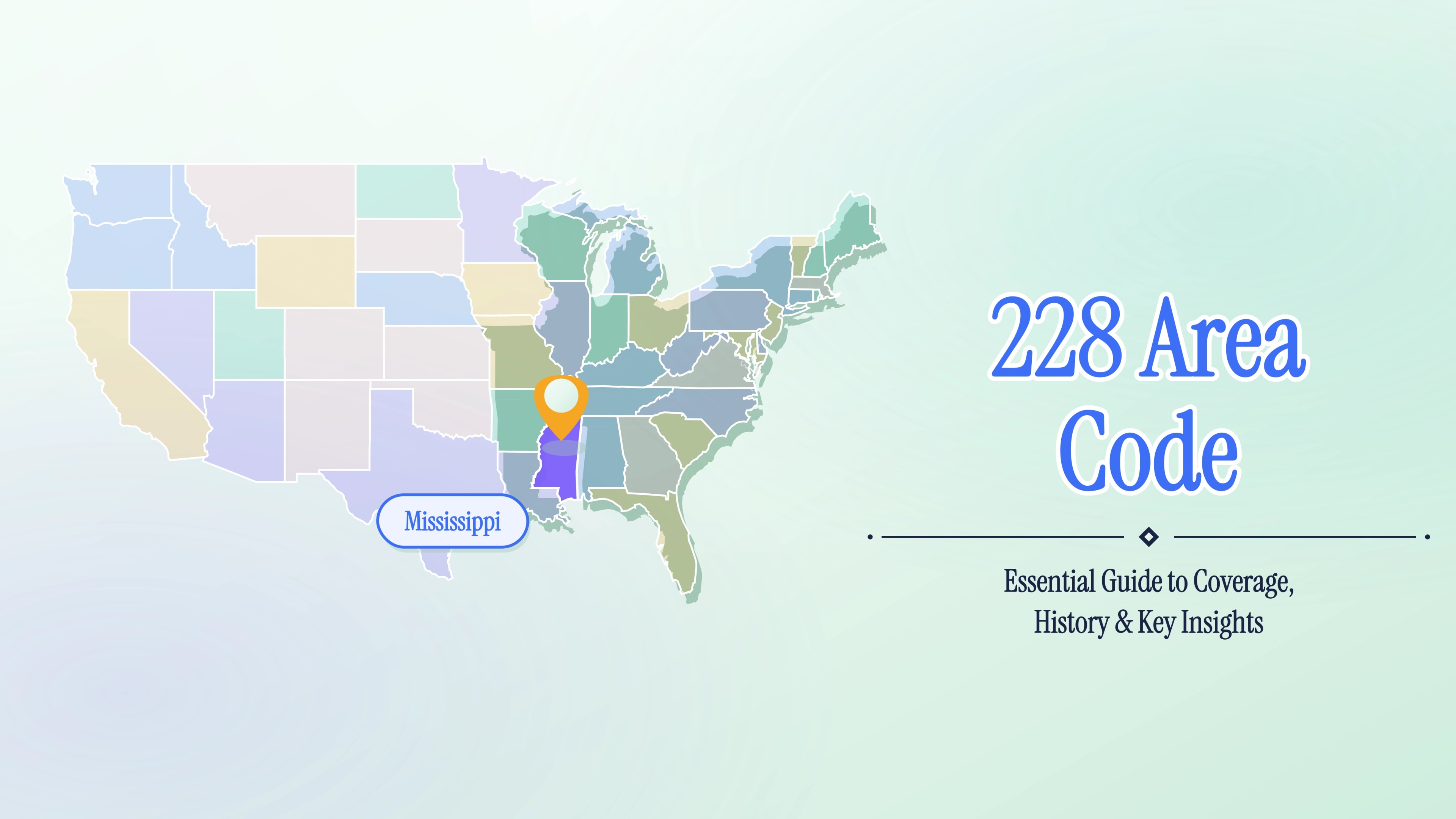
The 228 prefix is the connective tissue of Mississippi's Gulf Coast, tying together the working ports of Gulfport, the casino strip in Biloxi, and the shipyards of Pascagoula. In 2026 it keeps roughly 420,000 residents across three coastal counties connected, making this the state's second-busiest metro region. A local line on area code 228 suits households, offices, remote teams, and growing businesses alike. This 2026 guide walks through the region's key cities, time zone, population, economy, history, dialing formats, scam-avoidance tips, and the cloud calling features Acepeak offers for a fast setup.
The appeal of this coast is its blend of relaxed Southern character and real economic momentum — fresh-catch seafood at roadside stands, walkable beach boardwalks, and a community bond hardened by storms and rebuilds. Families are drawn by safe neighborhoods, strong schools, and year-round outdoor life, while remote workers and newcomers value the affordable cost of living, steady job growth, and the natural beauty that defines the shoreline.
Key Takeaways
- Area code 228 covers Mississippi's Gulf Coast — Harrison, Hancock, and Jackson counties — including Gulfport, Biloxi, and Pascagoula.
- It went live on September 15, 1997 as a split from area code 601 and is still the sole code for the region, with no overlay planned.
- The territory runs on Central Time (CST/CDT) and serves roughly 420,000 residents in 2026.
- The coastal economy is anchored by shipbuilding (Ingalls), gaming and tourism, and military installations like Keesler Air Force Base.
- A local 228 number can be provisioned through a cloud provider in minutes, with no Gulf Coast address required.
What is the 228 Area Code?
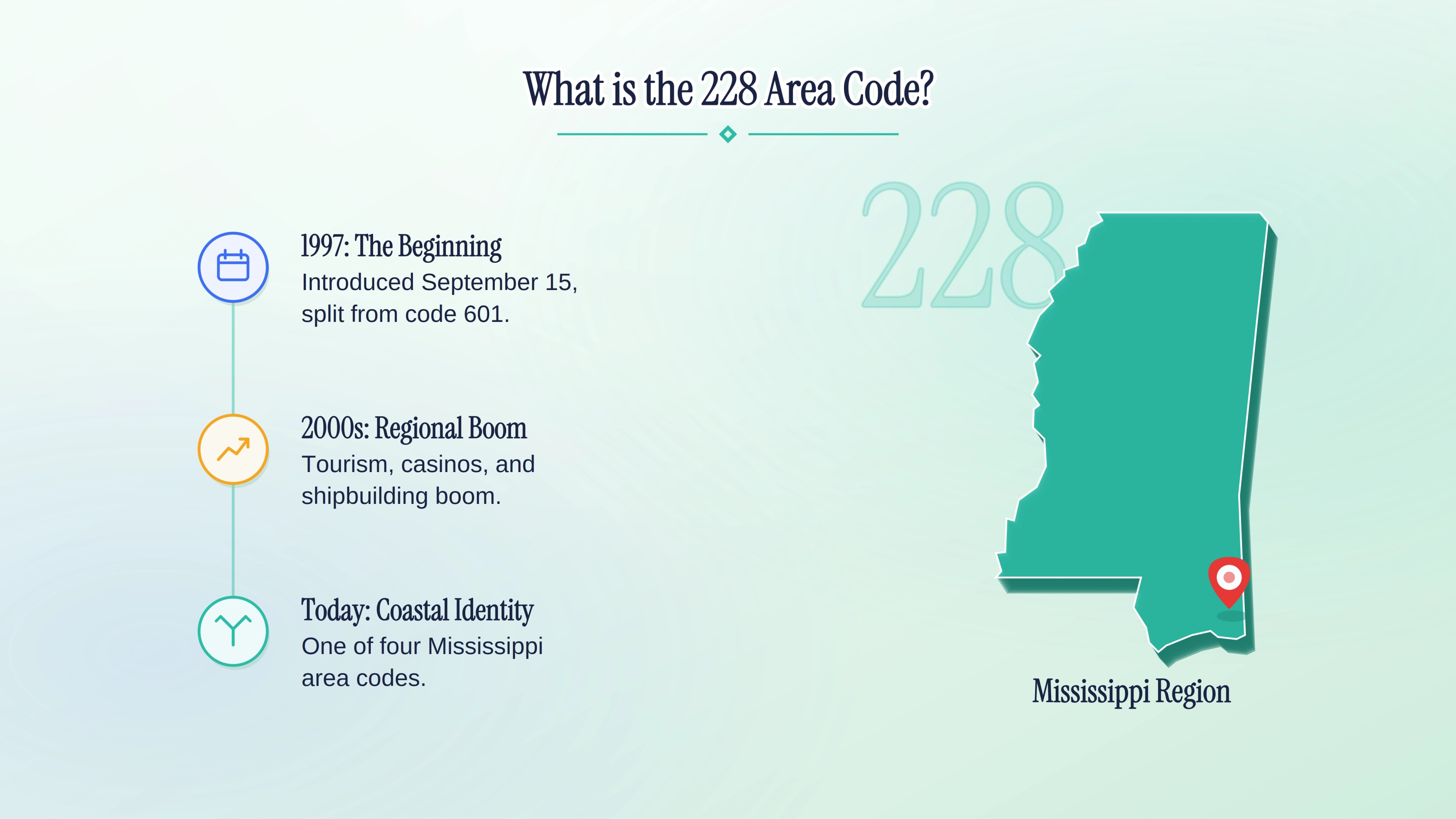
Area code 228 was introduced under the North American Numbering Plan (NANP) and took effect in 1997 after a split from area code 601. The change was driven by rapid population and business growth across Gulfport, Biloxi, and Pascagoula, which made a dedicated code necessary. The NANP framework routes calls accurately and reliably across regions, and the new code let coastal residents and businesses keep strong local connections.
Today the code remains a vital part of the region, supporting economic development, strengthening community ties, and keeping residents and businesses linked as the local economy grows.
Geographic Coverage & Time Zone of the 228 Area Code
The code stretches across three counties — Harrison, Hancock, and Jackson — running nearly 100 miles along the Mississippi Sound and out to the Gulf of Mexico. The landscape spans white-sand beaches, barrier islands such as Ship Island and Cat Island, dense wetlands, historic neighborhoods, and everything from quiet beach towns to busy industrial ports. Businesses that serve both the Texas Gulf Coast and Mississippi often pair a 228 number with a 346 area code for the Houston market.
The territory sits entirely in the Central Time Zone (CST/CDT), so coordinating calls with neighbors in Alabama (251) or Louisiana (985/504) is straightforward. Across the three counties it covers roughly 1,800 square miles of low-lying coastal land and forms the core of the Gulfport-Biloxi-Pascagoula Combined Statistical Area.
Major Cities in the 228 Area Code (2026 Snapshot)
| City | County | 2026 Est. Population | Key Industries |
|---|---|---|---|
| Gulfport | Harrison | 75,500 | Port operations, tourism, retail, military |
| Biloxi | Harrison | 49,000 | Casinos, hospitality, maritime, healthcare |
| Pascagoula | Jackson | 22,000 | Shipbuilding, manufacturing, energy |
| Ocean Springs | Jackson | 19,200 | Arts, healthcare, coastal trade, tourism |
| Gautier | Jackson | 19,100 | Education, light industry, residential |
| D'Iberville | Harrison | 13,800 | Retail, residential development, gaming |
Other established towns — Bay St. Louis, Long Beach (around 17,400), Pass Christian, Moss Point, Waveland, Diamondhead, and St. Martin — share the same reliable network. The Gulfport-Biloxi-Pascagoula metro tops 420,000 residents in 2026, Mississippi's second-largest urban area.
Economy and Key Industries in the Area Code 228
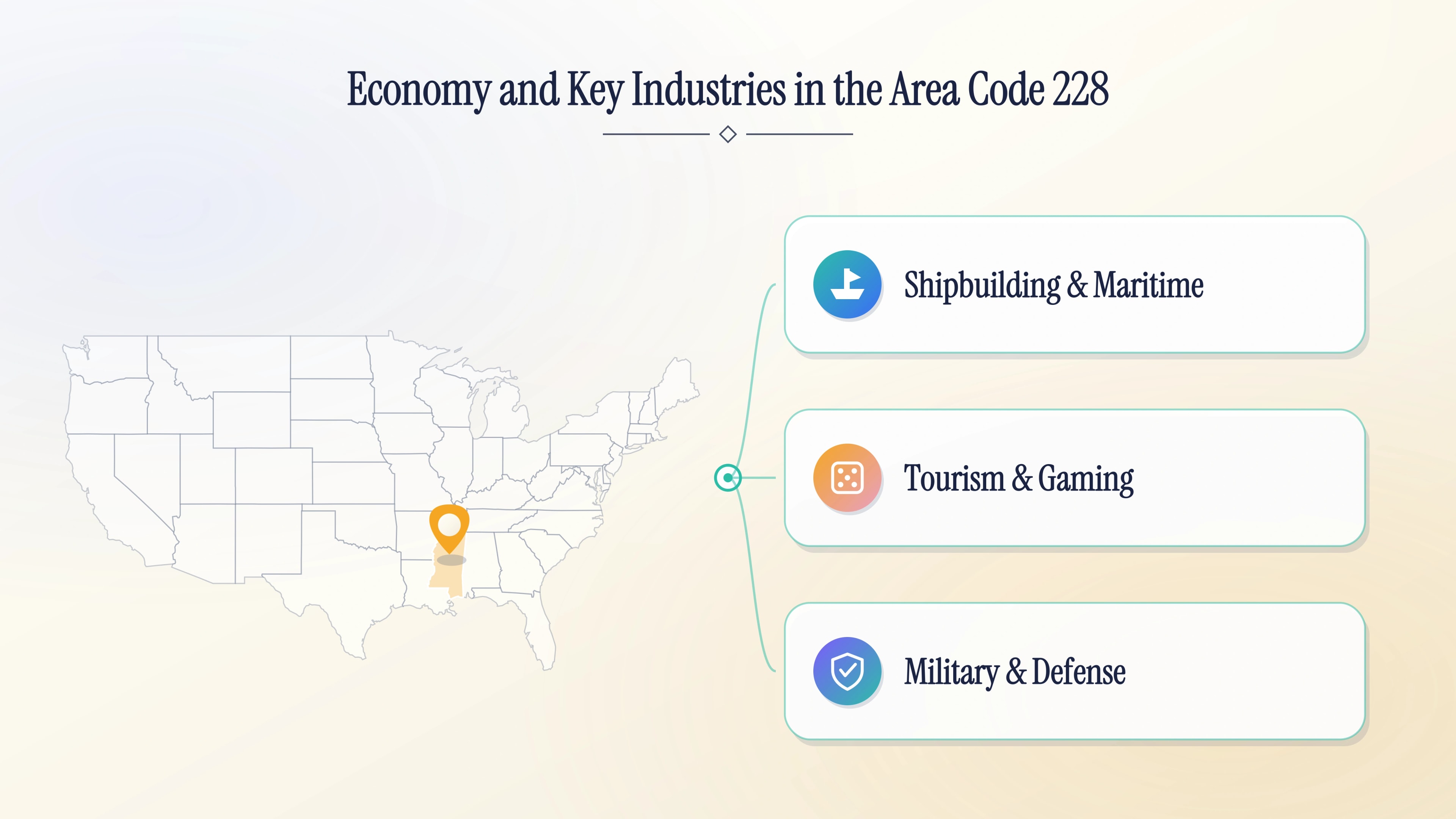
The coast is a major engine of Mississippi's economy, with the metro generating roughly $24.7 billion in GDP in 2023.
- Shipbuilding & Maritime: Ingalls Shipbuilding in Pascagoula is the state's largest private employer, building advanced U.S. Navy ships. With more than 11,000 jobs, it keeps suppliers across Mississippi busy.
- Tourism & Gaming: About a dozen casinos along the coast generate billions annually, drawing millions of visitors for beaches, golf, and events, and sustaining hotels, restaurants, and shops year-round.
- Military & Defense: Keesler Air Force Base in Biloxi provides thousands of jobs and education programs, anchoring military and local collaboration.
The coast's Blue Economy adds tens of billions more, supported by solid infrastructure with average broadband speeds above 200 Mbps.
Life and Culture on the Mississippi Gulf Coast
Away from work, daily life draws its flavor from Southern hospitality and coastal tradition. Year-round festivals celebrate seafood, music, and art, and fresh Gulf oysters, shrimp, and crab land at restaurants the same morning they're caught.
Outdoor options run from state parks to deep-sea fishing to uncrowded beaches. The region's French, Spanish, and African American roots show up in its architecture, cuisine, and community gatherings. That cultural depth is what turns a workplace into a genuine home, where people put down roots and actually enjoy life.
Supported Services for 228 Phone Numbers
The code supports landlines, 4G/5G mobile, and cloud phone systems, keeping the Gulf Coast connected. Acepeak's cloud phone system turns a local 228 number into a full business tool with AI analytics, call recording, CRM integration, and auto-attendants — all working across any device, so teams stay reachable from anywhere.
These tools deliver a clear edge in today's fast-moving market. Calls can be answered remotely while still appearing fully local to Gulfport, Biloxi, or Pascagoula customers. Analytics surface call patterns and peak times to sharpen service and lift sales, and seamless app integrations keep workflows smooth without constant tool-switching.
Claim a Local 228 Number in Minutes
Establish an instant Gulf Coast presence and manage every call from anywhere in the world.
Historical Background of Area Code 228
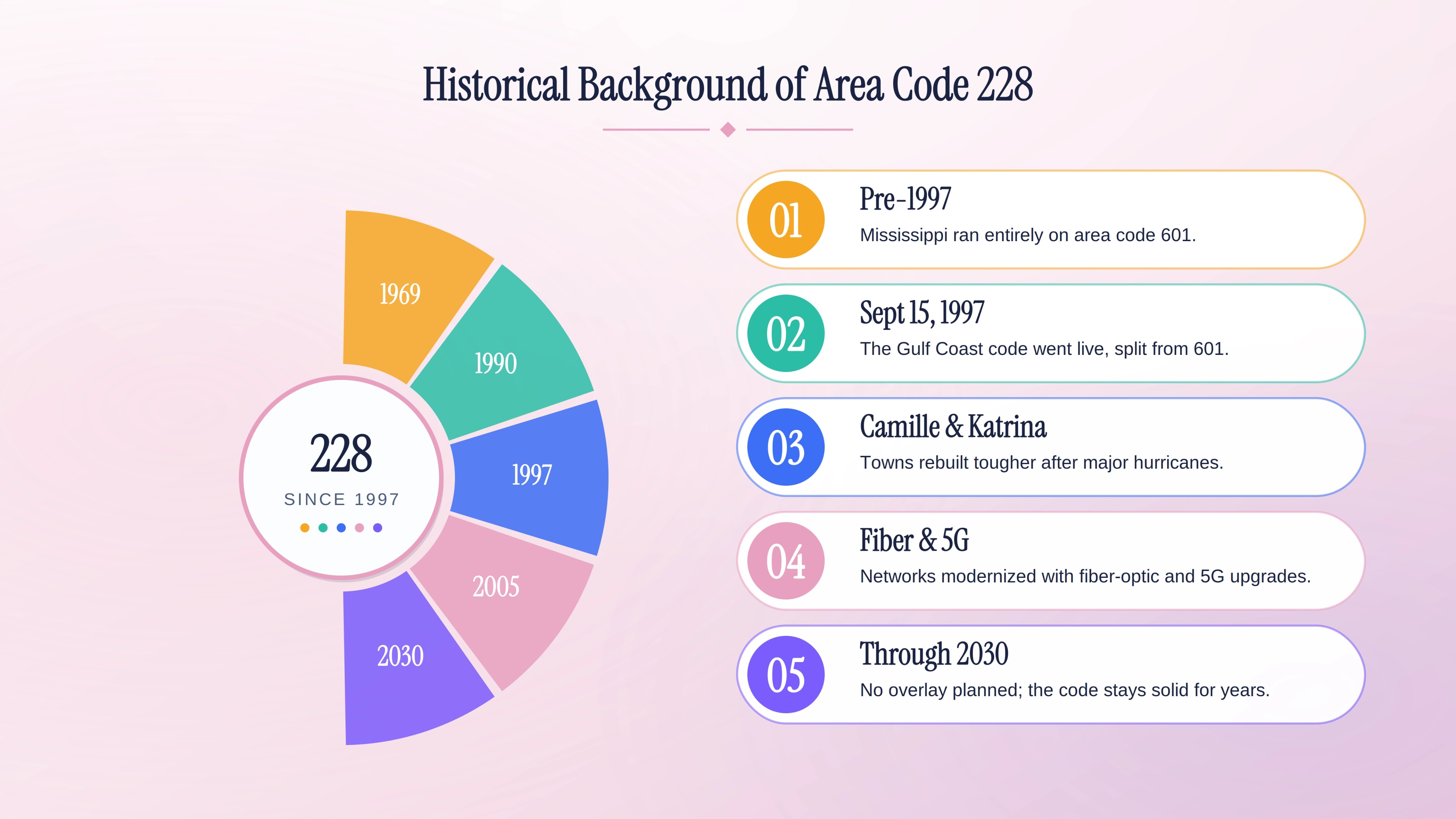
Before 1997, all of Mississippi ran on area code 601. Surging growth — fueled by recovery after Hurricane Camille in 1969, the legalization of casino gaming in 1990, and the cellphone boom — forced a split. The new code went live on September 15, 1997, finally giving the Gulf Coast its own identity.
Since then it has weathered major hurricanes, absorbed fiber-optic and 5G upgrades, and helped the region recover without driving up costs. The rebuild after Hurricane Katrina in 2005 still defines the area: towns rebuilt stronger, improved evacuation planning, and modernized their communication networks with federal and state support, turning hardship into a foundation for steady growth.
Benefits of Getting a 228 Phone Number
- Immediate customer trust: A local number signals community roots, so customers answer and engage more readily.
- No extra long-distance charges inside the region.
- Stronger local SEO and Google Business rankings.
- Natural fit with remote teams — appear local from anywhere.
- Visibility in local directories.
For anyone in hospitality, maritime work, retail, or defense contracting, it remains one of the smartest moves in 2026. Many Gulf Coast businesses also complement their local line with a toll-free 844 number to serve national customers without long-distance charges. A local number also tightens supplier coordination during storms and emergencies, and emergency services recognize it instantly.
How to Get a 228 Area Code Number
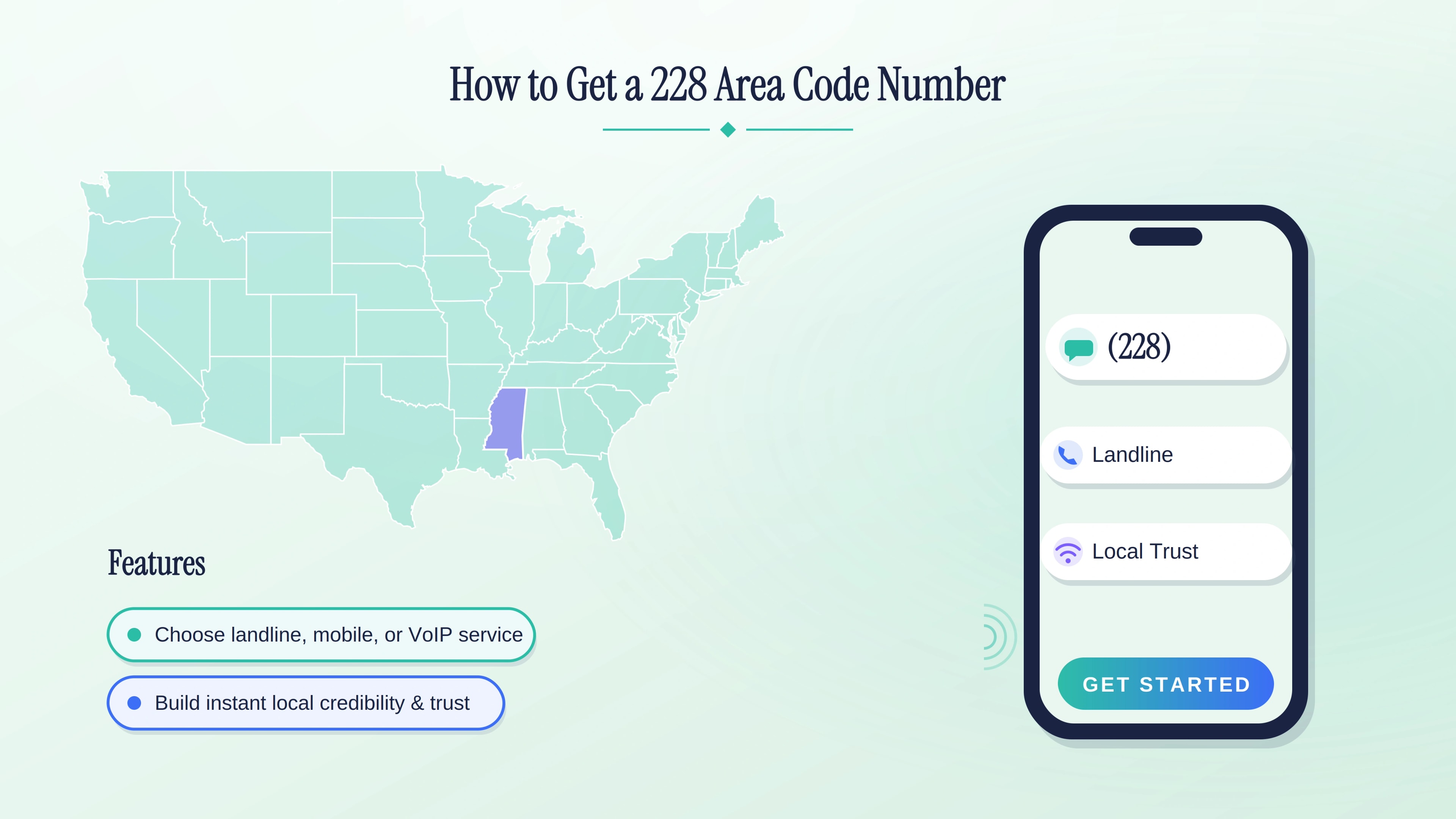
Getting a number is quick in 2026, and there's no need to live on the Gulf Coast. Leading cloud providers like Acepeak let anyone claim a real local number in minutes, wherever they are.
- Step 1: Sign up for a free Acepeak account.
- Step 2: Open the number search section and pick this code.
- Step 3: Browse the available numbers and choose one.
- Step 4: Check out and activate it.
- Step 5: Connect it to a phone, app, or CRM — and it's live.
Most users are up and running within 5–10 minutes, and porting an existing number is simple. Acepeak keeps plans affordable with no contracts and real 24/7 support, so calls stay clear and features scale as a business grows.
Dialing Formats for the 228 Area Code
- Local calls: 10 digits — 228-XXX-XXXX
- U.S. long-distance: 1 + 228 + XXX-XXXX
- International: +1 228 XXX-XXXX
Key Providers & Infrastructure in 228 Mississippi
Infrastructure on the coast is strong, with average speeds topping 200 Mbps. The main carriers are AT&T, C Spire, Spectrum, and Verizon Wireless, alongside Acepeak for business-grade cloud calling. C Spire stands out locally, with broad coverage and plans built specifically for coastal residents and businesses.
Protecting Against Scams on 228 Phone Numbers
Scam calls remain a nuisance. The best defenses for a local number are simple: verify unknown callers, switch on built-in spam blockers or AI fraud detection, report suspicious activity to the Federal Trade Commission (FTC), and register on the Do Not Call list.
A few extras help too — enable two-factor authentication everywhere and review call logs periodically for unusual patterns. Spending a few minutes teaching a team or family the common scam tactics pays off quickly.
Tips for Effective Use of Local Numbers
Whether for personal or business use, small adjustments add real value. Linking the number to a CRM makes tracking easier, and digging into analytics reveals call patterns worth acting on. Keeping voicemail greetings and auto-replies current maintains a professional impression, and anyone coordinating across countries should remember the coast runs on Central Time. These small habits project a polished, trustworthy image and squeeze full value from a local connection.
Future Outlook for the 228 Area Code
With steady population growth, an expanding port, and new development, demand for local lines stays strong. According to the North American Numbering Plan administrator, no overlay is currently planned and number exhaustion is not projected for the foreseeable future, so the code is set for the next decade.
Economic signals point to further growth in the key industries. Investment in renewable energy and port upgrades should create thousands of jobs, while the coast pushes sustainable tourism to preserve its natural beauty for the long term.
Get Your Local 228 Number Today
Instantly establish a local presence on the Gulf Coast and manage your calls from anywhere in the world.
Resilience and Coastal Character in Every Gulf Coast Call
This code is far more than a string of digits — it's the voice of resilience and coastal character on Mississippi's Gulf Coast. Whether the goal is a personal line or business growth, a local number is available today through Acepeak, connecting callers straight to the heart of the Gulf Coast.
Questions, answered.
Area code 228 serves the Gulf Coast of Mississippi, covering cities such as Biloxi, Gulfport, and Pascagoula across Harrison, Hancock, and Jackson counties.
As an international dialing code, 228 belongs to Togo in West Africa. The same three digits are a U.S. area code for the Mississippi Gulf Coast — the two are unrelated.
Within the United States, 228 is a geographic area code for the Mississippi Gulf Coast, used for landline, mobile, and cloud calling in and around Gulfport, Biloxi, and Pascagoula.
On WhatsApp, a number that begins with +228 is registered in Togo, since 228 is that country's international dialing code.
As a U.S. area code, 228 is in the United States, serving Mississippi's Gulf Coast. The identical three-digit string also functions as Togo's international country code.
Signing up for a 228 area code number takes minutes with a cloud phone provider — no local office in Mississippi Gulf Coast required. Pick the number, connect it to your existing phone or app, and calls route in immediately. This keeps the 228 area code presence you already have while adding the local credibility Mississippi customers respond to.